Mike Kuhn, Fresh Vision for the Muslim World (a book review)

[Kuhn, Mike. Fresh Vision for the Muslim World. Downers Grove, IL: Intervarsity Press, 2009.]
Kuhn proceeds then to talk about the theological differences between Christianity and Islam. For instance, “the essence of the Christian faith—God became human being in Christ—is diametrically opposed to Islamic faith” (69). There is also a vast difference in the view of what constitutes humanities problem and thus our view of salvation is different. Islam teaches that “individuals are neither dead in sin nor in need of redemption; rather, they are weak, forgetful, and in need of guidance” (78). The heart of the difference between Islam and Christianity is how man is put right with their Creator (81).
In chapters seven through nine, Kuhn reminds us that Jesus’ concern was not with “the geopolitical state of Israel during his earthly ministry. His concern is with his kingdom—the kingdom of heaven” (120). The place of the state of Israel is a subject filled with tension for many Muslims and Christians alike but it is also a very important and practical subject. So, we must seek God and His Scripture for wisdom, we must understand Jesus’ words (130, 171). Kuhn points out that the need of the entire world is to see “the manifestation of the kingdom of Jesus in his people” (158, italics mine), not in an earthly nation. As we have seen, we are to love our neighbors and part of loving someone is understanding them, their history, their perspective, their past hurts.
Chapter ten talks about jihad and explains that not all Muslims understand jihad in the same way, some have a spiritualized understanding of jihad (e.g. 199). So, it is important to understand that Muslims, like Christians, are not all the same. In fact, “the primary concerns of most Muslims are similar to ours—raising their children, providing for their children’s education, saving for that new car or outfit… We must exercise care not to be monofocal in our understanding of Islam” (187). Chapter eleven challenges us to faithfully speak for Jesus and live for His Kingdom and not our own. In part 5, chapters twelve through thirteen, we see steps to incarnation and what it means to live missionally (see esp. 225).
I believe Kuhn could have had more Scriptural argumentation at places but I realize his book was not meant to be exhaustive. However, I agree with most of what he wrote and believe it is truthful. That is, I believe Kuhn made a cogent case in what he said. I also appreciate that he gave a recap of each chapter, it helped give the book clarity.
Stylistically, I appreciate that Kuhn covered many different topics yet did not lose the focus of the book. For example, he introduced incarnation at the beginning (8) and then weaved it through the rest of the book (see e.g. 13, 16, 75, 85. 242). What is needed Kuhn pointed out, though sadly rare, “is an extended hand, a caring smile, someone who is willing to go the extra mile to help someone in need” (259) (cf. Matt. 5:13-16; Jn. 13:35; 1 Cor. 10:33).
I appreciate Kuhn’s reminder that “The kingdom of Jesus as opposed to empire is not concerned in the least about the political boundaries of a country. It is a reality that overlays the political boundaries” (256). We must remember that the Roman Empire came and went, but Jesus’ Kingdom is eternal (254) (cf. Jn. 18:36). Kuhn’s challenge is timely, he says, “if Western Christians are able to bid farewell to our fortress mentality, we will find that our countries have already become exceedingly accessible and potentially fruitful mission fields” (244). Kuhn further points out that if American Christians are overly aligned with their governments’ policies then their missional impact will likely be impacted (241). Instead, as Christians, Jesus should be our King and His policies should hold ultimate sway. The real hope of the Muslim world, and the Western world for that matter, is not democracy, it the diffusion of the good news of Jesus the Christ and the establishment of His reign (218).
As Muslims grow increasingly suspicious and fed up with the violent response of Islamists, they are beginning to look for alternatives. Some are finding their alternative in secularism. Others are turning to materialistic pleasure. Will we as Christ-followers have anything to offer them? (214-15)
Paul’s Letters

C.S. Lewis on the Importance of Reading Old Books

As part of our book diet, C.S. Lewis reminds us to not leave out old books. “It is a good rule, after reading a new book, never to allow yourself another new one till you have read an old one in between. If that is too much for you, you should at least read one old one to every three new ones” (C. S. Lewis, “On the Reading of Old Books”).
Lewis is wise to also say that,
“People were no clever then than they are now; they made as many mistakes as we. But not the same mistakes. They will not flatter us in the errors we are already committing; and their own errors, being now open and palpable, will not endanger us. Two heads are better than one, not because either is infallible, but because they are unlikely to go wrong in the same direction” (C. S. Lewis, “On the Reading of Old Books”).
Quotes on Literature

“When we are at play, or looking at a painting or a stature, or reading a story, the imaginary work must have such an effect on us that it enlarges our own sense of reality.”
~Madeleine L’Engle, Walking on Water
“Students value literature as a means of enlarging their knowledge of the world, because through literature they acquire not so much additional information as additional experience.”
~Marie Rosenblatt, Literature as Exploration
“Literature… serves to deepen and to extend human greatness through the nurture of beauty, understanding, and compassion. In none of these ways, of course, can literature, unless it be the literature of the Christian faith, lead us to the City of God, but it may make our life in the city of man far more a thing of joy and meaning and humanity, and that in itself is no small achievement. Great literature may not be a Jacob’s ladder by which we can climb to heave, but it provides an invaluable staff with which to walk the earth.”
~Roland M. Frye, Perspectives on Man: Literature and the Christian Tradition
“Art is one of the means by which man grabbles with and assimilates reality.”
~Ralph Fox, The Novel and the People
“The primary job that any writer faces is to tell you a story of human experience—I mean by that, universal mutual experience, the anguishes and troubles and gifts of the human heart, which is universal, without regard to race or time or condition.”
~William Faulkner, Faulkner at West Point
“A poem… begins in delight and ends in wisdom [and]… a clarification of life… For me the initial delight is in the surprise of remembering something I didn’t know I knew… There is a glad recognition of the long lost.”
~Robert Frost, “The Figure a Poem Makes”
______________
See Leland Ryken, The Christian Imagination
Book Released! Gospel-Centered War
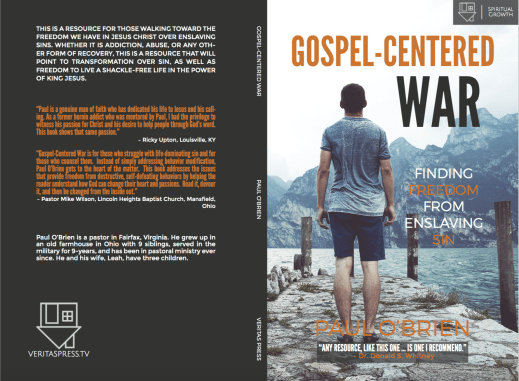

My book Gospel-Centered War: Finding Freedom from Enslaving Sin just got released! Here are a few of the things people are saying about it.
“As the title of this book makes clear, a gospel-centered approach is, in the long run, the only effective way to combat sin and addiction. Any resource, like this one by Paul O’Brien, which helps us fight our sinful compulsions by means of the gospel of Jesus Christ is one I recommend.”
—Dr. Donald S. Whitney, professor of biblical spirituality and associate dean at The Southern Baptist Theological Seminary
“Gospel-Centered War is for those who struggle with life-dominating sin and for those who counsel them. Instead of simply addressing behavior modification, Paul O’Brien gets to the heart of the matter. This book addresses the issues that provide freedom from destructive, self-defeating behaviors by helping the reader understand how God can change their heart and passions. Read it, devour it, and then be changed from the inside out.”
—Pastor Mike Wilson, Lincoln Heights Baptist Church, Mansfield, Ohio
“Paul is a genuine man of faith who has dedicated his life to Jesus and his calling. As a former heroin addict who was mentored by Paul, I had the privilege to witness his passion for Christ and his desire to help people through God’s word. This book shows that same passion.”
—Ricky Upton, Louisville, KY
The Storyline of Scripture
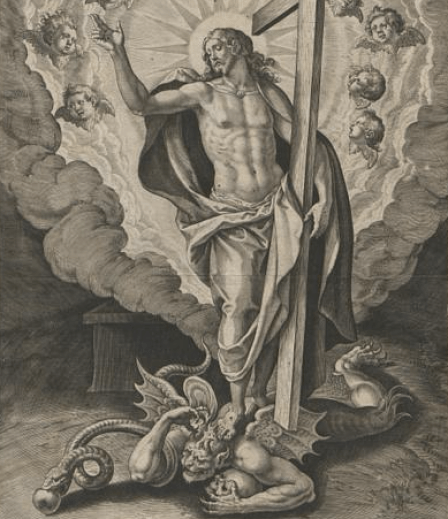
Spoiler alert. If you don’t want to know the resolution to all the twists and turns of the plot line of the Bible do not read on!
Jesus is the hero of the story. He saves the day. As Michael Emlet says, “If you read the Bible from cover to cover you realize that it narrates (proclaims!) a true and cohesive story: the good news that through Jesus Christ God has entered history to liberate and renew the world from its bondage to sin and suffering.”[i] He goes on; God “pursues the restoration of his creation at the cost of his own life. He is making all things new (Rev. 21:5)! That’s the simple and yet profound, life- and world-altering plotline of the Bible.”[ii]
The Bible is chiefly a story about God’s glory being displayed through the recompense of all things wicked, redemption of those made righteous, and finally, the reconciliation of all things in Christ.[iii] The Bible is a true story about God making the world, man messing it up, and God becoming a man to fix the world by not messing up. It is a story of Eden—exile—repeat. It is not until the true Adam, the true and righteous Son of God comes that this process is put to an end. All of Christ’s predeceases fell short; Adam, Noah, Abraham, Saul, David, Solomon, and the lambs, priests, and prophets could not fill Christ’s role.
From the beginning of time and the beginning of God’s word, the Word has been a prominent character in the script (Gen. 1:1; John 1:1). At first, the promised offspring (Gen. 3:15) is vague, in fact, Eve rejoiced because she thought she had the offspring (4:1) but it was all for naught for Cain was of the offspring of the serpent and killed his brother. However, now we have seen that which even the prophets longed to look (Matt. 13:17), we know that all Scripture finds its fulfillment in Jesus who is the long-awaited Christ (2 Cor. 1:20).
When Jesus came the first time, He had no beauty or majesty. When He comes again His face will shine like the sun in full strength (Rev. 1:16). We were cast out of the garden in the beginning but as Jesus said to the thief on the cross, we will be with Him in paradise in the end. Jesus is the linchpin among all the cogs of Scripture. “The trajectory of the arrow shot from the Hebrew Scriptures finds its target (fulfillment) in Jesus of Nazareth.”[iv]
The storyline of the Bible can be understood as creation, fall, redemption, and new creation. We can see the gospel in the storyline of the Bible. God loves us even though we have rebelled against Him. He has provided forgiveness for us through Jesus Christ and if we repent of our sin and trust in Him we will enjoy Him forever in heaven.
Through the creation part of the narrative we see that God made everything (Gen. 1:1; John 1:1-3) and it was good (Gen. 1:4; 10; 12; 18; 21; 25; 31). There was no sin, no death, and no problems before man sinned. Man had perfect fellowship with God.[v]
However, the plot thickens. A cosmic problem is introduced. Through Adam’s fall, we see the collapse of the creation, which explains why everything is no longer good. Man disobeyed and rebelled (Gen. 2:16-17; 3:6) and this brought spiritual and physical death (Gen. 2:17; 3:19), pain (3:16-17), difficulties (3:18-19), and separation from God (3:23-24). This is the bad news. We deserve death and hell.
But there is good news. This is not the end of the story. Even at the beginning of the story, God promised that He would send someone (that is, the Messiah/Christ) to defeat the “bad guy” (that is Satan) of the story (cf. Gen 3:15). In a similar scene, seen throughout the Bible, man’s nemesis is once again at it with him. Satan is tempting not Adam but the second Adam in the wilderness (Luke 4). However, unlike Adam in paradise, the second Adam does not give into the serpent’s temptation although He is in the desert. Jesus was tempted in every way that Adam was, and we are, yet He did not sin (Heb. 4:15) and still He bore our sin upon Himself.
Jesus became man so “that through death he might destroy the one who has the power over death, that is, the devil” (Heb. 2:14). Jesus’ heel was “bruised” at the cross but through that same cross, where He received the bruising, He struck the serpent with a definitive death blow to the head (cf. Gen. 3:15). From the cross, Jesus cried out, “It is finished!” In Jesus’ death, the devil, and death are defeated! He has delivered us from the domain of darkness (Col. 1:13). He disarmed the demonic rulers and authorities and put them to open shame, by triumphing over them through the cross (Col. 2:15).
Jesus is the promised one (Luke 24:27, 44-46; Acts 13:23, 27; 17:3; Rom. 1:2-4; 1 Cor. 15:3-4;) who brings the redemption of all things (cf. Rom. 5:10; Col. 1:20; Titus 2:14; Gal. 3:13; Eph. 1:7, 10). He secures for us an eternal redemption by means of His own blood (Heb. 9:12). Jesus Christ is the solution to the problem; He takes our sin, our problem, upon Himself on the cross. This is the good news; Jesus is the good news! Jesus reversed the curse of sin by becoming a curse for us (Gal. 3:13). Jesus was cast out of the garden so that we could be welcomed back in. Through the one man Adam we all have condemnation yet through the one Man Jesus Christ the grace of God has abounded for many (Rom. 5:12-21). We deserved to be crushed under God’s wrath because of our sin but instead Jesus was crushed in our place (Is. 52:13-53:12). Jesus is the solution to our problem of sin, the sole solution (Jn. 14:6; Act. 4:12). Jesus is the Lamb of God, without blemish, that takes away the sin of the world (John 1:29; Heb. 9:14)!
Jesus is the good news but the good news is not static it goes on and on and on; those in Christ live happily-ever-after. In contrast, God “will gather out of his kingdom all causes of sin and all law-breakers” (Matt. 13:41) and cast them into the pit of eternal fire (Rev. 20:14-15). “They will suffer the punishment of eternal destruction, away from the presence of the Lord and from the glory of his might” (2 Thess. 1:9). However, for those in Christ the story of history will have a happy ending (Rom. 8:29-39).
I concur with what C.S. Lewis says in The Last Battle,
“We can most truly say that they all lived happily ever after. But for them it was only the beginning of the real story. All their life in this world and all their adventures in Narnia had only been the cover and the title page: now at last they were beginning Chapter One of the Great Story which no one on earth has read: which goes on forever: in which every chapter is better than the one before.”[vi]
I believe we, upon arrival to the new Eden, will exclaim with Lewis’ Unicorn:
“I have come home at last! This is my real country! I belong here. This is the land I have been looking for all my life, though I never knew it to now. The reason why we loved the old Narnia [“old creation”] is that it sometime looked a little like this.”[vii]
Through Jesus the Christ we have the unwavering hope of a new creation (2 Peter 3:13). “The creation was subjected to futility” in Adam (Gen. 317-19) but in Christ “the creation itself will be set free from its bondage to corruption and obtain the freedom of the glory of the children of God” (Rom. 8:20-21). As Isaac Watts put it in “Joy to the World,”
“No more let sins and sorrows grow,
Nor thorns infest the ground;
He comes to make His blessings flow
Far as the curse is found,
Far as the curse is found.”
The problem (all of them!) will be fixed and there will be no more sin (Rev. 21:27; 22:3; Matt. 13:41). Everything will be more right than it was ever wrong. We will see that God did, in fact, work all things together for good (Rom. 8:28). Christ will make a new creation and we will be like Him (1 Jn. 3:2; Rom. 8:29; 2 Peter 1:4). “Just as we have borne the image of the man of dust, we shall also bear the image of the man of heaven” (1 Cor. 15:49). God will fulfill our deepest desires and we will finally love the LORD our God with all our heart, soul, mind, and strength when we receive our glorified bodies (Deut. 30:6; Jer. 31:33-34; 32:40; Phil. 3:20-21)! There will be no more pain or problems and God will wipe away all our tears (Rev. 7:17; 21:4). We will once again be in Paradise, the New Jerusalem, and we will have fellowship with God (Rev. 21:3)!
However, this story by its nature, by the fact that it claims to be true, does not leave us alone but calls for a response. We can receive this story or we can reject it outright. God can rewrite us, as it were, into His marvelous script or He can cast us, the unruly “cast,” into hell. We must respond to this story, will we respond rightly? Will we strive to obey the God who reveals Himself? Will we turn to Jesus in faith and repentance?
This is the gospel, the story of all the woes of existence finding their solution in Christ.
____________
[i] Emlet, CrossTalk, 41. A true and cohesive story contained within sixty-six books written by numerous people (with one divine author) in various languages (Hebrew, Greek, and Aramaic) over thousands of years! God’s word about the world being reconciled through the Word is truly amazing!
[ii] Ibid.
[iii] James M. Hamilton Jr. says that “in the broadest terms, the Bible can be summarized in four words: creation, fall, redemption, restoration” (God’s Glory in Salvation through Judgment: A Biblical Theology (Wheaton, IL: Crossway, 2010), 49) but the “ultimate end” of everything is “God’s glory in salvation through judgment.” He goes on to say, “The created realm (creation) is a spectacular theater that serves as the cosmic matrix in which God’s saving and judging glory can be revealed. God’s glory is so grand that no less a stage than the universe—all that is or was and will be, across space and through time—is nescessary for the unfolding of this all-encompassing drama” (Ibid., 53). See also John Piper’s book The Pleasures of God and Jonathon Edwards’ The End for Which God Created the World.
[iv] Emlet, CrossTalk, 47.
[v] Perfect in sense but not like it will be in the new creation; Adam and Eve related to God as creation to Creator and we will relate to God in the new creation as the redeemed to the Redeemer. So we will enjoy a consummated perfect fellowship with God.
[vi] C.S. Lewis, The Last Battle (New York: NY: Harper Collins, 2002), 228.
[vii] Ibid., 213.
The Megalomania of Mass Media

Through Twitter, Instagram, and Facebook (and remember MySpace?) we have a world essentially created in our image. It’s nice. But it also feeds our narcissistic souls.[i] We like what we want and we want what we like; and if you, a certain political agenda, a religious view, or a video, a picture, or an advertisement (the most difficult thing to avoid in our cyber-haven) gets in my way I have the right, without reproach, to scroll on by.
Media brings a form of megalomania but it can also be a monster to meaning. It destroys meaning by stripping it of its context and by placing weighty things into too close a proximity to funny dog videos. When posts about politics, pantiliners, and poodles all show up in our (raging and undirected directed) “stream” then we might be taking in not a stream but a torrent of incoherent information.
It seems that social media has great potential to create an anti-intellectual ivory tower. That is, it distances us from people and what is really going on and allows us to make unsubstantiated comments that haven’t truly been contemplated. If we don’t take in the protein and exercise of hard thought we’re going to be weak. If we feed on what’s frail and fruitless, we will be frail and fruitless.
Tweets and feeds won’t feed us. And we cannot understand politics in sixty-second-sound-bits. Racial reconciliation isn’t and can’t be reconciled, let alone understood, when we merely rely on social media; instead of deep, patient, embodied, social change.
Violence and vengeance, bullying and bad behavior, won’t be solved by ads alone; even if the words are backed by a famous actor, artist, or athlete (that ironically likely undercuts the very thing they’re supposedly trying to communicate).
Further, social media may fool us, but it won’t fill us. We may enjoy Instagram but we weren’t there, we aren’t now, or we didn’t receive enough “stars” (or whatever) to fill out our significance.
The “word” “tweet” is fitting for Twitter because although I myself have a Twitter the whole thing is not congruent. When sentences and phrases are sheared of their context they have about as much meaning as a bird tweeting. So when we “tweet” we may be performing a type of onomatopoeia (an onomatopoeia is a word that phonetically imitates, resembles, or suggests the source of the sound that it describes). That is to say, to tweet is to not say anything; or, at least, anything that is human in an extended rational sense.
As humans we can hear more than “tweet, tweet, tweet.” We can take in and bask in beautiful poetry or follow powerful prose. We can be “intoxicated” in beautiful ways literarily, but not so much if we stick w/ texting & tweeting.
Thankfully Chopin and Beethoven’s media wasn’t a kazoo and a triangle, that media would have greatly hindered them. Could it be that our media is hurting and hindering us? Maybe sometimes we need to even focus on a medium. Maybe even pick up a pencil and paper, put away distractions, and put something powerful and substantial down. Something outside of us, beyond us, and not about us. Maybe it’s time to read a book and get off Facebook.
________________________
[i] In the picture above by Caravaggio (1571-1610), Narcissus gazes at his own reflection and in a similar way we gaze into our computers, phones, and tablets. We narcissistically gaze at our profiles and our worlds that we have created in our image. Could we meet the same fate as Narcissus? Could we drown in a stream of information and technology?
Learning from Literature: Uncle Tom’s Cabin

This is a gripping book in many ways. I think every American should read it. It has brought me to tears on more than one occasion. History is an important teacher. It can smack you in the face with past realities so that you don’t get smacked in the face by present ones. We, as Christians, must be discerning, and realize that the same foil may come in a different guise.
Uncle Tom’s Cabin reminds us that Scripture is often interpreted in the darkness of cultural situations without the light of a clear and unbiased perspective. As soon as society changes so will the interpretation of the text. Where are the Harriet Beecher Stowes who will stand up for what the text is saying however unpopular it may be? As Stowe said, if the cotton trade was no longer needed people’s understanding on slavery would be changed, there previous “understanding” would no longer be needed.
Of course, the issue then was slavery but Stowe makes a valid point for any day. Hermeneutics (i.e. the science of interpretation) seeks to understand what the text means.[1] However, we often view the text in light of our own context instead of the original context. We interpret texts many times to mean what we want them to mean and not what they really mean. We put a spin on things to suite ourselves. It is much like what the media can do with a sound bit. If you look at words out of their context, you can make them mean almost whatever what you want. We should take hints from history and seek to not make the same blunders.
What texts or issues do we dismiss outright or misinterpret to our benefit? Who or what are you avoiding listening to or reading? I am inclined to think that our (my!) use (or ill use) of money is one area where we tend to reinterpret Scripture.[2] Or what about God’s command for us to be holy? It’s pretty easy to knock that command down to moral, isn’t it? We think: other people watch this movie, even other “good” people. Yet, did you see where the thinking went wrong? We are not merely commanded to be good, moral, or culturally acceptable; we are called to be set apart as God’s own people. God’s holiness is our standard. Not our neighbors.
________________
[1] Which implies application. You don’t truly understand something until you understand how it applies… further, you might say you don’t truly understand something until it is applied. At least, I think this is the case with Scripture.
[2] I realize that there has been a lot of harm done in this area by people laying legalistic blanket commands that are neither helpful nor biblical. Yet, the Bible and Jesus do speak much of, and strongly about, wealth and the stewardship that we have of it. So what I am saying is we must make sure that we are not just dismissing texts on wealth and the right use of wealth but honestly evaluating what God is calling us to. It is too easy, as history demonstrates, to be blinded by the now. This applies to wealth, it applies to many things.
Religious Affections
“For although to true religion, there… must indeed be something else besides affection, yet true religion consists so much in the affections, that there can be no true religion without them. He who has no religious affection, is in a state of spiritual death, and is wholly destitute of the powerful, quickening, saving influences of the Spirit of God upon his heart. As there is no true religion, where there is nothing else but affection; so there is no true religion, where there is no religious affection. As on the one hand, there must be light in the understanding, as well as an affected fervent heart, where there is heat without light, there can be nothing divine or heavenly in that heart, a head stored with notions and speculations, with a cold and unaffected heart, there can be nothing divine in that light. If the great things of religion are rightly understood, they will affect the heart. The reason why men are not affected by such infinitely great, important, glorious, and wonderful things, as they often hear and read of, in the Word of God, is undoubtedly because they are blind; if they were not so, it would be impossible, and utterly inconsistent with human nature, that their hearts should be otherwise, than strongly impressed, and greatly moved by such things”

~Jonathan Edwards, Religious Affections (Yale University, 2009), 120-21
“Holy affections are not without light; but ever evermore arise from some information of the understanding, some spiritual instruction that the mind receives, some light or actual knowledge. The child of God is graciously affected, because he sees and understands something more of divine things than he did before, more of God or Christ and of the glorious things exhibited in the gospel; he has some clearer and better view than he had before, when he was not affected: either he received some understanding of divine things that is new to him; or he has his former knowledge renewed after the view was decayed”
~Jonathan Edwards, Religious Affections (Yale University, 2009), 266
Biblical Mysticism?

A Mystic’s Meter
The rhythms of a mystic’s faith are not drudgery upon duty and duty upon drudgery. The mystic’s meter, rather, is delight. Delight in a God they know. Yet, as much freedom as rhythm and cadence have, there is still structure. So, I want to look at the structure of the meter. What cadence does knowing God take?
Is Mysticism Wrong?
Is mysticism wrong? I think a lot depends on how it is defined. If you define mysticism as subjective vain emotional longings, then yes it is wrong. If you define mysticism as unbiblical, then yes it is wrong. If mysticism is set on anything else then God in the face of Christ (2 Cor. 4:6), then yes, mysticism is wrong.
Mysticism, however, is not wrong in itself. It is the focus that can be wrong. It is the information, or perhaps more often, the lack of information, that can be wrong.
Don Whitney instructs us:
“Don’t be deceived by a complex spirituality that gives the appearance of wisdom but doesn’t start with ‘Christ, in whom are hidden all the treasures of wisdom and knowledge’ (Colossians 2:3). And don’t become entangled in any spiritual practices that sound good but incline your mind and heart away from the ‘things that are above’” (“Practice True Spirituality”).[1]
Not All Mysticism is Created Equal
Mysticism does not have “inalienable rights.” That is, not all mysticism is created equal.
Frist, some mysticism is based on illusionary dreams and speculation. However, there is a problem with this (1 Jn. 4:1). Satan parades himself around like an angel of light (2 Cor. 11:14) so that he may devoir like a lion (1 Pet. 5:8). Subjective experiences alone cannot be our guide.[2]
Second, some mysticism contradicts the Word of God. Any word that contradicts His Word should not be our word. God is our authority. And His Word is our authority. There are many other good and important texts but they are not ultimate. They are subordinate.
Third, any form of mysticism that does not prize and exalt Messiah and His work is defective (1 Jn. 4:2). Mysticism is about knowing God. Jesus the Messiah is God in the flesh (Jn. 1:14). It is through Him that we can know God (e.g. 2 Cor. 4:4); that we can go boldly before the throne of grace (Heb. 4:16). Jesus reveals God. If we conceal Him, belittle Him, or don’t rightfully honor Him, we are not practicing mysticism but anti-mysticism; we are concealing God.
Good Mysticism
Mysticism, I believe, at it’s heart, is about knowing God deeply and experientially.[3] So then, how do we know God? We know Him through His Spirit, amen![4] And the Spirit, most typically, uses the means of His own inspired Word, the Bible. We meditate on His Word, as well as other good texts, and God, by the Spirit, reveals Himself to us. Good Christian mysticism thus relies on: 1) The Spirit for illumination, not vain visions or the like (Rom. 8:26; 1 Cor. 2:12-16; Eph. 3:14-19; 1 Jn. 4:1); 2) The inspired Word of God, not primarily other sources (2 Tim. 3:16; 2 Pet. 1:3-4); 3) The Incarnate Son to show us God, and not visions (Jn. 1:1-14; 14:6; 2 Cor. 4:4; Heb. 1:3).
Good biblical mysticism (some may prefer “spirituality”) is about having a deeper sense of God’s truth. It’s seeking for God to open our eyes that we would be deeply impacted by His truth (Ps. 119:18). It is about knowing God’s love that surpasses knowledge that we may be filled with all the fullness of God (Eph. 3:19). It’s about being renewed by the transformation of our minds (Rom. 12:2; Eph. 4:23-24; Col. 3:10). It is about revival.
It short, mysticism does not seek mere knowledge. It seeks to also experience the truth of that knowledge. So, it seeks to taste the sweetness, and not just know hypothetically and intellectually that something is sweet.
Jonathan Edwards words are enlightening:
“There is such a thing as a spiritual and divine light immediately imparted to the soul by God, of a different nature from any that is obtained by natural means… This spiritual light that I am speaking of, is quite a different thing from inspiration: it reveals no new doctrine, it suggests no new proposition to the mind, it teaches no new thing of God, or Christ, or another world, not taught in the Bible, but only gives a due apprehension of those things that are taught in the word of God… There is a difference between having an opinion, that God is holy and gracious, and having a sense of the loveliness and beauty of that holiness and grace. There is a difference between having a rational judgment that honey is sweet, and having a sense of its sweetness.”[5]
Mystics, so to speak, not only want to know that something is sweet, they want to taste it’s sweetness.
A.W. Tozer: A Good Example of a Good Mystic
James L. Snyder points out that “the word ‘mystic’ did not scare Tozer. The term ‘mysticism’ simply means ‘the practice of the presence of God,’ the belief that the heart can commune with God directly, moment by moment, without the aid of outward ritual. He saw this belief at the very core of real Christianity, the sweetest and most soul-satisfying experience a child of God can know.”[6]
Tozer rightly reminds us—how sad that we need reminded!—that salvation is “not an end but an inception, for now begins the glorious pursuit, the heart’s happy exploration of the infinite riches of the Godhead.”[7] Conversion is meant to lead to communion. Orthodoxy must, if it is to be true orthodoxy, result in doxology. “’You can be straight as a gun barrel theologically,’ Tozer often remarked, ‘and as empty as one spiritually.’”[8]
The true Christian mystic should be heat and light. Heart, head, and hand. He should love the LORD with all that he is, his heart, soul, mind and strength; and his neighbor as himself.
Conclusion
So, you might say, a mystic’s meter, what gives him his aesthetic poetry and music, is knowing God by the Spirit, though the Word, and in Christ. This is where he can find true delight. He can know God and true joy in this rhythmic triad; instead of the clashing and subjective thrashings found elsewhere. A mystic’s meter in sum, should be rhythmic, not chaotic. It should have a distinguished element to it, not destructive and haphazard vague desires. God has, Paul reminds us, revealed Himself; we don’t worship Him as unknown, but as known (Acts 17:23). We can know God truly, if not fully.
Will you seek to know God? Will you dance to the melodious meter? Will you use the means He has given you? Will you be a Christian mystic?
_______________________________________
[1] Don Whitney, “Practice True Spirituality.”
[2] Let it be noted that exceptional things may likely still happen. See 2 Cor. 12:2-4, for example.
[3] Mysticism is “the belief and practice that seeks a personal, experiential… knowledge of God by means of a direct, nonabstract and loving encounter or union with God. Although a psychophysical dimension (including visions, dreams or special revelation) may be part of the mystical experience, this dimension is not necessary. Instead, Christian mystics generally teach that the true test of the experience is the resulting fruit of the Spirit in the mystic’s life” (Pocket Dictionary of Theological Terms, 81). “The mystic,” Tozer said, “differs from the ordinary orthodox Christian only because he experiences his faith down in the depths of his sentient being while the other does not. He is quietly, deeply and sometimes almost ecstatically aware of the presence of God in his own nature and in the world around him” (The Christian Book of Mystical Verse).
[4] Mysticism, at least, true accurate mysticism, can only take place after the regenerating work of the Holy Spirit (see Jn. 3:3).
[5] Jonathan Edwards, “A Divine and Supernatural Light”).
[6] The Life of A.W. Tozer: In Pursuit of God, 155.
[7] The Pursuit of God, 13 cf. Jn. 17:3. Brother Lawrence reminds us that “Many do not advance in the Christian progress because they stick in penances and particular exercises, while they neglect the love of God, which is the end” (Brother Lawrence, The Practice of the Presence of God, 24).
[8] The Life of A.W. Tozer: In Pursuit of God, 155.



 in X
in X 