The Shroud of Turin: Evidence of a Resurrection?
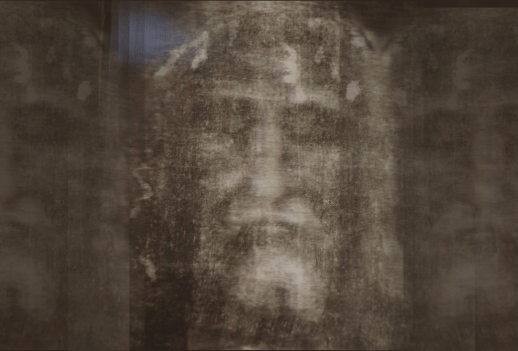
The Shroud of Turin is a cloth bearing the negative image of a man.[1] Some people believe it is the burial cloth of Jesus of Nazareth. There’s also a face cloth known as the Sudarium of Oviedo, which matches the shroud.[2] Why would anyone think it is Jesus’ burial cloth? It may seem loopy, but there are at least some interesting things to consider.
So, what caused the image on the burial cloth? How did it get there? No one knows exactly, even after thousands and thousands of hours of scientific investigation. We do know no substances were manually applied; no paint, ink, dye, pigments, stains, or secretions of the body were used to make the image. “No one has satisfactorily explained how the image was produced.”[3] Even though the shroud is the single most studied artifact ever, no other artifact comes close.
The image on the Shroud of Turin is from discoloration. The discoloration is only 200 nanometers deep into the linen fibers. Strangely, many believe the “image was formed by a sort of electromagnetic source of energy.”[4] The best explanation is that light—ultraviolet light—emanating from inside the shroud caused the image on the shroud. It has been estimated that about 6 billion watts of energy is what would be needed to produce the image.
This is where it seems like science fiction. What could explain this? Are there other things about the shroud that are mysterious? Yes. There are type AB bloodstains on the cloth. And the bloodstains are consistent with a victim of crucifixion. There is also pollen from ancient Palestine on the cloth. And the cloth has recently been dated to the time of Jesus (amending a previous date).[5]
Amazingly, the information gleaned from the burial cloth is compatible with the accounts in the Bible. The image and the blood stains show wounds on the wrists, a wound on the feet, and a wound on the side, and the stains account for the effect of gravity (showing the body hung from a vertical position). But there are no stains from the decomposition of the body and no sign that the man’s legs were broken.
The image on the shroud shows it was wrapped around a person when the image was formed. The image on the shroud varies in proportion to the distance between the cloth and the body, thus communicating 3D information about the body wrapped in the shroud. That is, the intensity of the image is directly proportional to the distance between the body and the shroud. It is similar to a topographical map. The parts of the cloth that touch the body (like the forehead) are darker, and the farther away parts (like the eye sockets) are fainter.
This has enabled researchers to take the data and create an anatomically proportional three-dimensional human form. This data can even be used to make a sophisticated guess about the height and weight of the figure in the shroud. The estimate is between 5 feet 10 inches and 6 feet, with a weight of 165 to 180 pounds.
National Geographic has called the shroud “one of the most perplexing enigmas of modern times.” Of course, it cannot be proved that this was Jesus’ burial cloth. But it forces questions upon us. What explains the Shroud of Turin? We don’t know for sure. But if Jesus actually did rise from the dead as the Bible reports, it would make sense that a burst of energy would be involved in His resurrection and that His burial cloth would be kept.
It currently seems like the Shroud of Turin is either awesome physical proof of Jesus’ resurrection, or a miraculous forgery. Because even with all our scientific understanding and technology, the shroud still cannot be replicated. So, how could it have been created a long time ago? No one knows.
The New Testament, however, does mention Jesus’ face cloth and burial cloth (John 20:7), and Acts says Jesus showed Himself to be alive from the dead through many convincing proofs (Acts 1:3). Was the shroud one of those convincing proofs?
Notes
[1] See “What Is the Shroud of Turin? Facts & History Everyone Should Know.”
[2] Barta, César & Alvarez, Rodrigo & Ordóñez, M. Almudena & Sánchez, A. & García, J.. (2015). “New coincidence between Shroud of Turin and Sudarium of Oviedo.” SHS Web of Conferences. 15. 00008. 10.1051/shsconf/20151500008.
[3] W.H. Gloer, “Shroud,” 496 in The International Standard Bible Encyclopedia Bromiley, Geoffrey W. Bromiley, ed. (Grand Rapids: Eerdmans, 1982).
[4] https://www.sci.news/physics/scientists-suggest-turin-shroud-authentic.html. W.H. Gloer, “Shroud,” 496.
[5] See “New test dates Shroud of Turin to era of Christ” and “Turin Shroud ‘is not a medieval forgery’.”
Life Beyond Life? What Explains Near-Death Experiences?

As many of you know, I’m a hospice chaplain and experience the reality of death on a consistent basis.
Recently I’ve been reading about near-death experiences (NDEs). I also met a very dear lady who had an incredible and, as is often true, transformative NDE. She was very loving. She contributes her love to Jesus. She tells of drowning in the ocean and giving up hope when a loving presence she describes as Jesus embraces her. She had an overwhelming sense of peace and love as she had never experienced. She was later rescued and revived. She was never the same.
I myself have almost died in a car accident on Interstate 71. I went through the median and got hit by an oncoming semi-truck. (I want to interject here, “Kids, don’t sleep and drive.”)
I almost died, but that’s not the kind of near-death experience I’m talking about. Actually, in many “near-death experiences,” people actually die. That is, their heart stops for some period of time, there are no brain waves, or they’re pronounced dead.
Very wild and interesting stuff. Here’s a summary of some of what I’ve learned about NDEs (not generated by AI).
Confirmation of Data Experienced During NDEs
NDEs are common.[1] Of course, common does not equal credible. But many people have had out-of-body experiences where they accurately report real-world events and sights while they were unconscious or clinically dead. People have reported data after they revived from being brain dead that medical science cannot explain. And many of these reports have been corroborated as accurate and factual.[2]
“Many cases have been gathered in which dying persons were able to view individuals, events, or circumstances around them, or even in other places, with amazing accuracy after coming close to dying or being pronounced clinically dead. Some of the descriptions were of events that happened even while the patients were comatose. In other words, these subjects reported independently corroborated data that would not normally have been in the range of their senses even if they were fully conscious at the time.”[3]
Like, how did Maria know there was a specific left-footed tennis shoe on the third-story window ledge of the hospital after she was resuscitated?[4] Or what explains the lady who reported seeing a single red shoe on the top of the hospital, which was later confirmed to be there?[5] How did a patient know about specific goings-on in their home when they were flatlined and pronounced dead at the time? How did a blind person accurately describe specific visual details?[6] How have people recognized family members they never knew existed but were later confirmed to have died?
Or how do you explain Tony’s experience? He traveled from his home in Florida to Wisconsin for a complex open-heart surgery. Tony’s “heart was arrested for 30 minutes.” During this trauma, Tony had an NDE and reported correct observations regarding his wife in the hospital waiting room and was able to look in on his home in Florida over 1,200 miles away. These reports were confirmed later by discussions with the house sitter, their own observations when returning home to Florida, and were also investigated later by a physician.[7]
Or here’s another NDE example: “A woman who had both a flat EEG reading and no vital signs had been declared dead. But she spontaneously revived about three and one-half hours later… Then she reported that she had floated over her body during the resuscitation attempts. She precisely described not only the procedures used in her attempted rescue but also the number of persons who came into the hospital room, what they said (she even repeated a joke told to relieve the tension), and perhaps most interestingly, she described the designs on the doctors’ ties.”[8]
How can so many people report accurate real-world events and sights that transpired while they were unconscious or clinically dead? Perhaps an elaborate hoax? Or just a bunch of liars with super random guesses that just happen to be accurate? Perhaps something more sinister?
Consistency across NDEs
While there’s no universally accepted definition of a near-death experience, a remarkable consistency exists in what people report. Here’s a breakdown of the common experiences that Dr. Jeffrey Long drew from data from thousands of verified NDE accounts gathered through detailed surveys:
- Out-of-body experience: separation of consciousness from the physical body (75.4%)
- Heightened senses (74.4% said “more conscious and alert than normal”)
- Intense and generally positive emotions or feelings (76.2% “incredible peace”)
- Passing into or through a tunnel (33.8%)
- Encountering a mystical or brilliant light (64.6%)
- Encountering other beings, either mystical beings or deceased relatives or friends (57.3%)
- A sense of alteration of time or space (60.5%)
- Life review (22.2%)
- Encountering unworldly (“heavenly”) realms (52.2%)
- Encountering or learning special knowledge (56%)
- Encountering a boundary or barrier (31%)
- A return to the body (58.5% were aware of a decision to return)[9]
Dr. Long explains that medical science fails to fully explain why people from vastly different cultures, languages, and religions report such similar and highly lucid sequences of events while clinically dead or unconscious.[10]
What accounts for the consistency of NDEs? If NDEs are a hoax, why are they consistent across cultures?
Corroboration with the Christian Bible
Interestingly, many aspects of NDEs are corroborated in the Bible. Actually, many think what Paul says in 2 Corinthians 12:1-3 (“whether in the body or out of the body”) describes an NDE. Some think the NDE may have happened when Paul was stoned and left for dead as recounted in Acts 14:19. Or it could have happened one of the times he was shipwrecked (2 Cor. 11:25). Of course, we don’t know. But what Paul relates in 2 Corinthians 12 has a lot of similarities with modern NDEs.
Many NDEs fit with what the Bible says about the afterlife:
- Many people experience a rapid, panoramic evaluation of their lives (Matt. 25:31; 2 Cor. 5:10).
- Enjoyment of beauty that is better than can be imagined (Is. 64:4; 1 Cor. 2:9).
- Reunited with loved ones (2 Sam. 12:23; Jn. 14:1-3; 1 Thess. 4:13–18).
- Experiences that communicate the relational love of God (Jn. 15:15, 17:3).
- Overwhelming sense of peace and love (1 Cor. 13:8; 1 Jn. 4:8; 16; Is. 54:10; Jn. 14:27; Phil. 4:7).
- Some people have negative experiences akin to punishment (Gal. 6:8; 2 Thess. 1:9)[11]
- Radiating and pervasive light (Rev. 21:23; 22:5).
- Many encounter other beings (Rev. 22:9).
- Many note cessation of pain (Rev. 21:4).
If NDEs were influenced by one’s religious beliefs and background, you would expect there to be big differences in the content of NDEs across cultures. But that’s not the case. In Dr. Long’s review of over 500 NDEs from dozens of countries around the world, he found impressive similarities.[12] “The differences are in the explanation and the interpretation of the experience,”[13] and not the content of the NDEs.
If people—especially people from different cultures—report similar experiences and those experiences line up with a powerful and time-tested religious text, could their collaboration lend credibility to the reality of life after death? And could NDEs support the truthfulness of the Christian Bible?
Conclusion
Many NDEs have outside confirmation of the data experienced during the NDE. Many people have had out-of-body experiences where they accurately report real-world events and sights while they were unconscious or clinically dead. There is also surprising consistency across NDEs. Many NDEs corroborate what the Christian Bible says about the afterlife.
The phenomenon experienced during NDEs is medically inexplicable. NDEs challenge our understanding of consciousness, mortality, and the possibility of life beyond death. Do near-death experiences provide credible, scientific proof of an afterlife? Many believe so.
What do you think? Have you thought about life after death? What explains the prevalence of NDEs?
Notes
[1] “NDE data have been presented in more than 100 peer-reviewed medical, psychological, and other reputable journals. Many millions of people claim to have experienced them. Documented cases of patients with neither measurable brain waves nor heartbeats have clearly reported rather incredible data during these times that were actually verified by others, both from their own vicinity as well as far away. Over 300 cases of highly evidenced NDEs have been reported.” (Gary R. Habermas, On the Resurrection, 951).
[2] Gary R. Habermas and J. P. Moreland, Beyond Death: Exploring the Evidence for Immortality, 156.
[3] Habermas and Moreland, Beyond Death, 157.
[4] John Burke, Imagine Heaven, 41-42.
[5] Gary Habermas, On the Resurrection, 974.
[6] “Other particularly interesting cases involve blind persons. A chemist, for example, after being blinded a year earlier in an accident, correctly reported the visual details surrounding his near-death experience. Other individuals who had been blind for years (and were even tested for blindness again afterward) accurately described the design and colors of clothing and jewelry worn by those around them when they almost died… These cases are not rare; they are unexpectedly common.” (Habermas and Moreland, Beyond Death, 158).
[7] Habermas, On the Resurrection, 975.
[8] Habermas and Moreland, Beyond Death, 161.
[9] Long and Perry, Evidence of the Afterlife: The Science of Near-Death Experiences.
[10] “It is fascinating to consider, therefore, that some of the most vivid memories these people had were of events that happened while their brains registered no known activity.” (Habermas and Moreland, Beyond Death, 160).
[11] “Some studies have also mentioned negative experiences in NDEs, including ‘hellish’ ones, although it seems that some NDEr’s may still be reluctant to share their experiences” (Amirhossein Hashemi, Ali Akbar Oroojan, Maryam Rassouli, and Hadis Ashrafizadeh, “Explanation of Near-Death Experiences: A Systematic Analysis of Case Reports and Qualitative Research.”).
[12] Jeffery Long, “Near-Death Experiences Evidence for Their Reality.”
[13] Hashemi, Oroojan, Rassouli, and Ashrafizadeh, “Explanation of Near-Death Experiences.”
The Bible: Transcultural Truth

The Bible, as God’s word, is not confined to a single time or culture. It claims to be the very word of God to us (e.g., 2 Timothy 3:16). Consequently, it can be challenging to read, understand, listen to, and apply in various ways. The Bible being outside of us makes it best suited to speak to us. Even if, for that very reason, it’s difficult for us to receive.
The Bible is, as Christopher Watkin has said, “a book that does not share our contemporary assumptions or blind spots and that was not written for our particular culture. More than that, it is a library of old books, illuminating our blind spots and assaulting our prejudices from a kaleidoscopic range of angles simultaneously.”[1]
So, the very thing that some people balk at in the Bible is one of the very things that shows its worth. We often need a critic of our culture even if we don’t think we do, probably especially if we don’t think we need it. The Bible being outside our culture is best able to speak to our culture. “The Bible will affirm some aspects of all cultures and challenge some aspects of all cultures, and it can find a home in all cultures as it transforms each of them from within.”[2]
If you think the Bible is out of date or not in line with your sensibilities, that might be just what you need. Your date and sensibilities are not the arbiter of truth. You need a measurement other than yourself. You need a compass outside your culture.
The Bible is much more than a map, but a map helps us not because it tells us what we want to hear, but because it aligns with reality. In fact, a map helps us in proportion to how much it matches reality. We need something outside of us to orient us, even if we don’t like it or naturally agree with it. Perhaps especially if we don’t agree with it; that’s when a map or GPS is most helpful, when we’d be most lost without it.
A treasure map like I used to make as a kid, with a squiggly line and an “X” marking the spot, doesn’t do anything to orient us. It’s fully autonomous.[4] Sometimes, however, we don’t like accurate maps. For instance, I don’t always like where the GPS says I am located in reference to my destination, especially if I’m late for an appointment. It’s true. It’s useful. But it’s not always enjoyable.
The Bible is not like a mirror reflecting an image of ourselves, but yet it is a mirror showing us ourselves.[5] But through the mirror of God’s word, we see ourselves not alone, but in reference to God, so we see ourselves as we were meant to be, and not just as we are (James 1:22-25). The Bible, in contrast to science (not that science is bad!), gives us what ought to be, not just what is.
I’m not trying to be unkind in saying this, but if we think about it for more than a moment, I think we should be able to realize that our autonomous reason is not the most reliable truth-discerning tool in the universe. If, however, there’s a God like the Bible describes, He’s smarter, and His judgments are more reliable than mine. If He and I differ on a matter, and He’s God and I’m a creature, it’s reasonable to assume He’s correct and I’m mistaken. If the Bible’s God exists, His reason and ways are more reliable than mine.[3]
God is much more than a cosmic referee, and the Bible is much more than a measuring stick. It is that. It tells the truth (John 17:17). And we need that. But the Bible tells a story. A big, grand, true story. A story that starts before time and ends in eternity, ends in happily ever after. It tells the story of a wise and loving King, a fierce dragon set to destroy, and a rebellious people in great need of rescue.
So, the Bible is not only transcultural truth, it’s a transcultural story. God not only speaks the truth to the world, but He loves and provides salvation to the world (John 3:16). The Bible narrates a cohesive story with Jesus as the central figure who fulfills every promise of Scripture and defeats sin, death, and the dragon of old. This story calls for a response, urging individuals to accept or reject Jesus and His promise of eternal life in a new creation.
Conclusion
The very thing that some people find objectionable in the Bible is one of its greatest strengths. We often need a critic of our culture, even if we don’t realize it, especially if we don’t think we need one. The Bible’s external nature is the quality that makes it both difficult to receive and inestimably valuable.
The Bible, as God’s word, transcends time and culture, challenging and affirming aspects of all cultures. It serves as a compass, aligning with reality and providing a grand, true story that offers a perspective beyond our own.
Notes
[1] Christopher Watkin, Biblical Critical Theory, 333.
[2] Watkin, Biblical Critical Theory, 583.
[3] Watkin, Biblical Critical Theory, 135.
[4] The ancient Greek word autonomos, which means “having one’s own laws” or “self-governing.” It combines autos (“self”) and nomos (“law”).
[5] God is not like us; He is not a mirror in the sky reflecting our reflections back at us. Instead, He is a window that shows us something beyond ourselves. He rebukes our pride and never quite conforms to our idea of how He should be (Watkin, Biblical Critical Theory, 522).
*Photo by Meredith Spencer
Jesus as the Unique: Does the Unique

Considering who we encounter in Jesus’ biographies, it would be amazing if He did not touch blind eyes and make the crippled walk. The miracles just fit in with the central miracle of who Jesus is.[1] The miracles surrounding Jesus are not absurd but natural, given His unique and divine nature.
Jesus “was the Unique, and therefore did the unique.”[2] Jesus’ miracles are a natural continuation, not a contradiction. Miracles are certainly supernatural. There is an explanation for miracles beyond the merely natural.
When people consider the miraculous claims of the New Testament, they must consider the central person from whom they flow. “When the emphasis is on the whom then the how becomes credible.”[3] In Christianity, we don’t talk about miracles based on natural law, but in light of Jesus. And that makes a huge difference. The question is, would miracles happen around someone like Jesus?[4]
When the broken and dispirited disciples, now radiant with a wild hope, whispered to each other, ‘He is arisen,’ they were simply echoing what his whole life had done. Throughout his life he arose. Where we sank, he arose. The resurrection fits in with that fact. There must be an empty tomb where there is such a fullness of Life.[5]
Two things destroy all humans—sin and death. Jesus conquered sin as we see through His utterly unique life. It would then be surprising if He didn’t also conquer death.[6] Of course, Jesus’ biographies say He did in fact defeat death. Jesus’ resurrection, if not His most profound and powerful miracle, is preceded only by His very incarnation.
One of the very reasons I believe in Jesus is because He is the utterly unique. He is heaven touching earth. He is God made visible. He is love incarnate. Miracles flow from Him as naturally as rays of light come from the sun. He the Supernatural, He the Creator of all, does the supernaturaland recreates.
Jesus’ miracles, including His resurrection, are a natural extension of His unique and divine nature. The miracles surrounding Jesus are not absurd but expected, given His identity as God incarnate.
Notes
[1] E. Stanley Jones, The Christ of the Indian Road, 161.
[2] Jones, The Christ of the Indian Road, 162.
[3] Ibid., 162.
[4] Ibid., 158. “In the light of natural law miracle seems absurd, but in the light of this person of Jesus it becomes the most natural of things” (Ibid., 159).
[5] Ibid., 162-63.
[6] Ibid.
Jesus: The Embodiment of God
One of the things that makes Jesus utterly unique is His concrete embodiment. Jesus did not just have a dream or an idea; He is not just an ideal. He is God become man; God in flesh, living and loving for all to see.
God is not aloof in an ivory tower. Jesus is down on earth in the muck and grime, being spit upon and crying. Jesus’ life and teachings reveal God’s character and compassion. Creation has always revealed God’s utter glory (Ps. 19:1), but Jesus reveals the abundance of God’s grace (Jn. 1:14-18).
Jesus reveals God to us. Jesus makes God known. People may have questions and confusion about God, but when they see Jesus, those questions are answered. “The distracted and doubting mind turns toward Jesus with relief and says, ‘If God is like that, He is all right.’”[1]
If the best and brightest humans on earth sat down to the task of thinking about the best possible God they would like to see run the universe, they would gradually form a description of Jesus of Nazareth. Who better could humans contrive? And yet the Bible says He really is the God running the universe. “The greatest news that has ever been broken to the human race is the news that God is like Christ.”[2]
Jesus is unique because He is God incarnate, revealing God’s character and compassion through His life and teachings. He answers questions about God and embodies the best possible God that humans could imagine.
Notes
[1] E. Stanley Jones, The Christ of the Indian Road, 35.
[2] Jones, The Christ of the Indian Road, 36.
*Photo by Jon Tyson
The Concrete Christ

One of the things that makes Jesus utterly unique is that He didn’t just teach truth; He is the Truth. Jesus was not theoretical. He didn’t just talk about a good idea; He is Himself good; He Himself is goodness.
Jesus was not abstract. He’s the truth embodied in concrete form. That’s what John’s biography of Jesus tells us. God became flesh and lived among humans (Jn. 1:14).[1]
Jesus did not just know the truth or teach the truth. He Himself is the Truth. Jesus doesn’t just know the way; He is the Way. Jesus didn’t just live a good life; He is the Life (Jn. 14:6). Jesus is the concrete embodiment of all that is good.[2] He is God in flesh; Truth lived out for all the world to see. So, Jesus was different than every guru, every moral guide, every leader of mankind.
As E. Stanley Jones astutely pointed out, “Many teachers of the world have tried to explain everything—they changed little or nothing. Jesus explained little and changed everything. Many teachers have tried to diagnose the disease of humanity—Jesus cures it.”[3] Jesus is different. “Many teachers have told us why the patient is suffering and that he should bear with fortitude Jesus tells him to take up his bed and walk. Many philosophers speculate on how evil entered the world—Jesus presents himself as the way by which it shall leave.”[4]
We see the utter contrast between Christ and all others when we consider the crucifix. Compare the meditating guru with Christ on the cross. Christ’s eyes are open, His body torn, and His arms are outstretched to welcome whosoever in. The guru’s eyes are closed, turned inward. His arms and whole body are self-contained. He is not torn. He is unaffected by conflict. Sin and suffering are not solved but dissolved.[5]
Christ suffers in the concrete struggles of the real world. “Jesus does not stand before the blind and the leper and the poor and the sinner and discourse philosophically on why they are in such condition, but lays his hands of sympathy upon them and heals.”[6] Jesus did not teach in the schoolroom manner the necessity of humility—He took up a towel and kneeled down and washed His disciples’ feet.[7]
He didn’t merely argue about justice and how the poor should be treated. He brought justice and changed the world. He did not argue, like Socrates, about the immortality of the soul—He raised the dead.[8]
Jesus didn’t just speculate or talk a good game. He did the thing. He did all the things. It was His eat and drink to do His Father’s will (Jn. 4:34). Jesus did not make a long, eloquent argument that God answers prayer—He prayed, sometimes all night, and in the morning the power of the Lord was present to heal. He did not paint in glowing colors the beauties of friendship and the need for sympathy; He wept at the grave of His friend.[9]
Jesus turned the world upside down. Not because He was a philosopher, ethicist, or charismatic leader. He was all of those things. But He was more. He was the embodiment of all humans were ever meant to be. But He was more than that; He is God in flesh. God in physical form.[10]
Conclusion
Jesus did not love and word and talk but in deed and truth (1 Jn. 3:18). He was concrete. Not hypothetical or abstract. Jesus is the embodiment of truth, goodness, and life, unlike any other being in the universe. While others teach or speculate, Jesus actively demonstrates and brings about.
Notes
[1] He “pitched His tent” or tabernacled. This langauge alludes to God’s dwelling among the Israelites in the tabernacle (Ex. 25:8–9; 33:7).
[2] “Jesus underlies our moral and spiritual universe deeper than the force of gravity underlies our material universe” (E. Stanley Jones, The Christ of the Indian Road, 134).
[3] Jones, The Christ of the Indian Road, 187.
[4] Ibid., 187.
[5] Peter Kreeft, Fundamentals of The Faith: Essays in Christian Apologetics (San Francisco: Ignatius Press, 1988), 93.
[6] Jones, The Christ of the Indian Road, 205. “He did not speculate on why temptation should be in this world—he met it, and after forty days struggle with it in the wilderness he conquered, and returned in the power of the Spirit to Galilee. He did not discourse on the dignity of labor—he worked at a carpenter’s bench and his hands were hard with the toil of making yokes and plows, and this forever makes the toil of the hands honorable” (Ibid., 182).
[7] Ibid., 183.
[8] Ibid., 182.
[9] Ibid., 183.
[10] See Phil. 2:6-7; Col. 2:9; Heb. 1:3; Ezek. 1:26-28; Dan. 7:9; Gen. 18:1-3; 32:30 and also what I have written on the Trinity.
*Photo by Jon Tyson
Jesus: The Utterly Unique

When we read Jesus’ biographies, we realize we are “in the presence of the utterly unique.”[1]
The Utterly Unique
Consider some of the most unique and paradigm-shifting musical artists—whether Nirvana, Elvis, The Beatles, Jimi Hendrix, or Taylor Swift—they all left an indelible impact. Whether raw and real emotions, gyrating hips, or unbelievably packed stadiums. Each one of these artists brought a massive shift in music culture. They redefined style and what was possible. They were unique and had an impact.
But they were not utterly unique. They shifted a paradigm; they weren’t something entirely new. Jesus was different. Obviously, he wasn’t a musical artist. But He was different in that He was and is someone entirely different and unexpected. He was “utterly unique.”
Jesus transcends conventional notions. He was and is much, much more than people imagine. Jesus is larger, more profound, and disturbing than anyone could conceive.[2]
People did not have categories to understand who Jesus was. Again, He brought more than a paradigm shift. He was something else altogether and brought a Kingdom not of this world.
Jesus did so many things and had such an impact, but His biographies couldn’t nearly communicate everything. In fact, one of his biographers wrote that there is not room enough in all the world to contain all the books that would need to be written (John 21:25). But there have been some 109,000,000 books about Jesus.
Jesus was not a king; He was the true King. People are accustomed to “the ordinary, shabby, second-rate sort.” People were seeking a builder to construct their desired home, but Jesus was the architect with a new plan entirely. They wanted a singer to sing their familiar song, but Jesus was the composer bringing a whole new beautiful genre. Jesus redefined what it means to lead and love. Jesus gave us a new way to be human.[3]
Because Jesus was so unique, people were all sorts of confused by Him. His biographies repeatedly capture this confusion. There were questions in public (Matt. 11:2–3; Lk. 7:18–20; Jn. 10:24). In fact, when Jesus enters Jerusalem, the entire city is stirred up and asking, “Who is this?” (Matt 21:10).
There are all sorts of reactions to Jesus’s authority. The disciples ask, “Who is this that even the wind and sea obey Him?” (Mk. 4:41; Matt. 8:27; Lk. 8:25). The religious leaders of the time challenge His authority to forgive sins, asking “Who can forgive sins except God?” (Mk. 2:7; Lk. 5:21; 7:49). People marvel at His authority over unclean spirits, asking what this new teaching is (Mk. 1:27; Lk. 4:36).
People were dumbfounded by who Jesus was and questioned His origins. They marveled and questioned: “Is not this the son of the carpenter?” (Matt 13:54–56). “Is not this the carpenter, son of Mary?” (Mk. 6:2–3). “Is not this Jesus, the son of Joseph?” (Jn. 6:42). “Is not this the son of Joseph?” (Lk. 4:22).
There was debate about Jesus’ identity as the promised Messiah. Some of the people of Jerusalem said, “Can it be that the authorities really know that this is the Messiah?” (Jn. 7:26). The crowd debates whether He is the prophet or the Messiah, questioning whether the Messiah could come from Galilee (Jn. 7:40–43).[4]
Sometimes there were direct questions: “Who are you?” (Jn. 8:25). “Who do you claim to be?” (Jn. 8:53) “Who is this Son of Man?” (Jn. 12:34). The Samaritan woman wondered aloud whether Jesus might be the Messiah (Jn. 4:29). The Pharisees debated whether Jesus was from God, with some claiming He couldn’t be because He broke the Sabbath, while others questioned how a sinful man could perform such signs (Jn. 9:16).
Jesus Himself asked His disciples who people said He was. “Some say John the Baptist, others say Elijah, and others Jeremiah or one of the prophets” (Matt. 16:13–15). Then Jesus asked them directly who they believe He is. “You are the Christ,” is the response (Mk. 8:27–29; Lk. 9:18–20).
The disciples, captivated by Jesus’ character, miracles, and teachings, follow Him, yet they struggle to comprehend who He really is.[5] The confusion about Jesus’ identity in His biographies isn’t accidental—it’s integral to how their honest message is communicated. Everyone was confused by Jesus the Christ. Of course they were. No one on earth had ever been like Him. To truly understand Jesus, we must work backwards from His crucifixion and resurrection.[6] We must see that He is the utterly unique.
When we read Jesus’ biographies, the Gospels about Him, we read with hindsight. We read knowing about the end. His earliest disciples didn’t have that convenience. They were perplexed. “Who is this man?”
Jesus’ biographers were honest about Jesus and His story, the confusing and the fantastic. They could be honest because “Jesus does not need to be protected. He needs to be presented. He protects himself.”[7]
Jesus “was not a hothouse plant that would wither under the touch of criticism, but he was rooted in reality, was the very living expression of our moral and spiritual universe.”[8] Christ comes out of the storms untouched and stronger when really seen. “The only way to kill Christianity is to take it out of life and protect it. The way to make it shine and show its genius is to put it down in life and let it speak directly to life itself. Jesus is his own witness.”[9]
We can be honest too. We can take our trust in Jesus and put it out before the world. We can say, “There He is, break Him if you can.” But the more people try to crush Him, the more He shines.[10]
Conclusion
Jesus is absolutely unprecedented. His biographies capture the confusion and awe He inspired, as people struggled to comprehend His identity as the true King and Messiah. Despite the confusion, Jesus’ biographers present an honest portrayal of His life, confident in His ability to withstand scrutiny and reveal His true nature: the utterly unique.
If you like this post, you might also like “Who is the real Jesus of history?“
Notes
[1] E. Stanley Jones, The Christ of the Indian Road, 160.
[2] N.T. Wright, Simply Jesus.
[3] Wright, Simply Jesus.
[4] Jesus also asks the Pharisees what they think about the Messiah and whose son he is (Matt 22:41–46) (Matt. 22:41–46; Mk. 12:35–37; Lk. 20:41–44). The Phariees show constanation and can’t answer Jesus’ question.
[5] Mark J. Keown, Discovering the New Testament: An Introduction to Its Background, Theology, and Themes: The Gospels & Acts (Bellingham, WA: Lexham Press, 2018).
[6] Stefan Alkier and David M. Moffitt, New Testament Basics: A Guide for Reading and Interpreting the Text (Minneapolis, MN: Fortress Press, 2022), 354.
[7] E. Stanley Jones, The Christ of the Indian Road, 133.
[8] Jones, The Christ of the Indian Road, 132.
[9] Jones, The Christ of the Indian Road, 132.
[10] Jones, The Christ of the Indian Road, 132.
*Photo by Stephanie LeBlanc
Eat God’s Word

The Bible talks about eating God’s word. Kinda strange. What’s that mean, and where do we see that in the Bible?
We see the concept of eating God’s word in various places. Jeremiah 15:16 says, “Your words were found, and I ate them, and your words became to me a joy and the delight of my heart, for I am called by your name, O Lord, God of hosts” (see also Revelation 10:10-11, Ezekiel 3:1-3).
What does it mean to eat God’s word? To answer that question, consider what it means to eat food.
When you eat food, it becomes part of you through a biological process that breaks down everything you eat into microscopic building blocks. Food, once broken down, enters the bloodstream and your cells take the absorbed amino acids and rearrange them to build new muscle tissue, organs, and enzymes.
Essentially, what you eat becomes you. It changes you. Food helps you grow, energizes you, and keeps you alive. We can’t live without it.
In the same way, when we eat God’s word, it becomes part of us. We, more and more, not only know about God but reflect Him.
Also, we can’t live without God’s word. Being nourished by God’s word is as important as physical food. Jesus said, “Man shall not live by bread alone, but by every word that comes from the mouth of God” (Matt. 4:4). And Job 23:12 says, “I have treasured the words of His mouth more than my daily bread.”
The Bible says to eat God’s word, and that it is at least as important as physical food. Why? What impact does eating God’s word have on us? Eating God’s word nourishes and changes us. It transforms us. That’s what Paul meant when he said “be transformed by the renewal of your mind” (Rom. 12:2).
That’s the goal. Getting God’s word into us in such a way that it becomes us, it transforms us from the inside out. It should be understood that the outside world is not always excited about this transformation. When we are transformed more into the image of Jesus, we are likely to be rejected like Jesus.
That happened with the prophets too. They ate the scroll, and it became bitter. They and their message were often not received. Thankfully, as we eat God’s word, it sustains us and is sweet, even as the world rejects us.
The concept of eating God’s word is also helpful because, as there are various ways to consume food, there are various ways to get God’s word inside of us. I sometimes take lots of time and enjoy a feast. At other times, I grab a protein bar and banana. The big thing is regularly eating good food. There are various ways to eat.
In the same way, we have and need to consume God’s word in various ways. We are told to let God’s word dwell in us richly, singing songs and hymns and spiritual songs. God uses singing to get God’s word into us richly. God also uses reading, listening, and preaching. Regular intake and variety are important. Again, the big thing is taking in God’s word in various ways so that it will transform us from the inside out.
More than just reading or even memorizing God’s word, ideally we get a taste for it and delight in it (Ps. 34:8; 1 Pet. 2:2–3; Heb. 6:4–5). The Apostle Paul not only knew things about God and His word, but he delighted in God and His word (Rom. 7:22). He said, “I delight in the law of God, in my inner being.”
In Deuteronomy 6, where we’re told to teach and discuss God’s words diligently at all times and places, we are first told we must love the Lord our God with all our heart and with all our soul and with all our might. The delight, the enjoyment of the food of God’s word, is vital. The regurgitation of words and facts is not mainly what it is about.
Notice it is the person who delights “in the law of the LORD” who also meditates on it day and night (Ps. 1:2-3). That person is then like a healthy tree that bears good fruit. God’s word is to us what water is to a tree; it makes us healthy and strong.
Photo by Tim Mossholder
AI and Ethics: 10 Concerns

Plato criticized the use of the original clay tablet. There was concern that people would rely on writing instead of memory. People would seem to know many things, but not actually know anything deeply. Also, written texts cannot defend themselves when misunderstood, unlike spoken conversations.
Even the technology of the clay tablet had drawbacks. We would be wise to consider the potential problems of AI.
Writing out “Artificial Intelligence” reminds us of something important. The intelligence of AI is artificial. It is not the same as naturally occurring human intelligence. AI has different advantages and different limitations. Awareness of both is critical. As well as understanding the vast difference between raw facts and wisdom.
I share 10 concerns below, though others could be raised. For example, I don’t share about security threats, deepfakes, and misinformation.
1) The Environmental Impact of AI
Water is used in AI data centers for cooling; a lot of water. A less efficient model, for example ChatGPT3, consumes the equivalent of one water bottle to generate 100 words of text. Newer models are more efficient, but they have to be trained, which uses vast amounts of energy and water to do so. We are currently in an “AI arms race” leading to a proliferation of new AIs requiring training.
AI comes with a high environmental price tag. Most AI facilities draw water from municipal supplies, and about 80% of the water evaporates, removing water from the local watershed. America has a vast watershed, but it is a finite and precious resource that takes time to replenish.
It is always wrong to be haphazard with anything finite and precious. When some people are dying of thirst, and others are using AI to cheat in school, which consumes a bunch of good water, we are in a moral quagmire.
Environmentally responsible AI is a must. Thought and money must be invested in not just faster AI, but environmentally responsible AI. Also, as is pointed out below, responsible AI use includes using AI where it is actually needed. For example, creating nonessential memes is not a good use of AI.
2) The Epistemological Echo Chamber of AI
Epistemology relates to how we know things. It involves methods and how we justify what is true and false. One of the problems with AI is that it does not weigh the factuality of information. Recycling wrong data is a concern when using AI.
False information can be replicated and presented as true. It is all the more insidious because it is often accurate, trusted, and not fact-checked. People often use AI for the very reason that they do not want to take the time to do actual research. This is problematic.
You may remember the big old copy machines and the problem of making copies of copies. If an imperfection is introduced in one copy, it is then passed on. The text gets blurrier each time. That’s what AI does. Envitably, false information is in the system and is then built upon and multiplied, compounding the false information. The trajectory of relying on and getting information from AI is not good. Is the future potentially riddled with false information?
This is an ethics concern because the truth is an ethical concern. Regurgitating information does nothing to further us as a civilization. Stagnant water only breeds disease. This is especially true if something bad is introduced into the water source. This seems inevitable if AI-generated information just builds upon other AI-generated information.
AI is good for distilling, organizing, and summarizing information. It does not provide new information, even if it helps us see and understand information better. We must be wise users of AI, and not let it take our wisdom.
3) The Economic Impact of AI
AI chatbots are used in call centers to field questions and perhaps at your local Taco Bell. Most people are annoyed by call centers either way, but chatbots replacing humans still represents jobs lost. And it doesn’t stop with call centers and fast food. It impacts programmers, administrators, and many others. Some expect 9% of workers to be displaced by AI.
There is a clear economic impact of AI. This represents heartache and loss to many people and families. It also has a toll on the US. This has happened in the past. Technology has wreaked havoc on various parts of industry. The government and employers should prepare employees as best as they can. One way employers could do this is by providing retraining in other areas within the company or even allowing extra transition time so employees can prepare and find a new job.
4) The Biased Algorithms of AI
Were there “Black Nazis”? No. Never. I do not believe so. Except when AI generated pictures of them. Developers added strict “diversity filters” to correct past biases; this caused the system to force diversity in inappropriate places.
In reality, black people in Nazi-occupied lands were treated very harshly and even murdered. To picture black Nazis is not only inaccurate, it is also offensive. But AI does not have a brain or a moral compass. AI also lacks common sense and may apply rules where they do not belong, like adding racial diversity to Nazis.
AI learns by looking at millions of examples. Humans can be biased and create biased information. If an AI is trained using biased information, it will be biased. Garbage in, garbage out. One of the inherent problems with AI is that it is made by humans with human information, so it will never be foolproof.[2] The bias of AI must be understood and taken into account.
5) The Specific Ethical Concerns of AI
Related to the above concerns, there are concerns that military decisions will be made using AI, and it will make the wrong decision either because the AI is based on faulty information or because AI does not have the moral compass that humans can and should have. “These systems can get the answers wrong, and those wrong answers can be morally significant,”[3] especially in the military that focuses on the use of violence. “Military activities are inherently of great moral significance.”[4] And we have not even considered autonomous weapons systems.
There’s also the creativity-killing effects of AI. AI has “the capacity to plagiarize, and can generate content that looks like it was produced by a specific human creator, raising potential copyright issues.” Coopting creativity is no light thing. Creativity is a big part of what it means to be human and a big portion of where we receive our pleasure. To divert that duty to a machine is as foolish as it is un-fun.
Another specific ethical concern is that the data AI uses is in some ways just large-scale stealing from others. “AI artwork” is just copied and compiled from thousands of pieces of artwork.[1] It is not a new creation; it is a conglomeration.
6) The Frivolous Focus of AI
There are certainly good, wise, and positive applications of AI. Medical research benefits from AI. AI is effectively used to identify signs of tumors in X-rays. But a lot of AI is focused on creating cute kitty videos or funny spoofs (if not desecrating videos). For example, a recent analysis from Forbes found that 71% of images shared on social media are now AI-generated.
So, while AI has the potential to cure cancer, we’re sadly likely to focus on creating cute cat videos. The potential power for good that something has correlates with the seriousness with which we should evaluate and use that thing.
7) The Power Grid Problem of AI
Training AI models like GPT-4 requires immense computational power, leading to significant and unstable electricity consumption, increased carbon dioxide emissions, and power grid problems. Data center power requirements in North America rose from 2,688 megawatts in 2022 to 5,341 megawatts in 2023, driven by the demands of generative AI. Globally, data centers consumed 460 terawatt-hours in 2022, making them the 11th largest electricity consumers, between Saudi Arabia (371 terawatt-hours) and France (463 terawatt-hours) (See “Explained: Generative AI’s environmental impact”).
AI seems forced upon us. It seems to be replacing regular searches. ChatGPT queries, however, consume about five times more electricity than simple web searches. The power grid problem connects to ethics because it impacts people, their everyday lives, and finances. People should understand the impact of AI on the power grid and should be given every opportunity to speak into AI and its use.
8) The Social and Relational Problems of AI
Loneliness and social isolation are already a problem in America. The impact of social media and AI is keenly felt in social settings. It’s not just conversations that have been impacted. Marriages have been affected as spouses connect with chatbots instead of their spouse.
In fact, this is what replika.com says about their chatbot: “Always here to listen and talk. Always on your side.” The website says there are 42,160,934 users worldwide. Another provider of AI companions, nomi.ai, says, “Create an AI companion, girlfriend, boyfriend, or friend with human-level memory, a personality that’s genuinely theirs, and real emotional intelligence.”
When people are told they can create a “companion, girlfriend, boyfriend, or friend,” we are clearly in territory that requires ethical reflection. What are the implications, potentially good and bad, of creating these AI companions? These questions must be asked and carefully answered.
9) The Abrogation of Work and AI
There are certain things that technology advances allow. Many advances are good and helpful, but we should be mindful of the potential results. We should also be aware of what we are likely to sacrifice through the use of the technology.
The automation of certain things—such as simple tasks—may have few ethical ramifications, but certain things have much more moral weight. I, for example, don’t hate that washboards are now a thing of the past for most people; even while the simple practices we do each day can be profoundly important and a type of ritual when done with the right heart and mindset. But all that is to say that different things have different moral weight. A person given a school assignment of writing an essay on racism will be impacted differently if they write it themself rather than having an AI write it. The finished project may be of higher quality if the AI writes it, but the moral impact on the person will be greatly reduced. Many other examples could be given, but this proves that we must consider what tasks should and should not be given to AI.
Sometimes the work is as important as the final product. If we skip the journey, we may be shortchanging ourselves and the final destination we’ll be able to reach. Character counts, but when we skip important steps, we limit our own meaningful transformation.
10) The Anthropological Impact of AI
What is the impact of AI on what it means to be human? Technology has always profoundly shaped our understanding of humanity. AI intensifies this question as we create machines that mimic and imitate what we once thought was uniquely human.
Jason Thacker has pointed out that “Until we begin to see how these technologies shape every aspect of our lives, including how we understand what it means to be human, we will fail to understand just how far-reaching and life-altering these technologies are and will be.”[5] But the truth is we tend to use technology thoughtlessly without ever considering its impact. The colossal companies behind AI have substantial economic incentives to keep it that way.
Neil Postman, the late media theorist and cultural critic, perceptively said, “embedded in every tool is an ideological bias, a predisposition to construct the world as one thing rather than another, to value one thing over another, to amplify one sense or skill or attitude more loudly than another.”[6] AI has an inherent biased and shaping influence on people and culture.
We use human-like, anthropomorphic language to refer to AI. For example, we refer to the Alexia device and say, “she said…” What impact does it have on humans when they are regularly having “conversations” with AI chatbots? As Andy Crouch has said, we would be wise to ask: “Is this technology helping me grow in my emotional and relational capacities, or is it robbing me of the very essence of what it means to be human?”[7]
Conclusion
We have highlighted ten ethical concerns surrounding AI. We have seen the need for careful consideration of AI’s role in society, urging a balance between its benefits and potential drawbacks.
We have seen that AI’s intelligence is artificial and different from human intelligence, with its own advantages and limitations. There is a significant difference between raw facts and true wisdom. AI’s inability to discern fact from fiction can lead to the spread of misinformation, similar to the “copy of a copy” effect. AI-driven social media and chatbots can negatively impact social interactions, relationships, and potentially exacerbate loneliness. While AI can automate tasks, it’s crucial to consider the ethical implications of delegating certain tasks, as the process of work itself can be valuable for human growth and development.
The most crucial problem with AI is that it is not the truth, even as it can sometimes approximate the truth. It cannot love or show us how to love, even while it can tell us about and define love in all sorts of ways. It can tell us all sorts of things and show us all sorts of ways to do all sorts of things, but it can never be the Way. It can never be the Truth. It can never be the Life. Despite its capabilities, AI cannot replace fundamental human experiences such as truth, love, and finding meaning in life.
Notes
[1] I know all artwork is built upon and comes from the influence of many others. And I have read Steal Like an Artist. But “AI art” seems somehow soulless.
[2] “In 2018, Amazon developed an Al-powered hiring tool that exhibited gender bias. The system was trained on resumes submitted to the company over a ten-year period, and in that timeframe, men were hired more often than women. As a result, the tool learned to favor male candidates and penalized resumes that included terms associated with women. Google faced a similar issue with its face recognition technology. In 2015, the company’s image recognition system labeled a photo of two Black individuals as ‘gorillas, highlighting racial bias within the algorithm. The incident exposed the limitations of training data that lacks diversity, leading to biased outcomes. Google acknowledged the problem, issued an apology, and committed to addressing the issue. The actual model performance, though, has not been corrected.’” (Joe Chapa, “Artificial Intelligence and the Future of Military Ethics” 112 in Heather Venable, The Future of Airforce and Space Power: Intersections of Theory and Technology.).
[3] Chapa, “Artificial Intelligence and the Future of Military Ethics,” 112.
[4] Ibid., 117.
[5] Jason Thacker, “You Are Not a Machine.”
[6] Neil Postman, Technopoly: The Surrender of Culture to Technology.
[7] Andy Crouch, “Redemptive Artificial Intelligence.”
*Photo by Zulfugar Karimov
Non-Combatant Chaplaincy: Preserving the Spiritual Mission of Military Ministry
Introduction
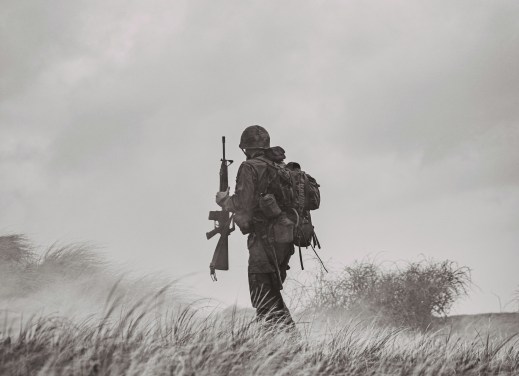
There he was in a blood-spattered Humvee. The ring and roar of mortars, bullets ripping through flesh, and yells. The sights unmentioned and horrible. Why was he there? Why was a chaplain there? This essay explores that question.
Specifically, why would a non-combatant be in the military?[1] What is the ethical framework underpinning the non-combatant status of chaplains, and what are the theological and practical principles that guide ministry in military contexts? Even though there is a long history of chaplains serving as non-combatants, some argue that chaplains should be combatants.[2]
If the war is just—if there are good moral grounds for engaging in combat—then should not the chaplain be the first one willing and able to take up arms and fight? If there is truly just cause, then the chaplain should be willing to lead from the front, right?[3] He or she should not fear death and should have a holy conviction that the war is right.[4]
In fact, Darrell Cole concludes his essay by saying: “Christians who willingly and knowingly refuse to engage in a just war do a vicious thing: they fail to show love toward their neighbor as well as toward God.”[5] So, why are chaplains non-combatants? Because there are other important theological considerations. My thesis is that although there is theological warrant for warfare, the chaplains’ non-combatant status is essential for their role in providing spiritual guidance, moral counsel, and upholding religious freedom within the military. This is the chaplain’s God-given calling, and it must be the focus, not engaging the enemy.
Theological Principles
Some argue that in light of Jesus’ command to love one’s enemies (Matt. 5:38-42) and the value of human life (Gen. 1:26-27), chaplains should not engage in combat. But if that is true for chaplains, why is it not true for all people? What about “Blessed are the peacemakers” (Matt. 5:9)? That is true. And there are times to make peace by striving to righteouslywage war. How does “turning the other cheek” (Matt. 5:39) square with warfare? One answer is that Jesus meant individuals should not take the law into their own hands. What about king David being unable to build the temple because he was a man of war (1 Chron. 22:8; 28:3)? Chaplains are not serving under the old covenant or building a temple.
The Bible does not say it is wrong to wage war, but it does say to serve in the military justly (Lk. 3:14). So, war is not wrong. But there are a few biblical reasons why chaplains should be non-combatants. First, from a Christian perspective, governing authorities should be obeyed (Romans 13:1-7),[6] and chaplains are currently non-combatants. Although, chaplains are allowed to defend themselves.[7]
The most important aspect of the chaplain’s non-combatant status, however, is the chaplain’s particular calling and stewardship to focus on spiritual fitness. Chaplains can best serve military personnel and the mission by being non-combatants. Biblical stewardship is the calling to be faithful with what God has given (Matt. 25:14–46; 1 Cor. 4:2) because He owns and gives every good gift (e.g., Lev. 25:23; 1 Chron. 29:11–12; Ps. 24:1; James 1:17), including our time and talents, and wants them employed to His glory (1 Cor. 10:31). Chaplains have specifically been given the responsibility to provide “religious support and spiritual care” which importantly “ensures all Airmen and their authorized dependents have opportunities to exercise their constitutional right to the free exercise of religion.”[8] That is the important calling chaplains should focus on.
Chaplains focusing on spiritual fitness is absolutely vital. George C. Marshall, who among other things served as the 3rd United States Secretary of Defense, said, “I look upon the spiritual life of the soldier as even more important than his equipment. … The soldier’s heart, the soldier’s spirit, the soldier’s soul are everything. Unless the soldier’s soul sustains him, he cannot be relied upon and will fail himself and his country in the end.”[9]
It should also be considered that military members are literally trained to kill with powerful killing machines. As Samuel Huntington puts it, “They are specialists in the application of violence.”[10] It is thus important that they have moral guidance by their side. Chaplains must advise commanders, guide military members, and restrain unjust actions when needed.[11]
Chaplains being non-combatants allows them to focus on their distinct role of holding the all-important spiritual realities before the military, as well as providing for the free exercise of religion. So, the non-combatant status of chaplains facilitates focusing on morals and morale. These are very worthy goals that make sense of chaplains being non-combatants.[12]
Moral and Ethical Framework
Just war theory best captures the teaching of the Bible. It also allows a much-needed moral and rational framework to evaluate military decisions. Just war theory establishes moral boundaries around military conflict by identifying conditions under which warfare is ethically defensible.[13] There are three main considerations: right to go to war, right conduct in war, and justice after war.[14]
Just war theory is an important theological and ethical foundation because, as has often been said and experienced, “War is hell.” It should not be entered into casually. Also, human life is incredibly, even inestimably, valuable. There must be strong reasons to allow for violence and destruction. Further, all resources are finite, so their destruction should not be taken lightly.
A realistic view of the world will see the clear persistence of evil, and the government’s moral responsibility to defend its people’s lives, property, and social order.[15] The Bible teaches war is, sadly, inevitable in the fallen world (Matthew 24:6-8). What must be asked is how it can be waged justly with minimized destruction.[16] Chaplains have a vast part to play here, and it is another reason why they are non-combatants. Chaplains must reckon with the dark realities of conflict and understand there will be casualties and chaos.[17] In the midst complexity, evil, and gore, they must tenaciously pursue righteousness.
Implications for Chaplaincy Practice
A chaplain’s non-combatant status is important for various reasons. Primarily, it allows them to focus on what they are uniquely trained and equipped to focus on. Chaplains can best support the military mission with God’s word, rather than with a gun. Aquinas, the eminent 13th-century philosopher, believed chaplains should be non-combatants because he did not want warlike pursuits to prevent them from focusing on their God-given jobs.[18]
The non-combatant status also enables chaplains to function as religious leader liaisons and build relationships with indigenous religious leaders.[19] This has proven especially beneficial in some Muslim contexts. Chaplains are often especially respected for trusting God and not wielding a gun. This facilitates promoting peace and reconciliation.
Lastly, all officers, including chaplains, have sworn (or affirmed) to “support and defend the Constitution of the United States against all enemies, foreign and domestic.” The chaplain does this in a unique and powerful way. The chaplain does it from the pulpit and with the pen and by providing for the religious expression of all military members. This is a high ideal. And it is worth chaplains going to battle and being shot at, all the while not carrying a gun because we as a nation believe that all people are created equal and have been “endowed by their Creator with certain unalienable Rights.” One of these rights is the freedom of religion.[20] Chaplains exist, in large part, to help protect First Amendment rights.[21]
Conclusion
The non-combatant status of chaplains is important from a theological and practical standpoint. While one may acknowledge the arguments for chaplains as combatants, chaplains should retain their non-combatant status. This status allows chaplains to focus on their unique calling of spiritual guidance, moral counsel, and upholding religious freedom, which are vital for the well-being of military personnel and the success of the mission. Chaplains are to be faithful stewards ofthe gifts and responsibilities given to them, focusing on their primary calling (2 Corinthians 10:4; 2 Timothy 2:4).
The mission of the chaplain corps is spiritual fitness; spiritual resiliency. It is to “nurture the living, care for the wounded, and honor the dead.” It is not killing the enemy or even defending themselves. That is why chaplains are non-combatants.
We have explored the complex relationship between Christianity and warfare, with a specific focus on the role of chaplains. Some may cite biblical passages advocating for pacifistic peace,[22] but there are times when war is necessary to oppose evil, even while chaplains demonstrate heroism, willing to serve without weapons, to accomplish their important mission of advocating for and facilitating religious freedom and providing spiritual care. Chaplains oppose evil not with a gun but with godly grit.
Why was a chaplain in a blood-soaked Humvee? So, he could wipe up the blood, the tears, and serve for peace as Jesus did. So, he could—in imitation of Jesus—bring to flesh the hope, calm, and peace of God in a cursed, chaotic world. That is why we have chaplains who do not engage in combat. Their focus is daring love, compassion, and peace. Reminders of the good we fight for.
Notes
[1] Chaplains’ noncombatant status stems from the Council of Ratisbon in A.D. 742, prohibiting them from carrying weapons (Michael C. Whittington and Charlie N. Davidson, Matters of Conscience: A Practical Theology for the Evangelical Chaplain Serving in the United States Military [Liberty University Press, 2013], 201–202). “The chaplaincy, it can be argued, has been alive and well either formally or informally for as long as man can imagine. The chaplaincy is as old as war itself.” (Steven A. Schaick, “Examining the Role of Chaplains as Non-Combatants While Involded in Religious Leader Engagement/Liaison,” 1).
[2] For example, Chaplain (Lt. Col.) Joseph Friedman, has said, “The DOD’s insistence on unarmed chaplains does not make sense” (https://www.armyupress.army.mil/Journals/Military-Review/English-Edition-Archives/September-October-2023/Pistol-Packing-Padres/). Friedman says, for example, that when a chaplain is in a combat situation the chaplain becomes a tremendous liability to the combatants around him.
[3] Chaplains are spiritual leaders, that assumes people should follow them. But if chaplains are non-combatants essentilly because it is wrong to engage in combat then it follows that no one, not least the miliatry personel looking to the chaplain’s spiritual leadership, should engage in combat. In other words, if combat is morally and biblically wrong for chaplain’s then it is wrong to all people. It is different, however, if the question is one of prudential wisdom and not transcultural ethics.
[4] Chaplain William Emerson is an example here. In fact, Schaick says, “The Revolutionary War cannot be understood apart from the influence of clergy, many of whom alternated between fighting and preaching for the very freedoms their faith required.” (Schaick, “Examining the Role of Chaplains as Non-Combatants While Involded in Religious Leader Engagement/Liaison,” 2).
[5] Darrell Cole, “Good Wars” https://firstthings.com/good-wars/. He even says, “war-making, when just, can be a form of love” (Ibid.). Jeff Myers simiarly says, “A shameful peace based on nonaction is not to be preferred to a just peace based on action.” (Should Christians Support Israel?: Seeking a Biblical Worldview in an Impossible Situation, 83).
[6] There is clear warrant for civil disobedience in certain limited circumatances: Exodus 1:15-21; Daniel 3:6; Acts 4:19-20; Romans 6:1-2. But the regular pattern is faithful and grateful obedience: Matthew 22:15-22; Romans 13:1-7; 1 Timothy 2:1-2; 1 Peter 2:12-17.
[7] Department of the Air Force Instruction 52-104: 3.2. says “chaplains, as religious personnel, serve exclusively in a humanitarian capacity. Chaplains, therefore, will not engage in activities that could create perceptions of combatant behavior or that compromise the protected status of other chaplains in the field.” But it also says they “have the inherent right of self-defense.”
[8] Air Force Instruction 52-101:1.1.
[9] George C. Marshall, quoted in Donald W. Shea, “A Ministry in the Eye of the Storm,” Army, September 1991, 54.
[10] Samuel Huntington, The Soldier and the State: The theory and politics of civil–military relations, 18.
[11] Jo Brick wisely says that “while legal frameworks are important in regulating behavior, the ethical factors and the question ‘Can I live with myself if I do this?’ are drivers of individual behavior that are more important in complex circumstances. Military professionals must be trained in facing the inevitable dilemmas that arise in the course of military operations. Increasing moral fitness in military professionals is an important means of preventing moral injury. Training in the laws of war is, of itself, not enough. The law is easy; ethics is hard” (Jo Brick, “The Military Profession: Law, Ethics, and the Profession of Arms” in Redefining the Modern Military: The Inersection of Profession and Ethics edited by Nathan K. Finney and Tyrell O. Mayfield (Naval Insitute Press: Annapolis, MD, 2018), 62.
[12] Another important aspect is non-combatant status is supposed to allow chaplains to continue to provide relgious care if detained along with prisoners of war. To retain military religious status, chaplains must belong to a force whose members qualify for prisoners of war status, be designated as exclusive religious personnel, and serve exclusively in a religious capacity. This ability would be compromised if they were to engage in combat which would leave soildeis without much needed spiritual care (Naomi K. Paget and Janet R. McCormack, The Work of the Chaplain (Judson Press, 2006), 45.). One of the problems, however, is that “the purported immunity granted by the conventions has not been exhibited by U.S. enemies in over seventy-five years” (https://www.armyupress.army.mil/Journals/Military-Review/English-Edition-Archives/September-October-2023/Pistol-Packing-Padres/).
[13] See for example Hak Joon Lee, Christian Ethics: A New Covenant Model (Grand Rapids, MI: William B. Eerdmans Publishing Company, 2021), 467–468 and David P. Gushee and Glen H. Stassen, Kingdom Ethics: Following Jesus in Contemporary Context (Grand Rapids, MI: William B. Eerdmans Publishing Company, 2016), 462.
[14] Aquinas, 1274, 2.40.1. Here are the conditions that must be met before starting a war: just cause: Typically self-defense or protecting innocent people from serious harm, legitimate authority: War must be declared by a proper governing body, right intention: The goal should be justice (e.g., peace), not revenge or conquest, last resort: All peaceful options must have been tried first, probability of success: There should be a reasonable chance of achieving the goal, and proportionality: The expected benefits must outweigh the harm. Here are the rules that apply during war: discrimination (distinction): Combatants must distinguish between military targets and civilians, proportionality: The force used must not be excessive relative to the military objective, military necessity: Actions must be necessary to achieve a legitimate military goal, and no inherently evil means: Some methods (e.g., genocide, torture) are forbidden. These principles guide how wars should end and what happens after the war: fair peace terms: Avoid punishing populations excessively, reconstruction: Help rebuild affected societies, accountability: War crimes should be addressed, and the restoration of rights: Aim to reestablish a just political order.
[15] Lee, Christian Ethics, 467.
[16] “Defenders of the Just War tradition regret that they live in a world where they have to kill human beings in order to restrain evil; that is to say, they regret the Fall. But they find it to be even more regretful for Christians to stand idly by while people are being abused and killed unjustly” (Darrel Cole, “Good Wars”).
[17] As John Keegan says so powerfully, “What battles have in common is human: the behaviour of men struggling to reconcile their instinct for self-preservation, their sense of honour and the achievement of some aim over which other men are ready to kill them. The study of battle is therefore always a study of fear and usually of courage, always of leadership, usually of obedience; always of compulsion, sometimes of insubordination; always of anxiety, sometimes of elation or catharsis; always of uncertainty and doubt, misinformation and misapprehension, usually also of faith and sometimes of vision; always of violence, sometimes also of cruelty, self-sacrifice, compassion; above all, it is always a study of solidarity and usually also of disintegration for it is toward the disintegration of human groups that battle is directed” (John Keegan, The Face of Battle).
[18] Aquinas, 1274, 2.40.2. I disagree with Aquinas’ second reason. He says warfare is “unbecoming” because those who give the Eucharist should not shed blood, even if they do so in accordance with just war theory. Perhaps this line of reasoning works in a Catholic theological system but not in mine which has a different view of the priesthood.
[19] Schaick, “Examining the Role of Chaplains as Non-Combatants While Involded in Religious Leader Engagement/Liaison.” This is an important consideration. Donald Rumsfeld once said, “Overall, we are not doing a good job… of trying to include religious leaders to show respect for their faith as part of stability operations” (Donald Rumsfeld, keynote address, Eisenhower National Security Conference, Ronald Reagan Building and International Trade Center, Washington, DC, 25 September 2003).
[20] Protecting this right is vital and we can and should thank God for our freedoms. “Denying religious freedom is a precursor to denying all other freedoms. If the state can put itself in between citizens and God, there is no other part of life within society that the state will not see itself as apt to disrupt and intervene in, either.” (Andrew T. Walker, Faithful Reason: Natural Law Ethics for God’s Glory and Our Good, 286). “The state that recognizes and protects religious freedom is not an omni-competent state, but rather a state that acknowledges the rights of conscience and the prerogatives of the institutions that men and women freely sustain to express and pass on their religious convic-tions. It recognizes its duty to serve, and not to impede, those communities of civil society. Thus the recognition of religious freedom in full is a crucial barrier to the totalitarian temptation that seems to exist in all forms of political modernity” (Evangelicals and Catholics Together, “In Defense of Religious Freedom, ” First Things, March 1, 2012, https:// http://www.firstthings.com/article/2012/03/in-defense-of-religious-freedom. Quoted in Walker, Faithful Reason, 287).
[21] This does not mean, however, that all religious requests will be granted. Commanders must weigh religious freedom with safty and mission impact. As Andrew Walker has said in reference to general soceity: “Restrictions on religious liberty are indeed legitimate insofar as rightly authorized authorities carefully delineate what harms a religion’s adherents pose to society and does not arbitrarily penalize. Public health and public safety cannot countenance threats to sound order under an absolutized appeal to religious liberty” (Faithful Reason, 283).
[22] My advocacy of righteous realism agrees with Andrew T. Walker, who says, “Christian pacifism fails to adequately love one’s neighbor. It is an over-idealized ethic that cannot be reasonably pursued in an age marked by sin” (Walker, Faithful Reason, 272).
*Photo by Eduard Delputte