Nietzsche: Prophet of Doom (Part 2)

Nietzsche was Right, but He was also very Wrong
What I hope to show in my paper is that Nietzsche’s philosophy was either very accurate or very wrong. That is, Nietzsche’s conclusions if God is “dead” lead inevitably to certain conclusions. In my evaluation, I take three of Nietzsche’s late period writings (1886-88) as my main point of interaction.[1] This is for a two reasons. First, Nietzsche’s writings are large and this paper is not. Second, because his philosophy is more likely to be further established in his later writings.
In Nietzsche’s writings, he shows over and over again that his thought is the converse of Christianity; this is true if we look at his doctrine of eternal recurrence or his writings on slave morality. And as Nietzsche said, philosophy “always creates the world according to its own image, it cannot do otherwise”[2] and for Nietzsche’s thought, when extrapolated and applied, it makes hell. That is what I hope to argue, I hope to show how Nietzsche’s thought, when applied, makes a world in its own image, one that is terrible, filled with war, rape, and violence. I want to show this because I believe it is the inevitable outcome of the path he started. Since the beginning, it has been true that when we turn away from God we turn to our own destruction (Ps. 16:2; Jer. 2:5; Rom. 1; 3:12; etc.).
So, how is Nietzsche right? Nietzsche is right in that he paints a powerful portrait for us of what it means to be given up to our own devices (cf. Rom. 1). Nietzsche shows us the fallout from the Fall of humanity. But, Nietzsche was also gravely wrong. God is not dead!
Nietzsche’s philosophy is most clearly the converse of Christianity. Nietzsche says God is dead.[3] He says there is no truth. He says to assert yourself and make your own way. He says there is no heaven so live each moment today like it will occur eternally. In short, I hope to show that in the throwing off the “shackles” of morality and the hope of heaven Nietzsche has fettered those who follow him to hell on earth. Nietzsche’s writings and subsequent history show us that a world where right and wrong do not exist, is a world where lots of pain and oppression do.[4]
Ideas and beliefs have consequences, profound consequences. Paul says in 1 Corinthians 15 that if Christ has not been raised then let us eat and drink for tomorrow we die. Elijah says in 1 Kings 18:21 that if God is not God then don’t live for Him, live for whatever it is that you believe is true, whether Baal or, I believe he would say, whatever applicable philosophy. So, as we look at Nietzsche’s thought, which is the converse of Christianity, we can begin to understand and better appreciate Christianity.
__________________
[1] That is, Beyond Good and Evil: A Prelude to the Philosophy of the Future (1886), On the Genealogy of Morality (1887), and The Antichrist (1888).
[2] Nietzsche, Beyond God and Evil, par 9.
[3] Friedrich Nietzsche, The Gay Science, par. 108, 125, 343. Cf. e.g. Friedrich Nietzsche, Thus Spake Zarathustra, “Zarathustra’s Prologue,” par. 2 and 3.
[4] “By denying human equality and human rights, and by devaluing the lives of the masses, Nietzsche’s philosophy is really a loveless, forlorn philosophy of death, cruelty, and oppression” (Weikart, Richard, The Death of Humanity: and the Case for Life [Regnery Publishing], Kindle Locations 3394-3395.
Nietzsche: Prophet of Doom (Part 1)
Introduction
What follows is important and relevant for individuals, society, and the world. The water is deep at places but must be forded for us to get to solid ground. The world, I fear, is in a swamp of uncertainty, but the water is rising, every day the need for solid ground is more apparent but harder to reach. Wade through this with me, and perhaps we can find something solid to build upon. Something that will stand through the next wave, whatever that wave may be. As we set out, we will use Friedrich Nietzsche as our marker, though he is no North Star, he helps us map the mire.
First, we should know some about Nietzsche. Friedrich Wilhelm Nietzsche was born on October 15th, 1844 and died on August 25th, 1900. Nietzsche lived a sickly life and died at the age of 55 of pneumonia.[1] Nietzsche’s father was a Lutheran pastor. “Nietzsche’s uncle and grandfathers were also Lutheran ministers, and his paternal grandfather, Friedrich August Ludwig Nietzsche (1756–1826), was further distinguished as a Protestant scholar.”[2] Nietzsche faced many difficulties from a young age. His father died when Nietzsche was only four years old and just six months after the death of his father his younger brother died.
Nietzsche must have been gifted intellectually from a young age. For example, he composed piano, choral, and orchestral music as a teenager. He also received a good education at a first-rate boarding school. As a teenager, he read “David Strauss’s controversial and demythologizing Life of Jesus Critically Examined”[3] and it had a big impact on him. Early on Nietzsche considered himself devout, he was even called “little preacher” when he was young, but eventually, he would deny the faith, though at first not publically.[4]
Second, it should be understood, that in my mind, Nietzsche’s ramblings are closer to rhetoric than to philosophy. Nietzsche often employees ad hominem arguments and attacks a person (e.g. the Apostle Paul[5]) rather than their arguments. Nietzsche also seems fond of constructing straw man fallacies for his argumentative flame.
Third, Nietzsche wrote in a very unique and even enjoyable style. However, his lack of precision in writing is dangerous; people can construe his writings in many ways, and they have. There is much disagreement over Nietzsche and his work, which must to a large degree, must be because Nietzsche seems to have communicated often more like a poet, using words to paint, and not as much for precision.[6] It is true that Nietzsche at times is very hard to discern and it is also true that his body of work is large and there is much disagreement upon what place Nietzsche’s unpublished work should play in Nietzschean scholarship. However, all that being the case, Nietzsche is still responsible for what he wrote and the way he wrote.
Yannick Imbert has said,
In the history of Western thought, Nietzsche most likely holds the distinction of being the most misunderstood and misrepresented philosopher. Understanding him represents a particular challenge for Christians, given Nietzsche’s radical criticism of anything related to Christianity. Let us consider more closely the philosophy of the so-called father of nihilism.[7]
________________
[1] See e.g. D. Demelsoet, K. Hemelsoet, and D. Devreese, “The neurological illness of Friedrich Nietzsche,” 9-16 in Acta neurologica Belgica (April 2008).
[2] Robert Wicks, “Friedrich Nietzsche” in The Stanford Encyclopedia of Philosophy ed. Edward N. Zalta (Fall 2016 Edition)(https://plato.stanford.edu/entries/nietzsche/#Life1844 accessed on December 5th, 2016).
[3] Ibid.
[4] “From his early boyhood, Nietzsche was expected to follow the family tradition and become a minister himself. As late as 1864, when he studied classics and theology at Bonn University, he seems to have adhered to his family’s expectations (if no longer wholeheartedly). When one year later he finally dropped theology, he proved a family crisis” (Jörg Salaquarda, “Nietzsche and the Judaeo-Christian tradition,” 90-118 in The Cambridge Companion to Nietzsche [Cambridge: Cambridge University Press, 1997], 92).
[5] E.g. Nietzsche says, “In Paul is incarnated the very opposite of the “bearer of glad tidings”; he represents the genius for hatred, the vision of hatred, the relentless logic of hatred. What, indeed, has not this dysangelist sacrificed to hatred!… The life, the example, the teaching, the death of Christ, the meaning and the law of the whole gospels—nothing was left of all this after that counterfeiter in hatred had reduced it to his uses. Surely not reality; surely not historical truth!… He simply struck out the yesterday and the day before yesterday of Christianity, and invented his own history of Christian beginnings… The figure of the Saviour, his teaching, his way of life, his death, the meaning of his death, even the consequences of his death—nothing remained untouched, nothing remained in even remote contact with reality. Paul simply shifted the centre of gravity of that whole life to a place behind this existence—in the lie of the “risen” Jesus… The figure of the Saviour, his teaching, his way of life, his death, the meaning of his death, even the consequences of his death—nothing remained untouched, nothing remained in even remote contact with reality. Paul simply shifted the centre of gravity of that whole life to a place behind this existence—in the lie of the “risen” Jesus… What he himself didn’t believe was swallowed readily enough by the idiots among whom he spread his teaching.—What he wanted was power…” (Nietzsche, The AntiChrist, par. 42).
[6] So, Alvin Plantinga has said, Nietzsche “writes with a fine coruscating brilliance, his outrageous rhetoric is sometimes entertaining, and no doubt much the extravagance is meant as overstatement to make a point. Taken overall, however, the violence and exaggeration seem pathological; for a candidate for the sober truth, we shall certainly have to look elsewhere” (Alvin Plantinga, Warranted Christian Belief [Oxford: Oxford University Press, 2000], 136).
[7] Class notes from Yannick Imbert’s lecture in “History of Philosophy and Christian Thought” on Oct. 12th, 2016.
The Thesis and Anti-Thesis on Life and it’s Negation

Life is futile. A senseless waste. We live, we die. That is it.
We squeeze out meaning. Or inject it into our veins. We run, but we know not for what, and then expire. We build our castles and pile up things. Then we die.
The sun rises and sets or spins and spins. Seasons come, seasons go. We grow old. We die. The same remains until the sun burns out and we grow cold.
All is futile.
There is no meaning, accept what we make. So fill your coffer, kill the pain. Feed your pleasure, though a monster it becomes.
Thus is life if there’s no hope beyond the grave.
Yet, if this is the sleepy land and we wait for what is true life then this is but the testing ground. We plant what grows for us there. If we make our meaning here, then we destroy it there. If we are lethargic and vague in pursuit then we’ll obtain the wind.
“Genetic Homosexual?” and our morality…

John is attracted to men. Jane is attracted to women. And so, our cultural says, “Go for it! If that’s the way you feel (the culture’s only form of “objective” truth). After all, that’s the way you were born. It’s in your genes.”
I, Paul, am attracted to women (pl.) and yet I am married, to a singular woman. I also have the tendency, bent, disposition, because of innumerable factors (nature, nurture, etc.) to be angry and act out in anger. If I left myself unchecked and just did whatever I felt like, I, sad to say, would be an abusive adulterer. Something that would not be good for me, my wife, my children, or society.
So, even if I am by nature a genetic abusive adulterer is that ok? Should I be content with that? Promote that?
I do not see how that is admirable. Many people would lead me to believe that is the higher good; to be something akin to animals. To do whatever we want, whatever our natural self would want to do. It sounds like many would sniff the wind and follow their inner impulse. However, does anyone realize that our inner impulse, whatever it might be, will often lead to some very bad places?
We all have many dispositions: selfishness, pride, boastfulness, etc. but that does not make it right; even if natural. If we want to just say that everyone should just do whatever their genetic disposition has given them, then we should just do away with the penal system and society in general. For what, in that line of thought, would allow us justification to repress any inner and natural desire?
Many studies, for instance, show that many drug addicts, whether meth, heroin, or cocaine, have a genetic disposition to drug addiction. However, we don’t say, or most of us don’t say, that drug addiction is okay. Why? Many would say because it harms the body and harms society. Just because someone has a disposition for something does not justify that disposition.
The logic that says homosexuality is fine because people have a disposition towards it is faulty. That just does not follow. People have dispositions in all sorts of ways. But that does not make it morally good.
People say: “To your own self be true” and other such phrases. But where does our deepest self lay? In our pants? Or does our mind and our convictions play a pretty big part? Maybe being “true to our self” also, and more fundamentally, means being true to our convictions, to what we think and believe at the core of our being. If I ask, “Is love more than bodily fluids?” This will be answered not unbiasedly but according to other deeper and more fundamental questions. The real issue at stake in this conversation is about fundamental convictions; how we see the world, our ultimate desires, our view of life and our view of “the good.”
People, for instance, compare sex to eating. Yes, sex is like eating in some ways. It is a natural enough thing (although much more significant psychologically, relationally, etc.), yet if we don’t eat we die. That is not the case with sex. Yet sex, under certain belief systems, e.g. naturalistic hedonism, will be seen as close to ultimate. Whereas the Christian sees sex as a good gift from God. A gift that must be enjoyed in the right way to the right end. In the Christian’s belief system there is something more awesome more significant than sex, infinitely more.
When the Christian, whether their tendency is more towards heterosexual, homosexual, or bisexual temptation, has found that there is something more significant, lasting, and satisfying than sex (yes, something better than sex!) it obviously impacts them. They can be recreated and desire what is more significant than some of their inner dispositions.[1] Through relationships, whether with friends, a spouse, or God, we see that we are not just sexual animals; that is one part of our constitution. It is not, or I don’t think we should let it be, the fundamental and driving part. That view is shallow, problematic, and simply just not accurate to reality.
What we are seeing in our culture is two worldviews colliding. One says we are fundamentally animals and thus expects us to live according to our innate animal desires. And from that worldview, it’s consistent. Only why stop with adultery or homosexuality?… whatever one finds to do, whatever the desire, it should be allowed in that system.[2] The other worldview says we are not animals and we should not live simply according to our desires. Our desires can be wrong, very wrong. The Christian says that we were created in the image of God but have been marred through sin. We need to be remade in God’s image by listening to His Word. The problem happened in the beginning exactly because we were not listening and did what we (wrongly) desired.
Our desire must be shaped, informed, led by He who knows; namely God. God has all wisdom. Not us. He, as our good Father, knows how to give good gifts, even if we think we want something else. He knows what we ultimately need and what will ultimately satisfy.
So, there may be “genetic homosexuals” that are not practicing homosexuals. I myself am a “genetic adulterer” yet, by God’s empowering grace, I am not a practicing adulterer.
___________________________________________
[1] Of course, here, if someone sees humans as fundamentally just sexual animals then what I am saying will be scoffed at. However, I will also rightfully scoff at their shallow, sad, and bankrupt view. If we are mere animals then what of love, what of society, what of the penal system? Obviously, “non-Christian presuppositions will lead to non-Christian interpretations and ultimately to non-Christian conclusions” (Michael J. Kruger, “The Sufficiency of Scripture in Apologetics,” 87 in The Master’s Seminary Journal, Vol. 12, No. 1, Spring 2001). Yet, those conclusions are chaotic, problematic, and wrong.
[2] “Logic, science, and morality make no sense within the non-Christian worldview. For example, how can the atheist justify and explain the origin and universal applicability of moral absolutes? He simply cannot. Consider philosopher William Lane Craig as he explains the impossibility of moral absolutes in an atheist worldview: If there is no God, then any ground for regarding the herd morality evolved by homo sapiens as objectively true seems to have been removed. After all, what is so special about human beings? They are just accidental by-products of nature which have evolved relatively recently on an infinitesimal speck of dust lost somewhere in a hostile and mindless universe and which are doomed to perish individually and collectively in a relatively short time. Some action, say incest, may not be biologically or socially advantageous and so in the course of human evolution has become taboo; but there is on the atheistic view nothing re ally wrong about committing incest. If, as Kurt states, ‘The moral principles that govern our behavior are rooted in habit and custom, feeling and fashion,’ then the non-comformist who chooses to flout the herd morality is doing nothing more serious than acting unfashionably (William Lane Craig, The Indispensability of Theological Meta-Ethical Foundations for Morality, located at http://www.leaderu.com/offices/billcraig/meta-eth.html, 4)” (Michael J. Kruger, “The Sufficiency of Scripture in Apologetics,” 83n35 in The Master’s Seminary Journal, Vol. 12, No. 1, Spring 2001).
Our Chronological and Geographical Snobbery and Our Need for a Standard Beyond Ourselves
Science is about what is and can never be about what ought be. Thus, left to our own devices, left to science and our subjective view of what ought to be, we are left with a “might makes right” morality. We are left to Nietzsche and Nazism, to Stalin and suffering. We need a standard that science with all its greatness cannot give us. We need a salvation that science with all its greatness cannot give us. Science, what is, without what ought be, a moral standard beyond us, will inevitably lead to the moral atrocities committed in concentration camps.
Hitler and Nazism justified extermination camps based on what they thought was a good rationale. The U.S. Supreme Court ruling on Dread Scoot vs. Sandford shows that humans are not omniscient. Even now in the 21st century. We will continue to make grave mistakes if we continue in our historical snobbery and arrogant pride and disregard all previous history. As we say “we’ve arrived, we know,” we quote many dead civilizations. I guess we might say with those civilizations, “we’ve arrived” …to our tomb.
We can look down our nose at the Aztecs for their bloody sacrifices. But then, they didn’t know any better. We can look in disdain at Baal worshipers and their practice of baby sacrifice. Perhaps we can even look to Africa, India, and Islam and disdain some of their practices. But, here in the States, here where we lay more babies down each day then what the U.S. lost on D-Day, here where “have it your way” is the moral mantra, here there is nothing to be gained. We’ve arrived. We don’t need a moral compass. We are the moral compass.
We’ll follow our impulses. “Might will make right” and “have it your way” will hold sway. We’ll wade in blood. We’ll turn away. Until we drown.
We don’t need the light of history or God’s word. We are god. We make the rules.
We walk in the darkness we’ve created (cf. Is. 59:10ff). We walk on bodies through the cemetery we’ve created. No wonder we don’t want a light.
Is it not plain that we need Truth, Jesus the Lord of life and the Great Light of the world, to shine away our darkness (Is. 35:5)? We need the Lamb to set on the throne and be our Shepherd (Rev. 7:14-17). All other leaders fail. Scientists and Presidents cannot and will not bring salvation or what finally ought be. The One in the beginning that said it was very good (Gen. 1:31) alone can make it good again (Rev. 21:1ff). The LORD in the face of Jesus Messiah is our sure hope.
True Knowledge Should Truly Humble

Knowledge[1] is dangerous. Not only the consequence that ideas themselves have but also the tendency that knowledge has to puff up. Truths that should lay us low in humility often conflate our egos. Paradoxically, knowledge is also the very thing that humbles.[2] We may not be proud without knowledge but neither will be humble. We will be ignorant. Knowledge is dangerous. Albeit, a necessary danger.
Knowledge is indispensable to live life rightly. We must understand though, that knowledge is not innate within us. It must be pursued. However, the very fact that knowledge is external should press us to pursue it in humility. It is not ours. We do not have the market on knowledge. Also, if we pursue it arrogantly we will miss much of it (Prov. 3:5-6; 15:14, 22). We should realize that not only is knowledge external from us but so is the desire for knowledge. We should not think we are better than the ignorant because our very desire for knowledge is itself a gift (James 1:17).
The desire for knowledge with the goal of being humbled is good. The fear of the LORD is the beginning of knowledge and humility comes before honor (Prov. 1:7; 9:10; 15:33; Job 28:28). Jesus pronounces woes upon the Pharisees, not for their knowledge, their knowledge is commendable, but on the result that their knowledge had upon them. It did not humble them (Matt 23:5-7, 11-12). The publican had little knowledge but it served to humble him. If we truly understand, if the eyes of our hearts are enlightened, we will praise God and not ourselves. We can have all knowledge but if we have not love, it profits us nothing (1 Cor. 13:1-3).
Thomas A Kempis said in The Imitation of Christ that “On the day of judgment, surely, we shall not be asked what we have read but what we have done; not how well we have spoken but how well we have lived.” That is not to say that knowledge is not important, it is. However, knowledge that does not lead to life change and humility is worthless and condemning. The person that knows the right thing to do and does not do it for that person it is sin (James 4:17). Kempis rightly says, “The more you know and the better you understand, the more severely will you be judged, unless your life is also the more holy. Do not be proud, therefore, because of your learning or skill. Rather, fear because of the talent given you.” God will judge us according to all that He has entrusted to us (see Matt. 25:14-30).
As our minds rise to exalted things, our consciousness of ourselves must fall. Truth humbles, or it is not understood to be truth to ourselves. Again Kempis says,
“What good does it do to speak learnedly about the Trinity if, lacking humility, you displease the Trinity? …I would rather feel contrition than know how to define it. For what would it profit us to know the whole Bible by heart and the principles of all the philosophers if we live without grace and the love of God?”
Knowledge is vital, we cannot serve or know the LORD without it, but knowledge must always humble.
How do we fight the damning affect that knowledge so often has? It all has to do with our motivation from the outset. As J.I. Packer has said, in his classic book Knowing God, “there can be no spiritual health without doctrinal knowledge; but it is equally true that there can be no spiritual health with it, if it is sought for the wrong purpose.”[3] Do we study the Trinity to be in awe and wonder before the God who is three-in-one? Or do we study the Trinity to look astute before our peers? The choices are not restricted to arrogance or ignorance but we have to fight for the last alternative, humility. If we go the way of ignorance we will never know humility, who or what would we be humbled before? And arrogance is the misapplication of knowledge. It is a pursuit of knowledge with the wrong goal in mind. Do we read science journals and Scripture to merely gain knowledge? Or do we do it to be humbled by the God that formed the furthest reaches of the galaxies and yet revealed Himself to us; yea, atoned for our sins (cf. Heb. 1:3)?
Pursue knowledge. Pursue it in whatever field. But do so in humble worship with your ultimate end being to glorify God. May we be amazed by and enraptured in the truths of Scripture as children. May we continually go to God humbly in awe of Him and His truth that is contained everywhere around us for God gives grace to the humble (James 4:6).
~Whatever you study or seek to know, do it all to the glory of God~
______________________
[1] I say “knowledge” and not any specific stream of knowledge because I believe that all truth is God’s truth. What I mean by knowledge is knowledge that is true, true truth, as Schaeffer put it. This could be in the realm of science, math, history, etc. All truth is God’s truth because God upholds the universe by the Word of His power thus all mathematical equations are held together by His hand. Science shows us the extent to which the glory of God is manifested in His universe (as Johannes Kepler said, “science is thinking God’s thoughts after Him”), all history is a story of God unfolding Himself and is actually a testimony of His grace to redeem such as we are.
[2] Richard Baxter rightly says, “If we have any knowledge at all, we must needs know how much reason we have to be humble; and if we know more than others, we must know more reason than others to be humble” (The Reformed Pastor, 144).
[3] J.I. Packer, Knowing God, 22. He further says, “if we pursue theological knowledge for its own sake, it is bound to go bad on us. It will make us proud and conceited” (21). Rather “our concern must be to enlarge our acquaintance, not simply with the doctrine of God’s attributes, but with the living God whose attributes they are” (23).
What Forms and (Re)forms You?

Introduction
First off, this in many ways is the prequel to “Are You Mindful of Your Mind?” It is also very related to “The Fight of Faith: How we are Transformed” but from a different vantage point. In the future I hope to put the three together in a more substantial article.
We’re shaped by a whole host of things—constitution, genetics, socioeconomic factors, health, education, culture, upbringing, etc.; and we are (re)shaped by a few, consciously and subconsciously. Therefore, we see the importance of understanding how it is that we are transformed. For when we know how transformation takes place we can make a better conscious effort at transformation.
We’re shaped by one of two Gods, one of two voices. The god of this world (Jn. 12:31; Eph. 2:2-3; 6:12), or the one true God. There are two masters with two different sets of commands, we will obey one of them (Matt. 6:24; Lk. 16:13). We will be slaves, that’s inevitable (Rom. 6). The question is to who? And with what result? Life or death (Rom. 6:23)? We’re shaped by one of two kingdoms. Our kingdom, informed by Satan; or, God’s Kingdom, informed by God.
This post is not concerned with which kingdom we should desire. It is assumed that we should desire the Kingdom of God. This post is concerned with helping us understand how we are (re)shaped or transformed to desire the right Kingdom. This is a more difficult task than it would first appear. However, if you know Scripture, and indeed your own heart, you know this is a difficult task. Yet, it is terribly grave and important (e.g. think of Judas desiring his own kingdom and thus betraying the Messiah and the true Kingdom).
We are being shaped. But how? And by what?
Definitions
Putting things in categories, like putting things in containers, is helpful. However, their strength lies where their fault lies: they keep things that naturally run together from running together. With food this is helpful for taste, with thoughts it is helpful for understanding, but, when it’s all said and done, we must realize that containers like categories do not finally keep the contents apart. They are helpful, and perhaps necessary, but in the end affect (and yet assist) precision. Our categories are: 1) knowledge, 2) worship, and 3) practice. Below is a figure that shows their interconnected relationship (Figure 1).

______________________________________________
Figure 1. The Interconnectedness of Knowledge, Worship, and Practice in Transformation.
Knowledge
By “knowledge” I mean worldview or view of our chief end or “the good.” Worldview deals with more then what we see as “the good.” However, it does, or should, also shape what we see as our ultimate goal as well. A worldview answers questions and tells the story of our existence, but it must also tell us where, if anywhere, that story is going or should go.
Notice also that it’s not just the intentional thinker or the Christian that is shaped by a worldview, by knowledge. We are all shaped and informed by what we know, or think we know. For instance, the sex addict and gangster are shaped by a worldview, even if it is a sub-conscious and unarticulated form of hedonism or nihilism. However, I do believe that one will be shaped more when one’s knowledge or worldview is more explicit. So, perhaps a sex addict who is also a convinced and proud naturalistic hedonist will have less restraint when it comes to illegal sexual practices (e.g. rape, prostitution, etc.); rather, for him it is more a practical matter of will he be caught, than a question of whether such and such practice is ethical or not.[1]
Worship
What then is “worship”? Worship here is the (often purposeful and artistic) ingesting of “the good.” This definition equally applies to the sex addict watching porn, the gangster listening to rap, and the Christian singing songs, meditating on Scripture, or celebrating the Lord’s Supper. Worship, as you can see, very clearly incorporates both the two other categories. Worship is, you could say, the conscious (and also subconscious) practice (our second category) of thinking about something (our first category).
Therefore we see that many things that we would not typically consider worship are in fact worship under this definition. Television, the mall, the radio, and innumerable other things shape and influence our view of the good life or our view of “the good” and thus are a form of worship. They move and inspire us. They shape us to a certain end. And this clearly happens subconsciously and consciously. Just as if we feed upon something or imbibe food through a different means it becomes part of us through the metabolic process. What we feed on, intentionally or unintentionally, shapes us into who we are and thus also greatly shapes what we do.
Practice
Practice is the conscious and subconscious practices that shape our life.[2] What some have explained as thick and thin habits or practices.[3] These habitual practices have greater or lesser affect upon us depending upon their significance.
What we do has an effect upon who we are and what we will be. So, for example, when three different types of men see an attractive lady jogging on the side of the road they will have three different responses because of their conscious and subconscious practices which are ingrained in them through their “knowledge” and “worship.” Yet, their practices, as we’ll see, serve to further their worship and knowledge.
So, for example, the sex addict will undress the attractive jogger. This will in part be because of his worship and knowledge and will yet undergird and inform his worship and knowledge. He will in a sense say to himself subconsciously that his knowledge of things is justified by the image of this woman and his worship is also justified. The gangster will have a similar response. But, perhaps to a different end; he may think of all the money he could make with her body. The Christian man also informed by his knowledge and worship will pray for the jogger; or, perhaps, not look at her so as not to be tempted.
Whatever the specific example, we see that our knowledge, worship, and practices have a very real impact on us and how we are shaped. Each aspect serves it’s purpose, yet it is closely tied to the other two. We cannot neglect any aspect or the fact that they are closely interconnected.[4] Now that we have defined each category, we will look at each aspect in more detail.
How are we Transformed?
In Aristotle’s terms our view of “the good” is reshaped by knowledge.[5] And, in catechismal terms, if our chief end is to glorify God and enjoy Him forever[6] it will necessarily have a specific impact on our lives. That is just the way we are as humans. We all, without exception, live towards our chief end, our view of the “good life.” However, this is messy, there are many things and ideas which vie for this place. Thus the importance of knowledge rightly directed (i.e. wisdom), worship, and habits; all of which inform, play off, and undergird the others (see figure 2 below). Notice also that it is not just the Christian that worships, all men do (e.g. the gangster has a certain type of rap music that glorifies his view of the good life).
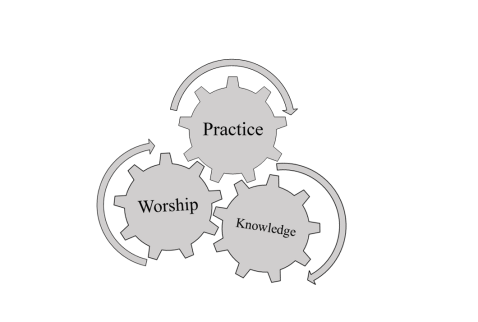 _______________________________________________
Figure 2. The Reciprocal Transforming Relationship of Knowledge, Worship, and Practice.
It is clear then that right and good worship is vital because it exalts and holds before us our chief end. If our worship has as its object the wrong thing we will thus go wrong in innumerable ways (cf. Rom. 1:18-32). Because of this, the reformation of our lives is a slow, and often painful, process. Witness the fall (the body of the book) and rise (the epilogue) of Raskolnikov from Dostoyevsky’s Crime and Punishment.[7] If we dig ourselves into a ditch we do not magically rise out of it (cf. Prov. 26:27). We have to dig ourselves out of it. Of course, as Christians we do believe that the Spirit assists us (e.g. Jn. 14:16). Yet, the fact remains, transformation is difficult and does not finally occur here.[8]
Scripture and reality are not at odds. We are shaped by what we know, worship, and do (and these are all interrelated). Scripture tells us to know the LORD, worship Him, and serve Him and thus be transformed. We see this same type of thing when we understand the relationship of faith and works, and the relationship of indicative and imperative. We know/believe God’s truth (faith) thus worship and have corresponding actions (works). Again, when we (rightly and supernaturally) understand God’s truth (indicative) we will worship, which in turn will change the way we live (imperative).
In Scripture we see huge importance placed on listening to He who speaks wisdom, the LORD, and not to the father of lies, Satan. We see this especially in the beginning. Eve listens to the serpent’s words and disregards the LORD’s, and chaos and curse ensue. However, notice that she did not just receive information/knowledge or believe the wrong source. Her desires were also wrongly informed. Because Eve listened to the serpent she saw the tree as delightful. She saw the tree as desirable (Gen. 3:6). Thus she fell.
As the Scripture says, “Each person is tempted when he is lured and enticed by his own desire. Then desire when it has conceived gives birth to sin, and sin when it is fully grown brings forth death” (James 1:14-15). We, thus, resist the devil by being firm in the faith. We, like Jesus, fight off wicked desires with God’s Word. Satan would have us be reconstituted by his words, wicked untruth, yet we combat his lies by teaching ourselves to desire good things by the implantation of God’s words, the truth (e.g. the place of Prov. 7:1-5 in the larger context of Prov. 7). When we feed on the Word of God the metabolic result is a healthy representation of God. God would have us (re)shaped into His image, the image of His Son. Conversely, Satan would have us formed into what C.S. Lewis called the “unman.”
Our thinking and our beliefs play a large part but we are tempted not by thinking and believing but by our desires (recall James 1:14-15 from above). I do think, however, that thinking and beliefs are the atmosphere in which desire lives. They are the soil and habitat; they’re the ocean in which desire can swim. Thinking and believing are not unimportant. Eve would have never sinned had she not heard Satan’s “knowledge” and believed him. Yet, we are understanding Eve, and ourselves, wrongly, if we don’t also realize that she desired (again, recall Gen. 3:6; also Eph. 2:3 says that we also once carried out the desires of the flesh).
I think it also must be noted here that our desires are shaped by our thinking and believing but they are also shaped by less conscious things. I am quite sure, for instance, that quite a few Nazi Youth did not read Hitler’s Mein Kampf but yet were shaped by the very same image. This was because they lived and breathed and ingested it’s teaching, though not mainly consciously, but because it was the cultural air they breathed.
We have a lot of things externally and internally that seek to shape us. As Calvin has famously said, we are idol factories.[8] That’s why we see much emphasis in Scripture placed on loving God with our whole heart (cf. e.g. 1 Chron. 12:38; 28:9; 29:9, 19; 2 Chron. 15:15; 16:9; 19:9; 25:2; Ps. 9:1; 16:9; 86:12), not just a portion of it.
We temper our hearts variously through understanding (cf. Deut. 6:4-9; Neh. 8), worship (e.g. Ps.; Eph. 5:18-20) and practice (e.g. Lev.). That’s how we’re shaped biblically and practically. The more we have our chief end in view and the better our chief end is the better we will live.
For instance, Jesus reasons with us in Matthew 6:19-24 about desire. He shows that what is in our best interest, i.e. what we should desire, is laying up treasure in heaven. He tells us specifically in verse 21 that what we desire, i.e. “treasure,” will bring the rest of us along (i.e. “heart”). So, again, Eve was led into sin because she desired (“treasured”) the fruit. Our battle is thus the battle of treasuring, desiring. That’s why sex education doesn’t work, for example. You can show a bunch of kids images of a bunch of nasty things and tell them a bunch of bad stories. But, in the end, if sex is what they treasure then that’s what they’ll do. After all, that is what is glorified on the screen and in our culture.
On the positive side, Paul lived the way he did, and died the way he did, not merely because of his cognitive understanding or because of his beliefs; but because of what he desired (though, as we have said, they are closely related). Paul, in his letter to the Philippians, tells us of the desire that fueled his powerful life. He drove on through thick and thin because he had counted everything as loss because of the surpassing worth of knowing Christ Jesus His Lord. For Christ’s sake Paul suffered the loss of all things and counted them as rubbish, in order that he may gain Christ (Phil. 3:8).
Truly, wherever our treasure (i.e. desire, view of “the good,” or our view of the good life) is, our heart (“heart” in Scripture has to do with our whole self; cognition, volition, emotions) will be also (Matt. 6:21; Lk. 12:34).
If we are transformed by knowledge, worship, and practices, how do you think they can transform us? How should our everyday life be different?
___________________________________________________________
[1] There is a transcript from Reasonable Faith’s podcast that shows the truth of my statement. Our worldviews have consequences, good or bad. R.C. Sproul shows this in his book The Consequences of Ideas. Friedrich Nietzsche even says in Beyond Good and Evil that philosophy always creates a world in it’s own image, it cannot do anything different.
[2]“Certain habits stir up corresponding affections and appetites; certain core affections and desires are expressed in corresponding habits. You can’t separate desire from practice” (Michael R. Emlet, “Practice Makes Perfect?” 42).
[3] See James K. A. Smith’s insightful book Desiring the Kingdom: Worship, Worldview, and Cultural Formation, esp. 80-85.
[4] Michael Emlet understands the complex nature of change. He says, “What we do flows out of who we are, but who we are is indeed shaped by what we do… We are changed by doing and we are changed by a self-conscious and iterative process that scrutinizes thoughts, affections, and actions of their faithfulness to a kingdom ethic, and then chooses certain actions and practices in response” (Michael R. Emlet, “Practice Makes Perfect?” 44).
[5] E.g. Aristotle says, “All knowledge and every choice have some good as the object of their longing” (1095a14 Page 4 for in Aristotle’s Nicomachean Ethics Trans. Robert C. Bartlett and Susan D. Collins [The University of Chicago Press: Chicago, 2011]). The glossary says that “Aristotle famously argues that all human beings do everything for the sake of what seems or is held to be good” (Ibid., 309).
[6] From the first question of the Westminster Shorter Catechism.
[7] “While God is always free to work miraculously and instantaneously, soul-change is typically a slow process that involves the replacement of old beliefs, affective responses, attitudes, and motives and patterns of relating to others with new ones, one at a time. Given what we know now of the neurological conditions of such change, it is not surprising why this process is gradual. Old neural networks must be shut down, and new ones must be constructed. None of this happens in genuine sanctification apart from the work of the Holy Spirt, but in this age most of the time God tends to work through the created order, and not take shortcuts. Though an incremental approach is sometimes hard for counselees to accept, such a stance, when grounded in justification, helps them to accept their present limitations and to be more realistic about the speed of their recovery, without undermining the ongoing call to grow in conformity to the image of Christ” (Eric L. Johnson, “Reformation Counseling: A Middle Way,” 26-27).
[8] Though I do not agree with everything, I believe “The Spiritual Experience of the Divine Truth of Transformation” is helpful.
[9] “The human mind is, so to speak, a perpetual forge of idols” (Calvin, Institutes, 97).
Are You Mindful of Your Mind?

What is the place of the mind in Christianity? Is thinking relevant to the faith? What, if any, emphasis should we place on the importance of knowledge? Does hard thinking bring any beneficial fruit to the Christian life or is the tree bare, shorn of any value?
If we boil down and distil Christianity the remaining content is not logical argument. Christianity is more than a philosophy, more than a religion. It is more than cognitive assent. It is more than a social club. Christianity is not simply about ritual. It is not just about emotions. It is not just about the mind.
Christianity is a relationship with a God who has made Himself known. It is more than formulas and repetition of rote words; though there are meaningful words and ceremonies. Christianity is something that must be believed, but belief is merely the beginning (though it must continue). Christianity gives true—chiasm bridging—fellowship, but is not merely a fellowship. Christianity is a philosophy, indeed, the philosophy. We, in a sense, worship wisdom incarnate.[1] But still, Christianity is not just a philosophy.
Christianity is not just about thinking and knowing. Yet, thinking and knowing are vital.
The Christian mind is vital because it is emphatic in Scripture.[2] It is vital because Christian living is. It is vital because we are commanded to worship the LORD with all we are, are mind included (Matt. 22:37; Mk. 12:30; Lk. 10:27).[3]
The Christian mind is very important. Yet, where do we see this in Scripture? Why is this the case? And what affect does it have?
The Christian Mind and the Bible
The Bible shows us that the Christian mind is very important.[4] Thinking for Christians is not just theoretical, it is practical. We trust God because we know Him (Ps. 9:10).[5]
God tells us to think. He tells us He will teach us, yet we must learn and not be like animals without understanding (Ps. 32:8-9 cf. 73:22). In fact, we must learn so that we can obey (Josh. 1:8-9; Ps. 37:31; 86:11; 95:10; 119:11, 34).



 in X
in X 