What is Pentecost?

What is Pentecost? And what’s its significance?
Did you know there’s a day that celebrates Pentecost?
I didn’t know what Pentecost Sunday was for a long time, and I certainly didn’t understand the full significance of it. Yet, Pentecost is full of significance. Pentecost Sunday is a celebration of the coming of the Holy Spirit. It, however, is not widely celebrated, at least, not very much in non-liturgical churches.
I grew up celebrating Christmas and praising God for the incarnation of Jesus. And I’m thankful for that. I grew up rejoicing in the truth of Easter, that Jesus is victorious over sin and death! And I’m thankful for that. But Jesus said something that makes me think we’re missing out on an important celebration.
Jesus—God in human form—came to earth and walked and talked and performed miracles. And this GodMan, Jesus, said, “It is better that I go away” (Jn. 16:7). How could that be true? I mean, I know Jesus always speaks the truth, but how could this be true? How could anything be better than Jesus walking and talking on earth with us?
How could something be better than Jesus’ physical presence?!
Jesus has said some pretty shocking things, but this is one of His greatest hits!
Who or what could be better than Jesus’ physical presence?! Thankfully Jesus answers that question for us.
He said, “It is to your advantage that I go away, for if I do not go away, the Helper will not come to you. But if I go, I will send Him to you” (Jn. 16:7).
Jesus said it was to our advantage that He go because then He would send the Helper, the Holy Spirit, to us.
We rightly celebrate the coming of Jesus the Messiah at Christmas. Yet, if it is to our advantage that the Messiah goes so we have the Spirit, shouldn’t we celebrate the Spirit too? Of course, one of the reasons the Spirit is not celebrated as Jesus is, is because one of the roles of the Spirit is to help us celebrate Jesus (Jn. 16:14).[1] Nevertheless, we should acknowledge and know and praise God for His helpful presence by the Spirit.
Pentecost Sunday is a day to celebrate the powerful presence of the Spirit.
Pentecost’s Background
Pentecost (pentékosté) comes from a Greek word that means “fifty.” Pentecost takes place fifty days or seven weeks after Passover (Ex. 23:14-16; 34:22-23; Lev. 23:15-16; Num. 28:26; Deut. 16:9).[2] Sometimes people call it the Feast of Weeks. Pentecost is one of the three major Jewish festivals or feasts. It was a day to celebrate, anticipate, and thank God for His provisions, specifically wheat.
For this festival, God’s people would offer the first fruits of their wheat harvest (Ex. 34:22), and their new grain (Lev. 23:15-16) to the LORD (Ex. 34:23). This required a pilgrimage. And it required much planning because no customary work was supposed to be done on this feast day (Num. 28:26). “Though the holiday lasted but one day, it was a national event with elaborate rituals well known throughout the land.”[3]
Pentecost, however, is not just mentioned in the Old Testament; it’s in the New Testament as well (Acts 2:1; 20:16; 1 Cor. 16:8). Passover is the more famous festival, but both Passover and Pentecost are important. “The Festival of Passover… pointed forward to the death and resurrection of Jesus, so the Feast of Pentecost pointed forward to another pivotal event in the history of the church.”[4]
The time of Pentecost was a time of anticipation. God had promised to provide and it was a time to see God’s provision. So, “Pentecost is all about living in anticipation of a harvest that is yet to come.”[5] With God’s provision, there was life, health, and rejoicing. But, if God did not provide there would be devastation.[6]
Pentecost in Acts 2
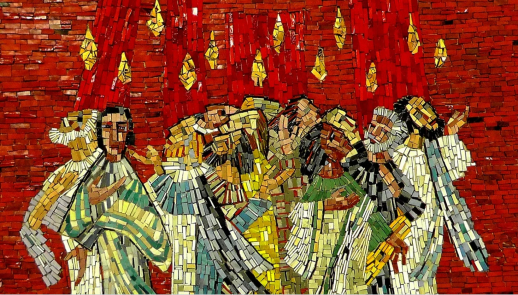
In Acts 2, we see God provide more than just grain. God provided the gift of His presence as Jesus said He would and as was foretold in Joel 2:28-29. God’s people received power from on high (Lk. 24:49).
In Acts 2, we see that “something tremendous happened in Jerusalem that transformed the Apostles into men of conviction and courage and provided them with a spiritual impetus that enabled the Christian movement to expand rapidly, so that in a few decades vital congregations were in all the major cities of the Roman Empire.”[7]
At Pentecost, there was a divine visitation; the presence of God came upon His people. In the Old Testament, we see God’s appearance was accompanied by wind and fire (1 Kings 18:38; 19:11-13; Ezek. 37:9-14). Yet, we see something new in the New Testament. God’s presence was also accompanied by the gift of tongues. So, we see at Pentecost that God is shifting His redemptive purpose from Israel, His particular people, to all people being welcomed in through Christ the risen King.[8] People were scattered because of sin at Babel but through the much-anticipated gift on Pentecost, we see God gathering and uniting His people in King Jesus.[9]
The Spirit did not come just for us personally. The Spirit is also given for the purpose of mission: that all people might know Jesus as both Savior and King. As Glasser has said, “The spirit was not given just to enable the people of God to pursue personal holiness and joy in corporate worship and fellowship… The spirit was also given to energize corporate waiting on God for missionary outreach.”[10]
Jesus told His disciples to make disciples, but He let them know they wouldn’t have to do it all on their own. He would be with them, even to the end of the age. But how? At Pentecost, we find the answer. Jesus sends the Spirit (Jn. 14:16–17, 26 15:26) and is with us by the Spirit (Scripture even speaks of “the Spirit of Christ,” see Rom. 8:9; Gal. 4:6; 1 Pet. 1:11).
The Spirit given at Pentecost is the “first fruits” of more to come (Rom. 8:23; Eph. 1:13-14). God heaps grace upon grace!
“Our redemption has begun, with the fullness yet to come. As Jesus has risen, so we will too. As we have come to Christ, more will follow. The Holy Spirit who guarantees our final redemption is the first part of her vital new relationship with God, with more to come.”[11]
Jesus, who has redeemed the Church, will recreate the whole earth.
On Pentecost Sunday, we thank God for sending the Helper. We rejoice in His gift of the much-needed and anticipated Helper.
Notes
____
[1] It’s important to realize that Peter’s concern on Pentecost aligns with the Spirit’s concern: focus on Jesus Christ!
[2] Pentecost Sunday happens fifty days after Easter. Of course, Easter or Resurrection Sunday corresponds with Passover.
[3] David Brickner and Rich Robinson, Christ in the Feast of Pentecost, 101.
[4] Brickner and Robinson, Christ in the Feast of Pentecost, 31.
[5] Ibid., 108.
[6] In the Old Testament, we see God’s promise to provide crops is often in connection to His people’s faithfulness to obey Him.
[7] A. F. Glasser, “Pentecost,” 757 in The International Standard Bible Encyclopedia.
[8] Glasser, “Pentecost,” 757. “Pentecost marks the completion of Christ’s redemptive work. Following His resurrection He ascended into heaven and presented Himself as the first fruits of the coming harvest” (Ibid., 758).
[9] “Missionary outreach provides the divine reversal of the scattering and hostility of the nations that fall the judgment at Babel (Gen. 11:1-9)” (Glasser, “Pentecost,” 758).
[10] Glasser, “Pentecost,” 758.
[11] Brickner and Robinson, Christ in the Feast of Pentecost, 140.
We Still Need the Spirit’s Empowering Presence

We Still Need the Spirit’s Empowering Presence
Moses had stood before Pharaoh, led 600,000 Israelites out of Egypt, and received the Law from the LORD Himself. If there was someone that could feel accomplished and able you’d think it’d be Moses. Yet, he was humble and knew his need.
In fact, the book of Numbers says, “Moses was a very humble man, more humble than anyone else on the face of the earth” (12:3). It seems there is a correspondence between proximity to God and the weighty work He’s called you to, and humility. The more one sees God, the more one is humbled by God and sees their need for God’s empowerment.
Moses had led God’s people out of Egypt and was forming them into a nation, yet Moses knew His utter need for the Spirit’s presence and leading. He said, “If Your presence will not go with me, do not bring us up from here” (Exodus 33:15).
Moses said that, but I fear that I, along with many other Christians, run straight into various situations without the least thought as to our need for the Spirit’s help and leading. The Spirit was given as the Helper, but very often I’m afraid we don’t seek out His help. I know I’ve been guilty of that. That, however, is foolish.
Jesus Himself said that it was better that He go because then He’d give the Helper to be with us always. And Jesus’ disciples waited for the power of the Spirit before they moved. Moses—seemingly very capable Moses—also knew his need for the power of God’s presence.
The Bible says that what brought us from spiritual death to spiritual life was the Spirit of God. “It is the Spirit who gives life; the flesh is no help at all” (John 6:63). The Spirit was absolutely critical at the beginning, and He is all the way to the end. Galatians says it this way: “Since we live by the Spirit, let us also walk by the Spirit” (Galatians 5:25).
Here’s what comes to mind for me: we’re alive because we breathe, so we keep breathing; it’s good and keeps us alive. We wouldn’t think of just stopping breathing because it is critical for life. I think that’s basically what Moses had in mind. Moses is saying, ‘God, You brought us here, and we have no hope without You.’
Perhaps we don’t see our need for God because we don’t see what He’s done. We don’t see what He’s capable of. Perhaps we chalk a lot up to ourselves. We’re capable. We think we can manage in our own power. Perhaps we don’t feel much strain because we have a comfortable little life without many seemingly impossible goals.
Perhaps.
But whatever the reasons, the reality is, we desperately need the Spirit’s empowering presence.
Moses did. The apostles did.
We do.
God’s Spirit is crucial at the beginning and through to the end. We need help and God has given Help.
We still need the Spirit’s empowering presence.
*Photo by Jon Tyson
The Work of the Spirit | pt. 8
Prophecy
The ministry of a prophet does not contradict or add to Scripture but if truly from God is infallible. This is very controversial but it seems to be the correct conclusion when we unbiasedly consider the biblical evidence. It is helpful here to consider what Sam Storms has said, “If noncanonical revelation was not a threat to the ultimate authority of Scripture in its emerging from, neither should it pose a threat to Scripture in its final form.”[1] Many, however, do not buy that.
For example, John MacArthur says, “extrabiblical revelation always leads to error!”[2] Then he proceeds to look at cults and mentions the Book of Mormon as an example. It is true that there are many false claims to revelation but that in itself does not mean that there is not still revelation. If we truly believe in solo Scriptura we need to show where the Bible says there is no longer revelation.
Schreiner, in his helpful book Spiritual Gifts, argues that prophecy no longer continues because the prophecy in the New Testament was infallible and what is happening now is not infallible.[3] He never demonstrates, however, that all of what is called “prophecy” today is not at least in some cases from God and thus infallible. Further, this is not an argument grounded in Scripture. Instead, Schreiner is simply making an assertion about all modern claims to prophecy.[4] That, we should see, is a big sweeping claim.
I believe Schreiner actually helps the case for the continuance of prophecy because he makes a strong argument that not all prophecy is inscripturated. That is a big part of what I believe regarding prophecy. I believe infallible prophecy continues today but just like in the Old and New Testaments, not all infallible prophecy is included within the canon.
Schreiner shows that New Testament prophecy does not differ from Old Testament prophecy.[5] He says,
New Testament prophets spoke authoritatively and with complete truth to the situations in their churches. The fact that most prophecies weren’t written down and preserved is completely irrelevant as far as the truth of the prophecies is concerned. It is a category mistake to think that if prophecies are without error, then they must be written down and included in the Scriptures. And it doesn’t logically follow that prophecies must contain errors if they aren’t preserved and written down. God spoke authoritatively and truly through the prophets, even if their prophecies weren’t recorded and preserved. They spoke the infallible word of God to their contemporaries, who needed to hear these true and authoritative words of God.[6]
Further, in chapter 7, Schreiner makes a convincing case for infallible prophecy. He argues that “the idea that New Testament prophecies are mixed with error is mistaken.”[7]
I believe that what the prophets of today share is similar to what Agabus shared. Of course, some claim that Agabus’ prophecy in Acts 11 was wrong. They, however, are mistaken.[8] Ferguson concludes, “Paul’s testimony assumes its accuracy. We have no reason to believe that Agabus’ prophecy failed. Luke gives no indication that Paul thought it had done so.”[9]
Prophecy is never produced by human will[10]; instead, the person with the prophecy speaks what God gives them to say by the Spirit (2 Pet 1:20-21).[11] Thus, prophecy is infallible because prophecy gives the words of God and God always speaks the truth (Titus. 1:2; John 17:3,17; Heb 6:18; Prov 30:5).[12] Of course, we can misunderstand or disobey but God’s words are always without error.
So we see prophecy in the New Testament was both accurate and highly significant for the actions of the church[13] but it was not on par with Scripture in the sense that it was not to be inscripturated.[14] It is not the type of revelation to be inscripturated. It is not didactic revelatory teaching but pertains to the local body or a local situation. As in disclosing someone’s heart (as in the Spurgeon’s real-life example[15]) and that encourages the local body because they see the Lord at work. It is not something that would add to the canon.
The Work of the Spirit | pt. 7
The Gifts Must Function in Accordance with Scripture
When the gifts of the Spirit are carried out and employed within the parameters of Scripture then a lot of the concerns that cessationists have should be able to be set aside. So, first, let us consider some of the parameters that Scripture puts in place for us. The gifts must function in a way that serves others (1 Pet 4:10-11), edifies (1 Cor 14:3, 12), is clear and ordered, not confusing or chaotic (14:23, 29, 33, 40), is loving (1 Cor. 13),[1] and exalts Christ (Eph 3:21; 1 Cor 12:3).[2]
Scripture further says that tongues must be interpreted if they are shared in the gathering (1 Cor 14:27-28), prophecy must be weighed (v. 29 cf. 1 John 4:1; John 7:24), only two or at most three prophecies or tongues can be shared at a public gathering (1 Cor 14:27-29), and all things should be carried out in an orderly way (vv. 30-33, 40) for the express and emphatic purpose of building up the body of Christ (e.g. v. 12). Paul says, “When you come together, each one has a hymn, a lesson, a revelation, a tongue, or an interpretation” (v. 26). Why? “For building up” (v. 26). Thus, Paul tells us to “earnestly desire” (12:31; 14:1, 39) the Spirit-empowered gifts and “strive to excel in building up the church” (14:12).
Second, let’s ensure we have a biblical understanding regarding the more controversial issues related to the gifts of the Spirit. I created an acronym to help us consider this subject more effectively. The acronym is G.I.F.T.S. Here is a summary of the acronym:
- God continues to give gifts to build up the church.
- Individuals with the gift of prophecy do not contradict or add to Scripture but if what they share is truly from God then it is infallible.
- Fallible apostles still exist and are gifted men of God but the office of Apostle does not continue.
- Tongues are used in two overlapping ways in Scripture and should be pursued and practiced as outlined in the Bible.
- Scripture is to always be obeyed as the final authority.
We will now look at each of those bullet points in order.
The Work of the Spirit | pt. 4
You can see the previous post here.
There is no indication that the gifts would cease before Christ’s second coming. The Bible never indicates the cessation of the grace gifts until the return of Jesus, this is the second reason I believe in their continuance. There is no indication in the New Testament that the gifts would cease before the coming of Christ. Of course, it is possible that they could just fade out but we would not expect that to be the case from reading the Bible. Jack Deere contends that “If you were to lock a brand-new Christian in a room with a Bible and tell him to study what the Scriptures have to say about healing and miracles, he would never come out of the room a cessationist.”[1]
In 1 Corinthians 1, it seems to indicate the expectation that the gifts will continue until the coming of Christ. If you read the letter as the first recipients would have there is nothing at all that would make you think otherwise. In 1 Corinthians 1:7, Paul says, “…you are not lacking in any gift[2], as you wait for the revealing of our Lord Jesus Christ.” Notice it says “any gift” and it seems as if the gifts will continue until the revealing of the Lord Jesus Christ. That seems to clearly indicate that the gifts of the Spirit will continue until Jesus returns.
Paul, thus, seems to believe that all of the gifts will not be lacking until “the revealing of our Lord Jesus Christ” (1 Cor 1:7). Paul expects that those who are witnesses of Christ[3] will have the spiritual gifts available to them until “the perfect comes” (cf. 13:8-12), that is “the revealing of our Lord Jesus Christ” (1:7).[4] It is also important to note that in the context of 1 Corinthians, “spiritual gifts” (χαρίσματι cf. HCSB, NLT, NIV, Rom 1:11) cannot be limited to encouragement and the like but must also include what is considered the “charismatic gifts.”[5]
The Work of the Spirit | pt. 3
In the last post, we looked at “God the Spirit and the Filling of the Spirit.” In this post, we will be looking at…
Grace Gifts
Next, we need to understand that God the Spirit gives “grace gifts.”[1] God’s abundant grace that we see demonstrated all throughout redemptive history issues in grace gifts.[2] God expresses His grace concretely in the rich number of grace gifts He bestows upon the Church for its upbuilding.[3] Schreiner observes this and says, “I would define spiritual gifts as gifts of grace granted by the Holy Spirit which are designed for the edification of the church.”[4]
The Spirit was vital at the beginning of the church and He continues to be on through to the consummation. He brought the birth of the Church, He hovered over the Church like He hovered over the water at the beginning. The Spirit does not bring charismatic chaos but the creation of order. That was the Spirit’s work at the beginning and it is the Spirit’s work today. There is no biblical warrant for believing in some big discontinuity between the work of the Spirit then and the work of the Spirit now in the last days. Actually, Scripture says, “in the last days I will pour out my Spirit on all flesh” (Acts 2:17). We are in those latter days today and we still need the empowering presence of the Spirit.
The hodgepodge, unlearned, and often unimpressive group of Jesus followers did not see the messianic movement die. Instead, the people of the way (Acts 9:2) actually exploded in growth, this group of people that followed a crucified and cursed man who claimed to be God, this group of people who had no leader on earth. How did this group survive let alone thrive?
Because Jesus did not leave His disciples without what they needed. Jesus sent the Helper.
Jesus said, that it was better that He go. That seems shocking. As it should. And as it did for the first disciples. We are left asking, how could it be better that Jesus’ bodily presence not be with us?
Thankfully Jesus answers that question. He tells us that He will not leave us as orphans. He gives us the Helper, the Holy Spirit, to be with us (See John 14).
The Grace Gifts Continue Today
“You shall receive power when the Holy Spirit comes upon you; and you will be My witnesses” (Acts 1:8[5]). Will we? Will we receive power?
The Work of the Spirit | pt. 2
God the Spirit and the Filling of the Spirit
God the Spirit. Since we are considering the work of the Spirit within the church, it is important that we consider God the Spirit, who He is and what He does. First, without going into any detail, the Holy Spirit is the third person of Trinity. The Spirit is fully God.[1] The Holy Spirit also has personhood; He is not an impersonal force.[2] That is who the Spirit is.
Second,[3] it is important that we briefly consider what it is that the Spirit does. The Old Testament teaches us various things about the Holy Spirit. The Spirit molds creation into shape and gives life to created beings (Gen 1:2; 2:7; Ps 33:6; Job 26:13; 33:4). The Spirit controls the course of nature and history (Ps 104:29-30; Isa 34:16). The Spirit teaches and reveals God’s truth and will to His messengers.[4] The Spirit elicits personal response to God.[5] The Spirit equips individuals for leadership.[6] We also see that the Spirit equips individuals with skill and strength (Exod 31:1-11; 1 Kgs 7:14; Hag 2:5; Zech 4:6).
The Spirit is given as our Helper (John 14:24). He takes what belongs to the Son and shares it with those who believe (John 16:14), beginning with the new birth (John 3:6), teaching and guiding (John 16:14), and transforming (2 Cor 3:5-18) in ways that surpass human capacity (1 Cor 2:10-14). He empowers believers to be Jesus’ witnesses to the end of the earth (Acts 1:8) and to the end of the age (Matt 28:20). By indwelling believers (Rom 8:9; 1 John 2:27), the Spirit washes and renews (Titus 3:5), pours out divine love in our hearts (Rom 5:5), reproduces the divine virtues (Gal 5:22-23; Rom 14:17), enables us to resist sin (Rom 8:13) and pursue holiness (2 Thess 2:13), and build unity among the church (Eph 2:22; 4:3, 13; Phil 2:1-2).[7] The Spirit hears, speaks, witnesses, convinces, shows, leads, guides, teaches, commands, forbids, desires, gives speeches, helps, and intercedes with groans.[8] It is vital that we not leave out the most miraculous work that the Spirit works within people; He makes them new creations in Christ (2 Cor 5:17; 3:3, 6, 18; Titus 3:5-6; Ezek 36:25-28; Rom 2:28-29).



 in X
in X 