The Shroud of Turin: Evidence of a Resurrection?
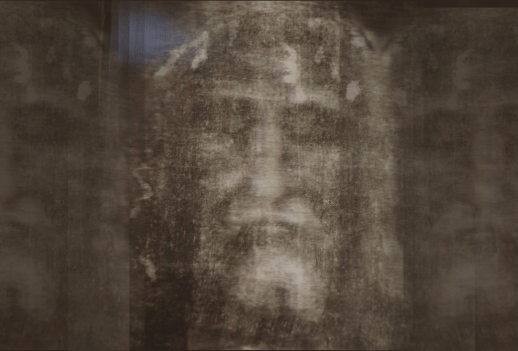
The Shroud of Turin is a cloth bearing the negative image of a man.[1] Some people believe it is the burial cloth of Jesus of Nazareth. There’s also a face cloth known as the Sudarium of Oviedo, which matches the shroud.[2] Why would anyone think it is Jesus’ burial cloth? It may seem loopy, but there are at least some interesting things to consider.
So, what caused the image on the burial cloth? How did it get there? No one knows exactly, even after thousands and thousands of hours of scientific investigation. We do know no substances were manually applied; no paint, ink, dye, pigments, stains, or secretions of the body were used to make the image. “No one has satisfactorily explained how the image was produced.”[3] Even though the shroud is the single most studied artifact ever, no other artifact comes close.
The image on the Shroud of Turin is from discoloration. The discoloration is only 200 nanometers deep into the linen fibers. Strangely, many believe the “image was formed by a sort of electromagnetic source of energy.”[4] The best explanation is that light—ultraviolet light—emanating from inside the shroud caused the image on the shroud. It has been estimated that about 6 billion watts of energy is what would be needed to produce the image.
This is where it seems like science fiction. What could explain this? Are there other things about the shroud that are mysterious? Yes. There are type AB bloodstains on the cloth. And the bloodstains are consistent with a victim of crucifixion. There is also pollen from ancient Palestine on the cloth. And the cloth has recently been dated to the time of Jesus (amending a previous date).[5]
Amazingly, the information gleaned from the burial cloth is compatible with the accounts in the Bible. The image and the blood stains show wounds on the wrists, a wound on the feet, and a wound on the side, and the stains account for the effect of gravity (showing the body hung from a vertical position). But there are no stains from the decomposition of the body and no sign that the man’s legs were broken.
The image on the shroud shows it was wrapped around a person when the image was formed. The image on the shroud varies in proportion to the distance between the cloth and the body, thus communicating 3D information about the body wrapped in the shroud. That is, the intensity of the image is directly proportional to the distance between the body and the shroud. It is similar to a topographical map. The parts of the cloth that touch the body (like the forehead) are darker, and the farther away parts (like the eye sockets) are fainter.
This has enabled researchers to take the data and create an anatomically proportional three-dimensional human form. This data can even be used to make a sophisticated guess about the height and weight of the figure in the shroud. The estimate is between 5 feet 10 inches and 6 feet, with a weight of 165 to 180 pounds.
National Geographic has called the shroud “one of the most perplexing enigmas of modern times.” Of course, it cannot be proved that this was Jesus’ burial cloth. But it forces questions upon us. What explains the Shroud of Turin? We don’t know for sure. But if Jesus actually did rise from the dead as the Bible reports, it would make sense that a burst of energy would be involved in His resurrection and that His burial cloth would be kept.
It currently seems like the Shroud of Turin is either awesome physical proof of Jesus’ resurrection, or a miraculous forgery. Because even with all our scientific understanding and technology, the shroud still cannot be replicated. So, how could it have been created a long time ago? No one knows.
The New Testament, however, does mention Jesus’ face cloth and burial cloth (John 20:7), and Acts says Jesus showed Himself to be alive from the dead through many convincing proofs (Acts 1:3). Was the shroud one of those convincing proofs?
Notes
[1] See “What Is the Shroud of Turin? Facts & History Everyone Should Know.”
[2] Barta, César & Alvarez, Rodrigo & Ordóñez, M. Almudena & Sánchez, A. & García, J.. (2015). “New coincidence between Shroud of Turin and Sudarium of Oviedo.” SHS Web of Conferences. 15. 00008. 10.1051/shsconf/20151500008.
[3] W.H. Gloer, “Shroud,” 496 in The International Standard Bible Encyclopedia Bromiley, Geoffrey W. Bromiley, ed. (Grand Rapids: Eerdmans, 1982).
[4] https://www.sci.news/physics/scientists-suggest-turin-shroud-authentic.html. W.H. Gloer, “Shroud,” 496.
[5] See “New test dates Shroud of Turin to era of Christ” and “Turin Shroud ‘is not a medieval forgery’.”
The Resurrection and Our Hope No Matter What

What is the correct response to the coronavirus? Should we have fear or faith?
Well, the answer to that question depends on where you’re coming from and your understanding of this world…
The Bible teaches Christians that through Christ, no matter what we face, we can have faith. We can have hope.
Reflecting on the resurrection of Jesus helps us have faith. It helps us see that we have a solid, untouchable hope.
In Acts chapter 2, Peter refers to Psalm 16 which is a Psalm that king David wrote. Psalm 16:27 says, “For you will not abandon my soul to Hades, or let your Holy One see corruption.” In Peter’s message he said: Friends, I can confidently tell you something about king David: He is both dead and buried, and his tomb is with us today (Acts 2:29). David is dead and his body rotted.