Why should I believe the Bible? (pt 2)

“Why should I believe the Bible?”
That is a very important question and one that requires us to look at various aspects of the Bible. In the first post in this series, we considered that the Bible is literature. It is also important that we realize that the Bible is…
Complex
It is important to not think simplistically about the Bible.[1] The Bible is clear but it is also complex.[2] The youngest child can understand the core of its teaching yet the learned scholar can spend a lifetime pursuing understanding. We shouldn’t think we will be able to understand its mysteries in a few moments—let alone millions of them—but we also shouldn’t hopelessly resign to ignorance either. As the psalmist and many others have said and experienced, faithful digging leads to many treasures of gold.
Why should I believe the Bible? (pt 1)

“Why should I believe the Bible?”
That is a very important question. In the next couple of posts, we will briefly consider various aspects of the Bible so that we are in a better position to answer that question.[1]
First, the Bible is…
Literature
The Bible is a very distinct piece of literature; it is truly unlike any other literary work. It is unique.
The Bible is the best selling book of all time and the most translated book of all time.[2] The figures vary but it is estimated that there are approximately 44 million copies sold each year. The Bible, whatever your opinion about its supernatural nature, should be read by all people. Reading and understanding the Bible is important in part because of the huge cultural impact it has had.[3] “No other book in all human history has in turn inspired the writing of so many books as the Bible.”[4]
So, read the Bible as literature. As C.S. Lewis said, “There is a sense in which the Bible, since it is after all literature, cannot properly be read except as literature; and the different parts of it as the different sorts of literature they are.”
___________________
[1] There are a lot of aspects to look at because, as Ravi Zacharias has said, a worldview is not built on one line of argument, but is built on a connected series of arguments.
[2] “As of September 2016 the full Bible has been translated into 636 languages, the New Testament alone into 1442 languages and Bible portions or stories into 1145 other languages. Thus at least some portion of the Bible has been translated into 3,223 languages” (http://www.wycliffe.net/statistics).
[3] See, as just one example, Martin Luther King Jr.’s “I have a Dream” speech. It alludes to Is. 40:4-5; Amos 5:24; Ps. 30:5; Gal. 3:28.
[4] Bernard Ramm, Protestant Christian Evidences, 239.
20 Quotes from Gregory Koukl’s Tactics
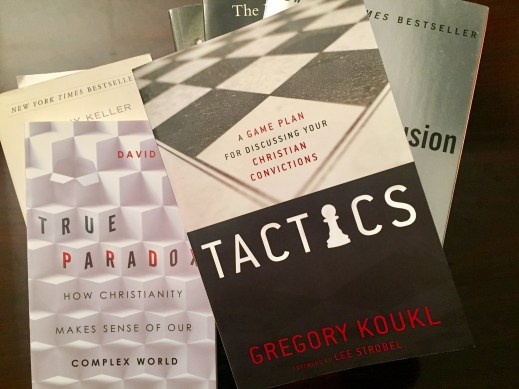
I found Gregory Koukl’s book Tactics helpful. Here‘s a book review to check out and here are some quotes from the book that I enjoyed:
- “Even though there is real warfare going on, our engagement should look more like diplomacy than D-Day” (19).
- “You must be careful not to use your tactics merely to assault others… I am not opposed to being assertive, direct or challenging. However, I never intend to be abrasive or abusive” (27).
- “Always make it a goal to keep your conversations cordial. Sometimes that will not be possible. If a principled, charitable expression of your ideas makes someone mad, there’s little you can do about it. Jesus’ teaching made some people furious. Just make sure it’s your ideas that offended not you, that your beliefs cause the dispute and not your behavior” (31).
- “The ability to argue well is vital for clear thinking. That’s why arguments are good things. Arguing is a virtue because it helps us determine what is true and discard what is false” (33).
- “It doesn’t follow that if God’s Spirit plays a vital role, then reason and persuasion play none” (35) (cf. Acts 17:2-4).
- “Some people think Christians are the only ones who need to answer for their beliefs. Of course, we should be able to give reasons for what we think is true. But we are not the only ones; others should be able to do this, too” (58).
- “Many Challenges to Christianity thrive on vague generalities and forceful but vacuous slogans” (58).
- Ask people for facts to support their conclusions. “Most critics are not prepared to defend their faith” (61).
- “Reversing the burden of proof is not a trick to avoid defending our own ideas. When we give opinions, we have to answer for them just like anyone else. We have a responsibility, but so do they” (65).
- “When someone asks for your personal views about a controversial issue, preface your remarks with a question that sets the stage—in your favor—for your response. Say, ‘You know, this is actually a very personal question you’re asking. I don’t mind answering, but before I do, I want to know if it’s safe to offer my views. So let me ask you a question: Do you consider yourself a tolerant person or an intolerant person on issues like this? Is it safe to give my opinion, or are you going to judge me for my point of view? Do you respect diverse points of view, or do you condemn others for convictions that differ from your own?’ Now when you give your point of view, it’s going to be very difficult for anyone to call you intolerant or judgmental without looking guilty, too” (78).
- “The quickest way to deal with a personal attack is to simply point it out with a question. When someone goes after you rather than your arguments, ask, ‘I’m a little confused about your response. Even if you were right about my character, could you explain to me exactly what that has to do with this issue?’” (79).
- “Think about using the phrase ‘Have you considered’ to introduce your concern, then offering a different view that gently questions the person’s beliefs or confronts weaknesses with his argument… ‘Have you ever considered… that the existence of evil is actually evidence of the existence of God, not against it?’… ‘Have you ever considered… that if Jesus was wrong about being the only way of salvation, it is difficult to call him a good man, a prophet, or a wise religious teacher? What do you think about that problem?’” (84).
- “Can you help me understand this? If there is no evidence that life came from non-life (abiogenesis)—that life spontaneously arose from inanimate matter to kick off the sequence of evolution—and there is much evidence against it, how can we say that Darwinian evolution is fact?” (85)
- “If someone’s thinking is flawed, the key to finding the error is to listen carefully to the reasons and then ask if the conclusions follow from the evidence. Point out errors with questions rather than statements. You might soften your challenge by phrasing your concern as a request for clarification or by suggesting an alternative with the words ‘Have you considered…’ before offering your own ideas” (88).
- “As a general rule, go out of your way to establish common ground. Whenever possible, affirm points of agreement. Take the most charitable read on the other person’s motives, not the most cynical. Treat them the way you would like others to treat you” (95).
- “If all religions are true, then Christianity is true. Yet a central claim of classical Christianity is that other religions are false when taken as a whole. Clearly, Jesus was not a pluralist. Either Christianity is correct that Jesus is God’s Messiah for the world and other religions are deceptions, as Scripture teaches, or Christianity is false and some other view is true. In no case, though, can all religions be true and valid” (119).
- “If you help someone see in advance that the route his map recommends will actually lead him off a cliff, he might consider changing his course. He might even discover he is using the wrong worldview map altogether and exchange it for one that is more reliable” (143).
- “When there is a conflict between methodology and materialism, the philosophy always trumps the facts. Modern science does not conclude from the evidence that design is not tenable” (171).
- “When an academic begins with naturalism, a series of ‘facts’ fall into place before any genuine historical analysis begins… Starting with one’s conclusions, though, is cheating. Nothing has been proved, only assumed” (173).
- “Carnage of unimaginable proportions resulted not from religion, but from institutionalized atheism” (177).
Apologetics Resources

I really enjoy apologetics and believe it’s important that we know why we believe what we believe. Here are some resources I’ve found helpful.
General
Ecclesiastes: Necessary Destruction

A treatise on vanity. That is basically the book of Ecclesiastes. What a depressing book. How is a book like that ever to be read and enjoyed, especially with our modern sensibilities? We need stuff that will make us feel good even if it is not the truth, right? Isn’t that what we need? That, at any rate, is what much of society would have us believe.
At first glance, it seems that the book of Ecclesiastes is a book that would throw you into nihilistic depression just short of suicidal. So what use has it in Scripture? Or, what, at least, use do we have for it today?
Well, it does no good to build upon a shoddy and cracked foundation. We can build all we want but all we do is for naught if the building will never truly stand. If we are to truly build something that is worth anything we must start anew. We must strip it down to the bedrock. To say that all is vanity is to say that all is cracked, you cannot build upon it. That is not to say that these things are inherently bad, they are not. But for us to understand these things, whatever they may be for you, we must first know they are desperately cracked. They can never hold anything of substance. They can truly never be built upon. They can’t hold the weight. Thus, if we experience discomfort from Ecclesiastes it is the doctor’s scalpel. It is the necessary pain for the healing of our life.
Addiction and Virtue

I really appreciated Kent J. Dunnington’s book, Addiction and Virtue. Here are a few quotes that I found especially helpful:
“Because recovery as conceived by A.A. is a technology of habit reformation, it demands vigilant attention to both the external and internal dimensions of sober action” (79).
“Addiction is a complex habit” (88).
“The scope of recovery is therefore radically extended within a Christian view of addiction. Indeed ‘recovery’ does not sufficiently name the Christian hope in the face of addiction. Instead the Christian hopes for ‘discovery’ and ‘new creation’—not a return to some maintainable equilibrium between who we are and what we want but rather a transformation of the self that brings who we are and what we want… into perfect coordination and harmony” (183).
“In claiming the identity of ‘addict’ or ‘alcoholic,’ we deny that addiction is a habit and assert instead that it is an entity” ( 184).
“Worship is… a totalizing activity; it demands that everything in a person’s life be put in the dock before God, interrogated by one standard and consequently renounced or reordered” (170).
“If the church is to provide a genuine alternative to addicted persons seeking recovery, it must provide daily, rather than once-weekly opportunities for communal worship, testimony and prayer, and it must challenge its parishioners to treat the church as their primary social community” (191).
“The wisdom of the twelve-step program lies in the recognition that the habit of addiction can only be supplanted through the development of another habit that is as pervasive and compelling as the habit of addiction” (165).
“The addicted person, recognizing her own insignificance and her own insufficiency to realize perfect happiness, seeks to be taken up into a consuming experience, longs to be the object rather than the subject of experience, craves to suffer happiness rather than produce it” (158-59).
“The pull of addiction is this pull toward ecstasy, the expression of a deep discontent with the life of ‘just so’ happiness, and the pursuit of an all-consuming love” (159).
“Addictions are addicting just to the extent that they tempt us with the promise of such a perfect happiness, and they enslaving just to the extent that they mimic and give intimations of this perfection” (159).
The War of Art

I appreciate this from Steven Pressfield in The War of Art:
“The following is a list, in no particular order, of those activities that most commonly elicit Resistance:
1) The pursuit of any calling in writing, painting, music, film, dance, or any creative art, however marginal or unconventional.
2) The launching of any entrepreneurial venture or enterprise, for profit or otherwise.
3) Any diet or health regimen.
4) Any program of spiritual advancement.
5) Any activity who aim is tighter abdominals.
6) Any course or program designed to overcome an unwholesome habit or addiction.
7) Education of every kind.
8) Any act of political, moral, or ethical courage, including the decision to change for the better some unworthy pattern of thought or conduct in ourselves.
9) The Undertaking of any enterprise or endeavor whose aim is to help others.
10) Any act that entails commitment of the heart. The decision to get married, to have a child, to weather a rocky patch in a relationship.
11) The taking of any principled stand in the face of adversity.
In other words, any act that rejects immediate gratification in favor of long-term growth, health, or integrity. Or, expressed another way, any act that derives from our higher nature instead of our lower. Any of these will elicit Resistance.”
The Crash of the American Church?

Research shows that the “evangelical church” lost around 10 percent of her people in the last decade. There are many factors that are involved that have resulted in this decline. Further, most churches that are growing are just taking people from other churches, not converting people. The Great Evangelical Recession explores the factors involved in the decline of the church and offers suggestions for the future. I found the book helpful and thought-provoking.
Nabeel Qureshi, Seeking Allah, Finding Jesus (a book review)
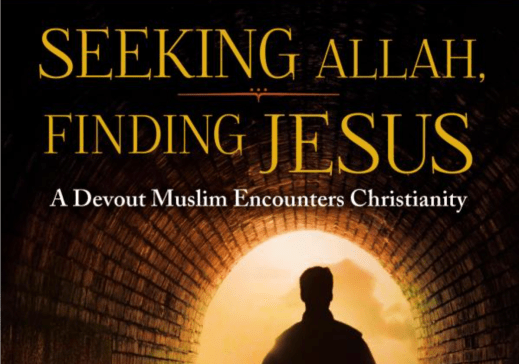
Hearing about Qureshi’ struggle as he thought about what it would mean to convert to Christianity was helpful. It will help me to be appropriately empathetic will discussing Christianity with Muslims. It is helpful to realize that “Muslims often risk everything to embrace the cross” (p. 253). I appreciated hearing his prayer: “O God! Give me time to mourn. More time to mourn the upcoming loss of my family, more time to mourn the life I’ve always lived” (p. 275). I also appreciated what he said about the cost of discipleship: “I had to give my life in order to receive His life. This was not some cliché. The gospel was calling me to die” (p. 278). Read More…
The Importance of Correct Hermeneutics

If we don’t understand things in their proper context there will be grave results. Let’s look at a few verses as an example and apply a skewed hermeneutical approach and see what the result is.
John 3:16 says, “God sent His Son” and we see that Jesus as God’s son is confirmed in other Scriptures. Take for example Romans 8:32. Or Hebrews 5:8 tells us that although Jesus “was a son, He learned obedience.” Luke 2:42 says that “Jesus increased in wisdom and in stature and in favor with God and man.”
So, it could be argued that Jesus, as God’s Son, was created and had to learn. After all, doesn’t “son” mean “son”?! Isn’t that the clear reading of the text? If the Bible says that Jesus is a “son” and “the firstborn of all creation” does that mean that Jesus is not eternal? Does it mean that He is a created being?
If we just look at the word “son” and extrapolate its meaning without understanding the context and the sense in which the author is using the word we can make very dangerous and false conclusions. Is Jesus a son in the sense of being a created being? No! That is the Arian heresy. We must understand what the author meant and we must use clear texts to help us interpret the less clear. A bad hermeneutical approach will lead to all sorts of false and destructive doctrines.
When looking at any doctrine it is important to understand a number of things. When looking at the sonship of Jesus for example, it is important to know the Old Testament and cultural importance of sonship. It is also important that other Scriptures are factored in. For example, John 1:1-14 and Colossians 1:15-17 show us that Jesus is not created but instead Creator.
So, “the obscure passage must yield to the clear passage. That is, on a given doctrine we should take our primary guidance from those passages which are clear rather from those which are obscure.”[1] Charles Hodge said in his Systematic Theology that
“If the Scriptures be what they claim to be, the word of God, they are the work of one mind, and that mind divine. From this it follows that Scripture cannot contradict Scripture. God cannot teach in one place anything which is inconsistent with what He teaches in another. Hence Scripture must explain Scripture. If a passage admits of different interpretations, that only can be the true one which agrees with what the Bible teaches elsewhere on the same subject.”[2]
Here are some important affirmations for biblical hermeneutics:
- We should affirm the unity, harmony, and consistency of Scripture and declare that it is its own best interpreter.[3]
- We should affirm that any preunderstandings which the interpreter brings to Scripture should be in harmony with scriptural teaching and subject to correction by it.[4]
- We should affirm that our personal zeal and experiences should never be elevated above Scripture (see Rom. 10:2-3).
- We should affirm that texts of Scripture must be interpreted in context (both the immediate and broad context).
- We should affirm that we must only base normative theological doctrine on clear didactic passages that deal with a particular doctrine explicitly. So, we should affirm that we must never use implicit teaching to contradict explicit teaching.
______________________
[1] Bernard Ramm, Protestant Biblical Interpretation: A Textbook of Hermeneutics, 37.
[2] Charles Hodge, Systematic Theology, Vol. 1, Introduction, Chapter VI, The Protestant Rule of Faith.
[3] See “The Chicago Statement on Biblical Hermeneutics,” Article XVII.
[4] See Ibid., Article XIX.



 in X
in X 