The Ascension

As we saw in the previous post on the resurrection, Peter looked at Psalm 16 and showed how Jesus’ resurrection was foretold. In Acts 2 Peter goes on to show that Jesus is now at God’s right hand, as Psalm 110 foretold. Jesus Himself had quoted from Psalm 110 and stomped His critics (see e.g. Matt. 22:41-46). And when you look at 110:1 it’s not surprising that they were stomped.
So, we see that Jesus is at God’s right hand until… Until He makes His enemies His footstool. That means that Jesus is coming back—and the New Testament repeatedly says soon—to bring judgment, and pervasive peace through that judgment.[1]
Jesus’ death and resurrection shows that He is indeed the Lord and Messiah.[2] As the Lord and Messiah, He is coming back soon to vanquish every foe and establish His forever reign of peace. In His second coming, He will bring the Kingdom that was expected at His first coming. Read More…
The Resurrection

Peter refers to this Davidic Psalm in Acts chapter 2. He said: “Fellow Israelites, I can confidently speak to you about the patriarch David: He is both dead and buried, and his tomb is with us today” (Acts 2:29). In short, David’s dead and his body rotted. David did, however, as a prophet tell us that one of his descendants would sit on his throne (v. 30). So, David seeing that in advance “spoke concerning the resurrection of the Messiah: ‘His body was not abandoned to the realm of the dead, nor did His body see decay’” (v. 31).
Paul says it a little differently. He says King “David, after he had served the purpose of God in his own generation, fell asleep and was laid with his fathers and saw corruption” (Acts 13:36). King David saw corruption. His body decomposed. So, David is not the “Holy One” that the Psalm refers to.
Paul goes on to say, “But He whom God raised up did not see corruption” (v. 37). Ding, ding, ding! Jesus is the Holy One! He is the long-awaited Messiah and forever King!
David knew that the LORD would place one of his descendants on the throne. How did he know this? Because…
The Death
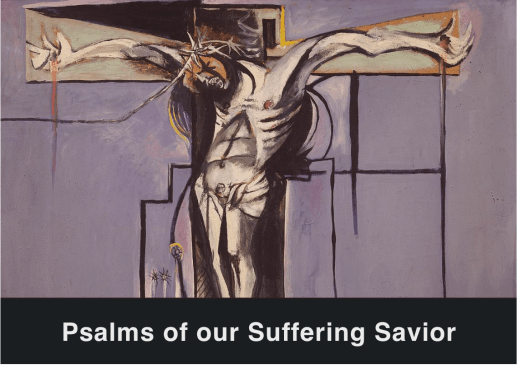
The Righteous One was not delivered. The Righteous One was afflicted and slayed. The Righteous One was condemned, condemned to die the terrible death of a criminal and slave.
Jesus was slaughtered. But it was not a senseless slaughter.
As the centurion nearby Jesus acknowledged, something more was going on behind the scenes. The centurion would have observed many deaths and many crucifixions. And so, he is in a unique position to recognize the purity and power of Jesus. The centurion said, “Certainly this man was innocent and the Son of God! (Lk. 23:47/Matt. 27:54; Mk. 15:39)
The centurion responded in that way after he saw Jesus call out and say, “It is finished. Father, into your hands I commit my spirit!” and breathe his last (Jn. 19:30/Lk. 23:46). The centurion must have been amazed by Jesus’ composure and everything else that had taken place surrounding Him. The centurion may have seen the way Jesus treated His enemies (Lk. 23:34), His promise to the criminal on the cross (v. 43), His prayer to God (v. 46), not to mention the ominous darkness (v. 44).[1]
Jesus’ death was not senseless, but according to Scripture. The Righteous One was slain in between two criminals. Jesus was, as Isaiah says, “numbered with the transgressors.” Yet in being cursed Jesus was carrying out a rescue plan that had long since been written (Rev. 13:8). “When He was hung on the cross, He took upon himself the curse for our wrongdoing. For it is written in the Scriptures, ‘Cursed is everyone who is hung on a tree’” (Gal. 3:13).
The Committal
Jesus’ life was bathed in the language of the Psalms. Yet, when Jesus quotes Psalm 31 He doesn’t quote it exactly. Instead, He says, “Father, into your hands I commit my spirit” (Lk. 23:46).[1] And so, Jesus’ dying moment was one of trust in His Father. Jesus trusted as He taught us to pray (“Our Father in heaven…”—Matt. 6:9-15). Jesus trusted as He brought a way for us too to go to the Father (Jn. 14:6).
And so we see that Jesus who cries out in despair—trusts God.[2] And we see He laid His life down. Jesus committed Himself into the care of His Father[3] and said, “It is finished” (Jn. 19:30) and breathed His last. Jesus was in control of His life, and He laid it down. The fact that no one took His life from Him but that He laid it down[4] also implies that He is able to “take it up again” (Jn. 10:17).
It is because Jesus trusted God His Father in His life and in His death, and because He freely laid His life down, that we have access to the Father. Jesus makes a way for us by being the perfect sacrifice. Jesus always perfectly trusted God.
So, through Jesus we can have God as our Father. We can go to Him in prayer as Jesus taught us (Matt. 6:9-15). We don’t have to be anxious like unbelievers because we know that we have a heavenly Father who knows all that we need (v. 32). And we can be assured of our Father’s love and care for us because He loved us so much that He sent Jesus (Jn. 3:16).
The Forsaken

On the cross Jesus cries out and quotes from Psalm 22: “My God, my God,[1] why have Thou forsaken me?!”[2] This is especially pungent because Jesus, unlike all other humans, did not deserve to be forsaken.[3]
Jesus’ forsaken cry comes at the end of three hours of darkness (Matt. 27:45). This is in great contrast to other momentous occasions in Jesus’ life. At Jesus’ birth, the star led the way and angels announced His arrival (Lk. 2:8-14).[4] At Jesus’ baptism, the heavens were torn open and a voice from heaven said, “You are my beloved Son; with You I am well pleased” (Matt. 3:17). At Jesus’ transfiguration “a cloud overshadowed them,[5] and a voice came out of the cloud, ‘This is my beloved Son; listen to Him’” (Mk. 9:7).
Jesus is Forsaken
Jesus is Forsaken
On the cross, Jesus cries out and quotes Psalm 22:1: “My God, my God,[1] why have Thou forsaken me?!”[2] This is especially pungent because Jesus, unlike all other humans, did not deserve to be forsaken.[3]
Jesus’ forsaken cry comes at the end of three hours of darkness (Matt. 27:45). This is in great contrast to other momentous occasions in Jesus’ life. At Jesus’ birth, the star led the way and angels announced His arrival (Lk. 2:8-14).[4] At Jesus’ baptism, the heavens were torn open and a voice from heaven said, “You are my beloved Son; with You I am well pleased” (Matt. 3:17). At Jesus’ transfiguration “a cloud overshadowed them,[5] and a voice came out of the cloud, ‘This is my beloved Son; listen to Him’” (Mk. 9:7).
Yet, when Jesus is on the cross crying out His forsaken cry the sky is dark and there is no voice from heaven.[6]
However, it is through Jesus being forsaken by God that a gentile centurion[7] says, “Truly this man is the Son of God” (Mk. 15:39). It is through Jesus being forsaken by God that the temple curtain is ripped in two (Mk. 15:38)[8] and we can now, through Jesus Christ, boldly go to God our Father (Heb. 9:2–3, 12; 9:24; 10:19–20).[9]
Jesus cried His forsaken cry so that all who trust in Him will not have to for all eternity.[10] Jesus died in agony, crying out, “My God, my God! Why have You forsaken me?!” so that we could die in peace. The voice that called out to Abraham to not touch Isaac is silent for the Son of God so that we too could be spared.
Later on, the psalmist says: “I am poured out like water, and all my bones are out of joint; my heart is like wax; it is melted within my breast; my strength is dried up like a potsherd, and my tongue sticks to my jaws; you lay me in the dust of death” (Ps. 22:14-15 cf. 69:17-21).
That too was Jesus’ experience. He was forsaken by God. His life was poured out like water as He drank the cup of God’s wrath and suffered severe thirst. John 19:28 says, “Jesus, knowing that all was now finished, said (to fulfill the Scripture), ‘I thirst.’”[11] And so we see, the One “who had made gallons of wine for a wedding party, who had spoken of living water that would quench all thirst forever” was dying with a parched tongue and the sour smell of vinegar on His beard.[12]
Jesus died in the dark. Thirsty. Forsaken by God.
Yet it is through Jesus being forsaken that He opens the way for whosoever will to come to God through the way that He made. Jesus is the way, He is the gate (Ps. 118:20; Jn. 14:6).
Reflections
- It’s helpful to realize in the midst of suffering that God takes our suffering seriously. In fact, “God takes our misery and suffering so seriously that he was willing to take it on himself.”[13]
- Jesus, because He Himself suffered when tempted, He is able to help those who are being tempted (Heb. 2:18). Jesus was “made like his brothers in every respect, so that He might become a merciful and faithful high priest in the service of God” (v. 17). So, as you struggle and strive in this fallen world, remember Jesus sympathizes with your weaknesses, because He was tempted in every way that we are, yet He never sinned (Heb. 4: 15).
Prayer
God, we are thankful and amazed that You are mindful of us. But we know that You are. And You even sent Jesus to bear the wrath that we deserve so we could be welcomed into friendship with You. Thank You, God. Be praised by our lives we ask, because You deserve it. We ask this through Jesus our once forsaken Great High Priest. Amen.
Notes
________
[1] Jesus said, “My God, my God” and so we see both Jesus’ personal relationship with God—even though He doesn’t say “My Father, my Father” here since He’s quoting the psalmist—and His continued trust in God (Bauckham, Jesus and the God of Israel, 258).
[2] Forsaken me in this context means “to cast off,” “reject,” “to be far from,” “to hide God’s face from,” “to turn in anger from,” “to forget” (Richard Bauckham, Jesus and the God of Israel: God Crucified and Other Studies on the New Testament’s Christology of Divine Identity, 256). “To be forsaken by God means that he has allowed this to happen and does nothing to help. So it is somewhat misleading to say—of the psalmist or of Jesus echoing his words—that he feels forsaken by God as though this were an understandable mistake. What Jesus experiences is the concrete fact that he has been left to suffer and die. God has, in this sense, abandoned him, not merely in psychological experience but in the form of the concrete situation that Jesus experiences” (Ibid., 257).
[3] So, we could read the text: “Why have You forsaken Me, Me of all people?!” We know the truth, however. We know that Jesus knew that it was God’s will that He bear the sins of many.
[4] See Colin R. Nicholl, The Great Christ Comet: Revealing the True Star of Bethlehem.
[5] God’s presence to bless is often seen in atmospheric symbols like clouds. We see this for example in the Exodus (Ex. 13:21).
[6] In Scripture darkness sometimes expresses God’s judgment as well as His nonappearance to bless and protect (see e.g. Ex. 10:21-22; Is. 8:22; Amos 5:20; Zeph. 1:15).
[7] This centurion would have observed many deaths and many crucifixions. And so, he is in a unique position to recognize the purity and power of Jesus. The centurion said, “Certainly this man was innocent!” (Lk. 23:47), after he saw Jesus call out and say, “It is finished. Father, into your hands I commit my spirit!” and breathe his last (Jn. 19:30/Lk. 12:46). The centurion must have been amazed by Jesus’ composure and everything else that had taken place surrounding Him. For example, the centurion may have seen the way Jesus treated His enemies (v. 34), His promise to the criminal on the cross (v. 43), His prayer to God (v. 46), not to mention the ominous darkness (v. 44).
[8] “The curtain between the Holy Place and the Most Holy Place was an elaborately woven fabric of 72 twisted plaits of 24 threads each. It was 60 feet (18 m) high and 30 feet (9.1 m) wide. No one was allowed to enter the Most Holy Place behind the curtain except the high priest, and he only once a year, on the Day of Atonement (Heb. 9:2–7). Torn in two signifies the removal of the separation between God and the people” (The ESV Study Bible note on Matt. 27:51).
[9] As D.A. Carson has said, “At the very moment when Jesus gives up his spirit (v. 50), Matthew reports, ‘The curtain of the temple was torn in two from top to bottom’ (v. 51a). This is not some mere datum of interesting destruction. The destruction of the curtain makes a theological statement” (D.A. Carson, Scandalous, 34).
[10] D.A. Carson, Scandalous, 36.
[11] Yet in Jesus’ thirst, He was given sour wine. So, “What David was offered in metaphor, Jesus was offered in fact” (Kidner, Psalms 1-72, 266). See Ps. 69:21; Matt. 27:34, 48; Jn. 19:28.
[12] Philip Yancey, The Jesus I Never Knew.
[13] Keller, The Reason for God, 31. “The cross is God’s act of self-identification with all people in that extremity of the human condition and that heart of all suffering that is the absence of God” (Richard Bauckham, Jesus and the God of Israel, 267).
The Trial and Mocking

See more devotionals in this series here.
Jesus is on trial. He who calmed the storm and reached out and healed lepers is on trial. Jesus could have answered as God had once before when He was questioned. He could have said, “Who is this that darkness counsel by words without knowledge?!” (Job 38:2).
Jesus could have responded: “Where were you when I laid the foundation of the earth?! (v. 4). Do you make the sun rise? (v. 12). Can you send forth lightning? (v. 35). Do you give the horse his might? (39:19). Is it by your understanding that the hawk soars? (v. 26).
And yet the One who created the universe by the word of His power and holds it together (Heb. 1:3), is on trial and even mocked. And the people cry out: “Crucify, crucify Him!”
Jesus is hated without cause (Ps. 35:19; 69:4) and people are wrongfully His foe because He never did a single thing that was wrong (1 Pet. 2:22; Heb. 4:15; 1 Jn. 3:5). And so, because He has never done anything wrong, He is attacked with lies and words of deceit (Ps. 35:20; 69:4). Jesus’ accusers said, “Aha, Aha! Our eyes have seen it!” (Ps. 39:21). But they hadn’t. They hadn’t because Jesus was without sin.
An Easter Devotional
I wrote the blog series, “Psalms of our Suffering Savior,” to help us “remember Jesus Christ, risen from the dead” (2 Tim. 2:8).
It is to be used devotionally leading up to Easter (Resurrection Sunday). It is a 12-day devotional that starts with the Triumphant Entry and goes through to the Ascension of Jesus Christ.[1]
In these devotions, we’ll be looking at Psalms that express Jesus’ experience. Jesus “saw in the experiences of David the pattern, writ small, of his own calling.”[2] And as Jesus said, in Luke 24:44 “the Psalms must be fulfilled.”[3]
These devotionals will help us see how it is that Jesus fulfilled the Psalms.[4] And it is quite amazing to see.
Remember “many prophets and righteous people longed to see what you see” (Matt. 13:17)! So, let’s intentionally celebrate and “remember Jesus Christ, risen from the dead”!
If you’re interested in this devotional series, like the Facebook page here or follow the blog via email (look to the right under the search bar) and receive the devotionals that way.
“Give me understanding that I may live”

“Give me understanding that I may live” (Ps. 119:144) grabbed me as I was reading through Psalm 119 today. It’s pleading. It’s serious. It’s a matter of life and death. But is it? I mean, is it for me?
Well, very often it’s not for me. I don’t care. Or not like I should.
Very often I don’t even really seek understanding. I seek a checked box. However, let me tell you, that is not life giving. Yet, I am not sure I am willing to say it’s legalism either.
I know God’s word is important as a lamp to my feet (Ps. 119:105), I know it is important to keep me from sin (v. 9, 11, 165), yet it is often not “the joy of my heart” (v. 111) as it should be. Sadly, I don’t aways concur with the statement “give me understanding that I may live” (v. 144). I don’t normally rise before dawn to meditate on Scripture (cf. v.147, 148).
LORD, help me to seek You with my whole heart (v. 2). I am, or was, willing to wake up at 4am to study for tests in college so why does Your word not hold that kind of sway? Apparently that test had more gold (v. 72) and life in it than Your word. God, I admit I am fickle. I need Your help.
LORD, open my eyes that I would see the awesome truths contained in Your word (v. 18). Please make me understand Your law (v. 27) and help me not to waste my time on worthless things (v. 37) like excessive TV and the endless social media feed.



 in X
in X 