
Desecration and De-creation via the Red-Light District

I was in Germany for my job a few years ago. I got to wander the streets of Nuremberg with a few friends. It was a great time until…
Until my friends just happened to stumble upon the red-light district. I saw a woman, made in the image of God, standing naked in the arch of a door offering herself up for purchase. It was very sad.
…Imagine a dozen roses being trampled underfoot and ground into the pavement. Or your families heirloom vase being thrown crashing to the ground. The intended beautiful design gravely marred and belittled…
We didn’t walk down the street.
I wouldn’t.
…Nuremberg is a beautiful city. The city from all I could tell is thriving. Yet it has places, I suppose like any city, where the thin veneer has washed away and the anti-creation is showing. Where the inner man is as visible as the graffiti on the walls…
Here’s a poem I wrote later that day:
Strained by tears that she wears inside
Never to hide
Ever inspected for beauty
Yet coldly rejected
Infected by the strain
The strain of prideful lust
Her bosom embraced but not with kind face
Ever the look of lust
She is a mere possession
A brief obsession
To use and then discard
Disregard that she’s a person and use her for your end
Ageless beauty,
clothed in agony,
the only veil she knows
She roams the streets
Anything for the right price
O’ but this woman that we deface
Is more than a nice face
Men may have her
and hate her
but for her,
Christ He died!
Jesus cries, Daughter!
You are my daughter, no whore!
I will embrace and wipe your tears
I will love and calm your fears
O’ my child, for you I weep
I long to tenderly clothe you
To clothe you with love
To you, show the meaning of true love
When Jesus our King returns
Clean will be the streets
Angst

2016 and Time

“Time flies,” we say. Time, even as you read this, is tick tick ticking away never to return (are you sure you want to read further?!).
Thinking of the fleeting nature of time can be depressing. Yet, as we think of our limited time it should awaken in us intentionality and seriousness. Of course, that does not mean we shouldn’t have fun. If anything it means we should be more intentional about having fun (Ecclesiastes 2:24).
So as we think of the fleeting nature of time we must not become unhelpfully rigid. We must be intentional and purposeful not only in the good that we want to accomplish but also in the good we want to enjoy.
We must realize that much of American culture is akin to a hamster wheel. There’s many people going and doing but for what? To what end? Is it intentional, calculated, purposeful? Or is to no end (see Eccl. 2:26)?
We must also acknowledge that cultures think of time and promptness differently. Some cultures are more relational then prompt. The issue is not really about how much we do or about what people think about what we do but about being an intentional wise steward of the time that God has given us. This will likely look different in different cultural contexts but the stewardship principal remains.
God does not want us, His servants and workman, to waste the time that He has given us to labor for Him. We can rest from time to time like any worker but we must remember that there will come a time when we can no longer work at all (Jn. 9:4). We must keep in mind the perfect rest (shalom) and reward that He has waiting for His laborers.
In this post we will look at why being conscious of the way we spend our time is important. Jonathan Edwards is especially insightful here because he realized the importance of time (See esp. “The Preciousness of Time and the Importance of Redeeming it”).
The Preciousness of Time
Why is time valuable and precious? Edwards said, “Because a happy or miserable eternity depends on the good or ill improvement of it” for you and for others. “Things are precious in proportion to their importance or to the degree wherein they concern our welfare.”[i]
“Gold and silver are esteemed precious by men; but they are of no worth to any man, only as thereby he has an opportunity of avoiding or removing some evil, or of possessing himself of some good. And the greater the evil is which any man hath advantage to escape, or the good which he hath advantage to obtain, by anything that he possesses, by so much the greater is the value of that thing to him, whatever it be. Thus if a man, by anything which he hath, may save his life, which he must lose without it, he will look upon that by which he hath the opportunity of escaping so great an evil as death, to be very precious. — Hence it is that time is so exceedingly precious, because by it we have opportunity of escaping everlasting misery, and of obtaining everlasting blessedness and glory. On this depends our escape from an infinite evil, and our attainment of an infinite good.”[ii]
For example: The life preservers on the Titanic, “the unsinkable ship,” were not thought of as valuable at the outset of the cruise. People must have thought: What is the need of a life preserver on a ship that won’t sink? But that mindset changed. What was it that brought a new and priceless value to the life preservers? People realized that they were, in fact, not on the unsinkable ship; for it was sinking.
In a short time the value of the life perseveres sky rocketed. The people now clinched the life preservers tight, perhaps even fighting over them, when before they would not even give them a second thought. Just like the passengers treated the life preservers differently once they realized the ship was sinking so we must treat time differently once we see that our lives are fleeting. When we realize that time is precious we will clinch it tight and use it wisely.
Life is transitory and we do not know how long we will live. Our life is just a mist that appears for a little time and then vanishes (James 4:14). Time is so valuable, in part, because it is very short. Our time on earth is but dust in the wind, vapor that is here for a moment, grass that withers in the sun. Our time on earth is short and “the scarcity of any commodity occasions men to set a higher value upon it, especially if it be necessary and they cannot do without it… So time is the more to be prized by men, because a whole eternity depends upon it; and yet we have but a little of time.”[iii]
“Time ought to be esteemed by us very precious, because we are uncertain of its continuance.”[iv] We know that time will end for all people; however, we do not know when. We do not know the date and the time.
Time is valuable because when it is gone you can never get it back. Edwards said,
“There are many things which men possess, which if they part with, they can obtain them again. If a man have parted with something which he had, not knowing the worth of it, or the need he should have of it; he often can regain it, at least with pains and cost… But it is not so with respect to time. When once that is gone, it is gone forever; no pains, no cost will recover it.”[v]
“Once the time of life is gone, when once death is come, we have no more to do with time; there is no possibility of obtaining the restoration of it, or another space in which to prepare for eternity. If a man should lose the whole of his worldly substance, and become a bankrupt, it is possible that his loss may be made up. He may have another estate as good. But when the time of life is gone, it is impossible that we should ever obtain another such time. All opportunity of obtaining eternal welfare is utterly and everlastingly gone.”[vi]
The way we spend our time on earth has eternal consequences. This is not a subject to be taken lightly. “A person cannot do anything to time itself—delay or hasten, save or lose it—much less ‘manage’ it. The challenge is to manage ourselves under the lordship of Jesus Christ, from whom we get our goals and values.”[vii]
May we be intentional and wise stewards of 2016.
________________________
[i]Jonathan Edwards, The Works of Jonathan Edwards:2 Volume Set, (Peabody, Massachusetts: Hendrickson Publishers, 2005), 233.
[ii]Edwards, The Works of Jonathan Edwards, 233.
[iii] Ibid.
[iv] Ibid., 234.
[v] Ibid.
[vi] Ibid.
[vii] Charles E. Hummel, The Freedom from the Tyranny of the Urgent (Downers Grove, IL: IVP Books, 1997, 31.
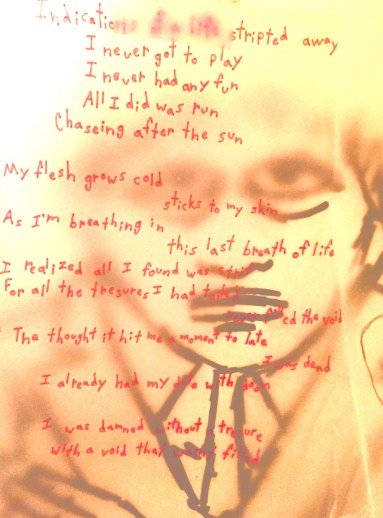
The “Yes!” we scream, whispers “No”
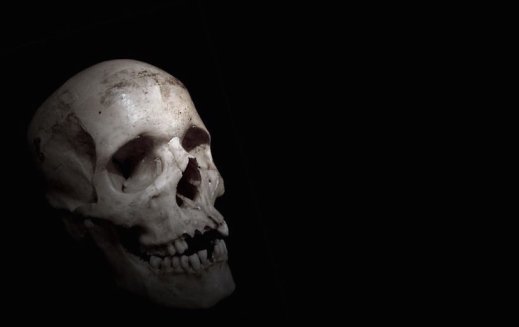
Greet the reaper as he reaps
and weep because of the same
  This silly game
  We do this to ourselves

We’ve mapped out our whole mission
We sketched the whole thing out
  The plan for our destruction

The black hole that is you
  It will consume you
More, more is your mantra
 The only thing that will not go is “no”

Inject the pleasure
Digest the pain
Is it all a game?

You dance,
You dance to your own dirge
The Thesis and Anti-Thesis on Life and it’s Negation

Life is futile. A senseless waste. We live, we die. That is it.
We squeeze out meaning. Or inject it into our veins. We run, but we know not for what, and then expire. We build our castles and pile up things. Then we die.
The sun rises and sets or spins and spins. Seasons come, seasons go. We grow old. We die. The same remains until the sun burns out and we grow cold.
All is futile.
There is no meaning, accept what we make. So fill your coffer, kill the pain. Feed your pleasure, though a monster it becomes.
Thus is life if there’s no hope beyond the grave.
Yet, if this is the sleepy land and we wait for what is true life then this is but the testing ground. We plant what grows for us there. If we make our meaning here, then we destroy it there. If we are lethargic and vague in pursuit then we’ll obtain the wind.
Our Chronological and Geographical Snobbery and Our Need for a Standard Beyond Ourselves
Science is about what is and can never be about what ought be. Thus, left to our own devices, left to science and our subjective view of what ought to be, we are left with a “might makes right” morality. We are left to Nietzsche and Nazism, to Stalin and suffering. We need a standard that science with all its greatness cannot give us. We need a salvation that science with all its greatness cannot give us. Science, what is, without what ought be, a moral standard beyond us, will inevitably lead to the moral atrocities committed in concentration camps.
Hitler and Nazism justified extermination camps based on what they thought was a good rationale. The U.S. Supreme Court ruling on Dread Scoot vs. Sandford shows that humans are not omniscient. Even now in the 21st century. We will continue to make grave mistakes if we continue in our historical snobbery and arrogant pride and disregard all previous history. As we say “we’ve arrived, we know,” we quote many dead civilizations. I guess we might say with those civilizations, “we’ve arrived” …to our tomb.
We can look down our nose at the Aztecs for their bloody sacrifices. But then, they didn’t know any better. We can look in disdain at Baal worshipers and their practice of baby sacrifice. Perhaps we can even look to Africa, India, and Islam and disdain some of their practices. But, here in the States, here where we lay more babies down each day then what the U.S. lost on D-Day, here where “have it your way” is the moral mantra, here there is nothing to be gained. We’ve arrived. We don’t need a moral compass. We are the moral compass.
We’ll follow our impulses. “Might will make right” and “have it your way” will hold sway. We’ll wade in blood. We’ll turn away. Until we drown.
We don’t need the light of history or God’s word. We are god. We make the rules.
We walk in the darkness we’ve created (cf. Is. 59:10ff). We walk on bodies through the cemetery we’ve created. No wonder we don’t want a light.
Is it not plain that we need Truth, Jesus the Lord of life and the Great Light of the world, to shine away our darkness (Is. 35:5)? We need the Lamb to set on the throne and be our Shepherd (Rev. 7:14-17). All other leaders fail. Scientists and Presidents cannot and will not bring salvation or what finally ought be. The One in the beginning that said it was very good (Gen. 1:31) alone can make it good again (Rev. 21:1ff). The LORD in the face of Jesus Messiah is our sure hope.
The Subversive Nature of True Art

True beauty and art subvert the lie whispered in the Garden that roars in cacophonous echo today: “You shall be like gods!”
We walk the path that was blazed by our forebears; we autonomously seek for meaning in ourselves. Yet, periodically we stand before a sunset or Mozart or some other masterpiece and our autonomous walk is halted and we know, we intimately know, and even bask in the fact that we are not god and our good is not in autonomy, it is outside of us. We need. We need God.
Sin is Not Good #5
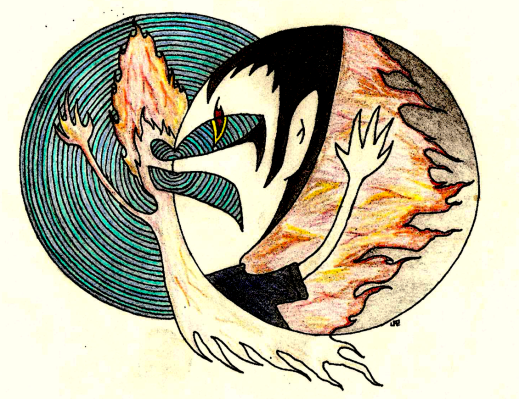
Sin Looks Really Good
It is a graphic scene, depicted in the most vivid way. A recent celebrated movie shows the character smiling in glee as he takes his own life. This depiction is sad yet we see it week-in and week-out. The movie is The Return of the King and the character is Gollom. Gollom, previously known as Sméagol, use to be a regular hobbit but was corrupted, enslaved by the ring. His infatuation with the ring started slow (a weekend here and there) but ended desperately. Gollom loved and hated the ring. He was torn, he wanted to be free from the ring and yet relentlessly pursued it.
At the end of the movie, Gollom finally has, as he says, “my precious.” But in getting the ring he has destroyed himself and everyone, indeed, everything around him. Yet his refrain is, “my precious.” Gollom’s last scene is one of great joy (for him). Gollom fights Frodo over the ring, another character that was nearly wholly-destroyed by the ring. Gollom is fierce. He wants the ring at any price. He bites off Frodo’s finger and rejoices over his plunder. He embraces his cruel master as his beloved friend. He falls, seemingly, blissfully in the lava and as he sinks he rejoices that he has comfort from pain, he has everything, he has his “precious.” Then he sinks and he and his “precious” are gone.
This scene, though portrayed differently, is a scene I have seen too often. This scene is the climax and conclusion of far too many stories of sin. Sin looks good. It is so sad to see people enraptured in love with their cruel master and executioner.
Sin is ingeniuine. It makes big promises but never delivers. Truly the world and sin “promises happiness, and nothing less… It promises to satisfy our desires, but only increases them; it gives poisoned pills, but wraps them in sugar.”[i]
Satan sells us lies and blinds our eyes. He would have us contended with filth and miss the glorious Lord who is worthy of all praise and can satisfy our longing soul. Truly Satan is crafty and subtle in his lies (recall the way he talked to Eve; Gen. 3:1ff cf. Lk. 4:1). He is a lion that is crouched low (1 Pet. 5:8). We don’t always see him but his desire is to destroy.
Satan is the god of this world (2 Cor. 4:4; Rev. 2:13) and his worship leads to curses and hatred of neighbor. In him is death and he is the futility of man; whoever lives in his influence shall perish and not have life (reverse of Jn. 1:4; 3:16). The world sits on the back of this evil beast of death (cf. Rev. 17:3). The world doesn’t know it but all people follow the course the beast as set, and it’s a funeral procession, that leads to the grave (cf. Eph. 2:1-3).
So Satan, the lord of this age, is rightly called the “deceiver of the whole world,” the “father of lies” (Rev. 12:9; Jn. 8:44 cf. Rev. 13:14; 18:23; 19:20; 20:3; 2 Cor. 11:3; 2 Thess. 2:9-11; 1 Tim. 2:14). He is a dragon that smites many hosts yet not by the fire of his mouth but by the damning effects of his lies. And what do you expect his children to say? “They promise freedom, but they themselves are slaves” (2 Pet. 2:19 cf. Matt. 24:24; Jn. 8:44; Rom. 16:18; Eph. 4:14). Those that know not Christ are blind and would have us wonder around in darkness too (cf. 2 Cor. 4:4-6). Satan and his children boast of good, but it’s all tainted, and leads to death (cf. Prov. 5:1-6; 7).
Thus, sin is not good because although it can look good, it’s not. It damns and destroys the good world God made. The de-creation voice of Satan pulls us toward death and non-being. It may sound good, as it did to Eve, but it is anything but good. It destroys. It curses and creates confusion. It sends us guilty out of Eden, where our good lays, and into Gehenna.
________________________________
[i] Thomas Watson, Heaven Taken by Storm, 44.



 in X
in X 