Why did Jesus flip over tables?
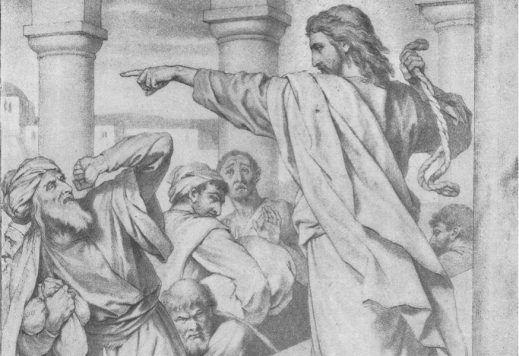
“And He entered the temple and began to drive out those who sold and those who bought in the temple, and he overturned the tables of the money-changers and the seats of those who sold pigeons. And He would not allow anyone to carry anything through the temple” (Mark 11:15-16).
Why did Jesus drive out those who sold and bought in the temple? Why did He flip over tables? That seems pretty extreme. Why was He so worked up? What was such a big deal? I mean in some ways the moneychangers actually helped people it would seem.
When I was in Germany, for instance, I had to go to the “moneychangers” to get euros. Without the moneychangers, after all, I would have had no schnitzel. Further, pigeons were sold. That is actually pretty convenient. Because who wants to have to haul a pigeon halfway across the known world? Not me. So, what was the deal with Jesus getting upset?
It seems that money was not the only issue. In fact, maybe not the biggest issue. Though, Jesus does mention that the moneychangers were essentially robbers (again, reminds me of the bank in Germany where I got my euros). But I think the bigger issue is what the Temple was intended to be and what it had become. It clearly was never meant to be “a den of robbers” but “a house of prayer.” A house of prayer “for all peoples,” it says.
The moneychangers were in the “Court of the Gentiles,” that’s basically equivalent to where Gentiles (non-Jews/”the nations”) would worship. As you can imagine that would obstruct worship. It would be a hindrance from Gentiles, “the nations,” from worshiping the Lord. This is the converse, as Jesus pointed out, of what Isaiah said: “my house shall be called a house of prayer for all peoples” (Is. 56:7).
Jesus brings blessing and salvation to all peoples but at the temple people were hindered from worshiping. That is why Jesus was furious. And rightly so. May we never be worthy of Jesus’ wrath for that same sin.
May we never prevent or hinder people from coming to the LORD, even if they are convenient or important things that we don’t want to give up. May we work to destroy unnecessary stumbling blocks. And may the church be a house and family that welcomes all people in!
We Harvest what we Plant

“If you sow to the flesh you will reap from the flesh, reap corruption. But if you sow to the Spirit you will reap from the Spirit, reap eternal life” (Galatians 6:8).
Sowing and reaping are not things most of us are really familiar with, let alone sewing and weeping. So, what does it mean to sow? To sow means to plant seeds.
What does it mean to reap? To reap means to gather, to harvest what was planted.
If a farmer plants corn what do they collect at the end? They gather corn. Whatever we plant we harvest. You can’t plant beans and expect wheat to grow. That’s not how things work.
In life it is the same way. What we plant we gather. Where we work is where we get paid. What we sow we reap.
In this verse, we see that in life there are only two types of seeds to plant. There are only two options of things that we can harvest at the end.
We can plant towards the flesh, that is, we can just care about and live for our physical and material life. What, however, is the end of all physical life? It is death and decay. It is corruption. It is decomposition. If we live merely for the flesh we don’t get a very good return on our work.
If we plant towards the Spirit the harvest is much different. At the end, there will be eternal life. And because this is the case, we have huge motivation to continue planting towards the Spirit. Because we will reap at the appointed time if we don’t give up (Gal. 5:9).
He is the Faithful God

“Know that the LORD your God is God, the faithful God who keeps His gracious covenant loyalty for a thousand generations with those who love Him and keep His commands” (Deuteronomy 7:9).
How surprising and sad that we need to be reminded so often of God’s truth. And yet we do. I’m thankful that God accommodates to our forgetful ways.
We are told to know something. Our knowledge is not to be merely intellectual. Though it is intellectual. We need to know actual things about God. In this verse, we are to grasp with our minds that the LORD God is actually God.
It is not only that the LORD is really God but that the LORD your God is really God. There is a relational aspect to our knowledge of God. The LORD your God is the supreme being and Creator of the universe. The LORD is not distant and uncaring, He is not a god, but our God.
Wow. That’s a game-changer.
It doesn’t stop there, though.
The supreme being and Creator of the universe that is our God is also faithful. Amazingly faithful.
Deuteronomy 7:9 heaps good news upon good news. If you have the LORD as your God then that means that God—The supreme being and Creator of the universe—is your God. It means the Faithful One is your God.
Our intellectual knowledge of God has a huge practical impact on our lives. It means we do not need to be afraid because the LORD our God is powerful (Deut. 7:18).
So, fight forgetfulness. Work to remember and intimately know your faithful God. And don’t be terrified because the LORD your God, a great and awesome God, is among you (Deut. 7:21).
the primal lie

Falling like the Rain

I woke to the sound of rain drenching everything in its path and my daughters quiet voice asking if the dog can still go out to use the restroom. “Yes, please take the dog out!” was my urgent reply.
I have always loved the rain. The sound it creates as it slaps the ground, rushing along the path it created just moments ago. It is a gift from God. He uses the rain to feed and nourish all His creation. All of our senses are brushed by His creation. We shiver in the dampness, we smell & taste the sweet yet dank rain, we hear and see the chorus of individual drops dissolve.
The ten most popular posts of 2019…

An Easter Devotional
I wrote the blog series, “Psalms of our Suffering Savior,” to help us “remember Jesus Christ, risen from the dead” (2 Tim. 2:8)…
A Brief Theology of Emotions

We all have emotions. How often do we consider emotions from a biblical perspective though?… Yet, what better place to turn than God’s word! So, what does the Bible say about emotions?…
Holding on to Hope: 10 Actions Steps to Fight Depression
 1. Call out to God
There are all sorts of Psalms in Scripture in which the psalmist calls out to God in distress. The Bible encourages us to call out to God and be real with Him about where we’re at…
20 of the best books I read in 2019

Here are twenty of my favorite books that I read in 2019. I think I only read three fiction books this year. I need to fix that. I plan to read quite a bit more fiction next year. Anyhow, here’s some of my favorites… (in no particular order)
- Why Suffering?: Finding Meaning and Comfort When Life Doesn’t Make Sense
by Ravi Zacharias - Safely Home by Randy Alcorn
- Apologetics at the Cross: An Introduction to Christian Witness by Josh Chatraw and Mark D. Allen
- Them: Why We Hate Each Other–and How To Heal by Ben Sasse
- How Long O Lord?: Reflections on Suffering and Evil by D.A. Carson
- Titan: The Life of John D. Rockefeller, Sr. by Ron Chernow
- Alienated American: Why Some Places Thrive While Others Collapse
by Timothy P. Carney - Holy Sexuality and the Gospel: Sex, Desire, and Relationships Shaped by God’s Grand Story by Christopher Yuan
- Remember Death: The Surprising Path to Living Hope by Matthew McCullough
- The Autobiography of Martin Luther King Jr by Clayborne Carson
- Today Matters: 12 Daily Practices to Guarantee Tomorrow’s Success by John C. Maxwell
- Elon Musk: Tesla, SpaceX, and the Quest for a Fantastic Future by Ashlee Vance
- Walking with God through Pain and Suffering by Timothy Keller
- Preaching as Reminding: Stirring Memory in an Age of Forgetfulness by Jeffrey D. Arthurs
- An Unhurried Leader: The Lasting Fruit of Daily Influence by Alan Fadling
- Everyday Church: Gospel Communities on Mission by Tim Chester and Steve Timmis
- Susie: The Life and Legacy of Susannah Spurgeon, wife of Charles H. Spurgeon by Ray Rhodes Jr.
- To the Golden Shore: The Life of Adoniram Judson by Courtney Anderson
- Endurance: Shackleton’s Incredible Voyage by Alfred Lansing
- Deep Work: Rules for Focused Success in a Distracted World by Cal Newport
Out of all the books I read last year, Remember Death by Matthew McCullough, is the one I would suggest you read over all the rest.
Read it.
Proof of God’s Grace #3: Overcoming Grace

Scripture teaches that it is the Spirit that overcomes people’s hardness of heart and gives spiritual life. So, John 6:36 says, “It is the Spirit who gives life; the flesh is no help at all” (see also Ezek. 11:19-21; 36:25-27).[1] Notice it says, “the flesh is no help at all.” The Apostle Paul also says it is “the Spirit that gives life” (2 Cor. 3:6). Thus, salvation does not come from “human will or exertion, but on God, who has mercy” (Rom. 9:16). So Paul says, “It is God who works in you, both to will and to work for His good pleasure” (Phil. 2:13).
James 1:18 says, “Of His own will He brought us forth by the word of truth, that we should be a kind of firstfruits of His creatures.” Whose will was it? It was “His will.” Of course, God uses means to accomplish His will. People are brought to new life through “the word of truth” (cf. Rom. 10:14; 1 Pet. 1:23).[2]
Jesus said, “Truly, truly, I say to you, unless one is born again he cannot see the kingdom of God” (Jn. 3:3). That is because, “That which is born of the flesh is flesh, and that which is born of the Spirit is spirit” (v. 6). It is the supernatural work of God that makes a person a new creation in Christ (2 Cor. 5:17). “No one can say, ‘Jesus is Lord,’ except by the Holy Spirit” (1 Cor. 12:3). That is why we “must be born again” (Jn. 3:7). And of course, no one can make himself or herself be born, let alone born again. It is the Spirit’s prerogative; the Spirit works the way He works (Jn. 3:8). We also see that even faith is a gift from God (1 Chron. 29:14; Jn. 3:27; 1 Cor. 4:7; James 1:17). No one would believe without God first giving the gift of faith. Therefore, Jesus says, “You did not choose me, but I chose you” (Jn. 15:16 cf. v. 19).
So, we say with Peter, “Blessed be the God and Father of our Lord Jesus Christ! According to His great mercy, He has caused us to be born again to a living hope through the resurrection of Jesus Christ from the dead” (1 Pet. 1:3). Peter says that God “has caused us to be born again.”
Proof of God’s Grace #2: Resurrecting Grace

In this series of posts we are looking at proof of God’s grace (Planned, Resurrecting, Outrageous, Overcoming, and Forever grace [1]). In the previous post we looked at Planned Grace. In this post we are looking at…
Resurrecting Grace
The Bible teaches that people need resurrected or brought to life spiritually because they are spiritually dead and don’t go to God apart from the work of the Holy Spirit. Why is this the case? And where does the Bible teach this?
People do not turn to God apart from the Spirit’s intervening grace of regeneration because they are dead (Eph. 2:1-5), slaves of sin (Rom. 6:20), deceitful and desperately wicked (Jer. 17:9 cf. Gen. 6:5; Ps. 51:5), and blinded by Satan so they don’t see the glory of God in the face of Christ (2 Cor. 4:4ff).
In our natural state since the Fall we are dead in trespasses and sins (Eph. 2:1). We follow “the course of this world,” “the prince of the power of the air,” and “the spirit that is now at work in the sons of disobedience” (v. 2). That is how “we all once lived in the passions of our flesh” (v. 3).
Proof of God’s Grace #1: Planned Grace

The Bible shows us over and over again proof of God’s abundant grace. Here we are going to look at the acronym PROOF[1] to look at God’s grace. We are going to look at: Planned grace, Resurrecting grace, Outrageous grace, Overcoming grace, and Forever grace.
Why is it important that we consider the proof of grace? First, because when we understand all the proof of God’s grace we praise and glorify God for His abundant grace. Second, anything that is the teaching of Scripture is important and profitable for us to understand (2 Tim. 3:16-17). Third, when we understand the extent of God’s grace it humbles us. Fourth, when we understand more of the extent of our desperation we will (or should) love God more (Lk. 7:47).



 in X
in X 