Christmas is real good news of great joy for all people

I think, no matter who you are, there has been misinformation on both sides of about everything the past year or two. Sometimes we see something on social media, Facebook, or whatever, and it grabs our attention and seems pretty possible. Then there’s other stuff like this…
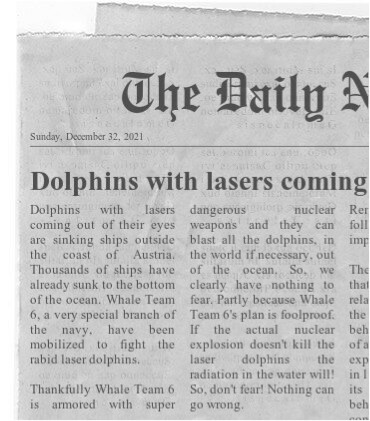
There is no coast of Austria. Austria is a land-locked country. And there is no Whale Team 6, at least that I know of. This story, of course, is just made up to be funny.
But, there has been a lot of bad news and a lot of false news this year. But, thankfully, I have something much different for you.
I have some incredibly good news and it is not fake!
First, I want to show you that this is not false news. That’s really important. Then we’ll get into the really good news. Of course, if the news were fake then it couldn’t be good.
Real News (Luke 1:1-4; 2:1-3)
Luke, the one who wrote one of the accounts of Jesus’ life, had a fourfold approach to his task. First, we see he did an investigation. He interviewed eyewitnesses. Second, he went back to the beginning. He didn’t pick up halfway through. Third, we see that Luke was thorough. He did his homework and “investigated everything.” Fourth, we see it wasn’t done in a roughshod way. Luke “carefully investigated everything.” So, the main impact of what Luke writes is that “Christianity is true and is capable of confirmation by appeal to what happened.”[i]
In fact, one author has said, “Wherever it has been possible to check Luke’s statements, his impeccability as a historian has come to light.”[ii]
Also, the Gospel of Luke doesn’t start out like a fairytale story: “Once upon a time…” It starts out by showing us that it is a biography. Luke did his research in putting together the account about Jesus. It’s not fake news. It’s real news.
The story of Jesus—of His birth and life—is not in the same category as fiction but history. Luke reports true historical events. Or, that’s certainly what it claims to report.
So, the issue on which everything hangs is not whether or not you like what the Bible teaches but whether or not the Bible is true.[iii]
The story of Christmas does not have value because it is a cute story about a down-and-out couple having a child in an unexpected setting. No. The story of Christmas has value because it is a true story about the good news of rescue through Jesus.
It’s very interesting to me that Caesar Augustus (Luke 2:1) was the first, and many say, the greatest Roman emperor. Actually, Augustus means, “Revered one” and some worshiped Caesar Augustus as divine. But, in his day, someone much greater was on the scene, someone truly divine. And it is actually because of this other person, this person that was a crucified Jewish carpenter, that I even know the name of Caesar Augustus.
Good News
Friends, this is good news! God has provided a Savior and we desperately need a Savior. We all fail, we all sin. As James says, “we all stumble in many ways.” Sometimes when we’re not even trying to. We don’t love others or God as we should.
The coming of Jesus the Messiah shows us that God keeps His promises. His promises to Abraham (Gen. 12:1-3), David (2 Sam. 7:16), Israel (Deut. 30:1, 5), and all people (Gen. 3:15). We see this truth highlighted a bunch throughout Luke chapters 1 and 2.
And that’s really good news. God kept His past promises. He said He would send a rescuer and He sent Jesus to rescue in ways that are mindboggling. And soon we’ll have perfect joy before Him. That promise too will come true.
Brothers and sisters, through the Messiah, we have light instead of darkness. Soon pervasive peace.
Joy to the world! the Lord is come;
Let earth receive her King;
Let every heart prepare him room,
And heaven and nature sing,…
Joy to the world! the Saviour reigns;
Let men their songs employ…
No more let sins and sorrows grow,
Nor thorns infest the ground;
He comes to make His blessings flow
Far as the curse is found,…
Brothers and sisters, we have good news even in this stinky year because Jesus came to bring good news of great joy…
for All Peoples
Who is this good news for? It is “for all the people” (Luke 2:10). “Regardless of nationality, age, wealth, fame, social position, sex, education, etc.”[iv]
Also, Jesus’ birth was announced to shepherds. As a class of people shepherds had a bad reputation. They were often known for stealing. They were also considered unreliable and were not even allowed to give testimony in the court of law (Talmud, Sanhedrin, 25b).[v]
Jesus is the deliver, master, and anointed king. Yet, He is born among very common folk. He is not born with pomp in a palace. He’s born around stinky smells in a mere stable.
What an amazing irony that the most amazing event of history took place in a lowly manger. Yet, how fitting because God elevates the lowly, and He humbles the proud. We see this also through the angelic announcement. The King’s birth was not announced to other kings, though Herod hunted for news. No! The news, the amazing news, was given to shepherds. The announcement to the humble was a harbinger of things to come.
The Lord cares for all and identifies with ordinary people.
Respond to the News
Look at Luke 2:13-14: “Suddenly a great company of the heavenly host appeared with the angel, praising God and saying, ‘Glory to God in the highest heaven, and on earth peace to those on whom His favor rests.'”
The angels themselves are in awe of God! The angels can’t help but praise God! The fact that God became flesh and was born to a poor family in a mere manger was indescribably awesome to the angels. They had never seen the wonder of God’s love shown to such an extent. And they responded as we all should. They praised God! And they desired that others give Him His rightful praise too.
“Glory to the newborn King!
Peace on earth and mercy mild
God and sinners reconciled”
Joyful, all ye nations rise
Join the triumph of the skies
With angelic hosts proclaim:
‘Christ is born in Bethlehem’
Hark! the herald angels sing:
‘Glory to the newborn King!'”
How will you respond?
Let’s look at how the shepherds responded in Luke 2:15-20:
“When the angels had left them and gone into heaven, the shepherds said to one another, ‘Let’s go to Bethlehem and see this thing that has happened, which the Lord has told us about.’ So they hurried off and found Mary and Joseph, and the baby, who was lying in the manger. When they had seen Him, they spread the word concerning what had been told them about this child, and all who heard it were amazed at what the shepherds said to them. But Mary treasured up all these things and pondered them in her heart. The shepherds returned, glorifying and praising God for all the things they had heard and seen, which were just as they had been told.”
The shepherds were in the middle of something, they were keeping watch over the sheep. Yet, we see they hurried off. We don’t even know what they did about the sheep. The shepherds’ main concern was to act. To respond. To see the Savior.
Yet, we should understand why. Is there more amazing news?!
That’s news to be told, at least, if we actually believe it.
Do you really believe it?
Do you really believe this is real news of great joy for all people?
Brothers and sisters, this news is real. Jesus did come. Jesus, who deserves to be magnified forever, was born in a manger. And the good news is He came as our Rescuer, our Savior. So, treasure up this truth in your heart and praise the Lord for the real good news we celebrate at Christmas.
On a day, a real day in history, in a city, in a real place, the Savior, came to take our sin away. The Messiah came to fulfill our hopes and keep His promise. The Lord came to defeat death and make us safe forevermore.
That’s why we have great joy. That’s why Christmas is such great news.
That’s why Christmas is real good news of great joy for all people.
So…
Notes
[i] N. B. Stonehouse, The Witness of Luke to Christ, 44.
[ii] William Hendriksen, The Gospel of Luke, 141.
[iii] See Keller who makes this point in The Reason for God p. 210.
[iv] William Hendriksen, The Gospel of Luke, 152.
[v] Leon Morris, Luke, 101.
*Photo by Tim Mossholder
Does science disprove miracles?

What is a Miracle?
David Hume, a skeptic philosopher believed a miracle is a violation and even a transgression of a law of nature. That view assumes the impossibility of miracles at the outset. It makes sense that someone who doesn’t want to believe in God, or God’s interference with our affairs, wouldn’t want to believe in the possibility of God’s intervention.[1] So, I understand where he’s coming from.
The Importance of Starting Places
Is Science able to Disprove Miracles?
Should we Believe every Miracle Claim?
Does Science Disprove Miracles?
Notes
Can an outside hand reach into the fishbowl of our universe?

Can an outside hand reach into the fishbowl of our universe?
Newton, a scientist that also happened to be a fish, was a keen observer of the ecology of the fishbowl. He was surprised to observe regular patterns in his fish universe. But he did.
For example, Newton observes that food daily falls upon the surface of the water at the same time each day. It is a law of nature. It’s just the way the world is.
Newton observes other natural phenomena like the temperature of the water. He further notes that each death of a goldfish results in a distant flushing noise and then in reincarnation of that goldfish. Newton, awestruck by his discoveries, publishes his findings in his magnum opus entitled Fishtonian Laws.
Many read his groundbreaking work and are convinced that the laws of the fishbowl are unassailable. After all, the patterns observed have always been that way and so always will be that way. No outside source can act within the fishbowl. The reality is food appears every day and as a goldfish dies, a new one appears. That is the unbroken chain of events we observe. That is the way it’s always been. How could it be different? Who or what could act on these laws of nature?
We are in a closed system; the aether of the universe—in which we live, move, and have our being—is constrained by an invisible force. There is an unknown unobservable wall that keeps us from knowing what is outside nature, what is outside the physical universe. There is no way for us to know the metafishbowl.
In the post-Fishtonian world, there were still whispers of the metafishbowl—of the supernatural hand of God—but most of those stories were dismissed as baseless dreams. After all, even if there were a God that set up the fishbowl, he no longer acts in the fishbowl. Such a being is wholly other and transcendent and would not care about lowly fish.
Everything just goes on swimmingly by itself. We shouldn’t expect an outside hand, right?… There is no reason to think an outside being or force could act within our world.
Or, does something smell fishy about this story?
Doesn’t science show that the scriptures are stupid and inaccurate?

Doesn’t science show that the scriptures are stupid and inaccurate?
Scripture is in line with science in various important ways.
Science has found Scripture to be correct in various regards way before its time. The Bible is not a scientific textbook. Yet it is accurate scientifically. That is, it concurs with all sorts of scientific discoveries. The Bible also, as we have seen, lays the groundwork for scientific research to be carried out.
The Bible is also accurate or predictive in connection with science. For example, the Bible clearly says that the universe came into being at a finite time. “Not until the twentieth century did any other book—whether science, theology, or philosophy—even hint at”[1] this reality. We now know that the universe is accelerating at ever faster speeds. If we were to reverse the accelerating expansion of the universe we would see that there was a point at which it did not exist. That is, the universe came into being—ex nihilo—out of nothing, as the Bible says. The “big bang” demonstrates empirically what the Bible has said for hundreds of years.[2]
So, although many people ridicule the Genesis creation account, the Bible’s accuracy in fact predates many scientific discoveries. It’s almost like the Bible had access to special information. There is currently debate regarding the days of creation. I do not currently have a dogmatic answer to that question, however, as we have seen, there are various plausible explanations.
Astrophysicist Hugh Ross has said,
“The Bible accurately and uniquely described the major features of the origin, structure, and history of the universe thousands of years before any scientist discovered them… The predictive success of biblical cosmology affirms the reliability of Scripture’s message about why the universe exhibits the characters it does.”[3]
Also, the Bible talks about the expanding universe. It doesn’t quite say “the universe is expanding” but that’s the picture we get. The Bible says that God “stretched out the heavens.”[4] The Bible talks about what we know as the “laws of nature,” it refers to the “fixed order of heaven and earth.”[5] We now know, as the informed modern people that we are, that the world is made up of a bunch of tiny things that we cannot see (atoms). The Bible does not contradict that truth but states nonchalantly that “the things which are seen were not made of things which are visible” (Hebrews 11:3).
The Bible explains the “happenstance” that trillions upon trillions of electrons have the identical electrical charge as one another. It explains the many “Goldilocks,” just right, factors that are necessary for life, such as, the earth’s position in relation to the sun.
Therefore, the Bible, far from being out of line with science, fell in line with scientific discoveries before they were discovered. Further, the biblical worldview provides a framework for the pursuit of scientific knowledge. So, when we consider the Bible’s relationship to science it ends up lending credibility to the trustworthiness of the Bible.
Christianity and Scientists
We should also understand that there have been many good scientists who are Christians, and they didn’t see a contradiction between their science and Christianity. If anything, many of them believe the two are complementary.
Christianity far from being filled with hacks has had a history of cultural contributions. Sophisticated calculations, diatribes on causation, and beautiful cathedrals are part of the Christian legacy. Christianity is based on the word made flesh and the words of the Bible, so, not surprisingly, it is a life philosophy with a rich history of books. Christianity even talks about two main books known as general and special revelation. That is, Christians believe that God reveals Himself and His will through both His word and His world. Christians have a long history of believing both matter and both are good. Christians have a long history of supporting literacy, scholarship, and science.
Here are some scientists that have had a massive impact that seemed to have believed in at least part of the Christian view of the world. Or “Christians of various stripes,” as Eric L. Johnson put it.[6]
- Blaise Pascal was a mathematician, physicist, inventor, and philosopher. He is behind Pascal’s principle, the syringe, and the hydraulic press.
- Robert Boyle is “the father of chemistry.”
- Isaac Newton is one of the greatest and most influential physicists and scientists of all time.
- Andre Ampere is where “amp” and our language of electrical measurement comes from.
- Michael Faraday discovered electromagnetic induction.
- Gregor Johann Mendel was an Augustinian monk whose work led to the concept of genes.
- Louis Pasteur was a chemist and microbiologist famous for pasteurization, principles of vaccination, and research that led to greater understanding as to the causes of and prevention of diseases.
- Lord Kelvin is where we get the Kelvin scale of absolute zero and why we say the sun is 6000° Kelvin.
- George Washington Carver was born into slavery and yet became one of America’s greatest scientists.
- Francis S. Collins recently led the Human Genome Project.
Thus, we can see Christians have a rich history of thought and scientific discovery. Of course, that does not at all mean that Christianity is true. But, I do believe it means that it deserves thoughtful and honest consideration.
And no. Science does not show that the scriptures are stupid and inaccurate.
Notes
[1] Hugh Ross, Why the Universe Is the way It Is, 133.
[2] The phrase “big bang” makes it sound as if the beginning was just a disordered explosion. That is wrong. Instead, “there must be an incredibly precise amount of order at the Big Bang. We know that the universe is moving from a state of order to a state of increasing disorder (this is the Second Law of Thermodynamics), and it is the case that you needed a lot of order at the beginning for the universe to be able to produce… the ordered structures we see” (Rodney D. Holder, “Is the Universe Designed?” Faraday Paper number 10).
If I’m shooting pool and I want one ball in the pocket, there is some complexity. I must hit the ball at roughly the precise spot for it to be knocked into the pocket. With every additional ball the complexity and thus precision is more crucial. If I was breaking up all the balls and wanting all the stripes to go in and none of the solids it would take a phenomenal amount of both calculation and precision. And it would be the initial hit that set a chain of cause-and-effect reactions into place.
[3] Ross, Why the Universe Is the way It Is, 15.
[4] Job 9:8; Ps. 104:2; Is. 40:22; 42:5; 44:24; 45:12; 48:13; 51:13; Jer. 10:12; 51:15; Zech. 12:1.
[5] Jer. 33:25 see also Ps. 74:16-17; 104:19.
[6] Eric L. Johnson, Foundations for Soul Care, 63.
Photo by Kitera Dent
What are humans?

What are humans?
Are we mere mammals, slightly more evolved than monkeys? Are we ourselves divine, known or unknowingly gods ourselves? Or are we made to know and reflect the Creator God? Are humans nothing more than evolved hydrogen? The chance outcome of random processes with no significance?
Do humans have spirits that go beyond or are we merely matter in motion? Simply an ocean of cause and effect?[1] Do humans have a choice and a voice or are we just in a cosmic Ping-Pong game?
What explains the nature of humans? What are we and why are we what we are? Why are humans capable of almost unbelievable feats of both good and wickedness? What explains our dignity and degradation?
The philosopher Blaise Pascal lamented, “What sort of freak is man! How novel, how monstrous, how chaotic, how paradoxical, how prodigious! Judge of all things, feeble earthworm, repository of truth, sink of doubt and error, the glory and refuse of the universe!”[2]
Nick Bilton said, in an article about the eccentric and amazing Elon Musk, “when we eventually end up on another planet, humanity is most likely to do there what we’ve done here: destroy whatever wonder we have built. Nowhere is that more on display than with Musk himself. Humans are capable of great things. Every once in a while, a human comes along and propels us forward by leaps and bounds. A human like Musk. But, at the same time, those humans are imperfect, even if we don’t want them to be.”[3]
So, once again, what explains humanity’s propensity and desire for perfection but yet our inevitable and abysmal imperfection? What view of the world or philosophy makes sense of this? What hypothesis explains the conflicting nature of humans?
There seem to be three main options. We’ll look at each. You can decide which view you think makes the most sense.
Are we divine?
One view of the world is that “we are saved not by trusting a transcendent God who reaches down to us in grace but by realizing that God is within us, that we are God. Salvation is not a matter of recognizing our sin; it’s a matter of raising our consciousness until we recognize our inner divinity.”[4]
There are a number of people and sources that say that we ourselves are divine. Shirley MacLaine, for instance, asserts: “You are everything. Everything you want to know is inside you. You are the universe.”[5]
This type of view often posits that there are no ultimate distinctions. When it comes down to it there is no true differentiation. All is one. Everything is divine. You too are divine.
This brings up a few questions.
If we—each and everyone—are divine, why do we all not know of our own divinity? What accounts for our cosmic amnesia?[6] “If, when I was asleep I was a man dreaming I was a butterfly, how do I know when I am awake, I am not a butterfly dreaming that I am a man?” How can one distinguish between fact and fantasy?
Is the tragedy of the human race that we have forgotten that we are divine? Is that what’s wrong with the world?
Also, if distinctions, whatever those distinctions are, are illusions, then how do we know what is real? Further, how can we actually say that there is right and wrong? We can’t. There is then “no basis for human dignity and meaning… No basis for morality. If God is in everything, God is in both good and evil; therefore, there is no final difference between them.”[7] Helping and healing and maiming and murdering would all be the same.
Can we take seriously a view of the world that denies the existence of good and evil? That does not distinguish between death and life, between pain and pleasure? Can we do away with scientific discoveries so easily? Can we sore 35,000 feet in the air while googling arguments in favor of vegetarianism on our iPhone and also say logic has no real bearing on life?
How do we know we are divine? We cannot reason our way to this conclusion because it is beyond reason. Therefore, it would seem clearly unreasonable to hold this view, would it not? There can literally be no reasons or arguments in favor of this position.
I get the appeal of the view of enchantment that we are all gods. I get the appeal of spirituality without the ties of restrained morality or doctrinal commitment. But, are there actually legitimate reasons to believe the view that we are all gods? That question is often not asked.
We also have the question of why humans pivot towards perfection in one area and then revert to a pale and poor reflection of what we could be in other areas. Perhaps it’s because we just randomly mutated into our present form?
Are we evolved?
What can “explain the phenomenon of mind, consciousness, reason and value?”[8] Where did consciousness come from? Do we inherently matter or are we just matter?
There have been countless books arguing for and against the claim that humans are merely evolved matter. Various topics could be considered. It is not the place here to go into the merits of those arguments; although, I encourage you to check out some books on those topics.[9]
Here, instead, I want to ask what follows if we are evolved? What implications does it have for us if there is no enchantment? No beyond? No meaning?
If we’re evolved and we just follow our inner urges because that is what made us fit to survive does it mean there’s any meaning in what we do?
Yuval Noah Harari is a naturalist and popular author. In his book Sapiens he says there is no meaning if we as humans are evolved. “As far as we can tell, from a purely scientific viewpoint, human life has absolutely no meaning. Humans are the outcome of blind evolutionary processes that operate without goal or purpose… Hence any meaning that people ascribe to their lives is just a delusion.”[10]
Is there a basis for morality? Is there a basis for logic? The late William Provine, once historian of science professor at Cornell University, apparently didn’t think so. He said, “no inherent moral or ethical laws exist, nor are there absolute guiding principles for human society. The universe cares nothing for us and we have no ultimate meaning in life.”[11]
If we are merely evolved then that perspective seems correct.
“If there is no God, then any ground for regarding the herd morality evolved by Homo sapiens as objectively true seems to have been removed. Human beings are just accidental by-products of nature that have evolved relatively recently on an infinitesimal speck of dust lost somewhere in a hostile and mindless universe and which are doomed to perish individually and collectively in a relatively short time.”[12]
If we are no more than evolved animals, is all life no more than a match struck in the dark and blown out again?[13]
If we’re not magnificently divine is it right to say we’re merely dirt? What explains the complexity of the human character? Courageous and caring conquers and quivering and cranky cowards? Why the walking talking contradiction called humans? What explains our glory and gloom?
If we’re merely evolved how can we account for the fine-tuning of the universe? For example, why is the earth we inhabit inhabitable? Like Goldilocks’ potage why is it not too hot or too cold but just right to allow for life (also consider gravitation, the nuclear force that binds proton and neutrons, and the electromagnetic force)?[14]
And what about the existence of matter? Where did it come from? Doesn’t it make sense to say that everything that begins to exist has a cause of its existence? And hasn’t it been shown that the universe had a beginning? What is its cause for existence? How did it happen?
Are we created in the image of the Creator?
What explains what seems to be the dual nature of humanity? Humanity is simultaneously great and wretched. What explains this paradox? We all innately sense it, but why is it here?
Christianity teaches that humans have dignity because they are made in the image of God but that they also can be devilish because they are rebellious (humans don’t always live and love according to God’s good design). “Our being made in the image of a personal and good God enables us to affirm objective goodness and reject evil.”[15]
As much as we are great, we bear God’s image. As much as we are wretched, we bear Satan’s. Human greatness split the atom; human wretchedness uses the same to kill millions of people. A great, though wretched, leader, Adolf Hitler, will lead a nation to slaughter millions. A great leader, Winston Churchill, will lead a nation in their defense. Ashok Gadgil,[16] with his intelligence, will fight for cures; others will inject poison.
Humanity is fallen, however. So we cannot neatly divide the line between good and evil. We cannot say all the bad people on the left and all the good people on the right. We’re all mixed together.[17] We are made in God’s image and thus can do fantastic things and fantastic good but we have been marred by the Fall and often reflect Satan so we can also do acts of unbelievable wickedness.
Thus, sin is not good because it wreaks havoc on our greatness, our image of God, and distorts it to evil ends. How sad that we who are capable of exploring the limitless expanse of the sea, the mind, space, and biology so often content ourselves with razing and rioting. How sad that though we as humans are capable of such good, there is such grave injustice. I’ve read, for example, that a woman born in parts of South Africa is more likely to be raped than to learn to read.[18] This surely should not be!
The world is a weird place. And, if the Christian view is the correct view, it must account for the weirdness of the world. It must best describe “the contours of the world as it actually exists.”[19]
Again, the world is a weird place. Did you know it’s not just the Christian scriptures that say the first humans were made out of mud?[20] Also, the Bible isn’t the only account that explains the origin of diverse languages connected to a huge tower.[21] Why is that?
Why is the world so strange? And what accounts for that strangeness? And why are humans so conflicted?
One hypothesis alone makes sense of who we are: “creation in the divine image followed by the fall, explains our predicament and, through a redeemer and mediator with God, offers to restore our rightful state.”[22] Sin, resulting in the fall, explains humanities wretchedness and yet greatness.
The Bible does not teach that we are gods but that we are to be like God. We image God.[23] For the Christian, “Everything is not the result of the impersonal plus time plus chance, but that there is an infinite-personal God who is the Creator of the universe.”[24] The Bible gives us a reason for believing in a lot inner in us. And a lot out there in the otter world. So, if you sense you have a lot of untapped ability, if you sense that the world is enchanted and spiritual, you’re correct.
It’s hard to consider these questions without also asking whether or not God exists. So, it’s important that you consider that all-important question: does God exist?
Notes
If God created the universe, what created God?

We, as sentient and at least somewhat intelligent humans, exist. That’s not debated by most people. How, however, did we get here? Where or who did we come from? And if God created us, who or what created God?
Panspermia
Some have speculated that we got here through panspermia or even directed panspermia.[1] Panspermia is the hypothesis that microorganisms were seeded to our planet through meteoroids, comets, asteroids, or even from alien life forms. That just moves the question back. Where then did life come from (to say nothing of matter)?
Interestingly, some have speculated what it would take for us to seed life to another planet by blasting off a rocket with microorganisms onboard. Some believe we could carry out a “Genesis” mission to an uninhabited planet within 50 to 100 years.
Of course, the mission would require a lot of really smart people working in coordination with a lot of really smart people. And it would cost a lot of money and use things like ion thrusters and really advanced robots. So, starting with life and intelligence, it may be possible to seed life to other planets (assuming they are fine-tuned to support life). But again, this just pushes the question back and proves the need for intelligent design.
Multiverse or many worlds hypothesis
Another hypothesis to explain the origin of life on earth (specifically intelligent life on earth) is the multiverse theory.[2] Yes, this should remind you of all the crazy stuff that happens in Spider-Man: Into the Spider-Verse. This theory is interesting and problematic for a number of reasons. It’s more science fiction than fact.
- It is, by far, not the simplest explanation. This is problematic (see: Occam’s razor).
- It’s nonsensical. One could then postulate that there is a near-infinite number of you, or of Loki. Loki was a cool show but the questions multiply as the “Lokis” multiply.
- There’s nothing that we have observed that would lead us to logically conclude that there is or is likely a multiverse (it seems, rather, that those arguing for this position are just frantically trying to get away from the reality of the existence of God[3]).
If God created the universe, what created God?
Here are the options:
- The universe somehow sprang from absolute nothingness completely on its own.
- The universe inanimate has existed eternally and that something somehow exploded and eventually led to the life forms we have now.
- The universe was created by a powerful and eternal Entity.
Each of those options is honestly hard to fathom. Which makes the most sense?
The universe somehow sprang from absolute nothingness completely on its own.
This is not something we really observe. In our experience and observation, something does not come from nothing. If even a simple pool ball is rolling on a pool table we assume it was set in motion by something. We don’t assume it moved although no force whatsoever acted upon it (What about quantum particles?[4]).
There’s a story about a scientist making a bet with God. The scientist bets God that he can create life. The scientist grabs some dirt and sets off to work. When a voice from heaven said, “Get your own dirt!”
“It is a vain hope to try to give a physical account of the absolute beginning of the universe. Not only must the creation event transcend physical law, it must also,… transcend logic and mathematics and therefore all the scientific tools at our disposal. It must be, quite literally, supernatural.”[5]
The universe has eternally existed.
If the expansion of the universe were an old VHS video that you could reverse, you’d see the contraction of the universe into an infinitesimally small singularity—back into the nothingness from which the universe sprang.[6] Thus, the Big Bang actually matches with what Scripture says. That is, the universe—all the matter that is—came into being at a finite time, ex nihilo, out of nothing.
The universe has not existed eternally.
The universe was created by a powerful and eternal Entity.
It makes sense to say, doesn’t it, that anything that begins to exist must have a cause of its existence?[7] I think that makes a lot of sense. I mean a pool ball on a pool table isn’t going to move unless someone or something causes it to move.
This is especially the case when we consider the extreme fine-tuning necessary to allow for life, especially intelligent life. “On whatever volume scale researchers make their observations—the universe, galaxy cluster, galaxy, planetary system, planet, planetary surface, cell, atom, fundamental particle, or string—the evidence for extreme fine-tuning for life’s sake, and in particular for humanity’s benefit, persists.”[8]
God is the Uncaused Cause, the Unmoved Mover. God is. He is the Creator.
But then, who or what created God?
Anything that begins to exist must have a cause of its existence. The thing with God is, He did not begin to exist. He has always existed. Therefore, He needs no cause or creator. He is the Creator.
“The Cause responsible for bringing the universe into existence is not constrained by cosmic time. In creating our time dimension, that agent demonstrated an existence above, or independent of, cosmic time… In the context of cosmic time, the causal Agent would have no beginning and no ending and would not be created.”[9]
This is, in fact, what the Bible says about the LORD God. It says, “the LORD is the everlasting God, the Creator of the ends of the earth” (Is. 40:28) and it says, “In the beginning, God created the heavens and the earth” (Gen. 1:1 cf. Ps. 136:5; Is. 45:18; Col. 1:16).
The universe has not always existed. Instead, “the universe was brought into existence by a causal agent with the capacity to operate before, beyond, unlimited buy, transcendent to all cosmic matter, energy, space, and time.”[10]
God revealed Himself to Moses as: “I Am who I Am” (Ex. 3:14). God is the One who Is. He is the Existing One. He is the One who is beyond and before time and matter. And as such, He is able to create time and matter.
If God’s existence doesn’t need an explanation then why should the universe’s existence need an explanation?
“This popular objection is based on a misconception of the nature of explanation. It is widely recognized that in order for an explanation to be the best, one need not have an explanation of the explanation (indeed, such a requirement would generate an infinite regress, so that everything becomes inexplicable). If astronauts should find traces of intelligent life on some other planet, for example, we need not be able to explain such extraterrestrials in order to recognize that they are the best explanation of the artifacts. In the same way, the design hypothesis’s being the best explanation of the fine-tuning does not depend on our being able to explain the Designer.”[11]
How should we respond to the One who created the universe?
That’s a big question. But, I’ll take it further, how should we respond if the Christian understanding of God is correct? What if the Programmer coded Himself into the program like the Bible talks about?
If what Scripture says of the Creator entering His creation is true, as I believe it is, then I think it clearly follows that we should be amazed and submit to the One who has shown Himself to be the Lord.
We must all, however, make that choice on our own. I can’t make it for you. But I, for one, am awed and astounded that the Creator would enter His creation to rescue His creation.
Not only that but the Creator was crucified (see Col. 1:15-20). As Jesus was making purification and propitiation for sin by bearing our sin on the cross, He was simultaneously upholding the universe by the word of His power (Heb. 1:2).
How should we respond to the One who created the universe and yet loves us?! I believe we should respond in reverent worship:
Notes
[1] E.g. Francis Crick, Life Itself: Its Nature and Origin (New York: Simon & Schuster, 1981).
[3] “The many worlds hypothesis is essentially an effort on the part of partisans of the chance hypothesis to multiply their probabilistic resources in order to reduce the improbability of the occurrence of fine-tuning” (J.P. Moreland & William Lane Craig, Philosophical Foundations for a Christian Worldview [Downers Grove: InterVarsity, 2003], 487). Ironically, “the many worlds hypothesis is no less metaphysical than the hypothesis of a comic designer” (Moreland & Craig, Philosophical Foundations for a Christian Worldview, 487).
[4] “There is no basis for the claim that quantum physics proves that things can begin to exist without a cause, much less that [the] universe could have sprung into being uncaused from literally nothing” (Moreland & Craig, Philosophical Foundations, 469). Even if one follows the Copenhagen interpretation of quantum physics, “particles do not come into being out of nothing. They arise as spontaneous fluctuations of the energy contained in the subatomic vacuum, which constitutes an indeterministic cause of their origination” (Ibid.). This very brief explanation is helpful: https://www.linkedin.com/pulse/quantum-field-theory-what-virtual-particles-laymans-terms-javadi/ and also see: http://atlas.physics.arizona.edu/~shupe/Indep_Studies_2015/Homeworks/VirtualParticles_Strassler.pdf
[5] David A. J. Seargent, Copernicus, God, and Goldilocks: Our Place and Purpose in the Universe, 114.
[6] A better illustration would actually be a balloon losing its air. When considering the expansion of the universe it’s amazing to consider that eventually the universe will grow dark because the speed of the expansion of the universe will eventually be too great for us to observe our cosmic surroundings.
[7] “Everything restricted to the cosmic timeline must be traceable back to a cause and a beginning” (Hugh Ross, Why The Universe Is The Way It Is, 132).
[8] Ross, Why The Universe Is The Way It Is, 124. See e.g. Hugh Ross, “Fundamental Forces Show Greater Fine-Tuning” https://reasons.org/explore/publications/connections/fundamental-forces-show-greater-fine-tuning, Fazale Rana, “Fine-Tuning For Life On Earth (Updated June 2004)” https://reasons.org/explore/publications/articles/fine-tuning-for-life-on-earth-updated-june-2004, and Seargent, Copernicus, God, and Goldilocks, 121-127.
[9] Ross, Why The Universe Is The Way It Is, 132.
[10] Ibid., 131.
[11] Moreland & Craig, Philosophical Foundations, 487.
*Photo by Tyler van der Hoeven
Is the world enchanted?

Is the world enchanted? Or merely natural? Deterministic? Are we just chemical processes that have been wound up and will wind down? Or, is there a “ghost in the machine”?
Is there something before and beyond? Can everything be coolly explained or is there an Unexplainable? Could it be that fantasy and fiction are tapping into something true? Something fantastic and far beyond us?
Are there spells and spirits, or are we mere decomposing skulls with sinews?
The world we inhabit: is it wondrous, consisting of beauty, mystery, as well as sad irony? Or is the world a mere and meaningless blip before the heat death of the universe?
Is “the cosmos,” as Carl Sagan has famously said, “all there ever was and all there ever will be”?
If so, what explains the wonder and wild nature of life? What explains the science fiction like rhinoceros and the beauty and rapture of art? What explains those moments, those brief moments, with family or friends that feel so right?
Most people today, believe it or not, believe in some form of Higher Power.[i] Yet, that should bring up various questions. Like who or what is this Power? Is the Higher Power good or bad or indifferent and are their other powers? I believe we’d be wise to ask and pursue answers. This seems especially true for those who do believe in some form of Higher Power. If such a being exists, or may exist, wouldn’t it make sense to care?
I believe there are subtle hints all along the road of life that point us to something out of sight. Markings or tracings of something; distant echoes of a not distant presence; the quiet speech of the spirits.
Those moments of silence under the glow and vastness of the sky, the moon reflecting the glory and splendor of the sun, speak. Those moments speak not to our heads but reverberate in our hearts. Those moments awaken. They call us beyond, they say there is more.
We must ask: what if there is more? If so, what good, what beauty, and yet what hideous evil might there be? And, if there is more, if there is the equivalent of witchcraft and evil, what spells might be possible and cast?
Perhaps a sort of blindness? A dullness to what is real?
If there is more, and evil, beyond the great beyond, might there be a battle? A cosmic battle? A Saruman and Sauron? A Voldemort? A Frodo? An Aragorn?
Could our lives have cosmic significance?
Is the world enchanted?
There are many ways to contemplate and answer this question. And we all answer it one way or another. We just may not think it through as intentionally as we should. I propose we that’s not a good way forward. If the world is “enchanted” in some way, it would be good to know. Perhaps very helpful to know. Because, to use The Lord of the Rings as an example, what if we are in the equivalent of Hobbiton, but there is a hoard of raging orcs on their way?
The Bible says the World is Enchanted
If the world is enchanted, it is more wondrous and wonderful than we could possibly know. But it may also be more dangerous.
That’s actually what the Bible teaches about the reality of the world we live in. It is, so to speak, “enchanted.” It is “placed under a spell.” Like the witch in C.S. Lewis’ The Chronicles of Narnia that made an enchantment over the whole country so that it was always winter and never Christmas. What if there truly is “an evil power loose in the world, independent of human beings, a power that has an agenda of its own, and this power can only be defeated by another power greater than itself”?[ii]
What if there is a spiritual realm? What if there is more than the merely physical? Curiously, Christians talk about fiction made real. Christians talk about a hideous dragon set to destroy and deceive. They talk about an enemy that is crouched low like a lion ready to pounce and attack (1 Pet. 5:8). And they talk about a “god of this world” (2 Cor. 4:4) that is subtly influencing the world to lead it astray (Rev. 12:9). Satan’s influence is often less perceptible than the wind but with all the devastation of a furious tornado.
Isn’t it True that the World is Filled with Wonder?
The world, not just the hills, are alive with the sound of music. The universe roars with echoes of life. Sometimes we are just not quick to notice, perhaps we’ve become callous to the call of creation. G.K. Chesterton once said, “Fairy tales say that apples were golden only to refresh the forgotten moment when we found that they were green. They make rivers run with wine only to make us remember, for one wild moment, that they run with water.”
A quick google will return wonder: Walakiri beach sunset, Halong Bay, Huangshan. Most images will do. Or think of the amazing ability of a chameleon or the weird wiggles of an octopus or just look at a peacock spider. What a world we inhabit! What a surprising and often beautiful world we live in. C.S. Lewis wisely said, “Reality is very odd, and… the ultimate truth, whatever it may be, must have the characteristics of strangeness.”[iii]
There are some things in nature that you would never expect to happen and yet they do. Wildly, wood frogs freeze and die, then thaw out and come back to life. Or consider this, someone in a one-dimensional reality would have trouble conceiving of a two-dimensional reality, let alone what that reality would be like. Someone in the two-dimensional reality would have a greater likelihood of conceiving of and pondering a three-dimensional reality because they already know that there are more than one-dimensional realities. They know things that seem impossible to the one-dimension reality are very much possible.
We live in reality that sometimes doesn’t feel like reality. Should we speculate that there may be a spiritual reality; something different than the dimension that we are so used to? And what if that reality is more real than our current reality, and what if that reality is actually more present than we can conceive?
Leanne Payne shares an interesting thought,
Our eyes cannot see cosmic, gamma, or X-rays, nor ultraviolet, infrared, radar, television, or shortwave radio waves—not to mention other known and unknown wavelengths of light… Man’s other sensory organs are just as limited. What we ordinarily speak of as ‘the supernatural’ may consist of those parts of creation beyond our narrow sensory capacity.[iv]
The True Fantasy?
The Christian story—the true myth—is similar to many amazing myths in literature. But with a big difference: The Christian story claims to be true. “The heart of Christianity is a myth which is also a fact. The old myth of the Dying God, without ceasing to be myth, comes down from the heaven of legend and imagination to the earth of history.”[v] Similarly, Nancy Pearcey says, “The great events of the New Testament have all the wonder and beauty of a myth. Yet they happen in a specific place, at a particular date, and have empirically verifiable historical consequences.”[vi]
And is it not clear, that in most myths the evil person/force of the story would be happy if people thought that evil did not really exist? It seems to me that would be a worthy goal of evil, to make people think evil and enchantment weren’t real. Imagine the spell one could wield on the world if the world couldn’t imagine that there was such a thing as spells?! As Johann Wolfgang von Goethe said, “None are more hopelessly enslaved than those who falsely believe they are free.”
The world is enchanted. In the original use of the world enchanted. The world is ‘under a spell;’ ‘bewitched,’ ‘utterly delighted,’ ‘captivated,’ ‘fascinated,’ and ‘charmed’ by someone or something. I believe this someone is Satan, and the spell is sin. The curse and fall of humanity have long since happened. The fall was not just the fall of humans but encompasses the fall of angels. We are in a cosmic story. The Christian Bible tells us that the myths are not magical enough for the reality of the truth.
We may not wish for the world to be this way. But that is not for us to decide. As Gandalf said, “All we have to decide is what to do with the time that is given us.”
Of course, that’s not to say that all is bad. The story of the Bible is a wonderful, almost unbelievable story, that starts with a beautiful couple in a bountiful garden paradise and ends with a host of their descendants in an eternal paradise. The Bible is a comedy, not that it’s funny—though it has its funny parts—but because it has a U-shaped plot. That is, it starts out great but then a terrible seemingly insurmountable problem is introduced, but thankfully it doesn’t end in that sorry state.
As in any good fantasy there is a hero. And, as any good hero, He has many names: Lion of the Tribe of Judah, Son of God, Immanuel, Redeemer, Alpha and Omega, First and Last, Good Shepherd, Creator, Great High Priest, Holy One, King of kings, Lamb of God, Light of the World, Prince of Peace, Savior, and Jesus of Nazareth. Jesus is the truemythic hero. He is Aragon and Frodo. He is Luke Skywalker and Harry Potter. He is Aslan and Ransom. He is Iron Man, Black Panther, and Captain America. He is Avatar Aang. The God/Man, the Hero, offers rescue to the whole world.
The Bible is a big, amazing story. It surpasses Marvel and the Lord of the Rings. It tells us about God making the universe. It tells us about angels rebelling against God and starting a cosmic battle. It tells us about deception and romance.
It tells us that God became man and that this GodMan—Jesus Christ—had superpowers. And He used His superpowers for good. He fought the evil enemy, He defeated and cast out the great dragon’s evil henchmen.
It looked like the GodMan was going to win. He was going to defeat all the bad guys and even rule the world. He had a large, loyal following.
But, something happened. The GodMan, the all-powerful One, died. He died. He that brought people back from the dead, died.
That, that was unexpected.
damp, dark, cold, and silent
enveloped in a shroud in the earth
the Life lay lifeless
the only thing that truly is,
is not?
the Life lay lifeless?
the Immortal Infinite slain?
With the GodMan’s death, hope died. The GodMan’s followers fled in fear. They didn’t know what had happened… they hid in fear, hid for three days.
But the GodMan returned. He defeated death. He rose from the dead.
damp, dark, cold, and silent
from life’s surmise
but from a different gaze
outside of life’s maze
Life lay not lifeless
but death is now dead
defeated!
in violence He brought victory!
enveloped in mystery
the great God of history
was slain, for you, for me
the foil was sprang
it brought Him great pain
our sin is the hand that bore it
yet He took our blame
to purchase our name
He bore the frame of our cross
through vile, the victory
in wrote woe, to wonder
The Bible claims and shows us that this really happened. It’s not a “once upon a time” story. Although, for all those who trust Jesus as the Hero and Lord that He is, they will live “happily ever after.”
From Genesis, the very beginning of the Bible, through Revelation, at the end, we see one unified true cosmic story. We see God making a very good and beautiful world. But we see the serpent enter the scene and humans depart from God’s good plan and we see the devastation it brings. The world is torn in two. Relationships are ruined and rebellion spreads. The whole world whirls.
But, as God promised, He was not done. He loved the broken world and would be broken Himself to fix it.
The Bible tells the story of a terribly fierce dragon set to destroy the entire world. It’s really not so different from the Marvel myths in some ways. But it claims to be true, and it recounts the tales of one hero. A hero that loves the planet, the whole world, so much that He died for it. He, however, didn’t stay dead. He was so great and powerful that even death itself couldn’t defeat Him.
The story of Scripture is different from Marvel and other myths in various other ways. For one, it claims repeatedly to be true.
So, is the world enchanted? If you have suspicions that what you see in the physical world is not all there is, the Bible says that your suspicions are correct. The Bible says there is more. A lot more.
Jesus’ resurrection proves to us, the world is indeed enchanted. There is more to the world than we can see with our mere eyes.
But, just as there was fear and trepidation by the first brave souls aboard a boat, there is a healthy type of fear that we should have. These are very uncharted seas.
Life is not something to take lightly. There are spirits, and angels, and fallen angels. There is a dragon set to defeat us all. We may not see him breathe fire, but what comes out of his mouth is deceptive lies.
The enchantment of this world is all the more dangerous because it’s elusive. We don’t see the spell. Many disbelieve. But the reality is, there is more than meets the eye.
Christianity gives an answer for the strangeness that we sense in the world. Christianity gives a solid reason for believing in the spiritual realm and for us ourselves having a spirit.
Humans are not robots or automatons. At least that’s what the Bible says. Our actions matter. Our lives and decisions matter, even eternally. They ripple through the corridors of time. There was and never will be a meaningless moment.
In Mere Christianity, C.S. Lewis said, “There are no ordinary people. You have never talked to a mere mortal. Nations, cultures, arts, civilizations—these are mortal, and their life is to ours as the life of a gnat. But it is immortals whom we joke with, work with, marry, snub, and exploit—immortal horrors or everlasting splendors.”
Friends, our lives matter, our actions matter, our voices matter. That, at least, is true from a Christian perspective. If, however, as Carl Sagan said, “The cosmos is all there ever was and all there ever will be,” then this world is not enchanted and meaning is limited to what you make it.
I believe, however, if we knew a millionth of the magnitude of our lives, we’d be moved to wonder and crippled by the significance of it all. Our lives, every action, has significance because this world and this life is not all there is. So, friends, let’s live fierce, purposeful lives because we have purpose. Our lives matter more than we can fathom.
If there is more than the material, more than meets the eye, then what are we? What then are humans?
Are there Reasons to Believe in Enchantment?
Yes, beyond the fact that most people think there is more to the world than meets the eye,[vii] there are practical reasons for believing in enchantment. There are good reasons for believing in the existence of God. As the philosopher Alvin Plantinga has said, there are some very good arguments for believing in the existence of God, “arguments about as good as philosophical arguments get”[viii] (see chapter 3 on God). “If God is, what he is has far-reaching consequences for our lives—who we are, how we live, and what happens after death,”[ix] and I would say, what’s possible.
In other words, if God exists, then it seems clear that spirits and thus the spiritual realm exists. If this is true, as it seems to be, then there is a lot unseen and unknown that can act in and on the world, as we know it. This, at least in some ways, is a rather frightening reality.
There are different ways of being on a beach. If you confuse them, it won’t be good. Taking the day off to play in the sand and the ocean with your kids calls for relaxation, a good book, boogie boards, and sand toys. Being on the beach on D-Day during WWII is obviously a much different experience. War and relaxation are very different. If the two are confused it won’t turn out well. The Bible tells us that the earth we are on is not just for rest and relaxation because we are also at war. We have an enemy seeking to kill, steal, and destroy (Jn. 10:10).
If we are on the “beach of life” and we see it merely as a vacation and a day in the sun but it’s actually D-Day, then we will get utterly destroyed. If we are in an unseen battle then we should anticipate opposition and adversity. We should expect subtle and sneaky attacks.
The problem is not just out there, however. Yes, it’s in the world but it’s also in our own flesh. Sin is “bred in the bone,” it’s in our DNA.[x] And there’s also a devil. There is an external evil acting in the world, acting on our hearts. So, it seems we must “take a fearless inventory of our own hearts. No one is free from the Power of Sin and Death. No one has power in himself to help himself. No one can say to herself, well, I’m not a murderer, so I’m not so bad.”[xi]
We are very likely to be outwitted by Satan and his fellow conspirators when we are unaware of their schemes, let alone their existence.[xii] We live in a magic world. Satan lies, hinders travel (1 Thess. 2:18), and even appears as an angel of light (2 Cor. 11:14). At least, that’s what the Bible says. The Bible says we are in a world where sinister evil lurks. But it also tells us about God’s rescue mission in Christ Jesus.
The world is at war. There is an enemy always seeking to do harm. We are in a world of magic, good and bad. As C.S. Lewis has said, “There is no neutral ground in the universe. Every square inch, every split second is claimed by God, and counterclaimed by Satan.” But the Bible says that the boss of the universe is good. And that’s a good thing. The Bible says that at the name of Jesus every knee will bow in heaven, on earth, and under the earth (Phil. 2:10-11). The sinister Satan will finally and decisively be defeated, never to work his woe again.
What do you think? Is the world “enchanted”? Is there an unseen spiritual realm? And if so, what ominous evil might lurk and unknowingly influence the world? If there are unseen evil spiritual forces at work, are there good forces at work as well? And what side are you on? Who or what are you being led by?
Questions to Consider
- Are there things that lead us to expect that the world is enchanted?
- What if the world is enchanted and “a great dragon” actually exists?
- If it’s possible the world is enchanted, is it also possible that our lives have significance beyond our physical lives?
- Fleming Rutledge, once said, “Unaided human beings can make no lasting headway against evil.”[xiii] What do you think about that? Is that true? How does history seem to answer that question?
Notes
[i] Jeffrey M. Jones, “Belief in God in U.S. Dips to 81%, a New Low” June 17, 2022
https://news.gallup.com/poll/393737/belief-god-dips-new-low.aspx
[ii] Fleming Rutledge, Advent: The Once and Future Coming of Jesus Christ, 93. Eerdmans. Kindle Edition.
[iii] C.S. Lewis, “Christianity and Culture.”
[iv] Leanne Payne, Real Presence: The Christian Worldview of C.S. Lewis as Incarnational Reality (Wheaton, IL: Crossway, 1988), 23-24.
[v] C.S. Lewis, “Myth Became Fact” 58 in God in the Dock (Grand Rapids: Wm. B. Eerdmans, 1970).
[vi] Nancy Pearcey, Saving Leonardo, 211.
[vii] Jeffrey M. Jones, “Belief in God in U.S. Dips to 81%, a New Low” June 17, 2022
https://news.gallup.com/poll/393737/belief-god-dips-new-low.aspx
[viii] Alvin Plantinga, Knowledge and Christian Belief (Grand Rapids: Wm. B. Eerdmans, 2015), x.
[ix] Esther Lightcap Meek, Longing to Know (Grand Rapids: Brazos Press, 2006), 17.
[x] Rutledge, Advent: The Once and Future Coming of Jesus Christ, 96.
[xi] Rutledge, Advent, 97.
[xii] See 2 Corinthians 2:11.
[xiii] Rutledge, Advent, 93.
*Photo by TOMOKO UJI
Deconstruction

Deconstruction is in vogue
I recently looked at #exchristian posts on Instagram. There are a lot of them. It’s pretty popular to recount what is wrong with the Church. Why? And how far should it go?
What’s deconstruction?
Deconstruction is more than just saying what’s wrong with church. A lot of times it’s saying what’s wrong with the Christian faith. It’s saying Christianity is essentially stupid. That’s often what deconstructionists say. But, they don’t so often set out to prove their claims.
Memes in no way prove that a worldview has no meaning or validity. And proving that there are problems with a church, the Church, or particular people in the Church is not the same as proving that Christianity gives an inaccurate picture of the world.
Deconstruction has happened before
Deconstruction is not new. The hashtags are new but deconstruction has actually been happening since the beginning of Christianity.
For example, the apostle Paul and other early Christians argued for the truthfulness of Christianity while others sought to disprove it (see Luke 1:3; Acts 1:3; 9:22; 17:3; 18:4-5, 28; 19:8; 24:25; 26:22-26; 28:23).
People have sought to deconstruct all sorts of aspects of Christianity. Early Christians were accused of cannibalism because of confusion over the Lord’s Supper. They were accused of atheism because they didn’t believe in the pantheon of Greek gods. And they were accused of political disloyalty because they wouldn’t give ultimate allegiance to the empire or offer sacrifices to the emperor.
There are things that should deconstruct
Many memes convey important messages, important critiques that should be taken to heart. There are many sad and despicable things that happen in the church. My family and I have experienced some of those things.
Spiritual abuse, sexual abuse, making idols of pastors, legalism, pridefulness, inhospitality, just to mention a few, are unacceptable and should be condemned as such. Many movements have important things that should be gleaned from them. There are things that can be learned from #exchristians. There are also things that should be confessed and cried over.
Jesus Himself “deconstructed” things
Jesus criticized the religious leaders. He was a rebel with a cause. He reached out and welcomed the Samaritan woman even when that was socially unacceptable (Jn 4). Jesus tipped tables in the Temple. He composed a letter through the hands of John partially to critique and challenge the Church (Rev. 2-3).
Jesus wasn’t silent. He brought up stuff but also proposed solutions. The apostle Paul modeled the same approach.
I believe church leaders should take the same approach. They should take the opportunity to listen, learn, and lovingly address problems.
How does one know what should be deconstructed?
Friedrich Nietzsche, the famous and influential German philosopher, came from a very devout family. Yet, he ended up a very articulate deconstructionist. He very poetically and memorably said: God is dead and we killed him.[1]
Nietzsche didn’t stop there, though. He spelled out what that means for our lives. He reasoned, and I think rightly, that if God is dead, then there is no actual meaning or morality. It is might that makes right. The strong slay and the strong say what is right and what is wrong.
Nietzsche lit a fuse and dynamited God and with Him all basis for morality and actual meaning.[2] So, how much should be deconstructed and destroyed? How do we know? On what basis can we judge what is right and wrong?
If we’re going to prune for the sake of health and good fruit, how much do we cut back? If we cut back too far do we not lose all hope of fruit and flourishing?
There is a point to pruning but if we prune back the very existence of purpose that seems like a cut too far. It seems to me that’s not going to serve the purpose of the pruning.
If one of the problems we’re critiquing is people’s failure to love it seems foolish and unproductive to cut off the possibility of the existence of actual love. And yet, that seems to be what many are doing. Richard Dawkins, the famous atheist said in his book, The God Delusion, that morality and love are simply a “blessed precious mistake;” a happenstance of evolution.[3]
Yet, as G.K. Chesterton said, if we rebel against everything we lose the grounds and ability to rebel against anything. So, is there a basis for actual truth? If so, what? And how does one know? If not, how does one know what should be deconstructed?
What are the reasons for deconstruction?
“Christian” Hypocrisy
Christians and so-called “Christians” often fail to live the Christian ethic. They fail to live a life of love. Often they even carry out evil actions. Sexual abuse seems to have even become prevalent. And so people reason, not so unreasonably, that Christianity is pointless if not also a plague on society.
Problems with people acting immorally, of course, don’t actually prove that Christianity is a shallow or wrong worldview though. This is especially the case if people are using Christian criteria to critique Christianity. Yuval Noah Harari has said,
“Americans got the idea of equality from Christianity, which argues that every person has a divinely created soul, and that all souls are equal before God. However, if we do not believe in the Christian myths about God, creation and souls, what does it mean that all people are “equal”?[4]
It doesn’t make sense to say Christianity is wrong and yet also use Christian morality as a measurement of what is morally wrong. If someone is to critique Christianity they must have an epistemological basis to do so. That is, they must have knowledge of what is right and wrong.
Is that knowledge just innate? If so, why? And how does it work?
Empty Dogmatism
Some people grew up attending a church that only offered empty platitudes and forced dogmatism. Their genuine questions were not able to be asked and certainly weren’t honestly answered. And so, when they confronted challenges or hostility with their beliefs they give it up. They don’t feel they have solid grounds for continuing to be committed to it.
Morality
Some “former Christians” deconstruct Christianity not because of reasoned augmentation but because of Christian morality. Some people don’t like what Christianity says about sexuality or other moral issues.[5] So, they criticize Christianity on moral grounds although they may have no warranted ground for their sense of morality.
Notes
[1] See his work Thus Spoke Zarathustra.
[2] Nietzsche grounded meaning in a doctrine he called “eternal recurrence.” He essentially proposed living in such a way that if your life was to eternally reoccur that you would be living in such a way that it would be less terrible. Nietzsche grounded purpose in this fictitious notion. Fictitious because Nietzsche did not actually believe in God or in the reoccurrence of our lives.
[3] Dawkins says, “Could it be that our Good Samaritan urges are misfirings”? By Dawkins account we have “programmed into our brains altruistic urges, alongside sexual urges, hunger urges, xenophobic urges and so on…. We can no more help ourselves feeling pity when we see a weeping unfortunate (who is unrelated and unable to reciprocate) than we can help ourselves feeling lust for a member of the opposite sex (who may be infertile or otherwise unable to reproduce). Both are misfirings, Darwinian mistakes: blessed, precious mistakes”). (Richard Dawkins, The God Delusion, 252-53).
But, if we are brutes, why shouldn’t we be brutal? Nietzsche, for instance, promotes the strong acting like “large birds of prey” and freely abusing the weak “lambs” because after all that’s what comes naturally and there is no God to impose morals. He said, “I expressly want to place on record that at the time when mankind felt no shame towards its cruelty, life on earth was more cheerful than it is today,… The heavens darkened over man in direct proportion to the increase in his feeling shame at being man” (See par. 7 of the Second Essay in On the Genealogy of Morality).
Jean-Paul Sartre said, “The existentialists… thinks it very distressing that God does not exist, because all possibility of finding values in a heaven of ideas disappears along with Him; there can no longer be an a priori Good, since there is not infinite and perfect consciousness to think it. Nowhere is it written that the Good exists, what we must be honest, that we must not lie; because the fact is we are on a plane where there are only men” (Jean-Paul Sartre, Existentialism and Human Emotions, 22).
If we don’t acknowledge God then the moral laws that flow from His character are gone as well, and we are left with blind skepticism and relativism; every person doing whatever is right in their own eyes. As we consider this we should never forget that, as Martin Luther King Jr. exhorted, “everything Adolf Hitler did in Germany was ‘legal.’”
[4] Harari, Sapiens: A Brief History of Humankind (New York: Harper, 2015), 109.
[5] As Romans 1 says, “people suppress the truth in unrighteousness.”
Photo by Aaron Burden
Does the concept of justice even make sense today?

Humans, I believe, want justice. I believe that is a natural and good desire that is innate within us. Where, however, does the concept of justice come from? How do we know what is right and what is not right? Does the concept of justice even make sense today?
The theme of the day is, “Have it your way,” “Do what’s right for you.” It’s, “You be you.” It’s, “You be happy.” It’s, “Free yourself from the oppressive shackles of society, family, and really any expectation at all.”
Don’t discard what’s valuable
Now, to use a disturbing and fitting analogy, we often sadly throw the baby out with the bathwater. No matter what the baby or the bathwater is. We throw them both out. I don’t think we should completely throw out the baby (of course!). I think there’s some definite truth to “doing what’s right for you,” “being yourself,” “being free from oppressive shackles,” “being happy,” and even “having it your way.”
But, does that mean that there’s not an actual right way to live? Does that mean that the actual best version of yourself might not require humility and the admitting of wrong? Do all restrictions have to be considered oppressive shackles (perhaps a train is most free on the tracks!)?
If there is actual truth and justice it might not just convict the bigoted and intolerant, it might convict me of wrong. If there is such thing as actual wrong, I’m not immune from justice’s scale. I myself could be found and wanting. Perhaps it could be found out that me “having my own way,” is not the way, is not right?
What if there is no actual truth or justice?
If, however, “moral truths” are nothing more than opinions of an individual and are thus infallible then what grounds is there for justice? If we believe in “truth” by majority—truth by popular consensus, then which majority, on which continent, at which time in history? And how is this actually very different than Nazism and “might makes right” morality?
People’s cry for justice would then be nothing more than mere power grabs, people asserting themselves over others. Crying out for justice would be nothing more than enforcing one’s own or a group’s preference on others. That does not seem very tolerant. “Who are you or who are y’all to enforce your opinion on me?”
When we say we can’t actually know what is truly right or wrong it undermines the concept of justice.[1] If we can’t truly know what is just how then can we have justice? If we can know what is just, how? Where do we get this concept of justice from?
So, is there actual truth and justice?
Can we know? Or, are we left in the dark to grope our way?
I believe our flourishing as a society is bound up with the truth. Our happiness is collectively tied to knowing how to live and living that way.
If the majority collectively says there is no actual truth then we will walk in epistemological darkness. And in the darkness, we will fall. We will trip into a thousand blunders.
If we say we cannot know what is truly just, then justice will wane. If there is no just, there is no justice. If there is no conviction that we are at least sometimes wrong, there will be no conviction that anyone is wrong. But, if there is the conviction that we are sometimes wrong, there must be a confession that there is actual truth.
There is a price to moral “freedom.” That cost is to shut the lights off and to walk in darkness.
I believe the concept of truth and justice makes sense today
I believe truth is precious. Although truth at times has rough edges. And at times I collide into it’s jagged ends.
“The modern man in revolt has become practically useless for all purposes of revolt. By rebelling against everything he has lost his right to rebel against anything” (G.K. Chesterton).
“If you see through everything, then everything is transparent. But a wholly transparent world is an invisible world. To ‘see through’ all things is the same as not to see” (C.S. Lewis).
“Believe in truth. To abandon facts is to abandon freedom. If nothing is true, then no one can criticize power, because there is no basis on which to do so. If nothing is true, then all is spectacle. The biggest wallet pays for the most blinding lights” (Timothy Snyder, On Tyranny).
So, truth sometimes tears into us and sometimes hurts because it’s actually there. We get hurt when we act like it’s not. Because it is. We intuitively know this, because we care about justice. We care about people “getting what’s coming to them.” Because the concept of justice makes sense even today?
How, however, can we know the truth? And what hope is there for us who have been measured and found wanting on the scales of justice?
___
[1] Steve Wilkens and Mark L. Sanford, Hidden Worldviews: Eight Cultural Stories That Shape Our Lives, 95.
Are We Brokenhearted Over Our Societies’ Idolatry?

Are we brokenhearted over our societies’ idolatry? The Apostle Paul was.
Paul was in Athens and he saw that it was full of idols (Acts 17:16). When he saw that there were idols everywhere, he was cut to the heart. Paul was visibly grieved. He was greatly troubled.
In Paul’s day, Athens was home to a stadium and a large concert hall. Athens’s most prominent feature, however, was its numerous pagan temples.
One author around the time of Paul said that it was easier to find a god than a man in Athens. There was a great temple to Athena (the Parthenon), a temple dedicated to multiple deities, and the temple to the goddess Roma. There were other pagan sacred sites that have been found as well.
Then, as now, there is a lot of idolatry. There is a lot of suppressing the truth about God for a lie. There is a lot of worshiping what is created rather than the Creator who alone is worthy of worship (Rom. 1:25).
So, how did Paul respond and how do we respond when we see rampant idolatry?
Paul was not consumed with anger or with amazement as to how stupid people are for their idolatry. No. His heart was broken for them. He had compassion for them.
And his compassion pushed him to winsome conversation…
“So he reasoned in the synagogue with the Jews and the devout persons, and in the marketplace every day with those who happened to be there” (Acts 17:17).
Paul apparently shared in a winsome way. People were interested in hearing from him. We see this because they took him to the Areopagus and said, “May we know what this new teaching is that you are presenting?” (Acts 17:19).
Paul had a heart for the lost and won a hearing with the lost.
It says that Paul walked around and looked carefully at their objects of worship. And something he saw gave him an opportunity to share the good news of Jesus. He saw “an altar with this inscription: ‘To the unknown god.’” So, Paul was able to say: “What therefore you worship as unknown, this I proclaim to you” (Acts 17:23).
In sharing Paul even quotes from two of the “rappers” of the day. They actually were long since dead but his audience would have been familiar with them.[1] Paul took the time to meet people where they were.
Paul had a heart for the lost. He wept over their idolatry. And he also studied how to effectively speak into their lives. He “looked carefully at their objects of worship” and could even quote their authors.
Yet, he did so not just to be on the in with them, but to point something out. He wanted to see what they see so he could show them how to see.
We too deal with idolatry today. It’s perhaps all the more insidious because it’s less apparent. We have no temple to Aphrodite;[2] but we carry the equivalent in our pocket on our phone. Idolatry is alive and well. We just don’t see it well.
Do we have broken hearts over societies’ idolatry? And are we willing to wisely, winsomely, and lovingly wade into the fray? Are we willing to reason in the religious meeting places as well as the marketplace? Are we willing to be “in the know,” so we can help people to know?
___
[1] Epimenides of Crete (c. 600 B.C.) and the Stoic poet Aratus (c. 315–240 B.C.).
[2] Aphrodite was known as the Ancient Greek goddess of beauty, desire, and all aspects of sexuality. Aphrodite was known to be able to entice both gods and men into illicit affairs because she was so attractive. Aphrodite was honored as a protector of prostitutes.
*Photo by Douglas O



 in X
in X 