The Forsaken

On the cross Jesus cries out and quotes from Psalm 22: “My God, my God,[1] why have Thou forsaken me?!”[2] This is especially pungent because Jesus, unlike all other humans, did not deserve to be forsaken.[3]
Jesus’ forsaken cry comes at the end of three hours of darkness (Matt. 27:45). This is in great contrast to other momentous occasions in Jesus’ life. At Jesus’ birth, the star led the way and angels announced His arrival (Lk. 2:8-14).[4] At Jesus’ baptism, the heavens were torn open and a voice from heaven said, “You are my beloved Son; with You I am well pleased” (Matt. 3:17). At Jesus’ transfiguration “a cloud overshadowed them,[5] and a voice came out of the cloud, ‘This is my beloved Son; listen to Him’” (Mk. 9:7).
The Insults

“But I am a worm and not a man,
scorned by mankind and despised by the people.
7All who see me mock me;
they make mouths at me; they wag their heads;
8’He trusts in the LORD; let him deliver him;
let him rescue him, for he delights in him!'”
—Ps. 22:6-8 (Matt. 27:35-44)
It is hard and painful to think of Jesus being mocked. And yet He was mocked and mocked ruthlessly. Jesus was mocked by the chief priests, the scribes, the elders (Matt. 27:41), by robbers (v. 44), and by soldiers (Lk. 23:36).
It didn’t stop there, though. The condemned would be crucified naked. The cross was an instrument of shame as well as pain. Much of the mocking that Jesus underwent occurred as He was vulnerable and stretched out on the cross.
The Righteous One becomes the Rejected One. The Great Exchange took place, the righteous for the unrighteous. Barabbas goes free and the beautiful Savior is bludgeoned. So in Barabbas’ deliverance, we see our own.[1]
The Crucifixion
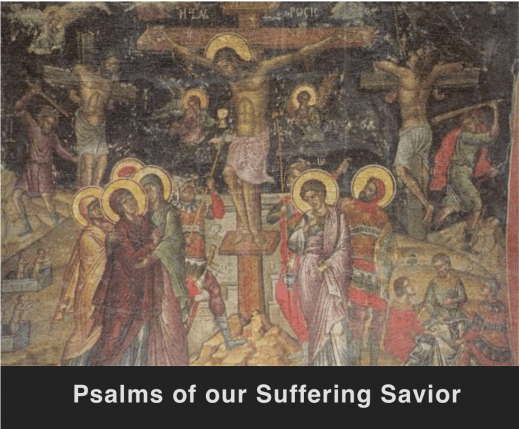
Psalm 22 has an amazing amount of parallels with Jesus’ experience on the cross on Good Friday. It says he is surrounded by rough enemies that want to harm him (v. 12), he is attacked by their words (v. 13), he is exhausted and close to death (v. 14), he experiences fatal dehydration (v. 15), his hands and feet are pierced (v. 16), his bony frame is exposed (v. 17), and his garments are divided and cast lots for (v. 18 cf. Matt. 27:35).[1]
Reading this Psalm you almost expect David to say something close to “Father, forgive them”[2] because the account of Jesus’ crucifixion is foreshadowed so many times (see also Ps. 69:4, 9, 21). Instead, in somewhat of a parallel passage to this Psalm and in great contrast to Jesus, David calls for God’s burning anger to overtake his enemies (69:24), he pleads that God would “add to them punishment upon punishment” (v. 27), and that they would be “blotted out of the book of the living” and “not be enrolled among the righteous” (v. 28).
Messiah Jesus instead Himself receives punishment upon punishment, His life is blotted out, and He joins the unrighteous on a cursed cross (see Is. 53:9 and Matt. 27:38) to save His enemies, those who are far from Him. Jesus is the perfect lamb of God, the lamb without blemish, that takes away the sin of the world (Jn. 1:29; 1 Pet. 1:19).[3]
The Trial and Mocking

See more devotionals in this series here.
Jesus is on trial. He who calmed the storm and reached out and healed lepers is on trial. Jesus could have answered as God had once before when He was questioned. He could have said, “Who is this that darkness counsel by words without knowledge?!” (Job 38:2).
Jesus could have responded: “Where were you when I laid the foundation of the earth?! (v. 4). Do you make the sun rise? (v. 12). Can you send forth lightning? (v. 35). Do you give the horse his might? (39:19). Is it by your understanding that the hawk soars? (v. 26).
And yet the One who created the universe by the word of His power and holds it together (Heb. 1:3), is on trial and even mocked. And the people cry out: “Crucify, crucify Him!”
Jesus is hated without cause (Ps. 35:19; 69:4) and people are wrongfully His foe because He never did a single thing that was wrong (1 Pet. 2:22; Heb. 4:15; 1 Jn. 3:5). And so, because He has never done anything wrong, He is attacked with lies and words of deceit (Ps. 35:20; 69:4). Jesus’ accusers said, “Aha, Aha! Our eyes have seen it!” (Ps. 39:21). But they hadn’t. They hadn’t because Jesus was without sin.
The Betrayal and Rejection

Jesus came to His own people and they did not receive Him (Jn. 1:11). Jesus was hated, rejected, and persecuted (Is. 53:3; Jn. 15:18). His friends abandoned Him (Ps. 88:8, 18; Matt. 26:56), even after making a pledge of undying loyalty. Yet, even while He Himself was being betrayed He protected His friends (Jn. 18:7-8)
Jesus, as Hebrews says, can sympathize with us (Heb. 4:15). He knows what it is like to experience betrayal of the worst kind.
Jesus was troubled in His spirit because one of His dear friends would betray Him. And it’s no wonder that He was troubled. Have you ever been hurt by a close friend? It hurts.
Yet Jesus was betrayed, as the Scriptures said He would be (Jn. 13:18).
Judas, Jesus’ “familiar friend” (Ps. 55:13), betrayed Him with a kiss[1] (Matt. 26:48-49). Jesus used to walk with Judas in the very same garden in which He was betrayed (Jn.18:2-3). Jesus had also recently shared bread with Judas.[2]
Jesus felt the blow of a backstabber but His pain would be far worse than any knife could inflict.
The Cleansing of the Temple
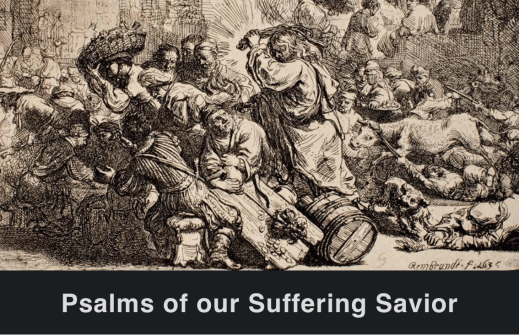
That’s exactly what happened to Jesus. He was consumed by zeal for the LORD’s house.
Can you imagine the scene? The whole city was frantic with excitement and expectation as Jesus came into Jerusalem.[1] Many expected that Jesus would soon bring freedom from Roman oppression and establish a reign of peace. People expected Jesus to ridicule Rome and inaugurate the Jewish state. Jesus, instead, condemns what’s going on in the Jewish temple.
If Jesus’ actions are unexpected it is because of misunderstanding or lack of zeal on our part. What Jesus did is in full agreement with Scripture (cf. Jer. 7:11; Zech. 14:21). The temple was to be a house of prayer, not a “den of robbers” (Is. 56:7). Specifically, the house of prayer is supposed to be “for all peoples” (v. 7). Because of all the selling, however, the court of the Gentiles would have been so filled with commotion that neither Jew nor Gentile would have been able to pray without distraction.
Jesus has concern for the poor, the sick, and the outsider. Jesus stands up for them even to the point of experiencing opposition. “Christ does more than denounce injustice—he takes action against it.”[2] That is good news!
The Hallel Psalms and the Supper

Psalm 115 is part of the Hallel Psalms. Hallel means, “praise.” Jesus would have sung the Hallel Psalms (Ps. 113-118) with His disciples on the eve of Passover.[1] Psalm 114 speaks directly of the exodus. From a New Testament perspective, we know that the salvation which began in Egypt would be finally filled in and through Jesus.
The Hallel Psalms were probably the last psalms Jesus sang before His suffering and death (Mk. 14:26). Jesus would have sung Psalm 115 knowing that He was Himself definitively showing God’s glory, love, and faithfulness. It is amazing also that Jewish people concluded the Hallel Psalms with the prayer:
“From everlasting to everlasting thou art God; beside thee we have no king, redeemer, or savior; no liberator, deliverer, provider; none who takes pity in every time of distress or trouble. We have no king but thee.”[2]
Truly! Apart from Messiah Jesus, there is no “no king, redeemer, or savior; no liberator, deliverer, provider.”
As we see in Psalm 115, idols are inept but God is a God of steadfast love and faithfulness. Whereas idols are inept God is involved. In fact, so involved that He came to this broken world in the form of Jesus Christ.
Idols are silver and gold but God came in flesh. Jesus has a mouth and with it, He spoke words of life. Jesus has eyes, and He saw this broken world and wept. Jesus has ears, and He heard the world’s bitter cries. Jesus has a nose, and He smelled the putrid smell of death. Jesus has human hands, and they were pierced. Jesus has feet, and they carried a cross, and were pinned to a cross. Jesus has a throat, and with it, He cried out: “my God, my God, why have Thou forsaken Me?!”
The Triumphant Entry

In Matthew’s passage about the Triumphant Entry, he quotes from and links to Psalm 118. It is likely that Jesus sang this Psalm, along with the other Hallel Psalms (Pss. 113-18), with the disciples after He instituted the Lord’s Supper (Mk. 14:26). That’s not surprising since Psalm 118 highlights God’s steadfast love and has many Christ connections.
Psalm 118 talks about the gate that the righteous enter through to go into the presence of God (v. 20). That is not a gate that we can open on our own because we cannot be righteous on our own (Rom. 3:10). Actually, the Bible says even the best we can do on our own is like filthy rags (Is. 64:6). We need the righteousness of Jesus Christ (Heb. 10:19-22). Jesus is the gate that gives us access to God the Father (Jn. 14:6), He is the one that makes us righteous.
Jesus was the rejected stone (Matt. 21:42) but He is the Messiah, the cornerstone (Ps. 118:22). All promises rest upon Him (2 Cor. 1:20). When Jesus made His way to Jerusalem, the people cried out: “Hosanna! Save us, we pray, O LORD!” (Matt. 21:9). The people spoke better than they knew. They cried out to Jesus who is God in flesh to save—and He soon would. He would fulfill their prayer to save by answering the next cry of the crowds, that He be crucified.
The Psalm says, “The LORD is God, and He has made His light to shine upon us” (Ps. 118:27). Truly. God in flesh dwelt among us. And yet He was the “festal sacrifice” (v. 27). Jesus is finally triumphant not by overthrowing the Roman government but by overthrowing Satan, sin, and death through His death and resurrection.
An Easter Devotional
I wrote the blog series, “Psalms of our Suffering Savior,” to help us “remember Jesus Christ, risen from the dead” (2 Tim. 2:8).
It is to be used devotionally leading up to Easter (Resurrection Sunday). It is a 12-day devotional that starts with the Triumphant Entry and goes through to the Ascension of Jesus Christ.[1]
In these devotions, we’ll be looking at Psalms that express Jesus’ experience. Jesus “saw in the experiences of David the pattern, writ small, of his own calling.”[2] And as Jesus said, in Luke 24:44 “the Psalms must be fulfilled.”[3]
These devotionals will help us see how it is that Jesus fulfilled the Psalms.[4] And it is quite amazing to see.
Remember “many prophets and righteous people longed to see what you see” (Matt. 13:17)! So, let’s intentionally celebrate and “remember Jesus Christ, risen from the dead”!
If you’re interested in this devotional series, like the Facebook page here or follow the blog via email (look to the right under the search bar) and receive the devotionals that way.
Remember Death by Matthew McCullough

“Even if your life plays out in precisely the way you imagine for yourself in your wildest dreams, death will steal away everything you have and destroy everything you accomplish. As long as we’re consumed by the quest for more out of this life, Jesus’s promise will always seem otherworldly to us. He doesn’t offer more of what death will only steal from us in the end. He offers us righteousness, adoption, God honoring purpose, eternal life—things that taste sweet to us only when death is a regular companion” (Matthew McCullough, Remember Death, p. 25)
“If we want to live with resilient joy—a joy that’s tethered not to shifting circumstances but to the rock-solid accomplishments of Jesus—we must look honestly at the problem of death. That may be ironic, but it’s biblical, and it’s true” (McCullough, Remember Death, p. 27).
“If death tells us we’re not too important to die, the gospel tells us we’re so important that Christ died for us” (p. 28).
McCullough quotes Ernest Becker from his book The Denial of Death: “Man is literally split in two: he has an awareness of his own splendid uniqueness in that he sticks out of nature with a towering majesty, and yet he goes back into the ground a few feet in order blindly and dumbly to rot and disappear forever.” McCullough goes on to say, “There is a massive disconnect between what we feel about ourselves and what death implies about who we are” (p. 68).
“Death says your less important than you’ve ever allowed yourself to believe. The gospel says you’re more loved than you’ve ever imagined” (p. 74).
“Wisdom never pretends things are better than they are. Never shrinks back from acknowledging the harsh realities of life” (p. 87).
“Death has an unmatched ability to expose the flimsiness of the things we believe give substance to our lives” (p. 99).
“Death exposes our idols for what they are: false gods with no power to save” (p. 107).
“It is Resurrection or vanity” (p. 110).
“The God who made us has come to us, entered the darkness we have chosen for ourselves, absorbed the just punishment for our sin in his death, and made new life possible in his resurrection” (p. 113).
“Loss is universal, not exceptional. It’s guaranteed, not unexpected. Every relationship is lost to time. So is every penny of everyone’s wealth, and ultimately so is every life. Loss isn’t surprising. It is basic to the course of every life” (p. 122).
“Life works like a savings account in reverse. Zoomed out to the span of an entire life cycle, you see that no one is actually stockpiling anything… Everything you have—your healthy body, your marketable skills, your sharp mind, your treasured possessions, your loving relationships—will one day be everything you’ve lost” (p. 122-23).
“It’s useful to practice paying careful attention to the experiences of people who have lived before you” (p. 123).
“We need to recognize that our problem is far worse that we’ve admitted so that we can recognize that Jesus is a far greater Savior than we’ve known… Honesty about death is the only sure path to living hope—hope that can weather the problems of life under the sun, that doesn’t depend on lies for credibility” (p. 150).
“The Bible never asks us to pretend life isn’t hard… The Bible never asks us to lighten up about the problems of life” (p. 153).
“Death-awareness resets my baseline expectation about life in the world” (p. 160).
“The brokenness I experience—the frustration, disappointments, dissatisfaction, pain—is not a sign of God’s absence. It is the reason for his presence in Christ” (p. 160).



 in X
in X 