18 of my favorite books I read in 2018
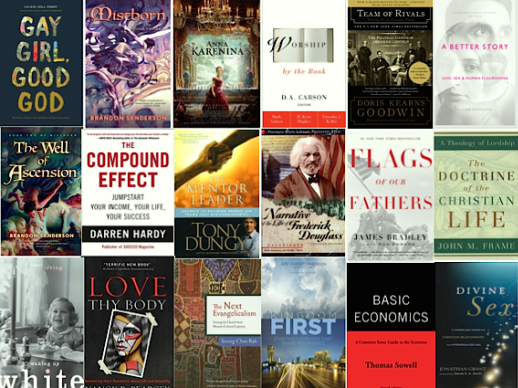
Here are my 18 favorite* books I read in 2018 (in no particular order**):
- Frederick Douglass, Narrative of the Life of Frederick Douglass
- John Frame, The Doctrine of the Christian Life
- Nancy Pearcey, Love Thy Body
- Zach Eswine, The Imperfect Pastor
- Darren Hardy, The Compound Effect
- Leo Tolstoy, Anna Karenina
- Tony Dungy, The Mentor Leader
- D.A. Carson, Worship by the Book
- Brandon Sanderson, The Final Empire
- Thomas Sowell, Basic Economics
- Jackie Hill Perry, Gay Girl, Good God
- James D. Bradley, Flags of our Fathers
- Doris Kearns Goodwin, Team of Rivals
- Brandon Sanderson, The Well of Ascension
- Jeff Christopherson, Kingdom First
- Debby Irving, Waking Up White
- Jonathan Grant, Divine Sex: A Compelling Vision for Christian Relationships in a Hypersexualized Age
- Soong-Chan Rah, The Next Evangelicalism
And here are a few runner-ups…
8 Reasons we need to learn from the Old Testament

If we have the New Testament why do we need the Old Testament?
- All Scripture is inspired by God and profitable (2 Tim. 3:16), not just the texts we like to read.
- All the promises of God find their answer in Jesus so it is important that we understand what the promises are (2 Cor. 1:20).
- When Paul preached to the Ephesian church he preached the whole counsel of God (Acts 20:27) and the whole counsel of God points us to Jesus (Lk. 24:27).
- When Stephen preached in Acts chapter seven he preached the Old Testament (see also the other sermons recorded in the New Testament) which demonstrates the vital importance of the Old Testament.
- The things in the Old Testament serve to instruct us and set an example for us (Rom. 15:4; 1 Cor. 10:11).
- When Paul ministered to churches one of his ministries was proving that Jesus was the Promised One, the Christ (Acts 9:22). Paul demonstrated the amazing truth that Jesus is the long-awaited Messiah by teaching the Old Testament. We see this all through Acts (Acts 9:22; 13:16ff; 16:13; 17:3, 17; 18:4-5, 19; 19:8ff; 24:25; 26:6, 22-26; 28:23, 31 cf. 18:28). We too must understand what it means that Jesus is the Messiah and that will require learning from the Old Testament.
- Much of the New Testament assumes knowledge of the Old Testament.
- Scripture is so good we need as much of it as we can get, Old Testament or New. Scripture is perfect (Ps. 19:7), true (Ps. 19:9), pure (Ps. 19:8), a light (Ps. 119:105,130), a sword (Eph. 6:17), a hammer (Jer. 23:29). It is better than gold (Ps. 19:10; 119:72) and we need it to live (Ps. 119:144). Scripture gives joy (Ps. 119:111; Jer. 15:16), makes wise (Ps. 19:7), guards (Ps. 119:9), guides (Ps. 73:24; 119:105), sanctifies (Ps. 119:9, 11).
Read and study the Old Testament along with the New. 🙂
5 Reflections on Zack Eswine’s book, The Imperfect Pastor

Here are a few things I really appreciated from Eswine’s book:
1. Eswine points out that “We’ve grown reactive, consuming of others, and hasty, and all of this for God. This means that we are likely to mentor others into these qualities as well” (149). Sadly, I see this propensity in my own life. My thinking sometimes goes, go, go, accomplish, accomplish, accomplish. Eswine reminds me of the importance of embodied presence. Even when it seems less efficient.
2. I can be envious of other places and other people. When I read this from Eswine it convicted me: “Please forgive me. I have prayers to say for persons you’ve never heard of. I’d best get on with this good work of the day. You’d best get on with yours too” (145). How true! I’m abrogating my responsibilities when I’m envious of someone else’s responsibilities. I shouldn’t envy other people for the places they serve. And I shouldn’t envy others for the gifts they have either. I found this helpful to reflect on too: “Anything another minister does well becomes an occasion, not for our gratitude to God for the sake of the other minister and the cause of the gospel in our generation, but a reason for us to wring our hands and pressure ourselves because now we too must equal or better what that other minster can do” (145). This should not be so. I should rejoice at the gifts and abilities of others.
3. Eswine reminded me of the broken nature of all people, spiritual leaders included (Cf. 100-101). Noah had courage and faith as well as a lapse of drunkenness. Abraham is remembered and honored for his faith but he sometimes acted in selfish fear. Moses led courageously but he also murdered, shrank back in fear, and his bursts of anger cost him dearly. We sing songs that David pinned but we also read of the chaos he wrote. Jonah preached and many turned in repentance to God but Jonah raised his fists at grace. James and John were close to Jesus (and they wanted to be at His left and right hand), so close that Jesus gave them a nickname—“sons of thunder.” Paul teaches us and tells us of transforming grace, grace he himself experienced as an accomplice to the first Christian martyrdom. Peter boldly exalts Christ but he also repeatedly and cowardly denied him. We too are like the heroes of the faith. We are struggling saints and sinners.
4. I think this quote gets at one of the most helpful things in the book: “We cannot do everything that needs to be done, which means that Jesus will teach us to live with the things we can neither control nor fix. We will want to resist Jesus and act as if we are omnipotent, but we will harm others and ourselves when we try” (99). It is vital that I remember that “sickness, death, poverty, and the sin that bores into and infests the human being will not be removed on the basis of human effort, no matter how strong, godly, or wise the effort is” (97). I must humbly recall “There is nothing we can do in ministry that does not require God to act, if true fruit is to be produced (John 15:5). Everything pastors hope will take place in a person’s life with God remains outside the pastor’s own power” (97). These truths are humbling but they are true. They are also comforting. I don’t have to be the Lord, I can’t. I’m not. I need to repent of even trying. And I need to rely on and pray to God for help.
5. I grew up in a small poor town. And I left as soon as I saved up enough money to do so. I was nineteen. Yet, as Eswine says,“The Holy One of God has a hometown” (76). The Holy One of God inhabited a locality on earth. He limited Himself to a specific place at a specific time. And in many ways, His hometown was a small poor town. It’s wild and powerful to think about Jesus walking those streets and working as a carpenter. And He did so for thirty years. “Jesus had a world to save, injustice to confront, lepers to touch. Isn’t greatness for God squandered by years of obscurity? What business does a savior have learning the names of trees?” (77) I need to learn from Jesus. I need to be satisfied and faithful no matter the season. I need to remember that the poor small town that I grew up in is not insignificant. I also need to trust my Father’s will for my life, whatever that looks like.
How to Keep Christ Central this Christmas Season

Christians often say, “He is the reason for the season,” which is true. Yet, it is easy in the “hustle and bustle” of the holidays for that not to ring true in our homes. So, here are some suggestions I have complied to help you keep Christ central this holiday season…
Give God a Gift
The notion of giving God a gift may sound funny since it is He that is the “giver of every good gift” (James 1:17 cf. 1 Cor. 4:7). Yet the Bible certainly gives us precedence for giving God gifts, from Abel offering gifts to God (Gen. 4:4) to Paul’s exhortation in Romans 12 for us to offer our bodies as living sacrifices in light of all His goodness to us.
So, this holiday season give the LORD a gift. No, He does not need it. But He does deserve it and it is thoroughly biblical. When we give gifts to God it gets our mind on God (Matt. 6:21). Here are a few ideas: Fast. Fast one of the holiday feasts. Not for the purpose of limiting your caloric intake but because you want to focus and intentionally praise the one who is “the reason for the season.” You could also give a financial gift to your church or other good ministry. Use your creativity and give a gift that you believe God would appreciate.
Read the Christmas Story on Christmas Day
Reading the Christmas story on Christmas is a super good thing to do if the whole season is supposed to be about the coming of the Messiah Jesus. I would personally chose Luke 1:5-2:20. I would also suggest singing a hymn and offering a prayer of thanks too.
Set up a Nativity Scene in your Home
This is a helpful visual representation of what the holiday season is really all about. The One who created the world—the One who was in the beginning with God—the One who made all things and holds all things together—He became flesh and dwelt among us. When we see the nativity scene we can rejoice that God waded into this broken world to redeem it.
How should Christian art be informed by the Christian worldview? (part 6)

In the last post in this series we considered Christ. In this post, we are going to…
Consider our Current Condition
It is important for us to correctly situate ourselves within our current condition. We, for instance, do not want to place ourselves within the new creation when we are still reeling from the crash. In the same way, we don’t want to forget that Christ has came. We need to understand our current condition. We do not want to have an “over-realized eschatology” or an “under-realized eschatology.” We want to correctly grasp our situation and communicate the struggles and hopes that we have to the world.
Steve Turner has said, “It is not Christian to make art that assumes that the world is unblemished.”[1] It’s certainly true that the Kingdom has come in God’s Son. The light is shining and the darkness is passing away (1 Jn. 2:8) but it hasn’t passed away yet. We still live in a fallen world. Soon the darkness will be forever gone (Rev. 22:5) but for now it’s an element in our reality so to paint or portray reality means including “darkness.” Read More…
20 Observations from Genesis 1-3

Gen. 1:1—We see the answer to our and the universes origin (and logic, math, science, etc.).
Gen. 1:24-25—We see where the different “kinds” of animals came from. It sounds like God made each different “kind” or type of animal with enough genetic code to produce all the different types of that kind but that they would stay with that “kind” or genetic code. There are similar genetic trademarks between each “kind” yet don’t overstep their kind. This is because they are made by the same Maker and He left the same stamp of intelligence on each of them.
Gen. 1:26-27—Humans have worth and should not be disregarded. From here we see humans have great potential. We also see grounds here for the immorality of mistreating humans. (People have argued that the idea of human rights came from the Christian understanding that all humans are made in the image of God).
Gen. 1:28-30 cf. 2:15—We see a call to stewardship and industry; something that has always been important for survival and compassion.
How should Christian art be informed by the Christian worldview? (part 5)

We have made some important observations about how the Christian worldview impacts Christian art. Most recently we considered the crash and the impact that the view of the Fall of humanity has on our perspective of art. In this post, we are going to briefly…
Consider Christ
After the crash of creation, after the curse was introduced, there was a promise of a deliverer that would set all right again. At first, the promised offspring (Gen. 3:15) was vague; in fact, Eve rejoiced because she thought she had the offspring (4:1) but it was all for naught because Cain was the offspring of the serpent and killed his brother.
However, later on, we see Him who even the prophets longed to see (Matt. 13:17), we know that all Scripture finds its fulfillment in Jesus who is the long awaited Messiah (2 Cor. 1:20). The one that will crush the curse and bring in the new creation.
The Bible is a true story about God making the world, man messing it up, and God becoming a man to fix the world by not messing up. It is a story of Eden—exile—repeat. It is not until the true Adam, the true and righteous Son of God—Jesus—comes that this process is broken. All of Christ’s predeceases fell short; Adam, Noah, Abraham, Saul, David, Solomon, and the lambs, priests, and prophets could not fill Christ’s role.
Through Christ we see what God has done to put things right. Christ hung, outstretched on the tree, and bore the curse and will come again to bring His eternal reign when peace will be pervasive and joy will be tangible.
Jesus is the hero of the story. He takes upon Himself the curse and brings the new creation and friendship with God that we all yearn for.
The Cosmic Creator that flung the stars in place and knows them all by name cares to the point of crucifixion. He is the author that writes Himself into the story. He makes, He comes, He dies, and He rises again. And He’s coming back to recreate the world.
Observation: In Christ, first we see our Savior, but we see also see a profound example. Christ’s character as seen in the Gospels is one of creativity and compassion. He is expressive and real. He is harsh and gentle.
Christ was honest about the reality of our current condition. He didn’t lighten the realities of the crash and the catastrophes that it created. However, He wasn’t hopeless either. He brought the world the solution it needed: Himself.
We too must understand our current condition and honestly and creatively communicate truth to the world.
Jesus’ death was ugly, anything but physically beautiful. It was gruesome, even embarrassing. Yet, in His death and resurrection Jesus composed the best victory in the history of literature—The God Man died for the sins of the world and rose again in victory.
Genesis
Introduction
I use to do construction and I remember my boss telling me that if you get something plumb, straight up and down, then it would go all the way up to the moon forever. But if you get it wrong by just a little bit than you are going to be off by a lot in the end. What you do in the beginning has a big impact on where you end up. It is the same with the Bible. The book of Genesis is very foundational. Without a good grasp of Genesis the rest of our theology will likely crumble to the ground and be worth nothing. So much is built on it. If we are off here, we are going to be way off down the road of the Bible.
There are many “plot conflicts” in the book of Genesis. They will serve as our compass to find our way through the huge book that is Genesis. Leland Ryken has wisely said “Stories are always built around plot conflicts. These conflicts progress toward some type of resolution… Noting plot conflicts is one of the best ways to organize a story, either in the actual process of reading or when talking about the story” (How to Read the Bible as Literature, 41). So, there are three things I want to pay careful attention to and note their expansion in the rest of Scripture and their fulfillment through or in Jesus the Christ.
Here are a few of the themes that are the building blocks of the theology of Genesis (NDBT, 140) and in many ways the whole Bible: (1) The promise of seed, i.e. offspring, (2) the promise of land, and (3) the promise of being a blessing to the nations (see esp. 12:1-3). All of these themes are in embryonic form in Genesis chapter three and expand through the rest of the book. They continue to expand through the Old Testament but don’t find their true fulfillment until the New Testament and the coming of the Promised One. Truly, even then, in the New Testament, there is still an element of the “not yet” until in Revelation all things are made new.
18 Quotes from Dave Harvey’s book Rescuing Ambition
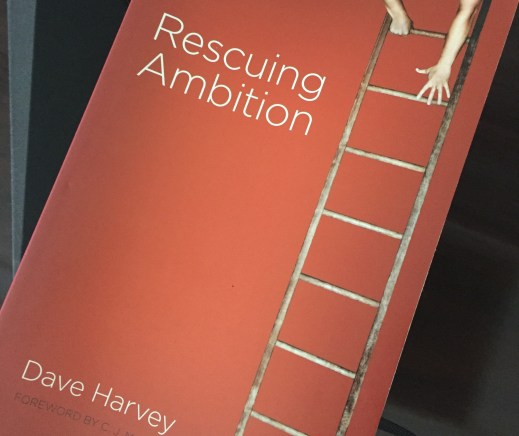
1. “Our search for approval is over. In Christ, we already have all the approval we need” (Dave Harvey, Rescuing Ambition, p. 56).
2. “My search for approval is over. In Christ I already have all the approval I need.
Because Christ’s righteousness has been transferred to me, all the time and energy I once squandered trying to be liked or praised or to achieve something to validate my existence can now be re-directed toward doing things for God’s glory. I no longer live for approval; I live from approval” (Harvey, Rescuing Ambition, p. 56).
3. “God loves good ambition. It brings him glory as he works through our desires to fulfill his purpose. God doesn’t need us, but amazingly he uses us. But to position us for fruitfulness, he’s continually working in our lives, turning our desires toward his ends and developing our ambitions and accordance with his will” (p. 74-75).
20+ Quotes from Zach Eswine book Preaching to a Post-Everything World

1. Zach Eswine quotes Francis Schaeffer as saying, “First of all, man is separated from God; second, he is separated from himself (thus the psychological problems of life); third, he is separated from other men (thus the sociological problems of life); fourth, he is separated from nature (thus the problems of living in this world—for example, the ecological problems). All these need healing” (p. 42).
2. “Beginning with sin instead of creation is like trying to read a book by opening it in the middle: they don’t know the characters and can’t make sense of the plot” (p. 44).
3. “In Eden person were created for:



 in X
in X 