Church Discipline

Introduction
The subject of church discipline is a difficult but important one. Many things must be understood regarding church discipline if we are going to faithfully carry out the task that Jesus has given to His Church.
Is church discipline culturally acceptable? Many people may say that church discipline is not acceptable now; however, that is not the question. There are many things that are not acceptable to our cultural but that does not make them right or wrong. The cross is not acceptable, it is foolishness! Yet we must never deny it. The question is rather: “Is it biblical?”
So, is church discipline biblical?
Yes. Although, if you search for “church discipline” in your Bible it won’t return any results. But the teaching is there. It is found in both Matthew 18 and 1 Corinthians 5.
Church Discipline in Matthew 18
In Matthew 18, we see the fourfold process of church discipline. It has been said that this passage is “severely practical as well as ruthlessly idealistic,” and so it is. So, this process, though used in formal church discipline, has practical insight for more common issues within the church as well.
If there is unrepentant sin, we are to first go to the offending party one on one and try to work things out on that level (Matt. 18:15-16). If we have not resolved the problem at that point, second, we are to go with one or two others (v. 16). Third, we see if the person does not listen, we are to tell it to the church (v. 17a) but if he or she is still impenitent then, fourth, he or she is to be treated like those outside of the church, i.e. excluded from communion (v. 17b). The next couple of verses talk about the authority that God has entrusted to the church, His representatives on earth.
Church Discipline in 1 Corinthians 5
Paul is adamant that he does not want the “so-called brother” to have community with the church (cf. 1 Cor. 5:5, 11, 13). Perhaps the three other steps of the church discipline process happened or perhaps they did not for whatever reason, that we cannot tell, but we do know that there certainly are times when it is appropriate to exclude people from church fellowship. The case in Corinth was clearly one of those times. Thus we see that the passage is not necessarilyprescriptive, unlike the principals laid down in Matthew 18, but descriptive. That is, Paul is writing a letter to tell the Corinthians what to do in that context at that time.
Putting Matthew 18 and 1 Corinthians 5 Together
I conclude from the two passages briefly looked at that pastor/shepherds and the church as a whole are to use biblical loving wisdom in each church discipline case. There is in fact no “cookie cutter mold” for each case but simply overarching principals to be applied to each different situation.
For instance, there are many passages that seem to reference church discipline besides Matthew 18 and 1 Corinthians 5 but some of them look quite different (Acts 8:17-24; Gal. 6:1; Eph. 5:11; Titus 3:10; 2 Thess. 3:14-15; 2 Jn. 9-10). Many of Paul’s letters deal with discipline and correction yet they look very different depending on the situation. Paul was always pastoral and wise in the way that he handled each situation (cf. Rom. 15:1; 1 Cor. 13:4-7; 1 Thess. 5:14; 2 Tim. 4:2).
Look, for example, at 2 Thessalonians 3:14-15: “If anyone does not obey what we say in this letter… have nothing to do with him, that he may be ashamed. Do not regard him as an enemy, but warn him as a brother.” Paul says, “Have nothing to do with him” yet “warn him as a brother.” It is unclear what exactly this looked like in practice but it seems to me that it is a different approach to that in 1 Corinthians 5.
What I conclude then, is that church discipline is an important and clear teaching from Scripture. It, however, is not always as clear exactly how it should look in the local body in each specific case. So after we boil down all we have seen in these passages what are some overarching principals to keep in mind? (1) Keep the matter as private as you can. (2) Church discipline is done as an act of love to keep the individual from damning sin. (3) Church discipline should always be done with gentleness and love though that is not to say without boldly calling the erring person to repentance. (4) If unrepentance continues the person must be removed from the church. (5) Church discipline is ultimately done for the glory of God. We desire that Jesus’ bride be pure and holy (cf. 2 Cor. 11:2; Eph. 5:25-27).
I believe we see from the collective passages that reference church discipline, that there is no exact formal that most always be followed. There are, however, principals laid down and a clear call to practice church discipline whatever each individual case might entail. Thus, in evaluating church discipline cases we do not simply have a list of sins, some warranting discipline and others not. Rather, we look at the witness that the person has before a lost world. We ask, Are they defacing the name of Jesus?
Jonathan Leeman talks about “A Gospel Framework for Understanding Discipline.” I think he gives a very helpful approach. The Church, as God’s representatives on earth, have been given the “keys to the kingdom.” The local church and the leaders within that church have been given the serious task of administering baptism and the Lord’s Supper. These things give credibility to the genuineness of one’s faith. In the same token, church discipline is the church removing that affirmation. It is the church formally denouncing the person’s faith. Thus, as Jonathan Leeman rightly says, church discipline is “driven by a single question: does the church still believe an erring member is really a Christian, such that it’s willing to continue declaring so publicly?”
The Manner and Motivation of Church Discipline
How should we approach church discipline? We must do so with much gentleness and humility (1 Thess. 2:6-7; 2 Cor. 10:1; Col. 3:12-14; 2 Tim. 2:24-25; Phil. 4:5). We must remember that we too are sinners, we are not above the very same sin they are being disciplined for. That is why Paul says, “If anyone is caught in any transgression, you who are spiritual should restore him in a spirit of gentleness.” And then he says, “Keep watch on yourself.” Why Paul? (we ask), “Lest you too be tempted” (Gal. 6:1). We, you and I, are not above sin, any sin, and we should not act as if we are. As Paul says elsewhere, let the person that thinks they stand take heed lest they fall (1 Cor. 10:12).
We must remember that the goal in church discipline is restoration. We want those living in sin to repent and once again join the fellowship. If they do repent then we, as the church, must cheerfully welcome them back (I think of the prodigal son here). Notice, that after Jesus teaches on church discipline in Matthew’s Gospel he teaches on forgiveness (Matt. 18:21-35).
Conclusion
We may not have an exhaustive how-to-book on church discipline but we are given principals that can and indeed need to be applied in each individual case. We, as the church, are God’s representatives on earth and so we must seek to have His church be holy and filled with true followers of Christ. Therefore, as is warranted by the situation, we must practice the steps outlined in Matthew 18, though of course with appropriate Christian sensitivity.
Suggested Resources
Why are we facing times of difficulty?

Paul tells us in his letter to Timothy that “Times of difficulty will come” (2 Tim. 3:1). Why? “For people will be…” People will be a lot of things… There are nineteen descriptions given.
It’s interesting to note that four of the nineteen descriptions are compounded with love. People will be “lovers of self, lovers of money,… not loving good,… lovers of pleasure” than it says, “rather than lovers of God.” These people love but it’s the wrong love. “What is fundamentally wrong with these people is that their love is misdirected.”[1]
When people are “proud, arrogant, abusive, disobedient to their parents, ungrateful, unholy, heartless, unappeasable, slanderous, without self-control, brutal, treacherous, reckless, and swollen with conceit” it is because of a worship problem. It is because they love themselves and not God.
The Regulative and Normative Principles of Worship

Brief History of the Principles
Humans have been worshiping and thinking about worship since the beginning. We see this, for instance, by looking at the narrative of Cain and Abel in Genesis 4. Further, all of life is about worship.[1] The question we are considering here, however, is how are we to formally worship God as the gathered church?
The two classic Protestant views of worship are the normative principle of worship and regulative principle of worship. There is a lot of confusion as to what these principals mean and how they are worked out in the life of the church. For example, an article online said that those who hold to the regulative view do not use instruments in their church services.[2]
8 Quotes from *Simple Church* by Thom Rainer and Eric Geiger

Why do we worship?

If “worship” means singing songs of praise, as “worship” is very often used, then here are some goals of worship: We strive to build each other up (1 Cor. 14:26), be filled with God’s Word (Col. 3:16), be filled with the Spirit (Eph. 5:18ff), be a testimony to an unbelieving world (1 Cor. 14:24-15), and gives thanks to God for all He is and has done for us (Eph. 5:20). It is our joy to sing but we are also commanded to sing (e.g. Ps. 100:1-2). Singing is serious.
We do not, however, want to worship God merely in song for if our worship is only in song it is not true worship. We show what we worship by what we give worth. Jesus said, where your treasure is your heart will be also. Jesus said that we cannot serve two masters, but we will serve one. So, worship is inevitable; it is not a matter of if but of what or who. We will serve one or the other. We will worship.
10 Quotes from Greg Gilbert’s book *What is the Gospel?*

- “An emaciated gospel leads to emaciated worship. It lowers our eyes from God to self and cheapens what God has accomplished for us in Christ. The biblical gospel, by contrast, is like fuel in the furnace of worship. The more you understand about it, believe it, and rely on it, the more you adore God both for who he is and for what he has done for us in Christ” (Greg Gilbert, What is the Gospel, p. 21).
- “That I have rebelled against the holy and judging God who made me is not a happy thought. But it is an important one, because it paves the way for the good news” (30).
- “Nobody wants a God who declines to deal with evil. They just want a God who declines to deal with their evil” (44).
- “Since the very beginning of time, people have been trying to save themselves in ways that make sense to them, rather than listening and submitting to God” (102).
- “If we say merely that God is redeeming a people and remaking the world, but do not say how he is doing so (through the death and resurrection of Jesus) and how a person can be included in that redemption (through repentance from sin and faith in Jesus), then we have not proclaimed the good news. We have simply told the narrative of the Bible in broad outline” (107).
- “The message of the cross is going to sound like nonsense to the people around us. It’s going to make us Christians sound like fools, and it most certainly is going to undermine our attempts to ‘relate’ to non-Christians and prove to them that we’re just as cool and harmless as the next guy. Christians can always get the world to think they are cool—right up to the moment they start talking about being saved by a crucified man. And that’s where coolness evaporates, no matter how carefully you’ve cultivated it” (110).
- “Sins don’t shock us much. We know they are there, we see them in ourselves and others every day, and we’ve gotten pretty used to them. What is shocking to us is when God shows us the sin that runs to the very depths of our hearts, the deep-running deposits of filth and corruption that we never knew existed in us and that we ourselves could never expunge. That’s how the Bible talks about the depth and darkness of our sin—it is in us and of us, not just on us” (54).
- “It is only when we realize that our very nature is sinful—that we are indeed ‘dead in our trespasses and sins,’ as Paul says (Eph. 2:1, 5)—that we see just how good the news is that there is a way to be saved” (55).
- “Faith and repentance. That is what marks out those who are Christ’s people, or ‘Christians.’ In other words, a Christian is one who turns away from his sin and trusts in the Lord Jesus Christ—and nothing else—to save him from sin and the coming judgment” (73).
- “If you are a Christian, then the cross of Jesus stands like a mountain of granite across your life, immovably testifying to God’s love for you and his determination to bring you safely into his presence” (117).
Is abortion morally justifiable?

Background of Roe vs. Wade
Roe v. Wade was decided 46 years ago on January 22nd 1973 by a vote of 7 to 2[1]. The court affirmed the legality of a woman’s right to have an abortion. The court held that the some of the Texas statutes violated the right of privacy. They held that a woman has a right to have an abortion under the Fourteenth Amendment to the Constitution.[2] Since then there have been approximately 61million surgical abortions in the United States.
Justice Henry Blackmun wrote an opinion that stated that the restrictive abortion laws (from Texas and Georgia) were unconstitutional.[3] “Blackmun’s opinion stated that because of uncertainty about the medical and moral status of the fetus, the state could not adopt a particular theory of when life begin—they could not decide, for example, that because life begins at conception fetuses have the same rights as newborn infants.”[4]
Although some deny that Roe established a right to abortion on demand, that was its practical effect, as The Oxford Companion to the Supreme Court of the United States says.[5]
The Natural Perspective on Abortion[8]
We live in a country that is extremely cautious about labeling everything; least something so terrible happen as someone burn their tongue on hot coffee or slip and fall on a slippery floor. We want to protect ourselves from lawsuits but we also want to protect human life.
We live in a country where the height and depth of our steps are regulated, where when our building and property isn’t up to code if it doesn’t have a certain height of handrail. We are cautious people.
We enforce speed limits and fine jaywalkers. We take precautions and enforce caution. We have an administration that monitors our food. We do this to protect our tongues, our bellies, and our lives.
Yet, we also throw caution to the wind as a country. We say we don’t know when a human baby becomes a human baby and so abortion has free reign. Michael S. Gazzaniga, professor of psychology at the University of California, said in an article in the New York Times that “We all seem to be in agreement that there must be a point at which moral status should be conferred on an embryo or fetus.”[9] What we don’t agree on, however, is when that moral status should be conferred.
It seems to be though, that in America we rightly side on the side of safety. It seems wiser and more in line with what would seem is the American conviction to say if we don’t know when life begins we should be cautious. After all, we enforce the height of handrails and fine jaywalkers so it seems unreasonable to not be cautious in regard to the most vulnerable. However, it seems in our country that “have it your way” is more important than caution when it comes to unborn humans.
People often bring up the fact that “we don’t know when life begins” but in light of the precautions we take all across America that is really a non-issue. Our government regulates where we can cross the road for safety’s sake but is not safe or cautious with regard to the “intersection” of abortion.
We must take “due diligence” in other matters or be held morally responsible because if we don’t we are morally responsible. To not be “safe” and “cautious” in regard to human life we know is wrong. In America, we have reduced speed limits outside of schools because we desire to do due diligence and protect our children and youth. We enforce lower speed limits near schools not because we know someone will get killed if we drive above a certain speed but because life is precious and we thus take precautions to protect it.[10]
The sentence for vehicular manslaughter in a school zone is obviously a worse offense then if the manslaughter happened outside of the school zone. In fact, if the manslaughter happened in a school zone it can take the charge from second degree to first degree. Yet, in the example of the first degree and second-degree manslaughter the guilty person did not necessarily proactively act upon or intentionally kill yet they failed to do due diligence and be cautious and thus they are rightly held accountable.
In other words, what should stop “pro-choice” people from being “pro-speeding-in-school-zone” people? There are some choices we don’t have. And shouldn’t have. We shouldn’t have the right, and don’t have the right, to speed in school zones. We shouldn’t, but do, have the right to destroy unborn babies. We sadly have the right to abandon caution and crush small human skulls within the protective womb of a mother because we are not sure that what is inside the mother’s womb constitutes human life. When we are “unsure” in any other case, we would “err on the side of caution.”
We have briefly considered what I have labeled a natural argument against abortion. We seek to protect life in all sorts of circumstances even though we don’t know when a certain situation will be lethal or not so that same logic should apply to abortion. If abortion could possibly destroy human life than it is morally unacceptable.
Now let’s turn to the…
The Biblical Perspective on Abortion
As we have already seen, Genesis 1:26-27 tells us we are created in the image of God. Second, Exodus 20:13 tells us, “Thou shall not murder.”
However, are these texts enough? Or could people object that that is all well and good but what is inside a woman’s womb is not a human? What can we say about that question from Scripture?
Exodus 21:22-25 says: “When men strive together and hit a pregnant woman, so that her children come out, but there is no harm, the one who hit her shall surely be fined, as the woman’s husband shall impose on him, and he shall pay as the judges determine. [23] But if there is harm, then you shall pay life for life, [24] eye for eye, tooth for tooth, hand for hand, foot for foot, [25] burn for burn, wound for wound, stripe for stripe” (See Grudem, Politics According to the Bible, 159-60, 160n2 and Frame, The Doctrine of the Christian Life, 718-21).
There are quite a few things to note on this significant passage. Notice what the result is if there is no harm to the child (see v. 22)? Just a fine. However, what happens if there is harm? “Life for life,” it says. Notice that this still means it is an accident (the men were striving together and hit a pregnant woman) but the punishment is still “life for life.” The baby inside the pregnant woman’s womb is seen as human life. In other cases of accidental manslaughter, this was not the mandate but provision of “house arrest” and protection was made. Therefore, this shows the seriousness of protecting unborn life. If God has such hatred for the accidental death of an unborn child what is His reaction to intentional death? (see Jer. 7:30-34).
Psalm 51:5 says: “Behold, I was brought forth in iniquity, and in sin did my mother conceive me.” Remember the context? David is repenting of his sin. What is David saying here? He is saying he has a sinful nature inherited from Adam. He is not saying it was his mother’s fault. Note, “Sin in Scripture is a personal quality, never an impersonal one. It is never a property of things, only of persons” (Frame, DCL, 722). Thus, we see here a very strong argument for personhood beginning at conception. If he had a sin nature in his mother’s womb then it follows that he was a real human being with a soul. “Fetal tissue” or any type of tissue or an inanimate object for that matter are not sinful, people alone are sinful. Do you see the conclusion here? David was a person, a real human person, in his mother’s womb.[11]
We see in Scripture that we should take precautions so as to avoid the possible destruction of life. Deuteronomy 22:8 says: “When you build a new house, you shall make a parapet for your roof, that you may not bring the guilt of blood upon your house, if anyone should fall from it.”
Thus, even if you are not entirely persuaded by these arguments the principle that we see in Scripture should lead you to not agree with abortion. As Frame says, “Even if the above arguments are only, say, 80 percent certain, they make it highly probable that abortion destroys human lives. And God’s law clearly tells us not to take that risk. So our practical response should be exactly the same as if we were persuaded 100 percent.”[12]
To illustrate this point imagine I go hunting with you. We go out into the thick woods and after a while I hear rustling in the grass so I do what any hunter should do, I don’t hesitate, I point in that general direction, and fire a few shots hoping I hit my intended target. Would you hunt with me very long if that was my practice? No, because you would be either too scared or dead. Do you see the principal? You don’t just shoot at any rustling noise because a human could be making the noise and not a deer. We take precautions to protect life!
The United States Military goes by an ROE (Rules of Engagement). They, for instance, have to have positive identity before they engage an enemy force. Or they have to use escalation of force. Our military personnel take great precautions to not destroy innocent life, even to the point of putting their own self in great harm, and yet in our own country we do not take these same precautions with our unborn. We do not have “positive identity” and yet many are okay with taking life. Should we not rather take great precautions even if we are not exactly sure when life begins? If we as a country make people put handrails up on their own house and enforce all sorts of other codes, should we not also protect the unborn even if there is disagreement when life begins?
It is also important to consider DNA. John Frame points out that “From the point of conception, unborn children have a full complement of chromosomes… Therefore, the child is not ‘part of his mother’s body.’ His genetic makeup is different from hers. So we should not treat the unborn child as we treat hair or fingernails, or even as we treat organs like the gall bladder or liver. The unborn child is a separate and unique human being.”[13] It is also important to note that a baby’s heartbeat begins on the 21st day after conception.
Some say the problem is that the child is dependent on the mother and that the mother then has the choice to abort. Yes the child is dependent on her mother yet the child will also be dependent after she is outside of the womb and that in no way gives her mother the right to kill her. Though there are helpful scientific observations, “Personhood is a metaphysical, religious, theological, and ethical category, not a scientific one. There are no scientific observations or experiments that can detect a difference between a person and a nonperson.”[14] Yet, as we saw above, if we have a ROE for combat how much more should we go to great lengths to protect unborn human life?!
What about pregnancies resulting from rape or incest? These situations, though few (around 1% or less of all abortions), should be treated with much sensitivity and love. However, the child should not be punished for the sin of the father (Deut. 24:16).[15]
The Sanctity of Human Life
Human life is sacred. This truth is grounded in the Bible. The Bible teaches us that humans are made in the image of God (very often referred to by the Latin imago Dei). This truth is seen in various places in Scripture (Gen. 1:26-27; 5:1-3; 9:6; 1 Cor. 11:7 Col. 3:10; James 3:9) but the most prominent is Genesis 1:27: “God created man in His own image, in the image of God He created him; male and female He created them.”
So, Christians are called to have concern for and show compassion to all people. Humans–all humans–have great worth! We have worth beyond what we do, we have worth in who we are. We also are to follow the model of Jesus who showed concern for all people.
The Christian Call to Action
The Bible calls us to action. The Bible calls us to stand up for the oppressed (Is. 1:17) and to speak for those who cannot speak (Prov. 31:8-9 cf. 3:27).[6]
God clearly condemns injustice (Ps. 9:8, 16; 10:16-18; 11:7; 33:5; 36:6; 37:6; 45:6; 101:1; 103:6; 106:3; 112:5; 140:12; 146:5-10; Prov. 18:5; 21:15; 29:7; Is. 1:17; Is. 9:7; 30:18; 42:1; 51:4-5; 56:1; 58:6; 59:15; 61:8; Jer. 21:12; 22:13; Ezek. 34:16; Hosea 2:19; 12:6; Amos 5:21-24; Micah 6:8; Zech. 7:810; Matt. 12:18; 23:23; Lk. 11:42; Rom. 3:22-26; Rev. 19:11). God loves justice and, conversely, hates injustice. God has compassion for those who suffer injustice—everywhere around the world; He judges and condemns those who perpetrate injustice, and He seeks active rescue for victims of injustice.[7]
1 John 3:18 exhorts us: “let us not love in word or talk but in deed and in truth.” So, we must not just talk but we must also act. But, we must act with compassion and care. We must extend grace and kindness to people.
We mustn’t have a holier-than-thou mindset that sets us up as perfect. That is far from the truth. We all do wrong. The Bible says everyone is a sinner. But it also thankfully says that whosoever goes to Jesus in faith and repentance can receive new life and be saved by the grace of God. 1 John 1:9 gives us all hope: “If we confess our sins, He is faithful and just to forgive our sins and to cleanse us from all unrighteousness.”
We must extend grace, forgiveness, and hope to those who have had an abortion. How can we not extend grace when God has extended such lavish undeserved grace and kindness to us?! (see e.g. Matthew 18:21-35)
Conclusion
Christians are called to love and compassion. We are to love and extend tinder care to people who have had abortions, are thinking about it, or those who are going to have an abortion or abortions. We, however, are called to speak out against injustice. This will require prayerful wisdom and dependence upon the Holy Spirit; but we must, as our faithful predecessors (like John the baptizer and the Apostle Paul), stand up for justice. And we must do so with grace and candor knowing that we are not called to be the moral majority since we are sojourners and exiles and this is not our home. We must also speak up for those who cannot speak even while realizing it is the gospel that is the power to salvation and thus heart change.
______________________
[1] Mr. Justice White, with whom Mr. Justice Rehnquist joins, dissenting, said, “The Constitution of the United States values the convenience, whim, or caprice of the punitive mother more than the life or potential life of the fetus” (“United States Supreme Court, Roe v. Wade: Majority Opinion and Dissent,” p. 224, in Contemporary Issues in Bioethics, Tom. L. Beauchamp and LeRoy Walters eds.).
[2] “All persons born or naturalized in the United States and subject to the jurisdiction thereof, are citizens of the United States and of the State wherein they reside. No State shall make or enforce any law which shall abridge the privileges or immunities of citizens of the United States; nor shall any State deprive any person of life, liberty, or property, without due process of law; nor deny to any person within its jurisdiction the equal protection of the laws” (section 1). Ironically, the 14th Amendment, which says, “nor shall any State deprive any person of life,” has used the 14th Amendment to do just that.
[3] “The opinion divided pregnancy into three periods, or trimesters. During the first trimester the woman had an essentially unrestricted right to choose abortion in consultation with her physician… During the second trimester, when according to medical experts abortion posed a greater threat to a woman’s health, states could regulate abortion to protect her health. Only in the third trimester was the state’s interest in protecting the potential life of the fetus great enough to warrant severe restrictions on abortion” (Kermit L. Hall, ed., The Oxford Companion to the Supreme Court of the United States, 740). “In essence,” Leonard H. Glantz says, “the court ruled that, during the first trimester of pregnancy, the state could have essentially no role in the regulation of abortion; that in the second trimester, the stacte could regulate abortions in ways designed to further maternal health; and that after fetal viability (not the third trimester), in furtherance of the state’s interest in protecting fetal life, the state could prohibit abortions except those that were necessary to protect the life or health of the pregnant woman” (“Abortion: A Decade of Legal Decisions,” p. 228 in Contemporary Issues in Bioethics).
[4] Ibid., 740.
[5] Ibid., 741.
[6] We should also realize that the problem of abortion cannot be fixed by mere legislation (abortion was happening when it was against the law and infanticide has sadly been around for thousands of years). Legislation is important, even if the fundamental problem is deeper.
[7] Gary A. Haugen, Good News about Injustice: A Witness of Courage in a Hurting World, 83. Regarding the crusades see Rodeny Stark, “The Case for the Crusades” in SBJT 20.2 (2016): 9-28 and his book, God’s Battalions: The Case for the Crusades. Much of secular society, however, does not have a reason to condemn injustice. Nietzsche actually lambasts Christianity and compassion and Dawkins seems to think compassion and justice are just mistakes. He says, “Could it be that our Good Samaritan urges are misfirings”? By Dawkins account we have “programmed into our brains altruistic urges, alongside sexual urges, hunger urges, xenophobic urges and so on…. We can no more help ourselves feeling pity when we see a weeping unfortunate (who is unrelated and unable to reciprocate) than we can help ourselves feeling lust for a member of the opposite sex (who may be infertile or otherwise unable to reproduce). Both are misfirings, Darwinian mistakes: blessed, precious mistakes” (Richard Dawkins, the God Delusion, 252-53).
[8] Ken Martyn wrote an interesting essay called “Technological Advances and Roe v. Wade: The Need to Rethink Abortion Law,” pp. 235-39 in Contemporary Issues in Bioethics. Martyn, writing in the 1980s, argued that there are advantages of defining the beginning of life in terms of brain function. I personally believe that life starts at conception and that the principle of the sanctity of human life should cause us to defer to protect life even if we are unsure when life actually begins. However, I believe that Martyn makes a good argument that should be employed to argue that abortions should at least not take place after it has been shown that embryos have brain function.
[9] https://www.nytimes.com/2005/06/19/books/chapters/the-ethical-brain.html
[10] There is such a thing as child endangerment, as there should be. Parents can (rightly) get in trouble for merely endangering their child. Why? Because human lives are innately precious and we must take precautions to protect human life. We do not even have to talk about the destruction of innocent human life; the endangering, or failure to take “due diligence,” be cautious, with human lives alone is a moral atrocity. We are anything but cautious, in contradiction to so much of the American way, when we literally go into (i.e. proactively act upon) the protective life-sustaining womb and destroy the unborn baby.
[11] See also: Psalm 139:13-16 (cf. Job 31:15-18; Ps. 22:9; Hos. 12:3; Gen. 25:23-26) says: “For you formed my inward parts; you knitted me together in my mother’s womb. [14] I praise you, for I am fearfully and wonderfully made. Wonderful are your works; my soul knows it very well. [15] My frame was not hidden from you, when I was being made in secret, intricately woven in the depths of the earth. [16] Your eyes saw my unformed substance; in your book were written, every one of them, the days that were formed for me, when as yet there was none of them.” We could also look at Luke 1:35. Jesus too was a divine-human person from conception (cf. Heb 2:17-18; 4:15; Lk. 41-44 cf. 2:16).
[12] John Frame, Doctrine of the Christian Life, 724.
[13] Frame, Doctrine of the Christian Life, 725
[14] Frame, Doctrine of the Christian Life, 726.
[15] Others say that if abortion is not allowed it is a wrongful restriction of freedom. However, I don’t think that makes sense. The government makes restrictions, isn’t that what we have empowered them to do? I do not have the freedom to drink and drive. I am not allowed to shoot guns at people, not even outside city limits… the government is restrictive… As we can see, the government restricts people and that is right and good. We should not be able to drink and drive, shoot guns at people, etc.
Why celebrate the Lord’s Supper?

Jesus commands us to together partake of the bread and the cup in remembrance of Him, and so that is why we celebrate Lord’s Supper. We see this in a few different passages (Matt. 26:26-29; Mk. 14:22-25; Lk. 22:17-20; 1 Cor. 11:23-25).
We partake together and first remember Jesus’ propitiatory death for us and so the Lord’s supper causes us to reflect on the past. Second, the Lord’s Supper causes us to reflect on the current fellowship we together experience through union with Christ. And third, we look ahead to the future when we shall feast with Jesus after His return (we “proclaim the Lord’s death until he comes,” 1 Cor. 11:26). Scripture also points us to the importance of self-examination so that we do not take the Lord’s Supper in an unworthy manner and thus bring condemnation upon ourselves (1 Cor. 11:28ff).
The New City Catechism says, “Christ commanded all Christians to eat bread and to drink from the cup in thankful remembrance of him and his death. The Lord’s Supper is a celebration of the presence of God in our midst; bringing us into communion with God and with one another; feeding and nourishing our souls. It also anticipates the day when we will eat and drink with Christ in his Father’s kingdom” (Q46).
The Lord’s Supper is a beautiful and amazing picture of the gospel for us. Jesus’ body was broken and His life was poured out so that we could have life. When we partake of the Lord’s Supper we are reminded of the amazing truth that Jesus—God in flesh—is the Lamb of God who takes away our sin. The Holy Spirit uses the God-ordained and Christ instituted means of the Lord’s Supper to help us remember with thankfulness Christ’s finished work on the cross.
4 Reasons Sermons are Essential

Why are sermons such a big deal? The Bible tells us to sing as the gathered church. The Bible also tells us to celebrate the Lord’s Supper and baptisms. But why are sermons essential?
Sermons are essential because they teach God’s truth so as to exalt Christ, encourage and build up, and exhort the gathered church.
First, the teaching aspect of the sermon is important. Its importance is seen all over Scripture (e.g. Neh. 8:7-8; 1 Tim. 3:2). God has spoken and so helping people understand and apply the revelation from Him is life-changing. God’s people, however, are able to understand His truth. This is because all believers are indwelt by the Holy Spirit (Eph. 2:22; 1 Cor. 3:16; 2 Cor. 6:16), Jesus has made all those in Him priests (1 Pet. 2:5, 9; Rev. 1:5-6), and Scripture is clear on the things which are “necessary to be known, believed, and observed, for salvation” (The Westminster Confession of Faith, ch. 1). Qualified teachers are still vital, however, because sound (or healthy) doctrine is vital. That is, in part, why pastors must be “able to teach” (1 Tim. 3:2; 2 Tim. 2:24) and defend the truth (2 Tim. 2:25; Titus 1:9). We also see in Scripture that right teaching leads to maturity and the body of Christ being equipped for every good work. Believers may be able to subsist on milk but teachers are able to provide needed meat (2 Cor. 3:2; Heb. 5:12-13).
Second, communicating God’s truth in sermons is vital because the Bible is the authoritative word of God and it is uniquely profitable (2 Tim. 3:16-17). It is our sole authority for faith and practice. Scripture is a light (Ps. 119:105,130), a sword (Eph. 6:17), a hammer (Jer. 23:29), and a surgeon (Heb. 4:12). Scripture is more essential than bread (Matt. 4:4), better than gold (Ps. 19:10; 119:72), and we need it to live (Ps. 119:144). Scripture is perfect (Ps. 19:7), true (Ps. 19:9), pure (Ps. 19:8), and eternal (1 Pet. 1:25). Scripture contains the words of life (Jn. 6:68) and the words that are breathed out by God (2 Tim. 3:16). Scripture gives joy (Ps. 119:111; Jer. 15:16), makes wise (Ps. 19:7), equips (2 Tim. 3:17), guards (Ps. 119:9), guides (Ps. 73:24; 119:105), saves (1 Pet. 1:23), sanctifies (Ps. 119:9,11; Jn. 17:17), and satisfies because by it we know God (1 Pet. 2:3 cf. Ps. 16:11; Jn. 17:3).
18 of my favorite books I read in 2018
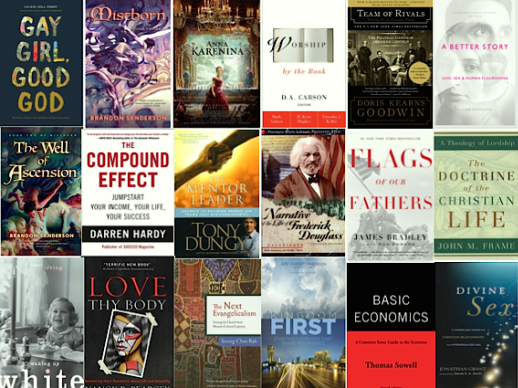
Here are my 18 favorite* books I read in 2018 (in no particular order**):
- Frederick Douglass, Narrative of the Life of Frederick Douglass
- John Frame, The Doctrine of the Christian Life
- Nancy Pearcey, Love Thy Body
- Zach Eswine, The Imperfect Pastor
- Darren Hardy, The Compound Effect
- Leo Tolstoy, Anna Karenina
- Tony Dungy, The Mentor Leader
- D.A. Carson, Worship by the Book
- Brandon Sanderson, The Final Empire
- Thomas Sowell, Basic Economics
- Jackie Hill Perry, Gay Girl, Good God
- James D. Bradley, Flags of our Fathers
- Doris Kearns Goodwin, Team of Rivals
- Brandon Sanderson, The Well of Ascension
- Jeff Christopherson, Kingdom First
- Debby Irving, Waking Up White
- Jonathan Grant, Divine Sex: A Compelling Vision for Christian Relationships in a Hypersexualized Age
- Soong-Chan Rah, The Next Evangelicalism
And here are a few runner-ups…