Why should I believe the Bible? (pt 3)

As we consider the question “Why should I believe the Bible?” it is important to understand various things about the Bible. One of those things is that the Bible is amazingly…
Unified
The Bible was written over the period of fifteen-hundred-years, by more than forty authors with varied backgrounds (e.g. king, herdsman, fisher, tax collector, physician) and literary styles (e.g. historical narrative, poetry, law, biography), on three different continents (Asia, Africa, and Europe), in three different languages (Hebrew, Aramaic, and Greek) and yet it tells one unified story.[1] The storyline of Scripture is amazing. It’s significance and glory can never be fully known and yet the storyline of Scripture can be beautifully portrayed in a three-minute video.
Why should I believe the Bible? (pt 2)

“Why should I believe the Bible?”
That is a very important question and one that requires us to look at various aspects of the Bible. In the first post in this series, we considered that the Bible is literature. It is also important that we realize that the Bible is…
Complex
It is important to not think simplistically about the Bible.[1] The Bible is clear but it is also complex.[2] The youngest child can understand the core of its teaching yet the learned scholar can spend a lifetime pursuing understanding. We shouldn’t think we will be able to understand its mysteries in a few moments—let alone millions of them—but we also shouldn’t hopelessly resign to ignorance either. As the psalmist and many others have said and experienced, faithful digging leads to many treasures of gold.
Why should I believe the Bible? (pt 1)

“Why should I believe the Bible?”
That is a very important question. In the next couple of posts, we will briefly consider various aspects of the Bible so that we are in a better position to answer that question.[1]
First, the Bible is…
Literature
The Bible is a very distinct piece of literature; it is truly unlike any other literary work. It is unique.
The Bible is the best selling book of all time and the most translated book of all time.[2] The figures vary but it is estimated that there are approximately 44 million copies sold each year. The Bible, whatever your opinion about its supernatural nature, should be read by all people. Reading and understanding the Bible is important in part because of the huge cultural impact it has had.[3] “No other book in all human history has in turn inspired the writing of so many books as the Bible.”[4]
So, read the Bible as literature. As C.S. Lewis said, “There is a sense in which the Bible, since it is after all literature, cannot properly be read except as literature; and the different parts of it as the different sorts of literature they are.”
___________________
[1] There are a lot of aspects to look at because, as Ravi Zacharias has said, a worldview is not built on one line of argument, but is built on a connected series of arguments.
[2] “As of September 2016 the full Bible has been translated into 636 languages, the New Testament alone into 1442 languages and Bible portions or stories into 1145 other languages. Thus at least some portion of the Bible has been translated into 3,223 languages” (http://www.wycliffe.net/statistics).
[3] See, as just one example, Martin Luther King Jr.’s “I have a Dream” speech. It alludes to Is. 40:4-5; Amos 5:24; Ps. 30:5; Gal. 3:28.
[4] Bernard Ramm, Protestant Christian Evidences, 239.
Darwin, Dawkins, and Moral Duty

Dawkins says “justice is a human construct of great importance in human affairs.”[1] And Dawkins believes that there is probably a Darwinian explanation that explains justice. So, our concept of justice is just a convenient Darwinian happenstance. I believe he says “blessed precious mistake” in his book The God Delusion. Of course, Nietzsche would disagree. Nietzsche in On the Genealogy of Morals doesn’t think it’s blessed or precious.
Also, if justice is merely a human construct then the cannibal clan in Cormac McCarthy’s book The Road are not wrong in keeping people locked up in the cellar in order to slaughter and eat.
***Porn*** (pt 4)

[This post contains explicit descriptions and is not suitable for all audiences]
Sex in Marriage and Porn
Good marriages and good sex are good for individuals and society.[i] I am not against good sex and God is certainly not against good sex either (see e.g. Prov. 5:18-19 and Song of Solomon). It’s just that God knows how sex can be most free and beautiful, and it is within a loving marital relationship.[ii] Sex flourishes within the protective “garden” of marriage (see Song of Solomon). And sex within marriage helps families and thus societies flourish.
***Porn*** (pt 3)

[This post contains explicit descriptions and is not suitable for all audiences]
The Supernatural Perspective
So, we have looked at the natural perspective but what does the supernatural or Biblical perspective have to say? The Bible has been saying what we just saw—that porn is bad—for over a millennia. But let’s look at a few specifics.
The Bible and Porn (porneia)
Pornography degrades and derogates the good design of sex and can also ruin relationships. We are wired for intimacy but pornography hijacks the brain[i] and leads to malfunction of God’s intended design. So, with that in mind, let’s look at a few Bible verses that speak to the issue of porn.
***Porn*** (pt 2)

[This post contains explicit descriptions and is not suitable for all audiences]
Porn and Objectification
Porn turns people into objects to use and then discard. A Princeton University study has actually shown that “viewing pictures of scantily clad women activated the ‘tool-use part’ of men’s brains, causing them to view women as tools to be used.”[i]
***Porn*** (pt 1)
[This post contains explicit descriptions and is not suitable for all audiences]
How should we think about porn?
Porn has been normalized and seems to be accepted for the most part in mainstream culture. It may not always be openly promoted but it seems to be assumed. It seems wise, in part because of porns prevalence, to at least consider the impact it is having and the place it should (or shouldn’t) have in our lives.
In America, there is no broadly shared consensus regarding sex.[i] For example, there are various answers to these important questions: What is the purpose of sex and when and with whom should we have it? Connected to people’s view of sex is people’s view of pornography.
Statistics,[ii] as well as mere observation of culture (e.g. Snapchat, Instagram), show us that there is moral ambiguity towards porn. In fact, teens and young adults view overeating as more immoral than viewing porn.[iii] So, as “access to pornography has increased, the stigma toward it has seemingly decreased.”[iv] I would suggest, however, that we shouldn’t assume this is a good thing.
I don’t think that we should blindly accept that porn consumption doesn’t matter. We would be wise to have and be able to defend our position on porn. As Socrates reportedly said, “The unexamined life is not worth living.”
How do we evaluate the acceptability of porn? There are two main ways we can evaluate porn and I believe they are both important to look at. We can look at porn from a 1) natural perspective and from a 2) supernatural perspective.
The Natural Perspective
Here are two questions I believe it is wise to answer: Does porn promote human flourishing? Does porn help individuals and society thrive? Those are obviously big questions (that we can not exhaustively cover here) but they are important to consider.
Porn and Self-image
Porn can turn healthy self-image into an unhealthy “sex-image” where people measure themselves by the images they view or by the images their partner views. Porn can very negatively affect self-image. For example, “A 2012 study of college-aged women with male partners who used porn concluded that the young women suffered diminished self-esteem, relationship quality and sexual satisfaction correlated with their partners’ porn use.”[v]
Look before you… Entertainment

There is something about physical harm and pain that reminds us to look before we… leap. Why? Because we leaped one too many times without looking and our brain has trained us not to do that again. That’s the way our brains work. And our brains work well. That is, at least, for a lot of things. However, our brains may work against us when it comes to others things.
We sit down and watch a cute, funny dog video on YouTube and that’s fine; no pain. Actually, we quite enjoy it. Our brains do not tell us: Look before you… watch. So, we don’t. We don’t consider what we watch or how often we watch because, after all, we like it.
Plus, entertainment is everything.[1] But, is it? Or, should it be? We would do well to consider this question as (likely) the most entertained people in all of history.[2]
What is “entertainment”? What does that word mean? It has been defined in this way: “the action of providing or being provided with amusement or enjoyment.” So, entertainment gives us pleasure, enjoyment, and diversion; especially by a performance of some kind. For instance, I was entertained at NitroCircus when Travis Pastrana did a double backflip on a dirt bike.
To quote someone from a different arena, it would have been fitting for Pastrana to scream out:
“Are you not entertained?! Are you not entertained?! Is this not why you are here?!”
There is a danger that people will die in entertaining us but is there also a danger for us as we are endlessly entertained?
Neil Postman wrote in 1985 about the danger of, as his book title says, Amusing Ourselves to Death, and that was before public internet, let alone social media and the smart phone. It is not an understatement to say that we are likely to amuse ourselves to death. There are serious health risks for us when all we care about is entertainment. There is the further danger that we’re not living and loving as we should. We’re liable to amuse ourselves until death, and never do anything worthwhile with the time we’ve been given.
The Christ of the Cosmos
The Massive Size of the Universe
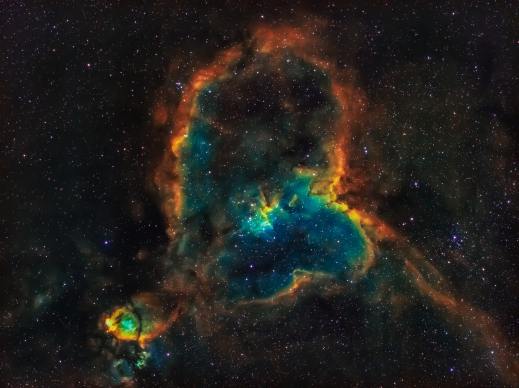
The heavens scream out and tell us of God’s surpassing worth (Ps. 19:1; Rom. 1:20). God’s glory is beyond our comprehension.
Do you know how far away the closest star is (besides the sun)? It is approximately 4 light-years away. A light-year is the length that light travels in one year. Light travels fast! 186,000 miles per second and there are 31,536,000 seconds in a year. A light year is really really really far. One light year is almost 6 trillion (6,000,000,000,000) miles! So, it takes four years for the light from the closest star to get to us.
And did you know that the sun is so big that about 1,300,000 earths could fit inside of it?[1] The universe is vast beyond comprehension.
The Astrophysicist, Hugh Ross has said, “Somewhere around 50 billion trillion stars make their home in the observable universe.”[2] That is impossible to conceive of. “A comparison may make it more comprehensible: if that same number of dimes were packed together as densely as possible and piled 1,500 feet high (as high as some of the world’s tallest skyscrapers), they would cover the entire North American continent.”[3]
Wow.
Jesus’ Massive Glory
And God—the One who created each star, named each one of them, and holds the entire universe together (Is. 40:26; Col. 1:16-17; Heb. 1:3)—cares about you! He cares so much that He sent His Son to die for you. Jesus, God in flesh, humbled Himself, came, and died for anyone who turns to Him for salvation.
Christ who created the cosmos and holds all things together (Col. 1:16-17) made Himself nothing, took the form of a servant, was born in the likeness of men, and humbled Himself to the point of death, even death on a cross (Phil. 2:7-8). Jesus, the Holy One, the spotless Lamb of God, became sin, so that in Him we might become the righteousness of God (2 Cor. 5:21).
The One who died on the cross for us died as He held the planets in orbit. He died, though He is the one that held the very nails together that pinned Him to that tree (Heb. 1:3).
He calls the host of stars by name and He knows your name! His judgments are just, His Word is true, and He is a God of sacrificial love. His faithfulness is never stopping, always and forever.
“Love so amazing, so divine
Demands my soul, my life, my all.”
The Christ of the cosmos deserves our praise!
Notes
[1] To get a visual of the expanse of the universe, use a tennis ball to represent the sun (2.7 inches in diameter) and the edge of a dime to proportionally represent the earth (0.02 inches), then place the tennis ball and dime twenty-four steps apart. That will help you see the distance between the sun and the earth (Jeffrey D. Arthurs, Preaching as Reminding, p. 76). Arthurs goes on to explain that “To explain the distance to Alpha Centauri, the nearest star: the tennis ball would be in Boston and Alpha Centauri would be in Memphis” (Ibid.).
[2] Hugh Ross, Why the Universe is the Way it Is, p. 31.



