What is Pentecost?

What is Pentecost? And what’s its significance?
Did you know there’s a day that celebrates Pentecost?
I didn’t know what Pentecost Sunday was for a long time, and I certainly didn’t understand the full significance of it. Yet, Pentecost is full of significance. Pentecost Sunday is a celebration of the coming of the Holy Spirit. It, however, is not widely celebrated, at least, not very much in non-liturgical churches.
I grew up celebrating Christmas and praising God for the incarnation of Jesus. And I’m thankful for that. I grew up rejoicing in the truth of Easter, that Jesus is victorious over sin and death! And I’m thankful for that. But Jesus said something that makes me think we’re missing out on an important celebration.
Jesus—God in human form—came to earth and walked and talked and performed miracles. And this GodMan, Jesus, said, “It is better that I go away” (Jn. 16:7). How could that be true? I mean, I know Jesus always speaks the truth, but how could this be true? How could anything be better than Jesus walking and talking on earth with us?
How could something be better than Jesus’ physical presence?!
Jesus has said some pretty shocking things, but this is one of His greatest hits!
Who or what could be better than Jesus’ physical presence?! Thankfully Jesus answers that question for us.
He said, “It is to your advantage that I go away, for if I do not go away, the Helper will not come to you. But if I go, I will send Him to you” (Jn. 16:7).
Jesus said it was to our advantage that He go because then He would send the Helper, the Holy Spirit, to us.
We rightly celebrate the coming of Jesus the Messiah at Christmas. Yet, if it is to our advantage that the Messiah goes so we have the Spirit, shouldn’t we celebrate the Spirit too? Of course, one of the reasons the Spirit is not celebrated as Jesus is, is because one of the roles of the Spirit is to help us celebrate Jesus (Jn. 16:14).[1] Nevertheless, we should acknowledge and know and praise God for His helpful presence by the Spirit.
Pentecost Sunday is a day to celebrate the powerful presence of the Spirit.
Pentecost’s Background
Pentecost (pentékosté) comes from a Greek word that means “fifty.” Pentecost takes place fifty days or seven weeks after Passover (Ex. 23:14-16; 34:22-23; Lev. 23:15-16; Num. 28:26; Deut. 16:9).[2] Sometimes people call it the Feast of Weeks. Pentecost is one of the three major Jewish festivals or feasts. It was a day to celebrate, anticipate, and thank God for His provisions, specifically wheat.
For this festival, God’s people would offer the first fruits of their wheat harvest (Ex. 34:22), and their new grain (Lev. 23:15-16) to the LORD (Ex. 34:23). This required a pilgrimage. And it required much planning because no customary work was supposed to be done on this feast day (Num. 28:26). “Though the holiday lasted but one day, it was a national event with elaborate rituals well known throughout the land.”[3]
Pentecost, however, is not just mentioned in the Old Testament; it’s in the New Testament as well (Acts 2:1; 20:16; 1 Cor. 16:8). Passover is the more famous festival, but both Passover and Pentecost are important. “The Festival of Passover… pointed forward to the death and resurrection of Jesus, so the Feast of Pentecost pointed forward to another pivotal event in the history of the church.”[4]
The time of Pentecost was a time of anticipation. God had promised to provide and it was a time to see God’s provision. So, “Pentecost is all about living in anticipation of a harvest that is yet to come.”[5] With God’s provision, there was life, health, and rejoicing. But, if God did not provide there would be devastation.[6]
Pentecost in Acts 2
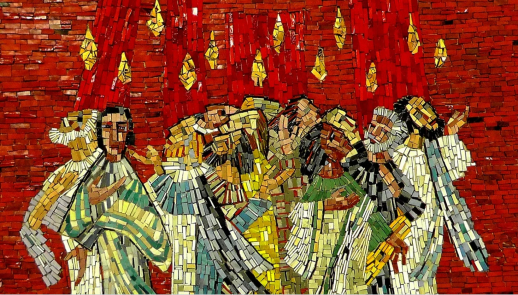
In Acts 2, we see God provide more than just grain. God provided the gift of His presence as Jesus said He would and as was foretold in Joel 2:28-29. God’s people received power from on high (Lk. 24:49).
In Acts 2, we see that “something tremendous happened in Jerusalem that transformed the Apostles into men of conviction and courage and provided them with a spiritual impetus that enabled the Christian movement to expand rapidly, so that in a few decades vital congregations were in all the major cities of the Roman Empire.”[7]
At Pentecost, there was a divine visitation; the presence of God came upon His people. In the Old Testament, we see God’s appearance was accompanied by wind and fire (1 Kings 18:38; 19:11-13; Ezek. 37:9-14). Yet, we see something new in the New Testament. God’s presence was also accompanied by the gift of tongues. So, we see at Pentecost that God is shifting His redemptive purpose from Israel, His particular people, to all people being welcomed in through Christ the risen King.[8] People were scattered because of sin at Babel but through the much-anticipated gift on Pentecost, we see God gathering and uniting His people in King Jesus.[9]
The Spirit did not come just for us personally. The Spirit is also given for the purpose of mission: that all people might know Jesus as both Savior and King. As Glasser has said, “The spirit was not given just to enable the people of God to pursue personal holiness and joy in corporate worship and fellowship… The spirit was also given to energize corporate waiting on God for missionary outreach.”[10]
Jesus told His disciples to make disciples, but He let them know they wouldn’t have to do it all on their own. He would be with them, even to the end of the age. But how? At Pentecost, we find the answer. Jesus sends the Spirit (Jn. 14:16–17, 26 15:26) and is with us by the Spirit (Scripture even speaks of “the Spirit of Christ,” see Rom. 8:9; Gal. 4:6; 1 Pet. 1:11).
The Spirit given at Pentecost is the “first fruits” of more to come (Rom. 8:23; Eph. 1:13-14). God heaps grace upon grace!
“Our redemption has begun, with the fullness yet to come. As Jesus has risen, so we will too. As we have come to Christ, more will follow. The Holy Spirit who guarantees our final redemption is the first part of her vital new relationship with God, with more to come.”[11]
Jesus, who has redeemed the Church, will recreate the whole earth.
On Pentecost Sunday, we thank God for sending the Helper. We rejoice in His gift of the much-needed and anticipated Helper.
Notes
____
[1] It’s important to realize that Peter’s concern on Pentecost aligns with the Spirit’s concern: focus on Jesus Christ!
[2] Pentecost Sunday happens fifty days after Easter. Of course, Easter or Resurrection Sunday corresponds with Passover.
[3] David Brickner and Rich Robinson, Christ in the Feast of Pentecost, 101.
[4] Brickner and Robinson, Christ in the Feast of Pentecost, 31.
[5] Ibid., 108.
[6] In the Old Testament, we see God’s promise to provide crops is often in connection to His people’s faithfulness to obey Him.
[7] A. F. Glasser, “Pentecost,” 757 in The International Standard Bible Encyclopedia.
[8] Glasser, “Pentecost,” 757. “Pentecost marks the completion of Christ’s redemptive work. Following His resurrection He ascended into heaven and presented Himself as the first fruits of the coming harvest” (Ibid., 758).
[9] “Missionary outreach provides the divine reversal of the scattering and hostility of the nations that fall the judgment at Babel (Gen. 11:1-9)” (Glasser, “Pentecost,” 758).
[10] Glasser, “Pentecost,” 758.
[11] Brickner and Robinson, Christ in the Feast of Pentecost, 140.
The Work of the Spirit | pt. 2
God the Spirit and the Filling of the Spirit
God the Spirit. Since we are considering the work of the Spirit within the church, it is important that we consider God the Spirit, who He is and what He does. First, without going into any detail, the Holy Spirit is the third person of Trinity. The Spirit is fully God.[1] The Holy Spirit also has personhood; He is not an impersonal force.[2] That is who the Spirit is.
Second,[3] it is important that we briefly consider what it is that the Spirit does. The Old Testament teaches us various things about the Holy Spirit. The Spirit molds creation into shape and gives life to created beings (Gen 1:2; 2:7; Ps 33:6; Job 26:13; 33:4). The Spirit controls the course of nature and history (Ps 104:29-30; Isa 34:16). The Spirit teaches and reveals God’s truth and will to His messengers.[4] The Spirit elicits personal response to God.[5] The Spirit equips individuals for leadership.[6] We also see that the Spirit equips individuals with skill and strength (Exod 31:1-11; 1 Kgs 7:14; Hag 2:5; Zech 4:6).
The Spirit is given as our Helper (John 14:24). He takes what belongs to the Son and shares it with those who believe (John 16:14), beginning with the new birth (John 3:6), teaching and guiding (John 16:14), and transforming (2 Cor 3:5-18) in ways that surpass human capacity (1 Cor 2:10-14). He empowers believers to be Jesus’ witnesses to the end of the earth (Acts 1:8) and to the end of the age (Matt 28:20). By indwelling believers (Rom 8:9; 1 John 2:27), the Spirit washes and renews (Titus 3:5), pours out divine love in our hearts (Rom 5:5), reproduces the divine virtues (Gal 5:22-23; Rom 14:17), enables us to resist sin (Rom 8:13) and pursue holiness (2 Thess 2:13), and build unity among the church (Eph 2:22; 4:3, 13; Phil 2:1-2).[7] The Spirit hears, speaks, witnesses, convinces, shows, leads, guides, teaches, commands, forbids, desires, gives speeches, helps, and intercedes with groans.[8] It is vital that we not leave out the most miraculous work that the Spirit works within people; He makes them new creations in Christ (2 Cor 5:17; 3:3, 6, 18; Titus 3:5-6; Ezek 36:25-28; Rom 2:28-29).



 in X
in X 