Health and Healing, Sickness and Suffering

Health and Healing, Sickness and Suffering
When it comes to health and healing, and sickness and suffering, there are a lot of questions and a lot of confusion.
This topic hits home for me because I serve as Care Pastor at Crossroads Church. But, more than that, it hits home because it is home. All the time. My wife has various diagnoses all adding up to making her chronically ill.* That is, she’s sick. She’s sick a lot; more or less all the time.
Does God want us to be healthy and happy? Then why is there suffering and sickness? And why are some people healthy and some people sick? Why is my wife sick? Did she do something to deserve it? Did I do something? Do we lack faith?
The answers to these questions are not simplistic. They are complex. And they are mysterious. It’s always good to remember that God as God is not like us. His ways are higher than our ways, and His thoughts are higher than our thoughts (Is. 55:8-9). That shouldn’t be surprising for us since He’s God, but it is vital that we remember that truth.
So, why sickness and suffering?
Sickness and suffering?
First, we should acknowledge how big and how relevant that question is. People have been asking this question for eons. The Bible gives some very valid and convincing reasons (especially when understand in the context of redemptive history).
Why sickness?
The Fall (sin in general, natural evil)
Sickness was introduced into the world as a result of sin (Gen. 3). When God made the world, it was very good (Gen. 1:31). So, sickness is an intruder. Sickness is not welcome and will not always be in the world. But it is certainly here now. Now in the natural course of the fallen world, people get sick and they die, and people die as a result of old age (Gen. 5 [notice the refrain of “and he died”], 48:1, 21).
Individual Sin (specific personal sin, moral evil)
Sometimes sickness is a result of a specific personal sin (1 Cor. 11:28-30). Of course, all sin leads to separation from God and death. But some sins bring especially pungent consequences. Some sins, as 1 Corinthians says, are against our own bodies (1 Cor. 6:18). Some sickness results from disobeying God (Ex. 15:26). It seems king David himself experienced the physical consequences of sin (Ps. 32:3-4; 38:3-5).
Demonic Forces
From reading the New Testament it seems clear that some sickness is a result of demonic forces. The Gospel of Mark talks about a young boy that has “a spirit that makes him mute” (Mk. 9:17-18 cf. Lk. 11:14). The Gospel of Luke talks about a woman that had a disabling spirit for 18 years (Lk. 13:11). Acts 10:38 tells us that Jesus “went about doing good and healing all who were oppressed by the devil” (cf. Matt. 8:16). Yet, Luke also distinguishes between the casting out of demons and healing (see Lk. 4:40-41) and thus shows that not all sickness is due to demonic forces. When we take into account the points below, it is clear that not all sickness comes from demonic forces.
For God’s Glory
Scripture also explicitly tells us that some sickness is for the glory of God. The most cogent and explicit is the story of the man born blind. Jesus says that the man was not born blind because of sin but instead “so that the works of God would be displayed in him” (Jn. 9:3).
Even the death of Lazarus was for the glory of God, so that Jesus might be glorified through it (Jn. 11:4). And Paul’s “thorn in the flesh,” whatever it was, was so that the power of Christ would rest upon him (2 Cor. 12:7-9).
In these examples, sickness was not a result of sin or a lack of faith. Sickness was for the glory of God.
We don’t always know why
At other times we simply do not know for sure what the reason for the sickness is. In Philippians 2:25-30 we see that Epaphroditus, a faithful co-laborer of Paul, was so sick he nearly died. Yet, we are not given a reason for his sickness. And we have no hint at all that it was because of lack of faith or because of a personal sin. And in 2 Timothy 4:20 we see that Trophimus is left in Miletus.
Paul was an apostle, had faith, and had healed others (Acts 19:11-12; 2 Cor. 12:12) and yet that didn’t guarantee that people—even his close and faithful co-workers—would be healed. We know God, by His Spirit, can heal and we can certainly pray that He will. But prayer and even the gift of healing is not a mechanism that we can simply push and guarantee that healing will be the result. God is sovereign over sickness. And for whatever reason, He doesn’t always heal. We don’t always know, as Paul the Apostle didn’t know, why some are healed, and others aren’t. But, just like Paul, we must trust God. He is good. And He has explicitly and repeatedly demonstrated His goodness.
So, sickness is clearly not always a result of sin or a lack of faith.
What should we do when we’re sick?
Look at James 5:13-18. Notice first that before it talks about healing it talks about patience in suffering (v. 7-11). So, even in the context of asking for healing, there is an expectation of suffering.
Next, notice that whatever situation we are in, good or bad, we are always to go to the LORD in it, with praise or lament (v. 13). Then we see what we are to do if we’re sick. First, we need to realize our need. That is what leads to the calling of the elders. So, humility is necessary. When we are sick, we should realize our need.
Second, we are to realize that our need is not just physical, but spiritual. That is why we call for the “elders of the church.” And that is why we ask for prayer. Prayer is a supernatural beseeching of God; it’s going to God as Father and asking for help.
Third, I think the “anointing” with oil could have at a least a twofold significance. In the Old Testament the king would be anointed with oil and that symbolized the Spirit’s presence and blessing. Oil was also used for medicinal purposes (Mk. 6:13) or used as shorthand for medicine as we see when the Good Samaritan took care of the wounded man (Luke 10:34). Therefore, in anointing with oil we are calling on the Spirit to work and we are also confirming the goodness of medicine and imploring God to make it effective to heal.
Fourth, sickness uniquely reveals that we are but dust, that we soon pass away and are no more (Ps. 39). Yet, the “prayer of faith will save the one who is sick, and the Lord will raise him up” (v. 15), even if it is on the last day that he is raised up (Jn. 6:39-40, 44, 54). I don’t believe this passage means that just because the elders prayed over someone, and they had faith, they will be healed. But I do believe the prayer of faith saves. I believe this because that’s what the Bible teaches elsewhere (Jn. 3:16; 1 Jn. 1:9). Also, as we have said, some sins uniquely lead to sickness. If someone commits one of those sins, they too can be forgiven (v. 15), but that doesn’t necessarily mean they will be healed.
But, fifth, we do have a strong encouragement to confess our sins and pray for one another that we may be healed (v. 16). We know from elsewhere that sin can hinder our prayer (1 Pet. 3:7). It is the prayer of a righteous person that has great power (James 5:16). Just because people are not always healed when we pray does not at all mean they cannot be healed when we pray. James 5:17-18 goes to great lengths to tell us that Elijah was a normal enough guy and yet God moved mightily through his prayers.
So, when we’re sick, we must realize our utter need; we certainly cannot heal ourselves. We should realize the nature of our need as well as who it is we need help from: supernatural help from God. And we should realize that medicine although good, is no good apart from God’s intervening grace. So, even in our use of medicine we must be reliant and thankful to the Lord. If we have unconfessed sin we should confess and repent, knowing that sin can lead to sickness. Lastly, we should pray in faith knowing that God can and does heal.
We should seek the Lord and medical help
I believe that it’s important that we seek the Lord and medical help. We must remember that every good gift comes from the Father (James 1:17). And so, we should receive our Father’s good gifts with thanksgiving (1 Tim. 4:4).
Yet, it is vital that we not just seek out medical help and not seek the help of God. He’s God! He holds every molecule together. It would be utterly foolish to seek out the help from a person who has limited knowledge on a limited number of things, and not seek out God—the All-Knowing-One.
As great as Asa king of Judah was, this was one of his main sins. Second Chronicles 16:12 tells us that “Asa was diseased in his feet, and his disease became severe. Yet even in his disease he did not seek the LORD, but sought help from physicians.” That’s sad. And that’s foolish.
We should not follow Asa’s example. Rather, we should follow what I propose is the biblical example. We should seek the Lord and we should seek out the good physicians He has graciously provided. Paul even tells Timothy to make use of wine for help with a stomach problem (1 Tim. 5:23).
Does God promise health and healing?
Yes and no
In the story of Scripture, the story of Christ’s cosmic rescue, it starts out and the world is flawless, there’s no suffering or sin. But then the cosmic problem comes in. There’s a tear in time, a warp in the world, a curse in the cosmos. And it’s all because of sin.
Yet, the story of Scripture is the story of Jesus—God in flesh—coming to fix the broken world. The story starts in the Garden with God, and it ends in the Garden with God. It starts with no pain, suffering, sin, or sickness, and it ends that way.
Revelations 21 tells us of the glorious reality of God the Father wiping ever tear from all of His children’s faces. We, however, are not at that place in this true cosmic story.
Yes, that will happen—no suffering, sin, sickness, sadness, or death. But we are not there yet.
Yes
Yes, the LORD both forgives iniquities and heals our diseases (Psalms 103:3-5), but that doesn’t mean that the effects will be fully felt at the same time. For instance, the LORD has not yet brought “justice for all the oppressed” (v. 6). But that will happen. Jesus will bring complete justice. Jesus will satisfy His people with good thingsand He will renew our youth (v. 5). But not yet.
We are forgiven and welcomed into the Kingdom in and through Jesus Christ and yet we are not yet in the full realization of the Kingdom. It is true that Jesus has “took our illnesses and bore our diseases” (Matt. 8:16-17; Is. 53:4). And our main illness and disease is that of sin and in taking that on Himself He enables access to the New Creation in which there is no illness or disease.
As Sam Storms has said, “To whatever degree we experience healing in this life, it is the fruit of Christ’s atoning death.” It is by Jesus that we receive the undeserved grace of God, and God taking our illnesses and diseases is certainly undeserved. “But it doesn’t necessarily follow that where there is atonement there is immediate healing.”
That’s a biblical and verifiable reality. Paul, Epaphroditus, Trophimus, and many other faithful Christian brothers and sisters have had their sins bore by Jesus and thus been accounted righteous (Is. 53) and yet died with various sicknesses. Therefore, Jesus’ atoning and propitiatory death does not equal healing in this life.
There’s also another real sense in which “yes, God wants us to be healthy and happy.” That’s part of why God gives His good commands, so that it may go well with us (Deut. 4:40; 5:29, 33; Eph. 6:3). Yet, following God’s commands does not in any way guarantee that things will go well with us from an earthly perspective. Just look at Jesus’ 12 disciples…
No
Does God promise health and healing? No. Not in this life. However, because of the love of God in Christ Jesus we know that in spite of sickness we have a surpassing hope. We know that all things will actually work together for good (Romans 8:28, in context).
“This light momentary affliction is preparing for us an eternal weight of glory beyond all comparison, as we look not to the things that are seen but to the things that are unseen. For the things that are seen are transient, but the things that are unseen are eternal. For we know that if the tent that is our earthly home is destroyed, we have a building from God, a house not made with hands, eternal in the heavens. For in this tent we groan, longing to put on our heavenly dwelling, if indeed by putting it on we may not be found naked. For while we are still in this tent, we groan, being burdened—not that we would be unclothed, but that we would be further clothed, so that what is mortal may be swallowed up by life” (2 Cor. 4:17-5:4).
God does not promise health in healing in this life. In fact, persecution and plague are very likely to await us. That’s what Jesus repeatedly said (see The New Testament on Suffering). Yet, we are “waiting for new heavens and a new earth in which righteousness dwells” (2 Pet. 3:13). This place is not our home. And our current bodies are not our final bodies (1 Cor. 15:35-49).
Conclusion
As you can see, a simplistic answer to the question of sickness and healing will not suffice. Yet, God gives the answer. And the answer is Jesus Christ the Lord. But the answer may be “yes” now, and it may be “no” now, but for all who trust Jesus it’s a “yes” later. Healing will happen. Suffering will cease. But that doesn’t mean it will happen now.
____
*Lyme disease, POTS, EDS. And as of this writing, she has COIVD-19 which is not good to mix in with all of her other health issues.
Why was the Blind Man Healed Twice?
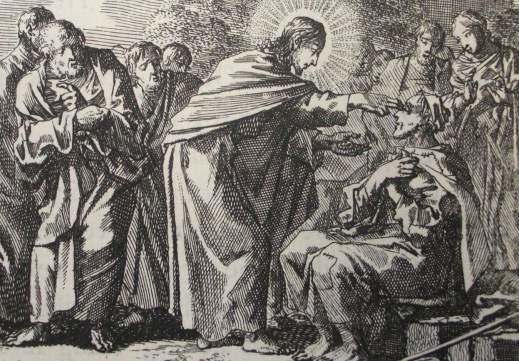
Why would Jesus touch the blind man twice to heal him? Surely He had the power to heal him the first time. So, it would appear to me that there is some significance for why this healing happened this way. Though, in this as with all Scripture we must remember that the hidden things belong to the LORD but the things that have been revealed belong to us (Deut. 29:29). Thus, we cannot take all of the mystery out of this passage but we can offer a few reasons for why this miracle went down as it did (Remember Jesus could have done it much differently cf. Matt. 9:27-31; Jn. 9:1-12). Here is the text under question:
[22]And they came to Bethsaida. And some people brought to him a blind man and begged him to touch him. [23]And he took the blind man by the hand and led him out of the village, and when he had spit on his eyes and laid his hands on him, he asked him, “Do you see anything?” [24]And he looked up and said, “I see people, but they look like trees, walking.” [25]Then Jesus laid his hands on his eyes again; and he opened his eyes, his sight was restored, and he saw everything clearly. [26]And he sent him to his home, saying, “Do not even enter the village.” (Mark 8:14-26)
As with any passage, the context must be considered. This is a cursory look at the passage but we should be able to get at the reason for the double healing. So in the broad context of the New Testament and the Gospels there is quite a lot about spiritual seeing. In Mark chapter four Jesus explains His use of parables. He said (see Mk. 4:10-12) I use parables “so that ‘they may indeed see but not perceive, and may indeed hear but not understand, lest they should turn and be forgiven’” ( cf. Is. 6:9-10).
In the immediate context in chapter 8 we see that Jesus talks about “seeing,” i.e. understanding. He says, “Having eyes do you not see, and having ears do you not hear? And do you not remember? When I broke the five loaves for the five thousand, how many baskets full of broken pieces did you take up?” They said to him, “Twelve.” “And the seven for the four thousand, how many baskets full of broken pieces did you take up?” And they said to Him, “Seven.” And He said to them, “Do you not yet understand?’” (Mk. 8:18-21).
After this the disciples and Jesus (“they”) went to Bethsaida (Mk. 8:22). So there was some time that elapsed between verse 21 and verse 22 in historical reality. Yet Mark places the healing of the blind man directly following the conversation between Jesus and the disciples.
Why? And why such a strange healing? Why would Jesus spit in the blind man’s eyes and yet not completely heal him? Why would he still have poor sight (Mk. 8:24)? Why would Jesus have to touch him again (Mk. 8:25)?
Based on the context I think it reminds us of the disciples and their vision. They “see,” i.e. understand, but their understanding is still very poor. They too will need a second touch. Notice what follows this passage. Jesus asks His disciples, “What do you say that I am?” Peter as the disciples typical spokesman said, “You are the Christ.”
Jesus is essentially asking the disciples, “Do you see, do you understand?” The disciples respond, “Yes, we see you are the Christ.” Yet, they did not know but they didn’t see as clearly as they thought they did. They saw “men , but they look like trees,” you could say (Mk. 8:24). This is proven later especially by the once very vocal Peter as he denies Jesus (Mk. 14:66-72). He truly did not see what it meant for Jesus to be the Christ. He too needed a second touch. He too needed to be healed of his blindness.
Thus I think in retrospect the healing of the blind man in this passage is a type of parable. Jesus asked, “Having eyes do you not see, and having ears do you not hear? And do you not remember?” (Mk. 8:18). The disciple did see and yet they did not see. It is a strange paradox. They had in a sense been healed as the blind man but their vision, their understanding, was still a long way off. Their vision would not be truly “fixed” until they saw the Lord again and He fixed them (Mk. 16:12-14). At the end of Luke, after Jesus’ resurrection, we see that Jesus gave the disciples the correct understanding of the Christ that they lacked (Lk. 24:27, 44-47). After this lens adjustment they could see clearly.
So why was the blind man healed twice? I think to teach something about the disciples. And about us. It appears that way to me based on the immediate context of the passage and the way that blindness and seeing is used in Scripture. It has also been pointed out to me that there is a chiastic structure in this passage. Here’s the diagram:
A: The Apostles don’t see clearly (vv. 14-21)
B: The blind man can’t see clearly (vv. 22-24)
B’: The blind man can see clearly (vv. 25-26)
A’: The Apostles see clearly (vv. 27-30)
We see that the blind man needed a second touch, the Apostles needed a second touch, and we often need second, third, fourth, etc., touches to see as well. We need more contact with Jesus the Lord of life if we are going to see.
Sin is Not Good #7 (but Jesus is)

Sin’s Solution
In the book of Genesis we read of societal progress. There are advances in technology and the arts. Yet, the problem remains: We have sinful hearts. Thus relationships and truly the world remain fractured. Like humpty dumpty; we can’t put it back together again. The answer to my problem, humanities problem, and the world’s problem is external to us.
One would think that
“Auschwitz destroyed… the idea that European civilization at least was a place where nobility, virtue and humanizing reason could flourish and abound… It seems remarkable that the belief in progress still survives and triumphs… People still continue to this day to suppose that the world is basically a good place and that its problems are more or less soluble by technology, education, ‘development’ in the sense of ‘Westernization.’”[i]
However, today’s problems, like that of all history past, is not solved by advances in technology or even any sort of knowledge or morality. It is solved by a Savior. It is Messiah Jesus that will once and for all eradicate sin and suffering (see e.g. Rom. 11:26-27; Heb. 12:23; 1 Jn. 3:2; Rev. 3:12; 21:1-8, 27; 22:3).
When we control the measures to make a utopian society the way we think it should be, it fails. Whether we control “the stirrings” (e.g. The Giver), emotions (e.g. Equilibrium), everything (e.g. The Lego Movie), or the socioeconomic structure (e.g. The Hunger Games) the result is not paradise; it’s a sort of hell, at least for many. We messed up utopia, we can’t with our fallible minds design a new one. Only our Lord can. He has the only infallible and incorruptible mind. He perfectly balances justice and grace. And He alone can make us and all things new.
So the recent movie and classic The Giver does more than entertain. It teaches us a profound truth, one we would do well to remember: There is no utopian society outside of Christ. We can’t fix it. There have been many botched attempts throughout history. They lay died with their victims.
“Everything is awesome. Everything is cool when you’re part of a team…” As catchy as The Lego Movie song is, it is not exactly right. Everything is not awesome, not yet. However, it will be. But not from our own doing (Notice I am not saying we shouldn’t work for social justice. We should! Yet, it will not bring the ultimate and forever peace that we long for.).
Heaven comes down (Rev. 21:2). We don’t, nor can we, build it here. I am with you and Miss America in saying I desire world peace, yet it won’t ultimately come until our Lord does. When our Lord comes He will wipe away all evil, pain, and tears, not some charismatic leader or government (Rev. 21:1ff). Jesus will make all things new. Jesus will bring utopia.
Maranatha! Come Lord Jesus, come!
Sin is not good. But Jesus is. He will bring the shalom we all desire. Live for Him.
___________________________
[i] N.T. Wright, Evil and the Justice of God, 22-23.
Are the Gifts of the Spirit for Today? A Brief Exploration

Introduction
“Are the gifts of the Spirit for today?” This is a big question and an important one because it impacts the church, missions, and individual’s spiritual lives. It is an important question because many denominations and individuals are divided over it.
Truly and sadly very often “those who [speak] most loudly of being led by the Spirit [are] the very persons responsible for quenching the Spirit’s work.”[1] Interestingly, this was also true of the Corinthians of Paul’s day. Yet, Paul does not say, “Away with the Spirit!” Instead, he says, “Don’t quench the Spirit” (1 Thess. 5:19)! The Spirit is not the problem; we are.
I think both camps, cessationists (they believe the gifts have seized) and continuationists (they believe the gifts continue), are right on some points and wrong on others. “Error is much more likely to be propagated, when it is mixed with truth. This hides deformity and makes it go down more easily.”[2] Those who believe that the miraculous gifts of the Spirit continue and those that believe they do not both very often sound right. This likely means that both arguments have been construed wrongly.
Neither side is understanding the question rightly. Of course, I will not satisfy everyone, or, perhaps, anyone. But this is my attempt to satisfy myself on this subject. And I hope to bring you along as well.
We will first look at four negative arguments that people make that believe the charismatic gifts have seized. Then we will look at one positive argument in favor of the continuation of the charismatic gifts. I also have included a long excursus that outlines a somewhat chronological example of the ongoing powerful and uncommon work of the Spirit since Pentecost. Finally, we will look at a few practical reflections.



 in X
in X 