What sets Christianity apart? (part 2)

In Part One, we found that part of what sets Christianity apart is trinitarian monotheism and God’s eternal love. Here we will add four more aspects that set Christianity apart from other religions.
3. The Incarnation of God
Christians believe that God loves the world so much that Jesus took on flesh and became man to die for the sins of the world (Jn. 1:1-3, 14, 29; 3:16). Other religions, such as Greek mythology, believe in gods who appeared in human form for various reasons, including love or punishment.[1] Greek gods, however, only temporarily took on human form. Jesus permanently became human.[2]
In Hinduism, the incarnation of a deity usually refers to Vishnu, who is said to have appeared in various avatars (e.g., Rama, Krishna, Narasimha, and Varaha). Other than Hinduism and various mythologies (which most people no longer take seriously), the concept of the incarnation of God is uncommon. However, Wikipedia does give a list of other people who have been considered deities. Egyptian pharaohs were considered deities, and North Korea’s Supreme Leader is considered a deity, for example. Interestingly, even on Wikipedia, Jesus is in a class of His own. He is listed by Himself under the “Controversial Deification” heading.
The Hindu avatar comparison to Christian incarnation is not as clear as it might at first seem. There are clearly some important distinctions between the Hindu and Christian beliefs regarding incarnation.[3] First, Hindus claim many divine incarnations have appeared throughout history, while Christians believe Jesus is unique—the only begotten Son of God. The Christian Bible teaches that Jesus appeared “once to bear the sins of many” and “will appear a second time, not to deal with sin but to save those who are eagerly waiting for Him” (Heb. 9:28). So, second, we see that the purpose of avatars and the purpose of Christ are different. The avatars do not take away or bear sin. Third, in contrast to Hinduism, Christianity teaches that Jesus is Immanuel, God with us, and that He is still with us by the Holy Spirit. Lastly, the avatars in Hinduism appear for a time to balance out good and evil; in contrast, Jesus came and will come again to forever banish evil and sin.
So, Christianity’s belief in the incarnation of Jesus sets it apart from all other religions. The Creator became creation, the eternal entered time. As is sometimes said, there are many who would be god but only one God who would be man. Or, as Dietrich Bonhoeffer said, ”While we exert ourselves to grow beyond our humanity, to leave the human behind us, God becomes human.”[4]
4. Messiah Jesus
Muslims say they believe Jesus was the Messiah. In fact, the Quran explicitly refers to Jesus as the Messiah. One of the disagreements between Christians and Muslims, however, is what it means that Jesus was the Messiah. Muslims do not believe Jesus was God in flesh or that He was crucified.
It is true that the expectation presented in the Jewish Scriptures (Old Testament for Christians) for the Promised One seems almost impossibly diverse. How could any one person fulfill the many expectations? How could it make sense for the “Ancient of Days” (Dan. 7:9, 13, 22) to be a descendant of king David (2 Sam. 7:12-16; Is. 11:1; Jer. 23:5-6)?
The messianic expectations appeared to be nothing more than unrelated and random shards of glass. Yet, the New Testament authors, over and over, argue that Jesus is in fact the Promised One, the long-awaited Messiah, who fulfills the prophecies, patterns, pointers, and promises (2 Cor. 1:20). Jesus, who was from Nazareth (of all places) is believed to be the one who will crush the serpent of old and lead the way back into Eden, bless all the nations of the earth, and set up His righteous and eternal Kingdom. The New Testament helps us see that the Old Testament predictions work together to form an astounding, almost unbelievable, stained-glass picture of Jesus, the long-awaited, promised Messiah.
Regarding prophecy, there are several Old Testament passages we could consider. Here’s a sample:
- His appearance will be disfigured (see Isaiah 52:14 and Matthew 26:67).
- He will be despised and rejected (see Isaiah 53:3 and John 11:47-50).
- He will take sin upon Himself (see Isaiah 53:4-6, 8 and 1 Corinthians 15:3).
- He will be silent before oppressors (see Isaiah 53:7 and Matthew 14:60-61).
- He will be assigned a grave with the wicked and with the rich in His death (Isaiah 53:9 and Mark 15:27-28, 43-46).
- He will be a descendant of David (see 1 Chronicles 17:11-14 and Luke 3:23, 31).
- He will be born in Bethlehem (see Micah 5:2 and Matthew 2:1).
- He will be preceded by a messenger (see Isaiah 40:3-5 and Matthew 3:1-2).
- He will have a ministry of miracles (see Isaiah 35:5-6 and Matthew 9:35; 11:4-5).
- He will enter Jerusalem on a Donkey (see Zechariah 9:9 and Matthew 21:7-9).
- His hands and feet will be pierced (see Psalm 22:16 and Luke 23:33).
- He will be hated without reason (see Psalm 69:4 and John 15:25).
- His garments were divided, and lots were cast for them (see Psalm 22:18; John 19:23-24).
- His bones were not broken (see Psalm 34:20 and John 19: 33).
- His side was pierced (see Zechariah 12:10 and Jn. 19:34).
- He, the Mighty God, was born (see Isaiah 9:2-7 and Matthew 1:23).
Christianity is set apart from all other world religions because it says that Messiah Jesus, who is God incarnate, “died for our sins in accordance with the Scriptures” (1 Cor. 15:3).
5. The Resurrection
Christians believe that Messiah Jesus died as predicted, but that He didn’t stay dead; He rose, conquering sin and death. Christians believe that the resurrection of Jesus is the firstfruits of more to come. The resurrection of Jesus is like the down payment with a whole lot more to follow. He is the “test of concept” that proves that God will one day soon set the world aright.[5]
So, Christians believe time is going somewhere. The world itself groans to be fixed, and the Bible says that the resurrection of Jesus proves it will be fixed.
6. Historical Evidence
Christians do not base their beliefs on a dream wish. There are legitimate historical grounds for their beliefs. This sets Christianity apart from all other religions. Now, some other religions claim historical and archeological support, but the evidence for Christianity is much more convincing.
So, for instance, Douglas Groothuis has said, “The New Testament witness is far better established historically than the revisionism of the Quran.”[6] The New Testament documents are amazingly historically reliable. “Nearly 100 biblical figures, dozens of biblical cities, over 60 historical details in the Gospel of John, and 80 historical details in the book of Acts, among other things, have been confirmed as historical through archaeological and historical research.”[7]
Further, we can gather a substantial amount of information about Jesus through nonbiblical historical writers. From Pliny, Tacitus, Josephus, Lucian, Thallus, and Celsus, we see Jesus clearly existed and had a brother named James who was killed when Ananus was High Priest. Jesus was known to be some kind of wonderworker, wise man, and teacher. Yet, He was regarded by His followers to be divine. He was crucified under Pontius Pilate during the reign of Tiberius, and His crucifixion seems to have been accompanied by a very long darkness. Surprisingly, His crucifixion didn’t squelch the Christian movement.[8] Historical writings outside of the New Testament corroborate the accuracy of the New Testament.
The English philosopher Antony Flew, while not a believer in the resurrection of Jesus, said, “The evidence for the resurrection is better than for claimed miracles in any other religion. It’s outstandingly different in quality and quantity.”[9] Not only does the historical evidence point in the direction of Christianity, but the positive historical impact does too. We’ll look at that in “What sets Christianity apart” (part 3).”
Go to Part Two three here.
Notes
[1] E.g., Zeus, Poseidon, and Apollo.
[2] The New Testament repeatedly teaches that Jesus is God in flesh. Jesus and the New Testament writers over and overclaim Jesus’ divine nature. We see the creedal formula “Jesus is Lord” (1 Cor. 12:3; Phil. 2:11). “Lord” was used in the LXX to translate the divine name, so this designation very often equates Jesus with God. Jesus’ title is “Son of God” which implies He is of the same nature as God (Matt. 11:27; Mk. 12:6; 13:32; 14:61-62; Lk. 10:22; 22:70; Jn. 10:30; 14:9). Jesus is eternally preexistent (Jn. 1:1; Phil. 2:6; Heb. 13:8; Rev. 22:13). He has authority to forgives sins (Mk. 2:5-12; Lk. 24:45-47; Acts 10:43; 1 Jn. 1:5-9). He is even explicitly referred to as “God” (Matt. 1:21-23; Jn. 1:1-14; Titus 2:13; 1 Jn. 5:20; Rom. 9:5; 2 Pet. 1:1). And Jesus was condemned for who He claimed to be (Mk. 14:61-64; Jn. 8:58-59). Yet, the writers say it is right to worship Him (Matt. 2:11; 14:33; 28:9; Jn. 20:28; Heb. 1:5-9; Rev. 5). So, Jesus claimed to be the Lord and the New Testament confesses Him to be Lord. The Early Church taught that Jesus was God, too. Ignatius of Antioch (c. 50-117) said in his Letter to the Ephesians, “Our God, Jesus the Christ, was conceived by Mary according to God’s plan, both from the seed of David and of the Holy Spirit” (18.2 cf. 19.3; Letter to the Romans, 3.3; Letter to Polycarp, 3.2). Polycarp of Smyrna (c. 69-155) said, “The Son of God Jesus Christ, build you up in faith and truth…, and to us with you, and to all those under heaven who will yet believe in our Lord and God Jesus Christ and in his Father who raised him from the dead (Philippians 12.2). Justin Martyr (100-165) said, “Christ being Lord, and God the Son of God” (Dialogue with Trypho, 128), and he said that he would “prove that Christ is called both God and Lord of hosts” (Dialogue with Trypho, 36). We also have early archeological evidence from around 230AD. Ancient remains of an early church were discovered in the Megiddo prison in Israel. The church has ornate religious mosaics and an inscription that says, “God Jesus Christ” (Vassilios Tzaferis, “Inscribed ‘To God Jesus Christ,’” 38-49 in Biblical Archaeology Review March/April 2007 Vol 33 No 2).
[3] Kyle Brosseau, “How to Explain the Incarnation to Hindus.”
[4] Bonhoeffer, Ethics, 84 as quoted in Biblical Critical Theory 360.
[5] “The resurrection raises our consciousness to a new set of possibilities in this world and shows us that the way things are is not the way they will always be” (Christopher Watkin, Biblical Critical Theory, 442). “The resurrection is not a one-time happening but the beginning of a new and ongoing age.” (Ibid., 457).
[6] Douglas Groothuis, Christian Apologetics: A Comprehensive Case for Biblical Faith, 664.
[7] Holden and Geisler, The Popular Handbook of Archaeology and the Bible, 181.
[8] See Boyd and Eddy, Lord or Legend?, 135.
[9] See Groothuis, Christian Apologetics, 583.
* Photo by Willian Justen de Vasconcellos
Free e-Book
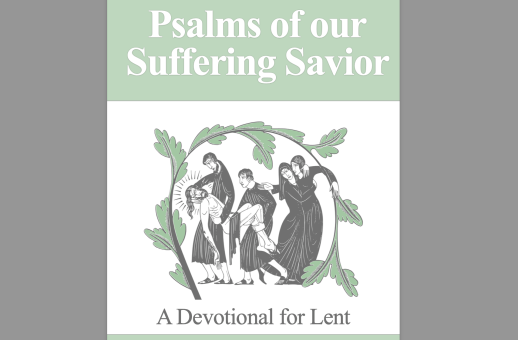
In preparation for Easter, I put together a devotional book. If you don’t have something to go through, I encourage you to check it out.
Here’s the link to the free e-book, I hope you find it helpful: Psalms of Our Suffering Savior
What is Christmas about?

Christmas is about the coming of the Christ. But, what does “Christ” mean? And why does it matter?
The word Christ comes from New Testament Greek. The Greek word is Christos (Χριστός), and it translates the Hebrew word Messiah (מָשִׁיחַ). Great. But what does Christ/Messiah mean? The simple answer is that Messiah means “anointed one.” But there is much more behind the meaning of the word Messiah than just “anointed one.” The Old Testament in various ways and in numerous writings promises that one would come and fulfill various promises. So, the expectation for the Messiah cannot be captured if we think it just means “anointed one.” It does mean that, but that is not all it means.
Do you know what a “honey-do-list” is? Have you ever seen one? I currently have a few things on the list: fix the leaky faucet, refinish the chair, and paint my son’s bedroom. A “honey-do-list” is a checklist of expectations. My wife, Leah, gave me a list and expects me to get everything done on the list. I am glad my wife is understanding and gracious, so the list isn’t very long.
As we think about the Jewish expectations for the Promised One, we are looking at a “honey-do-list” of sorts. We see from Scripture and history the “honey-do list” was not as small and understanding as my wife’s. The Jewish people had a huge list. And different people had different lists, but any list would be difficult to check off.
I think of the messianic expectations like water and oil. You don’t expect them to go together. How can the promised one be a king (2 Sam. 7:12-13; 1 Chron. 17:11-14) and a servant (Is. 52:13-53:12)? “One like the son of man” (Dan. 7:13) and also “Everlasting Father” (Is. 9:6)? How could the promised one suffer and die for His people and yet bring an eternal righteous reign? You don’t think of those things as going together. But sometimes things that you wouldn’t think go together, work quite nicely.
You wouldn’t think oil and vinegar make sense together. And you probably wouldn’t initially think it would make sense to have bacon with anything! It’s good enough on its own, right? But if you add spinach, candied pecans, cheese, oil, and vinegar (transformed into salad dressing), the bacon is elevated, and maybe even a little healthier.
If unexpected combinations result in delicious food, how great would the impact be on a spiritual level? A king who is also a servant?! Someone who has all power but is also all good? We don’t often think of these combinations, but if they could happen, it would be amazing.
The expectation presented in the Old Testament for the Promised One seems almost impossibly diverse. How could any one person fulfill the many expectations? How could it make sense for the “Ancient of Days” (Dan. 7:9, 13, 22) to be a descendant of king David (2 Sam. 7:12-16; Is. 11:1; Jer. 23:5-6)?
The New Testament authors, over and over, argue that Jesus is the Promised One, the long-awaited Messiah, who fulfills the prophecies, patterns, pointers, and promises of the Old Testament (2 Cor. 1:20). He will crush the serpent of old (Gen. 3:15) and lead the way back into Eden, He will bless all the nations of the earth, and He will set up His righteous and eternal Kingdom.
The messianic expectations appeared to be nothing more than unrelated and random shards of glass. But the New Testament helps us see they all work together to form an astounding, almost unbelievable, stained-glass picture of Jesus, the long-awaited, promised Messiah. That’s why understanding what Christ means matters. Without understanding the expectations for the Messiah, we’re left with broken glass, rather than a breath-taking mosaic.
Regarding prophecy, there are several Old Testament passages we could consider. I’ll give the Old Testament reference and then the New Testament reference.
- His appearance will be disfigured (see Isaiah 52:14 and Matthew 26:67).
- He will be despised and rejected (see Isaiah 53:3 and John 11:47-50).
- He will take sin upon Himself (see Isaiah 53:4-6, 8 and 1 Corinthians 15:3).
- He will be silent before His oppressors (see Isaiah 53:7 and Matthew14:60-61).
- He will be assigned a grave with the wicked and the rich in His death (Isaiah 53:9 and Mark 15:27-28, 43-46).
- He will be a descendant of king David (see 1 Chronicles 17:11-14 and Luke 3:23, 31).
- He will be born in Bethlehem (see Micah 5:2 and Matthew 2:1).
- He will be preceded by a messenger (see Isaiah 40:3-5 and Matthew 3:1-2).
- He will have a ministry of miracles (see Isaiah 35:5-6 and Matthew 9:35; 11:4-5).
- He will enter Jerusalem on a Donkey (see Zechariah 9:9 and Matthew 21:7-9).
- His hands and feet will be pierced (see Psalm 22:16 and Luke 23:33).
- He will be hated without reason (see Psalm 69:4 and John 15:25).
- His garments will be divided and lots will be cast for them (see Psalm 22:18; John 19:23-24).
- His bones will not be broken (see Psalm 34:20 and John 19: 33).
- His side will be pieced (see Zechariah 12:10 and Jn. 19:34).
- He, the Mighty God, will be born (see Isaiah 9:2-7 and Matthew 1:23; John 1:1-3, 14).
Christmas—the real meaning of the season—is about Christ, the fulfillment of God’s promises, and all the many things that means.
Photo by Jakob Owens
Pervasive Peace through the Second Advent

In Christmas, we celebrate the advent or coming of Christ. The first coming enabled a way for peace to be realized. Humans can, through Christ, have renewed fellowship with God. Yet, as Jesus Himself said, in the world we will have trouble and tribulation.
So, if that’s the case, if in the world we will have difficulty and distress, then how can we have peace? This Sunday I get to preach on the “Pathway to Peace” from Isaiah chapter 11. I’m excited and thankful to be able to do that.
I, however, have too much material. So, I thought I’d share here, part of how that peace is possible.
First, Isaiah paints a beautiful and powerful picture of peace (see Isaiah 11:1-9). A little baby can play with a king cobra without fear (v. 8). How is this possible?
Isaiah 11:9 tells us: the knowledge of God is intimately experienced. And so: nothing will “harm nor destroy on all [the Lord’s] holy mountain.” Instead of harm, “the earth will be filled with the knowledge of the Lord as the waters cover the sea.”
The Messiah will make it so not only the knowledge of the LORD is pervasive but intimacy with the LORD is too. Knowledge in the Old Testament is not merely head knowledge, but it is experiential (When Adam “knew” Eve, Genesis 4:1, it was not mere cognitive knowing, it was experiential).
Also, we should ask, how is it that the waters cover the sea? The waters cover the sea by filling it to the fullness of capacity. God and His goodness will be experienced and known to maximum capacity! We will have the strength together with all the saints to comprehend and know “the breadth and length and height and depth” of the “love of Christ that surpasses knowledge” and we will be “filled with all the fullness of God” (see Ephesians 3:18-19).
Look at what’s going to happen when Jesus reigns on earth!:
“Of the greatness of his government and peace
there will be no end.
He will reign on David’s throne
and over his kingdom,
establishing and upholding it
with justice and righteousness
from that time on and forever” (Isaiah 9:7).
Of peace, there will be no end!
Justice and righteousness forevermore!
Of course, this is not yet a reality. First, Christ came as a Lamb to be slain. Next, He’s coming as the Lion of the tribe of Judah (see Revelation 5:5).
In that day, when perfect peace comes upon the earth, the LORD says, “my chosen ones will long enjoy the work of their hands” (Is. 65:22). The most precious moments that we experience on earth—whether that’s a Thanksgiving dinner, a beautiful sunset, or being lost in a song or prayer of praise—will be multiplied infinitely.
“What no eye has seen, nor ear heard, nor the heart of man imagined, what God has prepared for those who love Him” (1 Corinthians 2:9).
How ironic, how sad, that the Rejected One, is the One who brings renewal of the whole earth.
Fellow Christians, please share the message that is so needed in these days of distress. And pray for your neighbors, that they would have peace that surpasses understanding.
Please pray that the Rejected One, the one alone who brings perfect and pervasive peace, would no longer be rejected.
The Ascension

As we saw in the previous post on the resurrection, Peter looked at Psalm 16 and showed how Jesus’ resurrection was foretold. In Acts 2 Peter goes on to show that Jesus is now at God’s right hand, as Psalm 110 foretold. Jesus Himself had quoted from Psalm 110 and stomped His critics (see e.g. Matt. 22:41-46). And when you look at 110:1 it’s not surprising that they were stomped.
So, we see that Jesus is at God’s right hand until… Until He makes His enemies His footstool. That means that Jesus is coming back—and the New Testament repeatedly says soon—to bring judgment, and pervasive peace through that judgment.[1]
Jesus’ death and resurrection shows that He is indeed the Lord and Messiah.[2] As the Lord and Messiah, He is coming back soon to vanquish every foe and establish His forever reign of peace. In His second coming, He will bring the Kingdom that was expected at His first coming. Read More…
An Easter Devotional

I wrote the blog series, “Psalms of our Suffering Savior,” to help us “remember Jesus Christ, risen from the dead” (2 Tim. 2:8).
It is to be used devotionally leading up to Easter (Resurrection Sunday). It is a 12-day devotional that starts with the Triumphant Entry and goes through to the Ascension of Jesus Christ.[1]
In these devotions, we’ll be looking at Psalms that express Jesus’ experience. Jesus “saw in the experiences of David the pattern, writ small, of his own calling.”[2] And as Jesus said, in Luke 24:44 “the Psalms must be fulfilled.”[3]
These devotionals will help us see how it is that Jesus fulfilled the Psalms.[4] And it is quite amazing to see.
Remember “many prophets and righteous people longed to see what you see” (Matt. 13:17)! So, let’s intentionally celebrate and “remember Jesus Christ, risen from the dead”!
If you’re interested in this devotional series, like the Facebook page here or follow the blog via email (look to the right under the search bar) and receive the devotionals that way.
8 Reasons we need to learn from the Old Testament

If we have the New Testament why do we need the Old Testament?
- All Scripture is inspired by God and profitable (2 Tim. 3:16), not just the texts we like to read.
- All the promises of God find their answer in Jesus so it is important that we understand what the promises are (2 Cor. 1:20).
- When Paul preached to the Ephesian church he preached the whole counsel of God (Acts 20:27) and the whole counsel of God points us to Jesus (Lk. 24:27).
- When Stephen preached in Acts chapter seven he preached the Old Testament (see also the other sermons recorded in the New Testament) which demonstrates the vital importance of the Old Testament.
- The things in the Old Testament serve to instruct us and set an example for us (Rom. 15:4; 1 Cor. 10:11).
- When Paul ministered to churches one of his ministries was proving that Jesus was the Promised One, the Christ (Acts 9:22). Paul demonstrated the amazing truth that Jesus is the long-awaited Messiah by teaching the Old Testament. We see this all through Acts (Acts 9:22; 13:16ff; 16:13; 17:3, 17; 18:4-5, 19; 19:8ff; 24:25; 26:6, 22-26; 28:23, 31 cf. 18:28). We too must understand what it means that Jesus is the Messiah and that will require learning from the Old Testament.
- Much of the New Testament assumes knowledge of the Old Testament.
- Scripture is so good we need as much of it as we can get, Old Testament or New. Scripture is perfect (Ps. 19:7), true (Ps. 19:9), pure (Ps. 19:8), a light (Ps. 119:105,130), a sword (Eph. 6:17), a hammer (Jer. 23:29). It is better than gold (Ps. 19:10; 119:72) and we need it to live (Ps. 119:144). Scripture gives joy (Ps. 119:111; Jer. 15:16), makes wise (Ps. 19:7), guards (Ps. 119:9), guides (Ps. 73:24; 119:105), sanctifies (Ps. 119:9, 11).
Read and study the Old Testament along with the New. 🙂



 in X
in X 