The Betrayal and Rejection

Jesus came to His own people and they did not receive Him (Jn. 1:11). Jesus was hated, rejected, and persecuted (Is. 53:3; Jn. 15:18). His friends abandoned Him (Ps. 88:8, 18; Matt. 26:56), even after making a pledge of undying loyalty. Yet, even while He Himself was being betrayed He protected His friends (Jn. 18:7-8)
Jesus, as Hebrews says, can sympathize with us (Heb. 4:15). He knows what it is like to experience betrayal of the worst kind.
Jesus was troubled in His spirit because one of His dear friends would betray Him. And it’s no wonder that He was troubled. Have you ever been hurt by a close friend? It hurts.
Yet Jesus was betrayed, as the Scriptures said He would be (Jn. 13:18).
Judas, Jesus’ “familiar friend” (Ps. 55:13), betrayed Him with a kiss[1] (Matt. 26:48-49). Jesus used to walk with Judas in the very same garden in which He was betrayed (Jn.18:2-3). Jesus had also recently shared bread with Judas.[2]
Jesus felt the blow of a backstabber but His pain would be far worse than any knife could inflict.
The Cleansing of the Temple
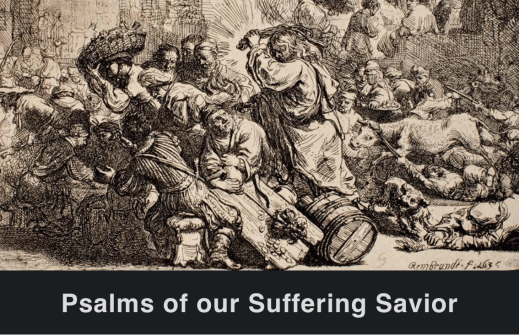
That’s exactly what happened to Jesus. He was consumed by zeal for the LORD’s house.
Can you imagine the scene? The whole city was frantic with excitement and expectation as Jesus came into Jerusalem.[1] Many expected that Jesus would soon bring freedom from Roman oppression and establish a reign of peace. People expected Jesus to ridicule Rome and inaugurate the Jewish state. Jesus, instead, condemns what’s going on in the Jewish temple.
If Jesus’ actions are unexpected it is because of misunderstanding or lack of zeal on our part. What Jesus did is in full agreement with Scripture (cf. Jer. 7:11; Zech. 14:21). The temple was to be a house of prayer, not a “den of robbers” (Is. 56:7). Specifically, the house of prayer is supposed to be “for all peoples” (v. 7). Because of all the selling, however, the court of the Gentiles would have been so filled with commotion that neither Jew nor Gentile would have been able to pray without distraction.
Jesus has concern for the poor, the sick, and the outsider. Jesus stands up for them even to the point of experiencing opposition. “Christ does more than denounce injustice—he takes action against it.”[2] That is good news!
The Hallel Psalms and the Supper

Psalm 115 is part of the Hallel Psalms. Hallel means, “praise.” Jesus would have sung the Hallel Psalms (Ps. 113-118) with His disciples on the eve of Passover.[1] Psalm 114 speaks directly of the exodus. From a New Testament perspective, we know that the salvation which began in Egypt would be finally filled in and through Jesus.
The Hallel Psalms were probably the last psalms Jesus sang before His suffering and death (Mk. 14:26). Jesus would have sung Psalm 115 knowing that He was Himself definitively showing God’s glory, love, and faithfulness. It is amazing also that Jewish people concluded the Hallel Psalms with the prayer:
“From everlasting to everlasting thou art God; beside thee we have no king, redeemer, or savior; no liberator, deliverer, provider; none who takes pity in every time of distress or trouble. We have no king but thee.”[2]
Truly! Apart from Messiah Jesus, there is no “no king, redeemer, or savior; no liberator, deliverer, provider.”
As we see in Psalm 115, idols are inept but God is a God of steadfast love and faithfulness. Whereas idols are inept God is involved. In fact, so involved that He came to this broken world in the form of Jesus Christ.
Idols are silver and gold but God came in flesh. Jesus has a mouth and with it, He spoke words of life. Jesus has eyes, and He saw this broken world and wept. Jesus has ears, and He heard the world’s bitter cries. Jesus has a nose, and He smelled the putrid smell of death. Jesus has human hands, and they were pierced. Jesus has feet, and they carried a cross, and were pinned to a cross. Jesus has a throat, and with it, He cried out: “my God, my God, why have Thou forsaken Me?!”
The Triumphant Entry

In Matthew’s passage about the Triumphant Entry, he quotes from and links to Psalm 118. It is likely that Jesus sang this Psalm, along with the other Hallel Psalms (Pss. 113-18), with the disciples after He instituted the Lord’s Supper (Mk. 14:26). That’s not surprising since Psalm 118 highlights God’s steadfast love and has many Christ connections.
Psalm 118 talks about the gate that the righteous enter through to go into the presence of God (v. 20). That is not a gate that we can open on our own because we cannot be righteous on our own (Rom. 3:10). Actually, the Bible says even the best we can do on our own is like filthy rags (Is. 64:6). We need the righteousness of Jesus Christ (Heb. 10:19-22). Jesus is the gate that gives us access to God the Father (Jn. 14:6), He is the one that makes us righteous.
Jesus was the rejected stone (Matt. 21:42) but He is the Messiah, the cornerstone (Ps. 118:22). All promises rest upon Him (2 Cor. 1:20). When Jesus made His way to Jerusalem, the people cried out: “Hosanna! Save us, we pray, O LORD!” (Matt. 21:9). The people spoke better than they knew. They cried out to Jesus who is God in flesh to save—and He soon would. He would fulfill their prayer to save by answering the next cry of the crowds, that He be crucified.
The Psalm says, “The LORD is God, and He has made His light to shine upon us” (Ps. 118:27). Truly. God in flesh dwelt among us. And yet He was the “festal sacrifice” (v. 27). Jesus is finally triumphant not by overthrowing the Roman government but by overthrowing Satan, sin, and death through His death and resurrection.
An Easter Devotional
I wrote the blog series, “Psalms of our Suffering Savior,” to help us “remember Jesus Christ, risen from the dead” (2 Tim. 2:8).
It is to be used devotionally leading up to Easter (Resurrection Sunday). It is a 12-day devotional that starts with the Triumphant Entry and goes through to the Ascension of Jesus Christ.[1]
In these devotions, we’ll be looking at Psalms that express Jesus’ experience. Jesus “saw in the experiences of David the pattern, writ small, of his own calling.”[2] And as Jesus said, in Luke 24:44 “the Psalms must be fulfilled.”[3]
These devotionals will help us see how it is that Jesus fulfilled the Psalms.[4] And it is quite amazing to see.
Remember “many prophets and righteous people longed to see what you see” (Matt. 13:17)! So, let’s intentionally celebrate and “remember Jesus Christ, risen from the dead”!
If you’re interested in this devotional series, like the Facebook page here or follow the blog via email (look to the right under the search bar) and receive the devotionals that way.
Jesus, Rebel With A Cause

Jesus was a rebel. But not like James Dean; not a “Rebel Without a Cause.”
Jesus had a cause. Actually, we might say He had a lot of causes. Of course, if we left off thinking Jesus was merely a rebel with a cause we’d be gravely mistaken. He’s much more than that. It is, however, still important that we not forget that He was indeed a rebel.
How was Jesus a Rebel?
This is an important question to ask, in part, because “People didn’t get crucified for being gentile or spiritual or for saying their prayers. They got crucified for being understood to be rebels.”[1]
Jesus was a rebel because…
Set Us Free

Paradise,
polluted and poisoned.
Our resounding plea:
“Set us free.”
We are writhing and reeling from the Fall.
Our affections wander and wane,
our struggles remain.
O’ Lord set us free.
We fettered our shackles,
we tossed the key.
But O’ Messiah, set us free.
Heaven’s Hope

Bound by sins darkened glow
In this world of pain and woe
Helpless, hopeless to us He came
And in the midst was slain
Darkest night, the Light extinguished
Will we forever captives be?
Messiah’s mission ends in death?
Where’s the hope of life and peace?
But by power He awaketh
All of death He did breakth
By His death, deaths defeated
Sins depleted of its power
Thus the hour of unrest
Has become our hope, our joy, our rest
For in Christ’s death,
Deaths defeated!
Yes, He burst the bonds that bound Him
And leads many captives in His wake
Yes, from the cross He is victorious
And all of heaven hails He’s glorious!
8 Reasons we need to learn from the Old Testament

If we have the New Testament why do we need the Old Testament?
- All Scripture is inspired by God and profitable (2 Tim. 3:16), not just the texts we like to read.
- All the promises of God find their answer in Jesus so it is important that we understand what the promises are (2 Cor. 1:20).
- When Paul preached to the Ephesian church he preached the whole counsel of God (Acts 20:27) and the whole counsel of God points us to Jesus (Lk. 24:27).
- When Stephen preached in Acts chapter seven he preached the Old Testament (see also the other sermons recorded in the New Testament) which demonstrates the vital importance of the Old Testament.
- The things in the Old Testament serve to instruct us and set an example for us (Rom. 15:4; 1 Cor. 10:11).
- When Paul ministered to churches one of his ministries was proving that Jesus was the Promised One, the Christ (Acts 9:22). Paul demonstrated the amazing truth that Jesus is the long-awaited Messiah by teaching the Old Testament. We see this all through Acts (Acts 9:22; 13:16ff; 16:13; 17:3, 17; 18:4-5, 19; 19:8ff; 24:25; 26:6, 22-26; 28:23, 31 cf. 18:28). We too must understand what it means that Jesus is the Messiah and that will require learning from the Old Testament.
- Much of the New Testament assumes knowledge of the Old Testament.
- Scripture is so good we need as much of it as we can get, Old Testament or New. Scripture is perfect (Ps. 19:7), true (Ps. 19:9), pure (Ps. 19:8), a light (Ps. 119:105,130), a sword (Eph. 6:17), a hammer (Jer. 23:29). It is better than gold (Ps. 19:10; 119:72) and we need it to live (Ps. 119:144). Scripture gives joy (Ps. 119:111; Jer. 15:16), makes wise (Ps. 19:7), guards (Ps. 119:9), guides (Ps. 73:24; 119:105), sanctifies (Ps. 119:9, 11).
Read and study the Old Testament along with the New. 🙂
Why should I believe the Bible? (pt 7)

We have already looked at many reasons why we can believe the Bible. Yet, there are still many more. Here we briefly look at the Bible being trustworthy because it is…
Prophetic
The Bible contains all sorts of fulfilled prophecies (see e.g. “The Prophecy of Daniel 8”), particularly about Jesus. These attest to the Bible’s uniqueness, truthfulness, and authority.
“Whatever one may think of the authority of and the message presented in the book we call the Bible, there is a world-wide agreement that in more ways than one it is the most remarkable volume that has ever been produced in these some five thousand years of writing on the part of the human race.
It is the only volume ever produced by man, or a group of men, in which is to be found a large body of prophecies relating to individual nations, to Israel, to all the peoples of the earth, to certain cities, and to the coming of One who was to be the Messiah. The ancient world had many different devices for determining the future, known as divination, but not in the entire gamut of Greek and Latin literature, even though they use the words prophet and prophecy, can we find any real specific prophecy of a great historic event to come in the distant future, nor any prophecy of a Savior to arise in the human race…”[1]