Why should I believe the Bible? (pt 3)

As we consider the question “Why should I believe the Bible?” it is important to understand various things about the Bible. One of those things is that the Bible is amazingly…
Unified
The Bible was written over the period of fifteen-hundred-years, by more than forty authors with varied backgrounds (e.g. king, herdsman, fisher, tax collector, physician) and literary styles (e.g. historical narrative, poetry, law, biography), on three different continents (Asia, Africa, and Europe), in three different languages (Hebrew, Aramaic, and Greek) and yet it tells one unified story.[1] The storyline of Scripture is amazing. It’s significance and glory can never be fully known and yet the storyline of Scripture can be beautifully portrayed in a three-minute video.
Why should I believe the Bible? (pt 1)

“Why should I believe the Bible?”
That is a very important question. In the next couple of posts, we will briefly consider various aspects of the Bible so that we are in a better position to answer that question.[1]
First, the Bible is…
Literature
The Bible is a very distinct piece of literature; it is truly unlike any other literary work. It is unique.
The Bible is the best selling book of all time and the most translated book of all time.[2] The figures vary but it is estimated that there are approximately 44 million copies sold each year. The Bible, whatever your opinion about its supernatural nature, should be read by all people. Reading and understanding the Bible is important in part because of the huge cultural impact it has had.[3] “No other book in all human history has in turn inspired the writing of so many books as the Bible.”[4]
So, read the Bible as literature. As C.S. Lewis said, “There is a sense in which the Bible, since it is after all literature, cannot properly be read except as literature; and the different parts of it as the different sorts of literature they are.”
___________________
[1] There are a lot of aspects to look at because, as Ravi Zacharias has said, a worldview is not built on one line of argument, but is built on a connected series of arguments.
[2] “As of September 2016 the full Bible has been translated into 636 languages, the New Testament alone into 1442 languages and Bible portions or stories into 1145 other languages. Thus at least some portion of the Bible has been translated into 3,223 languages” (http://www.wycliffe.net/statistics).
[3] See, as just one example, Martin Luther King Jr.’s “I have a Dream” speech. It alludes to Is. 40:4-5; Amos 5:24; Ps. 30:5; Gal. 3:28.
[4] Bernard Ramm, Protestant Christian Evidences, 239.
Darwin, Dawkins, and Moral Duty

Dawkins says “justice is a human construct of great importance in human affairs.”[1] And Dawkins believes that there is probably a Darwinian explanation that explains justice. So, our concept of justice is just a convenient Darwinian happenstance. I believe he says “blessed precious mistake” in his book The God Delusion. Of course, Nietzsche would disagree. Nietzsche in On the Genealogy of Morals doesn’t think it’s blessed or precious.
Also, if justice is merely a human construct then the cannibal clan in Cormac McCarthy’s book The Road are not wrong in keeping people locked up in the cellar in order to slaughter and eat.
20 Quotes from Gregory Koukl’s Tactics
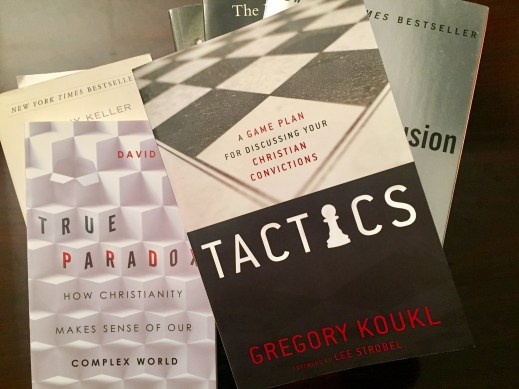
I found Gregory Koukl’s book Tactics helpful. Here‘s a book review to check out and here are some quotes from the book that I enjoyed:
- “Even though there is real warfare going on, our engagement should look more like diplomacy than D-Day” (19).
- “You must be careful not to use your tactics merely to assault others… I am not opposed to being assertive, direct or challenging. However, I never intend to be abrasive or abusive” (27).
- “Always make it a goal to keep your conversations cordial. Sometimes that will not be possible. If a principled, charitable expression of your ideas makes someone mad, there’s little you can do about it. Jesus’ teaching made some people furious. Just make sure it’s your ideas that offended not you, that your beliefs cause the dispute and not your behavior” (31).
- “The ability to argue well is vital for clear thinking. That’s why arguments are good things. Arguing is a virtue because it helps us determine what is true and discard what is false” (33).
- “It doesn’t follow that if God’s Spirit plays a vital role, then reason and persuasion play none” (35) (cf. Acts 17:2-4).
- “Some people think Christians are the only ones who need to answer for their beliefs. Of course, we should be able to give reasons for what we think is true. But we are not the only ones; others should be able to do this, too” (58).
- “Many Challenges to Christianity thrive on vague generalities and forceful but vacuous slogans” (58).
- Ask people for facts to support their conclusions. “Most critics are not prepared to defend their faith” (61).
- “Reversing the burden of proof is not a trick to avoid defending our own ideas. When we give opinions, we have to answer for them just like anyone else. We have a responsibility, but so do they” (65).
- “When someone asks for your personal views about a controversial issue, preface your remarks with a question that sets the stage—in your favor—for your response. Say, ‘You know, this is actually a very personal question you’re asking. I don’t mind answering, but before I do, I want to know if it’s safe to offer my views. So let me ask you a question: Do you consider yourself a tolerant person or an intolerant person on issues like this? Is it safe to give my opinion, or are you going to judge me for my point of view? Do you respect diverse points of view, or do you condemn others for convictions that differ from your own?’ Now when you give your point of view, it’s going to be very difficult for anyone to call you intolerant or judgmental without looking guilty, too” (78).
- “The quickest way to deal with a personal attack is to simply point it out with a question. When someone goes after you rather than your arguments, ask, ‘I’m a little confused about your response. Even if you were right about my character, could you explain to me exactly what that has to do with this issue?’” (79).
- “Think about using the phrase ‘Have you considered’ to introduce your concern, then offering a different view that gently questions the person’s beliefs or confronts weaknesses with his argument… ‘Have you ever considered… that the existence of evil is actually evidence of the existence of God, not against it?’… ‘Have you ever considered… that if Jesus was wrong about being the only way of salvation, it is difficult to call him a good man, a prophet, or a wise religious teacher? What do you think about that problem?’” (84).
- “Can you help me understand this? If there is no evidence that life came from non-life (abiogenesis)—that life spontaneously arose from inanimate matter to kick off the sequence of evolution—and there is much evidence against it, how can we say that Darwinian evolution is fact?” (85)
- “If someone’s thinking is flawed, the key to finding the error is to listen carefully to the reasons and then ask if the conclusions follow from the evidence. Point out errors with questions rather than statements. You might soften your challenge by phrasing your concern as a request for clarification or by suggesting an alternative with the words ‘Have you considered…’ before offering your own ideas” (88).
- “As a general rule, go out of your way to establish common ground. Whenever possible, affirm points of agreement. Take the most charitable read on the other person’s motives, not the most cynical. Treat them the way you would like others to treat you” (95).
- “If all religions are true, then Christianity is true. Yet a central claim of classical Christianity is that other religions are false when taken as a whole. Clearly, Jesus was not a pluralist. Either Christianity is correct that Jesus is God’s Messiah for the world and other religions are deceptions, as Scripture teaches, or Christianity is false and some other view is true. In no case, though, can all religions be true and valid” (119).
- “If you help someone see in advance that the route his map recommends will actually lead him off a cliff, he might consider changing his course. He might even discover he is using the wrong worldview map altogether and exchange it for one that is more reliable” (143).
- “When there is a conflict between methodology and materialism, the philosophy always trumps the facts. Modern science does not conclude from the evidence that design is not tenable” (171).
- “When an academic begins with naturalism, a series of ‘facts’ fall into place before any genuine historical analysis begins… Starting with one’s conclusions, though, is cheating. Nothing has been proved, only assumed” (173).
- “Carnage of unimaginable proportions resulted not from religion, but from institutionalized atheism” (177).
Apologetics Resources

I really enjoy apologetics and believe it’s important that we know why we believe what we believe. Here are some resources I’ve found helpful.
General
Reflections on “the problem of evil”

I have been reflecting on Uncle Tom’s Cabin, it has made me think about “the problem of evil.” In fact, at the end of the book Tom himself, one of the spiritual heroes of the book, is wrestling with the problem himself. In the book, there are all sorts of terrible realities that represent actual events. Injustice after injustice happen to the people in the story, and again, these stories are based on actual real life events.
One could try to do away with these sad and confused thoughts by just saying that slavery ended long ago. However, this does not solve the problem. Evil continues, injustice continues, ramifications continue. Further, there is still slavery. There is still abuse. Some live life as a mere dash in-between agony and futility. That is all they know, tossed on an endless wave of seemingly nothingness. So one does not escape the question by saying things are now good, or at least not so bad. What then is the answer to the pain, the suffering, the injustice?! Why do people, millions of people, live painful lives, just to die in greater pain?
Jesus and Jihad (part two)

Jesus and Jihad
I talked to a Muslim friend recently that said Islam and Christianity are ninety-six percent the same. I strongly disagree with him and believe most informed Muslims would as well. There is an irrevocable difference between Christianity and Islam. Some Christian missionaries go and die if need be, whereas some Muslim “missionaries” go and kill if need be. This is because Jesus died and said take up your crosses whereas Muhammad killed and said take up your swords. Jesus promises salvation through justification; Muhammad claims it comes through jihad.
It is important to understand that Jesus (Isa in the Qur’an) is quite prominent in the Qur’an and is held to be a prophet. The Qur’an assumes that its readers will have a working knowledge of Jesus and His teaching (cf. Surah 2:136; 4:29; 5:46). Islam even teaches that Jesus will return and carry out justice and “break the cross.”[1] However, there is a very large contrast between what the Qur’an teaches about religious use of violence and what Jesus teaches on violence. So, let’s look at what Jesus has to say about violence.
Jesus and Jihad (part one)

Introduction
Islam has many expressions. It is not monolithic. We are wrong if we think we understand Muslims because we have met one or read the Qur’an. That is a simplistic and false understanding. “Islam is a dynamic and varied religious tradition.”[1] In the same way, if you have met a Christian and read the New Testament, for example, that does not mean that you understand Christianity. “The range of contemporary Muslim religiosity varies tremendously. One of the reasons for this is that people understand and ‘use’ religion in a variety of ways; that is true whether we are dealing with Islam or Christianity or any other religion.”[2]
As Christians have different beliefs regarding certain doctrines, Muslims have different beliefs as well. Christianity has many expressions, liberal and fundamental and various particular denominations. In this post (and in part two), we will explore the Islamic understanding of jihad and contrast it with Christianity. Our first observation is to realize the multifaceted nature of our exploration.
Many Expressions of Islam
As we have briefly seen, not all Muslims are the same and not all Muslims understand jihad in the same way. So, some Muslims emphasize the more peaceful passages (e.g. surah 5:32; 2:256; Allah is also repeatedly said to be “most gracious, most merciful”) and that the Qur’an seems to teach to not begin the fight (2:190; 22:39). However, others believe that those who have not confessed Allah and his prophet have already essentially made war with Muslims and should be subjugated.[3] Some Muslims are strict adherents to Islam and some are secular. Muslims are not homogeneous. (For example, we see two very different narrative accounts in Nabeel Qureshi’s, Seeking Allah, Finding Jesus and Mosab Hassan Yousef’s, Son of Hamas). In fact, “not all Muslims believe that the Qurʾān is the literal and inerrant word of God, nor do all of them believe that Islam requires strict conformity to all the religious and moral precepts in the Qurʾān.”[4] We could group Muslims into three broad groups: secular Muslims, traditional Muslims, and fundamentalist Muslims.
Nabeel Qureshi, Seeking Allah, Finding Jesus (a book review)
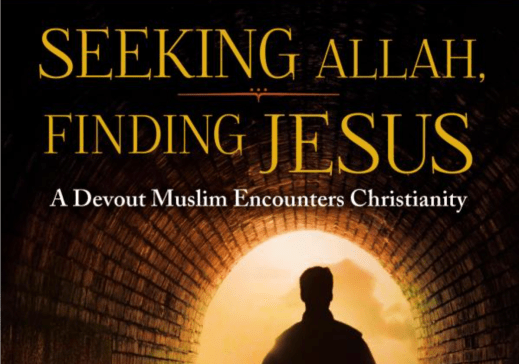
Hearing about Qureshi’ struggle as he thought about what it would mean to convert to Christianity was helpful. It will help me to be appropriately empathetic will discussing Christianity with Muslims. It is helpful to realize that “Muslims often risk everything to embrace the cross” (p. 253). I appreciated hearing his prayer: “O God! Give me time to mourn. More time to mourn the upcoming loss of my family, more time to mourn the life I’ve always lived” (p. 275). I also appreciated what he said about the cost of discipleship: “I had to give my life in order to receive His life. This was not some cliché. The gospel was calling me to die” (p. 278). Read More…
Texts Espoused to Teach Universalism

The goal here is not to give an exhaustive commentary on each passage but merely to show that there are very viable interpretations that are faithful to the whole of Scripture and do not lead to universalism.
Is. 45:22-23
“Turn to me and be saved, all the ends of the earth! For I am God, and there is no other. [23] By myself I have sworn; from my mouth has gone out in righteousness a word that shall not return: ‘To me every knee shall bow, every tongue shall swear allegiance.’”
In the LXX (the Greek translation of the Old Testament) απιστραϕητε is an imperative and means “turn around.” It has to do with changing ones beliefs and ways. It translates the Hebrew word (פָּנָה) meaning “turn” which is also in the imperative. So God here is not asking people to turn to Him, He’s commanding it. And it says that all people (from the farthest stretches of the earth) who turn to Him will be saved. But it implies that all who don’t turn to Him (in space in time before the Judgment) will not be saved. So we see precedence for “all” being saved here, that is, if any turn to the Lord from all over the earth they will be saved. Whosoever believes will be saved, Jew or Gentile. It was (in the OT and NT) an amazing thing for Paul for example that Gentiles can now be welcomed in (he called it a mystery). All the uncircumcised, the Egyptians that enslaved Israel, the Babylonians, all people that turn to the Lord (in space in time before the Judgment) will be saved. They will be saved from the terror of the Messiah’s Second Coming and the Final Destruction.
In the context, this passage would strike fear into the hearers, not comfort. This passage is saying, “repent and turn or else!” Further, v. 25 says “all the offspring of Israel shall be justified,” i.e. all those who have faith (see e.g. Rom. 2:28-29; 4:1-16; 9:6), not all without exception. “Yahweh’s speech ends with a prediction of destructive fire for those who do not submit to his reality and reign (Isa 47:14-15)… There is voluntary submission for some and involuntary submission for others.”[1]



 in X
in X 