Angst

to deep darkness the Light
“The people who walked in darkness
have seen a great light;
those who dwelt in a land of deep darkness,
on them has light shone.”
~Isaiah 9:2
Incarnation to New Creation

Just a word and all wonders wrought,
God announced, and behold, it was all good.
Creation had communion with the Creator,
God walked in the Garden.
Yet with Adam the serpent did conspire,
and brought the world into mire.
Beckoned to the grave,
everything disarranged.
The curse burst upon the scene,
but in the midst a seed of hope was seen.
Yes, long of told
,
the Scriptures told
,
of a King who’d come.
In His wake,
death shall quake
,
and the deserts they shall bloom.
Yet, many men came and went,
was the hope of promise spent?
Many lambs, prophets, priests and kings,
yet none with true salvation in their wings.
Darkness for a time,
no prophet’s voice was heard.
Yet in the darkness,
I light it shone,
and it would overcome the darkness.
Behold, O’ world, your Prophet, Priest, and King,
Jesus the Promised seed and Lamb.
The curse brought in shall be expunged;
yes, replunged upon the Son.
Christ was crushed as promised,
but in His crushing, crushed Satan, sin, and death.
Yes, He was cursed to reverse the curse.
He felt our plight to set all things right.
Yes, creation Creator collided
yet we did not hide
for God He brought no wrath,
there was no blood bath,
the world did not implode or explode into non-being.
Instead, angelic greeting:
“Peace on the earth,
goodwill to men”
because the Great I AM is come.
Our Lord, Messiah, Savior in a crib.
Wonderful Counselor,
Prince of Peace,
Bright and Morning Star,
born.
He who lay the foundations of the earth,
laid in a manger.
The Infinite born,
a swaddled babe.
Yes, He that holds the nations in His hand,
grasps His mother’s hand.
He that calls the stars by name,
spoke no name,
nor word.
He formed Himself
in His mother’s womb.
He upheld the nails
that held His hands.
He died for you,
for me.
He became poor
to restore our riches.
Yes, He felt our plight
to set all things right.
He was born to die,
that we might live.
The Deity
incarnate brings
salvation in His wings.
Man once again will be in the Garden
because God’s Son walked from Gethsemane to Golgotha.
No more brier prick or thorn to stick.
All shall be made new.
When our King all subdue,
all shall be made new.
All foes to be forgotten.
Forever banished now.
Satan’s role will be revoked,
the Lord Messiah come.
The demons tremble in His wake;
the blind see,
creation glimmers,
soon the groaning’s cease.
This is the time in between,
the already and not yet.
The Kingdom has come, but not consummated;
it shall be slightly belated.
Peace on the earth,
goodwill to man,
God’s eternal plan in fruition.
The Kingdom has come in God’s Son,
the lion to lay down with the lamb.
No tent or temple,
for the LORD tabernacled.
Yahweh is Messiah.
Immanuel,
born the balm,
for the vacuum of our souls.
Yes, the myth came true in the manger.
God is no longer a stranger,
but makes Himself known in His Son.
Jesus, Joshua’s namesake, true!
The LORD our Savior come!
He was, and is, and is to come.
All things consummate(d) in Him.
Amen.
(click here for audio)
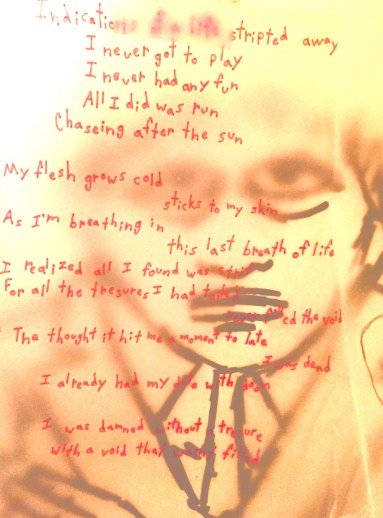
The “Yes!” we scream, whispers “No”
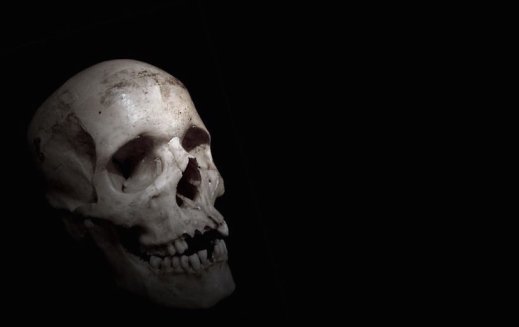
Greet the reaper as he reaps
and weep because of the same
  This silly game
  We do this to ourselves

We’ve mapped out our whole mission
We sketched the whole thing out
  The plan for our destruction

The black hole that is you
  It will consume you
More, more is your mantra
 The only thing that will not go is “no”

Inject the pleasure
Digest the pain
Is it all a game?

You dance,
You dance to your own dirge

The Subversive Nature of True Art

True beauty and art subvert the lie whispered in the Garden that roars in cacophonous echo today: “You shall be like gods!”
We walk the path that was blazed by our forebears; we autonomously seek for meaning in ourselves. Yet, periodically we stand before a sunset or Mozart or some other masterpiece and our autonomous walk is halted and we know, we intimately know, and even bask in the fact that we are not god and our good is not in autonomy, it is outside of us. We need. We need God.
The Breadth and Width of Musical Expression

It’s important for a painter to paint with a full pallet; yellows, reds, and blues and various types of hues; orange, green, and pink, in short, a full panorama of colors. This allows one to do better justice to reality. If a painter paints for very long and very well, he will eventually use the full range of colors.
Shouldn’t it be the same for musicians? Should not they, at times, have clashing symbols, bludgeoning bass, and frantic whispers? Is not there a time for aggression as well as joy? Soprano singers have their place, that’s true; but left to their own devices they won’t be able to communicate the breadth of the human condition and reality. We need waltzes and swing, we need metal and Mozart, we need jazz and, surprised to say, we need pop. However, that is not to say that all forms or types of music are good. That is not true in the artistic or moral sense. What I mean, rather, is that human experience is so broad that we need lots of “colors” and “easels” to express it. Look at the Psalms. Or look even just at David’s Psalms. David would have understood (and perhaps wrote) pop praise songs akin to what we hear on the radio as well as laments. David did not paint with broad bland strokes but used the appropriate “brush” for the appropriate picture.
I think we see a parallel also in the breadth of literature or genres in Scripture. One genre or form of literature simply won’t do in the communication of truth.[1] In the same way, contemporary Christian music in the vein of CCM, won’t be able to communicate the full breadth of truth in Scripture.[2] There are things worth screaming over and musically weeping over. I, for instance, am personally convinced that Christians need double-bass “fight” songs from time to time. I would argue that some heavy music is better than a lot of the stuff we hear on Christian radio (see here and here).
Popular contemporary Christian music tends to paint with brood bright strokes, using mainly happy and poppy major chords. Dark colors and minor keys seem to be all but forgotten. It’s like they’ve remembered redemption but forgotten the Fall. There are reasons to rejoice. But there are also reasons to weep, and scream. Christianity offers a full-orbed worldview. It deals with the pain and paradoxes of life. Much of contemporary Christian music doesn’t. A lot of secular music deals with angst; and that, that I can relate to. The world has much good in it, yet much bad, we are vying for meaning and redemption, and we have a thirst that can’t be quenched here. Much of contemporary Christian music, through lyrics and arrangement, doesn’t deal with or admit angst. It often seems ingeniune.[3]
Witness the realness and struggles of the Psalms. They are not always just poppy and happy. Sometimes they are, but not always. They incorporate a richer view of what it is to be: Blacks, browns, grays as well as pinks, yellows, and light blues; they use minor as well as major cords. They sing and scream. They cry and rejoice.
“When all Scripture references to music making are combined, we learn that we are to make music in every conceivable condition: joy, triumph, imprisonment, solitude, grief, peace, war, sickness, merriment, abundance, and deprivation. This principle implies that the music of the church should be a complete music, not one-sided or single faceted.”[4]
The Psalms and the Bible broadly communicate and speak to the human condition and I hope more and more Christian art will as well.
Christian music as a role should take into account the major plot turns of Scripture. Neither stuck in the Fall or New Creation. To do justice to Scripture and reality, much of Christian music must expand its scope to include the Fall and the tragic pain and loss that humanity now suffers as a result.
“Modern and postmodern art often claim to tell the truth about the pain and absurdity of human existence, but that is only part of the story. The Christian approach to the human condition is more complete, and for that reason more hopeful (and ultimately more truthful). Christian artists celebrate the essential goodness of the world that God has made… Such celebration is not a form of naive idealism, but of healthy realism. At the same time, Christian artists also lament the ugly intrusion of evil into a world that is warped by sin, mourning the lost beauties of a fallen paradise… There is a sense not only of what we are, but also of what we were: creatures made to be like God… Even better, there is a sense of what we can become. Christian art is redemptive… Rather than giving in to meaninglessness and despair, Christian artists know that there is a way out.”[5]
Hopefully there will be more and more Christian artists that deal with the damning affects of the Fall. That will deal with the angst and anger we often feel. But also the amazing promise of hope, redemption, and shalom through Messiah Jesus. This world is fallen but we must not forget the future, the coming reign of Christ, or what He has already accomplished on the cross.
True Christian expression should take into account the dark night of the soul, the melancholy madness we sometimes feel, as well as exuberant joy. It should recall our suffering Savior on the cross as well as His coming reign in which He’ll slay unrepentant sinners. It should at times acknowledge doubt and affirm belief. It should encompass the whole range of human emotions, various genres of Scripture, and the full sweep of the Christian story and the end (telos) of it all should be the glory of God through the exaltation of Christ.
This then would be real, rich, and weighty musical art. Music that strives, obtains, aches, yearns, realizes, weeps, and rejoices. Music that is accurate and true; music that is richly diverse and leaks over into other genres. Music that reflects the great story that we all find ourselves in—the creation of all things good, the Fall and thus futility we all reckon with, the redemption offered in Christ, and the Judgment and New Creation that awaits. Music that is rich, hopeful, and honest. Music that is hard and peaceful. Music that does justice to the world we live in, in all of its beauty and pain. Music that offers hope and redemption but that’s not naive about pain and pointlessness and suffering.
Music has a distinct ability to distill, channel, and focus truth and beauty into a unified whole so that the result is a type of laser that cuts into our core to wreak havoc and heal. As Augustine said, sounds flow into our ears, and truth streams into our hearts. Music is important and it shapes us.[6] It is thus important that it is done well and shapes us well, to the right end (telos).
________________________________
[1] “When the psalmist says, ‘Sing to him a new song; play skillfully, and shout for passages throughout the Psalms refer to all four main forms of music: strings, woodwinds, brass, and percussion. The ascriptions to the Psalms also contain evocative references to musical tunes, such as “The Death of the Son’ (Ps. 9) and ‘The Lily of the Covenant’ (Ps. 60). The Bible is full of many kinds of music. And as for literature, what further endorsement is needed beyond the Bible itself, which is the world’s richest anthology of stories, poems, historical torical narratives, romances, soliloquies, psalms, laments, prophecies, proverbs, parables, epistles, and apocalyptic visions?” (Philip Graham Ryken. Art for God’s Sake: A Call to Recover the Arts [Kindle Locations 180-185]. Kindle Edition.)
[2] “By continuously ‘praising the Lord’ the CCM artist rarely shows evidence of a comprehensive worldview. In fact, the world is not viewed at all. What is viewed is personal spiritual experience and usually only its more beautiful peaks. The valley of the shadow of death is rarely traversed, nor is the valley of indecision” (Steve Turner, Imagine: a vision for Christians in the arts, 52).
[3] “The problem with some modern and postmodern art is that it seeks to offer truth at the expense of beauty. It tells the truth only about ugliness and alienation, leaving out the beauty of creation and redemption. A good deal of so-called Christian art tends to have the opposite problem. It tries to show beauty without admitting the truth about sin, and to that extent it is false-dishonest about the tragic implications of our depravity. Think of all the bright, sentimental landscapes that portray an ideal world unaffected by the Fall, or the light, cheery melodies that characterize the Christian life as one of undiminished happiness. Such a world may be nice to imagine, but it is not the world God sent his Son to save” (Ryken, Art for God’s Sake, 242-246).
[4] Harold M. Best, Music Through the Eyes of Faith, 186.
[5] Ryken. Art for God’s Sake, 217-227
[6] “Music gets ‘in’ us in ways that other forms of discourse rarely do. A song gets absorbed into our imagination in a way that mere texts rarely do… Song seems to have a privileged channel to our imagination, to our kardia, because it involves our body in a unique way… Perhaps it is by hymns, songs, and choruses that the word of Christ ‘dwells in us richly’” (Smith, Desiring the Kingdom, 171).
The Megalomania of Mass Media

Through Twitter, Instagram, and Facebook (and remember MySpace?) we have a world essentially created in our image. It’s nice. But it also feeds our narcissistic souls.[i] We like what we want and we want what we like; and if you, a certain political agenda, a religious view, or a video, a picture, or an advertisement (the most difficult thing to avoid in our cyber-haven) gets in my way I have the right, without reproach, to scroll on by.
Media brings a form of megalomania but it can also be a monster to meaning. It destroys meaning by stripping it of its context and by placing weighty things into too close a proximity to funny dog videos. When posts about politics, pantiliners, and poodles all show up in our (raging and undirected directed) “stream” then we might be taking in not a stream but a torrent of incoherent information.
It seems that social media has great potential to create an anti-intellectual ivory tower. That is, it distances us from people and what is really going on and allows us to make unsubstantiated comments that haven’t truly been contemplated. If we don’t take in the protein and exercise of hard thought we’re going to be weak. If we feed on what’s frail and fruitless, we will be frail and fruitless.
Tweets and feeds won’t feed us. And we cannot understand politics in sixty-second-sound-bits. Racial reconciliation isn’t and can’t be reconciled, let alone understood, when we merely rely on social media; instead of deep, patient, embodied, social change.
Violence and vengeance, bullying and bad behavior, won’t be solved by ads alone; even if the words are backed by a famous actor, artist, or athlete (that ironically likely undercuts the very thing they’re supposedly trying to communicate).
Further, social media may fool us, but it won’t fill us. We may enjoy Instagram but we weren’t there, we aren’t now, or we didn’t receive enough “stars” (or whatever) to fill out our significance.
The “word” “tweet” is fitting for Twitter because although I myself have a Twitter the whole thing is not congruent. When sentences and phrases are sheared of their context they have about as much meaning as a bird tweeting. So when we “tweet” we may be performing a type of onomatopoeia (an onomatopoeia is a word that phonetically imitates, resembles, or suggests the source of the sound that it describes). That is to say, to tweet is to not say anything; or, at least, anything that is human in an extended rational sense.
As humans we can hear more than “tweet, tweet, tweet.” We can take in and bask in beautiful poetry or follow powerful prose. We can be “intoxicated” in beautiful ways literarily, but not so much if we stick w/ texting & tweeting.
Thankfully Chopin and Beethoven’s media wasn’t a kazoo and a triangle, that media would have greatly hindered them. Could it be that our media is hurting and hindering us? Maybe sometimes we need to even focus on a medium. Maybe even pick up a pencil and paper, put away distractions, and put something powerful and substantial down. Something outside of us, beyond us, and not about us. Maybe it’s time to read a book and get off Facebook.
________________________
[i] In the picture above by Caravaggio (1571-1610), Narcissus gazes at his own reflection and in a similar way we gaze into our computers, phones, and tablets. We narcissistically gaze at our profiles and our worlds that we have created in our image. Could we meet the same fate as Narcissus? Could we drown in a stream of information and technology?



 in X
in X 