Do we live for a mere inscription on a tomb?

Is there meaning to this madness? Is it just a rat race and then nothing but a cold, silent, and rotten end? Do we live for a mere inscription on a tomb? An inscription that will inevitably fade with the passage of time?
Seneca Said,
“When you see a man often wearing the robe of office, when you see one whose name is famous in the Forum, do not envy him; those things are bought at the price of life. They will waste all their years, in order that they may have one year reckoned by their name… Some, when they have crawled up through a thousand indignities to the crowning dignity, have been possessed by the unhappy thought that they have but toiled for an inscription on a tomb” (“On the Shortness of Life“).
Christ gives much more to live for. Christ gives us motivation for going “through a thousand indignities.” Christ gives meaning and motivation because through His resurrection our labor in the Lord—whatever it is—is not in vain (1 Cor. 15:58)! We can please the Lord and work heartedly unto the Lord in whatever we do (1 Cor. 10:31; Col. 3:23-24)!
So, the goal of a Christian is not to “wear the robe of office” or be “famous in the Forum.” The goal of a Christian is to put a smile on the face of God their Father and hear: “Well done, good and faithful servant; thou hast been faithful over a few things, I will make thee ruler over many things: enter thou into the joy of thy Lord.”
Perhaps that will entail being famous in the Forum or wearing the robe of office but the Christian is indifferent. The Christian’s goal is the same whether a pauper a prince: “He must become greater; I must become less” (Jn. 3:10). Christians know that when they do what’s right, they are still unworthy servants; who have only done what was their duty (Lk. 17:10).
So, no; we, or at least Christians, do not live for an inscription on a tomb. But rather for the One who forever takes us beyond the tomb. We live for the veil to lift so we can see the full marvelous glory of God; so we can continually taste of the goodness of God. It is about God and His glory. He deserves all glory and our very purpose is found in enjoying His glory and glorifying Him in the myriads ways that He has called us to.
Christians “crawl” up through a thousand indignities to the crowning dignity of eternal and endless delight.
So, no matter what they tell us, or no matter what we feel, there is a telos. There is a point. There is meaning.
Our end does not have to be the grave because of God.
_
*Photo by Ronni Kurtz
Does the concept of justice even make sense today?

Humans, I believe, want justice. I believe that is a natural and good desire that is innate within us. Where, however, does the concept of justice come from? How do we know what is right and what is not right? Does the concept of justice even make sense today?
The theme of the day is, “Have it your way,” “Do what’s right for you.” It’s, “You be you.” It’s, “You be happy.” It’s, “Free yourself from the oppressive shackles of society, family, and really any expectation at all.”
Don’t discard what’s valuable
Now, to use a disturbing and fitting analogy, we often sadly throw the baby out with the bathwater. No matter what the baby or the bathwater is. We throw them both out. I don’t think we should completely throw out the baby (of course!). I think there’s some definite truth to “doing what’s right for you,” “being yourself,” “being free from oppressive shackles,” “being happy,” and even “having it your way.”
But, does that mean that there’s not an actual right way to live? Does that mean that the actual best version of yourself might not require humility and the admitting of wrong? Do all restrictions have to be considered oppressive shackles (perhaps a train is most free on the tracks!)?
If there is actual truth and justice it might not just convict the bigoted and intolerant, it might convict me of wrong. If there is such thing as actual wrong, I’m not immune from justice’s scale. I myself could be found and wanting. Perhaps it could be found out that me “having my own way,” is not the way, is not right?
What if there is no actual truth or justice?
If, however, “moral truths” are nothing more than opinions of an individual and are thus infallible then what grounds is there for justice? If we believe in “truth” by majority—truth by popular consensus, then which majority, on which continent, at which time in history? And how is this actually very different than Nazism and “might makes right” morality?
People’s cry for justice would then be nothing more than mere power grabs, people asserting themselves over others. Crying out for justice would be nothing more than enforcing one’s own or a group’s preference on others. That does not seem very tolerant. “Who are you or who are y’all to enforce your opinion on me?”
When we say we can’t actually know what is truly right or wrong it undermines the concept of justice.[1] If we can’t truly know what is just how then can we have justice? If we can know what is just, how? Where do we get this concept of justice from?
So, is there actual truth and justice?
Can we know? Or, are we left in the dark to grope our way?
I believe our flourishing as a society is bound up with the truth. Our happiness is collectively tied to knowing how to live and living that way.
If the majority collectively says there is no actual truth then we will walk in epistemological darkness. And in the darkness, we will fall. We will trip into a thousand blunders.
If we say we cannot know what is truly just, then justice will wane. If there is no just, there is no justice. If there is no conviction that we are at least sometimes wrong, there will be no conviction that anyone is wrong. But, if there is the conviction that we are sometimes wrong, there must be a confession that there is actual truth.
There is a price to moral “freedom.” That cost is to shut the lights off and to walk in darkness.
I believe the concept of truth and justice makes sense today
I believe truth is precious. Although truth at times has rough edges. And at times I collide into it’s jagged ends.
“The modern man in revolt has become practically useless for all purposes of revolt. By rebelling against everything he has lost his right to rebel against anything” (G.K. Chesterton).
“If you see through everything, then everything is transparent. But a wholly transparent world is an invisible world. To ‘see through’ all things is the same as not to see” (C.S. Lewis).
“Believe in truth. To abandon facts is to abandon freedom. If nothing is true, then no one can criticize power, because there is no basis on which to do so. If nothing is true, then all is spectacle. The biggest wallet pays for the most blinding lights” (Timothy Snyder, On Tyranny).
So, truth sometimes tears into us and sometimes hurts because it’s actually there. We get hurt when we act like it’s not. Because it is. We intuitively know this, because we care about justice. We care about people “getting what’s coming to them.” Because the concept of justice makes sense even today?
How, however, can we know the truth? And what hope is there for us who have been measured and found wanting on the scales of justice?
___
[1] Steve Wilkens and Mark L. Sanford, Hidden Worldviews: Eight Cultural Stories That Shape Our Lives, 95.
Awaking Relevance: Death?
How do we face the reality of death?
When I was seven I remember weeping with my mom and dad after hearing that my grandma died. I remember kissing her bodies’ cold dead lips at the open casket. I remember the hardness of her skin.
When I was 13 I remember hearing the news right before Thanksgiving that my best friend had been killed in a tragic hunting accident. I remember the silence. The shock and the pain. The questions. The emptiness. The deep sense that it was not right. It was not supposed to be like that.
When I was in my mid-20s I remember hearing that a dear friend that I had met with a few days before and encouraged to keep fighting against his drug addiction had committed suicide. I remember meeting with his family and sitting with them and crying alongside them. I remember his funeral and how his mother was late because she didn’t want to say bye. I remember his mom and girlfriend weeping at his casket and I remember helping them say their final goodbyes.
I remember hearing that my brother-in-law that taught me how to drive and meant so much to me died. His son found him in the kitchen after a massive heart attack. I remember getting a group text message three months later about one of my other brothers-in-law. I was on the campus of George Mason University and the world stopped. My brother-in-law who had been like a brother and father to me had died.
I remember a dear friend that was struggling with depression. I remember first hearing that he had lost the battle and had taken his own life. I remember deeply wrestling that week with what to say at his funeral.
I remember death. I remember the bitterness. I know it is a dark reality.
Death is coming for us all. One way or another. That’s the cold stark truth.
It is appointed for each person to die once.[1]
As Solomon, the great philosopher said, “The fate of the sons of men and the fate of beasts are the same. As one dies so dies the other.”[2]
My own dear wife, because of various health issues, has a shorter life expectancy than most people her age. However, even the concept of “life expectancy” admits the reality of death but seems to try to hide it. We will all die. It would be more accurate to talk about “death expectancy.” But it’s more palatable to say “life expectancy.”
The truth is though, that we should remember death, and remember death often, because we’re all gonna die. We are all terminal. We have the devastating condition known as mortality.
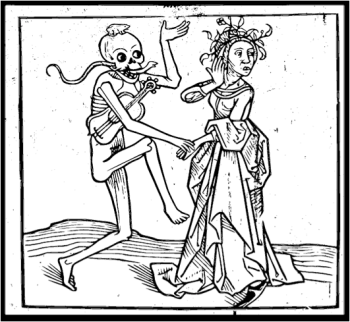
There was a time when danse macabre, or pictures of the “dance of the dead,” were common (see the picture below for an example). The purpose of these pictures “was to remind the viewer not only that death was always close to them and could strike at any moment, but that everyone was equal in the face of it.”[3]
History shows that “What we really need is wisdom for how to truly live and die well.”[4]
 When we live life in light of our coming death, we’ll be better positioned to live well. Death, however, is more distant from our minds than at any other point in history.[5] We try our best to ignore and silence the disturbing reality of our own mortality.[6] So, to the question: “How do we face the reality of death?” The answer is, at least in many cases: We try to avoid thinking about it.
Reality is what it is regardless of if we accept it or think about it. I believe that we are better positioned for life if we consider and live in light of reality.
There’s a local apple orchard where I live. Their cider is the best tasting liquid I think I’ve ever had. But their cider is seasonal. It’s not available year-round. So that reality means that I need to make the most of cider season. I need to cough up the money and enjoy the cider while I can. There will come a day when I won’t be able to enjoy the cider anymore. That reality has a very real impact on the beverage choices I make.
When we realize the reality of death—and not just cognitively with our heads—then it will make a difference in our lives. We will “buy the cider” and we will enjoy every drop. Death can give us profound enjoyment of life. When we grasp and meditate on the fact that death can snatch anyone away in an instant then we will realize that “life exists to be lived to the full, that every moment must be cherished as a gift, that you should make the most of the few years granted to you.”[7]
Death, strangely, can give us the gift of life; a full and fulfilling life.
“Our modern desire to keep death at a distance, to insulate ourselves from its shadowy presence, is a form of collective denial that diminishes our capacity to feel the fragility and fleetingness of our earthly being, and saps us of our life force.”[8]
That’s why we want to consider death here. We are different from animals. We can consider the concept of both life and death. We know that we will die, and that those near us, our loved ones, will die as well.[9] We would do well to take advantage of this ability.
Humans realize “loss is universal, not exceptional. It’s guaranteed, not unexpected. Every relationship is lost to time. So is every penny of everyone’s wealth, and ultimately so is every life. Loss isn’t surprising. It is basic to the course of every life.”[10]
When we consider the constant reality of the presence of death it helps us to see both how precious and precarious life is. If we don’t acknowledge the haunting reality of death, we are unlikely to truly prize life. Just as money is valuable because it is fleeting and limited so is life.
You might be thinking, “Why would we want to consider anything related to death?” First, it is important for me to challenge you to consider death because I don’t think you have a lot of people telling you to do that. And death is a lot more sanitized than it used to be. I’m not saying that’s a bad thing but the truth is “wakes,” “calling hours,” or “viewings” used to take place in homes and death was a lot easier to consider because it was harder to forget.[11] Now, however, it’s easy to put off thinking about death almost entirely.
But remembering death brings a needed perspective change to our lives.
The other day I was on the couch and my favorite baseball team, the Cleveland Indians, were on and I just wanted to chill and watch the game. But, my kids wanted to spend some quality time with me. They wanted to wrestle. So, I lay there for a little bit but then I remembered something… I remembered death. I remembered to think of things in light of death and so you know what I did? I got up and wrestled with my kids. It was great! I hurt my toe. But it was great!
If we remember death, it will absolutely have an impact on us.
Psalm 39 somewhat strangely says, “O LORD, make me know my end and what is the measure of my days; let me know how fleeting I am! Surely all mankind stands as a mere breath!”
This Psalm says, “let me know how fleeting I am.” As far as prayer requests go, this one is a strange one… Imagine some guy in the corner saying, “I really want you to pray that I would know the shortness of my life”? That’s a funny picture.
So, why would the person who wrote Psalm 39 ask God for that?
I think of my kids playing with bubbles in the front yard. They blow bubbles. Pop. Pop. Pop.
The Psalm says we are a mere breath.
Pop, pop, pop, and we’re gone.
We don’t know when, we don’t know how, but just like a bubble we will soon pass away.
When we realize that it changes the way we think, and it changes the way we live. That’s why the person that wrote Psalm 39 asked that they would know how fleeting they are.
“We must all die; we are like water spilled on the ground, which cannot be gathered up again.”[12] Death is the way of all the earth. And we are always but a step from it. “We must all die; we are like water spilled on the ground, which cannot be gathered up again.”[13] Death is the way of all the earth. Even the wise die. “The stupid and the senseless alike perish.”[14]
So, I’m telling us to remember death because we’re unlikely to. I’m telling us to remember death because we’re likely to think we’re the center of the universe, but death reminds us that we’re not.[15] I’m telling us to remember death because death helps us to put things in the right perspective and remember the things that really matter.
When we remember things it helps us chart the right course but when we forget even little things it causes us all sorts of problems. That is why “it is better to go to a funeral than a feast. For death is the destiny of every person, and the living should take this to heart.”[16] Therefore, remember death while you yet have life. Let the reality of death give you perspective and wisdom in life.
You may have an elaborate sandcastle, but the tide is rising. “Death has an unmatched ability to expose the flimsiness of the things we believe give substance to our lives.”[17] We are used to commanding our destiny. We make plans and we accomplish goals. But no one has authority over the day of death.[18]
When you’re on vacation and you have limited time, you ironically wear yourself out making the most of the time. You know the time’s limited so do you refuse to have fun? No! You capitalize on the time and make sure you spend good time with your family… That’s death for us.
Even though flowers wither in the autumn doesn’t mean we shouldn’t enjoy their beauty. If anything, it means we must enjoy their beauty while we can. It’s the same with the beauty of autumn. There’s a short window of time when the sky is ablaze with the color of the trees. That scarcity makes autumn all the more precious and beautiful.
The shortness of life should spur us on to make the most of life. Our time is short. So, we should consider how we should live and why?
What hope is there in the face of death?
The Christian Scriptures say a lot about our coming death. It says a lot about how we should prepare for it and live in light of its reality. Ecclesiastes tells us to enjoy life while we can (9:9-10). This makes sense when we are reminded how amazingly short our lives really are (see e.g. Job 14:2; Ps. 90:2-12; 103:14-17; James 4:13-16). And so, in light of the fleeting nature of life, we are told to “number our days that we may get a heart of wisdom” (Ps. 90:12).
The Christian Scripture points to death as confirmation that something has gone terribly wrong in the world. Thankfully, however, that’s not where Scripture leaves off. Scripture says that death is not the end. It is not the termination of all consciousness.
When Jesus’ close friend Lazarus died, Jesus wept (See Jn. 11:1-54). Jesus did not react with cold detachment. Jesus intimately cares. Jesus is heartbroken. One of the reasons He’s heartbroken is because death is not the way it was supposed to be. That’s partly why we’re repulsed by it.
The Bible teaches that God has no pleasure in death (Ezekiel 18:32; 33:11; 1 Timothy 2:4, 6; 2 Peter 3:9; Titus 2:11). And so He did something about it. He provided a way for people to be saved from death; the death the Bible says that was deserved.
Death is deserved because of sin. Just as a ticket is the wages of speeding, so death is the wages of sin. Just as speeding is dangerous and destructive so is sin. And so it’s taken seriously and punished to minimize its destructive impact.
So “death spread to all, because all sinned.”[19] Because of sin, no one can live and not see death.[20] “Judgment in Scripture,” however, “is anything but arbitrary or capricious… Most often, judgment is a matter of God leaving an individual or a society to the logic of their own settled choices.”[21]
Christ brought rescue from sin’s penalty but its presence remains until He returns. Soon death will be no more, the Christian Scripture teaches. But not until then. Yet, there is rescue from both the penalty and presence of death through Christ.
So, what hope does Christianity give in light of the grim reality of death? The Bible talks about resurrection. It talks about the resurrection of Jesus the Messiah and it talks about the eventual resurrection, to true and everlasting life, for all those who trust and follow Him.
Perhaps this is getting a little out there for you now. Too much like an episode of The X-Files or Stranger Things.
I’d encourage you to at least read on and check out the next post. Partly because I believe, as Matthew McCullough has said, “It is Resurrection or vanity.”[22]
Awaking Relevance Introduction

How should we live and why?
This is written for those who think church is bigoted and bad. It’s written for those who are bitter and done. It’s honestly specifically written for one of my friends. I want to awake them and you to the relevance of Christianity. Will you take some time to consider some important questions with me?
My question over all of this project is, does Jesus, who the Bible claims to be the Messiah, matter? We will not come at that question straight on. Instead, we will consider that question by asking other very important questions. Questions that are important but are often left unasked. Questions that close in on us and surround us and squeeze us. Questions that are there lurking.
Questions about death. About whether or not the world is enchanted. Questions about science and satisfaction. And morality and meaning.
You will answer these questions. We all have to. Will we, however, ask them? Will we think through them? Will we answer them honestly? And thoughtfully and thoroughly?
Socrates, the old and famous philosopher, is reported as saying, “The unexamined life is not worth living.” I personally think that Socrates exaggerated. I think life is worth living even if we don’t think about it. But, I do believe that it’s much better to live an examined life. And it’s much more honest and genuine too.
So, will you consider these questions? Will you ask them and find the real you? Will you find out what you really believe? Will you fight the façade and live the most honest and genuine life you can?
It’s better to consider these questions before it’s too late. To truly ask and answer: Does Jesus matter?—then to assume He does, if doesn’t. The opposite follows too. What if we assume Jesus doesn’t matter when He does? As the adage goes, if we ASSUME it makes an ASS out of U and ME. And as C.S. Lewis said, “Christianity, if false, is of no importance, and if true, of infinite importance, the only thing it cannot be is moderately important.”
If Jesus is not really God in flesh, as the Bible claims, then “what conceivable relevance may the teachings and lifestyle of a first-century male Jew have for us today, in a totally different cultural situation?”[1] So, does Messiah Jesus matter? Consider that question with me through the lens of these other questions. Perspective often allows us to see something we didn’t before. That’s our goal. To gain perspective so that we can come full cycle and be in a better place to ask the question “does Messiah Jesus matter?”
I’m sure it’s apparent to you at the outset, but I’m convinced He does matter. I believe He matters more than the oxygen in my lungs. I want to be totally honest with you. Also, something in the back of my head informing a lot of what I write is a verse from the Bible. It has been very meaningful and challenging to me. It says, “How long will you go limping between two different opinions, if the LORD is God, follow Him; but if Baal, then follow him.”[2]
I want you to be truly convinced one way or the other. To tweak Socrates’ wisdom: the unexamined life is not consistent.
I believe we should examine our convictions about what is true, right, good, and beautiful, and then seek to live consistently with our convictions in every area of our lives.[3]
A couple of years ago my family and I lived outside of Washington, DC. I was grabbing tacos with a friend at a really good local chain. I believed I was at the right place. it was the right taco chain after all. But my friend, who was not normally late, was not there. So I called him. He said he was sitting in the front of the restaurant and waiting for me. But I was there and sitting in the front and waiting for him. And he was nowhere to be found.
I believed I had the right spot, that’s why I was there. But I was wrong. I was at the right taco establishment but not the right location. So, you see, when we get little things wrong, even if we get a lot right, it can have a big impact. Even a devastating impact.
“Little, everyday decisions will either take you to the life you desire or to disaster by default… Stray off course by just two millimeters, and your trajectory changes; what seemed like a tiny, inconsequential decision then can become a mammoth miscalculation.”[4]
When we believe something, like the place we’re meeting a friend, it leads to a corresponding action: going there. We can think we’re right, and even have reasons for thinking we’re right, but still be wrong. Because beliefs inevitably impact our actions it’s important that we be reasonably sure our beliefs are correct.
Of course, my belief in the correctness of the taco joint location is less impactful than my belief about many other things. My point, however, is that even less meaningful beliefs have an impact so how much more beliefs about things that we deem of much higher importance?!
William Kingdon Clifford, the philosopher and mathematician in his essay “The Ethics of Belief” said, “It is wrong always, everywhere, and for anyone to believe anything upon insufficient evidence.”[5] Or, as the philosopher and English writer, G.K. Chesterton said, “An open mind is like an open mouth: useful only to close down on something solid.”
Our beliefs matter. They have an impact on our life and the lives of others. It is important that we consider what we believe and why. We’d be wise to remember, “It doesn’t matter how smart you are unless you stop and think.”[6]
We see this through social media. It’s easy to get duped by fake news. It’s too easy for people to take the bait and believe lies. It’s too easy for people to hype conspiracy theories.
We don’t want to be guilty of living the unexamined life. We don’t want to live a conspiracy theory. We don’t want to build our foundation on the equivalent of fake news. Fake news is no foundation.
If you’re like me, however, you have a built-in mechanism that is like a gag reflex to certain serious questions. I remember when my parents were separated as a kid before they got divorced. We had various “family meetings.” I remember my brother’s and I being the kings of diversion.
We were like the squirrel in the movie “Hoodwinked,” except our mission was distraction. We would wedge in any funny comment. Anything to lighten the mood. We didn’t want to hear and deal with the harsh realities in front of us.
I’m older now. Obviously. But sometimes my inner hyperactive squirrel wants to take over when I’m in a serious conversation. I want to run. I want to do anything to escape.
If it’s not my inner squirrel, sometimes it’s my inner lawyer that wants to come out and defend myself and throw the book at the other party. I don’t want to hear. I want to yell. I want to prove myself in the right.
The way of my inner squirrel and the way of my inner lawyer is not the way of wisdom. I need to listen. I need to learn.
I need to question some of my beliefs. I need to weigh them to see if I really have good reasons for holding them.
Distractions can be devastating. Want if I have a concern that I have cancer but I fear what that would mean. So, I just keep putting it off. I don’t deal with it. I don’t get checked out.
There can come a time when it’s too late. The damage has been done.
I challenge you to consider this question with me: How should we live and why? As well as the questions that accompany this important question. The philosopher Peter Kreeft said,
“If we are at all interested in the question of how to live (and if we are not, we are less than fully human and less than fully honest), then we too must… ask questions. They are inherent in the very structure of our existence.”
Thoughts and questions are important. They shape our destiny. As Samuel Smiles said,
As I alluded to, this series is called Awaking Relevance because I’d love to have you awake to the relevance of Jesus. I’d love for you to come away seeing that Messiah Jesus matters. I’d love for you to find that Jesus shows us a meaningful way to live as well as the motivation for doing so.
But, perhaps you’ll never agree that Jesus matters. Perhaps this will be a decisive death to the relevance of Jesus for you. Regardless, I think it makes sense to really weigh it out. After all, Jesus had and has a big following. He had an impact.
Should He have an impact on your life? That’s what will consider through various questions in the following posts. I hope you will join me. I hope you will examine your beliefs. I hope you will consider: How should we live and why?



 in X
in X 