Good Communication

If you are like me, you have had times when you have thought that good communication is not possible. You may have even said, “We’re too different,” “We just think on different wavelengths,” or “I can’t stand that person.” However, the truth is we can have good communication and further Scripture tells us to (see for example Eph. 4:25, 29, 31-32; Ps. 141:3; Prov. 18:13, 17; 21:23; 25:11). I have been reading a little pamphlet by Stuart Scott called Communication and Conflict Resolution, and yes, I am mainly reading it for my own marriage but I hope that this helps you as well; at work, at home, and aboard.
There are many negative effects to poor communication. I could list them but I am sure that you acutely feel many of them already. However, I will remind you, and myself, that our horizontal relationships between friends and family are not the only relationship effected by our communication. Our vertical relationship with God can also be greatly effected by our communication. If we dishonor God by what we say it hinders not only human fellowships but also our fellowship with God (cf. Matt. 5:23-24). If we speak unkindly or lie to someone that is also not a good testimony before an unbelieving world. However, the opposite is also true, we can greatly honor God by our communication with our fellow humans. All of this is to say that there is more at stake than just being polite or culturally appropriate in our communication (see James 3:5-6 to be reminded of the importance of what we say).
As we think about communication; what we say, and how we say it. We must understand why we say it, i.e. where it comes from. So, where does it come from? The Bible says that what we say comes out of our heart (cf. Matt. 12:34). From the overflow of the heart the mouth speaks. Thus, it is vital that we not merely fix what people say (the external) and gloss over what is going on inside (the internal).
Stuart Scott gives six prerequisites to good communication that don’t gloss over what is going on inside. I will give each of his points with Scripture reference:
1. You must want to please God more than anything else (2 Cor. 5:9). Our desire in conversation must not be to make much of ourselves, to prove we’re right, but to honor and make much of God.
2. You must be humble (Eph. 4:1-3). We must realize that we are sinful and it is very likely that we have done wrong. We must acknowledge that even if we have not done wrong in this particular instance, we have before and we will again soon.
3. You must be aware that you are accountable to God for everything you communicate (Matt. 12:36). As we talk, no matter the conversation, we should not take it lightly for we will stand before the Judgment Seat of Christ to give an account.
4. You must know how to listen (Prov. 18:13; James 1:19). Not only should we attentively listen to others because it is the right thing to do, not only because it is in line with the Golden Rule, but because without it there can be no meaningful conversation.
5. You must know that communication involves more than just words (James 4:17). Whether we know it or not, or like it or not, the volume of our voice, the gestures of our hands, the ruling of our eyes, the posture of our body, and numerous other things communicate to people.
6. You must be willing to put forth the effort and spend the time it takes to communicate (Rom. 12:10-12). In Romans, we are told to be “devoted to one another.” This devotion takes time and intentionality.
Scott also gave four specific principals for biblical communication: 1) Speak the truth (Eph. 4:25, 29-32), 2) Speak with purpose (1 Cor. 10:31; Eph.4:29; Col. 4:6), 3) Speak clearly (Prov. 10:19; 15:28; Matt. 5:37), and 4) Speak at the right time (Prov. 25:11).
There is a lot more that I could say and a lot more that Scott said that was helpful. However, I think a good start is simply realizing that good communication is important and something that the Bible is not silent on. Second, good communication is something that we must be intentional about. It takes time. It takes work.
Take time now and evaluate your communication. Will you put these points into practice to improve your communication? Will you honor God by working at communication?
Are the Gifts of the Spirit for Today? A Brief Exploration

Introduction
“Are the gifts of the Spirit for today?” This is a big question and an important one because it impacts the church, missions, and individual’s spiritual lives. It is an important question because many denominations and individuals are divided over it.
Truly and sadly very often “those who [speak] most loudly of being led by the Spirit [are] the very persons responsible for quenching the Spirit’s work.”[1] Interestingly, this was also true of the Corinthians of Paul’s day. Yet, Paul does not say, “Away with the Spirit!” Instead, he says, “Don’t quench the Spirit” (1 Thess. 5:19)! The Spirit is not the problem; we are.
I think both camps, cessationists (they believe the gifts have seized) and continuationists (they believe the gifts continue), are right on some points and wrong on others. “Error is much more likely to be propagated, when it is mixed with truth. This hides deformity and makes it go down more easily.”[2] Those who believe that the miraculous gifts of the Spirit continue and those that believe they do not both very often sound right. This likely means that both arguments have been construed wrongly.
Neither side is understanding the question rightly. Of course, I will not satisfy everyone, or, perhaps, anyone. But this is my attempt to satisfy myself on this subject. And I hope to bring you along as well.
We will first look at four negative arguments that people make that believe the charismatic gifts have seized. Then we will look at one positive argument in favor of the continuation of the charismatic gifts. I also have included a long excursus that outlines a somewhat chronological example of the ongoing powerful and uncommon work of the Spirit since Pentecost. Finally, we will look at a few practical reflections.
Marriage like a Mirror

Marriage is like a mirror.[1] It’s pretty good at pointing out blemishes. It shows you things that you wouldn’t have seen otherwise. It shows you ugly things.
A mirror tells me my pants do not go with my shirt and a mirror tells my wife that she should smudge a little more stuff on her forehead. A mirror helps us by pointing out faults and blemishes. It does this without a word. Just by being there. Marriage—the covenant union of one man and one woman—has this same effect.
It often brings the scalpel to things that we were rather fond of. It tells me, “Paul, you may think you are not selfish, but look at this, I disagree.” It tells me, “You may think you are sympathetic and caring but, I beg to differ, look at this.” Marriage, like a mirror, tells me what I am. It is hard to see sometimes. But, like a mirror, it’s better for everybody, if I take a good and true look into it.
The mirror of marriage doesn’t promote vanity. It promotes healthy realism. It shows us when we need to “change our shirt.” Marriage is a mirror that God uses to remake us in His image.
This image is actually best reflected when spouses image the Triune God through their respective loving roles. Spouses, in contrast to the Trinity, show love through dealing with the failings of their spouse; through loving them in the midst of their failure, and gently pointing out their flaws. Yet, this is all done, or should be done, in love. For the building up and the betterment of the other.
May I, and may my spouse, truly desire not to just have a better, easier marriage, but may we desire to be more like Jesus who gave His life for us. May we desire to use the “mirror” to be transformed into the image of the Son.
Now may I resolve to honestly and humbly look into the mirror!
_______________________________________________
[1] The single person has a different mirror, their “mirror” is singleness. They must ask, for instance, what will truly satisfy. A spouse? Let me tell you, or let my wife tell you, a spouse makes a bad god.
Eschatology and Ethics

Eschatology (i.e. the teaching on end times) is not mainly about charts and predictions. It is about worship, longing, and hoping. It is about crying out, How long, O’ Lord?! (Rev. 6:10) and “Come, Lord Jesus!” (Rev. 22:20). Eschatology is about motivation. Motivation to not live for this world that will soon be dissolved but for one that is unfading (cf. 1 Pet. 1:4; 2 Pet. 3:10-12). When we hope in Christ’s return we have motivation to be pure as He is pure (1 Jn. 3:3). Motivation to labor diligently and constantly because our Master is expected at any time (e.g. Matt. 24:36ff; 25:13; 1 Thess. 5:1-2). We are to constantly remind ourselves of His nearing advent and of the feast we shall share with Him (cf. Matt. 26:29; Mk. 14:25; Lk. 22:16; 1 Cor.11:26; Rev. 19:9).[1]
I do think it is good to be well-informed when it comes to Christ’s return. We should understand the main arguments for the different views on eschatology. However, I don’t think we should be dogmatic about how and when exactly it will happen (cf. e.g. Mk. 13:32). But that it will happen and will be glorious. And that it should motivate us as we seek to live faithful lives here as exiles waiting for our blessed hope.
“It is a pity that the church’s teaching on eschatology, the last days, has been concerned mostly with arguments about the order of events. In Scripture itself, the primary thrust of eschatology is ethical,” says John Frame.[2] I agree with Frame, although that should not be a cop-out for studying the book of Revelations and all the other relevant passages.
Yet, if we are just concerned with revealing that which Jesus said would be unrevealed until He came back then we are in a fruitless pursuit (cf. Matt 24:36; Acts 1:7; 1 Thess. 4:13-5:3). However, I do think it is profitable to have general convictions regarding end times. But, in my opinion, a dogmatic conviction is simply unbiblical and unwise. Most of the Pharisees, for example, were so dogmatic they missed Jesus the Messiah. They were so stuck in their ingrained thoughts (and convictions) that they couldn’t see their long Promised Savior before their eyes. Instead, we should be like the Bereans (Acts 17:11). We should know and search the Scriptures; but we should not have every jot and tittle of eschatology dogmatically lined out to a t.
Seven ways the Main Thrust of Eschatology is Ethical[3]:
- We live in the “already but not yet.” That is, the Kingdom of God has been ushered in but it has not been decisively established yet. “So while we are risen with Christ, we must seek the things that are above (Col. 3:1-4). We have died to sin (v. 3), but we must ‘put to death’ the sins of this life (v. 5). So the Christian life is an attempt, motivated by God’s grace, to live according to the principles of the age to come.”[4]
- Peter reminds us that since the present world will be dissolved we should not then live for this world but the next. And thus have morals shaped by the next Kingdom and not this evil one (2 Peter 3:11; 1 Cor. 7:26, 29).
- We “purify ourselves as He is pure,” why? Because we eagerly await the return of Jesus (Phil. 3:20; 2 Peter 3:12; 1 Jn. 3:3). Thus, we see that eschatology is not about hanging up charts that map out when Jesus will return, we clearly cannot know that, but about being found ready when He does come (Matt. 24).
- We can be sure that since Christ resurrected from the grave and was the “firstfruits” that we also will be raised. Therefore,we are told, to be steadfast, immovable, always abounding in the labor of the Lord, because our labor in the Lord is not in vain (1 Cor. 15:58)! When we remember that we too will be raised and receive glorified bodies and enjoy God forever we are motivated to labor for the Lord.
- “We look to the return of Christ as our deliverance from tribulation and thus a source of hope (Luke 21:28).”[5]
- We must always be ready to meet the Lord, always! This is a great prod to faithfulness ( 24:44; 1 Thess. 5:1-10; 1 Peter 1:7; 2 Peter 3:14).
- We also think of the reward that God will give in heaven and this also encourages us to labor for Him (see for example Matt. 5:12, 46; 6:1; Rom. 14:10; 1 Cor. 3:8-15; James 1:12; Rev. 11:18).
Take Away
1) We should study end times. We need to seek to accurately handle the Word of truth (I speak to myself!). Yet we should not dogmatically hold to our position on this subject.
2) We need to remember, that the end of the story, and the main point of the Revelations, is to show that God through Jesus the Christ is victorious! This truth encouraged John who was exiled on Patmos and all the churches that were being persecuted to whom the letter went. If we read the letter, especially in that context, we will respond, not so much with a certain view of how everything will happen, but by saying, “Come Lord Jesus, come”! And that is the more powerful takeaway from the book.
3) Thus, we need to understand that all talk of end times does, or should, have a very practical thrust.
Conclusion
A person can have charts on the wall, even fairly accurate ones, and yet not have Christ in their heart and exuding out of their heart. If our study of the second coming of Christ and the future Kingdom of God does not have a very practical thrust, I don’t care how much we think we understand eschatology, we don’t understand eschatology. May we meditate on eschatology, but may it change not merely our view of the end times, but our ethics!
_____________________________________________________
[1] “We are called to be a people of memory, who are shaped by a tradition that is millennia older than the last Billboard chart. And we are called also called to be a people of expectation, praying for and looking forward to a coming kingdom that will break in upon our present as a thief in the night” (James K. A. Smith, Desiring the Kingdom, 159).
[2] John Frame, The Doctrine of God, p. 277.
[3] These seven points are taken from John Frame.
[4] Ibid., 277.
[5] Ibid., 278.
The King’s Priceless Vessel

Once upon a time, in a faraway land, in an even further away palace, depending on the route you take, lived a king with all the things that kings have. Fancy things, shiny things, showy things, normal things, things, things, things. However, this is a simple story about one particular thing, a humble pot. To be honest with you, it was hard to tell what the pot was, was it a washbasin? Was it a bowl? Was it a trashcan? No one seemed to know, or care for that matter. We must simply refer to this thing as as the humble vessel. Well, I am getting ahead of myself, to the story!
The king, as we said, had lots of things but he found that many of those things were not very useful. So, he sent one of his various servants on a mission to find something that would be useful.
The king’s servant searched high and low across the great kingdom. He brought fancy goblets that boasted of great feasts. Yet the king was not satisfied with goblets. They just sat there; they were only there for feasts. And so back on the road the servant went. The servant was confused, what could the king want? Surly, he must want more shine, more bling. The goblet, though fancy, did not shine.
The king’s servant had an idea. He would spread news across the land that he would pay a large sum of money to the person that could bring him the shiniest, fanciest, most specialist, and brightest bowl. And so people hoping to get a fast buck lined up for days. The servant decided that he would wash each bowl up real nice and look into the bowl. Whichever bowl showed his reflection the best would win. It was the fifth day of bowl shining and face looking and the servant was exhausted but then he saw it, he saw the bowl. Sure enough, when he shined the bowl up he could see his reflection, it was just like looking into a mirror, and this bowl even had rubies on the side of it, big ones!
The servant, in his haste and excitement leapt out of his seat and bumped a stack of bowls that he had on the table, crash! Every last one of them broke, and in nearly a million pieces. So the servant had to buy a stack of broken useless bowls, a very very expense fancy bowl, and an odd shaped vessel (known to us as “the humble vessel”) of some sort to put all the of broken pieces into.
The servant quickly swept up the shards of bowls spewed across the floor and dumped them into the humble vessel. He also gingerly wrapped the fancy bowl in layers and layers of cloth and placed it gently inside. Then he picked up the humble vessel with all the bowls, or I should say, broken bowls inside. He noticed that the handles on the container were in just the right spot and it was made of just the right material to be both durable and light.
On the way back to the palace, the broken bowls looked at the fancy bowl and admired it. They were impressed by the fancy bowl. They said the fancy bowl was the best bowl ever, it was just so impressive looking. The fancy bowl agreed. It was glad it was so shiny and it was glad it had pretty rubies and it was glad that the other bowls thought it was great, but most of all, it was glad it did not have to do what the larger humble vessel had to do. In fact, it told the other bowls that it was glad that it didn’t have to carry them all around. The broken bowls all agreed, but they didn’t stop there. They said, Even though we’re broken and not as good as we used to be, we’re still better and more important than this humble vessel that has to carry us.
The large humble vessel heard the other bowls talk about him. He was saddened and hurt by what they said, but he went on because he was bringing the kings treasure to him. When he thought about that, that he got to serve the king, it put a little skip in his step. He was overjoyed to serve the king of the great land, no matter what that service was.
At last the servant arrives, the journey is finally through. He walks into the kings throne room confident that he has found just what the king is looking for. He places the humble vessel down that has carried the others the whole way and pulls out the fancy, shiny, glowing bowl, and over the king walks. He exclaims, That is perfect, that is what I need, that is what I want! It is just right! Thank you, good servant. You did well. And the servant with a sigh of relief goes to hand the king his prized bowl. The bowl slips between the king’s hands and falls crashing to the ground. The king picks up the neat humble vessel (without noticing “the priceless bowl” crash to the ground), This is what I need, something I can use. This thing will be trusty. I have so many things but I need something that can be a trash can, be a laundry container, be, be… this container! Good job servant, you found just what I wanted. This is truly priceless.
As the servant swept up the very expensive, once very fancy bowl (that was no longer a bowl at all), he learned something. The king may want things we would not think he would want. He may not want to use fancy things that think they’re something special, or that the world thinks is special. He may be happy to simply use useful things that are glad to be useful, regardless of what they’re doing, simply because they’re serving the king.
Are you an Animal?

“He is just an animal.” That is not a very nice thing to say. However, sometimes it is not far from the truth. Sin is sub-human. Think of how Professor Weston becomes the “Un-man” in C.S. Lewis’ Perelandra or think of how J.R.R. Tolkien’s Smeagol mutated into Gollum.
God created us in His image. Not in the image of a dog sniffing the air for food or…. God made us to resemble Himself, morally and spiritually. The more sin we live in, the less we are being what God created us to be, and the closer we are to being animals. The way of the fool is the way of the animal: living on instinct and unaware of higher forms of reality.
Are you an animal? That is a strange question. But the Bible talks about people behaving like “irrational animals, creatures of instinct” (2 Peter 2:12). It says that these people have their belly as their god; that is, they instinctively pursue what they crave and their thoughts rise no higher than the earth (Phil. 3:19). Actually, since the fall, that is our default position (Eph. 2:1-3). I, you, John Doe and Jane Doe—everyone—is naturally desperate.
There is a lot wrong with us. But the solution is Jesus. He transforms us. He makes us into His image. He makes us the way we were intended to be. Yet, how are we to be what we are intended to be?
If you have been raised with Christ, seek the things that are above, where Christ is. Set your minds on things that are above, not on things that are on earth (i.e. don’t act like an ignorant animal).
Don’t act like an animal but put to death what is earthly in you: sexual immorality, impurity, lust, evil desire, and materialism, which is idolatry. Because of these the wrath of God is coming. In these you once walked, when you were living in them. But now you must put them all away: anger, wrath, meanness, insult, and rude talk. Don’t act like an animal! But put off the old self with its practices and put on the new self, which is being renewed in knowledge after the image of its creator.
Put on then, as God’s chosen ones, holy and beloved, compassionate hearts, kindness, humility, meekness, and patience, bearing with one another and, if one has a complaint against another, forgiving each other; as the Lord has forgiven you, so you also must forgive. And above all these put on love, which binds everything together in perfect harmony. And let the peace of Christ rule in your hearts, to which indeed you were called in one body. And be thankful. Let the word of Christ dwell in you richly, teaching and admonishing one another in all wisdom, singing psalms and hymns and spiritual songs, with thankfulness in your hearts to God. And whatever you do, in word or deed, do everything in the name of the Lord Jesus, giving thanks to God the Father through him (Col. 3:1-3, 5-10, 12-17).
What Forms and (Re)forms You?

Introduction
First off, this in many ways is the prequel to “Are You Mindful of Your Mind?” It is also very related to “The Fight of Faith: How we are Transformed” but from a different vantage point. In the future I hope to put the three together in a more substantial article.
We’re shaped by a whole host of things—constitution, genetics, socioeconomic factors, health, education, culture, upbringing, etc.; and we are (re)shaped by a few, consciously and subconsciously. Therefore, we see the importance of understanding how it is that we are transformed. For when we know how transformation takes place we can make a better conscious effort at transformation.
We’re shaped by one of two Gods, one of two voices. The god of this world (Jn. 12:31; Eph. 2:2-3; 6:12), or the one true God. There are two masters with two different sets of commands, we will obey one of them (Matt. 6:24; Lk. 16:13). We will be slaves, that’s inevitable (Rom. 6). The question is to who? And with what result? Life or death (Rom. 6:23)? We’re shaped by one of two kingdoms. Our kingdom, informed by Satan; or, God’s Kingdom, informed by God.
This post is not concerned with which kingdom we should desire. It is assumed that we should desire the Kingdom of God. This post is concerned with helping us understand how we are (re)shaped or transformed to desire the right Kingdom. This is a more difficult task than it would first appear. However, if you know Scripture, and indeed your own heart, you know this is a difficult task. Yet, it is terribly grave and important (e.g. think of Judas desiring his own kingdom and thus betraying the Messiah and the true Kingdom).
We are being shaped. But how? And by what?
Definitions
Putting things in categories, like putting things in containers, is helpful. However, their strength lies where their fault lies: they keep things that naturally run together from running together. With food this is helpful for taste, with thoughts it is helpful for understanding, but, when it’s all said and done, we must realize that containers like categories do not finally keep the contents apart. They are helpful, and perhaps necessary, but in the end affect (and yet assist) precision. Our categories are: 1) knowledge, 2) worship, and 3) practice. Below is a figure that shows their interconnected relationship (Figure 1).

______________________________________________
Figure 1. The Interconnectedness of Knowledge, Worship, and Practice in Transformation.
Knowledge
By “knowledge” I mean worldview or view of our chief end or “the good.” Worldview deals with more then what we see as “the good.” However, it does, or should, also shape what we see as our ultimate goal as well. A worldview answers questions and tells the story of our existence, but it must also tell us where, if anywhere, that story is going or should go.
Notice also that it’s not just the intentional thinker or the Christian that is shaped by a worldview, by knowledge. We are all shaped and informed by what we know, or think we know. For instance, the sex addict and gangster are shaped by a worldview, even if it is a sub-conscious and unarticulated form of hedonism or nihilism. However, I do believe that one will be shaped more when one’s knowledge or worldview is more explicit. So, perhaps a sex addict who is also a convinced and proud naturalistic hedonist will have less restraint when it comes to illegal sexual practices (e.g. rape, prostitution, etc.); rather, for him it is more a practical matter of will he be caught, than a question of whether such and such practice is ethical or not.[1]
Worship
What then is “worship”? Worship here is the (often purposeful and artistic) ingesting of “the good.” This definition equally applies to the sex addict watching porn, the gangster listening to rap, and the Christian singing songs, meditating on Scripture, or celebrating the Lord’s Supper. Worship, as you can see, very clearly incorporates both the two other categories. Worship is, you could say, the conscious (and also subconscious) practice (our second category) of thinking about something (our first category).
Therefore we see that many things that we would not typically consider worship are in fact worship under this definition. Television, the mall, the radio, and innumerable other things shape and influence our view of the good life or our view of “the good” and thus are a form of worship. They move and inspire us. They shape us to a certain end. And this clearly happens subconsciously and consciously. Just as if we feed upon something or imbibe food through a different means it becomes part of us through the metabolic process. What we feed on, intentionally or unintentionally, shapes us into who we are and thus also greatly shapes what we do.
Practice
Practice is the conscious and subconscious practices that shape our life.[2] What some have explained as thick and thin habits or practices.[3] These habitual practices have greater or lesser affect upon us depending upon their significance.
What we do has an effect upon who we are and what we will be. So, for example, when three different types of men see an attractive lady jogging on the side of the road they will have three different responses because of their conscious and subconscious practices which are ingrained in them through their “knowledge” and “worship.” Yet, their practices, as we’ll see, serve to further their worship and knowledge.
So, for example, the sex addict will undress the attractive jogger. This will in part be because of his worship and knowledge and will yet undergird and inform his worship and knowledge. He will in a sense say to himself subconsciously that his knowledge of things is justified by the image of this woman and his worship is also justified. The gangster will have a similar response. But, perhaps to a different end; he may think of all the money he could make with her body. The Christian man also informed by his knowledge and worship will pray for the jogger; or, perhaps, not look at her so as not to be tempted.
Whatever the specific example, we see that our knowledge, worship, and practices have a very real impact on us and how we are shaped. Each aspect serves it’s purpose, yet it is closely tied to the other two. We cannot neglect any aspect or the fact that they are closely interconnected.[4] Now that we have defined each category, we will look at each aspect in more detail.
How are we Transformed?
In Aristotle’s terms our view of “the good” is reshaped by knowledge.[5] And, in catechismal terms, if our chief end is to glorify God and enjoy Him forever[6] it will necessarily have a specific impact on our lives. That is just the way we are as humans. We all, without exception, live towards our chief end, our view of the “good life.” However, this is messy, there are many things and ideas which vie for this place. Thus the importance of knowledge rightly directed (i.e. wisdom), worship, and habits; all of which inform, play off, and undergird the others (see figure 2 below). Notice also that it is not just the Christian that worships, all men do (e.g. the gangster has a certain type of rap music that glorifies his view of the good life).
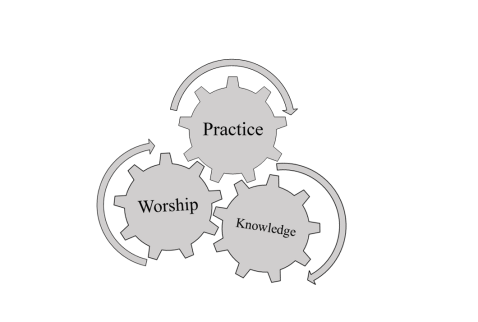 _______________________________________________
Figure 2. The Reciprocal Transforming Relationship of Knowledge, Worship, and Practice.
It is clear then that right and good worship is vital because it exalts and holds before us our chief end. If our worship has as its object the wrong thing we will thus go wrong in innumerable ways (cf. Rom. 1:18-32). Because of this, the reformation of our lives is a slow, and often painful, process. Witness the fall (the body of the book) and rise (the epilogue) of Raskolnikov from Dostoyevsky’s Crime and Punishment.[7] If we dig ourselves into a ditch we do not magically rise out of it (cf. Prov. 26:27). We have to dig ourselves out of it. Of course, as Christians we do believe that the Spirit assists us (e.g. Jn. 14:16). Yet, the fact remains, transformation is difficult and does not finally occur here.[8]
Scripture and reality are not at odds. We are shaped by what we know, worship, and do (and these are all interrelated). Scripture tells us to know the LORD, worship Him, and serve Him and thus be transformed. We see this same type of thing when we understand the relationship of faith and works, and the relationship of indicative and imperative. We know/believe God’s truth (faith) thus worship and have corresponding actions (works). Again, when we (rightly and supernaturally) understand God’s truth (indicative) we will worship, which in turn will change the way we live (imperative).
In Scripture we see huge importance placed on listening to He who speaks wisdom, the LORD, and not to the father of lies, Satan. We see this especially in the beginning. Eve listens to the serpent’s words and disregards the LORD’s, and chaos and curse ensue. However, notice that she did not just receive information/knowledge or believe the wrong source. Her desires were also wrongly informed. Because Eve listened to the serpent she saw the tree as delightful. She saw the tree as desirable (Gen. 3:6). Thus she fell.
As the Scripture says, “Each person is tempted when he is lured and enticed by his own desire. Then desire when it has conceived gives birth to sin, and sin when it is fully grown brings forth death” (James 1:14-15). We, thus, resist the devil by being firm in the faith. We, like Jesus, fight off wicked desires with God’s Word. Satan would have us be reconstituted by his words, wicked untruth, yet we combat his lies by teaching ourselves to desire good things by the implantation of God’s words, the truth (e.g. the place of Prov. 7:1-5 in the larger context of Prov. 7). When we feed on the Word of God the metabolic result is a healthy representation of God. God would have us (re)shaped into His image, the image of His Son. Conversely, Satan would have us formed into what C.S. Lewis called the “unman.”
Our thinking and our beliefs play a large part but we are tempted not by thinking and believing but by our desires (recall James 1:14-15 from above). I do think, however, that thinking and beliefs are the atmosphere in which desire lives. They are the soil and habitat; they’re the ocean in which desire can swim. Thinking and believing are not unimportant. Eve would have never sinned had she not heard Satan’s “knowledge” and believed him. Yet, we are understanding Eve, and ourselves, wrongly, if we don’t also realize that she desired (again, recall Gen. 3:6; also Eph. 2:3 says that we also once carried out the desires of the flesh).
I think it also must be noted here that our desires are shaped by our thinking and believing but they are also shaped by less conscious things. I am quite sure, for instance, that quite a few Nazi Youth did not read Hitler’s Mein Kampf but yet were shaped by the very same image. This was because they lived and breathed and ingested it’s teaching, though not mainly consciously, but because it was the cultural air they breathed.
We have a lot of things externally and internally that seek to shape us. As Calvin has famously said, we are idol factories.[8] That’s why we see much emphasis in Scripture placed on loving God with our whole heart (cf. e.g. 1 Chron. 12:38; 28:9; 29:9, 19; 2 Chron. 15:15; 16:9; 19:9; 25:2; Ps. 9:1; 16:9; 86:12), not just a portion of it.
We temper our hearts variously through understanding (cf. Deut. 6:4-9; Neh. 8), worship (e.g. Ps.; Eph. 5:18-20) and practice (e.g. Lev.). That’s how we’re shaped biblically and practically. The more we have our chief end in view and the better our chief end is the better we will live.
For instance, Jesus reasons with us in Matthew 6:19-24 about desire. He shows that what is in our best interest, i.e. what we should desire, is laying up treasure in heaven. He tells us specifically in verse 21 that what we desire, i.e. “treasure,” will bring the rest of us along (i.e. “heart”). So, again, Eve was led into sin because she desired (“treasured”) the fruit. Our battle is thus the battle of treasuring, desiring. That’s why sex education doesn’t work, for example. You can show a bunch of kids images of a bunch of nasty things and tell them a bunch of bad stories. But, in the end, if sex is what they treasure then that’s what they’ll do. After all, that is what is glorified on the screen and in our culture.
On the positive side, Paul lived the way he did, and died the way he did, not merely because of his cognitive understanding or because of his beliefs; but because of what he desired (though, as we have said, they are closely related). Paul, in his letter to the Philippians, tells us of the desire that fueled his powerful life. He drove on through thick and thin because he had counted everything as loss because of the surpassing worth of knowing Christ Jesus His Lord. For Christ’s sake Paul suffered the loss of all things and counted them as rubbish, in order that he may gain Christ (Phil. 3:8).
Truly, wherever our treasure (i.e. desire, view of “the good,” or our view of the good life) is, our heart (“heart” in Scripture has to do with our whole self; cognition, volition, emotions) will be also (Matt. 6:21; Lk. 12:34).
If we are transformed by knowledge, worship, and practices, how do you think they can transform us? How should our everyday life be different?
___________________________________________________________
[1] There is a transcript from Reasonable Faith’s podcast that shows the truth of my statement. Our worldviews have consequences, good or bad. R.C. Sproul shows this in his book The Consequences of Ideas. Friedrich Nietzsche even says in Beyond Good and Evil that philosophy always creates a world in it’s own image, it cannot do anything different.
[2]“Certain habits stir up corresponding affections and appetites; certain core affections and desires are expressed in corresponding habits. You can’t separate desire from practice” (Michael R. Emlet, “Practice Makes Perfect?” 42).
[3] See James K. A. Smith’s insightful book Desiring the Kingdom: Worship, Worldview, and Cultural Formation, esp. 80-85.
[4] Michael Emlet understands the complex nature of change. He says, “What we do flows out of who we are, but who we are is indeed shaped by what we do… We are changed by doing and we are changed by a self-conscious and iterative process that scrutinizes thoughts, affections, and actions of their faithfulness to a kingdom ethic, and then chooses certain actions and practices in response” (Michael R. Emlet, “Practice Makes Perfect?” 44).
[5] E.g. Aristotle says, “All knowledge and every choice have some good as the object of their longing” (1095a14 Page 4 for in Aristotle’s Nicomachean Ethics Trans. Robert C. Bartlett and Susan D. Collins [The University of Chicago Press: Chicago, 2011]). The glossary says that “Aristotle famously argues that all human beings do everything for the sake of what seems or is held to be good” (Ibid., 309).
[6] From the first question of the Westminster Shorter Catechism.
[7] “While God is always free to work miraculously and instantaneously, soul-change is typically a slow process that involves the replacement of old beliefs, affective responses, attitudes, and motives and patterns of relating to others with new ones, one at a time. Given what we know now of the neurological conditions of such change, it is not surprising why this process is gradual. Old neural networks must be shut down, and new ones must be constructed. None of this happens in genuine sanctification apart from the work of the Holy Spirt, but in this age most of the time God tends to work through the created order, and not take shortcuts. Though an incremental approach is sometimes hard for counselees to accept, such a stance, when grounded in justification, helps them to accept their present limitations and to be more realistic about the speed of their recovery, without undermining the ongoing call to grow in conformity to the image of Christ” (Eric L. Johnson, “Reformation Counseling: A Middle Way,” 26-27).
[8] Though I do not agree with everything, I believe “The Spiritual Experience of the Divine Truth of Transformation” is helpful.
[9] “The human mind is, so to speak, a perpetual forge of idols” (Calvin, Institutes, 97).
Are You Mindful of Your Mind?

What is the place of the mind in Christianity? Is thinking relevant to the faith? What, if any, emphasis should we place on the importance of knowledge? Does hard thinking bring any beneficial fruit to the Christian life or is the tree bare, shorn of any value?
If we boil down and distil Christianity the remaining content is not logical argument. Christianity is more than a philosophy, more than a religion. It is more than cognitive assent. It is more than a social club. Christianity is not simply about ritual. It is not just about emotions. It is not just about the mind.
Christianity is a relationship with a God who has made Himself known. It is more than formulas and repetition of rote words; though there are meaningful words and ceremonies. Christianity is something that must be believed, but belief is merely the beginning (though it must continue). Christianity gives true—chiasm bridging—fellowship, but is not merely a fellowship. Christianity is a philosophy, indeed, the philosophy. We, in a sense, worship wisdom incarnate.[1] But still, Christianity is not just a philosophy.
Christianity is not just about thinking and knowing. Yet, thinking and knowing are vital.
The Christian mind is vital because it is emphatic in Scripture.[2] It is vital because Christian living is. It is vital because we are commanded to worship the LORD with all we are, are mind included (Matt. 22:37; Mk. 12:30; Lk. 10:27).[3]
The Christian mind is very important. Yet, where do we see this in Scripture? Why is this the case? And what affect does it have?
The Christian Mind and the Bible
The Bible shows us that the Christian mind is very important.[4] Thinking for Christians is not just theoretical, it is practical. We trust God because we know Him (Ps. 9:10).[5]
God tells us to think. He tells us He will teach us, yet we must learn and not be like animals without understanding (Ps. 32:8-9 cf. 73:22). In fact, we must learn so that we can obey (Josh. 1:8-9; Ps. 37:31; 86:11; 95:10; 119:11, 34).
“The Giver” and the Failure of Utopian Societies

When we control the measures to make a utopian society the way we think it should be, it fails. Whether we control “the stirrings” (e.g. The Giver), emotions (e.g. Equilibrium), everything (e.g. The Lego Movie), or the socioeconomic structure (e.g. The Hunger Games) the result is not paradise; it’s a sort of hell, at least for many. We messed up utopia, we can’t with our fallible minds design a new one. Only our Lord can. He has the only infallible and incorruptible mind. He perfectly balances justice and grace. And He alone can make us and all things new.
So the recent movie and classic The Giver does more than entertain. It teaches us a profound truth, one we would do well to remember: There is no utopian society outside of Christ. We can’t fix it. There have been many botched attempts throughout history. They lay died with their victims.
“Everything is awesome. Everything is cool when you’re part of a team…” As catchy as The Lego Movie song is, it is not exactly right. Everything is not awesome, not yet. However, it will be. But not from our own doing.*
Heaven comes down (Rev. 21:2). We don’t, nor can we, build it here. I am with you and Miss America in saying I desire world peace, yet it won’t ultimately come until our Lord does. When our Lord comes He will wipe away all evil, pain, and tears (Rev. 21:1ff). He will make all things new. He will bring utopia.
Maranatha! Come Lord Jesus, come!
________________
*Notice I am not saying we shouldn’t work for social justice. We should! Yet, it will not bring the ultimate and forever peace that we long for.
The LORD Sees, The LORD cares

Are you troubled? Are you overcome with grief, fear, and sorrow? Are you questioning where your next meal will come from? Do you hear the nations rage and shrink in fear?
Behold, the nations are like a drop from a bucket,
And are accounted as the dust on the scales (Is. 40:15).
When you weigh yourself, are you worried about the dust on the scale? No! It’s irrelevant. And so, we are reminded:
All the nations are a nothing before Him,
They are accounted as less than nothing and emptiness (v. 17).
We may not know what will happen or how we will get through, but we serve He who does. We serve the One who “stretches out the heavens like a curtain” (v. 22).
If we are down in despair and do not know where our help will come, we must lift up our eyes and see (v. 26a): Who created these? Who numbered the stars? Who calls them all out by name (v. 26; there are some 100 billion stars in our galaxy)?
Thus, why do we say, “My way is hidden from the LORD, He does not see me, He does not care” (v. 27)?
Our LORD says,
Have you not known? Have you not heard?
The LORD is the everlasting God,
the Creator of the ends of the earth.
He does not faint or grow weary;
His understanding is unsearchable.
He gives power to the faint,
and to Him who has no might He increases strength.
Even youths shall faint and be weary,
and young men shall fall exhausted;
but they who wait for the LORD shall renew their strength;
they shall mount up with wings like eagles;
they shall run and not be weary;
they shall walk and not faint (vv. 28-31).
O’ LORD, our God and Father, we wait on You, we trust You. We know that You see, that You care.



 in X
in X 