The Bible teaches that what we do matters.

The Bible teaches that what we do matters.
“For the Son of Man is going to come with His angels in the glory of His Father, and then He will repay each person according to what he has done” (Matthew 16:27).
“The Son of Man is going to come.” That’s going to happen. Just as surely as Jesus came, He’s coming back. And He’s coming in glory.
No stable, no mere star. All of the world will see His utter glory. That’s going to happen. And Scripture repeatedly reminds us to be ready because it’s going to happen soon.
The One who took His cross and beckons us to take up ours will soon take His full rightful glory. All the world will be awed by His power. All the world will bow and acknowledge the reality that He is Lord (Rom. 14:11; Phil. 2:10-11).
And as the Lord, He will dish out what’s deserved. The Just One will measure out justice. All will meet their deserved fate. There will be grace and wrath in abundance. And there will be peace.
A takeaway for all Christians: we must see the utter importance of our actions. Just because one is saved by grace through faith does not at all mean that what one does doesn’t matter.* Christians should be people of faith-filled sacrificial love. Because…
The Lord Jesus will repay each person according to what they have done.
What we do and don’t do matters. It matters a lot. Our lives and our actions have significance. They have significance because there is a Savior who reigns who will enforce His loving rule.
____
*Christians are saved by faith alone but the faith that saves is never alone. Those who are made new creations in Christ (2 Cor. 5:17), are to live as new creations in Christ. They are to live holy lives because they are holy (1 Cor. 1:2).
How is being hated by the world motivating?

“You will be hated by all for My name’s sake. But the one who endures to the end will be saved” (Matthew 10:22).
Wow. What an encouraging word. Not!
You will be hated by a ton of people. But, if you can take it long enough, if you endure until you die… Well… Well, then you’ll be saved!
How is that good news? Isn’t it too late for good news at that point? How is this verse at all motivating?
Being hated by all and enduring that hatred makes no sense. At least, it makes no sense if you don’t believe in who Jesus is or what He says. If, however, you experience the truth of who He is you are positioned to endure the reality of what He says. You are positioned to practice sacrificial love as He did and so many of His followers have.
We who have seen Jesus’ blooded limbs outstretched for us on the tree are in a position to take a similar posture. We know “a disciple is not above his teacher, nor a servant above his master” (v. 24). We know the Lord of the universe took up His cross and we must too (v. 38).
We know singleminded devotion is not only required, it is right. It is in line with the grain of the universe. To be suffering for the Savior is to be in rebellion against a rebellious world. To be hated by the world is, in a sense, is to be Frodo and Luke Skywalker and Princess Leia; it is to be on the right side. The dark side, with the contemptuous orcs, are wrong.
The world’s very fury is a sign of victory. As the world hated Him so must the world hate us. And as we are hated as He was, so we are His. And so share His victory. So, the more we look like the victims of this world, the more we are the victors.
Thus, it actually is good news that those who endure to the end will be saved. Because the reverse is also true: those who don’t endure, will not be saved. So, we don’t have to fear (v. 26). We do “not fear those who kill the body but cannot kill the soul.” Instead, we “fear Him who can destroy both soul and body in hell” (v. 28).
If we know—truly know—who Jesus is, we will acknowledge. If we love Him, we will live for Him. If we delight in Him, we will die for Him. If we don’t, we won’t. But it’s important that we do. Jesus Himself says: “everyone who acknowledges Me before men, I also will acknowledge before My Father who is in heaven, but whoever denies Me before men, I also will deny before My Father who is in heaven” (v. 32–33).
Our endurance of hatred and a thousand hostilities is just what it means to be in the cosmic fight that we are in. No, it is not a fight we fight with fists and fury but with love. But a fight it still is. And it demands endurance. The endurance of Frodo and Sam on their mission to Mordor and the sometimes awkward encouragement of Leia and Luke.
So, endure. Fight to the finish. We’re in a real battle that is bigger than guns. There’s not always a happy ending. And there’s no reset. We’re in reality. And the stakes are high.
*Image by Gordon Johnson
The End is Near

Strangers

- The language – even though we have learned one National language and one tribal language and function in a third area trade language and deal with 3 other tribal languages.
- The bugs – even though when people ask about the most dangerous animals we have, I reply – mosquitoes, ameba, thyroid, and other assorted microbes. The Lord has been very good to us and our kids, He has, I know, protected us from many things we were not aware of.
- The snakes – I saw more snakes growing up in Eastern Oklahoma. We see some big snakes on occasion. I have seen 20ft snakes and eaten them. I have been face to face with a king cobra.
- The rivers – we travel by river, not road. And in the beginning, made some unplanned swims in the river.
- The mountains – we are thankful for missionary pilots that fly us over the mountains.
- The heat – this is a much bigger issue and seems to be affecting us more as we go along. But we have fans that help.
What I’m talking about is something that is more basic than just physical comforts. It has to do with relationships and our reason for being in a 3rd world tropical environment. The most difficult thing has been that we are always strangers/foreigners. I am always too tall, and too white. I don’t always talk and think like the natives.
Sometimes life gives you a gift that you want to lose but you have to use.


Do you view singleness as a gift? Sometimes we receive gifts that we don’t want to use, don’t know how to use, or don’t even want to possess. I am afraid many of us feel this way about singleness. We don’t know what to do with it, we don’t know why we’re stuck with it, and we just want to get rid of it.
The Apostle Paul saw singleness as a gift. In 1 Corinthians 7:7–9, he says “I wish that all were as I myself am. But each has his own gift from God, one of one kind and one of another. To the unmarried and the widows I say that it is good for them to remain single, as I am. But if they cannot exercise self-control, they should marry. For it is better to marry than to burn with passion.”
Pastor J.P. Pokluda from Harris Creek Baptist in Texas said about singleness “sometimes life gives you a gift that you want to lose but you have to use.” Singleness is a gift from God.
If singleness is a gift, then how do we use this gift?
In 1 Corinthians 7:32–35, Paul says “I want you to be free from anxieties. The unmarried man is anxious about the things of the Lord, how to please the Lord. But the married man is anxious about worldly things, how to please his wife, and his interests are divided. And the unmarried or betrothed woman is anxious about the things of the Lord, how to be holy in body and spirit. But the married woman is anxious about worldly things, how to please her husband. I say this for your own benefit, not to lay any restraint upon you, but to promote good order and to secure your undivided devotion to the Lord.”
The most important relationship that we can ever pursue is our relationship with God. Singleness teaches us about the sufficiency of Christ. He alone satisfies. Until Jesus is enough for us, no person, relationship, or marriage will ever be. Singleness is a unique time to pursue undivided devotion to the Lord. Contentment in life comes when we find our worth, identity, purpose, and satisfaction in Christ alone.
To the single person reading this, I encourage you to “set the believers an example in speech, in conduct, in love, in faith, in purity” (1 Timothy 4:12). Singleness is a unique opportunity to demonstrate to the church and the world that Christ is sufficient. Marriage is not the most important thing ever, Jesus is. We exist to live in relationship with Him, enjoy Him, and bring glory to Him.
Whether we are single, dating, or married let us “seek first the kingdom of God and his righteousness” (Matthew 6:33). No matter what your relationship status is, we are called to be satisfied in Him, devoted to Him, and abiding in Him. Singleness is a gift, a unique opportunity to pursue undivided devotion to Christ. Let’s use this gift for the glory of God.
In the shelter of the Most High

Sunday morning in church we were looking at Luke chapter one and my attention was drawn to verse 35. The angel said to Mary, “the power of the Most High will overshadow you.”1
This phrase brings us to Psalm 91 verse 1: “Those who live in the shelter of the Most High will find rest in the shadow of the Almighty. “
If we go on and read the entire Psalm. We have some serious food for thought regarding the present situation we are in regarding COVID.
“For he will rescue you from every trap and protect you from deadly disease” (v. 3).
“Do not dread the disease that stalks in darkness” (v. 6).
“No plague will come near your home” (v. 10).
“The Lord says, “I will rescue those who love me” (v. 14).
There are many other promises in this powerful Psalm but the one regarding disease and plague stands out. These promises are contingent on sheltering in the shadow of the Almighty.
So does this mean no true believers in the Almighty will get COVID? We know this is not true. Many believers have contracted COVID and been healed—100% recovery rate. Some recovered on this planet in this time and space and others are now experiencing the ultimate recovery and healing—instant healing—in eternity. In thinking of a friend with COVID, he will be healed; it is a confirmed fact, one way or the other he will be healed. The Almighty has said so—Psalm 91 ends with the final and ultimate shelter: “and give them my salvation”.
So what does it mean to shelter in the shadow of the Almighty? To me sheltering in the shadow of the Almighty means being always conscious of God’s presence and “shadow” around me. He is always there and by faith, I see His shadow. He has said, “I will never live you nor forsake you.”
Isaiah put it this way, “You will keep in perfect peace all who trust in You, all whose thoughts are fixed on You! Trust in the Lord always, for the Lord God in the eternal Rock” (Is. 26:3-4).
To abide in the shadow of the Almighty means to have our heart, minds, and faith fixed, fastened securely to the promises of the Almighty. Not fixed ultimately on medical science, our insurance policy, the government, our diet and health regiment, a vaccine, but fixed on the Almighty.
My prayer for all of us this season will be that we are sheltering under the Almighty—not mainly sheltering in place but under the shadow of the Almighty.
1 Using the New Living Translation for all of this.
10 Quotes from John Piper’s book, Future Grace

“The commandments of God are not negligible because we are under grace. They are double because we are under grace” (John Piper, Future Grace, 168).
“The way to fight sin in our lives is to battle our bent toward unbelief” (Piper, Future Grace, 219).
“The faith that justifies is a faith that also sanctifies… The test of whether our faith is the kind of faith that justifies is whether it is the kind of faith that sanctifies” (Ibid., 332).
“The blood of Christ obtained for us not only the cancellation of sin, but also the conquering of sin. This is the grace we live under—the sin-conquering, not just sin-canceling, grace of God (Ibid., 333).
“The problem with our love for happiness is never that its intensity is too great. The main problem is that it flows in the wrong channels toward the wrong objects, because our nature is corrupt and in desperate need of renovation by the Holy Spirit” (Ibid., 397).
“The role of Gods Word is to feed faith’s appetite for God. And, in doing this, it weans my heart away from the deceptive taste of lust” (Ibid., 335)
“It is this superior satisfaction in future grace that breaks the power of lust. With all eternity hanging in the balance, we fight the fight of faith. Our chief enemy is the lie that says sin will make our future happier. Our chief weapon is the Truth that says God will make our future happier. We must fight it with a massive promise of superior happiness. We must swallow up the little flicker of lust’s pleasure in the conflagration of holy satisfaction” (Ibid., 336).
“There are no closed countries to those who assume that persecution, imprisonment and death are the likely results of spreading the gospel. (Matthew 24:9. RSV)” (Ibid., 345).
“Perseverance in faith is, in one sense, the condition of justification; that is, the promise of acceptance is made only to a persevering sort of faith, and the proper evidence of it being that sort is its actual perseverance” (Piper, Future Grace, 26 quoting Jonathan Edwards).
“Humility follows God like a shadow” (Ibid., 85).
Should Wives Work Outside the Home?

Titus 2:4-5 and 1 Timothy 5:14 talk about young wives working at home, is this the ideal role God ordained for women? Should women not work outside the home?
To answer those questions, it will be helpful to look at five considerations.
Principles from the Bible
First, it is important to glean principles from the Bible to answer this question. The first principle or truth that I think is relevant is that God made humans gendered. The Bible clearly teaches that males and females are both made in the image of God (Gen. 1:26-27) and yet males and females differ from one another in some respects to various degrees. Scripture also teaches that within the family and within the church God has given complementary roles and gifts. For example, see the table from God, Marriage, and Family by Andreas Kostenberger:
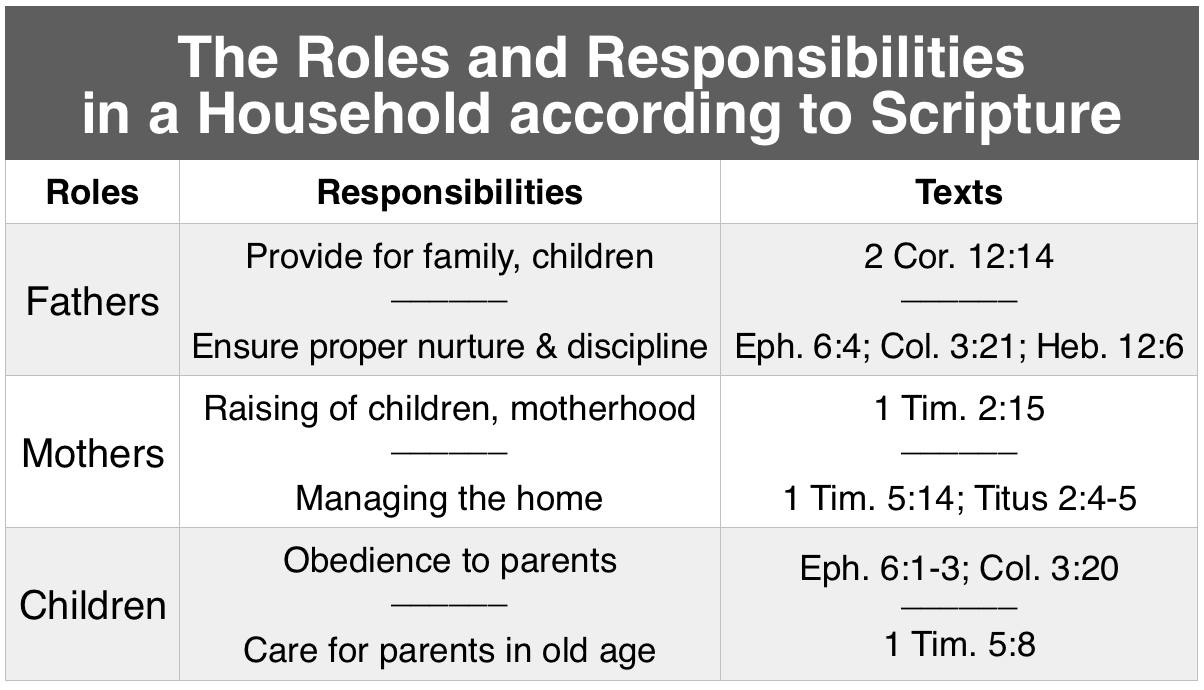
The way that Andreas Kostenberger says it, is that “Women are to place special priority on their God-given calling as mothers and homemakers.”[1] That, I agree, seems to be a biblical principle. Women are especially equipped for that task (even physiologically).
Priorities from the Bible
Next, it is important to consider priorities from a biblical perspective. We want our priorities to lineup with the priorities of Scripture. If they don’t we will have a problem with Scripture wherever it is at odds with our priorities. Our priorities, however, should be aligned with Scripture; we should not seek to align Scripture with our priorities.
Interestingly, “A 1982 Gallup poll showed that more than eight out of ten respondents (82 percent) assigned top priority… to the importance of family life. Families… rated as more important than the possession of material goods.”[2] Scripture agrees with what was the majority assessment in 1982 (see e.g. Deut. 11:19, 21; Ps. 127:3-5).
What, however, do we value?[3] Fortune or family?
Tacitcus, the Roman historian and politician writing around the same time as the Apostle Paul in A Dialogue on Oratory said,
“Our children are handed over at birth to some silly Greek servant maid… The parents themselves make no effort to train their little ones in goodness and self-control; they grow up in an atmosphere of laxity… they come to lose all sense of shame, and all respect for themselves and for other people.”
Tacitcus had a problem with that approach. And I think Christians should too.
We, however, haven’t answered our above question yet, but we’re getting there. But, it’s vital that we consider our motivation and priorities as we ask the question.



 in X
in X 