The “One Another” Passages Are Commands, Not Options

Online church and spectator church don’t prioritize the practice of the “one another” commands. They make the “one another” passages optional add-ons, but Scripture doesn’t. A handshake and even a weekly hug is not the same as taking these commands seriously. But what if the practice of these commands is vital for the maturity of Christians? What if these commands are in Scripture to be practiced and prioritized?
The phrase “one another” is derived from the Greek word allelon, which means “one another, each other; mutually, reciprocally.” It occurs 100 times in the New Testament. Approximately 59 of those occurrences are specific commands teaching us how (and how not) to relate to one another. Obedience to those commands is imperative. It forms the basis for all true Christian community, and has a direct impact on our witness to the world (John 13:35). The following list is not exhaustive:
Positive Commands (how to treat one another)
- Love one another (John 13:34 – This command occurs at least 16 times)
- Be devoted to one another (Romans 12:10)
- Welcome one another as Christ has welcomed you (Romans 15:7)
- Honor one another above yourselves (Romans 12:10)
- Live in harmony with one another (Romans 12:16)
- Build up one another (Romans 14:19; 1 Thessalonians 5:11)
- Be like-minded towards one another (Romans 15:5)
- Accept one another (Romans 15:7)
- Admonish one another (Romans 15:14; Colossians 3:16)
- Greet one another (Romans 16:16)
- Care for one another (1 Corinthians 12:25)
- Serve one another (Galatians 5:13)
- Bear one another’s burdens (Galatians 6:2)
- Forgive one another (Ephesians 4:2, 32; Colossians 3:13)
- Be patient with one another (Ephesians 4:2; Colossians 3:13)
- Speak the truth in love (Ephesians 4:15, 25)
- Be kind and compassionate to one another (Ephesians 4:32)
- Speak to one another with psalms, hymns and spiritual songs (Ephesians 5:19)
- Submit to one another (Ephesians 5:21, 1 Peter 5:5)
- Consider others better than yourselves (Philippians 2:3)
- Look to the interests of one another (Philippians 2:4)
- Bear with one another (Colossians 3:13)
- Teach one another (Colossians 3:16)
- Comfort one another (1 Thessalonians 4:18)
- Encourage one another (1 Thessalonians 5:11)
- Exhort one another (Hebrews 3:13)
- Stir up [provoke, stimulate] one another to love and good works (Hebrews 10:24)
- Show hospitality to one another (1 Peter 4:9)
- Employ the gifts that God has given us for the benefit of one another (1 Peter 4:10)
- Clothe yourselves with humility towards one another (1 Peter 5:5)
- Pray for one another (James 5:16)
- Confess your faults to one another (James 5:16)
Negative Commands (how not to treat one another)
- Do not lie to one another (Colossians 3:9)
- Stop passing judgment on one another (Romans 14:13)
- If you keep on biting and devouring each other… you’ll be destroyed by each other (Galatians 5:15)
- Let us not become conceited, provoking and envying each other (Galatians 5:26)
- Do not slander one another (James 4:11)
- Don’t grumble against each other (James 5:9)
All of these passages assume a deep relational connection. As Christians, we are in a real sense “members of one another” (Romans 12:5; Ephesians 4:25) and very much need one another.
These “one another” commands cannot be practiced one Sunday a week, sitting in a church service. To truly practice the exhortations in these passages requires a type of “living together.” I think the whole Western American church structure needs a redo. I think the paradigm is sick. Perhaps church was never supposed to be structured with a stage and an audience to entertain? Perhaps the church was never meant to be something we merely attend? Perhaps “we are family” was never meant to be a church tagline, but a reality?
Perhaps it’s utterly vital that we prioritize practicing the one another passages? What if we need to restructure the church to ensure the practice of these passages? What if we need to make time, maybe even have a meal together at least once a week, to help ensure we’re complying with the commands of God’s word? Big adjustments would make sense if the “one another” passages are commands, not options.
I propose we make the changes and make it incredibly difficult for people to be passive observers of church. Jesus has said we are the church, His body. We need to be allegiant to Him as the Lord and do the things He has called us to do. I don’t want to make it easy for people to disobey the Lord.[1]
Notes
[1] I appreciate that a lot of churches have Sunday School or Community Groups but sadly a lot of people opt out of these. And sometimes churches make it to easy to opt out.
*Photo by Tegan Mierle
We Must Love Others as Jesus Has Shown Us

In this article we’re looking at love. But to quote the singer Haddaway, “What Is Love”? The band Foreigner must not have known what love is because they said, “I Want to Know What Love Is.” Tina Turner was confused about love too, sheasked, “What’s Love Got to Do with It”? I’m not sure what Elvis Presley thought about love but he “Can’t Help Falling In Love.” And Taylor Swift has a whole “Love Story.”
Others aren’t so favorable on the topic of love. Khalid’s opinion is that “Love Lies” and Lady Gaga just says, “Stupid Love.” But the Backstreet Boys don’t care, “As Long As You Love Me.” Justin Bieber’s advice, however, is “Love Yourself.”
But the Beatles have a very favorable view of love. They say, “All You Need Is Love.” Lastly, I would be remiss if I didn’t encourage you by sharing Whitney Houston’s pledge: “I Will Always Love You.”
Okay, I said a lot of things but I didn’t answer my question. What is love? We can talk a lot about love and even sing about it but that doesn’t mean we know what ‘love’ is. This points us to the importance of defining love. It seems especially important to understand what it means if it’s ‘all we need,’ as the Beatles said.
So, what even is love? In the movie 10 Things I Hate About You, we see an explanation of the difference between ‘like’ and ‘love.’
Bianca says: ‘See, there’s a difference between like and love, because I like my Skechers, but I love my Prada backpack.’
Chastity says: ‘But I love my Skechers.’
Bianca says: ‘That’s because you don’t have a Prada backpack.’
I think Bianca is correct. There is a difference between ‘like’ and ‘love.’ We intuitively know there are differences, but we’re still very often confused. In English, there’s just one word for love: love. In Greek, there are four.[1] The very short Bible passage we’re looking at has two Greek words for “love” (philadelphia and agapaó).
Sometimes a spelled-out definition is helpful but sometimes seeing an example is more powerful. The Bible shows us what love is. Actually, from the beginning to the end, it recites a better love story than Taylor Swift’s (the song or all the hype about her and Travis Kelce).
Paul, one of the first Christian leaders, wrote to a group of Jesus followers who lived in the city of Thessaloniki: “Now concerning brotherly love you have no need for anyone to write to you, for you yourselves have been taught by God to love one another, 10for that indeed is what you are doing to all the brothers throughout Macedonia. But we urge you, brothers, to do this more and more” (1 Thess. 4:9–10).
Paul says, “You have no need for anyone to write to you, for you yourselves have been taught by God to love one another.” Paul is saying that the Jesus followers know what love is. And they are loving one another. Why? How can our culture be so confused about love and yet they were so proficient at loving others?
They were “taught by God.” Not to geek out too much but this is one word in Greek—they were God-taught. This is the first time in Greek literature that this word appears. Paul made it up. Theodidaktos.[2] It’s kinda like “Bussin” or “Snatched,” it’s made up to communicate something. Except God-taught is amazingly profound and unexpected.
Think about what we learn about love from Greek mythology. Not a lot. Instead, we see gods at war and spreading mass chaos. Here’s a small sample:
- Kronos swallowed up his children as soon as they were born so they wouldn’t have the chance to overpower him as they grew older and stronger.
- Zeus turned his first wife into a fly and ate her, chained Prometheus to a rock so an eagle could eat his liver, was consistently unfaithful to his wife, and turned one of his lovers into a cow to hide her from his wife.
- Athena, known as the wisest of the gods, turned Medusa into a snake-headed monster whose gaze turns people to stone because she was raped by Poseidon.
- Marduk, the god of storms and justice, in the Babylonian creation myth, created the world by defeating Tiamat, the primordial sea goddess, and then used her body to form the heavens, earth, and other elements of the cosmos.
In contrast to Greek mythology, it is amazing that we are “taught by God to love one another.” Greek mythology taught snubbing and brutal subjugation, Jesus taught sacrificial service. Greek mythology taught rape, Jesus taught appropriate restraint. Greek mythology taught lust, Jesus taught true love.
In contrast to the mythology of the time:
Jesus teaches us to Love
Once again, the Bible says we are “taught by God to love one another” (v. 9). The Bible doesn’t just say that God is loving, though it does say that. The Bible says much more. It says, “God is love” (1 Jn. 4:8, 16). Love is deeply connected to God’s very being. This sets the Christian God apart from all other views of God. For love to truly exist there must be relationship. The Bible teaches that God is a relational being to His core. God is triune.
Very briefly, “Trinity” means God is one in relation to His ontological being yet exists in three persons (Father, Son, and Holy Spirit). The Trinity is unparalleled in the entire universe but is not a logical contradiction. This, in a way, should not be surprising to us because God is beyond our full comprehension. Although we cannot fully grasp what this means, we do know that God has for all eternity been in loving relationship. This means that because God is love, He cares about love and teaches us to love (1 Jn. 4:7).
What Mark Howell says here is spot on:
“In reality, God is the only One fully qualified to teach on the subject of love, because love would not exist without Him. He is its author. He is its commentator, because you would not know how to love without His instruction. So then, God not only teaches you about love, but He also teaches you how to love. Therefore, to begin any discussion on the subject oflove, the logical starting point must be with God Himself.”[3]
God is love and teaches us what love is. God is love and He teaches us how to love. God being love and Himself teaching us to love is unprecedented. The three-in-one nature of God shows us that He is relational, loving, self-giving, and personal to His core. God is not just some distant, cosmic force. He has personhood. He has existed in all eternity past in loving relationship, odd to say, with Himself. God amazingly calls us to join Him in relationship (John 17:21-23). He recreates us in His image and welcomes us as His sons and daughters. God welcomes us to have communion with Himself.
I love how 1 John 4 says it:
“Beloved, let us love one another, for love is from God, and whoever loves has been born of God and knows God. 8 Anyone who does not love does not know God, because God is love. 9 In this the love of God was made manifest among us, that God sent His only Son into the world, so that we might live through Him. 10 In this is love, not that we have loved God but that He loved us and sent His Son to be the propitiation for our sins. 11 Beloved, if God so loved us, we also ought to love one another. 12 No one has ever seen God; if we love one another, God abides in us and his love is perfected in us… 19 We love because He first loved us. 20 If anyone says, “I love God,” and hates his brother, he is a liar; for he who does not love his brother whom he has seen cannot love God whom he has not seen. 21 And this commandment we have from Him: whoever loves God must also love his brother” (1 Jn. 4:7-12, 19-21).
Many of us were moved by seeing the sacrificial love of Tony Stark (Iron Man) in the Marvel movie, Avengers: Endgame, where he sacrifices himself to save the universe and his friends. Remember? After Thanos’s snap in Infinity War, the Avengers are devastated and the universe is in peril.
Despite Tony Stark’s initial reluctance, he chooses to use the Infinity Gauntlet to snap Thanos and the remaining half of the universe back, even though it means his own death. He utters the famous line, “I am Iron Man,” before snapping his fingers, saving the universe but giving up his own life.
There is a true story of overwhelming and powerful love, not in the Marvel universe, but in the real universe; and salvation comes not through Iron Man, but through Jesus, the God/man.
Tony Stark’s sacrifice is powerful but it’s not real. The thing is, Jesus and His sacrifice are real. The all-powerful, all-good, God who ruled the entire world, and upheld the very universe in which we live, move, and have our being, came into the world and was born in a pohick town, was mocked and ridiculed by His creation—like termites mocking the owner of the house—and Jesus died for those very same mocking termites. Of course, as Jesus’ biographies go on to say, Jesus didn’t stay dead, unlike Tony Stark. Jesus expressed His surpassing love through His sacrificial death and Heshowed His utter power by rising from the dead. So, Jesus beats both hate and death.
We started out by quoting the song, “What is love?” God not only knows the answer to that often confusing question and tells us the answer, but He Himself is the answer. This is love not that we loved God, but that He loved us and set His son to be the sacrifice to rescue us from the consequences of sin (1 John 4:10).
As the late great poets, DC Talk, said, “Love is a verb.” If you don’t remember what a verb is, I get it, but a verb is an action word. It doesn’t just sit on the couch. It doesn’t just talk. It gets up and does something. And God doesn’t just talk about His love for us. He demonstrates His love for us. God loves the world so much that He gave His Son. Because God is so loving He amazingly has made a way for us to be His friend. “For God so loved the world, that He gave His only Son, that whoever believes in him should not perish but have eternal life” (John 3:16).
But, the love of God does not stop with us. We are not to be a damn holding in God’s love. No. We are to be conduits through which God’s love flows freely. Jesus taught us how to love and He loves us, so we love.
Christian love turns the world upside down, it did in the first century and it will today. I don’t mean some undefined vague kind of love; I mean the Jesus kind of love. In this way, Christianity has always been subversive and disruptive.[4]
We must love
The Jesus followers Paul wrote to were already loving each other. Paul is sure that they had been God-taught. They practiced “brotherly love.” Again, not to ‘Greek out’ too much but the word for “brotherly love” here is philadelphia. It’s where the city, Philadelphia, gets it’s name. That’s why it’s known as “the city of brotherly love.” However, perhaps a better way to translate this word is “family affection.” The Jesus followers were God-taught and so clearly had healthy family affection for one another.
In the secular world of that time, the word for “family affection” (philadelphia) was only used for actual family relationships. It wasn’t used within religious groups. It was used to refer to love for one’s siblings. “In the New Testament, however, it is always used as it is here, of love between members of the Christian family (Rom 12:10; Heb 13:1; 1 Pet 1:22; 2 Pet 1:7).”[5]
As Jesus taught us in the model prayer, we are together to pray “our Father in heaven…” We don’t pray alone. We pray to our Father who we share. “The early Christians saw themselves as members of a family”[6] and we should too.
Paul told them, you are loving all the brothers and sisters throughout Macedonia. “But we urge you, brothers, to do this more and more.”
When our kids were young and not yet talking we taught them how to communicate with sign language. Our son, Uriah, was sitting in the highchair and wanted more food (it was probably tomatoes based on how much he enjoys them now). So, he excitedly and quickly did all the signs he knew. He didn’t just do the sign for “more.” He almost did every sign he knew simultaneously because he wanted more so much. It reminds me of what Paul is doing here. He’s really passionate about us loving each other more and more. Why? Because God is loving and God Himself showed us how to love. It’s important. It’s worth getting excited about.
Brothers and sisters, if you are reading this and you have turned to Jesus for rescue and you’re following Him as your Boss and Lord, you have been God-taught to love. You must love. What God is saying to us is brothers and sisters, love more and more. And don’t just love in name only.
A deacon in a church who taught the kid’s Sunday school class had poured some concrete for the church… the next day he saw footprints in the concrete. He was very angry and talking very loudly. A man who was standing by said, “I thought you loved kids.” The deacon said, “I love them in the abstract but not in the concrete!”[7] We, however, must love not just in the abstract, but in and through the concrete things of life. It won’t always or ever be easy.
One of the reasons I believe in simple church is because love shines best in relationship. Church is not a building, it’s a body of people, made up of rich and poor, black and white, Jew and Gentile, coffee drinker and tea drinker, democrat and republican. If we are in Jesus, He is our elder brother, God is our Father, and the Holy Spirit is our ever-present Helper.
Church isn’t about entertainment or coffee. Jesus calls us out, out of the boat, off the couch, chair, or pew. Church is about loving Jesus, loving like Jesus, and sharing the life-transforming news of Jesus.
Church isn’t about some super-pastor it’s about the called-out people of God being the church in coffee shops, factories, schools, and offices. Light shines best when it’s not hidden in a building, salt is no good if it’s stuck in the shaker.
Conclusion
Our world is lonely but we have the love of God to share. Our world is isolated and alone but Jesus came to be with us. And brothers and sisters, Jesus said, “As the Father sent Me, in the same way, I am sending you” (John 20:21). As Jesus loved the sometimes unlovely, He calls us to do likewise. As Jesus went to the destitute and distraught, He calls us to do the same. We have been God-taught; as Jesus loves, we are to love.
“God’s own expression of his love resulted in his total self-giving in the person and death of his son. Christian expression of the same love must have the same self-giving quality.”
If we as Christians are God’s adopted children through Jesus, we must resemble our Father, we must be loving. And if we are His children, we must love one another. Beloved, guess what‽ The reality is, in Jesus we are family. So, as Paul said, let’s have family affection for one another, let’s love more and more. Now, as 1 Thessalonians 3:12 says, “May the Lord make you increase and abound in love for one another and for all.”
Notes
[1] As C.S. Lewis explains. He says, “There are 4 kinds of love, all good in their proper place.” First, there is “affection love.” This is the type of love that one has for family or familiar relationships. Second, there is “friendship love.” Third, there is “charity love.” This type of love is sacrificial and puts the interests of others first. A fourth would be “like” or “desire.” As we think about love, it is important that we keep these different kinds of ‘love’ in mind. I would like for English to have more options. It doesn’t seem correct that I’ve said, “I love Cinnamon Toast Crunch” and “I love my wife.” Hopefully I don’t love cereal and my wife in the same sense. Yet, I think the fact that in English the four words have been conflated into one word, communicates something.
[2] “‘Taught by God’ translates a single compound word (theodidaktoi). This is the only occurrence of the word in the New Testament and the earliest known occurrence in any body of Greek literature. It may well have been coined by Paul himself. The closest biblical phrase is in the LXX text of Isa 54:13 (quoted in John 6:45). It predicts a day when ‘all your sons will be taught by the Lord.’ A hallmark of the new covenant in the New Testament is the presence of the Spirit with each believer (Acts 2:16–18; Gal 4:6) and the resultant internal witness to the will of God (cf. Jer 31:34; Heb 8:10–11).” (D. Michael Martin, 1, 2 Thessalonians: An Exegetical and Theological Exposition of Holy Scripture).
[3] Mark Howell, Exalting Jesus in 1 & 2 Thessalonians.
[4] In his book Dominion, Tom Holland (not the Tom Holland from Spiderman) argues that the Christian concept of love, which he describes as a social practice rather than a feeling, has been a powerful force in shaping Western morality and the idea of universal human rights.
[5] D. Michael Martin, 1, 2 Thessalonians: An Exegetical and Theological Exposition of Holy Scripture. See alsoMichael W. Holmes, 1 and 2 Thessalonians.
[6] N. T. Wright, Paul for Everyone: Galatians and Thessalonians.
[7] J. Vernon McGee, Thru the Bible Vol. 49: The Epistles (1 and 2 Thessalonians).
*Photo by Ben Lambert
Confession Before A Christian Meal

When our church gathers, we always share a meal together. Sharing a meal follows the pattern of the early church and helps us cultivate hospitality and relationships; both of which are sorely lacking in our American culture. Before we eat, we share a confession to remind ourselves of the special significance of eating together.[1] Here are some of our past confessions:
“Let us say what we believe…
#1: Being the apprentices of someone who is sinless and who died for the sins of a sinful world, never promised to be easy or to fit nicely into the life we carved out for ourselves. Jesus says, “If you lose your life you will find it.” He doesn’t say, “Find a place to fit Me in.” But the reason Jesus so wants to explode our lives and the way of living is not because He is some monster that wants to ruin the good thing we have going. No! Jesus wants us to walk in the way of abundant, full flourishing, and eternal life. Jesus, as the way, the truth, and the life, knows how we ought to live, and wants us to walk that straight and narrow, beautifully righteous, road.
One of the things Jesus shows He values is eating with others, eating with friends and soon-to-be friends. We take time to eat and talk because Jesus did. We take time to love because Jesus did. So, as we eat and talk and love today, let’s seek to take time this week to do the same. As followers of Jesus, let’s follow Jesus.
#2: Messiah Jesus has called us together to be a people of purity in a land littered with porn, He has called us to be light in a world of darkness, salt in a world of decay, a harbor of hope in a world of hopelessness. He has called us to be His people of radical love in a world of hate. So, as we gather, may God gift us and grow us to that end. May God build us up as we are gathered and use us to bless this broken world as we scatter.
#3: Jesus’ Kingdom is made up of people from Sierra and Senegal, Armenia and America, China and Chad, Portugal and Pakistan, Mexico and Malaysia, and many many more. The reality is, in Christ, we are all one. Division is dead. We are united. So, we are to live together in purposeful unity. It will not be easy, but Jesus’ blood was spilled to welcome us into union with Him and each other. We should not disregard Jesus’ great sacrifice for us, instead, we must “make every effort to keep the unity” (Eph. 1:3).
#4: As we eat even a meager meal together it is significant. We testify to the truth of our unity in Jesus. We remember the relationship with God and each other that Jesus has welcomed us into at great cost to Himself. We remember the various people that Jesus ate with while He walked the earth—prostitutes, Pharisees, and frauds. He welcomed them, He welcomes us, and we are to welcome others. We also remember that soon we will eat with Jesus and with people from every tribe, language, nation, and tongue.
#5: We eat remembering the fellowship and love of the Trinity and we share together in that fellowship. We eat as an act of rebellion against the ways of the world. We eat as a tangible reminder of all we share. So, while we eat, let us pursue what makes for peace and for mutual upbuilding (Rom. 14:19).
#6: God gives the gift of rain and crop, He gives the gift of life, and breathe, and everything. Often we as humans fight over everything. But in a meal we share and partake together. We give grace and we receive grace. A meal is a teacher and a uniter. God cares about meals. As we eat, we remember and we are thankful that we are not in the final analysis independent, we are dependent, dependent on God and upon one another.
#7: Jesus’ posture on the cross is His posture towards us; His arms are open wide. Jesus says to everyone who is thirsty, “Come. Quench your thirst.” To everyone who is sick, Jesus says, “Come. Be healed.” To everyone who is lonely, Jesus says, “Come. Be loved.” Jesus welcomes us, so we welcome one another, and we welcome others. And as we eat now, we remember and celebrate the fellowship Jesus welcomes us into.
#8: When the church comes together, it’s a political rally. We testify and celebrate the reality that Jesus is King. Jesus reigns in goodness, justice, and power. And though we may not see it with physical eyes, we are a powerful group of people, because we are the LORD’s people, we are the church of God (Gal. 1:13; 1 Cor. 10:32, 15:9). We all together are in Christ. Our identity is new in Him; we are not the old people we used to be (2 Cor. 5:17), we are people who radically love, who radically give. We are in Jesus’ Kingdom and under His powerful and eternal reign. We can’t be hurt by the second death because we are more than conquerors and will celebrate at the marriage supper of the Lamb. So, even as we eat now, we testify to these realities. We remember and we rejoice.
#9: It is no light or flippant thing to gather with God’s saints. We celebrate and rejoice that we get to share this meal and time together. As Hebrew 10:24 says, we want to consider how to stir up one another to love and good works, we do not want to neglect meeting together, but instead intentionally encourage one another. So now, Father, may you build us up, and bless us so we can bless the broken world that needs to know the love of your Son, Jesus.
#10: We together give thanks to the LORD for He is good, for His steadfast love endures forever (Ps. 136:1). We give thanks because the LORD is the giver of every good gift (James 1:17), the giver of life, breath, and everything (Acts 17:25). Our Lord gives food and friends to eat with. Therefore, as we come to eat together, we come with thankful hearts. Together we acknowledge God’s abundant goodness. As we eat, may we remember and teach ourselves and one another, that God is a God of extravagance and abundance; God has more grace, more love, and more pleasure in store, so may we likewise be lavish in our love for others.
[1] During the singing portion of our gathering, we sometimes confess one of the historic confessions (the Nicene Creed or Apostle’s Creed). I’ve thought about us systematically working through a confession but we haven’t done that yet.
Photo by Jaco Pretorius
Let’s be the church, not watch church

Many churches have focused a lot of attention on their online presence—online services and social media. There are upsides to these things but what are the potential downsides? In this blog series, we’re asking, “What if church were different?”
Throughout church history, physical presence has mattered a great deal for multiple reasons. And it still matters. Why does physical presence matter?
Jesus’ Physical Presence
This point is the most succinct and it packs the most punch. The incarnation of Jesus is the ultimate sign that points to the importance of physical presence. In Jesus, God took on flesh. He was physically present among people (see e.g., John 1:1-3,14). God values physical presence.
Jesus’ “life is the full truth of living, Jesus is the standard by which life is to be measured.”[1] And Jesus shows us that physical presence matters deeply. Because Jesus was very much present physically.
Shut-ins Need Physical Presence
It is often said that online services are for shut-ins. I appreciate churches thinking of shut-ins but it would also be good to visit those shut-ins. I wonder what percentage of shut-ins utilize online services versus able-bodied people? I think churches investing in and visiting shut-ins would be a wiser and better use of resources (especially when there is already all sorts of church service content available). Our epidemic of loneliness and social isolation is not being helped by the internet and online services. People need actual people.
Online Presence cannot replicate Physical Presence
Actual physical presence has been important for centuries in order to celebrate the Lord’s Supper with the saints. Part of the reason the Lord’s Supper is sometimes referred to as “communion” is because through Jesus we have communion with God and with one another.
Physical presence is important so we can practice the “one another passages.” For example, we are to accept one another (Rom. 15:7), bear with one another (Eph. 4:2; Col. 3:13), forgive one another (Eph. 4:32; Col. 3:13), pray for and confess sins to one another (James 5:16), cheer and challenge one another (Heb. 3:13; 10:24-25), admonish and confront one another (Rom. 15:14; Col. 3:16; Gal. 6:1-6), warn one another (1 Thess. 5:14), teach one another (Col. 3:16), bear one another’s burdens (Gal. 6:2), submit to one another (Eph. 5:21).
In Bowling Alone, Robert Putnam argues that social capital in the U.S. has declined, as people are less engaged in civic life, social organizations, and community activities. He attributes this to factors like television, suburbanization, and generational changes, warning that this trend weakens democracy and social trust. He calls for efforts to rebuild connections and foster civic engagement. He says, “The single most common finding from a half-century’s research on the correlates of life satisfaction, not only in the United States but around the world, is that happiness is best predicted by the breadth and depth of one’s social connections.” Online presence cannot replicate physical presence.
Discipleship Needs Physical Presence
Following Jesus isn’t just informational, it’s transformational. We are Jesus’ apprentices. We seek to imitate others as they imitate Jesus (1 Cor. 11:1). This requires physical presence.[2]
You can curate your playlist but you can’t curate your pastor or the people of the church. You can skip a podcast with content you don’t like (but maybe need to hear!) but you can’t, or at least you shouldn’t shush the people sitting with you in church. We can be our own DJ of “digital church,” we can form it in our own image to fit our whims, but real church—the gathering of Jesus’ blood-bought body—works to reform us in Jesus’ image. Jesus DJ’s us.
We can filter and unfollow our online community and we can turn it off and on. We can accept, block, and unfollow “friends.” But in real-life discipleship in apprenticeship with Jesus, we must love everyone.
One of the strategies of the enemy at war is to divide the army so that they are more easily defeated. If the arm is divided, they can’t support one another and encourage one another. That is to a great extent what has happened to many Christians today. They are very much on their own and vulnerable to the attack of the enemy.
The Apostle Paul used the “technology” of the time and wrote the amazing letter to the Romans—quite a gift!—but he says, “I long to see you, that I may impart some spiritual gift to strengthen you” (Rom. 1:11). John repeatedly talks about the importance of seeing people “face to face” (2 Jn. 12; 3 Jn. 14). Actual physical presence is important.
Actual “Church is a resistance to certain ways of being formed.”[3] Church is about Jesus, loving Him, and others. It’s not about convenience. Online often malforms us, Jesus wants to form us in His image. If we’re online we’re not putting our life on the line for Jesus and others.
Jesus’ Ideal is Physical Presence
Imagine the scenario in heaven where Jesus is sharing His plan for the redemption of the church… Jesus says, “I want to purchase people from every tribe, language, nation, and tongue so that they will be a chosen race, a royal priesthood, a holy nation, a people for My own possession, so that they will sit in front of their TV and watch a church service. That’s my dream. That’s my big plan to transform the world and spread love.”
That’s crazy and not Jesus’ ideal. 1 Peter 2:9 says Jesus has made us His chosen race, royal priesthood, holy nation, and people for his own possession, so that we may proclaim the excellencies of Him who called us out of darkness into his marvelous light. What Jesus is doing is creating a bunch of little christs and spreading His love. In other words, God‘s plan for the transformation of all the world is not a bunch of couch potatoes, but an army of little Jesuses.
Plus, we lose out on glorifying Jesus in our diversity if we’re online and not in person. As Kendall Vanderslice has said, “Church is one of the few remaining institutions that brings people together across generations, across physical and cognitive abilities, across relationship status and life stage.”[4]
Conclusion
The world is often a lonely place, especially in America. The Mayo Clinic recently shared an article on the importance of friendship and how to be a friend. The word is realizing what the church has known for centuries and seems to be forgetting. Let’s be the church, not watch church. Let’s be friends, not just accept friend requests. In a world of loneliness, let’s love and open the doors of our homes and hearts.
Notes
[1] Norman Wirzba, Food and Faith: A Theology of Eating, 195.
[2] 1 John 2:6 says, whoever says Jesus abides in them ought to walk in the same way in which He walked. James tells us, “Be doers of the word, and not hearers only” (1:22). Jesus said, “Why do you call Me ‘Lord, Lord’ and do not do what I tell you?” (Lk. 6:46). See also 1 Cor. 4:14-17; 1 Thess. 1:4-10; Heb. 13:7-8.
[3] Kendall Vanderslice, “The Church of the Chronically Online” 56 in Common Good issue 17.
[4] Vanderslice, “The Church of the Chronically Online,” 56.
Photo by Priscilla Du Preez 🇨🇦
Summary of Our Epidemic of Loneliness and Social Isolation Study

Our Epidemic of Loneliness and Social Isolation is a 2023 advisory report by U.S. Surgeon General Vivek Murthy. It highlights the widespread issue of loneliness and social isolation in the U.S. and its severe health consequences.
Scope of the Problem
The report highlights that loneliness and social isolation have become widespread in the U.S., affecting millions of people across all demographics.
- About one in two adults reports experiencing loneliness. Social isolation has increased due to shifts in how people interact, including greater reliance on technology and remote work.
- Young adults, older adults, and marginalized communities are particularly vulnerable.
Causes and Contributing Factors
- Decline in community participation (e.g., fewer people engaging in religious or civic groups).
- Remote work and digital communication reducing in-person interactions.
- Changes in family structures leading to fewer social connections.
- COVID-19 has had a substantial impact.
- Americans spend less time with friends and family than in previous decades.
Health Impacts
The report emphasizes that loneliness and social isolation are not just emotional struggles—they have serious consequences for physical and mental health, comparable to other well-known public health risks.
- Chronic loneliness increases the risk of heart disease, stroke, dementia, depression, and anxiety.
- The health impact of lacking social connection is comparable to smoking 15 cigarettes per day.
- Social isolation raises the risk of premature death by 26-29%.
Solutions and Recommendations
The report outlines a six-pillar strategy to rebuild social connections and address the loneliness crisis:
1. Strengthen Social Infrastructure
- Invest in public spaces, community centers, and social programs that encourage connection.
2. Promote Pro-Social Public Policies
- Encourage workplace policies that support social well-being. Integrate social connection efforts into healthcare systems, such as screenings for loneliness.
3. Reduce Harmful Aspects of Technology
- Develop healthy digital habits.
4. Deepen Community Engagement
- Increase participation in local organizations, religious groups, and volunteer work**.
5. Equip the Public with Social Skills
- Teach social connection skills in schools and workplaces. Educate people about the importance of maintaining relationships for their well-being.
6. Make Social Connection a Public Health Priority
- Recognize loneliness as a public health crisis and fund research and initiatives.
Quotes from the Study
Social connection is a fundamental human need, as essential to survival as food, water, and shelter. (9)
Despite current advancements that now allow us to live without engaging with others (e.g., food delivery, automation, remote entertainment), our biological need to connect remains. (9)
The lack of social connection poses a significant risk for individual health and longevity. Loneliness and social isolation increase the risk for premature death by 26% and 29% respectively. More broadly, lacking social connection can increase the risk for premature death as much as smoking up to 15 cigarettes a day.* In addition, poor or insufficient social connection is associated with increased risk of disease, including a 29% increased risk of heart disease and a 32% increased risk of stroke. Furthermore, it is associated with increased risk for anxiety, depression, and dementia. Additionally, the lack of social connection may increase susceptibility to viruses and respiratory illness. (8)
Social connection is a significant predictor of longevity and better physical, cognitive, and mental health, while social isolation and loneliness are significant predictors of premature death and poor health. (23)
Substantial evidence also links social isolation and loneliness with accelerated cognitive decline and an increased risk of dementia in older adults, 10.41 including Alzheimer’s disease 63 Chronic loneliness and social isolation can increase the risk of developing dementia by approximately 50% in older adults, even after controlling for demographics and health status.41 A study that followed older adults over 12 years found that cognitive abilities declined 20% faster among those who reported loneliness. (28)
Evidence shows that being objectively isolated, or even the perception of isolation, can increase inflammation to the same degree as physical inactivity. (32)
Increased levels of social connection can improve various biomarkers of cardiovascular functioning, including blood pressure, cardiovascular reactivity, and oxidative stress. (32)
Loneliness… is associated with a greater risk of cardiovascular disease, dementia, stroke, depression, anxiety, and premature death. The mortality impact of being socially disconnected is similar to that caused by smoking up to 15 cigarettes a day. (4)
Photo by Toa Heftiba
How I Survived My Divorce

By Becky O’Brien
For a long time, I didn’t think I’d make it.
I was scared, not knowing how I could manage without a husband and dad in the home for our 10 kids. I was angry. This was not the way it was supposed to be. I prayed that God would help our marriage but didn’t really believe it. So, then I felt guilty.
It is hard to really go back to remember the pain and the rejection I felt. Today I am sitting far down the road—25 years after the separation. I am at the midpoint. I was married just short of 25 years.
We were separated for a long time, 6 years. When we were first separated, I had been a Christian for 11 years. But I loved the Lord and desired to follow Him with all my heart. Every time I read the Word, I would write down verses that spoke to me, memorizing or hiding His word in my heart as I could.
God’s Word
I knew God is sufficient and His power is made perfect in weakness (2 Cor. 12:9). Really getting a hold of that truth was so helpful. I would also often read and meditate on Zephaniah 3:17:
The Lord your God is in your midst,
a mighty one who will save;
he will rejoice over you with gladness;
he will quiet you by his love;
he will exult over you with loud singing.
God’s word was the light in my darkness. God’s word was the steady rhythm of truth, amongst a cacophony of lies.
The Church
Because of the situation, we (my children and I) went to a new church. It was mandatory. My husband had been the pastor of the church we had been attending. Not everyone liked the new church at first, but we grew to love it and became a vital part of it. I am so thankful that we were loved and well cared for. We were included, involved, and blessed in many ways.
I am thankful that I have the gift of hospitality and used it by inviting church brothers and sisters to my house, which provided a way to bond and share burdens (because we all have them). It was a way that I felt included in relationships with men and women, both in healthy ways. I missed relating with and communicating with a man. I also enjoyed a mixed Sunday School class where I could have fellowship with families which also provided an example to my children.
In our new church, the pastor and saints loved on us, prayed for us, engaged us, and helped us with physical needs (in very big ways!). I remember standing in the parking lot after church talking and being ministered to; our children played, as we prayed.
Joy
During the long, lonely nights, I would pray—drawing close to my friend who is closer than a brother (Prov. 18:24). I still pray a lot at night.
In the hardest of times, I felt the greatest joy. “The joy of the Lord is my strength” (Neh. 8:10).
I hated the hurt but loved the joy. I knew God was with me. You could not ask for more—but then the “nuts and bolts” of life! It was a roller coaster at times.
Later, when I was farther down the road, and things were going well, and I was more secure, I would long for the joy I experienced when things were so difficult. I experienced the reality of Psalm 46:1, “God is our refuge and strength, a very present help in trouble.” I experienced the joy of knowing that the God of the universe was carrying me and caring for me.
Contentment
I was always looking for my husband to return. I remember one time, early on, I thought I heard him come in—someone was talking in the kitchen. I went in expectantly and was crushed when it was the neighbor.
I would always be looking for his car to turn into the driveway. That went on for years. Finally, that is only a memory.
I also remember him picking up the kids for a visit or calling them, and I was jealous sometimes, even angry, because I wanted him to want to see me.
Remembering my yearning for love and care and desire to have a mate… It took a long time to be “content in all things.” It took longer than I now remember. That leads me to share another verse:
Not that I am speaking of being in need, for I have learned in whatever situation I am to be content. I know how to be brought low, and I know how to abound. In any and every circumstance, I have learned the secret of facing plenty and hunger, abundance and need. I can do all things through him who strengthens me (Phil. 4:11-13).
How I clung to this verse. It became my focal verse to remind myself of all the time! I worked hard to cast all my cares on the Lord, remembering that He cares for me (1 Pet. 5:7). And I looked to Jesus (Heb. 12:2); oh, how I looked to Jesus.
Jesus the Great Healer
God used my hurting, emptiness, and desperation to draw me into an intimate love relationship with Him. I was not an easy case. For a while, I looked for God in all the wrong places (including another man, food, and other people) to fill what I was really seeking—that intimate relationship with the God of the universe. The God that was real to Moses, David, and Noah. The road was rough, but it was how I grew in intimacy with my Father, my Abba Daddy.
I sorrow over hurting people and desire their salvation. No wonder people turn to the bottle and drugs. I understand—to numb the pain. I am so thankful I had and have Jesus!
We have a Great Healer. I remember having a decorative wood heart that was in two pieces with some kind of metal piece holding the two pieces together. It was very symbolic to me of my broken heart and of the Great Physician’s healing work. He does great heart surgery, by the way. But the healing period is very slow and there’s still some pain along the way.
Incidentally, after hearing of a sweet friend (not close, but dear) who had a broken heart, I passed that on to her. I rarely see her, but recently, after many years, she told me she still has it and thinks of me still. A broken heart will do that. Sometimes the Great Physician uses us as His nurses in His healing work.
Blessed be the God and Father of our Lord Jesus Christ, the Father of mercies and God of all comfort, who comforts us in all our affliction, so that we may be able to comfort those who are in any affliction, with the comfort with which we ourselves are comforted by God (2 Cor. 1:3-4).
So, how did I survive my divorce? I clung to Jesus and His Word. Or rather, they clung to me. They held me although my husband didn’t.
Reviving Church Connection: From Handshakes to Heartfelt Relationships

What if church were different? What if we had deep instead of surface relationships?
Relationships have always been important because we are relational beings made in the image of the relational triune God. Yet, sadly, people are more relationally disconnected than ever—honestly, likely more relationally disconnected than at any other point in history.
Various studies bear out the problems of our epidemic of loneliness and isolation. “All Americans (both young adults and older adults) have fewer social relationships than their parents and grandparents did.”[1] Yet, Vivek H. Murthy, the United States Surgeon General, has said, “People with strong social relationships are 50 percent less likely to die prematurely than people with weak social relationships… weak social connections can be a significant danger to our health.”
A study by the Surgeon General’s Advisory team, titled “Our Epidemic of Loneliness and Isolation,” found that loneliness is prevalent today and surprisingly harmful. It is “associated with a greater risk of cardiovascular disease, dementia, stroke, depression, anxiety, and premature death. The mortality impact of being socially disconnected is similar to that caused by smoking up to 15 cigarettes a day.”[3]
Murthy points out that “Social connection stands out as a largely unrecognized and underappreciated force for addressing many of the critical problems we’re dealing with, both as individuals and as a society. Overcoming loneliness and building a more connected future is an urgent mission that we can and must tackle together.”[4] This is an opportunity and exhortation to the Church.
Relationships are important. As the Cheers theme song says:
Sometimes you want to go
Where everybody knows your name,
And they’re always glad you came;
You want to be where you can see,
Our troubles are all the same;
You want to be where everybody knows your name.
Relationship, strangely, is something that the church seems to have forgotten about. It’s something, however, that Starbucks and Alcoholics Anonymous have picked up on.
The thing that kept me sober until I got a grip on honesty was the love in the room of Alcoholics Anonymous. I made some friends for the first time in my life. Real friends that cared, even when I was broke and feeling desperate.
The body of Christ should be more affectionate and welcoming than any A.A. meeting or coffee shop.[5]
Secular research tells us we need each other. Experience tells us we need each other. The Bible tells us we need each other. We need each other![6] The secular world in many ways has seen this and the Bible has long since told us. It reminds us that a cord of three strands is not easily broken (Eccl. 4:12). We need the body of Christ to be the body of Christ. We need vital connection, not mere contact.
Many “one another” passages can only be carried out in small familiar settings. A small, simple church allows the benefit of practicing all the various aspects of life together. It gives us a setting to honor one another (Rom. 12:10), accept one another (Rom. 15:7), bear with one another (Eph. 4:2; Col. 3:13), forgive one another (Eph. 4:32; Col. 3:13), pray for and confess sins to one another (James 5:16), cheer and challenge one another (Heb. 3:13; 10:24-25), admonish and confront one another (Rom. 15:14; Col. 3:16; Gal. 6:1-6), warn one another (1 Thess. 5:14), teach one another (Col. 3:16), be real and honest with one another (Gal. 5:15; Rom. 12:9), bear one another’s burdens (Gal. 6:2), share possessions with one another (Acts 4:32; Gal. 6:10), and submit to one another (Eph. 5:21).[7]
We need actual relationships instead of handshakes. It is vital and commanded that Christians practice the “one another” passages. Perseverance is a community endeavor. It is imperative for people’s health and the health of the church that people are connected, vitally connected, not merely attending. “Going to church” is not biblical, being the church is.
In order to cultivate deep relationships, what if we had real food and fellowship instead of a handshake? Churches often have a time where you shake people’s hands and say, “Hi.” But, week after week, it becomes an empty expression when nothing more results. Empty platitudes are empty. What if we go to the early church model, and have a meal together every week (Acts 2:46; 20:11; 1 Cor. 11:20-34; Jude 12)?[8]
What if the church leaned into loving relationships and invested time and money to help relationships form? “The church may never outperform TV shows and music videos, but there is nothing like the community life of the church. There is nowhere else where diverse people come together in the same way. There is nowhere else where broken people find a home. There is nowhere else where grace is experienced and God is present by his Spirit.”[9]
What if we practiced hospitality instead of hiding? One of the qualifications for pastors is that they “be hospitable” (1 Tim. 3:2). Pastors were known and knew people, they didn’t hide. And they set the expectations for the rest of the church body. “Some theologians go so far as to state that the growth in the earliest churches was wholly dependent on the meals and hospitality of the believers.”[10] It is imperative for the church’s witness and health that we move from handshakes to heartfelt relationships.
Notes
[1] Allen, Lawton, and Seibel, Intergenerational Christian Formation, 54.
[2] Murthy, Together: The Healing Power of Human Connection in a Sometimes Lonely World, 13. “Religious communities offer not only social support but also purpose, hope, and meaning” and it has been found that religious community is more beneficial for preventing suicide and mortality than other forms of social support (Tyler J. VanderWeele, “Deaths of Despair and the Role of Religion”).
[3] Office of the Surgeon General, Our Epidemic of Loneliness and Isolation: The U.S. Surgeon General’s Advisory on the Healing Effects of Social Connection and Community, 4. “The lack of social connection poses a significant risk for individual health and longevity. Loneliness and social isolation increase the risk for premature death by 26% and 29% respectively. More broadly, lacking social connection can increase the risk for premature death as much as smoking up to 15 cigarettes a day.* In addition, poor or insufficient social connection is associated with increased risk of disease, including a 29% increased risk of heart disease and a 32% increased risk of stroke. Furthermore, it is associated with increased risk for anxiety, depression, and dementia. Additionally, the lack of social connection may increase susceptibility to viruses and respiratory illness” (Ibid., 8).
[4] Murthy, Together, xxvi.
[5] In passages like Philippians 2:25-26 and 1 Thessalonians 3:6-13, we read about the authentic relationships of the church and the concern that the church had for one another. Paul says that Epaphroditus has been longing for the Philippian church, and the Philippian church was distressed because they heard he was sick. They had the opposite of social isolation, they had social affirmation; instead of loneliness, they had a family of love.
[6] “While relationships with others are something we do, it is also true that relationships are what we are. We are what our history of relationships has built into us. We need social relationships like the body needs oxygen, but also like stone needs a sculptor to become a work of art (good or bad). We cannot become healthy adult persons without relationships. To flourish and to mature into persons of wisdom and Christian virtue, we need the shaping that comes with the best sorts of human relationships… Whatever we become or are becoming is a matter of both us and others – our actions and others’ responses, and our responses to others’ actions” (Brown, Warren S.; Strawn, Brad D., The Physical Nature of Christian Life (Cambridge University Press: Kindle Edition, 2012), 72-73).
[7] Also, remember, the book of Hebrews says to consider, that is, think about how to stir, spur, or motivate one another toward love and good works (Heb. 10:24). A “spur” is “a pointed device or sharp spiked wheel fixed to the heel of a rider’s boot to enable him to urge his horse on.” We are supposed to serve as a spur in one another’s lives. We are to be a goad. We are to incite action. We are to be a stimulus for change. We are to give incentive, inducement, and provocation. We are supposed to provoke, stimulate, impel, and inspire each other. This happens best in small relational settings where people are actually known. Most churches realize that “transformation happens best in community,” if that’s the case, why not capitalize on community contexts‽ Romans 14:19 says “Let us pursue what makes for peace and for mutual upbuilding.” Scripture exhorts us to intentionally pursue mutual upbuilding. Paul tells Timothy to “flee youthful passions and pursue righteousness, faith, love, and peace, along with those who call on the Lord from a pure heart” (2 Tim. 2:22). Is Timothy supposed to do this all by himself? No! It says “Along with those…” From the above verses, and many we did not look at, we see the practical, life-protecting, importance of being connected to Christ’s body in an intentional community.
[8] This was known as a “love feast.”
[9] Tim Chester and Steve Timmis, Everyday Church: Gospel Communities on Mission, 56.
[10] Verlon Fosner, Dinner Church, 24. “If you are looking for ways to evangelize, opening your home is one of the best methods of reaching unbelievers” (Alexander Strauch, Leading with Love, 102.
Pursuing Jesus in College

How can you keep pursuing Jesus in college?
This summer I will be graduating from George Mason University with a Bachelor’s Degree in Marketing. As I reflect on the past four years, I realize that as I entered college I was not sure what to expect, not prepared for how much harder college is than high school, and not sure how to pursue a relationship with Jesus while in college.
Life after high school is full of uncertainty and questions. What college do I go to? How am I going to pay for college? Do I even want to go to college? What am I going to eat? What should I major in? How am I going to make friends? Most importantly… how am I going to follow Jesus?
I can tell you from experience that college is full of opportunity, freedom, coffee, cramming for exams, ramen noodles, late nights, friends, temptations, people with different worldviews and backgrounds, and sadly hostility towards Christianity.
As you enter this next season of life, my encouragement to you is to pursue a relationship with Jesus by prioritizing a campus ministry, local church, and daily time alone with God. I hope you don’t see this as a to-do list but advice from someone who imperfectly pursued Jesus in college. I don’t say these things to overwhelm you, I say these things for your joy. I promise you that the most possible joy you can have in college is found in knowing Jesus and making Him known (Psalm 37:4, Matthew 6:33).
1. Prioritize a campus ministry.
Jonathan Pokluda says “if you want to change your life, change your playmates and your playground.” Life is all about where you go and who you go there with. Community is essential in college. A campus ministry is an excellent place to pursue friendships with people who will help you grow in your faith. While I was at George Mason, I was involved with a campus ministry called CRU. Their goal is to be a multiethnic community captivated by the Gospel, transformed by the Gospel and committed to taking the Gospel to GMU and the world. Through CRU at George Mason, I grew so much by being discipled by the staff, being a part of a small group, and being encouraged to serve. Life isn’t meant to be done alone, pursue Godly community.
2. Prioritize a local church.
Many college students go to church with their friends. While this isn’t a bad thing, I want to caution you that your friends may: 1) not go every week, 2) go to a different church every week, or 3) go to a bad church. Prioritize a local church that is word-centered and Christ-exalting.
Some evaluative questions: Is the Gospel preached? Is the worship music Christ-centered? Do they preach the Bible? Are there opportunities to serve? An excellent resource to use as you look for a good church is Mark Dever’s Nine Marks of a Healthy Church.
Why should you prioritize a local church? The Bible says to: Hebrews 10:24-25. Another three reasons to prioritize a local church are to weekly hear the Bible preached, have opportunities to be discipled, and opportunities to serve others.
3. Prioritize time alone with God.
We live in a culture that is driven by instant gratification. Slowing down and spending time with God isn’t always fun, easy, or enjoyable. But John Elmore puts it this way, “something doesn’t have to be amazing in order to be sustaining.” Nothing has helped me grow in my relationship with Jesus more than simply spending time with Him every day. By speaking to Him in prayer and hearing from Him through His word.
Dustin Benge said, “five minutes of prayer is worth more than an hour of scrolling through social media.” It is not that we don’t have the time to spend time alone with God, it’s that we don’t prioritize it. Sometimes we just need to cry out to God, confess that we haven’t prioritized spending time with Him, and ask that He would help us prioritize that. If you want to grow in your relationship with Jesus during college, prioritize spending time with Him daily.
In summary, my hope is that you seek to know Jesus and make Him known while at college. I encourage you to pursue Jesus by prioritizing a campus ministry, a local church, and daily time alone with God.
Photo by Avinash Murugappan
10 takeaways from Vivek H. Murthy’s book Together

Being connected in community is important. Murthy’s book, Together: The Healing Power of Human Connection in a Sometimes Lonely World, concurs. Below are some quotes I appreciated from his book.
“The values that dominate modern culture… elevate the narrative of the rugged individualist and the pursuit of self-determination. They tell us that we alone shape our destiny. Could these values be contributing to the undertow of loneliness” (Vivek H. Murthy, Together, p. xxi).
“Social connection stands out as a largely unrecognized and underappreciated force for addressing many of the critical problems we’re dealing with, both as individuals and as a society. Overcoming loneliness and building a more connected future is an urgent mission that we can and must tackle together” (Murthy, Together, p. xxvi).
“People with strong social relationships are 50 percent less likely to die prematurely than people with weak social relationships… weak social connections can be a significant danger to our health” (p. 13).
“Few of us challenge our cultural norms, even when their influence leaves us feeling lonely and isolated” (p. 95).
“Building… bridges for connection may never have been more important than it is right now” (p. 96).
“If you ask people today what they value most in life, most will point to family and friends. Yet the way we spend our days is often at odds with that value. Our twenty-first-century world demands that we focus on pursuits that seem to be in constant competition for our time, attention, energy, and commitment. Many of these pursuits are themselves competitions. We compete for jobs and status. We compete over possessions, money, and reputation. We strive to stay afloat and to get ahead. Meanwhile, the relationships we claim to prize often get neglected in the chase” (p. 98).
“Social media… fosters a culture of comparison where we are constantly measuring ourselves against other users’ bodies, wardrobes, cooking, houses, vacations, children, pets, hobbies, and thoughts about the world” (p. 112).
“Many factors play into… polarization, social disconnection is an important root cause” (p. 134).
“Even as we live with increasing diversity, it’s easier than ever to restrict our contact, both online and off, to people who resemble us in appearance, views, and interests. That makes it easy to dismiss people for their beliefs or affiliations when we don’t know them as human beings. The result is a spiral of disconnection that’s contributing to the unraveling of civil society today” (p. 134).
“When I think back on the patients I cared for in their dying days, the size of their bank accounts and their status in the eyes of society were never the yardsticks by which they measured a meaningful life. What they talked about were relationships. The ones that brought them great joy. The relationships they wish they’d been more present for. The ones that broke their hearts. In the final moments, when only the most meaningful strands of life remain, it’s the human connections that rise to the top” (p. 284).
*Photo by Robert Bye
United in a Time of Disunity

Christians are united and need to be united. This is especially important in this time of disunity as a country.
In Christ Jesus all—Jew and Gentle, rich and poor, black and white, republican and democrat, Clemson and Ohio State, Steelers and Browns, young and old—are one. That is what Scripture teaches. That is reality.
In Christ, we are one. That is what the Bible tells us. And that’s reality.
Paul highlights that in his letter to the Ephesians. The Ephesian church faced similar difficulties that we face. They lived in divisive days too.
Acts 19 talks about a riot in Ephesus and there may have been divisions when it came to sporting events too. Ephesus had the largest theater in Asia Minor with accommodation for up to 25.000 people. The theater housed sporting events. So, people probably fought about sports then too. Not sure, though, if gladiator games count…
Christians are united in Christ
Jesus’ Kingdom is not divided. Although Jesus’ Kingdom is made up of people from Sierra and Senegal, Armenia and America, China and Chad, Portugal and Pakistan, Mexico and Malaysia (and many many more). In Christ, we are all one. And so, “The Christian’s primary solidarity is not with those who pledge allegiance to a particular flag, but those who confess Jesus as the Lord, regardless of their nationality”[1]

We may not always feel like we’re together or unified, we may not always want to be together, but the reality is that we are. We are united and one in Christ Jesus (Eph. 4:4-7).[2] Believers in Africa and America, Iraq and Iran, Canada and Cambodia, all have the one Spirit in them. Although we look and act and think differently, we all have this in common: We are temples of the living God. More significant than our culture and country is that God lives in us believers.
All Christians have one Spirit and all Christians have one Lord (Eph. 4:5).[3] It reminds me of marching in the army. As we marched together, there was no distinction, in a whole company of 200 soldiers. No matter who you were or where you were from, there was no distinction… When our commander said, “left” we put our left foot down. When he said, “right” we put our right foot down.
We were a lot different, but we all had the same commander and so there was no distinction.
That’s the same for Christians. We all have “one Lord.”[4] And we all march the same.
Christians are to be United
In Christ we are united and we are to be united (Eph. 4:1-3). Paul says, “keep the unity of the Spirit.” In fact, he says, “make every effort to keep the unity.”
Paul knows it will take effort. That’s why he says, “make every effort.” So, what is the motivation for making this effort? The good news of Jesus.[5]
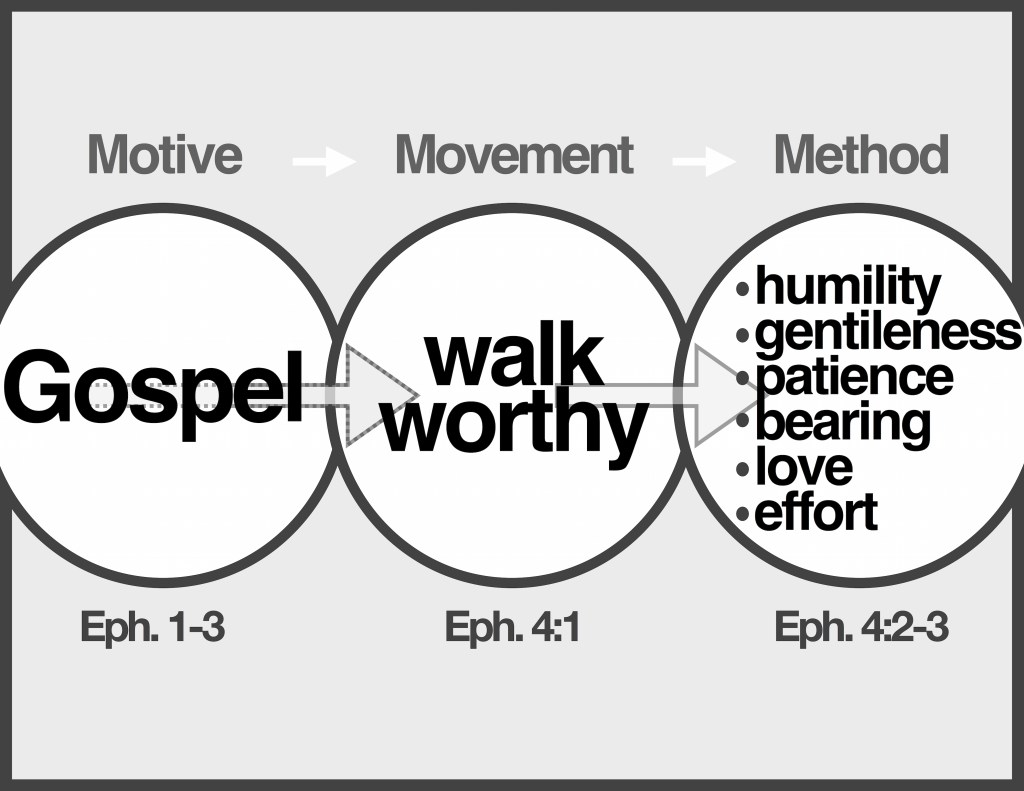
Our motivation is important because unity can be very difficult.[6] Imagine the context and challenges for Paul’s audience: Jew, Gentile, slave, free, lawbreaker, law keeper all in the same church.
That’s actually a good thing though. And a beautiful thing. As Scot McKnight has said, “The church God wants is one brimming with difference.”[7]
Imagine the context now… These are very divided and divisive times. The apparent reality is that Christians have a ton to divide over. But, the theological reality is that Christians are united and one in Christ.
People will know we are Christians by our love for one another. When we have both glaring differences and yet radiant unity we become a mosaic of Jesus’ transforming beauty.
What does it look like to “make every effort”? Paul tells us. Paul gives us five things that are necessary if we are going to be untied. John Stott rightly says that these are the “foundation stones of Christian unity. Where these are absent no external structure of unity can stand.”[8] Those foundation stones are gentleness, patience, love[9] effort, and humility which we’ll be concentrating on.
Humility: Essential to Unity
Ephesians 4:2 says “Be completely humble.” Stott correctly said, “Humility is essential to unity. Pride lurks behind all discord.”[10] I know that’s been true in my own life.
How can we have humility? Well, for one, we as Christians know we’re not all that. We know we sin. We know we get it wrong sometimes. We all stumble many ways. That should humble us.
And amazingly, the only sinless one, Jesus, the Son of God, the one that never did anything wrong, He humbled Himself. He humbled Himself to the point of death. Even the death of a cross (Phil. 2).
So, we as Christians must practice humility too. That’s part of what it means to “make every effort to maintain unity.” That’s what we’re called to do. Spare no expense. Do what it takes.
Winston Churchill during WWII made things happen. He would sometimes stamp his commands in red with the words “Action this Day.” And that’s what he expected. He expected that command to be done. He expected his people to make every effort, and I literally mean every effort to make sure it what done on that day.
I think Paul is saying something similar to us. I think he’s giving us a stamp in red ink that says: “Action this Day.” He’s saying do it. It’s that important. “Make every effort to keep the unity.”
Being united is part of what it means to walk in a worthy way; “to live a life worthy of the calling you have received” (Eph. 4:1). And that is supernatural. That’s part of what it means to be a city on a hill and a light in the darkness.
It’s abundantly clear that union with Christ implies union with others. The reality is that we are together built into a dwelling of God (Eph. 2:22). We are united and one whether we like it or not. If a person names and follows Jesus, we belong together even if we don’t always like that truth.
It’s also important for us to remember that we get grace from God vertically, but we also get much-needed grace from God horizontally from other people. Even when we don’t always like or agree with them.
Conclusion
Brothers and sisters, we have fellowship with each other and with God through our Lord Jesus! Rejoice in that good news. Division is dead. We are united. So, let’s live together in purposeful unity. It will not be easy, but Jesus’ blood was spilled to welcome us into union with Him and each other. Let’s not disregard Jesus’ great sacrifice for us.
May the God who gives endurance and encouragement give us the same attitude toward each other that Christ Jesus has towards us. Encourage one another, be like-minded, live in peace, be sympathetic, love one another, be compassionate, and humble. And the God of love and peace will be with us. So that with one mind and one voice we may glorify the God and Father of our Lord Jesus Christ. Lastly, accept one another, just as Christ accepted us, for the glory of God.[11]
Jesus prayed that we would be one[12] and He gave us one mission. So let’s work together to accomplish that mission.



 in X
in X 