What is so good about Good Friday?

Jesus was crucified on Friday. Good Friday is the day we remember Jesus’ death.
So, what is so good about Good Friday? It almost seems sick to call Good Friday good. If you have a loved one that died you do not celebrate the anniversary of that persons death as good, it was tragic. Why then when referring to the anniversary of Jesus’ death do we call it good? That almost seems sacrilegious.
We call it Good Friday because it truly is good. No, we do not celebrate Jesus’ death per se. Rather we celebrate all that His death accomplished. We celebrate that though He died, and died a terrible death, He said “It is finished,” and it was. We celebrate because He rose victorious over sin and death.
Jesus laid down His life for us to be the wrath absorbing sacrifice. He did this and many more things and that is why the anniversary of Jesus’s death can be said to be good. Actually, in some sense, because Jesus died and conquered death and sin the anniversary of our loved ones death who are in Christ can now be thought of with joy. It too can become a good anniversary.
I want to encourage you to meditate on what Jesus did for you. Think about the cross where Jesus bore the wrath of God that we deserved. I encourage you to read the narrative accounts in the Gospels. When you read it remember who it is that is being mocked, flogged, and crucified. Remember why it is that He suffered in that way and felt the wrath of God; it was not anything that He had done.
Read Isaiah 52:13-53:12 and be amazed at how precisely it describes both the events of the crucifixion and the reason for the crucifixion and this around 700 years before Jesus was born. Jesus was crushed for our sins (Is. 53:5) and thus makes many to be accounted righteous (v. 11), for example. After reading this passage, I composed this attempt at poetry:
Bound by sins darkened glow
In this world of pain and woe
Helpless, hopeless to us He came
And in the midst was slain
Darkest night, the Light extinguished
Will we forever captives be?
Messiah’s mission ends in death?
Where’s the hope of life and peace?
But by power He awaketh
All of death He did breakth
By His death, deaths defeated
Sins depleted of its power
Thus the hour of unrest
Has become our hope, our joy, our rest
For in Christ’s death,
Deaths defeated!
Yes, He burst the bonds that bound Him
And leads many captives in His wake
Yes, from the cross He is victorious
And all of heaven hails He’s glorious!
“Monday Thursday?”
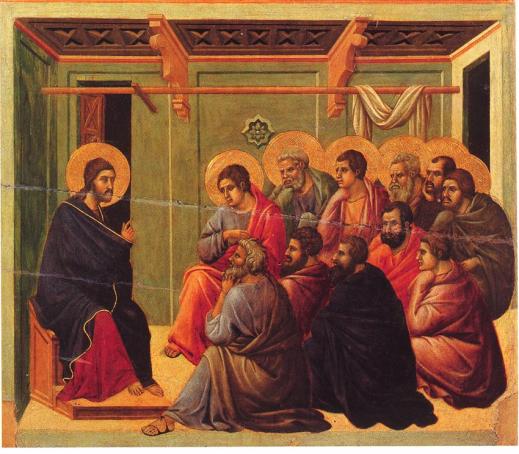
“’Monday’ Thursday? That doesn’t make any sense… Why do we celebrate ‘Monday’ Thursday and why would we celebrate it on Thursday?”
“Muandy Thursday,” not “Monday Thursday,” has to do with remembering what happened on the Thursday before Jesus was crucified. There were a lot of significant things that happened on this Thursday.
Maundy Thursday is known as commemorating variously the day of the Last Supper and the institution of the Lord’s Supper, the foot washing of the disciples, Jesus praying in the garden of Gethsemane, and the betrayal and arrest of Jesus by Judas Iscariot. So we commemorate Maundy Thursday for these reasons. However, why is it called “Maundy Thursday”? What does Maundy mean?
Maundy most likely comes to us from John 13:34 where Jesus says at the Last Supper (on Thursday): “A new commandment I give to you, love one another.” The word for “commandment” in Middle English is maunde, in Old French it’s mandé, and in it’s Latin mandatum. So, in other words, “Maundy Thursday” could be called Commandment Thursday or even, as it is sometimes called, “Covenant Thursday.”
So on Muandy Thursday we think of the command and the covenant. It is important to remember both. So, what was the command? Love one another. That is what we are told to do. And that doesn’t seem that hard, at first. Until we realize that we are given a comparison. The command is that we love one another love even as Jesus has loved us (Jn. 13:34). On Thursday, so many years ago, Jesus gave us a huge “maundy,” command. How can we live up to it? We must remember the amazing context in which it was given.
There were all sorts of events and themes that converged on this weekend in history. The Passover, a historical event in the life of the Jews where they celebrated their spectacular salvation, was celebrated. Yet, we also see that the LORD reaches down to save again, and this time no blood needed to be painted on the door frame. There was no need for a Passover lamb. He had come in the form of a Suffering Servant (cf. e.g. Is. 53).
Jesus brings a New Covenant (Matt. 26:26ff; Mk. 14:22ff; Lk. 22:14ff; 1 Cor. 11:17ff). One that had long since been promised. One that gives His people new hearts, hearts to follow after God (cf. Ezek. 11:19-20; 36:26-27). God takes His peoples sins literally upon Himself (cf. God taking the violations of the covenant upon Himself, Gen. 15; Is. 53; Jer. 34:18). He fulfills the Covenant that His people continually failed to fulfill. Jesus felt the weight of being forsaken. He cried out, “My God, My God, Why have You forsaken Me?!” Jesus was cut off like we deserve to be for breaking His Law.
Understanding the covenant, Jesus’ amazing work of salvation, and understanding what Jesus calls us to is very important and we see them intermingled on Maundy or Covenant Thursday. Jesus fulfills the covenant and His blood is spilled for us, and yet there is still a type of condition to the covenant: we must follow hard after Him.
So, first notice that on Maundy Thursday so many years ago, Peter tells Jesus that he does not want Him to wash his feet (Jn. 13:6). It is striking to me that Jesus says, “If I do not wash you, you have no share with me” (v. 8) and then He goes on to say, “If I then, your Lord and Teacher, have washed your feet, you also ought to wash one another’s feet” (v. 14). So Jesus is saying don’t try and work for your salvation (you can’t) but follow my example and serve others because I have served you.
Works do not save us. We are saved by accepting the work that Jesus did on our behalf, He washed us. And, in fact, if we try to work for our salvation we “have no share with [Jesus] (v. 8). However, that in no way negates the importance of works, to the contrary; it gives works deep significance. We are called to imitate Christ (v. 14-16). Jesus told Peter he could not work for salvation (v. 6-8) but works do have their place. Jesus served Peter (even enabling Peter to serve Him cf. John 1:13; 14:16; Gal. 5:16-24; 2 Peter 1:3; Ezek. 11:19-20; 36:25-27) through the cross and thus Peter served Jesus imitating Him, even to death (cf. John 13:14-16); tradition says, death by upside down crucifixion (cf. John 21:18-19). Peter was saved by trusting Jesus Christ’s all-sufficient service and yet Peter served and imitated Jesus out of a supreme joyous thankfulness (cf. 1 Peter 1:3-9; 2:21-25; 4:13-14).
May we serve in the same way and with the same motivation that Peter did. May we work and serve Christ not to earn right standing before God but, to demonstrate that through Christ’s atoning death we have right standing before God. If we have been declared righteous in Christ then let’s live righteously before Christ (cf. 1 Cor. 1:2). Let’s obey Jesus’ commands in light of His New Covenant.
Will the Real Messiah Please Stand Up?!
The Triumphant Paradox
Introduction. We find people by characteristics. They’re tall, or funny, or whatever it is… When my wife, Leah, is looking for me in a crowd it is her standard procedure to go around and ask people: “Have you seen my husband, he’s talk, dark, and handsome?” She does this because it is a description of me and will help her find me… 😉
The Messiah was found, or wasn’t found, in the same way. There were certain things people were looking for. Many people had different views on what exactly to look for. In fact, even John the baptizer was confused over who exactly the Christ would be and do (cf. Matt. 11:2ff; Lk. 7:18ff).
We see that there were many converging views throughout Scripture and in other literature around the time. There were many so-called christs or promised ones (that led people astray) (e.g. Acts 5:36; 21:38; Ant. 17:271ff; 20:97-98). Scripture indeed has many promises. How could one person meet them all? In fact, could the Messiah even be a person at all (cf. e.g. Is. 9:6-7; Zech. 2:11)?
A Few Questions. As we look at this text in the surrounding context of the book, the New Testament, and the whole of Scripture a few questions come to mind. What did the Jews expect in regard to the Messiah? Why was Jesus crucified, didn’t many people think He was the Messiah? Where do we see the Jewish expectations for the Messiah in Scripture? Where did the Jewish expectation of peace and victory go? How from a New Testament perspective do we make sense of the fact that the Messiah suffered and died? What did Paul and others say about the Messiah?
Main Point. However, before we get to these questions, or some of them, I think it will be helpful to state what I see as the main point of this passage in light of the whole of Scripture. The main point: Jesus of Nazareth is the long-awaited Messiah and fulfills the messianic prophecies in unexpected and amazing ways.
Messianic Expectations. There are many texts in Scripture that tell us about the expectation of the Messiah. See for instance: 2 Sam. 7:12-13, Ps. 89:3; 132:11, Hos. 3:5, Mic. 5:2, Is. 9:6-7; 11:1, 10; 55:3, Jer. 23:5-6; 30:9; 33:20-22, 25-26, Ezek. 34:23-24; 37:24-25, and Zech. 9:9 which our text highlights. There are also many other texts that are somewhat ambiguous but nevertheless point to the Messiah. The Suffering Servant passage from Isaiah 53 is a powerful passage but many would have been unsure about how it fit into the expectations of the Messiah (see “Jewish Interpretations of Isaiah 53”).
Messianic Expectations as Seen in Zechariah. Many passages also talk about the New Creation which the Messiah will usher in (see An Anthology of New Creation). However, since our passage today mainly deals with Zechariah we will primarily look at the expectations brought up by that book. Here is a tentative list:
- Jerusalem will not have walls because so many people will be in it (Zech. 2:4)
- The LORD will be the wall for Jerusalem and will dwell there (2:5, 10; 8:3)
- The nations shall be the LORD’s people (2:11; 8:22-23) (note the wording in v. 11: The LORD sends the LORD?!)
- The LORD will send His servant the Branch, i.e. the Messiah (3:8 cf. 6:12; Is. 11:1; Jer. 23:5)
- The Branch, the Messiah, shall build the temple of the LORD and rule on the throne (6:12-13)
- The LORD will remove the iniquity of the land on a single day (3:9)
- Jerusalem will be called the faithful city (8:3)
- There shall be great peace (8:12)
- Israel’s enemies will be destroyed (9:1-8; 14:11-15)
- The Promised one will rule “from sea to sea” (9:10)
- The blood of the covenant will set prisoners free (9:11 cf. Lk. 4:18)
- God will pour out fierce recompense on Israel’s enemies and Jerusalem will be inhabited again (12:1-7, 9)
- God’s people will have a spirit of grace poured out on them and will weep over Him who they pierced (12:10: “And I will pour out on the house of David and the inhabitants of Jerusalem a spirit of grace and pleas for mercy, so that, when they look on me, on him whom they have pierced, they shall mourn for him, as one mourns for an only child, and weep bitterly over him, as one weeps over a firstborn”).
- On that day, the day when they weep over Him they pierced, they will be cleansed (13:1)
- God will rid the world of uncleanness (13:2)
- The Shepherd will be struck and the sheep will be scattered (13:7)
- The LORD will be King over the whole earth (14:9 cf. Phil. 2:10-11)
- The world will be a kind of temple (14:20-21)
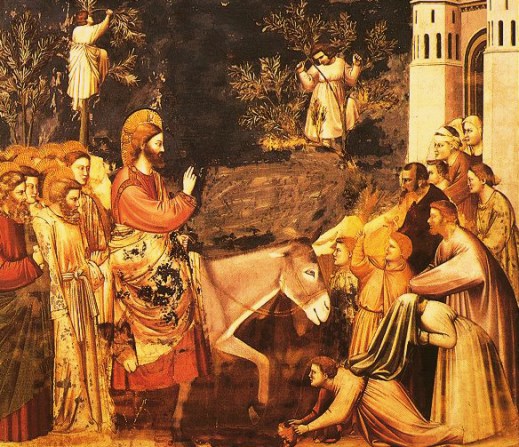
Text. Here is an anthology of the “Triumphant Entry” texts:
[28] And when he had said these things, he went on ahead, going up to Jerusalem. [29] When he drew near to Bethphage and Bethany, at the mount that is called Olivet, he sent two of the disciples, [30] saying, “Go into the village in front of you, where on entering you will find a colt tied, on which no one has ever yet sat. Untie it and bring it here. [31] If anyone asks you, ‘Why are you untying it?’ you shall say this: ‘The Lord has need of it.’” [32] So those who were sent went away and found it just as he had told them. [33] And as they were untying the colt, its owners said to them, “Why are you untying the colt?” [34] And they said, “The Lord has need of it.” (Lk. 19:28-34 cf. Matt. 21:1-3; Mk. 11:1-6). [4] This took place to fulfill what was spoken by the prophet, saying,
[5] “Say to the daughter of Zion,
‘Behold, your king is coming to you,
humble, and mounted on a donkey,
on a colt, the foal of a beast of burden’” [Zech. 9:9] (Matt. 21:4-5 cf. Jn. 12:14-15).
[6] The disciples went and did as Jesus had directed them. [7] They brought the donkey and the colt and put on them their cloaks, and he sat on them [the cloaks, not the donkeys] (Matt. 21:6-7 cf. Mk. 11:7; Lk. 19:35).
[36] And as he rode along, they [variously described as “most of the crowd,” “many,” and “multitude of disciples“] spread their cloaks on the road. [37] As he was drawing near—already on the way down the Mount of Olives—the whole multitude of his disciples began to rejoice and praise God with a loud voice for all the mighty works that they had seen, [38] saying, “Blessed is the King who comes in the name of the Lord! Peace in heaven and glory in the highest!” (Lk. 19:36-38 cf. Matt. 21:8-9; Mk. 11:8-10; Jn. 12:12-13[1]). [10] And when he entered Jerusalem, the whole city was stirred up, saying, “Who is this?” [11] And the crowds said, “This is the prophet Jesus, from Nazareth of Galilee” (Matthew 21:10-11 cf. Deut. 18:15).
[39] And some of the Pharisees in the crowd said to him, “Teacher, rebuke your disciples.” [40] He answered, “I tell you, if these were silent, the very stones would cry out.”
[41] And when he drew near and saw the city, he wept over it, [42] saying, “Would that you, even you, had known on this day the things that make for peace! But now they are hidden from your eyes. [43] For the days will come upon you, when your enemies will set up a barricade around you and surround you and hem you in on every side [44] and tear you down to the ground, you and your children within you. And they will not leave one stone upon another in you, because you did not know the time of your visitation” (Lk. 19:39-44).
[16] His disciples did not understand these things at first, but when Jesus was glorified, then they remembered that these things had been written about him and had been done to him. [17] The crowd that had been with him when he called Lazarus out of the tomb and raised him from the dead continued to bear witness. [18] The reason why the crowd went to meet him was that they heard he had done this sign. [19] So the Pharisees said to one another, “You see that you are gaining nothing. Look, the world has gone after him” (Jn. 12:16-19).
Explanation of the Text. First, we see that Jesus orchestrated the whole course of events (Lk. 19:28-34 cf. Matt. 21:1-3; Mk. 11:1-6). Truly, no one took Jesus’ life from Him but He laid it down on His own accord (Jn. 10:18). Jesus directed His disciples about what to do. They found the colt just as He said and they did just what He said. Jesus was now bringing in His “hour” by the events that He sets in order here.
Second, the events took place to fulfill Scripture (Zech. 9:9; Matt. 21:4-5 cf. Jn. 12:14-15). So Zechariah 9:9: “Rejoice greatly, O daughter of Zion! Shout aloud, O daughter of Jerusalem! Behold, your king is coming to you; righteous and having salvation is he, humble and mounted on a donkey, on a colt, the foul of a donkey.” And Psalm 118:25-26a is also mentioned: “Save us, we pray, O LORD! O LORD, we pray, give us success! Blessed is he who come in the name of the LORD!” (see also vv. 19-24, 27-29).
Third, the people welcomed Jesus as the Messiah who would bring peace and victory (Lk. 19:36-38 cf. Matt. 21:8-9; Mk. 11:8-10; Jn. 12:12-13). The people call out: “Hosanna to the Son of David!” What does that mean? It is basically a cry for deliverance. It reminds me of when God’s people in slavery in Egypt cried out to God for Him to save them and so God sent Moses. Well, here God’s people are crying out to who they see as the Messiah, the Christ, the Anointed One, the Promised One, the Deliverer, the Rescuer. They’re saying: “Save now! (cf. 2 Sam. 14:4; 2 Kings 6:26; Ps. 118:25) If you’re David’s promised son then start your reign now” (see the significance of Jesus being David’s son, i.e. decedent, in e.g. 2 Sam. 7:12; 1 Chron. 17:10-14; Matt. 1:1, 17; 9:27; 12:23; 15:22; 22:42-45).
We see what the people expected through their words and actions. They not only said “Hosanna!” they also welcomed Jesus as a victorious king with palm-branches (see Lev. 23:40; 2 Kings 9:13; 1 Macc. 13:51; 2 Macc. 10:7). Interestingly, Jesus, though a common name in that time, is the equivalent of Joshua which means “The LORD saves.” The LORD does indeed save, but not in the way that He did through the hands of Joshua in this case.
Many stories have paradoxical elements. What is a paradox? It is something that seems absurd or unreasonable but nevertheless may prove true. It is something that seems like it doesn’t make sense, at least, at first.
So in Tolkien’s famous series you have a little hobbit that defeats smog and really is used to defeat the evil powers. This is a kind of paradox. You don’t expect a little hobbit to do that sort of thing. You don’t expect David to defeat Goliath. You don’t expect the team in the sports movie to win the game because they are not very good and they have never won before… Oh wait, no, you do expect them to win… but you shouldn’t. They always win! But the reason it is a movie is because they shouldn’t win.
So we have a paradox in Scripture that we confront in this text. Jesus does bring victory and peace but not when and how people expected Him to. Jesus crushes Satan, and all wicked powers, by Himself being crushed (cf. e.g. Gen. 3:15).
Fourth, the people were clearly confused as to the identity of the Messiah (cf. Matt. 21:10-11; Jn. 6:15; Lk. 19:39-44), even the disciples (Matt. 16:21-23; Jn. 12:16). Remember Peter, after he had confessed that Jesus was “the Christ, the Son of the living God” (Matt. 16:16), said, “Far be it from you, Lord! This shall never happen to you” (v. 22). Peter said this about Jesus suffering and being killed (v. 21). People just didn’t have a category for how the Messiah would save. Even John the baptizer, who said, “Behold, the Lamb of God who takes away the sin of the world” (Jn. 1:29), said from prison, “Are you the promised one, or should we look for another?” (cf. Matt. 11:2ff; Lk. 7:18ff). No doubt he was confused by the fact that he was in prison and the Kingdom, from his perspective, had not come.
What the Jewish people were looking for was not a Son of David riding on a donkey but on a war horse. Solomon, David’s son was not the Messiah as it turned out, though he had thousands of stalls of horses for his chariots and 12,000 horsemen. Conversely, Jesus didn’t come with horses—or even a horse!—He came on a lowly donkey. Yet, remember that there are problems in trusting in horses (see Deut. 17:16; Is. 31:1-3). Instead of trusting in horses we are to trust in the LORD God (Ps. 20:7). What the Jews were looking for was something more like what will yet come. Revelation tells us about the coming of the white horse (see Rev. 19:11ff).
So, throughout Christendom, today is known as “Palm Sunday,” the day of Jesus’ “Triumphant Entry,” but rather should perhaps be known as “Paradox Sunday” or “Fickle Sunday.” The people ended up saying “we do not want this man to reign over us” (Lk. 19:14 cf. Is. 53:2-3; Jn. 1:10-11). They praise Jesus one day and almost the next are crying: “Crucify him! Crucify him!”
So, how do we understand these things? What about people’s expectations for the Messiah? Did Jesus fulfill them? Will He fulfill them?
The Impact of the Expectations. The people cry out in praise but then just a few days later this man who many people saw as the deliverer was Himself delivered to be crucified on a tree (and cursed is every man hung on a tree, Deut. 21:22-23). How can we make sense of this? How did they make sense of it? How does the New Testament and it’s teachers make sense of it? And how should we make sense of it?
Is Jesus the Messiah? If so, where are all the other promises? Maybe the question should actually be asked differently: If Jesus fulfilled 60 major prophecies and 270 ramifications how could He not be the long awaited Messiah?! It has been said that the probability of one man fulfilling all those prophecies’ is 1 in 100,000,000,000,000,000.
Further, as the Apostle Paul said, “Jesus was declared to be the Son of God… by His resurrection from the dead, Jesus Christ our Lord” (Rom. 1:4). Jesus’ resurrection is the first fruits Paul also explains (1 Cor. 15) which means there is more “fruit” to come (i.e. the resurrection/new life/New Creation). We have also been “sealed with the promised Holy Spirit, who is the guarantee of our inheritance until we acquire possession of it” (Eph. 1:13-14).
Regarding the resurrection, Professor Thomas Arnold who wrote the History of Rome and who was appointed the chair of modern history at Oxford said,
“I have been used for many years to study the histories of other times, and to examine and weigh the evidence of those who have written about them, and I know of no one fact in the history of mankind which is proved by better and fuller evidence of every sort, to the understanding of a fair inquirer, than the great sign which God has given us that Christ died and rose again form the dead.”
After Jesus was taken His Apostles were scared and hid in the upper room. As we know, Peter denied Jesus three times. They too doubted that He was, in fact, the Christ. However, after Jesus’ resurrection, He appeared to the Apostles and many others. After the Apostles saw the resurrected Jesus they were no longer scared, they were emboldened. They believed that Jesus was indeed the Messiah. All of the Apostles died for their beliefs, except John but tradition says he was boiled alive and exiled to the island Patmos. Who would die for a known lie? To what did the Apostles have to gain?
Here is how tradition says the Apostles died:
- Peter- crucified
- Andrew-crucified
- Matthew- the sword
- John- died a natural death after being boiled in oil and exiled
- James, son of Alphaeus- crucified
- Philip- crucified
- Simon- crucified
- Thaddaeus (who replaced Judas Iscariot)- killed by arrows
- James, the brother of Jesus- stoned
- Thomas- spear thrust
- Bartholomew- crucified
- James, the son of Zebedee- the sword
Further, we could discuss that all the promises will be fulfilled. All Scripture, as Paul reminds us, finds it’s yes or fulfillment in Jesus. The war horse, as we saw, will come (cf. Rev. 19). Jesus will bring peace like we have never known, but He will crush any rivals. Jesus will fix all our aches and pains. All things will finally be made new!
Just a word and all wonders wrought
God announced, and behold, it was all good
Creation had communion with the Creator
God walked in the Garden
Yet with Adam the serpent did conspire
And brought the world into mire
Beckoned to the grave
Everything disarranged
Yes, the curse burst upon the scene
But in the midst a seed of hope was seen
Many men came and went
Was the hope of promise spent?
Many lambs, prophets, priests and kings
Yet none with true salvation in their wings
Darkness for a time
No prophet’s voice was heard
Yet in the darkness I Light it shone
And it would overcome the darkness
Behold, O’ world, your Prophet, Priest, and King
Jesus the Promised Seed and Lamb
The curse brought in shall be expunged
Yes, replunged upon the Son
Christ was crushed as promised
But in His crushing, crushed Satan, sin, and death
He was cursed to reverse the curse
He felt our plight to set all things right
The lion to lay down with the lamb,
Because, the Great I AM, was slain
No more brier prick or thorn to stick
All shall be made new
When our King all subdue
All shall be made new
Conclusion. Jesus of Nazareth is the long-awaited Messiah and fulfills the messianic prophecies in unexpected and amazing ways. Further, Messiah Jesus is coming back soon to establish His eternal reign. He will make things finally good, in fact amazingly good beyond what we can understand. Yet, He will also carry out justice beyond what we can understand.
I end by saying: praise Jesus for His amazing work! Hosanna! Maranatha!
___________________________________________
[1] In John 12:13 it says the large crowd “went to meet him.” Andreas J. Kostenberger points out that “’went to meet him’ (rare in biblical literature: in the NT elsewhere only in Matt. 8:34; 25:1; in the LXX only in Judge. 11:34) was regularly used in Greek culture, where such a joyful reception was customary when Hellenistic sovereigns entered a city” (John, 369).



 in X
in X 