Rule #1: God is first, so make sure He’s first in your life.

“And God spoke all these words: I am the Lord your God, who brought you out of Egypt, out of the land of slavery. You shall have no other gods before me” (Exodus 20:1-3).
For the next couple of weeks, we’re going to be looking at rules, the Ten Commandments. Yeah! Just what everyone wants to look at! Rules! I’m sure you’re giddy with delight.
Maybe not.
Rules often have a bad reputation. They have for me in the past. Let me ask you though, have you heard of Thomas the Train? Thomas was a train. A blue train to be exact, and a happy train most of the time. But Thomas wanted to be free. He wanted to be free from the restrictions of the train track. He was unhappy because wanted to roam in the open countryside.
One day he got fed up. He made a break for it. He was going to go off the restrictive tracks once and for all! He was going to know freedom.
So, he did. He went of the tracks. He was finally free from the railroad tracks!
What do you think Thomas’ “freedom” was like?…
It was crushing. Literally, crushing. He couldn’t move. He was stuck.
He was somewhere where he wasn’t meant to be.
We often have…
Concern about Rules
We don’t like rules. But rules are good. Have you ever played the card game Mao? It’s a game with unspoken rules. It’s really hard to play because you don’t know the rules but get penalized when you break them. Rules are good because they keep things the way they’re supposed to be kept. They keep Thomas on the tracks so that he is free to come and go, free to be what he is supposed to be. It’s also good to know the rules so you’re not “penalized” for something you didn’t know.
Why do Black Lives & LGBTQ+ Lives Matter?

Why do black lives and LGBTQ+ lives matter? This is an important question because some people have views that don’t support the idea of lives mattering. For example, Charles Darwin, the most famous proponent of evolution titled his book, On the Origin of Species by Means of Natural Selection, or the Preservation of Favored Races in the Struggle of Life. And in his book, The Decent of Man, he says,
“The Western nations of Europe… now so immeasurably surpass their former savage progenitors [that they] stand at the summit of civilization…. The civilized races of man will almost certainly exterminate and replace the savage races through the world.”
Does a strict Darwinian view of the world lead to all lives mattering? It does not appear so. That’s why this question is important. Why do black lives and LGTBQ+ lives matter?
If we cut off our objective moral legs, we have no way to stand. If we say morality doesn’t matter, then it doesn’t matter. We can’t pick and choose. We can’t both say people are the way they are and have the desires they have and it’s fine and say it’s not okay for people to be certain ways and do certain things. That’s the crucial thing we need to consider.
Black lives matter. LGBTQ+ lives matter. White lives matter. Yes, yes, yes, and yes. But why?
That is a super important question and one that sadly isn’t receiving a lot of sustained thought. Why do black lives matter? Why do lives matter at all? Where do we get this concept? Is it true?
Jesus said, black lives matter.[1] Jesus said, LGBTQ+ lives matter. Jesus said, all lives matter.
“You shall love your neighbor as yourself” (Matthew 22:37-38).
But does Jesus matter? And if He doesn’t on what basis then are we saying all these lives matter? This may seem like a stupid question. We just know all types of lives matter, right? But do we?
The common view that many have is Darwinian evolution, that we came from nothing and we are going to nothing; from purposelessness to purposelessness. Where is meaning, morality, and lives mattering to be found?[2] Is there a basis for human rights?
Also, did the Roman culture, in whose hands Jesus was murdered say, all lives matter?[3] Did Joseph Stalin say all lives matter? Did Friedrich Nietzsche? Did Adolf Hitler? Did Mao Zedong? Is it even possible to say all lives matter or any lives matter when the highest maximum is have it your way and do what’s right for you? Could it be that “just as long as no one gets hurt” has been trampled upon and obliterated by “you can do whatever you want”?  If God is dead, and we killed him, as Nietzsche said, what follows? Perhaps Nietzsche was right, perhaps that makes all things permissible? Each person doing what is right in their own eyes, whatever that might be. Who is anyone, who or what is God, to restrain? …We are who we are and we want what we want and that’s nobodies business, right?
How or where, then, do we get the concept of lives, any lives, ultimately mattering? The concept of lives mattering would be merely imaginary (a social construct). Perhaps good for America right now but not for all people at all times and places.
We can’t deconstruct everything and still have a basis which to say lives matter or to say that we must love others. We can’t both say we can do whatever we want and you can’t do certain things (like be racist or homophobic).
The Work of the Spirit | pt. 4
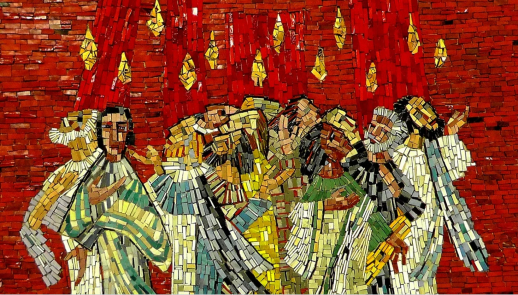
You can see the previous post here.
There is no indication that the gifts would cease before Christ’s second coming. The Bible never indicates the cessation of the grace gifts until the return of Jesus, this is the second reason I believe in their continuance. There is no indication in the New Testament that the gifts would cease before the coming of Christ. Of course, it is possible that they could just fade out but we would not expect that to be the case from reading the Bible. Jack Deere contends that “If you were to lock a brand-new Christian in a room with a Bible and tell him to study what the Scriptures have to say about healing and miracles, he would never come out of the room a cessationist.”[1]
In 1 Corinthians 1, it seems to indicate the expectation that the gifts will continue until the coming of Christ. If you read the letter as the first recipients would have there is nothing at all that would make you think otherwise. In 1 Corinthians 1:7, Paul says, “…you are not lacking in any gift[2], as you wait for the revealing of our Lord Jesus Christ.” Notice it says “any gift” and it seems as if the gifts will continue until the revealing of the Lord Jesus Christ. That seems to clearly indicate that the gifts of the Spirit will continue until Jesus returns.
Paul, thus, seems to believe that all of the gifts will not be lacking until “the revealing of our Lord Jesus Christ” (1 Cor 1:7). Paul expects that those who are witnesses of Christ[3] will have the spiritual gifts available to them until “the perfect comes” (cf. 13:8-12), that is “the revealing of our Lord Jesus Christ” (1:7).[4] It is also important to note that in the context of 1 Corinthians, “spiritual gifts” (χαρίσματι cf. HCSB, NLT, NIV, Rom 1:11) cannot be limited to encouragement and the like but must also include what is considered the “charismatic gifts.”[5]
Better News Than Politics

How does the good news of Jesus speak to politics?
First, I think it’s important that we see and agree that the good news that Jesus brings is better news than politics has ever or could ever bring. Let’s look at a simple outline of some forms of government that God’s people have been under in the Bible:
- Government by God (in Eden)
- Oppression and Slavery (in Egypt)
- Tribal Leadership
- Monarchy
- Exile
- Roman Rule
Out of the six forms of government only one was perfect: Government by God. And even that got messed up because of human sin. Representative democracy as good as it is, is not perfect and never will be. It has worked well. But it is important that we realize that it will never be perfect.
Jesus brings better news than politics can ever bring. Jesus gets us back to perfect government by God. And He does so by giving His very own life. Jesus will make things forever right (Rev. 21).
Let’s not put our hope in any political promise. Let’s hope in Jesus and in His Kingdom. Jesus is the true King and Savior.
Second, the gospel tells us our ultimate citizenship is somewhere else. As Christians, we live knowing that we don’t have a permanent home here. We’re looking for the forever and perfect home that is to come (Heb.13:14 cf. 10:34; 11:10, 16; 2 Cor. 5:4), a home prepared for us by Jesus Himself (Jn. 14:2).
Alexa… Amen

We bowed our heads to pray and instead of saying, “God…” What came out was, “Alexa.”
We looked up from our prayer and kinda smirked, kinda laughed. But for me, there was a tear, a start of a separation. I wondered if something more profound and problematic was behind that slip.
We pray to our all-knowing, ever-present, appendage. We, at least, certainly rely daily on our Internet technology. Even our presence and personality is mediated through this ever-present medium. We rely on it for strokes to our ego and many rely on it for titillation.
Is the Internet a false god?
Who is Jesus?

Who is Jesus? That is the all-important question. That is the hinge on which history hangs.
That question has been a question for centuries. John the baptizer even said, “Are you the one who is to come, or should we expect someone else?” (Matt. 11:3). Islam says Jesus is a prophet. Jehovah’s Witnesses say Jesus is a mighty being, even a god. But not God. They do not believe in the Trinity.[1]
So, who is Jesus?
For us to answer that question, it’s important that we consider what Jesus Himself said. So, who did Jesus Himself say He was? Jesus is asked about His identity in the Gospel of John. People asked Jesus, “Aren’t we right in saying that you are a Samaritan and demon-possessed?” (John 8:48).
Our Hope in the Midst of the Virus

This is a difficult time for many of us. Yet in the LORD we find comfort that transcends our earthly struggles. What hope do we have in the midst of this time of difficulty?
Zephaniah recounts for us a lot of really difficult things. Zephaniah is not a lighthearted read. It is heavy. If Zephaniah was a painter, he wouldn’t have used pastel colors. Instead, the canvas would be filled mainly with black and red.
Yet, there would be a glimmer of light, a glimmer of hope in the darkness. What hope is that and who is it for?
Statistics and Comfort in Calamity

Photo by Ben White
Does the 2% death rate statistic comfort you? What does the Bible say about comfort during calamity?
Some sources are saying that the mortality rate of COVID-19 looks to be 2%. However, it is too early to say. The percentage will be bigger or smaller depending on various factors (such as the age of the people infected, access to the needed medical treatment, etc.). I think we should acknowledge a few things about the statistic. First, 2% looks like a small number. And it is. At least, relative to a larger number.
Second, to put it into perspective, 2% of the population of the world is around 140 million people. That, as we can see, is a lot of people. COVID-19 could rival the AIDS epidemic. Of course, it seems highly unlikely that everyone in the world will get the virus. But even a fraction of that number is a lot of people. And it’s important for us to see the numbers from this vantage point so that we don’t play the numbers down.
The Church & the Coronavirus

“Peace I leave with you; my peace I give you. I do not give to you as the world gives. Do not let your hearts be troubled and do not be afraid” (John 14:27).
5 things for Christians to do in the midst of the coronavirus:
1. Continue in faith and fight against fear.
One way you can work at doing that is by memorizing these verses:
“We can confidently say, ‘The Lord is my helper; I will not fear; what can man do to me?’” (Hebrews 13:6).
“My help comes from the LORD, who made heaven and earth” (Psalm 121:2).
“Cast your burden on the Lord, and He will sustain you” (Psalm 55:22).
“From of old no one has heard or perceived by the ear, no eye has seen a God besides you, who acts for those who wait for Him” (Isaiah 64:4).
2. Feast on God’s word and fast social media & entertainment.
The Bible is the authoritative word of God and as such, it is uniquely profitable (2 Tim. 3:16-17). Scripture is a light (Ps. 119:105,130), sword (Eph. 6:17), hammer (Jer. 23:29), and surgeon (Heb. 4:12). Scripture is more essential than bread (Matt. 4:4), better than gold (Ps. 19:10; 119:72), and we need it to live (Ps. 119:144). Scripture is perfect (Ps. 19:7), true (Ps. 19:9), pure (Ps. 19:8), and eternal (1 Pet. 1:25). Scripture contains the words of life (Jn. 6:68) and the words that are breathed out by God (2 Tim. 3:16). Scripture gives joy (Ps. 119:111; Jer. 15:16), makes wise (Ps. 19:7), equips (2 Tim. 3:17), guards (Ps. 119:9), guides (Ps. 73:24; 119:105), saves (1 Pet. 1:23), sanctifies (Ps. 119:9,11; Jn. 17:17), and satisfies because by it we know God (1 Pet. 2:3). The Bible is of absolute importance.
So, feast on God’s word and spend less time on social media and entertainment.
3. Make a prayer list of 10 people & pray for them every day.
4. Make a check-in list of 10 people & check in on them.
5. Pray for needs across the globe & pray for God to turn hearts to Himself.
The Coronavirus and the Christian

How should Christians think about and respond to the coronavirus? Here are some initial thoughts…
Plague and the Problem of Evil
Christians see the world in a way that makes sense of the world. We have an understanding of why plagues and the problem of evil exist.
That leads us to acknowledge something else that’s super important to focus on: Jesus. Jesus did not leave us to our problems. He did not leave us to simply wallow in plagues. Instead, He Himself plunged headlong into our sorrow.
“The God of The Bible becomes completely human and hurts in every way that we do—from physical pain to social rejection, misunderstanding, hatred, violence, and death. He endures it all. And because he suffers all of this with us, he can empathize with our sorrow and pain. Even more amazingly, Jesus’ death on the cross and his resurrection are the avenues through which he overcomes all evil, pain, and misery and is able to offer us the promise that disappointment will give way to joy, brokenness to eternal healing, and evil to good. Because of Christ’s agony, death will die and life will live on forever.”[1]
Therefore, even in the midst of plague and the problem of evil we can point people to Jesus. We can point people to hope, no matter what happens. Therefore, Christian, continue to worship Christ as Lord and always be ready to tell everyone the reason you have hope even in the midst of the chaos of the curse and the coronavirus (1 Pet. 3:15).