Is the Bible Reliable?

Christians believe that the original manuscripts of the Bible give us God’s authoritative words, and we have very accurate copies of those original manuscripts. As the Bible says, God’s word will not pass away (Psalm 119:89; Isaiah 40:8; Luke 21:33; 1 Peter 1:23, 25).
We do not have an original copy of any piece of the New Testament (an “autograph manuscript”). The process known as textual criticism, however, helps us get back to what was originally written. What would have happened with the original writings of the New Testament, the autograph manuscripts, is they would have been carefully and painstakingly copied and then passed on to the next group of early Christians to carefully copy. These copies would have then been copied as well. Eventually, the original writing would get worn and torn.
We do not have original copies, but we have manuscripts that are very close to the date of the autographs. One of the amazing things about the New Testament is the sheer number of copies we have as well as how close they are to the original manuscripts, both in accuracy and date.
There are three main types of manuscript variants. Daniel Wallace, a specialist in Koine Greek and New Testament textual criticism, says that over 99 percent of textual variants don’t affect the meaning of the text, are not viable, or “don’t have any likelihood of going back to the original, or both.”[1] The largest category is spelling difference. “This accounts for over 75% of all textual variants.”[2] The second “largest category involves synonyms, word order, or articles with proper nouns.”[3] Neither of these categories impacts the message of the text in any meaningful way. There is a third and much smaller category, however, in which the meaning of the text can be affected. Two examples are the long ending of Mark (Mark 16:9-20) and the woman caught in adultery (John 7:53-8:11). In this third category, manuscript evidence must be weighed and considered. But even in this last category, no Christian doctrine is changed. Even Bart Ehrman, a popular New Testament scholar who is not a Christian, has written, “Essential Christian beliefs are not affected by textual variants in the manuscript tradition of the New Testament.”[4]
We can be sure that we accurately have the words of God, but in a few places, we have needed to get back to the words of God, so we have had to trim back what is not supported by the manuscript evidence. So again, that’s what there are notes in most Bibles about the long ending of Mark and the woman caught in adultery.[5]
It should also be understood that “many textual variants exist simply because many ancient manuscripts exist. The amount of the manuscript evidence is one thing that makes the New Testament stand out among other works of antiquity.”[6] Other ancient works are supported by a dearth of manuscripts. Of course, with fewer manuscripts, you have fewer variants, but you also have less evidence to weigh to get you back to the original work.
The Bible’s number of manuscripts is especially impressive considering the Roman emperor Diocletian’s “Edict against the Christians” during the Great Persecution. In Eusebius’ Church History, he talks about the edict “commanding that the churches be leveled to the ground” and the Scriptures be destroyed by fire.[7]
So, is the Bible historically reliable? The Bible reports actual historical events and the manuscripts for the Bible are very reliable. Nothing in ancient literature matches the historical documentation of the Bible. Nothing comes close.
Compared with other ancient writings, the Bible has more manuscript evidence to support it than any ten pieces of classical literature combined.[8]
The reliability of the New Testament history is overwhelming when compared to that of any other book from the ancient world.[9]
The New Testament is easily the best-attested ancient writing in terms of the sheer number of documents, the time span between the events and the documents, and the variety of documents available to sustain or contradict it. There is nothing in ancient manuscript evidence to match such textual availability and integrity.[10]
Christians can be confident that most English translations of the Bible are fair representations of what the biblical authors wrote. A vast number of variants exist only because a vast number of ancient, hand-copied manuscripts exist. No textural variant anywhere calls any essential Christian doctrine into question or indicates completely different, competing theologies among the New Testament authors. We have not lost the message of the text. God has preserved his Word, and the text’s wording is trustworthy.[11]
In comparison with the average ancient Greek author, the New Testament copies are well over a thousand times more plentiful. If the average-sized manuscript were two and one-half inches thick, all the copies of the works of an average Greek author would stack up four feet high, while the copies of the New Testament would stack up to over a mile high![12]
Here’s a table[13] so you can see a visual representation of the manuscript data:

Therefore, “to be skeptical of the resultant text of the New Testament books is to allow all of classical antiquity to slip into obscurity, for no documents of the ancient period are as well attested bibliographically as the New Testament.”[14]
The Bible is historically accurate and other historical works collaborate information we see from the Bible. Tacitus, a first-century historian, wrote this about the early Jesus movement:
Therefore, to scotch the rumour, Nero substituted as culprits, and punished with the utmost refinements of cruelty, a class of men, loathed for their vices, whom the crowd styled Christians. Christ, the founder of the name, had undergone the death penalty in the reign of Tiberius, by sentence of the procurator Pontius Pilatus, and a pernicious superstition was checked for the moment, only to break out once more, not merely in Judea, the home of the disease, but in the capital itself, where all things horrible or shameful in the world collect and find a vogue.[15]
Thus, early non-Christian sources support the main details about Jesus. The authors of the New Testament were either eyewitnesses to Jesus themselves or interviewed eyewitnesses, so we have accurate historical accounts about Jesus (e.g., Lk. 1:1-4; 2 Pet. 1:16; 1 Cor. 15:1-8; 1 Jn. 1:1-3).
There are reasons to trust the Bible from an archeological (and even an astronomical[16]) perspective as well. For years, many people thought the Hittites the Old Testament talks about did not exist. However, archaeological research has since revealed that the Hittite civilization did exist. There are many similar examples.
Various inscriptions support things we see in the Bible. The Pool of Siloam, once doubted, has been found. The James Ossuary seems to support facts about Jesus’ family. The Shroud of Turin, though debated, is potential “hard evidence.” In fact, “No book from ancient times has more archaeological confirmation than the Bible.”[17]
The death, burial, and resurrection of Jesus are attested by various historical accounts. I believe a persuasive argument can be made for the validity of the actual physical resurrection of Jesus of Nazareth. I believe the resurrection of Jesus best explains why the disciples were willing to die for their claim that Jesus was the resurrected Messiah and why the Jews would switch from gathering for worship on the Sabbath (on Saturday) to gathering on the Lord’s Day (Sunday, the day Jesus rose from the dead). I think it best explains why people, including Jews, would worship Jesus. It best explains all of it; the church,[18] the New Testament, and various parts of the Old Testament. So, we can trust the Bible to give us accurate historical accounts.
Notes
[1] Darrell L. Bock and Mikel Del Rosario, “The Table Briefing: Engaging Challenges to the Reliability of the New Testament” in Bibliotheca Sacra (vol. 175, January-March, 2018), 98.
[2] Darrell L. Bock and Mikel Del Rosario, “The Table Briefing: Engaging Challenges to the Reliability of the New Testament” in Bibliotheca Sacra, 98.
[3] Bock and Rosario, “The Table Briefing: Engaging Challenges to the Reliability of the New Testament” in Bibliotheca Sacra, 98.
[4] Bart Ehrman, Misquoting Jesus, 252.
[5] “The New Testament grew in size from the earliest copies to the latest copies—fourteen hundred years later –by about 2 percent. That is a remarkably stable transmissional process” (J. Ed Komoszewski, M. James Sawyer, Daniel B. Wallace, Reinventing Jesus: How Contemporary Skeptics Miss the Real Jesus and Mislead Popular Culture [Grand Rapids: Kregel Publications, 2006], 55).
[6] Bock and Rosario, “The Table Briefing: Engaging Challenges to the Reliability of the New Testament,” 99.
[7] Eusebius, Church History, 8.2.4.
[8] Josh McDowell, The New Evidence that Demands A Verdict, 9.
[9] The Popular Handbook of Archaeology and the Bible, 131.
[10] Ravi Zacharias, Can Man Live Without God?, 162.
[11] Bock and Rosario, “The Table Briefing: Engaging Challenges to the Reliability of the New Testament,” 104-05.
[12] J. Ed Komoszewski, M. James Sawyer, Daniel B. Wallace, Reinventing Jesus: How Contemporary Skeptics Miss the Real Jesus and Mislead Popular Culture (Grand Rapids: Kregel Publications, 2006), 82.
[13] See Josh McDowell, Evidence the Demands a Verdict, (San Bernadino, CA: Here’s Life, 1972). Homer’s Illiad is the best-attested ancient work after the New Testament.
[14] John Warwick Montgomery, History and Christianity, 29. “Since scholars accept as generally trustworthy the writings of the ancient classics even though the earliest MSS were written so long after the original writings and the number of extant MSS is in many instances so small, it is clear that the reliability of the text of the N. T. is likewise assured” (J. Harold Greenlee, Introduction to New Testament Textual Criticism, 16).
[15] Tacitus, Annals 15.44. There are other examples we could look at. A Rabiniac writing says, ““Jesus was hanged on Passover Eve. Forty days previously the herald had cried, ‘He is being led out for stoning, because he has practiced sorcery and led Israel astray and enticed them into apostasy. Whoever has anything to say in his defence, let him come and declare it.’ As nothing was brought forward in his defence, he was hanged on Passover Eve” (Sanhedrin 43).
[16] “Astronomical records show that there were several significant celestial events around the time of Jesus’ birth” (Paul W. Barnett, “Is the New Testament Historically Reliable?” 246 in In Defense of the Bible. See esp. The Great Christ Comet). This is significant because of the “star” (or comet?) that was connected to Jesus the Messiah’s coming.
[17] The Popular Handbook of Archaeology and the Bible, 139.
[18] For example, “The creation of so many texts and their survival is remarkable and counter-intuitive. Jesus was a Jew, and anti-Semitism was rife in the Greco-Roman world. He came from Nazareth, a tiny village in Galilee, a remote landlocked principality. He was crucified, a brutal and humiliating form of execution reserved for the lowest orders to deter subversives, troublemakers, and slaves like those who followed Spartacus” (In Defense of the Bible, 228-29).
Photo by Priscilla Du Preez 🇨🇦
4 Benefits of a Book Club

I recently became part of a book club. It has already been beneficial. I also asked my sister, a long-time “book cluber,” for her perspective. She, in turn, phoned her book club friends and they shared their thoughts too. Below are the 4 benefits of a book club that especially stuck out.
Accountability & Encouragement
Reading is important. There is much to gain from reading but we have to read to get those gains. And what we get from reading is not tangible. We can see a book but it’s difficult to see the impact a book has. Reading also takes concentrated effort. Reading is difficult in our age of distraction, especially if we’re out of practice.
With anything difficult, positive peer pressure is helpful. Atomic Habits, one of our book club books, says this:
One of the most effective things you can do to build better habits is to join a culture where your desired behavior is the normal behavior. New habits seem achievable when you see others doing them every day… Your culture sets your expectation for what is “normal.” Surround yourself with people who have the habits you want to have yourself. You’ll rise together.1
Discovery & Expansion
There are some books I would never choose to read. I used to only read nonfiction books but now I read about every genre. In fact, and I feel embarrassed to admit this now, there was a time when I didn’t want to read the Harry Potter book series. I told people that when I’m sitting in a nursing home then I’ll start them.2 Thankfully my son convinced me. I have the last book to finish but it’s been really good.
C.S. Lewis talks about the importance of reading old books “because they are unlikely to go wrong in the same direction.” Reading widely gives us a perspective we would not otherwise have. Reading can also help us “walk in someone else’s shoes.” Thus, reading widely can help us obtain wisdom and empathy. Getting out of our reading “comfort zone” might just help us see something we would otherwise be blind to. Of course, we must always be discerning readers.
Diverse Perspective
To misappropriate “A Whole New World” from Aladdin:
Books show you the world
shining, shimmering, splendid
books can open your eyes
take you wonder by wonder
over, sideways, and under
on a magic book ride
a whole new world
a new fantastic point of view
Or as Peter Kreeft has said, “There’s a real place you can go where you can really find magic. You can get into other worlds there… Like getting into Narnia through the wardrobe. There are thousands of other worlds there, and holes to get into each one… It’s called a library.”3
A book club is like a magic boost. One of the great things about book club is you not only read books that you otherwise might not read but you have conversations with people and perspectives that you otherwise wouldn’t have. When echo chambers are in vogue, it’s important to seek out real conversation and even, perish the thought, disagreement. If we are to learn to be patient with people with different perspectives, it’s helpful to sit across from those people, to hear them and not just soundbites.
Seeking out diversity in book clubs, both in books read and people reading, is important because “even as we live with increasing diversity, it’s easier than ever to restrict our contact, both online and off, to people who resemble us in appearance, views, and interests. That makes it easy to dismiss people for their beliefs or affiliations when we don’t know them as human beings. The result is a spiral of disconnection that’s contributing to the unraveling of civil society today.”4
Social Connection
Social connection is vital. In fact, in Vivek H. Murthy’s book, Together, he says, “People with strong social relationships are 50 percent less likely to die prematurely than people with weak social relationships… weak social connections can be a significant danger to our health.”5 So not trying to oversell this, but being part of a book club can help you live longer!
One mother said one of the benefits of book club is “guaranteed grown-up conversation once a month.” In my observation, “grown-up conversation” is sadly lacking in many people’s lives. We might talk with people a little or a lot, but is our talk deep and meaningful? A book club can help people have not only relationships but also meaningful relationships through the important themes discussed in the books that are read. Many books, as one respondent said, “show us the depths and height of the human heart.” A book club also allows deep and meaningful conversations for introverts and extroverts without it being too awkward.
If you’re not part of a book club, you should join one. You will reap a bunch of benefits. You might even live longer.
- James Clear, Atomic Habits, p. 117. ↩︎
- I now say this about the Wheel of Time series. Although, I have enjoyed a Wheel of Time graphic novel as well as the Wheel of Time TV show. Most of my nine siblings get angry at me for talking about their cherished book series in this way. ↩︎
- Peter Kreeft, Making Sense of Suffering. ↩︎
- Vivek H. Murthy, Together: The Healing Power of Human Connection in a Sometimes Lonely World, p. 134. ↩︎
- Vivek H. Murthy, Together: The Healing Power of Human Connection in a Sometimes Lonely World, p.13. ↩︎
C. S. Lewis on Longing

Introduction
You can trace the theme of longing through most of Lewis’ writings. In some places, it is explicit in other places it is implicit. For example, Perelandra does not so much make an argument as much as make you desire and long to experience something of what Lewis wrote. When reading some of Lewis, we often find ourselves hoping what he writes about is true. Lewis’ argument is not really cognitive and logical as much as it is “kardialogical,” that is, reasoned from the heart. As Blaise Pascal said, “The heart has its reasons, which reason does not know.”[1]
It is also important here to look at what Lewis meant by longing or desire. Lewis himself said, “From the age of six, romantic longing—Sehnsucht—had played an unusually central part in my experience.”[2] Sehnsucht is a German term that communicates the longing that all of humanity has. It means “longing,” “yearning,” or “craving.” It is a way of saying, “something is intensely missing, there must be more.” Joe Puckett defines Sehnsucht this way:
The aching, and yet pleasurable, intense longing for a life that we cannot yet have but naturally and universally crave. It is the feeling of having lost something that we once had—giving us a sense of homesickness and discontentment with the less-than-ideal world we currently find ourselves in.[3]
Lewis was specially equipped to discuss longing since from a very young age he had experienced such longing and had the ability to write about it with apologetic force in both narrative and essay form. My thesis is that Lewis is correct, our longing does point us beyond this world. Our longing ultimately points us to the Lord and His coming Kingdom.
20 of the best books I read in 2019

Here are twenty of my favorite books that I read in 2019. I think I only read three fiction books this year. I need to fix that. I plan to read quite a bit more fiction next year. Anyhow, here’s some of my favorites… (in no particular order)
- Why Suffering?: Finding Meaning and Comfort When Life Doesn’t Make Sense
by Ravi Zacharias - Safely Home by Randy Alcorn
- Apologetics at the Cross: An Introduction to Christian Witness by Josh Chatraw and Mark D. Allen
- Them: Why We Hate Each Other–and How To Heal by Ben Sasse
- How Long O Lord?: Reflections on Suffering and Evil by D.A. Carson
- Titan: The Life of John D. Rockefeller, Sr. by Ron Chernow
- Alienated American: Why Some Places Thrive While Others Collapse
by Timothy P. Carney - Holy Sexuality and the Gospel: Sex, Desire, and Relationships Shaped by God’s Grand Story by Christopher Yuan
- Remember Death: The Surprising Path to Living Hope by Matthew McCullough
- The Autobiography of Martin Luther King Jr by Clayborne Carson
- Today Matters: 12 Daily Practices to Guarantee Tomorrow’s Success by John C. Maxwell
- Elon Musk: Tesla, SpaceX, and the Quest for a Fantastic Future by Ashlee Vance
- Walking with God through Pain and Suffering by Timothy Keller
- Preaching as Reminding: Stirring Memory in an Age of Forgetfulness by Jeffrey D. Arthurs
- An Unhurried Leader: The Lasting Fruit of Daily Influence by Alan Fadling
- Everyday Church: Gospel Communities on Mission by Tim Chester and Steve Timmis
- Susie: The Life and Legacy of Susannah Spurgeon, wife of Charles H. Spurgeon by Ray Rhodes Jr.
- To the Golden Shore: The Life of Adoniram Judson by Courtney Anderson
- Endurance: Shackleton’s Incredible Voyage by Alfred Lansing
- Deep Work: Rules for Focused Success in a Distracted World by Cal Newport
Out of all the books I read last year, Remember Death by Matthew McCullough, is the one I would suggest you read over all the rest.
Read it.
Esther and the Purim Party

18 of my favorite books I read in 2018
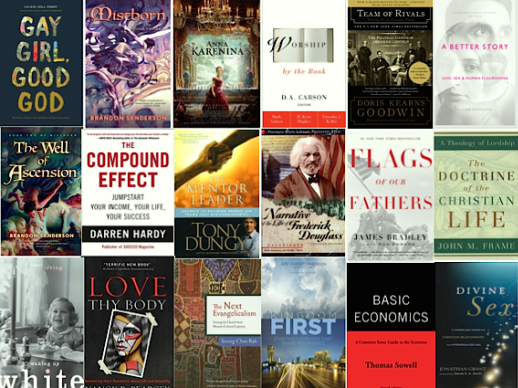
Here are my 18 favorite* books I read in 2018 (in no particular order**):
- Frederick Douglass, Narrative of the Life of Frederick Douglass
- John Frame, The Doctrine of the Christian Life
- Nancy Pearcey, Love Thy Body
- Zach Eswine, The Imperfect Pastor
- Darren Hardy, The Compound Effect
- Leo Tolstoy, Anna Karenina
- Tony Dungy, The Mentor Leader
- D.A. Carson, Worship by the Book
- Brandon Sanderson, The Final Empire
- Thomas Sowell, Basic Economics
- Jackie Hill Perry, Gay Girl, Good God
- James D. Bradley, Flags of our Fathers
- Doris Kearns Goodwin, Team of Rivals
- Brandon Sanderson, The Well of Ascension
- Jeff Christopherson, Kingdom First
- Debby Irving, Waking Up White
- Jonathan Grant, Divine Sex: A Compelling Vision for Christian Relationships in a Hypersexualized Age
- Soong-Chan Rah, The Next Evangelicalism
And here are a few runner-ups…
8 Reasons we need to learn from the Old Testament

If we have the New Testament why do we need the Old Testament?
- All Scripture is inspired by God and profitable (2 Tim. 3:16), not just the texts we like to read.
- All the promises of God find their answer in Jesus so it is important that we understand what the promises are (2 Cor. 1:20).
- When Paul preached to the Ephesian church he preached the whole counsel of God (Acts 20:27) and the whole counsel of God points us to Jesus (Lk. 24:27).
- When Stephen preached in Acts chapter seven he preached the Old Testament (see also the other sermons recorded in the New Testament) which demonstrates the vital importance of the Old Testament.
- The things in the Old Testament serve to instruct us and set an example for us (Rom. 15:4; 1 Cor. 10:11).
- When Paul ministered to churches one of his ministries was proving that Jesus was the Promised One, the Christ (Acts 9:22). Paul demonstrated the amazing truth that Jesus is the long-awaited Messiah by teaching the Old Testament. We see this all through Acts (Acts 9:22; 13:16ff; 16:13; 17:3, 17; 18:4-5, 19; 19:8ff; 24:25; 26:6, 22-26; 28:23, 31 cf. 18:28). We too must understand what it means that Jesus is the Messiah and that will require learning from the Old Testament.
- Much of the New Testament assumes knowledge of the Old Testament.
- Scripture is so good we need as much of it as we can get, Old Testament or New. Scripture is perfect (Ps. 19:7), true (Ps. 19:9), pure (Ps. 19:8), a light (Ps. 119:105,130), a sword (Eph. 6:17), a hammer (Jer. 23:29). It is better than gold (Ps. 19:10; 119:72) and we need it to live (Ps. 119:144). Scripture gives joy (Ps. 119:111; Jer. 15:16), makes wise (Ps. 19:7), guards (Ps. 119:9), guides (Ps. 73:24; 119:105), sanctifies (Ps. 119:9, 11).
Read and study the Old Testament along with the New. 🙂
How should Christian art be informed by the Christian worldview? (part 3)

In the last post, we considered that creation was once very good and we made some observations about how that impacts the way we look at certain forms of art. Now we are going to…
Consider that we are Creative Creatures
Humans are made in the image of God. We see this teaching–the doctrine of the image of God,[1] the imago Dei–in various places in Scripture (Gen. 1:26-27; 5:1-3; 9:6; 1 Cor. 11:7 Col. 3:10; James 3:9). The most prominent is Genesis 1:27: “God created man in His own image, in the image of God He created him; male and female He created them.”[2] “The ‘image (likeness) of God’ refers to a permanent aspect of our created nature, which was not affected by the fall. It is the special characteristic of the human race, which distinguishes us from other creatures.”[3]
So, “We are created in the likeness of the Creator… So we are, on a finite level, people who can create.”[4] We also see that humans–all humans–have great worth! We have worth beyond what we do, we have worth in who we are. But what we do is important.
18 books for ’18

Here are 18 of the books (plus 2 extras) I plan to read in 2018:
- Thomas R. Schreiner, The King in His Beauty
- Tony Reinke, Lit!
- Tish Harrison Warren, Liturgy of the Ordinary
- Tommy Keith, Finacial Security in Ten Easy Steps
- Levi Lusko, Swipe Right
- Alex Haley, Roots
- John Piper, Reading the Bible Supernatully
- The Quran
- Gregory Koukl, The Story of Reality
- Frederick Douglass, Narrative of the Life of Frederick Douglass
- Joseph Heller, Catch 22
- Albert Camus, The Stranger
- Francis S. Collins, The Language of God
- Elisabeth Elliot, Shadow of the Almighty
- Mark Forsyth, The Elements of Eloquence
- Steven Johnson, How We Got to Now
- Bruce Olson, Bruchko
- Andreas Kostenberger, God, Marriage, and Family
- Brandon Sanderson, The Final Empire (Mistborn, book 1)
- Dee Brown, Bury My Heart at Wounded Knee
I always aim to read at least one book each week. So this list gives me some flexibility but ensures a somewhat balanced diet.
What’s your eighteen? And what should I add to my list?
_ _ _
Here are a few books you should’ve read in 2017.
Why should I believe the Bible? (pt 6)

“Why should I believe the Bible?” This might sound crazy to a lot of people but you should believe the Bible because it is…
Scientific
The Bible is not a scientific textbook. Yet it is accurate scientifically. The Bible concurs with all sorts of scientific discoveries. The Bible also lays the groundwork for scientific research to be carried out.
“Belief in the rationality of God not only led to the inductive method but also led to the conclusion that the universe is governed rationally by discoverable laws. This assumption is vitally important to scientific research, because in a pagan or polytheistic world, which saw its gods often engaged in jealous, irrational behavior in a world that was nonrational, any systematic investigation of such a world would seem futile. ”[1]



 in X
in X 