The Betrayal and Rejection

Jesus came to His own people and they did not receive Him (Jn. 1:11). Jesus was hated, rejected, and persecuted (Is. 53:3; Jn. 15:18). His friends abandoned Him (Ps. 88:8, 18; Matt. 26:56), even after making a pledge of undying loyalty. Yet, even while He Himself was being betrayed He protected His friends (Jn. 18:7-8)
Jesus, as Hebrews says, can sympathize with us (Heb. 4:15). He knows what it is like to experience betrayal of the worst kind.
Jesus was troubled in His spirit because one of His dear friends would betray Him. And it’s no wonder that He was troubled. Have you ever been hurt by a close friend? It hurts.
Yet Jesus was betrayed, as the Scriptures said He would be (Jn. 13:18).
Judas, Jesus’ “familiar friend” (Ps. 55:13), betrayed Him with a kiss[1] (Matt. 26:48-49). Jesus used to walk with Judas in the very same garden in which He was betrayed (Jn.18:2-3). Jesus had also recently shared bread with Judas.[2]
Jesus felt the blow of a backstabber but His pain would be far worse than any knife could inflict.
The Cleansing of the Temple
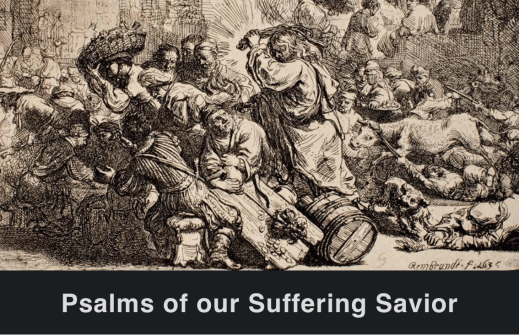
That’s exactly what happened to Jesus. He was consumed by zeal for the LORD’s house.
Can you imagine the scene? The whole city was frantic with excitement and expectation as Jesus came into Jerusalem.[1] Many expected that Jesus would soon bring freedom from Roman oppression and establish a reign of peace. People expected Jesus to ridicule Rome and inaugurate the Jewish state. Jesus, instead, condemns what’s going on in the Jewish temple.
If Jesus’ actions are unexpected it is because of misunderstanding or lack of zeal on our part. What Jesus did is in full agreement with Scripture (cf. Jer. 7:11; Zech. 14:21). The temple was to be a house of prayer, not a “den of robbers” (Is. 56:7). Specifically, the house of prayer is supposed to be “for all peoples” (v. 7). Because of all the selling, however, the court of the Gentiles would have been so filled with commotion that neither Jew nor Gentile would have been able to pray without distraction.
Jesus has concern for the poor, the sick, and the outsider. Jesus stands up for them even to the point of experiencing opposition. “Christ does more than denounce injustice—he takes action against it.”[2] That is good news!
The Hallel Psalms and the Supper

Psalm 115 is part of the Hallel Psalms. Hallel means, “praise.” Jesus would have sung the Hallel Psalms (Ps. 113-118) with His disciples on the eve of Passover.[1] Psalm 114 speaks directly of the exodus. From a New Testament perspective, we know that the salvation which began in Egypt would be finally filled in and through Jesus.
The Hallel Psalms were probably the last psalms Jesus sang before His suffering and death (Mk. 14:26). Jesus would have sung Psalm 115 knowing that He was Himself definitively showing God’s glory, love, and faithfulness. It is amazing also that Jewish people concluded the Hallel Psalms with the prayer:
“From everlasting to everlasting thou art God; beside thee we have no king, redeemer, or savior; no liberator, deliverer, provider; none who takes pity in every time of distress or trouble. We have no king but thee.”[2]
Truly! Apart from Messiah Jesus, there is no “no king, redeemer, or savior; no liberator, deliverer, provider.”
As we see in Psalm 115, idols are inept but God is a God of steadfast love and faithfulness. Whereas idols are inept God is involved. In fact, so involved that He came to this broken world in the form of Jesus Christ.
Idols are silver and gold but God came in flesh. Jesus has a mouth and with it, He spoke words of life. Jesus has eyes, and He saw this broken world and wept. Jesus has ears, and He heard the world’s bitter cries. Jesus has a nose, and He smelled the putrid smell of death. Jesus has human hands, and they were pierced. Jesus has feet, and they carried a cross, and were pinned to a cross. Jesus has a throat, and with it, He cried out: “my God, my God, why have Thou forsaken Me?!”
The Triumphant Entry

In Matthew’s passage about the Triumphant Entry, he quotes from and links to Psalm 118. It is likely that Jesus sang this Psalm, along with the other Hallel Psalms (Pss. 113-18), with the disciples after He instituted the Lord’s Supper (Mk. 14:26). That’s not surprising since Psalm 118 highlights God’s steadfast love and has many Christ connections.
Psalm 118 talks about the gate that the righteous enter through to go into the presence of God (v. 20). That is not a gate that we can open on our own because we cannot be righteous on our own (Rom. 3:10). Actually, the Bible says even the best we can do on our own is like filthy rags (Is. 64:6). We need the righteousness of Jesus Christ (Heb. 10:19-22). Jesus is the gate that gives us access to God the Father (Jn. 14:6), He is the one that makes us righteous.
Jesus was the rejected stone (Matt. 21:42) but He is the Messiah, the cornerstone (Ps. 118:22). All promises rest upon Him (2 Cor. 1:20). When Jesus made His way to Jerusalem, the people cried out: “Hosanna! Save us, we pray, O LORD!” (Matt. 21:9). The people spoke better than they knew. They cried out to Jesus who is God in flesh to save—and He soon would. He would fulfill their prayer to save by answering the next cry of the crowds, that He be crucified.
The Psalm says, “The LORD is God, and He has made His light to shine upon us” (Ps. 118:27). Truly. God in flesh dwelt among us. And yet He was the “festal sacrifice” (v. 27). Jesus is finally triumphant not by overthrowing the Roman government but by overthrowing Satan, sin, and death through His death and resurrection.
An Easter Devotional
I wrote the blog series, “Psalms of our Suffering Savior,” to help us “remember Jesus Christ, risen from the dead” (2 Tim. 2:8).
It is to be used devotionally leading up to Easter (Resurrection Sunday). It is a 12-day devotional that starts with the Triumphant Entry and goes through to the Ascension of Jesus Christ.[1]
In these devotions, we’ll be looking at Psalms that express Jesus’ experience. Jesus “saw in the experiences of David the pattern, writ small, of his own calling.”[2] And as Jesus said, in Luke 24:44 “the Psalms must be fulfilled.”[3]
These devotionals will help us see how it is that Jesus fulfilled the Psalms.[4] And it is quite amazing to see.
Remember “many prophets and righteous people longed to see what you see” (Matt. 13:17)! So, let’s intentionally celebrate and “remember Jesus Christ, risen from the dead”!
If you’re interested in this devotional series, like the Facebook page here or follow the blog via email (look to the right under the search bar) and receive the devotionals that way.
“Lower Still” by My Epic

Look, he’s covered in dirt
The blood of his mother has mixed with the Earth
and she’s just a child who’s throbbing in pain
from the terror of birth by the light of a cave
now they’ve laid that small baby
where creatures come eat
like a meal for the swine who have no clue that he
is still holding together the world that they see
they don’t know just how low he has to go
Lower still
Jesus, Rebel With A Cause

Jesus was a rebel. But not like James Dean; not a “Rebel Without a Cause.”
Jesus had a cause. Actually, we might say He had a lot of causes. Of course, if we left off thinking Jesus was merely a rebel with a cause we’d be gravely mistaken. He’s much more than that. It is, however, still important that we not forget that He was indeed a rebel.
How was Jesus a Rebel?
This is an important question to ask, in part, because “People didn’t get crucified for being gentile or spiritual or for saying their prayers. They got crucified for being understood to be rebels.”[1]
Jesus was a rebel because…
Set Us Free

Paradise,
polluted and poisoned.
Our resounding plea:
“Set us free.”
We are writhing and reeling from the Fall.
Our affections wander and wane,
our struggles remain.
O’ Lord set us free.
We fettered our shackles,
we tossed the key.
But O’ Messiah, set us free.
Heaven’s Hope

Bound by sins darkened glow
In this world of pain and woe
Helpless, hopeless to us He came
And in the midst was slain
Darkest night, the Light extinguished
Will we forever captives be?
Messiah’s mission ends in death?
Where’s the hope of life and peace?
But by power He awaketh
All of death He did breakth
By His death, deaths defeated
Sins depleted of its power
Thus the hour of unrest
Has become our hope, our joy, our rest
For in Christ’s death,
Deaths defeated!
Yes, He burst the bonds that bound Him
And leads many captives in His wake
Yes, from the cross He is victorious
And all of heaven hails He’s glorious!
What did Jesus accomplish on the Cross?

Jesus purchased His people (Jn. 6:36, 39; 1 Pet. 1:18-19). He showed God’s amazing love (Jn. 3:16; 15:13; 1 Jn. 3:16). He brought justification to all who would place their faith in Him (Rom. 5:18) by dying for their sins, in their place (1 Cor. 15:3; 1 Pet. 2:24; 3:18; Is. 53). He absorbed the wrath of God (1 Jn. 2:2). He became sin and made all who trust in Him the righteousness of God (2 Cor. 5:21). He canceled debt (Col. 2:14). He brought reconciliation (Rom. 5:10; Eph. 2:16; Col. 1:20-22). He defeated Satan, sin, and death and brought victory (Gen. 2:15; 1 Cor. 15; Col. 2:11-15; Heb. 2:14; Is. 53).
Jesus knew no sin, yet He became sin. We see the idea of someone bearing sin in the place of others attested to in both the Old Testament and New Testament (cf. Lev. 10:17; 16:21-22; Is. 53:6, 11-12; Jn. 1:29). Jesus is the Lamb without blemish that takes away our sin by dying in our place but He also rises; priest and lamb are not His only office. Jesus is also the coming King who reigns eternally. Consequently, the salvation that Christ brings through His work on the cross brings not only appeasement from wrath but also entrance back into the true Promised Land, the Garden of Eden. So, “the gospel is the good news of the Kingdom through the cross,” as Kevin DeYoung and Greg Gilbert say. The New City Catechism says, “Christ’s death is the beginning of the redemption and renewal of every part of fallen creation, as he powerfully directs all things for his own glory and creation’s good” (Q. 26).
Christ’s work and resurrection propels on this world new creation (cf. Rom. 8:29; 1 Cor. 15:20; Col. 1:18), it is the inevitable avalanche that will eventually encompass the whole earth (Ps. 72:19; Is. 11:9; Hab. 2:14) and those in Christ will be swallowed up in the effulgence of its glory, there to bask in eternal joy. Christ’s work on the cross and resurrection is the dawn, the first light, but soon the full splendor of the sun.



 in X
in X 