Why should I believe the Bible? (pt 9)
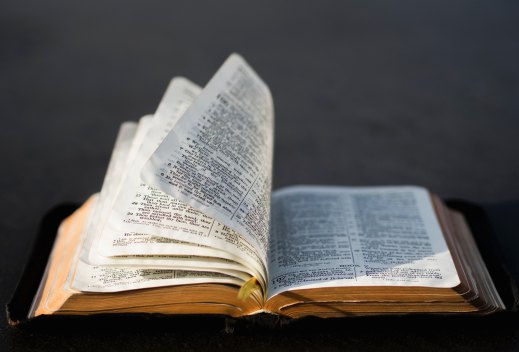
Some doubt the authority of the Bible but as we have already seen there are actually a lot of reasons to believe the Bible. The Bible itself also claims to be necessary and…
Authoritative
The Bible claims repeatedly to be more than mere human words. The Bible says it is inspired—breathed out—by God (2 Tim. 3:16-17). The Bible has the authority, not as words from men, but as words from God (1 Thess. 2:13). “When the Bible speaks, God speaks.”[1] Wayne Grudem says, “The authority of Scripture means that all the words of Scripture are God’s words in such a way that to disbelieve or disobey any word of Scripture is to disbelieve or disobey God.”
The Bible is not merely a record of what God has said in the past but a means of God speaking today. That is a good thing. We need to hear what God has to say. We need God’s guidance and we need an authority. God alone is equipped to be that authority.
Is Homosexuality Part of God’s Good Design?

“Why does a person’s sexual preference matter? If a guy loves another guy why can’t they hook up? Why would God have a problem with that? God created everything, right? So, did He create homosexuality?”
I appreciate those questions. They are important because sex and sexual identity are deeply personal as well as powerful.[1] So, the main question seems to be: Did God create homosexuality, is it part of God’s good design? In order to answer this question, I need to ask you a question. Do you consider yourself a tolerant person?[2] Will you hear me out and listen to my perspective?
If you answered that you are a tolerant person, that’s great. That will be helpful as we look at this controversial subject. So, I ask you to kindly consider my perspective on this question.
I want to be faithful to what I believe the Bible teaches because through it God shows His love and grace. So, as we consider this question, I deeply want the love and compassion of Christ to come through. He loves us all and wants us to have abundant life here and now and forever. Yet, life holds many struggles and temptations.[3]
As we consider this question, we are all caught up in God’s story, a story that can be summed up as creation, fall, redemption and new creation. What does the Bible have to say about this issue? The Bible provides directions to protect us and help us thrive. This is part of God’s good design. The directions include prohibitions against certain types of sexual activity. Those that violate the directions God has given often suffer for it. Individuals that struggle with homosexuality need to realize that natural disposition does not justify it any more than any other sin. And the fact that society elevates sexual fulfillment to the point of communicating that it is the purpose of life does not exempt it from God’s prohibition any more than any other sin. If you are struggling with this issue, then join the rest of us sinners and turn to Christ, who is good. God has given us the means to live within His good design.
Is abortion morally justifiable?
Here are a few things I left out of the video…
Thinking and talking about abortion is very difficult but also important. I, therefore, ask that you consider what I say before discounting it. I have strived to consider the subject with compassion and candor. So, out front, I want to say two things: First, I believe abortion is clearly wrong and cannot be morally justified in any circumstance. Second, and very important, there is grace, forgiveness, and hope for those who have had an abortion.
We all do wrong. The Bible says everyone is a sinner. But it also thankfully says that whosoever—liar, thief, cheat—goes to Jesus in faith and repentance can receive new life and be saved by the grace of God. All our sins can be washed away. First John 1:9 gives us all hope: “If we confess our sins, He is faithful and just to forgive our sins and to cleanse us from all unrighteousness.” It is vital that we all remember that there is grace, forgiveness, and hope for all!
And here are some statistics about abortion in America that I left out too…
- Since 1973, there have been 59,000,000 reported and legal abortions. That’s more than the total population of California and Virginia.
- There were 908,000 abortions in 2015.
- 1/4 of American women will have an abortion by the time they are forty-five.
- Reasons why women have an abortion:
- 1% listed rape or incest
- 6% listed potential health problems
- 93% listed social reasons:
- Abortion brings several health risks:
- Breast cancer
- Ectopic (tubal) pregnancy
- Bad effects on future pregnancies
- Becoming sterile
- Sexual dysfunction
- Mental health risks
Why should I believe the Bible? (pt 6)

“Why should I believe the Bible?” This might sound crazy to a lot of people but you should believe the Bible because it is…
Scientific
The Bible is not a scientific textbook. Yet it is accurate scientifically. The Bible concurs with all sorts of scientific discoveries. The Bible also lays the groundwork for scientific research to be carried out.
“Belief in the rationality of God not only led to the inductive method but also led to the conclusion that the universe is governed rationally by discoverable laws. This assumption is vitally important to scientific research, because in a pagan or polytheistic world, which saw its gods often engaged in jealous, irrational behavior in a world that was nonrational, any systematic investigation of such a world would seem futile. ”[1]
Why should I believe the Bible? (pt 5)

“Why should I believe the Bible?” Because the Bible is…
Historical
The Bible reports actual historical events and the manuscripts that we have for the Bible are very reliable. Nothing in ancient literature matches the historical documentation of the Bible. Nothing really comes close.
“Compared with other ancient writings, the Bible has more manuscript evidence to support it than any ten pieces of classical literature combined.”[1]
“The reliability of the New Testament history is overwhelming when compared to that of any other book from the ancient world.”[2]
“The New Testament is easily the best attested ancient writing in terms of the sheer number of documents, the time span between the events and the documents, and the variety of documents available to sustain or contradict it. There is nothing in ancient manuscript evidence to match such textual availability and integrity.”[3]
Darwin, Dawkins, and Moral Duty

Dawkins says “justice is a human construct of great importance in human affairs.”[1] And Dawkins believes that there is probably a Darwinian explanation that explains justice. So, our concept of justice is just a convenient Darwinian happenstance. I believe he says “blessed precious mistake” in his book The God Delusion. Of course, Nietzsche would disagree. Nietzsche in On the Genealogy of Morals doesn’t think it’s blessed or precious.
Also, if justice is merely a human construct then the cannibal clan in Cormac McCarthy’s book The Road are not wrong in keeping people locked up in the cellar in order to slaughter and eat.
7 Things for Universalists to Consider

Some have claimed that all people will be finally saved, even after torment in hell. However, there are all sorts of inherent problems with that view. Here’s a brief list of problems to consider.
Consider…
1. There Is No (Clear) Scripture That Teaches Universalism
The doctrine of universalism goes against the clear teaching of Scripture and finds no clear teaching supporting what it argues. Yes, I understand that there are a few passages that if you pull out of context and place into a certain system of thought, can seem to support the doctrine but it is not the texts natural meaning in context.
Jesus and Jihad (part two)

Jesus and Jihad
I talked to a Muslim friend recently that said Islam and Christianity are ninety-six percent the same. I strongly disagree with him and believe most informed Muslims would as well. There is an irrevocable difference between Christianity and Islam. Some Christian missionaries go and die if need be, whereas some Muslim “missionaries” go and kill if need be. This is because Jesus died and said take up your crosses whereas Muhammad killed and said take up your swords. Jesus promises salvation through justification; Muhammad claims it comes through jihad.
It is important to understand that Jesus (Isa in the Qur’an) is quite prominent in the Qur’an and is held to be a prophet. The Qur’an assumes that its readers will have a working knowledge of Jesus and His teaching (cf. Surah 2:136; 4:29; 5:46). Islam even teaches that Jesus will return and carry out justice and “break the cross.”[1] However, there is a very large contrast between what the Qur’an teaches about religious use of violence and what Jesus teaches on violence. So, let’s look at what Jesus has to say about violence.
Jesus and Jihad (part one)

Introduction
Islam has many expressions. It is not monolithic. We are wrong if we think we understand Muslims because we have met one or read the Qur’an. That is a simplistic and false understanding. “Islam is a dynamic and varied religious tradition.”[1] In the same way, if you have met a Christian and read the New Testament, for example, that does not mean that you understand Christianity. “The range of contemporary Muslim religiosity varies tremendously. One of the reasons for this is that people understand and ‘use’ religion in a variety of ways; that is true whether we are dealing with Islam or Christianity or any other religion.”[2]
As Christians have different beliefs regarding certain doctrines, Muslims have different beliefs as well. Christianity has many expressions, liberal and fundamental and various particular denominations. In this post (and in part two), we will explore the Islamic understanding of jihad and contrast it with Christianity. Our first observation is to realize the multifaceted nature of our exploration.
Many Expressions of Islam
As we have briefly seen, not all Muslims are the same and not all Muslims understand jihad in the same way. So, some Muslims emphasize the more peaceful passages (e.g. surah 5:32; 2:256; Allah is also repeatedly said to be “most gracious, most merciful”) and that the Qur’an seems to teach to not begin the fight (2:190; 22:39). However, others believe that those who have not confessed Allah and his prophet have already essentially made war with Muslims and should be subjugated.[3] Some Muslims are strict adherents to Islam and some are secular. Muslims are not homogeneous. (For example, we see two very different narrative accounts in Nabeel Qureshi’s, Seeking Allah, Finding Jesus and Mosab Hassan Yousef’s, Son of Hamas). In fact, “not all Muslims believe that the Qurʾān is the literal and inerrant word of God, nor do all of them believe that Islam requires strict conformity to all the religious and moral precepts in the Qurʾān.”[4] We could group Muslims into three broad groups: secular Muslims, traditional Muslims, and fundamentalist Muslims.
The Day of the LORD and the Decisiveness of the Present Life

What we do in this current life has an eternal impact. The New Testament insists on the decisiveness of this life.[1] In the early church, the “idea that the coming judgment will be based on deeds done in this life was widespread.”[2] For example, “Do not fear those who kill the body but cannot kill the soul. Rather fear him who can destroy both soul and body in hell” (Matt. 10:28).
All through Scripture it talks about the Day of the LORD (sg.).[3] The Bible does not talk about judgments starting at the Great White Throne Judgment (Rev. 20:11ff) and going from there on into eternity where people have multiple chances to repent. That’s why it says, “Behold [ἰδοὺ], now [νῦν] is the day of salvation” (2 Cor. 6:2; cf. Ps. 32:6; Is. 55:6). Acts 17:31 says, God “has fixed a day [sg.] on which He will judge the world in righteousness by a man whom He has appointed; and of this He has given assurance to all by raising Him [i.e. Jesus] from the dead.”
Hebrews says, “it is appointed for man to die once, and after that comes judgment [sg.]” (9:27). Thus, in Scripture, we do not see that people can repent after the Judgment. Actually, to get the idea of repentance after the Judgment you would have to add to Scripture. Yet, listen to Revelation: “I warn everyone who hears the words of the prophecy of this book: if anyone adds to them, God will add to him the plagues described in this book, and if anyone takes away from the words of the book of this prophecy, God will take away his share in the tree of life and in the holy city, which are described in this book” (22:18-19).



 in X
in X 