What is so good about Good Friday?

Jesus was crucified on Friday. Good Friday is the day we remember Jesus’ death.
So, what is so good about Good Friday? It almost seems sick to call Good Friday good. If you have a loved one that died you do not celebrate the anniversary of that persons death as good, it was tragic. Why then when referring to the anniversary of Jesus’ death do we call it good? That almost seems sacrilegious.
We call it Good Friday because it truly is good. No, we do not celebrate Jesus’ death per se. Rather we celebrate all that His death accomplished. We celebrate that though He died, and died a terrible death, He said “It is finished,” and it was. We celebrate because He rose victorious over sin and death.
Jesus laid down His life for us to be the wrath absorbing sacrifice. He did this and many more things and that is why the anniversary of Jesus’s death can be said to be good. Actually, in some sense, because Jesus died and conquered death and sin the anniversary of our loved ones death who are in Christ can now be thought of with joy. It too can become a good anniversary.
I want to encourage you to meditate on what Jesus did for you. Think about the cross where Jesus bore the wrath of God that we deserved. I encourage you to read the narrative accounts in the Gospels. When you read it remember who it is that is being mocked, flogged, and crucified. Remember why it is that He suffered in that way and felt the wrath of God; it was not anything that He had done.
Read Isaiah 52:13-53:12 and be amazed at how precisely it describes both the events of the crucifixion and the reason for the crucifixion and this around 700 years before Jesus was born. Jesus was crushed for our sins (Is. 53:5) and thus makes many to be accounted righteous (v. 11), for example. After reading this passage, I composed this attempt at poetry:
Bound by sins darkened glow
In this world of pain and woe
Helpless, hopeless to us He came
And in the midst was slain
Darkest night, the Light extinguished
Will we forever captives be?
Messiah’s mission ends in death?
Where’s the hope of life and peace?
But by power He awaketh
All of death He did breakth
By His death, deaths defeated
Sins depleted of its power
Thus the hour of unrest
Has become our hope, our joy, our rest
For in Christ’s death,
Deaths defeated!
Yes, He burst the bonds that bound Him
And leads many captives in His wake
Yes, from the cross He is victorious
And all of heaven hails He’s glorious!
“Monday Thursday?”
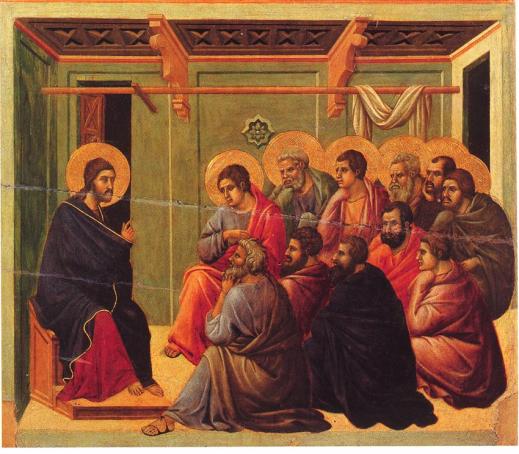
“’Monday’ Thursday? That doesn’t make any sense… Why do we celebrate ‘Monday’ Thursday and why would we celebrate it on Thursday?”
“Muandy Thursday,” not “Monday Thursday,” has to do with remembering what happened on the Thursday before Jesus was crucified. There were a lot of significant things that happened on this Thursday.
Maundy Thursday is known as commemorating variously the day of the Last Supper and the institution of the Lord’s Supper, the foot washing of the disciples, Jesus praying in the garden of Gethsemane, and the betrayal and arrest of Jesus by Judas Iscariot. So we commemorate Maundy Thursday for these reasons. However, why is it called “Maundy Thursday”? What does Maundy mean?
Maundy most likely comes to us from John 13:34 where Jesus says at the Last Supper (on Thursday): “A new commandment I give to you, love one another.” The word for “commandment” in Middle English is maunde, in Old French it’s mandé, and in it’s Latin mandatum. So, in other words, “Maundy Thursday” could be called Commandment Thursday or even, as it is sometimes called, “Covenant Thursday.”
So on Muandy Thursday we think of the command and the covenant. It is important to remember both. So, what was the command? Love one another. That is what we are told to do. And that doesn’t seem that hard, at first. Until we realize that we are given a comparison. The command is that we love one another love even as Jesus has loved us (Jn. 13:34). On Thursday, so many years ago, Jesus gave us a huge “maundy,” command. How can we live up to it? We must remember the amazing context in which it was given.
There were all sorts of events and themes that converged on this weekend in history. The Passover, a historical event in the life of the Jews where they celebrated their spectacular salvation, was celebrated. Yet, we also see that the LORD reaches down to save again, and this time no blood needed to be painted on the door frame. There was no need for a Passover lamb. He had come in the form of a Suffering Servant (cf. e.g. Is. 53).
Jesus brings a New Covenant (Matt. 26:26ff; Mk. 14:22ff; Lk. 22:14ff; 1 Cor. 11:17ff). One that had long since been promised. One that gives His people new hearts, hearts to follow after God (cf. Ezek. 11:19-20; 36:26-27). God takes His peoples sins literally upon Himself (cf. God taking the violations of the covenant upon Himself, Gen. 15; Is. 53; Jer. 34:18). He fulfills the Covenant that His people continually failed to fulfill. Jesus felt the weight of being forsaken. He cried out, “My God, My God, Why have You forsaken Me?!” Jesus was cut off like we deserve to be for breaking His Law.
Understanding the covenant, Jesus’ amazing work of salvation, and understanding what Jesus calls us to is very important and we see them intermingled on Maundy or Covenant Thursday. Jesus fulfills the covenant and His blood is spilled for us, and yet there is still a type of condition to the covenant: we must follow hard after Him.
So, first notice that on Maundy Thursday so many years ago, Peter tells Jesus that he does not want Him to wash his feet (Jn. 13:6). It is striking to me that Jesus says, “If I do not wash you, you have no share with me” (v. 8) and then He goes on to say, “If I then, your Lord and Teacher, have washed your feet, you also ought to wash one another’s feet” (v. 14). So Jesus is saying don’t try and work for your salvation (you can’t) but follow my example and serve others because I have served you.
Works do not save us. We are saved by accepting the work that Jesus did on our behalf, He washed us. And, in fact, if we try to work for our salvation we “have no share with [Jesus] (v. 8). However, that in no way negates the importance of works, to the contrary; it gives works deep significance. We are called to imitate Christ (v. 14-16). Jesus told Peter he could not work for salvation (v. 6-8) but works do have their place. Jesus served Peter (even enabling Peter to serve Him cf. John 1:13; 14:16; Gal. 5:16-24; 2 Peter 1:3; Ezek. 11:19-20; 36:25-27) through the cross and thus Peter served Jesus imitating Him, even to death (cf. John 13:14-16); tradition says, death by upside down crucifixion (cf. John 21:18-19). Peter was saved by trusting Jesus Christ’s all-sufficient service and yet Peter served and imitated Jesus out of a supreme joyous thankfulness (cf. 1 Peter 1:3-9; 2:21-25; 4:13-14).
May we serve in the same way and with the same motivation that Peter did. May we work and serve Christ not to earn right standing before God but, to demonstrate that through Christ’s atoning death we have right standing before God. If we have been declared righteous in Christ then let’s live righteously before Christ (cf. 1 Cor. 1:2). Let’s obey Jesus’ commands in light of His New Covenant.
How is our burden light?

“My yoke is easy, and my burden is light” (Matt. 11:30)
“I am the vine; you are the branches. Whoever abides in me and I in him, he it is that bears much fruit, for apart from me you can do nothing” (Jn. 15:5)
“His commandments are not burdensome” (1 Jn. 5:3)
I don’t want to, as the Pharisees, lay on burdens too hard to bear; especially since I can’t carry them myself. I want us to see that Christ carried our burdens! Christ says His burden is light. John said that Jesus’ “commandments are not burdensome.” Yet, how is this true in light of the all-encompassing call to which He calls us? Does He not tell us to take up our cross and follow Him? How is an instrument of torture light or easy?
Jesus is the image of the glory of God, the exact imprint of His nature; our call to imitate Him is no easy calling. We are to conform our life to His life, and death. So how then could Jesus say, “My yoke is easy, and my burden is light” (Matt. 11:30)? It is because it is in Him that we have fulfilled His commandments and it is through Him that we’re empowered to fulfill His commandments. Our burden is light because Christ took our burden. Our burden is light because through Christ we have the Spirit who helps us. In Jesus, we find “rest for our souls” (v. 29)!
We will with Christian of Pilgrim’s Progress, find our yoke easy and our burden light when at the sight of the cross our burden falls off. When we realize that our true burden, namely sin, has been carried for us by none other than Jesus, the Son of God, we will cry out “His commandments our not burdensome!” They are but an overflow of joy. The grace of the call of Christ bursts all bonds of the burden of the Christian life. We do have burdens, you could say, but we carry them now with joy.[1] We carry them knowing Christ carried our sin on the cross!
While we must be faithful to carry our cross, we do so in light of the fact that Jesus died on the cross for us and bore the wrath of God in our place. We carry our cross, yet not to death but to victory! The cross for the Christian is not a sign of death but of victory. We run the race set before us, yes with a limp at times, but the pain flees, as with any runner, as we gaze upon the prize. Life, and even death, has purpose in and for Christ. Yes, there are many commands in Scripture, but they are blessings. They encourage us on towards joyous Christ-like conformity. It is only when we are in Christ that these commands can begin to be truly obeyed.
Many in the Old Testament saw God’s Law as burdensome. How then did David love and delight in God’s Law? It was because God gave David that delight. In the same way when we are in Christ the Spirit comes to reside in us and changes us. We begin to love the things that God loves. His commands become not merely demands but delights to our soul.
We could talk long about the ills of contemporary Christianity, but what is the prescribed cure? Christ is! It is through Christ that we are once-and-for-all holy in our standing before God and it is through Christ that we become holy, i.e. live holy lives. Christ is the cure. Though, that does not mean that the remedy is simplistic. The prescription for the cure has been wrought in Christ, but ultimate healing won’t come this side of Eden.
We have right standing before God in Christ. No, this does not change the fact that we must still conform ourselves (that is, by God’s empowering) to match our position. But we are right before God!
No, you and I do not rightly evangelize but praise God Jesus did, and now, in Him, it is as if we do evangelize rightly. Are we willing to suffer? Christ did suffer for us! Do you spend your time wisely? Jesus always did what pleased the Father! No, brother and sister we don’t measure up. But Christ does! And in Christ we do! In our call to imitate Christ, we are just to imitate our actual standing before God; we are to, paradoxically, be where we already are.
David Platt has rightly said,
“You will never be radical enough. No matter what you do—even if you sell all your possessions and move to the most dangerous country in the world for the sake of ministry—you cannot do enough to be accepted before God. And the beauty of the gospel is that you don’t have to. God so loved you that, despite your hopeless state of sin, he sent his Son—God in the flesh—to live the life you could not live. Jesus alone has kept the commands of God. He alone has been faithful enough, generous enough, and compassionate enough. Indeed, he alone has been radical enough.”[2]
Interestingly, the way of Christ is at the same time impossible (more than just hard) and tremendously easy. We cannot carry the burden, we cannot bear the cross yet that is why the way of Christ is easy. Because we can do nothing. It is all done in Him. Jesus said, “apart from me you can do nothing.” Thus, the call of Christ is paradoxically impossible and easy.
Our burden is light because Christ carried our burden. He carried our cross. As we see from Isaiah 53, Christ has borne our griefs and carried our sorrows.
“He was wounded
for our transgression;
He was crushed
for our iniquities;
upon Him was the chastisement
that brought us peace,
and with His stripes
we are healed.”
Verse 11 of this chapter says that the Righteous One, Jesus Christ, will make many to be accounted righteous. We are not innately righteous. We have sinned, we do not rightly live for the Lord, yet we are accounted righteous in Christ. We have fulfilled all righteousness, but not in ourselves, but in Christ!
[1] Paul said he had many difficulties, many burdens, on top of all that he had anxiety for all the churches (2 Cor. 11:28 cf. vv.23-28) yet he also said, “We do not lose heart. Though our outer self is wasting away, our inner self is being renewed day by day” (4:16). “For as we share abundantly in Christ’s sufferings, so through Christ we share abundantly in comfort too” (2 Cor. 1:5). In fact, Paul was burdened to death. He said at one point, “We were so utterly burdened beyond our strength that we despaired of life itself.” (2 Cor. 1:8). We learn from 2 Corinthians 1:9-10 that at times we have burdens to teach us to rely on Christ, we learn to give Him our burden and find hope in Him. We carry burdens, but it is different now, we have Christ’s comfort abundantly now!
[2] David Platt, Radical Together, 27.
Biblical Mysticism?

A Mystic’s Meter
The rhythms of a mystic’s faith are not drudgery upon duty and duty upon drudgery. The mystic’s meter, rather, is delight. Delight in a God they know. Yet, as much freedom as rhythm and cadence have, there is still structure. So, I want to look at the structure of the meter. What cadence does knowing God take?
Is Mysticism Wrong?
Is mysticism wrong? I think a lot depends on how it is defined. If you define mysticism as subjective vain emotional longings, then yes it is wrong. If you define mysticism as unbiblical, then yes it is wrong. If mysticism is set on anything else then God in the face of Christ (2 Cor. 4:6), then yes, mysticism is wrong.
Mysticism, however, is not wrong in itself. It is the focus that can be wrong. It is the information, or perhaps more often, the lack of information, that can be wrong.
Don Whitney instructs us:
“Don’t be deceived by a complex spirituality that gives the appearance of wisdom but doesn’t start with ‘Christ, in whom are hidden all the treasures of wisdom and knowledge’ (Colossians 2:3). And don’t become entangled in any spiritual practices that sound good but incline your mind and heart away from the ‘things that are above’” (“Practice True Spirituality”).[1]
Not All Mysticism is Created Equal
Mysticism does not have “inalienable rights.” That is, not all mysticism is created equal.
Frist, some mysticism is based on illusionary dreams and speculation. However, there is a problem with this (1 Jn. 4:1). Satan parades himself around like an angel of light (2 Cor. 11:14) so that he may devoir like a lion (1 Pet. 5:8). Subjective experiences alone cannot be our guide.[2]
Second, some mysticism contradicts the Word of God. Any word that contradicts His Word should not be our word. God is our authority. And His Word is our authority. There are many other good and important texts but they are not ultimate. They are subordinate.
Third, any form of mysticism that does not prize and exalt Messiah and His work is defective (1 Jn. 4:2). Mysticism is about knowing God. Jesus the Messiah is God in the flesh (Jn. 1:14). It is through Him that we can know God (e.g. 2 Cor. 4:4); that we can go boldly before the throne of grace (Heb. 4:16). Jesus reveals God. If we conceal Him, belittle Him, or don’t rightfully honor Him, we are not practicing mysticism but anti-mysticism; we are concealing God.
Good Mysticism
Mysticism, I believe, at it’s heart, is about knowing God deeply and experientially.[3] So then, how do we know God? We know Him through His Spirit, amen![4] And the Spirit, most typically, uses the means of His own inspired Word, the Bible. We meditate on His Word, as well as other good texts, and God, by the Spirit, reveals Himself to us. Good Christian mysticism thus relies on: 1) The Spirit for illumination, not vain visions or the like (Rom. 8:26; 1 Cor. 2:12-16; Eph. 3:14-19; 1 Jn. 4:1); 2) The inspired Word of God, not primarily other sources (2 Tim. 3:16; 2 Pet. 1:3-4); 3) The Incarnate Son to show us God, and not visions (Jn. 1:1-14; 14:6; 2 Cor. 4:4; Heb. 1:3).
Good biblical mysticism (some may prefer “spirituality”) is about having a deeper sense of God’s truth. It’s seeking for God to open our eyes that we would be deeply impacted by His truth (Ps. 119:18). It is about knowing God’s love that surpasses knowledge that we may be filled with all the fullness of God (Eph. 3:19). It’s about being renewed by the transformation of our minds (Rom. 12:2; Eph. 4:23-24; Col. 3:10). It is about revival.
It short, mysticism does not seek mere knowledge. It seeks to also experience the truth of that knowledge. So, it seeks to taste the sweetness, and not just know hypothetically and intellectually that something is sweet.
Jonathan Edwards words are enlightening:
“There is such a thing as a spiritual and divine light immediately imparted to the soul by God, of a different nature from any that is obtained by natural means… This spiritual light that I am speaking of, is quite a different thing from inspiration: it reveals no new doctrine, it suggests no new proposition to the mind, it teaches no new thing of God, or Christ, or another world, not taught in the Bible, but only gives a due apprehension of those things that are taught in the word of God… There is a difference between having an opinion, that God is holy and gracious, and having a sense of the loveliness and beauty of that holiness and grace. There is a difference between having a rational judgment that honey is sweet, and having a sense of its sweetness.”[5]
Mystics, so to speak, not only want to know that something is sweet, they want to taste it’s sweetness.
A.W. Tozer: A Good Example of a Good Mystic
James L. Snyder points out that “the word ‘mystic’ did not scare Tozer. The term ‘mysticism’ simply means ‘the practice of the presence of God,’ the belief that the heart can commune with God directly, moment by moment, without the aid of outward ritual. He saw this belief at the very core of real Christianity, the sweetest and most soul-satisfying experience a child of God can know.”[6]
Tozer rightly reminds us—how sad that we need reminded!—that salvation is “not an end but an inception, for now begins the glorious pursuit, the heart’s happy exploration of the infinite riches of the Godhead.”[7] Conversion is meant to lead to communion. Orthodoxy must, if it is to be true orthodoxy, result in doxology. “’You can be straight as a gun barrel theologically,’ Tozer often remarked, ‘and as empty as one spiritually.’”[8]
The true Christian mystic should be heat and light. Heart, head, and hand. He should love the LORD with all that he is, his heart, soul, mind and strength; and his neighbor as himself.
Conclusion
So, you might say, a mystic’s meter, what gives him his aesthetic poetry and music, is knowing God by the Spirit, though the Word, and in Christ. This is where he can find true delight. He can know God and true joy in this rhythmic triad; instead of the clashing and subjective thrashings found elsewhere. A mystic’s meter in sum, should be rhythmic, not chaotic. It should have a distinguished element to it, not destructive and haphazard vague desires. God has, Paul reminds us, revealed Himself; we don’t worship Him as unknown, but as known (Acts 17:23). We can know God truly, if not fully.
Will you seek to know God? Will you dance to the melodious meter? Will you use the means He has given you? Will you be a Christian mystic?
_______________________________________
[1] Don Whitney, “Practice True Spirituality.”
[2] Let it be noted that exceptional things may likely still happen. See 2 Cor. 12:2-4, for example.
[3] Mysticism is “the belief and practice that seeks a personal, experiential… knowledge of God by means of a direct, nonabstract and loving encounter or union with God. Although a psychophysical dimension (including visions, dreams or special revelation) may be part of the mystical experience, this dimension is not necessary. Instead, Christian mystics generally teach that the true test of the experience is the resulting fruit of the Spirit in the mystic’s life” (Pocket Dictionary of Theological Terms, 81). “The mystic,” Tozer said, “differs from the ordinary orthodox Christian only because he experiences his faith down in the depths of his sentient being while the other does not. He is quietly, deeply and sometimes almost ecstatically aware of the presence of God in his own nature and in the world around him” (The Christian Book of Mystical Verse).
[4] Mysticism, at least, true accurate mysticism, can only take place after the regenerating work of the Holy Spirit (see Jn. 3:3).
[5] Jonathan Edwards, “A Divine and Supernatural Light”).
[6] The Life of A.W. Tozer: In Pursuit of God, 155.
[7] The Pursuit of God, 13 cf. Jn. 17:3. Brother Lawrence reminds us that “Many do not advance in the Christian progress because they stick in penances and particular exercises, while they neglect the love of God, which is the end” (Brother Lawrence, The Practice of the Presence of God, 24).
[8] The Life of A.W. Tozer: In Pursuit of God, 155.



 in X
in X 