Be Transformed by a New Consuming Passion


A Consuming Life Passion?
Instead of feigning for a substance or porn we need to have a new and better all consuming passion. We need to have a new purpose with a new goal as its end. We need a reason to get out of bed in the morning. We need a reason to be.
One of the fundamental questions that psychologists face is what is to be the motivational force in our lives? Is it to get rich? Propagate are genes? To enjoy as much pleasure as we can? What is to be the fuel for the engine of our lives? Do we have anything that can propel us through the sufferings and struggles of life?
This question cries out to be answered, and how it’s answered will have profound implications for the way that we live. Many, I’m sure, are unaware of their motivations and could care less about them. However, I’m sure that this is a great mistake.
The athlete, for instance, competes for a price and are very much aware of what that prize is. We, like the athlete, must not only be aware that there is a prize but what that prize is. We must seek to live with the intentionality of an athlete.
An athlete will discipline their body and bring it under subjection in pursuit of the prize. And when focused on the prize the athlete will gladly do away with hindrances. However, the athlete must have a goal, be competing for a prize, and have an idea of what that prize is if they are to have motivation to compete well.
Christians have Motivation to “Compete”
The language of running the race and competing for a prize were frequently used by the Apostle Paul. He was someone that clearly had a reason for getting out of bed in the morning. He had a consuming passion. He said, “I count everything as absolutely worthless compared to Christ.” Paul suffered the loss of all things in order that he could gain Christ. We also see that Jesus Himself raced the race and endured the cross for the joy that was set before Him.
We too need motivation. We need to be motivated like the Apostle Paul. We need the love of Christ to be the fuel that burns and propels us through the sufferings and struggles of life. Christ alone is sufficient motivation. Christ Jesus, as the Apostle Paul, Augustine, and Brian “Head” Welch, and many others make clear, alone satisfies and is it worth living for.
Here’s Brain “Head” Welch:
Take it from me, nothing you chase after on this earth will satisfy you like a real, everyday intimate relationship with Jesus Christ. Nothing. Trust me. While I was in Korn I had people waiting on me left and right. Anything I wanted, I got. Anywhere I wanted to go, I went. All I had to do was give the word, and it happened. I had the world in the palm of my hand, people; and I have to tell you one last time, there’s nothing there. I promise you. Jesus Christ is the only one that can make you complete. (Save Me from Myself)
The end of the last book of the Bible, the book of Revelation, tells us in chapter 21 what our ultimate goal is. To see God face to face, to be in the eternal temple where He will make all things new. Where He will wipe away every tear from our eye. Where there will be no more pain or crying anymore. Where we will have pleasure forevermore in His presence.
So we see that we have much that God has called us to do. We have much purpose. We have a reason to be. We would do well to set God’s truth before us so that we are motivated to live for the prize.
A verse that God has used to wake me up to the unseen realities and motivate me to purposeful living to His glory is 1 Corinthians 15:58. It says, “Therefore, my beloved brothers, be steadfast, immovable, always abounding in the work of the Lord, knowing that your labor in the Lord is not in vain.” This verse, when understood in the context of chapter 15, shows us that it makes sense for us to be motivated to labor for the Lord because of the reality of the resurrection of Jesus.
The Bible verse that says, “Whether you eat or drink, whatever you do, do you all to the glory of God” is not just a Bible verse. It is not just a good tagline under the name of some private Christian school. It is the way that it makes sense for us to live in light of the glorious gospel.
In a similar way, the oft-quoted phrase “our chief end [or main purpose in life] is to glorify God and enjoy him forever” is not a mere tagline but a phrase that gets at a biblical motivational reality.
Create Your Own Motivational Purpose Statement
We have laid a little bit of groundwork. Now it’s your turn. I want you to write out a biblically infirmed motivational purpose statement for your life.
Just write something down. It does not have to be able to stand the test of time like the Westminster Shorter Catechism on your first attempt. Your purpose statement can adapt and grow as you do.
My own purpose statement is not the best and I certainly could do better about purposely keeping it in my head so that it will be lived out through my hands. However, the purpose behind the statement is not to make it timeless or flawless. It is to be purposeful about our purpose. We have a purpose and it is great. We have a reason to wake up in the morning. A reason to be. I reason to say no to whatever sin it is that calls our name.
What Forms and (Re)forms You?

Introduction
First off, this in many ways is the prequel to “Are You Mindful of Your Mind?” It is also very related to “The Fight of Faith: How we are Transformed” but from a different vantage point. In the future I hope to put the three together in a more substantial article.
We’re shaped by a whole host of things—constitution, genetics, socioeconomic factors, health, education, culture, upbringing, etc.; and we are (re)shaped by a few, consciously and subconsciously. Therefore, we see the importance of understanding how it is that we are transformed. For when we know how transformation takes place we can make a better conscious effort at transformation.
We’re shaped by one of two Gods, one of two voices. The god of this world (Jn. 12:31; Eph. 2:2-3; 6:12), or the one true God. There are two masters with two different sets of commands, we will obey one of them (Matt. 6:24; Lk. 16:13). We will be slaves, that’s inevitable (Rom. 6). The question is to who? And with what result? Life or death (Rom. 6:23)? We’re shaped by one of two kingdoms. Our kingdom, informed by Satan; or, God’s Kingdom, informed by God.
This post is not concerned with which kingdom we should desire. It is assumed that we should desire the Kingdom of God. This post is concerned with helping us understand how we are (re)shaped or transformed to desire the right Kingdom. This is a more difficult task than it would first appear. However, if you know Scripture, and indeed your own heart, you know this is a difficult task. Yet, it is terribly grave and important (e.g. think of Judas desiring his own kingdom and thus betraying the Messiah and the true Kingdom).
We are being shaped. But how? And by what?
Definitions
Putting things in categories, like putting things in containers, is helpful. However, their strength lies where their fault lies: they keep things that naturally run together from running together. With food this is helpful for taste, with thoughts it is helpful for understanding, but, when it’s all said and done, we must realize that containers like categories do not finally keep the contents apart. They are helpful, and perhaps necessary, but in the end affect (and yet assist) precision. Our categories are: 1) knowledge, 2) worship, and 3) practice. Below is a figure that shows their interconnected relationship (Figure 1).

______________________________________________
Figure 1. The Interconnectedness of Knowledge, Worship, and Practice in Transformation.
Knowledge
By “knowledge” I mean worldview or view of our chief end or “the good.” Worldview deals with more then what we see as “the good.” However, it does, or should, also shape what we see as our ultimate goal as well. A worldview answers questions and tells the story of our existence, but it must also tell us where, if anywhere, that story is going or should go.
Notice also that it’s not just the intentional thinker or the Christian that is shaped by a worldview, by knowledge. We are all shaped and informed by what we know, or think we know. For instance, the sex addict and gangster are shaped by a worldview, even if it is a sub-conscious and unarticulated form of hedonism or nihilism. However, I do believe that one will be shaped more when one’s knowledge or worldview is more explicit. So, perhaps a sex addict who is also a convinced and proud naturalistic hedonist will have less restraint when it comes to illegal sexual practices (e.g. rape, prostitution, etc.); rather, for him it is more a practical matter of will he be caught, than a question of whether such and such practice is ethical or not.[1]
Worship
What then is “worship”? Worship here is the (often purposeful and artistic) ingesting of “the good.” This definition equally applies to the sex addict watching porn, the gangster listening to rap, and the Christian singing songs, meditating on Scripture, or celebrating the Lord’s Supper. Worship, as you can see, very clearly incorporates both the two other categories. Worship is, you could say, the conscious (and also subconscious) practice (our second category) of thinking about something (our first category).
Therefore we see that many things that we would not typically consider worship are in fact worship under this definition. Television, the mall, the radio, and innumerable other things shape and influence our view of the good life or our view of “the good” and thus are a form of worship. They move and inspire us. They shape us to a certain end. And this clearly happens subconsciously and consciously. Just as if we feed upon something or imbibe food through a different means it becomes part of us through the metabolic process. What we feed on, intentionally or unintentionally, shapes us into who we are and thus also greatly shapes what we do.
Practice
Practice is the conscious and subconscious practices that shape our life.[2] What some have explained as thick and thin habits or practices.[3] These habitual practices have greater or lesser affect upon us depending upon their significance.
What we do has an effect upon who we are and what we will be. So, for example, when three different types of men see an attractive lady jogging on the side of the road they will have three different responses because of their conscious and subconscious practices which are ingrained in them through their “knowledge” and “worship.” Yet, their practices, as we’ll see, serve to further their worship and knowledge.
So, for example, the sex addict will undress the attractive jogger. This will in part be because of his worship and knowledge and will yet undergird and inform his worship and knowledge. He will in a sense say to himself subconsciously that his knowledge of things is justified by the image of this woman and his worship is also justified. The gangster will have a similar response. But, perhaps to a different end; he may think of all the money he could make with her body. The Christian man also informed by his knowledge and worship will pray for the jogger; or, perhaps, not look at her so as not to be tempted.
Whatever the specific example, we see that our knowledge, worship, and practices have a very real impact on us and how we are shaped. Each aspect serves it’s purpose, yet it is closely tied to the other two. We cannot neglect any aspect or the fact that they are closely interconnected.[4] Now that we have defined each category, we will look at each aspect in more detail.
How are we Transformed?
In Aristotle’s terms our view of “the good” is reshaped by knowledge.[5] And, in catechismal terms, if our chief end is to glorify God and enjoy Him forever[6] it will necessarily have a specific impact on our lives. That is just the way we are as humans. We all, without exception, live towards our chief end, our view of the “good life.” However, this is messy, there are many things and ideas which vie for this place. Thus the importance of knowledge rightly directed (i.e. wisdom), worship, and habits; all of which inform, play off, and undergird the others (see figure 2 below). Notice also that it is not just the Christian that worships, all men do (e.g. the gangster has a certain type of rap music that glorifies his view of the good life).
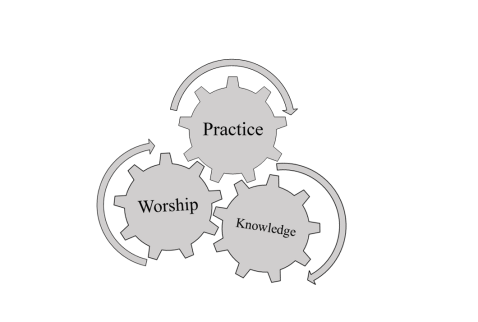 _______________________________________________
Figure 2. The Reciprocal Transforming Relationship of Knowledge, Worship, and Practice.
It is clear then that right and good worship is vital because it exalts and holds before us our chief end. If our worship has as its object the wrong thing we will thus go wrong in innumerable ways (cf. Rom. 1:18-32). Because of this, the reformation of our lives is a slow, and often painful, process. Witness the fall (the body of the book) and rise (the epilogue) of Raskolnikov from Dostoyevsky’s Crime and Punishment.[7] If we dig ourselves into a ditch we do not magically rise out of it (cf. Prov. 26:27). We have to dig ourselves out of it. Of course, as Christians we do believe that the Spirit assists us (e.g. Jn. 14:16). Yet, the fact remains, transformation is difficult and does not finally occur here.[8]
Scripture and reality are not at odds. We are shaped by what we know, worship, and do (and these are all interrelated). Scripture tells us to know the LORD, worship Him, and serve Him and thus be transformed. We see this same type of thing when we understand the relationship of faith and works, and the relationship of indicative and imperative. We know/believe God’s truth (faith) thus worship and have corresponding actions (works). Again, when we (rightly and supernaturally) understand God’s truth (indicative) we will worship, which in turn will change the way we live (imperative).
In Scripture we see huge importance placed on listening to He who speaks wisdom, the LORD, and not to the father of lies, Satan. We see this especially in the beginning. Eve listens to the serpent’s words and disregards the LORD’s, and chaos and curse ensue. However, notice that she did not just receive information/knowledge or believe the wrong source. Her desires were also wrongly informed. Because Eve listened to the serpent she saw the tree as delightful. She saw the tree as desirable (Gen. 3:6). Thus she fell.
As the Scripture says, “Each person is tempted when he is lured and enticed by his own desire. Then desire when it has conceived gives birth to sin, and sin when it is fully grown brings forth death” (James 1:14-15). We, thus, resist the devil by being firm in the faith. We, like Jesus, fight off wicked desires with God’s Word. Satan would have us be reconstituted by his words, wicked untruth, yet we combat his lies by teaching ourselves to desire good things by the implantation of God’s words, the truth (e.g. the place of Prov. 7:1-5 in the larger context of Prov. 7). When we feed on the Word of God the metabolic result is a healthy representation of God. God would have us (re)shaped into His image, the image of His Son. Conversely, Satan would have us formed into what C.S. Lewis called the “unman.”
Our thinking and our beliefs play a large part but we are tempted not by thinking and believing but by our desires (recall James 1:14-15 from above). I do think, however, that thinking and beliefs are the atmosphere in which desire lives. They are the soil and habitat; they’re the ocean in which desire can swim. Thinking and believing are not unimportant. Eve would have never sinned had she not heard Satan’s “knowledge” and believed him. Yet, we are understanding Eve, and ourselves, wrongly, if we don’t also realize that she desired (again, recall Gen. 3:6; also Eph. 2:3 says that we also once carried out the desires of the flesh).
I think it also must be noted here that our desires are shaped by our thinking and believing but they are also shaped by less conscious things. I am quite sure, for instance, that quite a few Nazi Youth did not read Hitler’s Mein Kampf but yet were shaped by the very same image. This was because they lived and breathed and ingested it’s teaching, though not mainly consciously, but because it was the cultural air they breathed.
We have a lot of things externally and internally that seek to shape us. As Calvin has famously said, we are idol factories.[8] That’s why we see much emphasis in Scripture placed on loving God with our whole heart (cf. e.g. 1 Chron. 12:38; 28:9; 29:9, 19; 2 Chron. 15:15; 16:9; 19:9; 25:2; Ps. 9:1; 16:9; 86:12), not just a portion of it.
We temper our hearts variously through understanding (cf. Deut. 6:4-9; Neh. 8), worship (e.g. Ps.; Eph. 5:18-20) and practice (e.g. Lev.). That’s how we’re shaped biblically and practically. The more we have our chief end in view and the better our chief end is the better we will live.
For instance, Jesus reasons with us in Matthew 6:19-24 about desire. He shows that what is in our best interest, i.e. what we should desire, is laying up treasure in heaven. He tells us specifically in verse 21 that what we desire, i.e. “treasure,” will bring the rest of us along (i.e. “heart”). So, again, Eve was led into sin because she desired (“treasured”) the fruit. Our battle is thus the battle of treasuring, desiring. That’s why sex education doesn’t work, for example. You can show a bunch of kids images of a bunch of nasty things and tell them a bunch of bad stories. But, in the end, if sex is what they treasure then that’s what they’ll do. After all, that is what is glorified on the screen and in our culture.
On the positive side, Paul lived the way he did, and died the way he did, not merely because of his cognitive understanding or because of his beliefs; but because of what he desired (though, as we have said, they are closely related). Paul, in his letter to the Philippians, tells us of the desire that fueled his powerful life. He drove on through thick and thin because he had counted everything as loss because of the surpassing worth of knowing Christ Jesus His Lord. For Christ’s sake Paul suffered the loss of all things and counted them as rubbish, in order that he may gain Christ (Phil. 3:8).
Truly, wherever our treasure (i.e. desire, view of “the good,” or our view of the good life) is, our heart (“heart” in Scripture has to do with our whole self; cognition, volition, emotions) will be also (Matt. 6:21; Lk. 12:34).
If we are transformed by knowledge, worship, and practices, how do you think they can transform us? How should our everyday life be different?
___________________________________________________________
[1] There is a transcript from Reasonable Faith’s podcast that shows the truth of my statement. Our worldviews have consequences, good or bad. R.C. Sproul shows this in his book The Consequences of Ideas. Friedrich Nietzsche even says in Beyond Good and Evil that philosophy always creates a world in it’s own image, it cannot do anything different.
[2]“Certain habits stir up corresponding affections and appetites; certain core affections and desires are expressed in corresponding habits. You can’t separate desire from practice” (Michael R. Emlet, “Practice Makes Perfect?” 42).
[3] See James K. A. Smith’s insightful book Desiring the Kingdom: Worship, Worldview, and Cultural Formation, esp. 80-85.
[4] Michael Emlet understands the complex nature of change. He says, “What we do flows out of who we are, but who we are is indeed shaped by what we do… We are changed by doing and we are changed by a self-conscious and iterative process that scrutinizes thoughts, affections, and actions of their faithfulness to a kingdom ethic, and then chooses certain actions and practices in response” (Michael R. Emlet, “Practice Makes Perfect?” 44).
[5] E.g. Aristotle says, “All knowledge and every choice have some good as the object of their longing” (1095a14 Page 4 for in Aristotle’s Nicomachean Ethics Trans. Robert C. Bartlett and Susan D. Collins [The University of Chicago Press: Chicago, 2011]). The glossary says that “Aristotle famously argues that all human beings do everything for the sake of what seems or is held to be good” (Ibid., 309).
[6] From the first question of the Westminster Shorter Catechism.
[7] “While God is always free to work miraculously and instantaneously, soul-change is typically a slow process that involves the replacement of old beliefs, affective responses, attitudes, and motives and patterns of relating to others with new ones, one at a time. Given what we know now of the neurological conditions of such change, it is not surprising why this process is gradual. Old neural networks must be shut down, and new ones must be constructed. None of this happens in genuine sanctification apart from the work of the Holy Spirt, but in this age most of the time God tends to work through the created order, and not take shortcuts. Though an incremental approach is sometimes hard for counselees to accept, such a stance, when grounded in justification, helps them to accept their present limitations and to be more realistic about the speed of their recovery, without undermining the ongoing call to grow in conformity to the image of Christ” (Eric L. Johnson, “Reformation Counseling: A Middle Way,” 26-27).
[8] Though I do not agree with everything, I believe “The Spiritual Experience of the Divine Truth of Transformation” is helpful.
[9] “The human mind is, so to speak, a perpetual forge of idols” (Calvin, Institutes, 97).
Are You Mindful of Your Mind?

What is the place of the mind in Christianity? Is thinking relevant to the faith? What, if any, emphasis should we place on the importance of knowledge? Does hard thinking bring any beneficial fruit to the Christian life or is the tree bare, shorn of any value?
If we boil down and distil Christianity the remaining content is not logical argument. Christianity is more than a philosophy, more than a religion. It is more than cognitive assent. It is more than a social club. Christianity is not simply about ritual. It is not just about emotions. It is not just about the mind.
Christianity is a relationship with a God who has made Himself known. It is more than formulas and repetition of rote words; though there are meaningful words and ceremonies. Christianity is something that must be believed, but belief is merely the beginning (though it must continue). Christianity gives true—chiasm bridging—fellowship, but is not merely a fellowship. Christianity is a philosophy, indeed, the philosophy. We, in a sense, worship wisdom incarnate.[1] But still, Christianity is not just a philosophy.
Christianity is not just about thinking and knowing. Yet, thinking and knowing are vital.
The Christian mind is vital because it is emphatic in Scripture.[2] It is vital because Christian living is. It is vital because we are commanded to worship the LORD with all we are, are mind included (Matt. 22:37; Mk. 12:30; Lk. 10:27).[3]
The Christian mind is very important. Yet, where do we see this in Scripture? Why is this the case? And what affect does it have?
The Christian Mind and the Bible
The Bible shows us that the Christian mind is very important.[4] Thinking for Christians is not just theoretical, it is practical. We trust God because we know Him (Ps. 9:10).[5]
God tells us to think. He tells us He will teach us, yet we must learn and not be like animals without understanding (Ps. 32:8-9 cf. 73:22). In fact, we must learn so that we can obey (Josh. 1:8-9; Ps. 37:31; 86:11; 95:10; 119:11, 34).
A Brief Christian Perspective on Psychoactive Medication

Depression, OCD, ADHD, bipolar disorder, are just a few of the things we are taking psychoactive medication for.[1] However, have we given the use of these drugs any thought? That is, if we use them, do we use them with a well-informed understanding? If we do not use them, or believe we should not, do we make the decision on the basis of hard thinking?[2]
I want to look briefly at the question and give you my conclusion. I would also like to know your thoughts. I would also encourage you to do more research on the subject.[3] Of course, as you read my opinion, know that I am not an M.D., PSY.D., Dr., or D.Min.; I’m a blogger that was employed as a heavy equipment operator when I wrote this.[4]
What must we consider as we consider the question of psychoactive medication?
We Must Consider Common Grace
There are many things we can look at regarding common grace. God pours out grace on all men (Ps. 145:9; Matt. 5:45). God has given us many good things to eat (Gen. 1:29). God has given us medicine, coffee, and doctors.[5] He keeps the universe from imploding; which He did not have to do (Heb. 1:2-3; Jn. 1:1-4). God gives some form of conscience to humans (Rom. 2:14-15) which in turn means that generally speaking parents love and provide for their children (Matt. 7:9-10; Acts 14:16-17). God, through various means, has restrained much evil (Gen. 20:6, 1 Sam. 25:26; Rom. 13:1, 6). The world is not as bad as it could be. God has also graciously preserved a semblance of His image in humans (Gen. 9:6: 1 Cor. 11:7). Humanity is not as evil as they could be. In fact, because of common grace, humans can give true, accurate, and even helpful descriptions of reality (think of Edison and Einstein).
As Eric Johnson says, because of common grace “unredeemed humans are capable of accurately understanding aspects of God’s creation (including human nature, psychopathology, and facets of its remediation)—except insofar as it requires spiritual illumination—and this understanding is the gift of God.”[6] John Calvin, also agreed that there is a lot we can gain from unregenerate humanity.[7]
Most evangelicals gratefully, or forgetfully, accept modern medicine (a form of common grace).
Yet, realizing there are extremes and overprescribing of psychoactive medication (laid out well in Carlat’s book Unhinged),[8] why do evangelicals so often, and so easily, disregard psychoactive medication? Is it because they are well-informed? Because if that is the case then fine, let it be disregarded. So long as the decision is justified on the basis of thought; and not vain hearsay.
However, I am led to believe that many are not well-informed on this subject so I will continue. We live in a fallen world and by God’s grace we have been granted medicine to reverse or alleviate some of the impacts of the curse. If there are in fact biological factors involved in someone’s depression, for example, then why not help them with medication (again, a form of common grace)?[9]
Eric Johnson, gives a helpful point. God created marriage and food “to be received with thanksgiving by those who believe and know the truth. For everything created by God is good, and nothing is to be rejected if it is received with thanksgiving, for it is made holy by the word of God and prayer” (1 Tim. 4:3-5). Johnson says, “Paul was admittedly addressing a very different subject than we are, but a legitimate analogy can be drawn. Like food and marriage, medication for a biological problem (such as the improper production of a neurotransmitter)… is not intrinsically evil… On the contrary, when used consciously and explicitly in dependence on God, biological and psychosocial soul-care assistance is ultimately a gift of God.”[10]
God has given us—all of us—minds. And the means by which to explore our minds. Given there is much that is shrouded in mystery. There’s probably less explored between our two ears than in the depth of the ocean and the limitless expanse in space. [11] Yet, we can speculate and know some things. And for that, we must be grateful to God.
Thus, because of common grace, I believe psychoactive medication can be beneficial in certain cases. See below.
We Must Consider that we are Psychosomatic Unities
Many today believe that we consist of mere biology. We, and everything about us, emotions, actions, thoughts, etc., are determined by the determinism of biological and neurological activity. This, as you can imagine, has all kinds of negative implications (e.g. think of the penal system).
Christians, however, believe in the material and also in the nonmaterial. We believe that we have a body and a soul.[12] We are what is known as psychosomatic unities.[13] The body is the vehicle of our soul. It provides the soul a means of expression. The body and soul are so closely tied, perhaps you could say interwoven even, that when the soul is absent from the body the result is death (esp. James 2:26; cf. Gen. 35:18; Ps. 31:5; Lk. 12:20; 23:43, 46; Acts 7:59; Phil. 1:23-24; 2 Cor. 5:8; Heb. 12:23; Rev. 6:9; 20:4). This understanding has historically had implications for various counseling issues and still has implications for us today.[14]
We see in Genesis 2:7 that when God made man He made him out of dust (i.e. material, the body) and He “breathed into his nostrils the breath of life” (i.e. the immaterial, the soul). We are spiritual beings but God has provided us with bodies as our earthly habitation (2 Cor. 5:1ff).[15] We are to be holy in body and soul, Paul tells us (1 Cor. 7:34; 2 Cor. 7:1). This implies that we are body and soul.
There should be certain implications if we believe we are body and soul. For one, we should realize that the body and soul are not unrelated. They have affects upon each other. So, for example, if you go without food or sleep (physical, bodily) you will be more irritable and prone to sin (spiritual, related to the soul). Thus as we minister to people (and think of sanctification for our self) the fact that we are psychosomatic unities should not go forgotten.
“Ministry must address the whole range of human needs if it is to minister to the whole person. God has constituted us as beings who exist as a unity but a complex unity that includes physical, psychological, spiritual, mental, and emotional faculties.”[16]
So, we believe we are soul and body. But, is this what we really believe? If this is what we believe does it show in the way that we minister to people? If we are body and soul (i.e. psychosomatic unities), which Scripture makes clear we are, then why is it wrong to take medication? We take medication if our knees ache, we take medication if we have a headache. So, if we can be fairly sure that medication will help for psychological problems, then why should we not take it?
Thus, because we are body and soul, I believe psychoactive medication can be beneficial in certain cases. See below.
We Must Consider that We are to Have Dominion
Many today believe that man is no different than animals (1 Cor. 15:39). However, it is clear both biblically and logically that we are more. We are sentient and rational beings. We are created in the image of God. We are more than animals, we are to have dominion over the animals.
Our dominion over the earth is derived from the fact that we are created in the image of God (Gen. 1:26-28). That’s why we’re vice-regents. God is Lord over all the earth (cf. Lev. 25:23; Ps. 24:1; 50:10-11; Matt. 5:45; 6:26, 28, 30) yet He has put us over the work of His hands (Ps. 8:6). So man is supposed to work. We see this teaching in Scripture and it is often referred to as the Protestant work ethic (cf. Gen. 1:28; 2:8, 15; 4:17-20; Ps. 128:2; Prov. 12:11; 13:4; 14:23; 16:3; 20:4; 22:29; Eccl. 2:20, 24; 3:22; 9:10; Acts 20:35; 1 Cor. 10:31; 15:58; Eph. 4:28; Col. 3:17, 23; 2 Thess. 3:10; 1 Pet. 4:10-11). We are to subdue the land with our hands and our heads.
We are to bring good out of what was cursed (cf. Gen. 1:26, 28-29; 2:15; esp. 3:23).[17] Of course, we can’t take away all the groaning, only the Lord can ultimately do that (Rom. 8:19ff). However, an implication of our dominion function and work ethic is that if we can relieve some of the strain caused by mental illness we should.
God has said, subdue the earth. Work the earth. Bring good out of what was cursed . God has also said work hard. Do a good job, and do it for my glory. I believe scientists, neurologists, and psychiatrists can do all of these things.[18] I believe God has commanded them to.
Thus, because we called to have dominion and bring good out of what was cursed and because we are to work hard to God’s glory in whatever we do, I believe psychoactive medication can be beneficial in certain cases. See below.
Principals for taking Psychoactive Medication
- We should be fairly sure that the medication will help us before we take it.
- We should understand that psychoactive medications are not the elixir of life. They cannot, nor should we seek for them to, fix all our problems.[19]
- We should understand that they often have negative side effects. We should understand what the possible side effects are and inform those closest to us.
- We should seek the advice of a competent doctor or psychiatrist; preferably with Christian convictions or sympathies.
- We should know the limitations of psychoactive medication. The medication cannot save or sanctify. However, that is not to say that God cannot use the medication to more easily facilitate the process.
- We should receive psychoactive medication, like all medication, with thankfulness. We must consciously thank God for His common grace in the provision of modern science and medicine.[20]
- We should take psychoactive medication, like all medication, in reliance on God asking Him to bless its use.
- We should realize that people, you and me, and even psychiatrists and neurologists, come to the data with a certain worldview bias that shapes the interpretation of things.[21]
- We should realize that the use of psychoactive medication does not do away with the need for reformational counseling (when counseling is needed) and vice versa, the presence of counseling does not mean that medication may not be needed.[22]
- We should understand that sometimes, as Hezekiah says, it is to our benefit that we have great bitterness (Is. 38:17). It just may be the fire alarm of our soul. It may be sounding to warn of imminent danger. Thus, to “smash” the “fire alarm” in this case would likely not be helpful.[23] Instead, we should seek counsel to root out the real underlying heart issue.
- We should understand that there is quite a bit of speculation involved in our understanding of how exactly psychoactive medications work. We cannot, for example, cut a patient’s head wide-open and see what’s going on.[24]
- We should understand that some physical ailments are the result of direct sin in our lives (Ps. 31:10; Prov. 14:30), others are not (e.g. Jn. 9:3), and still other ailments are a complex and interwoven mix of the two. It can be very difficult to know the difference between a spiritual and physical issue.[25]
- We should understand that the issue is complex. We must ask God to guide us with His wisdom. We must also remember His grace and love in the midst of uncertainty.
- We should hope in Jesus in the midst of suffering. It is through Jesus’ death and resurrection that all those who trust in Him have hope of glorified bodies where suffering and sin will be done away with (cf. Rom. 8:29; 1 Cor. 15:35-49; 2 Cor. 3:18; Phil. 3:21; 2 Pet. 1:4; 1 Jn. 3:2). We also have the hope of Jesus wiping every tear from our eyes and making all things new (Rev. 21:1-8).
Conclusion
Mike Emlet agrees that there are times to use medication. He says, “Medications are a gift of God’s grace and they can be used idolatrously. Any good gift can be used in a way that displaces God, his glory and his good purposes and makes something else (comfort, escape, even ‘normality’) more ultimate. We have freedom to use—but not abuse.”[26]
So, my perspective is one of caution and thankfulness. I praise God that He has allowed medication that can relieve great suffering. And I am cautious because we must realize that psychoactive medication is not anyone’s savior and it can be overprescribed. I conclude by echoing Jeremy Pierre’s words:
“Applying this teaching practically is no simple matter. The psychiatric medication industry is largely driven by naturalistic assumptions and compelled by profit margins, and mental illness has been stigmatized in many of our churches. Thinking about how to navigate the process practically would require a discussion beyond the present one.”[27]
Notes
[1] Psychoactive or psychotropic substances can cross the blood-brain barrier and affect brain function. They impact alertness, perception, consciousness, cognition, mood, and behavior. They alter brain function and subsequently behavior (E. John Kuhnley, “Psychopharmacology,” 58 and Frank Minirth “Psychoactive Drugs,” 66 in The Popular Encyclopedia of Christian Counseling).
[2] LifeWay Research has come out with a “Study of Acute Mental Illness and Christian Faith” that helps us to see where American evangelicalism is in regards to this question.
[3] I encourage you to read at least three things; (1) “Listening to Prozac… and to the Scriptures: A Primer on Psychoactive Medications,” by Michael R. Emlet, (2) “Psychiatric Medication and the Image of God,” by Jeremy Pierre, and (3) Blame it on the Brain? Distinguishing Chemical Imbalances, Brain Disorders, and Disobedience, by Edward T. Welch.
[4] I am happy to see that the Association of Certified Biblical Counselors came out with a “Statement Regarding Mental Disorders, Medicine, and Counseling.” I believe that their statement is helpful, biblical, and balanced.
[v] It may be helpful to realize that along with alcohol and nicotine, caffeine is also a type of psychoactive drug. And notice that Paul thus, in a sense, told Timothy something like, take some psychoactive medication (see 1 Tim. 5:23). Some have construed Paul’s words in in 1 Thessalonians 5:23 as showing the importance of whole person care. Paul says, may your whole spirit (the theological), soul (the psychological), and body (the physiological) be blameless (v. 24 may lend to this view because we will in fact be made finally “blameless” in all of these spheres). Also, notice that the Bible does not speak negatively about doctors or medication; Luke himself was a doctor (Matt. 9:12; Col. 4:14; 1 Tim. 5:23).
[6] Johnson, Foundations of Soul Care, 113.
[7] See The Institutes of the Christian Religion 2.1.8; 2.2.18-25. “In reference to the science and philosophy of which he was aware, Calvin argued strongly that Christians are to make constructive use of it. ‘If we regard the Spirit of God as the sole fountain of truth, we shall neither reject the truth itself, nor despise it wherever it shall appear, unless we wish to dishonor the Spirit of God'” (Johnson, “Reformational Counseling: A Middle Way,” 20).
[8] Daniel Carlat, a secular psychiatrist who trained at Harvard Medical School, wrote Unhinged: The Trouble with Psychiatry–A Doctor’s Revelations about a Profession in Crisis (New York: Free Press, 2010). In it he says, “The term ‘chemical imbalance’ is commonly used by laypeople as a shorthand explanation for mental illness. It is a convenient myth because it destigmatizes their condition—if the problem is a chemical imbalance, it is not their fault” (Ibid., 13). Later he says, “When psychiatrists start using what I call neurobabble, beware, because we rarely know what we are talking about” (Ibid., 74-75). Thus Edward T. Welch has said, “As Christians, we can’t just ‘listen to Prozac’; we need a biblically-based philosophy to guide the use or non-use of medications. We need to know not only the ‘what’ and ‘how’ of psychoactive medication use, but also the ‘why’ or ‘why not’ (“Listening to Prozac… and to the Scriptures: A Primer on Psychoactive Medications” in the The Journal of Biblical Counseling, 12). He goes on to say that the medications are “less like ‘smart bombs’ that work with laser precision, and more like conventional bombs with widespread effect on systems of neurotransmitters in the brain” (Ibid.). In fact, “in the majority of trials conducted by drug companies in recent decades, sugar pills have done as well as—or better than—antidepressants” (Shankar Vedantam, “Against Depression, a Sugar Pill Is Hard to Beat,” in Washington Post (May 7, 2002): A01. See also David Powlison, “Biological Psychiatry,” in Journal of Biblical Counseling 17 (Spring 1999). Richard Baxter, writing in the 1600s said, “If other means will not do, neglect not medicine” (“The Cure of Melancholy and Overmuch Sorrow, by Faith”).
[9] It is important to note here what Welch has said. Antidepressants “do seem to work—that is, improve mood and other symptoms of depression—in some people, some of the time, but they certainly are not the ‘silver bullet’ that some make them out to be. Even if we conclude that medications are or might be effective for a particular person, they comprise only a part of the total approach to the person” (“Listening to Prozac… and to the Scriptures,” 16).
[10] Johnson, Foundations, 375-76.
[11] There is still an awful lot that is still a secret. So, for example, in response to a study on a piece of a mouse’s brain the size of a piece of salt, Jeff Lightman, a neuroscientist and Professor at Harvard said, “It’s a wake-up call to how much more complicated brains are than the way we think of them” (“Secrets of the Brain“).
[12] The three contrasting anthropologies are: (1) tracheotomy; humans are made up of three parts, spirit, soul, and body, (2) dichotomy; humans are made up of two parts, soul and body, and (3) monism; humans are simply made up of physical organisms; what is commonly considered soul or mind is rather chemical and neurological processes.
[13] “Scripture does presuppose and explicitly teaches a distinction between the body and the soul—the view known as dichotomy—especially in its affirmation of the soul’s living presence before God at bodily death. However,… this view in no way entails, much less requires, a radical anthropological dualism. In that light, I would prefer a term such as psychosomatic holism, since dichotomy implies that the distinction between soul and body is more basic than its unity. The important point is that human nature is not to be identified exclusively or even primarily with the soul; the ‘real self’ is the whole self—body and soul” (Michael Hortan, The Christian Faith, 377).
[14] Early on various puritan writers knew the significance of the fact that we are psychosomatic unities. Here’s a clip from Jonathan Edwards: “This seems to be the reason why persons that are under the disease of melancholy, are commonly so visibly and remarkably subject to the suggestions and temptations of Satan: that being a disease which peculiarly affects the animal spirits, and is attended with weakness of that part of the body which is the fountain of the animal spirits, even the brain, which is, as it were, the seat of the phantasy. ‘Tis by impressions made on the brain, that any ideas are excited in the mind, by the motion of the animal spirits, or any changes made in the body. The brain being thus weakened and diseased, ’tis less under the command of the higher faculties of the soul, and yields the more easily to extrinsic impressions, and is overpowered by the disordered motions of the animal spirits; and so the devil has greater advantage to affect the mind, by working on the imagination” (The Religious Affections, 289-90). Also, earlier in the same work, he said, “Also, early on Jonathan Edwards realized this. He said, “Such seems to be our nature, and such the laws of soul and body, that there never is any case whatsoever, any lively and vigorous exercise of the inclination, without some effect upon the body.” Thus, he shows the interrelatedness of our body and soul. Richard Baxter, writing in the 1600s said, “If other means will not do, neglect not medicine” (“The Cure of Melancholy and Overmuch Sorrow, by Faith”). Martyn Lloyd-Jones, also considered a puritan in a sense, talked about the physical and the spiritual. And he was a medical doctor and in a sense doctor of theology. Lloyd-Jones said, “You cannot isolate the spiritual from the physical” (Spiritual Depression, 9).
[15] “The body is the material component of human nature distinct from–but intimately linked with–the immaterial component, commonly called the soul (or spirit)” (Gregg R. Allison, “Toward a Theology of Human Embodiment,” 5). It should also be noted that our human bodies are not in themselves bad. The Bible teaches that we will receive resurrection bodies (cf. 1 Thess. 4:13-18; Rev. 21:1-22:5). So the physical is not bad. It is good. But it needs resurrected.
[16] “The Doctrine of Humanity” in A Theology of the Church, 350.
[17] “More than 6,000 years from Eden, God’s creation is marred with many biological defects, including defects of brain structure and function. Sometimes these defects result in alterations in our abilities to reason, think clearly, and accurately perceive reality. In such a state, it is more difficult to discern truth and come to the knowledge of God. To the degree we can intervene with medication and restore the ability to reason clearly and perceive reality accurately, we increase the ability to know God and work with the Holy Spirit to restore the image of God in man. Antipsychotic medications are tools we can utilize to help those suffering with physical brain illness to think and function more clearly” (Timothy R. Jennings, “Antipsychotic Drugs,” in The Popular Encyclopedia of Christian Counseling, 66).
[18] I think Sarah Rainer is a good example of this. See “The Integration of Christianity and Psychology: A guest post by Sarah Rainer“ Jeff Forrey also offers some helpful thoughts on her comments in “A Response to ‘The Integration of Christianity and Psychology: A Guest Post by Sarah Rainer.’”
[19] John Piper has said, “I do not want to give the impression that medication should be the first or main solution to spiritual darkness. Of course, by itself medicine is never a solution to spiritual darkness. All the fundamental issues of life remain to be brought into proper relation to Christ when the medicine has done its work. Antidepressants are not decisive savior. Christ is. In fact, the almost automatic use of pills for child misbehavior and adult sorrows is probably going to hurt us as a society (When the Darkness Will Not Lift: Doing What We Can While We Wait for God, 27).
[20] “Taking depression medication that improves brain function gives God some glory, since God is the ultimate source of all medical improvement, and because he designed brains to function properly. However, if the medication is taken in God’s name, that is, with conscious and explicit gratitude to God (e.g., by thanking God for the creation grace that led to its use), God is given much greater glory, because the biological order is transposed into the spiritual by thanksgiving” (Johnson, Foundations, 374).
[21] As unregenerate humanity wades into the areas where Scripture is more explicitly relevant we will see that they bring more distortions. “Christians ought to expect that human scientific activity will yield some distortions in human understanding, particularly when dealing with the issues of ultimate significance” (Johnson, Foundations, 101). “Counseling concepts, in particular, are loaded with connotations shaped by worldview beliefs” (Ibid., 94 cf. 97).
[22] “Many mild conditions respond to non-medication approaches. For moderate to severe impairment, medication is often necessary. Studies indicate that medication alone may be sufficient for a few individuals. More commonly, an integrative approach is necessary to achieve optimum results” (E. John Kuhnley, “Psychopharmacology” in The Popular Encyclopedia of Christian Counseling, 60).
[23] cf. Jay Adams, Competent to Counsel (Grand Rapids: Zondervan, 1970), 103.
[24] See for example Blaming the Brain: The Truth About Drugs and Mental Health by Elliot Valenstein. On page 65 he gives a helpful and brief overview of his opinion.
[25] See Heath Lambert, “How Can Christians Tell the Difference Between a Spiritual Issue and a Physical One?”
[26] Mike Emlet, “The Doctor is IN – Part 4.”
[27] Jeremy Pierre, “Psychiatric Medication and the Image of God.”
Is Addiction a Disease?

There is a common model that says that addiction is a disease. It is a genetic malfunction. Well, I am no neuroscientists but I do believe that we have all been affected by the fall.[1] I do not mean the season fall, of course. I mean the fall that took place in the Garden of Eden. Man disobeyed God and we have been living with the ramifications ever since. We all have a sin nature.
So, for instance, one way my sinful nature shows itself is anger. When I get mad I like to punch people in the face; and I have done that in the past on a few occasions. But just because my natural disposition is anger and a tendency to violence does not make it right.[2] And it also does not make it a disease. I do not have a virus. I did not catch this sickness from someone else. It is my nature. That being said I do realize that many addictions have very difficult physical “side-affects.” However, those side-affects came as a result of choosing to do the addictive thing in the first place. I do believe it is clear that different people have tendencies. So, there are different factors involved; nature[3] and nurture. But when it all comes down to it, we, ourselves, are culpable. We choose to do whatever it is we choose to do.
That being said, it does have a lot of similarities to disease which is why that model has been so accepted. Scripture even uses sickness as an analogy:
“Oh, what a sinful nation they are—
loaded down with a burden of guilt.
They are evil people,
corrupt children who have rejected the LORD.
They have despised the Holy One of Israel
and turned their backs on him.
5Why do you continue to invite punishment?
Must you rebel forever?
Your head is injured,
and your heart is sick.
6You are battered from head to foot—
covered with bruises, welts, and infected wounds—
without any soothing ointments or bandages” (Is. 1:4-6).
But it uses it as an analogy. And says that the heart is sick. By “heart” is meant the “inner man,” “mind,” or “will.” It is similar to saying you have a fallen nature. All of you is affected and truly infected. It plays itself out like a rancid disease. Our sin is a parasitic cancer that eats away at our life and soul.
So, no, addiction is not a disease. Not biblically. And I would say not medically; though some make it sound like it is.[4]
Then what is it? Addiction is sin. Yet, it is a complex sin. It is idolatry. It is a complex habit.[5] It is a complex habit because through use the addicted has tricked their brain and body to say that they desperately need the substance (which is why professional help should be sought when detoxing). Truly, as Aristotle said, “habit is hard to change because it is like nature.”
Have you ever been off road mudding? When you go mudding it creates groves in the road, sometime huge groves, that are difficult not to drive in. Once you slip into one of those groves it takes you down that path until you can get out of it. But it is hard to get out of because it has been driven down so much. That is kinda what addiction is like. It is like a path that has been driven down a lot. It has created ruts. There are no barriers, no trees or even weeds, in the way. The neural pathways have been blazed. It is an easy path to go down now.
That is why I plan to blog about “action steps.” It is necessary to recalibrate your mind. You need to fill in those old destructive ditches and make new paths that lead to life. This reminds me of Romans 6:20-23. This passage tells us that in our natural state we are a “slave of sin.” That is, we do what our sin tells us to do and apparently it uses neural pathways to tell us what to do. However, these pathways, as Scripture tells us, leads to death. Instead, we need to be sanctified, progressively made into the image of Jesus, and this takes place, at least in part, by creating new healthy and God-honoring neural pathways (we see passages like Deut. 17:18, Rom. 12:2, Eph. 4:22-24, Col. 3:10, 1 Tim. 4:7-8, and Heb. 5:14 are important here) So we see neuroscience does not contradict Scripture. Actually, I think Scripture and neuroscience complement each other (I would like to explore this more in a future post).
[1] “Addiction looks like a disease, but it is a sin nature problem in the heart rather than a disease coming from the outside to the inside” (Mark Shaw, The Heart of Addiction, 20). One writer has said, “It’s a disease in the sense that it attacks a person and is degenerative. However, it’s not a disease in the sense that it takes over a person without that person making choices that allow it to happen” (Substance Abuse, 92). One of the problems is that “he ‘disease’ concept can be used to allow a person to escape moral responsibility” (Ibid.).
[2] “High levels of testosterone are related to higher levels of aggression…; yet malevolent violence is an expression of sin and is blameworthy.” People with “a biological predisposition toward aggressive behavior…” are “still ethically and spiritually responsible to deal with their aggressive predispositions in socially and divinely sanctioned ways” (Eric L. Johnson, Foundations of Soul Care, 477). However, he goes on to point out, “a comprehensive human understanding of such problems–one that corresponds in some measure to God’s understanding–cannot be gained by ignoring the lower-level influences and focusing only on their ethicospiritual blameworthiness. The lower-level dynamics constitute extenuating circumstances–without their being exculpating influences” (Ibid., 478-79).
[3] Note what Edward T. Welch who earned his Ph.D. in counseling (neuropsychology) from the University of Utah says, “There is a categorical difference between being influenced by genetics and being determined by it” (Addictions: A banquet in the grave, 27). He also says that “the scientific data… cannot support the disease approach. For example, it doesn’t account for identical twins (with the same genetic makeup) when one twin is a heavy drinker and the other is not” (Ibid.). Also see his book Blame It on the Brain: Distinguishing Chemical Imbalances, Brain Disorders, and Disobedience; especially 183-202.
[4] So, for instance, Kent Dunnington has pointed out that “neither neural adaptions brought on by substance abuse nor a genetic presdispostion for addiction provides sufficient evidence that addiction is a disease… The disease concept of addiction maintains, first, that addiction is a chronic physiological disorder, and second, that it therefore can be most adequately treated through medical intervention. As it turns out, however, neither of these claims is supported by the evidence. In fact, contrary to the prevailing view of addiction, most substance abusers do stop practicing their additions and go on to lead lives free of addiction, without relapse. Furthermore, the great majority of these addicted persons recover in a nonmedicalized context” (Addiction and Virtue, 24). Also see endnote 2.
[5] Mark Shaw defines addiction as the persistent habitual use of a substance known by the user to be harmful (The Heart of Addiction, 28). “Addiction is a ‘sin nature’ problem and the body responds to the substances in natural ways. Then, in time, the actions associated with addiction become habitual and extremely difficult to overcome” (Ibid., 15 see also Edward Welch,Addictions: A banquet in the grave, 38-39). He also says that this definition “brings more hope to the suffering Christian addict. Because ungodly, destructive habits can be replaced by godly, productive habits” (Ibid., 29). The most profound book on addiction I have ever read is Addiction and Virtue and it is very helpful here; see esp. 138-40.
The Fight of Faith: How we are Transformed

The fight of faith. The battle of belief. This is the war we wage.
Our sanctification, our survival, is tethered to the anchor of our hope. If we are not anchored deep we will be tossed to and fro. We will make shipwreck of our faith.
How do we cast anchor? How do we preserve in life’s storms? How do we wage our warfare?
We do it, the Bible continually shows us, through faith. Yet, how do we have faith? Or how do we increase our faith? We will get to that most practical question. But, first, let’s see (1) where it is that the Bible teaches this and (2) let us understand how faith does do this.
First, the Bible teaches that faith not only saves, but also sanctifies. Our belief that brings us into the fold also keeps us there. This is seen in various places in Scripture, both OT and NT. We’ll take our example from 1 Peter.
God has caused us to be born again through faith (1 Pet. 1:3 cf. Jn. 1:13; 3:3-8; Eph. 2:4-5; Col. 2:13; Titus 3:5; James 1:18; 1 Pet. 1:23; 1 Jn. 2:29; 3:9; 4:7; 5:1, 4, 18); that is, salvation. Yet, faith also continues to work; it sanctifies us, makes us holy in practice. By God’s power we are guarded through faith for salvation (1 Pet. 1:5 cf. Rom. 11:20). We see this worked out in 1 Peter 1. So, taking, for now, just one quick example, Peter says, “Having purified your souls by your obedience to the truth.” We purify our souls because we believe the truth, because we have faith. Faith acts! It did for Peter,[1] it did for Paul (cf. e.g. “the obedience of faith” Rom. 1:5; 16:26), it did for James (James 2:14-26), and it should for us.
Second, how it is that faith sanctifies and preserves us. Again, we will take our example from 1 Peter.
I hate to be repetitive, but here it is. When we believe that we have a reason for hope (1 Pet. 3:15), we know that we are not following cleverly devised myths (2 Pet. 1: 15, 16), then we live accordingly. We, for example, “put away all malice and all deceit and hypocrisy” (1 Pet. 2:1).[2] It’s simply the natural outcome of belief; or, that is, it should be.
So, for example, suppose I am exhausted from a long day’s work. I come home, see that chair in the corner of the kitchen that’s always beckoning me. It’s made from solid hardwood. I got it when I worked at furniture store. I know it’s solid. So, I sit down on it. I rest. I take my boots off.
However, suppose that chair was not made of hardwood. Suppose I did not get it from the furniture store at which I worked. Suppose I got it from a trash heap. I would then have much to question about its sturdiness. If I don’t believe that it will hold my weight then I will not sit in it.
Why? Why do I sit in one chair and not the other? Because I have faith in the one and not the other. Faith, quite literally, moves us. That is why Peter talks about the “tested genuineness of your faith” (1 Pet. 1:7). Faith is testable. Is action wedded with our faith? Do we, so to speak, sit in the chair?
Active faith is seen in various places in Scripture. Thus, it says, “when mindful of God,” i.e. when one has faith, one is willing to endure sorrows (1 Pet. 2:19). We are even told to rejoice when we share in Christ’s sufferings—Christ suffered an agonizing death on a cross—because then we will be blessed (1 Pet. 4:13-14; 5:4, 10). We can only rejoice at such things if we truly have faith.
Third, and practically, how can we be firm in the faith? How can we preserve? How can we increase in faith? This is very important because as Isaiah says, “If you are not firm in the faith, you will not be firm at all” (Is. 1:6 cf. 1 Cor. 16:13).
As we fight to be firm in the faith, it’s imperative that we have a holistic approach. The process of change, that is sanctification, is not a simplistic process. Here is one way of looking at the process: stimuli → thinking → emotions → actions → character.[3] I think we see this same type of schema in 2 Peter 1:5-11.[4]

We preserve in the faith as we think on God’s truth (1 Cor. 15:1; 2 Thess. 2:15). God’s truth is one of the positive forms of stimuli. It transforms (cf. Jn. 17:17). [5] We have faith not through some nebulous and opaque placement of faith. God uses means. He uses knowledge of various things. He uses experiences. He uses conversations with friends. He uses Scripture. He uses the gathered worship of the church. Thus faith is a fight. And continuing in the faith is a fight. This is because there are things we must do. God uses means to accomplish His ends.
So, what are some of these means that God uses to accomplish the end of us preserving us in the faith? How can we be firm in the faith?
First, God uses our mind (cognition) (cf. Prov. 4:23; 23:7; 2 Cor. 10:5; Rom. 12:2; Eph. 4:22-24; Phil. 4:8).[6] We prepare our minds for action (1 Pet. 1:13) and set our hope fully on the grace that was brought to us at the revelation of the Messiah. We are supposed to be able to give a defensive for the reason we have hope (1 Pet. 3:15). We must use our minds and remind ourselves of truth so we will be firmly established (2 Pet. 1:12). We must recall that we do not follow “cleverly devised myths” (2 Pet. 1: 15, 16).
We must use our minds! In fact, God “has granted to us all things that pertain to life and godliness, through the knowledge of Him” (2 Pet. 1:3). In this category, God often uses the means of apologetics, meditation, study of devotional texts, and so forth to transform. Our cognitive belief has practical impact (when it is true belief). So 1 Peter 1:13: “you believe in Him and [thus] rejoice with joy that is inexpressible” (In this case, we see an emotional impact).
Second, God uses our emotions (emotive). For example, when we have prepared minds, minds set on hope (1 Pet. 1:13), we are sober-minded. We have emotions but they are grounded in truth. So, we have due fear for the LORD because we believe, with our mind, that He is our Father and will judge us according to our deeds (1 Pet. 1:17 cf. Rom. 11:20). Thus, we, because of cognitive and emotive reasons, reform our actions. In this category, God often uses community, worship,[7] meditation, etc. to transform.
Third, God uses our actions (volition). Once we have right thinking and thus right emotions we have, or should have, right actions. We should no longer be “conformed to the passions of [our] former ignorance” (1 Pet. 1:14). We should no longer practice our “futile ways” (1 Pet. 1:18). Notice, “ignorance” and “futile” are both cognitive type terms but work out in the volitional realm. So, Peter says, “As He who called you is holy (both cognitive and emotive), be holy in all your conduct (volitional)” (1 Pet. 1:15). God uses worship, community, refraining from certain unholy practices, acts of charity, and so forth to transform us.
In this whole schema that I have sought to lay out, there is a back and forth. We should not fix lines where none is fixed. They intersect at many points and continue, like wires, woven together. Knowledge presses emotion and action forward and builds character. Yet, action (e.g. forcing one’s self out of bed early to read Scripture) affects our cognitive and emotive side.
“What we do flows out of who we are, but who we are is indeed shaped by what we do… We are changed by doing and we are changed by a self-conscious and iterative process that scrutinizes thoughts, affections, and actions for their faithfulness to a kingdom ethic, and then chooses certain actions and practices in response.”[8]
So, saving faith is a continuing faith and an active faith.[8] It makes use of means. That’s why we resist the devil by being “firm in the faith” (1 Pet. 5:9). Thus, we must remember, faith is not static. Neither does it stagnate. For God uses means.
“Therefore, brothers, be all the more diligent to confirm your calling and election, for if you practice these qualities you will never fall. For in this way there will be richly provided for you an entrance into the eternal kingdom of our Lord and Savior Jesus Christ” (2 Pet. 1:10-11).
__________________________________________________________
[1] “You are her [Sarah’s] children, [i.e. the regenerate children of God] if you do good and do not fear anything that is frightening” (1 Pet. 3:6). However, then, the converse would also be true. If you don’t do good then you are not children of God. Thus, faith is active. God’s children do not fear anything that is frightening. Why not? Because they trust God. They do good. Why? Because they are transformed through faith.
[2] Paul’s logical connections are very often more explicit. I think that is often why he seems to be more liked in evangelicalism (as well as his corpus being larger). Ephesians 4:1 is clear enough, and in Romans 12 Paul even tells us that his application is logical (12:1, the ESV has “spiritual”). Thomas R. Schreiner says, “Paul used the term with the meaning ‘rational’ or ‘reasonable,’ as was common in the Greek language. His purpose in doing so was to emphasize that yielding one’s whole self to God is eminently reasonable. Since God has been so merciful, failure to dedicate one’s life to him is the height of folly and irrationality” (Thomas R. Schreiner, Romans [Grand Rapids: Baker Academic, 1998], 645 [italics mine].). In addition, Schreiner points out that “the word ‘bodies’ here refers to the whole person and stresses that consecration to God involves the whole person… Genuine commitment to God embraces every area of life” (Ibid., 644. Italics mine).
[3] http://bradbigney.files.wordpress.com/2013/03/diagrams_counselor.pdf, pages 3-4. “While God is always free to work miraculously and instantaneously, soul-change is typically a slow process that involves the replacement of old beliefs, affective responses, attitudes, and motives and patterns of relating to others with new ones, one at a time. Given what we know now of the neurological conditions of such change, it is not surprising why this process is gradual. Old neural networks must be shut down, and new ones must be constructed. None of this happens in genuine sanctification apart from the work of the Holy Spirt, but in this age most of the time God tends to work through the created order, and not take shortcuts. Though an incremental approach is sometimes hard for counselees to accept, such a stance, when grounded in justification, helps them to accept their present limitations and to be more realistic about the speed of their recovery, without undermining the ongoing call to grow in conformity to the image of Christ” (Eric L. Johnson, “Formation Counseling: A Middle Way,” 26-27).
[4] The whole of Scripture shows us this. Jesus for instance said, Love the LORD your God with all your heart, soul, mind, and strength (Mk. 12:30). Paul says “be transformed by the renewal of your mind” (Rom. 12:2) (cognitive), the Psalms say worship (e.g. Ps. 29:2) (emotive), other places say do righteousness (Jer. 22:3) (volitional). We see that this is the very process that leads to revival in the book of Nehemiah. Cognitive understanding (see esp. Neh. 8:7-8) lead to emotional experience (Neh. 8:9-12) which in turn lead to action (confession, 9:1-37; and covenantal resolve, 9:38).
[5] Thomas Goodwin said, “Thoughts and affections are sibi mutuo causae—the mutual causes of each other: ‘Whilst I mused, the fire burned’ (Psalm 39:3); so that thoughts are the bellows that kindle and inflame affections; and then if they are inflamed, they cause thought to boil” (“The Vanity of Thoughts”).
[6] “Such is the nature of man, that nothing can come at the heart but through the door of the understanding: and there can be no spiritual knowledge of that of which there is not first a rational knowledge” (Jonathan Edwards, “The Importance and Advantage of a Thorough Knowledge of Divine Truth”). However, Michael Emlet is also wise to point out that “The issue usually isn’t an information gap, but a desire/practice gap… Mere insight never changes anyone. People don’t change, not because they lack information but because they lack imagination that leads to action” (Michael R. Emlet, “Practice Makes Perfect?” 45-46).
[7] “Worship is one of the most transforming activities for us to engage in as Christians… When we become duly impressed with God our lives change because the things that matter to us change. We no longer want some of the things we previously desired. An overridding and overwelming passion for God himself, God’s people, and God’s kingdom purposes in this world replace those desires. True worship happens when we get a glimpse of God–who he is and what is is about–and just stand there in awe of him, being impressed and transformed down to the very depths of our being by the magnificent vision of the glory of our heavenly Father” (Richard E. Averbeck, “Spirit, Community, and Mission: A Biblical Theology for Spiritual Formation,” 38 in the Journal of Spiritual Formation & Soul Care). I think Eph. 5:17-21 is noteworthy here. See also “Singing, in the Body and in the Spirit” by Steven R. Guthrie in JETS and “Being the Fullness of God in Christ by the Spirit” by Timothy G. Gombis in Tyndale Bulletin.
[8] Michael R. Emlet, “Practice Makes Perfect?” 44. “Certain habits stir up corresponding affections and appetites; certain core affections and desires are expressed in corresponding habits. You can’t separate desire from practice” (Michael R. Emlet, “Practice Makes Perfect?” 42).
[9] The key thing is that we must persevere. It is not, fundamentally, about whether the person was or was not ever regenerate. I happen to believe that if one does not persevere then they were never regenerate. However, that discussion is not the main point of Scripture. Rather, Scripture is saying persevere, believe, obey! That, it must be seen, is the main thing.
Temptation

Your lust, your addiction, your lying, your sin will kill you.
Proverbs 7 was likely composed between 971 and 931 B.C. That is around 3,000 years ago. So how does this passage apply to us?
First, we must look at what the passage is addressing. Look at Proverbs 7:10-12 . Who is the woman in this passage? She is a seductress, a temptress.
So why should you care? Because this passage is talking about your sin. No, you may not be running after a seductress but you crave something. Solomon here is not merely addressing the temptation of adultery but temptation to sin in general. He uses adultery as a case study. We will just have to plug in our own situation. This passage applies to us all. Listen. Because this, as we will see, is a matter of life and death.
Keep God’s Word, keep away from sin! Tattoo God’s Word on your heart (Prov. 7:1-5). Verse 2a says “keep my commandments and live” but in order to keep them we must know them. That is why we must treasure up God’s Word and keep it as the apple of our eye. We must keep God’s word always before us. We must even etch it onto our heart. It is one thing to write something down, another to use a Sharpie, but another thing altogether to engrave something. We must hide God’s Word so thoroughly in our hearts that it will be permanently upon us, like a tattoo. When God’s word is bond on our hearts and wisdom is our close friendthen it will keep us from the forbidden woman. When we know God’s Word we will see the lies of lust and the lies of addictive substances (cf. Ps. 119:11; Jn. 17:17). We need the sword of God’s Word to fight against temptation.
Run and hide from sin (Prov. 7:6-12). Why is the young man lacking sense in Proverbs 7, why is he stupid, and unwise? Because he is passing her corner. I am in the army and I have gone through tons of training of how to cross a road, go under bridges, and around corners when driving a Humvee. Why? Because they are danger spots. In fact, if these spots can be avoided we are to avoid them. It is not wise to go into these situations if you can avoid it because it is in these situations that the enemy is near and waiting in ambush. If mounted Humvees seek to avoid the “danger spots” we must avoid them all together.
We must flee from sin (1 Cor. 6:18; 2 Tim. 2:22; Prov. 5:8; 6:27). Too often we try to reason ourselves out of this. We say, “If I don’t hang out with them how will they get saved?” Yet the real question is, “If I keep falling into temptation before them, how will they get saved?” It true that Jesus ministered to prostitutes but that ministry is not for everyone. It true that drug dealers and drug users need Christ but if you’re tempted to sell or do drugs that is probably not the ministry that God has for you, at least at this point in your life.
Have you ever been on a diet? So you’re not trying to eat sweets to lose a few pounds. Let me ask you though, before you go on this diet, do you fill your freezer with ice cream and your cupboards with chocolate? If you do you are foolish. Or your just not serious about your diet. Yet how often do we do this very thing with our addiction? With pornography? With drugs? You might tell yourself, “I don’t want to use tonight. I’m just going to hang out for a little bit.”
We may say we don’t want to keep taking that pill, smoking that joint, but is that true if we keep going to that person’s house? We don’t want to do so many things, supposedly. If solders had that in Afghanistan today, they could literally be dead; the enemy would kill them. Yet we leave ourselves open to enemy ambush all the time. We think nothing of it. We walk right around her corner. We must be on guard and avoid “the corner.” You know your corner. You know where temptation gets you. If you can avoid that corner, you’ll be on the way to when the battle.
I, basically, never watch movies or TV. This is my personal conviction for me. This is me avoiding the corner (see Prov. 7:7-8 cf.5:8).
I use to work doing security and when I get to the guard shack, I was very intentional about turning off the TV right away. I don’t want to react but pre-act. If we are near the corner, we are foolish (Prov. 6:27). We must be proactive and avoid the corner. We must practice radical amputation. We must be willing to not drive on certain roads, look the other way when passing Hooters (I do this!), take a baseball bat to the laptop. We must do what it takes.
“Watch and pray that you may not enter into temptation. The spirit indeed is willing, but the flesh is weak” (Mk. 14:38).
Don’t listen to the lies (Prov. 7:13-27) “She seizes him and kisses him” and promises him sexual delight. She says “Come, let us take our fill of love till morning; let us delight ourselves with love.” She says there won’t be consequences, no one will find out, my husband is not home. She says, “Come with me we’ll have fun and no one will know. Is this not the lie of lust? The lie that we can drink in lust and it doesn’t matter; there are no consequences and it hurts no one and in fact is normal.
At first, she, the temptation, may look good. She may drip honey, but in the end, she is bitter as wormwood, sharp as a two-edged sword. Her feet go down to death; her steps follow the path to hell (Prov. 5:3-5). The river of temptation has a strong current and it will carry you along until your terrible fall unless you fight it and escape its grasp.
Temptation says, “Come, let us take our fill of love till morning; let us delight ourselves with love” (v. 18). Is this not what our temptation sounds like? And notice, it promises no consciences, “My husband is not at home” (v. 19); no one will ever know, so it doesn’t matter. Let’s apply this concept to dieting. No one may ever know that you ate that ice cream that night when you were all alone but your life will show it or at least your waistline will. Plus, once you have that one bit of ice cream the next one doesn’t seem so bad, in fact, it seems really good. Temptation promises pleasure and delivers it, for a time. Yet it is only for a time (see v. 21-23).
Lust is the way of death even if she promises delight. However, it is not just lust that brings death and depravity, it is sin. All sin. Your sin. Don’t let yourself off the hook here. You may not feel tempted to to go to a strip-club but what about that lie you told yesterday? What about those bottles you’re going to drink tonight? We all have lies we hear. We must answer them with God’s truth.
We must remember that if we follow her (our sin) it will be as an ox to the slaughter (Prov. 7:22). As surly as the ox going to the slaughter brings death so will our sin bring death. If we follow our temptation, we will be like a mouse going to the cheese in the mousetrap. We may get the cheese but it will kill us. If the mouse knew that, the mousetrap would kill it surly it would stay clear. Brothers and sisters we know sin will kill us and yet so often we fail to stay clear. May we be wiser than mice. We have seen here, through God’s Word, that sin is a trap that brings death, so avoid it. If we don’t it will cost us our family, our ministry, and our life.
Listen to wisdom, obey God’s Word because “many victims she has laid low.” Lust is pictured here as a dreadful mighty warrior and we are told not to fight with her but to avoid her because she has destroyed many. Bible students, pastors, and professors are included in this “many.” In fact, she can, and will take us all down if we don’t avoid her.
Brothers and sisters, sin, grave sin, is not beyond me and is not beyond you. Alcoholism, drug addiction, or whatever it may be is not beyond you.
“ And now, O sons, listen to me,
and be attentive to the words of my mouth.
Let not your heart turn aside to her ways;
do not stray into her paths,
for many a victim has she laid low,
and all her slain are a mighty throng.
Her house is the way to Sheol,
going down to the chambers of death”
(Prov. 7:24-27
Don’t listen to sins lies! Hide God’s Word in your heart and run from temptation!
Will this woman, will this sin, be the death of you? Or will you do everything in your power to flee from her?
All have sinned, everyone, and fallen short of the glory of God. None is righteous, not even you. We have all followed our temptation, whatever it may be. We are all as like ox going to the slaughter. We are all on the path to Sheol. Is not this true? Is not the wages of sin death?
Yes it is, but praise God, Jesus has died in our place! The wages of sin is death. But! But the gift of God is eternal life! Brother and sisters you, I, deserve death, slaughter. But, in while we were yet sinners Christ died for us! For us! God promises those who have faith in Him eternal life instead of the death we deserve. He not only gives eternal life but also an abundant and free life here.
Many of you are already in the shackles of sin. You’ve been entangled in the seductress’ lies, whatever those lies may be, you’re like a mouse in the trap. You may have the cheese but your caught, going nowhere, and dying. Can you be free? Free from the shackles of your addictive sin? God says you can! He is able to help those who are tempted. Trust in Jesus for salvation and look to Jesus in your sanctification.
Roman 6:20-23: “For when you were slaves of sin, you were free in regard to righteousness. But what fruit were you getting at that time from the things of which you are now ashamed? For the end of those things is death. But now that you have been set freefrom sin and have become slaves of God, the fruit you get leads to sanctification and its end, eternal life. For the wages of sin is death, but the free gift of God is eternal life in Christ Jesus our Lord.”
We are free, no longer slaves of sin! We no longer inherit death but eternal life. Yet, now, we serve as slaves to our good Master, God Himself. We now serve a good Master, with good rewards, but we must serve Him.
“Hello, my name is _____ and I am transformed”


The Bible does not deny that we were various things—addicts, homosexuals, angry, prideful, pornographic masturbators—but that is what we were (past tense). The emphasis in Scripture is on what we are and what we are called to be. The Christian does not say, “Hello, my name is _____ and I am a X Y or Z.” The Christian says I was dead but now I am alive. The Christian says I am a struggling sinner yet I am a saint. The Christians says I am a new creation; I am transformed. We must remember however that we are “simultaneously saint and sinner.” This is the biblical balance. We are holy in Christ and yet we are progressively becoming holy (see 1 Cor. 1:2; Heb. 10:14).
Paul wrote a letter to a church back in the day. The people had their own struggles. Many of them use to worship various false gods and perhaps were even involved in cult prostitution. But you know what Paul called them when he wrote to them? He called them “God’s beautiful creation” (Eph. 2:10). He didn’t say, “Now church, make sure that you are constantly reminding yourselves that you were part of the occult. In fact, when you meet together say, ‘Hello, my name is _____ and I am an occultist.’”
In a different post we are going to explore whether or not addiction is a disease. Suffice it to say that addiction is “a complex habit;”[1] I would say a complex sinful habit. However, one of the problems in claiming the identity of “addict,” “alcoholic,” or “overeater” is that we deny that addiction is a habit that can be finally overcome. I am not saying it won’t be a struggle. I am not even saying that it will even finally be overcome in this life. Yet, the Bible teaches the freeing and empowering truth that in Christ we are currently a new creation. It says we are adopted children of God. We are even God’s beloved; His treasure.
Labeling may not seem like a big deal but it is. In hospitals it is important for people to be labeled correctly. If someone has a gunshot wound on their leg they should not be taken to a cardiologist; and someone that has the flu should not be lifeflighted. Labels are important for treatment.
The Bible talks about sin. Actually, quite a lot about sin. It talks about the deceitfulness of sin, the sin that sticks so closely, our sin natures, and various specific sins among other things. But it does not talk about us now being identified as sinner; addict, overeater, alcoholic, or otherwise. Instead, our identity is in Christ and Him alone.
Truly,
The scope of recovery is… radically extended within a Christian view of addiction. Indeed ‘recovery’ does not sufficiently name the Christian hope in the face of addiction. Instead the Christian hopes for ‘discovery’ and ‘new creation’—not a return to some maintainable equilibrium between who we are and what we want but rather a transformation of the self that brings who we are and what we want… into perfect coordination and harmony.[2]
The Bible doesn’t primarily keep us from sin by reminding us what we were when we were dead. And for that I am glad. That seems depressing. The Bible instead says things like this:
“Put off your old self, which belongs to your former manner of life and is corrupt through deceitful desires, and to be renewed in the spirit of your minds, and to put on the new self, created after the likeness of God in true righteousness and holiness” (Eph. 4:22-23)
“Be imitators of God” (Eph. 5:1)“
“At one time you were darkness, but now you are light in the Lord. Walk as children of light” (Eph. 5:8)
The Bible says that we are progressively being transformed into the image of God. The Bible says that eternal serenity is available to us in Christ.
The Bible has taught me to say, “Hello, my name is Paul and I am transformed.” I was a lot of things. But now I am a new creation in Christ.
___________________________________________________________
[1] Kent Dunnington, Addiction and Virtue: Beyond the Models of Disease and Choice, 88.
[2] Ibid., 183.
Scripture is Sufficient to Address our Problems

The Bible gives us more than mere commands. It gives us the proper lens whereby to understand life.[1] The psalmist says that God’s Word is a light to our path (Ps. 119:105; cf. Ps. 1; 119:44-45; Prov. 6:23; 2 Tim. 3:15-17; 1 Peter 1:23; 2 Peter 1:3-4).
What does it mean that God’s Word is a light to our path? Here’s a friend’s story. It was dark and pine trees overhung and blocked any light from wandering onto the path. The moon and stars may have been bright but you couldn’t tell.
My friend was camping with some guys. It was late. Everyone was in for the night. But he had to go to the bathroom. Luckily he had a flashlight. He made it to the potter-pot, over a football field length away, with no problems. On the way back, however, the light flickered and went out.
My friend was in trouble. But he thought if he just walked slowly he would be ok. He would softly pat the ground in front of him and once he was convinced it was the road he would continue. Well, after walking like this for a while he became pretty comfortable and confident. He began to walk faster.
He was making good time walking. When he walked right off the road. He tripped on something, maybe a skunk for all he knew, and fell down a hill. Luckily he didn’t fall all the way down the hill. He was stopped by a tree. Actually, he was stopped pretty abruptly. Eventually, he regained his composure and crawled back up the hill.
After about an hour his friends were wondering where he was. So they sent out a “search party.” They found my friend crawling in the wrong direction. He was a little bruised and battered. But his pride was worse off.
My friend now knows the vital importance of having a light to light the path!
Having a “light” is no less important in life. It is actually more important, a lot more. There is more to fear than a tree or being found by your friends crawling in the wrong direction.
It is wrong to approach the Bible like a magic encyclopedia. It does not address every issue. Or, at least, not in the same way. However, it is fundamental to every issue. It gives the foundation on which to build. It is the ever-present and needed North Star. It is the compass pointing the way.
However, as John Piper works out in his article “Thoughts on the Sufficiency of Scripture”:
The sufficiency of Scripture does not mean that the Scripture is all we need to live obediently. To be obedient in the sciences we need to read science and study nature. To be obedient in economics we need to read economics and observe the world of business. To be obedient in sports we need to know the rules of the game. To be obedient in marriage we need to know the personality of our spouse. To be obedient as a pilot we need to know how to fly a plane. In other words, the Bible does not tell us all we need to know in order to be obedient stewards of this world.[2]
Scripture is not all we need. But we surely need it! And we especially need it to address moral and spiritual issues.
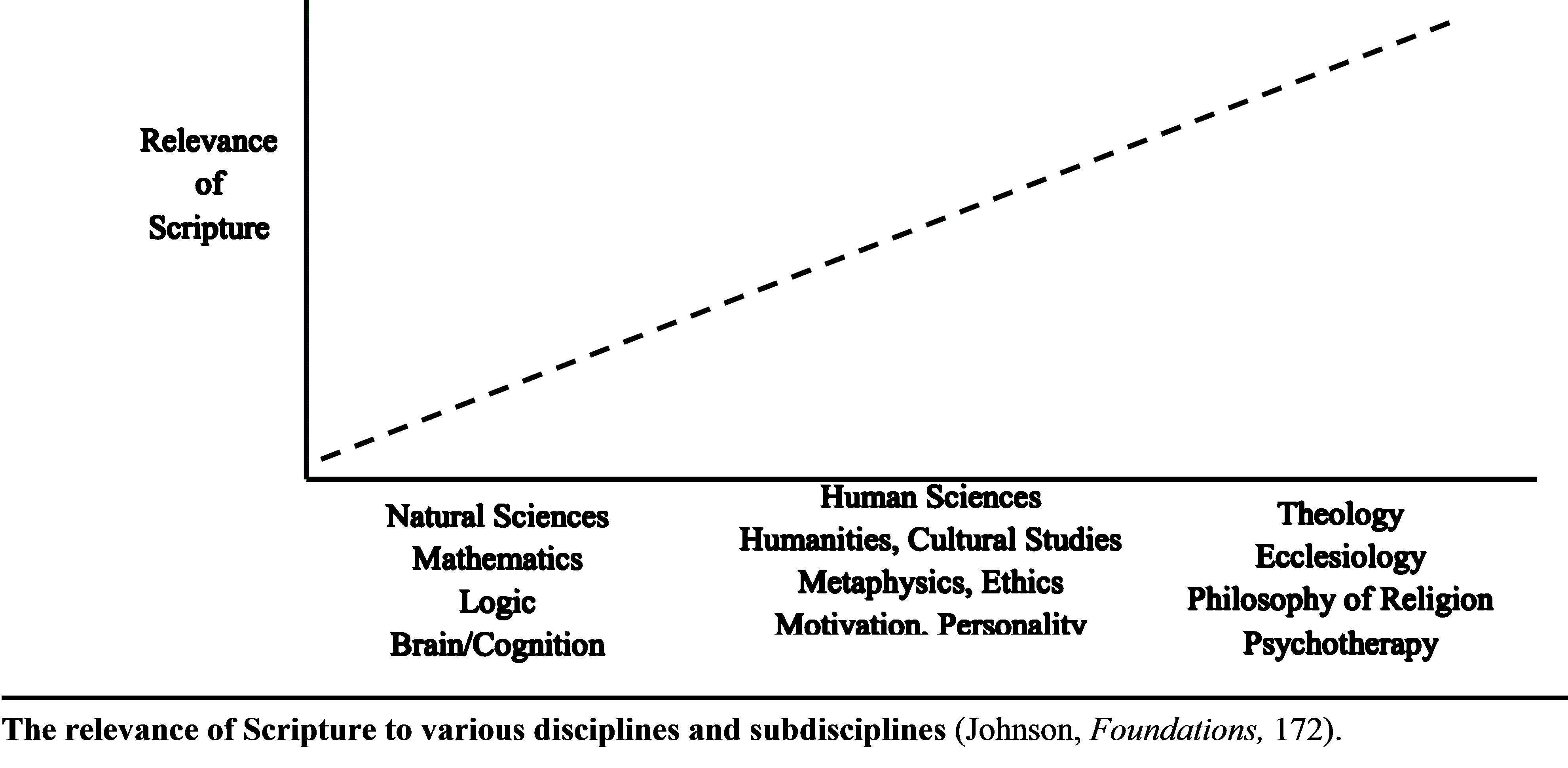
Eric Johnson points out that Paul “does not say that the Scripture contains all the soul-care information there is—all the knowledge that God has regarding the care of souls—or that all extrabiblical information that bears on human nature and counseling is irrelevant or useless or sin.”[3] Instead, he says, “The Bible contains what might be called the first principles of soul care—the most important truths for the maturation of the soul—and so it provides the God-breathed foundation for a radically Christian model of soul-healing.”[4]
So, how then is Scripture sufficient to address our problems?
First, Scripture gets to the most fundamental and important questions in all of the universe. It answers the questions: Does God exist, How did we get here, What is wrong with the world, what should we do with our life, what happens after this life, and other massive and important questions.
Second, Scripture tells us how we can receive salvation in Christ and live in Christ.[5] Thus the Bible tells us how to be transformed. David Powlison says, “The gospel of Jesus Christ is as wide as human diversity and as deep as human complexity. The Scriptures that bear witness to this Christ in the power of His Spirit are sufficient to cure souls.”[6]
Third, and something I have hinted at, the Bible gives us a lens in which to see the world. It is, again, the light to our path. John Calvin used the illustration of spectacles to explain this (Institutes 1.6.1). He said that the Bible is not only what we read, but what we read with. We use its pages as spectacles to view and read the world and the knowledge God has distributed throughout it.
Though Scripture may not be the only helpful text, it is the only necessary text. Further, and not surprisingly, God’s Word must be the authoritative text. God’s Word is the last word. That is not to say, however, that there are no other helpful resources. There certainly are. And it is in wisdom to make use of them. But, let it be clear, they must always be subordinate to the Word of the LORD.
God’s truth, as truth, is invaluable. God’s truth, as truth, is also immensely practical. It is practical for addiction.[7] It is even practical for aviation. Though, as the figure above points out, Scriptures relevance various depending on the topic. Scripture has less relevance in aviation. Yet, even in aviation Scripture is still important. For instance, it is through Scripture that we see that there is a God that rules the cosmos and thus we have laws that govern the realm in which we live. Laws that allow for flight under certain conditions. We see that the pilot must strive to be the best pilot he can be to the glory of God. We see that the pilot must praise the Lord who made the expansive world in which he lives. So we learn a few things that apply to aviation. However, we are not taught how to fly a plane. We are not taught how much fuel a plane will consume under various operating conditions.
Scripture does and does not address every relevant fact in the universe. It does address everything in that through Scripture we know the beginning and telos (goal) of all things. Yet, if obviously does not address every single datum of information. What it does is grander. More useful even.
The Word of God is truth. Guides us in truth. Makes us holy (Jn. 17:17). I realize this is not an apologetic,[8] but I can’t help but say with C. S. Lewis that I believe in Christianity and the Bible as I believe that the sun has risen. Not only because I see it, but because by it I see everything else.[9] “To the man enlightened by the Spirit, Scripture is no longer a bewildering jumble of isolated items… Part chimes in with part, Scripture meshes with Scripture, and the unified bearing of the whole Bible becomes apparent. The accompanying experience of the ‘taste’, or ‘flavour’ of spiritual realities is immediate and ineffable.”[10] Again, this is not something I can prove, it is a work of the Spirit. God the Spirit transforms by means of the Word of God. This is the biggest testimony of the sufficiency of Scripture; whether or not there is irrevocable evidence to prove it.
I will further say, that because God’s Word is truth, it gives us an accurate view of reality and of ourselves in that reality. “A true self-understanding is only possible in response to the word of God.”[11] Without God’s Word we are left to our own devices. We are left relying on a desperately wicked heart (Jer. 17:9). “Understanding Scripture promotes our understanding of God, ourselves and the way of salvation, so it is indispensable for our psychospiritual well-being (and for Christian soul care).”[12]
Look at what a proper, biblical understanding of our identity does: The Christian religion alone expels both the vice of pride and despair through the simplicity of the Gospel.
For it teaches the righteous, whom it exalts, even to participation in divinity itself, that in this sublime state they still bear the source of corruption, which exposes them throughout their lives to error, misery, death and sin; and it cries out to the most ungodly that they are capable of the grace of their redeemer. Thus, making those whom it justifies tremble and consoling those whom it condemns, it so nicely tempers fear with hope through dual capacity, common to all men, for grace and sin, that it causes infinitely more dejection than mere reason, but without despair, and infinitely more exaltation than natural pride, but without puffing us up. This clearly shows that, being alone exempt from error and vice, it is the only religion entitled to reach and correct mankind.[13]
So, as Eric Johnson has rightly pointed out the Bible claims to be and is a soul-care book.[14] “The Old and New Testament Scriptures together… have a virtue-shaping function… With the Holy Spirit’s aid, the Word of God reconfigures the minds of believers, recalibrates their hearts and reshapes their lives, moving them, communally, into an increasingly theocentric way of life.”[15]
God’s Word is truth and we are sanctified by it (Jn. 17:17). God’s Word is relevant. God’s Word is practical. God’s Word is sufficient.
_________________________________
[1] Michael Hortan says that “Theology is the lived, social, and embodied integration of drama (story), doctrine, doxology, and discipleship. I am suggesting that hearing the covenantal Word of our Lord is the source of that dethronement of the supposedly sovereign self and of the integration that subverts the disintegrating logic of Western dualism and individualism” (87). He goes on to say, “The ultimate goal of theology is practical—namely, to reconcile sinners to God in Christ and to restore them to communion with God and each other in true worship” (96).
[2] John Piper, “Thoughts on the Sufficiency of Scripture: What it Does and Doesn‟t Mean.”
[3] Foundations of Soul Care, 119.
[4] Ibid.
[5] Here are some relevant statements on Scripture: The Westminster Confession of Faith says, “The whole counsel of God concerning all things necessary for his own glory, man’s salvation, faith and life, is either expressly set down in Scripture, or by good and necessary consequence may be deduced from Scripture: unto which nothing at any time is to be added, whether by new revelations of the Spirit, or traditions of men. Nevertheless, we acknowledge the inward illumination of the Spirit of God to be necessary for the saving understanding of such things as are revealed in the Word: and that there are some circumstances concerning the worship of God, and government of the church, common to human actions and societies, which are to be ordered by the light of nature, and Christian prudence, according to the general rules of the Word, which are always to be observed” (1.6). “The Scriptures of the Old and New Testament were given by inspiration of God, and are the only sufficient, certain and authoritative rule of all saving knowledge, faith and obedience” (Abstract of Principals). “The Holy Scripture is the only sufficient, certain, and infallible rule of all saving knowledge, faith, and obedience” (The Baptist Confession of Faith [1689]). “We affirm that Scripture, having been given by divine inspiration, is infallible, so that, far from misleading us, it is true and reliable in all the matters it addresses” (XI of the Chicago Statement on Biblical Inerrancy). Wayne Grudem says, “The sufficiency of Scripture means that Scripture contained all the words of God he intended his people to have at each stage of redemptive history, and that it now contains all the words of God we need for salvation, for trusting him perfectly, and for obeying him perfectly” (Systematic Theology, 127). John Frame says “Scripture contains all the divine words needed for any aspect of human life” (John Frame, DWG, 220). He goes on, “Theology is the application of Scripture, by persons, to every area of life” (DWG, 276). I think especially helpful here is David Powlison’s article “Affirmations and Denials: A Proposed Definition of Biblical Counseling” in JBC 19 (2000): 18-25. Also see “On The Sufficiency of Scripture in a Therapeutic Culture” adopted by the Southern Baptist Convention.
[6] David Powlison, “The Sufficiency of Scripture to Diagnose and Cure Souls,” 13.
[7] Scripture surely speaks to the problem of addiction. Interestingly you could put a passage of Scripture alongside each step of many of the Twelve Step Programs. In many ways that is exactly what Celebrate Recovery has done.
[8] In defensive of Scripture I have found Frame, DWG helpful.
[9] Is Theology Poetry?”, The Weight of Glory and Other Addresses.
[10] J.I. Packer, A Quest for Godliness: The Puritan Vision of the Christian Life (Wheaton: Crossway, 1990), 92.
[11] Johnson goes on to say, “Scripture teaches that sanctification involves repentance and forgiveness of sins in Christ… and only within that context can genuine soul-healing occur. God’s word radically changes one’s perspective on one’s psychological predicament” (Ibid. 75).
[12] Johnson, Foundations, 38.
[13] Blaise Pascal, Pensees, 68.
[14] Foundations of Soul Care, 28 see also ch. 2. He says “The Bible is the primary soul care text for the Christian community” (Ibid., 18 italics mine). He says “primary” because he understands that other sources, even secular sources, can be helpful.
[15] Johnson, Foundations, 33.



 in X
in X 