I need to abide in Jesus!

It’s often tempting for me to think that if I better myself I will bear much fruit. If I just _______ and a million other things then I’ll bear much fruit and God will be able to use me. But that’s not what God’s Word says.
Jesus tells us that if we abide in Him we will bear much fruit. Jesus tells us that apart from Him we can do nothing. Zip. Zero. Nada.
Yet, often I get that backwards or flat out don’t believe that truth.
Don’t get me wrong. I realize that we need to be faithful and work hard. I get that.
But, left to my own devices I can’t do it. Not at all. I NEED THE LORD! But sadly I often forget that. A lot of times I work in my own strength.
Yet God is the one that calls the stars by name. He holds the great fireball in the sky that we call the sun. He has more strength than me. It is the height of stupidity for me to try to serve the Lord in my own strength and to bear fruit of myself.
Good Father, help me to abide in Jesus and so bear much fruit. O’ Spirit, our great helper, please come. I need You.
Be Transformed by Cultivating a Heart of Thanksgiving

Thankfulness to God, who is our Father, should be a defining characteristic of our lives. However, I fear we have a tendency of being practical atheists. I know I do. We may not say we don’t believe in God but we often act like we don’t.
What does this practical atheism look like? It looks thankless. Sometimes when everything is great we forget God. We’re actually really prone to do that as humans (Israel was prone to do that as well; cf. Deut. 6:10-12).
Why does God want us to have a thankful heart?
We are told to give “thanks always and for everything to God the Father in the name of our Lord Jesus Christ” (Eph. 5:20). Why? Why does God want us to have thankful hearts? Because we have a ton to be thankful for. We use to have our eyes closed tight. When we were unbelievers we didn’t give thanks to God (Rom. 1:21). But now we see things in a different light. We see all we have is a gift we don’t deserve.
God has given us new eyes! Life! We we’re dead. Now we’re alive.
Ephesians lists out some of the amazing things God has done in saving us and then says “to the praise of His glorious grace.” We are adopted by God through Jesus Christ “to the praise of His glorious grace” (Eph. 1:5-6). We have an eternal glorious inheritance through Jesus Christ “to the praise of His glorious grace” (v. 11-12). We have been given the Holy Spirit “to the praise of His glory” (v. 13-14).
We should have a thankful heart because there are so many reasons to be thankful!
We were dead in our sin. Christ made us alive. We were aliens, cast out. Christ brought us close and made us friends. We were enemies of God. Christ brought us peace. We use to walk in the darkness of sin. Now we walk in the light of Christ.
So why does God want us to have a thankful heart? Why are we told to give “thanks always and for everything to God the Father”? In part because He is our Father through Jesus! We have so many reasons to be thankful! Actually, how could we not be thankful?!
It says in Romans that if God gave us His Son how will He not also graciously give us all things? Wow! That is astounding. And think of all God already gives us. He gives us breath. We typically don’t really think of that being that amazing, right? We don’t really think about it. Breathing is so easy, so constant, so natural. Yet, it is God that gives to all man life and breath and everything. He gives it. It’s a gift. A gift we don’t deserve.
What gets in the way of having a thankful heart?
For me I think there’s quite a few things. I think sometimes I’m not even aware of things to be thankful for. Or I’m not aware that the good things I’m enjoying are from God. I often just think it’s just the way it just happened to turn out or it’s because of something I did. In short, when I’m not thankful I am acting like I don’t believe in God. I am acting like an atheist.
God created many good things that are to be received with thanksgiving. “For everything created by God is good, and nothing is to be rejected if it is received with thanksgiving” (1 Tim. 4:4) (notice it is not saying everything without exception, it says everything created by God, so wicked things that displease God are not good). But there are many many good things that we can receive with thanksgiving. Medication, walks in the woods, food, sports, music, Pop Rocks, etc. Yet, how quick I am to take those things and so many others for granted!
There are so many good gifts that God has given us. Yet if we forget to praise Him when we’re enjoying them we are liable to think the gifts are our due. And thus we’ll get upset when the littlest thing doesn’t go our way even though God has heaped good upon good. When we cultivate a heart of thanksgiving it builds us into God and protects us from grumbling and complaining.
Often times when we’re cheerful, whether from God’s gorgeous creation, good food, or good test results, or something else, we don’t think about God. We might bask in the warm sun on the beach, we might celebrate our work on an exam, we might scream out or tell someone why we’re so happy but we often don’t purpose to praise God.
So what seems natural is a response maybe even praise. But not always praise to God. If we’re eating good food we might praise the chef or Taco Bell because it seems like we’re hardwired to act out like that. However, do we thank God? Obviously I’m not saying you can’t tell the guy at Taco Bell that rolled up the mystery meat thanks but ultimately we need to thank God for that crunchy burrito grande thing. It may seem kinda silly and obviously I’m joking a little but I’m also super serious. “Every good [perhaps Taco Bell?] and perfect gift [Chipotle?] comes from the Father” (James 1:17).
We often, myself included, get caught up in the gift and forget the Giver.
How can we grow in thankfulness?
We are to rely on God for all things and look to Him for all things. So when someone is sick or suffering they are exhorted to pray (James 5:13-15). Because sometimes in those situations we can be hopeless and forget that we have a God in heaven who cares and can help. Or we think we can be self-sufficient and handle it ourselves.
However, on the other side, we are also prone to forget our need for God when things are going well. Maybe more prone to forget. So, either way, good or bad, we should turn to the Lord (James 5:13). If I’m thankful because I don’t loss it when I get mad, feel like I had a productive day, or do something well my tendency is not to thank and praise God but to be proud of myself. And God knows that. God knows us and knows our struggles. He knows that we are quick to forget that He is the giver of all good gifts (Acts 17:24-25).
So, God says, “Is anyone cheerful? Let him sing praise.” That is let him or her be happy but let them not forget who it is that brought that situation. God did! Paul reminds us to give thanks for everything God gives (Eph. 5:20). So God is reminding us not to forget Him in the midst of our good times. God is telling us to cultivate a heart of thanksgiving and praise.
It’s amazing how helpful and practical it is when we cultivate a heart of praise and thanksgiving. If we cultivate a heart of thanksgiving then we won’t be drawn away from the Lord when something good happens. And when something bad happens we’ll remember how good and gracious God is.
How do we cultivate a thankful heart? It says, “giving thanks” (Eph. 5:20) and in other places it says, “sing praise” (James 5:14). So there’s active intentionality. It’s not passive. It doesn’t just happen.
That’s typically why we pray before meals. Why? Because we’re giving thanks to God and acknowledging that it’s Him that provided it. This was Jesus’ practice. He gave thanks before meals (Matt. 15:36; 26:27; Jn. 6:11, 23 cf. Acts 27:35). In this way we infuse mundane activities with worship. In whatever we do we are to glorify and give thanks to God (1 Cor. 10:31).
How can we purpose to praise even with seemingly “run of the mill” things? I think it’s important that we look for things to be thankful for or realize what it is that we’re enjoying and then intentionally thanking the Lord for that. First of course is Jesus our Savior! But a few other big things are my family, outside, food, and being able to serve at my church.
It can be tempting to wonder why we’re thanking God for our meals. Why? Because after all, didn’t we buy the food? Didn’t we make the food? Didn’t we set the table? Yes we did. But all of that is a gift from God! We are so liable to forget that!
It’s sometimes strangely difficult to be thankful. So I think it’s also helpful to tell others about things that we’re thankful for. That’s part of what it means to sing (James 5:14), right?
What practical impact does having a thankful heart have?
Having a thankful heart changes the way we look at things. If I’m upset with my wife about something but I’ve been cultivating a heart of thanksgiving then I am in a much better place to handle disappointment. If I am cultivating a thankful heart and something happens to me, my car breaks down, someone offends me, I stub my toe, or whatever, I am in a much better place to handle the situation.
Thanksgiving is even an antidote to sin (cf. Eph. 5:4). Partly because sin is often a form of ingratitude. Actually, to neglect thanksgiving is sinful (cf. Lk. 17:16-18; Rom. 1:21). Ingratitude is one of the things that characterize wicked humanity in the last days (2 Tim. 3:2). Instead, we should give thanks continually (1 Cor. 1:4; Col. 2:6-7; 4:2), in all circumstances (Phil. 4:6), to God through Jesus Christ (Col. 3:17).
Thanksgiving should be more and more a characteristic of our lives and as it is we will be empowered to fight against our various nagging sins. We will see all God has given us and see sin for what it really is.
Questions to consider:
1. Do you struggle with being thankful?
2. Why does God want us to have a thankful heart?
3. What gets in the way of having a thankful heart?
4. How can we grow in thankfulness? How can we be intentionally thankful?
5. What practical impact does it make when we have a thankful heart?
6. What’s wrong with being unthankful?
7. What are some challenges you have to work through for you to be thankful?
8. How can cultivating a heart of thanksgiving have a positive impact on your life?
“Treasure in the Right Place” sermon on Matthew 6:19-34

Below are some follow up questions for you consider related to my message “Treasure in the Right Place” from Matthew 6:19-34.
Discussion/Application Questions:
-
Is it true that worry often tells us what we worship?
-
Is it true that we can be orthodox and even astute theologically and actually have our heart somewhere else entirely?
-
Is it true that social media and shopping malls shape us and our views of significance and security subtly but substantially?
-
Materialism may be the single greatest pull away from authentic Christianity (cf. Deut. 6 esp. v.10-13). What do you think?
- What does it mean to “lay up treasures in heaven”? What are “treasures” in heaven?
- How do vv. 25-34 relate to the previous verses (vv. 19-24)? How do we apply these verses to our context in Fairfax?
- How can we purposely invest in heaven and not drift to the service of other gods?
- Daily and seriously ask yourself, “Is life more than food, and the body more than clothing?”
- Ask yourself if what you’re focused on and are worried about will stand the test of eternity.
- In chapter 6:1-18 we see the word “reward” 6 times (ESV) and then in vv. 19-21 we see “treasure” used 3 times (ESV). Do we very often think about the “reward” and “treasure” that awaits us in heaven? Remember, anxiety produces nothing; except perhaps ulcers. And remember, anxiety isn’t inevitable. What can help us loosen the grip of anxiety upon our life?
Quote from the Message:
“In the day-to-day trenches of adult life, there is actually no such thing as atheism. There is no such thing as not worshipping. Everybody worships. The only choice we get is what to worship…” and the thing is “If you worship money and things—if they are where you tap real meaning in life—then you will never have enough. Never feel you have enough. It’s the truth. Worship your own body and beauty and sexual allure and you will always feel ugly, and when time and age start showing, you will die a million deaths before they finally plant you. On one level, we all know this stuff already… The whole trick is keeping the truth up- front in daily consciousness. Worship power—you will end up feeling weak and afraid, and you will need ever more power over others to numb your own fear. Worship your intellect, being seen as smart—you will end up feeling stupid, a fraud, always on the verge of being found out.” And so on.
He goes on to say, “Look, the insidious thing about these forms of worship is not that they’re evil or sinful; it is that they are unconscious. They are default-settings. They’re the kind of worship you just gradually slip into, day after day… And the so-called real world will not discourage you from operating on your default- settings, because the so-called world of men and money and power hums along quite nicely on the fuel of fear and contempt and frustration and craving and the worship of self. ” – From a commencement speech given by David Foster Wallace to the 2005 graduating class at Kenyon College
Recommended Resources:
A 20 Day Study in Stewardship by Redeemer Presbyterian Church
20+ Proverbs for those Pining for Substances or Porn

- “My son, if sinners entice you, do not consent” (Prov. 1:10 cf. v. 17-18)
- “Do not enter the path of the wicked, and do not walk in the way of the evil. Avoid it; do not go on it; turn away from it and pass on” (Prov. 4:14-15)
- “The iniquities of the wicked ensnare him, and he is held fast in the cords of his sin. He dies for lack of discipline, and because of his great folly he is led astray” (Prov. 5:22-23)
- “Whoever heeds instruction is on the path to life, but he who rejects reproof leads others astray” (Prov. 10:17)
- “Whoever despises the word brings destruction on himself, but he who reveres the commandment will be rewarded” (Prov. 13:13)
- “The teaching of the wise is a fountain of life, that one may turn away from the snares of death” (Prov. 13:14)
- “Whoever walks with the wise becomes wise, but the companion of fools will suffer harm” (Prov. 13:20)
- “The backslider in heart will be filled with the fruit of his ways, and a good man will be filled with the fruit of his ways” (Prov. 14:14)
- “The fear of the LORD is a fountain of life, that one may turn away from the snares of death” (Prov. 14:27)
- “There is severe discipline for him who forsakes the way; whoever hates reproof will die” (Prov. 15:10)
- “Whoever isolates himself seeks his own desire; he breaks out against all sound judgment” (Prov. 18:1)
- “Wine is a mocker, strong drink a brawler, and whoever is led astray by it is not wise” (Prov. 20:1 cf. 23:29-35)
- “One who wanders from the way of good sense will rest in the assembly of the dead” (Prov. 21:16)
- “Whoever loves pleasure will be a poor man; he who loves wine and oil will not be rich” (Prov. 21:17)
- “Let not your heart envy sinners, but continue in the fear of the LORD all the day” (Prov. 23:17)
- “Be not among drunkards or among gluttonous eaters of meat, for the drunkard and the glutton will come to poverty, and slumber will clothe them with rags” (Prov. 23:20-21)
- “A man without self-control is like a city broken into and left without walls” (Prov. 25:28)
- “Like a dog that returns to his vomit is a fool who repeats his folly” (Prov. 26:11)
- “Whoever digs a pit will fall into it, and a stone will come back on him who starts it rolling” (Prov. 26:27)
- “Whoever conceals his transgressions will not prosper, but he who confesses and forsakes them will obtain mercy. Blessed is the one who fears the LORD always, but whoever hardens his heart will fall into calamity” (Prov. 28:13-14)
Be Transformed by a New Consuming Passion


A Consuming Life Passion?
Instead of feigning for a substance or porn we need to have a new and better all consuming passion. We need to have a new purpose with a new goal as its end. We need a reason to get out of bed in the morning. We need a reason to be.
One of the fundamental questions that psychologists face is what is to be the motivational force in our lives? Is it to get rich? Propagate are genes? To enjoy as much pleasure as we can? What is to be the fuel for the engine of our lives? Do we have anything that can propel us through the sufferings and struggles of life?
This question cries out to be answered, and how it’s answered will have profound implications for the way that we live. Many, I’m sure, are unaware of their motivations and could care less about them. However, I’m sure that this is a great mistake.
The athlete, for instance, competes for a price and are very much aware of what that prize is. We, like the athlete, must not only be aware that there is a prize but what that prize is. We must seek to live with the intentionality of an athlete.
An athlete will discipline their body and bring it under subjection in pursuit of the prize. And when focused on the prize the athlete will gladly do away with hindrances. However, the athlete must have a goal, be competing for a prize, and have an idea of what that prize is if they are to have motivation to compete well.
Christians have Motivation to “Compete”
The language of running the race and competing for a prize were frequently used by the Apostle Paul. He was someone that clearly had a reason for getting out of bed in the morning. He had a consuming passion. He said, “I count everything as absolutely worthless compared to Christ.” Paul suffered the loss of all things in order that he could gain Christ. We also see that Jesus Himself raced the race and endured the cross for the joy that was set before Him.
We too need motivation. We need to be motivated like the Apostle Paul. We need the love of Christ to be the fuel that burns and propels us through the sufferings and struggles of life. Christ alone is sufficient motivation. Christ Jesus, as the Apostle Paul, Augustine, and Brian “Head” Welch, and many others make clear, alone satisfies and is it worth living for.
Here’s Brain “Head” Welch:
Take it from me, nothing you chase after on this earth will satisfy you like a real, everyday intimate relationship with Jesus Christ. Nothing. Trust me. While I was in Korn I had people waiting on me left and right. Anything I wanted, I got. Anywhere I wanted to go, I went. All I had to do was give the word, and it happened. I had the world in the palm of my hand, people; and I have to tell you one last time, there’s nothing there. I promise you. Jesus Christ is the only one that can make you complete. (Save Me from Myself)
The end of the last book of the Bible, the book of Revelation, tells us in chapter 21 what our ultimate goal is. To see God face to face, to be in the eternal temple where He will make all things new. Where He will wipe away every tear from our eye. Where there will be no more pain or crying anymore. Where we will have pleasure forevermore in His presence.
So we see that we have much that God has called us to do. We have much purpose. We have a reason to be. We would do well to set God’s truth before us so that we are motivated to live for the prize.
A verse that God has used to wake me up to the unseen realities and motivate me to purposeful living to His glory is 1 Corinthians 15:58. It says, “Therefore, my beloved brothers, be steadfast, immovable, always abounding in the work of the Lord, knowing that your labor in the Lord is not in vain.” This verse, when understood in the context of chapter 15, shows us that it makes sense for us to be motivated to labor for the Lord because of the reality of the resurrection of Jesus.
The Bible verse that says, “Whether you eat or drink, whatever you do, do you all to the glory of God” is not just a Bible verse. It is not just a good tagline under the name of some private Christian school. It is the way that it makes sense for us to live in light of the glorious gospel.
In a similar way, the oft-quoted phrase “our chief end [or main purpose in life] is to glorify God and enjoy him forever” is not a mere tagline but a phrase that gets at a biblical motivational reality.
Create Your Own Motivational Purpose Statement
We have laid a little bit of groundwork. Now it’s your turn. I want you to write out a biblically infirmed motivational purpose statement for your life.
Just write something down. It does not have to be able to stand the test of time like the Westminster Shorter Catechism on your first attempt. Your purpose statement can adapt and grow as you do.
My own purpose statement is not the best and I certainly could do better about purposely keeping it in my head so that it will be lived out through my hands. However, the purpose behind the statement is not to make it timeless or flawless. It is to be purposeful about our purpose. We have a purpose and it is great. We have a reason to wake up in the morning. A reason to be. I reason to say no to whatever sin it is that calls our name.
Singing, Sanctification, and Transformation

Why sing? Why are “psalms, hymns, and and spiritual songs” important? What does singing do?
In the world we live in
“There is a ‘downward pressure’ continually in operation, which seeks to take that which is penultimate, and make it ultimate… The antidote to such ‘downward pressure’ is the continual eschatological emphasis of word and sacrament, of prayer and praise, and of koinonia [fellowship] lived in the present in light of the age to come.”[i]
Truly, “unless there is within us that which is above us, we shall soon yield to that which is around us.”[ii] St. Gregory reportedly said something similar: “If you do not delight in higher things, you most certainly will delight in lower things.” Truly, “worship shapes individual and community character.”[iii] That is, all worship, good or bad, Christian or other, intentional or unintentional. Thus we must focus on what is true, noble, right, pure, lovely, admirable, excellent, and praiseworthy (see Phil. 4:8).[iv] We must keep “the good,” the true good—God and His truth—the summum bonum ever before us.
Our ultimate love, the place where we rest our desire, has an ultimate affect. So, “moral decay doesn’t happen in a vacuum. It is supported by the idolatry of the society at any given time, and expressive of its worship, even if such be completely unarticulated.”[v] Moral decay happens when something other then God is our ultimate good (cf. Rom. 1).
Thus, it is important that we temper our hearts variously through singing, community, and the absorption of God’s word. That’s how we’re shaped biblically and practically. The more we have our chief end in view, through various means, the better we will live to that end.
We need deep and substantive reflection and celebration. We need to work at fostering transformative experiential worship where we can taste and see that the LORD is good. We need God to restore to us the joy of our salvation. We need God to open the eyes of our heart, we need the Spirit to move, we need God’s strength to comprehend His amazing love that surpasses knowledge.
Truly
“It is… superior satisfaction in future grace that breaks the power of lust [or addiction]. With all eternity hanging in the balance, we fight the fight of faith. Our chief enemy is the lie that says sin will make our future happier. Our chief weapon is the truth that says God will make our future happier… We must fight [our sin] with a massive promise of superior happiness. We must swallow up the little flicker of lust’s pleasure in the conflagration of holy satisfaction.”[vii]
Where do we turn for this? “The role of God’s Word is to feed faith’s appetite for God. And, in doing this, it weans [our] heart away from the deceptive taste of lust.”[viii] Therefore, we must feast on Scripture. And singing is an especially useful tool to help the word of Christ dwell in us richly (Col. 3:16).
Singing psalms and hymns and spiritual songs and being involved in Christian community is very important because, as C.S. Lewis said, “What is concrete but immaterial can be kept in view only by painful effort.”[ix] We need each other, we need music, we need preaching to shake us awake to unseen realities. That’s why we’re told—commanded even when we don’t feel like it—to make a joyful noise to the LORD (Ps. 66:1; 81:1; 95:1, 2; 98:4, 6; 100:1).[x]
We’re told to sing because when we sing with our voice our whole body, and I would argue, our whole self (i.e. our heart) reverberates with the truth of what we sing. When we sing lyrics, whether good or bad, they get into us and shape us. We are essentially preaching to ourselves, teaching ourselves, telling our self what we should desire, we are holding up a vision of prospering and “the good.”[xi] If we are driving down the highway listening to Taylor Swift, Blink 182, or Eminem it has a very real potential to shape us. We, at least, very often, internalize what we are singing. We imagine and feel not only the rhythm and tone but what the whole artistic message is putting forth. Music shapes us by implanting seeds of desire.[xii]
We are to be filled with the Spirit, instead of being drunk with alcohol or high on drugs, in part through singing (Eph. 5:15-20). Thus,
“Worship is one of the most transforming activities for us to engage in as Christians… When we become duly impressed with God our lives change because the things that matter to us change. We no longer want some of the things we previously desired. An overridding and overwelming passion for God himself, God’s people, and God’s kingdom purposes in this world replace those desires. True worship happens when we get a glimpse of God–who he is and what he is about–and just stand there in awe of him, being impressed and transformed down to the very depths of our being by the magnificent vision of the glory of our heavenly Father.”[xiii]
Truly, “Reality is simply far too great to be contained in propositions. That is why man needs gestures, pictures, images, rhythms, metaphor, symbol, and myth. It is also why he needs ceremony, ritual, customs, and conventions: those ways that perpetuate and mediate the images to us.”[xiv] We must use a collaboration of means to remind ourselves that it is the LORD God, the Maker of heaven and earth alone, that can meet our every need. We must use good songs, good stories, the Bible, Christian community, logic, etc. to stir up our (correct) desires for the LORD and all the good He is and has for us. We must take care least there be an unworthy thought in our heart (Deut. 15:9). We must pursue things that bring light and life and reject what is rank in ruin and worthlessness (see e.g. Ps. 101).
Truly, wherever our treasure (i.e. desire, view of “the good,” or our view of the good life) is, our heart (“heart” in Scripture has to do with our whole self; cognition, volition, emotions) will be also (Matt. 6:21; Lk. 12:34).[xv] Thus, we must work at fostering worship of the one true God.
Singing sinks God’s truth deep within our souls. Singing works because it leads us to worship. Singing teaches us what we should truly desire. Singing tunes our hearts to sing God’s praise.
_______________________________
[i] Doe, Created for Worship, 236.
[ii] Christian worship: it’s Theology and practice, 81
[iii] Doe, Created for Worship, 234.
[iv] Cf. Payne, The Healing Presence, 140.
[v] Doe, Created for Worship, 236.
[vi] Ibid., 235 see also Jonathan Edwards very important book Religious Affections.
[vii] Piper, Future Grace, 336.
[viii] Ibid., 335.
[ix] C.S. Lewis, Letter to Malcolm: Chiefly on Prayer (New York: Harcourt, Brace and World, 1963), 114.
[x] “Worship isn’t merely a yes to the God who saves, but also a resounding and furious no to lies that echo in the mountains around us. The church gathers like exiles and pilgrims, collected out of a world that isn’t our home, and looks hopefully toward a future. Our songs and prayers are a foretaste of that future, and even as we practice them, they shape us for our future home” (Mike Cosper, Rhythms of Grace: How the Church’s Worship Tells the Story of the Gospel [Wheaton: Crossway, 2013] 104).
[xi] “Music gets ‘in’ us in ways that other forms of discourse rarely do. A song gets absorbed into our imagination in a way that mere texts rarely do… Song seems to have a privileged channel to our imagination, to our kardia, because it involves our body in a unique way… Perhaps it is by hymns, songs, and choruses that the word of Christ ‘dwells in us richly’” (Smith, Desiring the Kingdom, 171).
[xii] Even Nirvana communicates; even if it’s emptiness or aggression that they put forward. However, realize that I am not saying that we cannot listen to Garth Brooks or Bruno Mars. Though I am not sure how or to what end those and other artist will shape you. I would say that “For Today,” a Metal band that is explicitly Christian, would have more of intentional transformative affect upon me then most artists. This is, I guess, both because of the content of their lyrics and the package in which they are wrapped (i.e. often very active and passionate singing and yes even screaming). However, Garth Brooks could perhaps have a transformative affect for some people as well (I am not one of them). Bruno Mars may be close to a-formative. Yet, as humans, I think we are similar to water. If we are not moving, i.e. being transformed, then we are stagnating, being deformed. Our bent, since the Fall, is away from our creator. Thus, perhaps, if we listen too much Bruno Mars and the like, a-formative music, we will stagnate. If we are left to our own devises and don’t have a gaud we do not progress. Our default is digression.
[xiii] Richard E. Averbeck, “Spirit, Community, and Mission: A Biblical Theology for Spiritual Formation,” 38 in the Journal of Spiritual Formation & Soul Care). I think Eph. 5:17-21 is noteworthy here. See also “Singing, in the Body and in the Spirit” by Steven R. Guthrie in JETS and “Being the Fullness of God in Christ by the Spirit” by Timothy G. Gombis in Tyndale Bulletin.
[xiv] Payne, The Healing Presence, 146 cf. 148.
[xv] “Disordered action is a reflection and fruit of disordered desire” (Smith, Desiring the Kingdom, 177)
Religious Affections
“For although to true religion, there… must indeed be something else besides affection, yet true religion consists so much in the affections, that there can be no true religion without them. He who has no religious affection, is in a state of spiritual death, and is wholly destitute of the powerful, quickening, saving influences of the Spirit of God upon his heart. As there is no true religion, where there is nothing else but affection; so there is no true religion, where there is no religious affection. As on the one hand, there must be light in the understanding, as well as an affected fervent heart, where there is heat without light, there can be nothing divine or heavenly in that heart, a head stored with notions and speculations, with a cold and unaffected heart, there can be nothing divine in that light. If the great things of religion are rightly understood, they will affect the heart. The reason why men are not affected by such infinitely great, important, glorious, and wonderful things, as they often hear and read of, in the Word of God, is undoubtedly because they are blind; if they were not so, it would be impossible, and utterly inconsistent with human nature, that their hearts should be otherwise, than strongly impressed, and greatly moved by such things”

~Jonathan Edwards, Religious Affections (Yale University, 2009), 120-21
“Holy affections are not without light; but ever evermore arise from some information of the understanding, some spiritual instruction that the mind receives, some light or actual knowledge. The child of God is graciously affected, because he sees and understands something more of divine things than he did before, more of God or Christ and of the glorious things exhibited in the gospel; he has some clearer and better view than he had before, when he was not affected: either he received some understanding of divine things that is new to him; or he has his former knowledge renewed after the view was decayed”
~Jonathan Edwards, Religious Affections (Yale University, 2009), 266
True Knowledge Should Truly Humble

Knowledge[1] is dangerous. Not only the consequence that ideas themselves have but also the tendency that knowledge has to puff up. Truths that should lay us low in humility often conflate our egos. Paradoxically, knowledge is also the very thing that humbles.[2] We may not be proud without knowledge but neither will be humble. We will be ignorant. Knowledge is dangerous. Albeit, a necessary danger.
Knowledge is indispensable to live life rightly. We must understand though, that knowledge is not innate within us. It must be pursued. However, the very fact that knowledge is external should press us to pursue it in humility. It is not ours. We do not have the market on knowledge. Also, if we pursue it arrogantly we will miss much of it (Prov. 3:5-6; 15:14, 22). We should realize that not only is knowledge external from us but so is the desire for knowledge. We should not think we are better than the ignorant because our very desire for knowledge is itself a gift (James 1:17).
The desire for knowledge with the goal of being humbled is good. The fear of the LORD is the beginning of knowledge and humility comes before honor (Prov. 1:7; 9:10; 15:33; Job 28:28). Jesus pronounces woes upon the Pharisees, not for their knowledge, their knowledge is commendable, but on the result that their knowledge had upon them. It did not humble them (Matt 23:5-7, 11-12). The publican had little knowledge but it served to humble him. If we truly understand, if the eyes of our hearts are enlightened, we will praise God and not ourselves. We can have all knowledge but if we have not love, it profits us nothing (1 Cor. 13:1-3).
Thomas A Kempis said in The Imitation of Christ that “On the day of judgment, surely, we shall not be asked what we have read but what we have done; not how well we have spoken but how well we have lived.” That is not to say that knowledge is not important, it is. However, knowledge that does not lead to life change and humility is worthless and condemning. The person that knows the right thing to do and does not do it for that person it is sin (James 4:17). Kempis rightly says, “The more you know and the better you understand, the more severely will you be judged, unless your life is also the more holy. Do not be proud, therefore, because of your learning or skill. Rather, fear because of the talent given you.” God will judge us according to all that He has entrusted to us (see Matt. 25:14-30).
As our minds rise to exalted things, our consciousness of ourselves must fall. Truth humbles, or it is not understood to be truth to ourselves. Again Kempis says,
“What good does it do to speak learnedly about the Trinity if, lacking humility, you displease the Trinity? …I would rather feel contrition than know how to define it. For what would it profit us to know the whole Bible by heart and the principles of all the philosophers if we live without grace and the love of God?”
Knowledge is vital, we cannot serve or know the LORD without it, but knowledge must always humble.
How do we fight the damning affect that knowledge so often has? It all has to do with our motivation from the outset. As J.I. Packer has said, in his classic book Knowing God, “there can be no spiritual health without doctrinal knowledge; but it is equally true that there can be no spiritual health with it, if it is sought for the wrong purpose.”[3] Do we study the Trinity to be in awe and wonder before the God who is three-in-one? Or do we study the Trinity to look astute before our peers? The choices are not restricted to arrogance or ignorance but we have to fight for the last alternative, humility. If we go the way of ignorance we will never know humility, who or what would we be humbled before? And arrogance is the misapplication of knowledge. It is a pursuit of knowledge with the wrong goal in mind. Do we read science journals and Scripture to merely gain knowledge? Or do we do it to be humbled by the God that formed the furthest reaches of the galaxies and yet revealed Himself to us; yea, atoned for our sins (cf. Heb. 1:3)?
Pursue knowledge. Pursue it in whatever field. But do so in humble worship with your ultimate end being to glorify God. May we be amazed by and enraptured in the truths of Scripture as children. May we continually go to God humbly in awe of Him and His truth that is contained everywhere around us for God gives grace to the humble (James 4:6).
~Whatever you study or seek to know, do it all to the glory of God~
______________________
[1] I say “knowledge” and not any specific stream of knowledge because I believe that all truth is God’s truth. What I mean by knowledge is knowledge that is true, true truth, as Schaeffer put it. This could be in the realm of science, math, history, etc. All truth is God’s truth because God upholds the universe by the Word of His power thus all mathematical equations are held together by His hand. Science shows us the extent to which the glory of God is manifested in His universe (as Johannes Kepler said, “science is thinking God’s thoughts after Him”), all history is a story of God unfolding Himself and is actually a testimony of His grace to redeem such as we are.
[2] Richard Baxter rightly says, “If we have any knowledge at all, we must needs know how much reason we have to be humble; and if we know more than others, we must know more reason than others to be humble” (The Reformed Pastor, 144).
[3] J.I. Packer, Knowing God, 22. He further says, “if we pursue theological knowledge for its own sake, it is bound to go bad on us. It will make us proud and conceited” (21). Rather “our concern must be to enlarge our acquaintance, not simply with the doctrine of God’s attributes, but with the living God whose attributes they are” (23).
Are you an Animal?

“He is just an animal.” That is not a very nice thing to say. However, sometimes it is not far from the truth. Sin is sub-human. Think of how Professor Weston becomes the “Un-man” in C.S. Lewis’ Perelandra or think of how J.R.R. Tolkien’s Smeagol mutated into Gollum.
God created us in His image. Not in the image of a dog sniffing the air for food or…. God made us to resemble Himself, morally and spiritually. The more sin we live in, the less we are being what God created us to be, and the closer we are to being animals. The way of the fool is the way of the animal: living on instinct and unaware of higher forms of reality.
Are you an animal? That is a strange question. But the Bible talks about people behaving like “irrational animals, creatures of instinct” (2 Peter 2:12). It says that these people have their belly as their god; that is, they instinctively pursue what they crave and their thoughts rise no higher than the earth (Phil. 3:19). Actually, since the fall, that is our default position (Eph. 2:1-3). I, you, John Doe and Jane Doe—everyone—is naturally desperate.
There is a lot wrong with us. But the solution is Jesus. He transforms us. He makes us into His image. He makes us the way we were intended to be. Yet, how are we to be what we are intended to be?
If you have been raised with Christ, seek the things that are above, where Christ is. Set your minds on things that are above, not on things that are on earth (i.e. don’t act like an ignorant animal).
Don’t act like an animal but put to death what is earthly in you: sexual immorality, impurity, lust, evil desire, and materialism, which is idolatry. Because of these the wrath of God is coming. In these you once walked, when you were living in them. But now you must put them all away: anger, wrath, meanness, insult, and rude talk. Don’t act like an animal! But put off the old self with its practices and put on the new self, which is being renewed in knowledge after the image of its creator.
Put on then, as God’s chosen ones, holy and beloved, compassionate hearts, kindness, humility, meekness, and patience, bearing with one another and, if one has a complaint against another, forgiving each other; as the Lord has forgiven you, so you also must forgive. And above all these put on love, which binds everything together in perfect harmony. And let the peace of Christ rule in your hearts, to which indeed you were called in one body. And be thankful. Let the word of Christ dwell in you richly, teaching and admonishing one another in all wisdom, singing psalms and hymns and spiritual songs, with thankfulness in your hearts to God. And whatever you do, in word or deed, do everything in the name of the Lord Jesus, giving thanks to God the Father through him (Col. 3:1-3, 5-10, 12-17).
What Forms and (Re)forms You?
Introduction
First off, this in many ways is the prequel to “Are You Mindful of Your Mind?” It is also very related to “The Fight of Faith: How we are Transformed” but from a different vantage point. In the future I hope to put the three together in a more substantial article.
We’re shaped by a whole host of things—constitution, genetics, socioeconomic factors, health, education, culture, upbringing, etc.; and we are (re)shaped by a few, consciously and subconsciously. Therefore, we see the importance of understanding how it is that we are transformed. For when we know how transformation takes place we can make a better conscious effort at transformation.
We’re shaped by one of two Gods, one of two voices. The god of this world (Jn. 12:31; Eph. 2:2-3; 6:12), or the one true God. There are two masters with two different sets of commands, we will obey one of them (Matt. 6:24; Lk. 16:13). We will be slaves, that’s inevitable (Rom. 6). The question is to who? And with what result? Life or death (Rom. 6:23)? We’re shaped by one of two kingdoms. Our kingdom, informed by Satan; or, God’s Kingdom, informed by God.
This post is not concerned with which kingdom we should desire. It is assumed that we should desire the Kingdom of God. This post is concerned with helping us understand how we are (re)shaped or transformed to desire the right Kingdom. This is a more difficult task than it would first appear. However, if you know Scripture, and indeed your own heart, you know this is a difficult task. Yet, it is terribly grave and important (e.g. think of Judas desiring his own kingdom and thus betraying the Messiah and the true Kingdom).
We are being shaped. But how? And by what?
Definitions
Putting things in categories, like putting things in containers, is helpful. However, their strength lies where their fault lies: they keep things that naturally run together from running together. With food this is helpful for taste, with thoughts it is helpful for understanding, but, when it’s all said and done, we must realize that containers like categories do not finally keep the contents apart. They are helpful, and perhaps necessary, but in the end affect (and yet assist) precision. Our categories are: 1) knowledge, 2) worship, and 3) practice. Below is a figure that shows their interconnected relationship (Figure 1).

______________________________________________
Figure 1. The Interconnectedness of Knowledge, Worship, and Practice in Transformation.
Knowledge
By “knowledge” I mean worldview or view of our chief end or “the good.” Worldview deals with more then what we see as “the good.” However, it does, or should, also shape what we see as our ultimate goal as well. A worldview answers questions and tells the story of our existence, but it must also tell us where, if anywhere, that story is going or should go.
Notice also that it’s not just the intentional thinker or the Christian that is shaped by a worldview, by knowledge. We are all shaped and informed by what we know, or think we know. For instance, the sex addict and gangster are shaped by a worldview, even if it is a sub-conscious and unarticulated form of hedonism or nihilism. However, I do believe that one will be shaped more when one’s knowledge or worldview is more explicit. So, perhaps a sex addict who is also a convinced and proud naturalistic hedonist will have less restraint when it comes to illegal sexual practices (e.g. rape, prostitution, etc.); rather, for him it is more a practical matter of will he be caught, than a question of whether such and such practice is ethical or not.[1]
Worship
What then is “worship”? Worship here is the (often purposeful and artistic) ingesting of “the good.” This definition equally applies to the sex addict watching porn, the gangster listening to rap, and the Christian singing songs, meditating on Scripture, or celebrating the Lord’s Supper. Worship, as you can see, very clearly incorporates both the two other categories. Worship is, you could say, the conscious (and also subconscious) practice (our second category) of thinking about something (our first category).
Therefore we see that many things that we would not typically consider worship are in fact worship under this definition. Television, the mall, the radio, and innumerable other things shape and influence our view of the good life or our view of “the good” and thus are a form of worship. They move and inspire us. They shape us to a certain end. And this clearly happens subconsciously and consciously. Just as if we feed upon something or imbibe food through a different means it becomes part of us through the metabolic process. What we feed on, intentionally or unintentionally, shapes us into who we are and thus also greatly shapes what we do.
Practice
Practice is the conscious and subconscious practices that shape our life.[2] What some have explained as thick and thin habits or practices.[3] These habitual practices have greater or lesser affect upon us depending upon their significance.
What we do has an effect upon who we are and what we will be. So, for example, when three different types of men see an attractive lady jogging on the side of the road they will have three different responses because of their conscious and subconscious practices which are ingrained in them through their “knowledge” and “worship.” Yet, their practices, as we’ll see, serve to further their worship and knowledge.
So, for example, the sex addict will undress the attractive jogger. This will in part be because of his worship and knowledge and will yet undergird and inform his worship and knowledge. He will in a sense say to himself subconsciously that his knowledge of things is justified by the image of this woman and his worship is also justified. The gangster will have a similar response. But, perhaps to a different end; he may think of all the money he could make with her body. The Christian man also informed by his knowledge and worship will pray for the jogger; or, perhaps, not look at her so as not to be tempted.
Whatever the specific example, we see that our knowledge, worship, and practices have a very real impact on us and how we are shaped. Each aspect serves it’s purpose, yet it is closely tied to the other two. We cannot neglect any aspect or the fact that they are closely interconnected.[4] Now that we have defined each category, we will look at each aspect in more detail.
How are we Transformed?
In Aristotle’s terms our view of “the good” is reshaped by knowledge.[5] And, in catechismal terms, if our chief end is to glorify God and enjoy Him forever[6] it will necessarily have a specific impact on our lives. That is just the way we are as humans. We all, without exception, live towards our chief end, our view of the “good life.” However, this is messy, there are many things and ideas which vie for this place. Thus the importance of knowledge rightly directed (i.e. wisdom), worship, and habits; all of which inform, play off, and undergird the others (see figure 2 below). Notice also that it is not just the Christian that worships, all men do (e.g. the gangster has a certain type of rap music that glorifies his view of the good life).
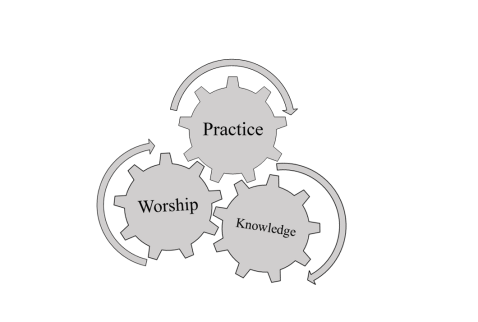 _______________________________________________
Figure 2. The Reciprocal Transforming Relationship of Knowledge, Worship, and Practice.
It is clear then that right and good worship is vital because it exalts and holds before us our chief end. If our worship has as its object the wrong thing we will thus go wrong in innumerable ways (cf. Rom. 1:18-32). Because of this, the reformation of our lives is a slow, and often painful, process. Witness the fall (the body of the book) and rise (the epilogue) of Raskolnikov from Dostoyevsky’s Crime and Punishment.[7] If we dig ourselves into a ditch we do not magically rise out of it (cf. Prov. 26:27). We have to dig ourselves out of it. Of course, as Christians we do believe that the Spirit assists us (e.g. Jn. 14:16). Yet, the fact remains, transformation is difficult and does not finally occur here.[8]
Scripture and reality are not at odds. We are shaped by what we know, worship, and do (and these are all interrelated). Scripture tells us to know the LORD, worship Him, and serve Him and thus be transformed. We see this same type of thing when we understand the relationship of faith and works, and the relationship of indicative and imperative. We know/believe God’s truth (faith) thus worship and have corresponding actions (works). Again, when we (rightly and supernaturally) understand God’s truth (indicative) we will worship, which in turn will change the way we live (imperative).
In Scripture we see huge importance placed on listening to He who speaks wisdom, the LORD, and not to the father of lies, Satan. We see this especially in the beginning. Eve listens to the serpent’s words and disregards the LORD’s, and chaos and curse ensue. However, notice that she did not just receive information/knowledge or believe the wrong source. Her desires were also wrongly informed. Because Eve listened to the serpent she saw the tree as delightful. She saw the tree as desirable (Gen. 3:6). Thus she fell.
As the Scripture says, “Each person is tempted when he is lured and enticed by his own desire. Then desire when it has conceived gives birth to sin, and sin when it is fully grown brings forth death” (James 1:14-15). We, thus, resist the devil by being firm in the faith. We, like Jesus, fight off wicked desires with God’s Word. Satan would have us be reconstituted by his words, wicked untruth, yet we combat his lies by teaching ourselves to desire good things by the implantation of God’s words, the truth (e.g. the place of Prov. 7:1-5 in the larger context of Prov. 7). When we feed on the Word of God the metabolic result is a healthy representation of God. God would have us (re)shaped into His image, the image of His Son. Conversely, Satan would have us formed into what C.S. Lewis called the “unman.”
Our thinking and our beliefs play a large part but we are tempted not by thinking and believing but by our desires (recall James 1:14-15 from above). I do think, however, that thinking and beliefs are the atmosphere in which desire lives. They are the soil and habitat; they’re the ocean in which desire can swim. Thinking and believing are not unimportant. Eve would have never sinned had she not heard Satan’s “knowledge” and believed him. Yet, we are understanding Eve, and ourselves, wrongly, if we don’t also realize that she desired (again, recall Gen. 3:6; also Eph. 2:3 says that we also once carried out the desires of the flesh).
I think it also must be noted here that our desires are shaped by our thinking and believing but they are also shaped by less conscious things. I am quite sure, for instance, that quite a few Nazi Youth did not read Hitler’s Mein Kampf but yet were shaped by the very same image. This was because they lived and breathed and ingested it’s teaching, though not mainly consciously, but because it was the cultural air they breathed.
We have a lot of things externally and internally that seek to shape us. As Calvin has famously said, we are idol factories.[8] That’s why we see much emphasis in Scripture placed on loving God with our whole heart (cf. e.g. 1 Chron. 12:38; 28:9; 29:9, 19; 2 Chron. 15:15; 16:9; 19:9; 25:2; Ps. 9:1; 16:9; 86:12), not just a portion of it.
We temper our hearts variously through understanding (cf. Deut. 6:4-9; Neh. 8), worship (e.g. Ps.; Eph. 5:18-20) and practice (e.g. Lev.). That’s how we’re shaped biblically and practically. The more we have our chief end in view and the better our chief end is the better we will live.
For instance, Jesus reasons with us in Matthew 6:19-24 about desire. He shows that what is in our best interest, i.e. what we should desire, is laying up treasure in heaven. He tells us specifically in verse 21 that what we desire, i.e. “treasure,” will bring the rest of us along (i.e. “heart”). So, again, Eve was led into sin because she desired (“treasured”) the fruit. Our battle is thus the battle of treasuring, desiring. That’s why sex education doesn’t work, for example. You can show a bunch of kids images of a bunch of nasty things and tell them a bunch of bad stories. But, in the end, if sex is what they treasure then that’s what they’ll do. After all, that is what is glorified on the screen and in our culture.
On the positive side, Paul lived the way he did, and died the way he did, not merely because of his cognitive understanding or because of his beliefs; but because of what he desired (though, as we have said, they are closely related). Paul, in his letter to the Philippians, tells us of the desire that fueled his powerful life. He drove on through thick and thin because he had counted everything as loss because of the surpassing worth of knowing Christ Jesus His Lord. For Christ’s sake Paul suffered the loss of all things and counted them as rubbish, in order that he may gain Christ (Phil. 3:8).
Truly, wherever our treasure (i.e. desire, view of “the good,” or our view of the good life) is, our heart (“heart” in Scripture has to do with our whole self; cognition, volition, emotions) will be also (Matt. 6:21; Lk. 12:34).
If we are transformed by knowledge, worship, and practices, how do you think they can transform us? How should our everyday life be different?
___________________________________________________________
[1] There is a transcript from Reasonable Faith’s podcast that shows the truth of my statement. Our worldviews have consequences, good or bad. R.C. Sproul shows this in his book The Consequences of Ideas. Friedrich Nietzsche even says in Beyond Good and Evil that philosophy always creates a world in it’s own image, it cannot do anything different.
[2]“Certain habits stir up corresponding affections and appetites; certain core affections and desires are expressed in corresponding habits. You can’t separate desire from practice” (Michael R. Emlet, “Practice Makes Perfect?” 42).
[3] See James K. A. Smith’s insightful book Desiring the Kingdom: Worship, Worldview, and Cultural Formation, esp. 80-85.
[4] Michael Emlet understands the complex nature of change. He says, “What we do flows out of who we are, but who we are is indeed shaped by what we do… We are changed by doing and we are changed by a self-conscious and iterative process that scrutinizes thoughts, affections, and actions of their faithfulness to a kingdom ethic, and then chooses certain actions and practices in response” (Michael R. Emlet, “Practice Makes Perfect?” 44).
[5] E.g. Aristotle says, “All knowledge and every choice have some good as the object of their longing” (1095a14 Page 4 for in Aristotle’s Nicomachean Ethics Trans. Robert C. Bartlett and Susan D. Collins [The University of Chicago Press: Chicago, 2011]). The glossary says that “Aristotle famously argues that all human beings do everything for the sake of what seems or is held to be good” (Ibid., 309).
[6] From the first question of the Westminster Shorter Catechism.
[7] “While God is always free to work miraculously and instantaneously, soul-change is typically a slow process that involves the replacement of old beliefs, affective responses, attitudes, and motives and patterns of relating to others with new ones, one at a time. Given what we know now of the neurological conditions of such change, it is not surprising why this process is gradual. Old neural networks must be shut down, and new ones must be constructed. None of this happens in genuine sanctification apart from the work of the Holy Spirt, but in this age most of the time God tends to work through the created order, and not take shortcuts. Though an incremental approach is sometimes hard for counselees to accept, such a stance, when grounded in justification, helps them to accept their present limitations and to be more realistic about the speed of their recovery, without undermining the ongoing call to grow in conformity to the image of Christ” (Eric L. Johnson, “Reformation Counseling: A Middle Way,” 26-27).
[8] Though I do not agree with everything, I believe “The Spiritual Experience of the Divine Truth of Transformation” is helpful.
[9] “The human mind is, so to speak, a perpetual forge of idols” (Calvin, Institutes, 97).



 in X
in X 