Commandment and Joy

I like to drive. And, whether I’m going to “happiness” or Ohio, it is helpful to know how to get there. So when I drive I obey the GPS, my wife. I listen to her instructions because she knows how to get where we’re going, I don’t, or if I do, I’ll forget.
Commandment has a similar relationship with joy. If we want to get somewhere, or something, i.e. happiness, we need to know how to get it. We are, so to speak, like a train; most free when “constrained” to the tracks. The tracks seem narrow. They seem restraining. But the only thing they restrain us from is destruction.
It is God who makes known to us the path to life. It is He that sets us on the road to fullness of joy. Not our inclinations.[1]
Often when we listen to our self, we say, “This is the way, I just feel it.” That, however, is much like my driving: Hopeless. I, we, need instruction. Remember this, Without instruction, destruction.
God Your Word, not my own, is a lamp to my feet and a light to my path. I need Your commandments that I may live.
_________________________________
[1] “Sensuous pleasure—pleasures of the body—divorced from enjoying a well-ordered life is problematic… The happy life is grounded in the moral life” (Ellen Charry, “Christian Happiness”).
An Anthology of New Creation

The place is forsaken,
the populous city deserted. (Is. 32:14a cf. 2:11; 5:21)
In that day their strong cities will be like the deserted places, there will be desolation.
For you have forgotten the God of your salvation
and have not remembered the Rock of your refuge;
therefore, though you plant pleasant plants
though you sow and toil,
yet the harvest will flee away
in a day of grief and incurable pain. (Is. 17:9-10 contrast Ezek. 47:1-12)
Until the Spirit is poured upon us from on high,
and the wilderness becomes a fruitful field. (Is. 32:15a)
Then justice will dwell in the wilderness,
and righteousness abide in the fruitful field.
And the effect of righteousness will be peace,
and the result of righteousness, quietness and trust forever.
My people will abide in a peaceful habitation,
in secure dwellings, and in quiet resting places. (Is. 32:16, 17, 18a)
The nations shall beat their swords into plowshares,
and their spears into pruning hooks;
nation shall not lift up sword against nation,
neither shall they learn war anymore. (Is. 2:2 cf. v. 3b, 4)
In that day the LORD will say, “Blessed be Egypt My people, and Assyria the work of My hands, and Israel My inheritance.” (Is. 19:25 cf. vv. 21-25)
The LORD will swallow up death forever;
and the Lord GOD will wipe away tears from all faces,
and the reproach of his people he will take away from all the earth,
for the LORD has spoken.
It will be said on that day,
“Behold, this is our God; we have waited for Him, that He might save us.
This is the LORD; we have waited for Him;
let us be glad and rejoice in His salvation.” (Is. 25:8-9)
For the LORD comforts Zion;
He comforts all her waste places
and makes her wilderness like Eden,
her desert like the garden of the LORD;
joy and gladness will be found in her,
thanksgiving and the voice of song. (Is. 51:3)
Our Messiah brings good news to the poor,
binds up the brokenhearted
the Anointed proclaims liberty to the captives,
opens the prison to those who are bound
He gives beautiful headdress instead of ashes
the oil of gladness instead of mourning
the garment of praise instead of a faint spirit. (Is. 61:1-4)
“For behold, I create new heavens
and a new earth,
and the former things shall not be remembered
or come into mind.
But be glad and rejoice forever
in that which I create;
for behold, I create Jerusalem to be a joy,
and her people to be a gladness.
I will rejoice in Jerusalem
and be glad in My people;
no more shall be heard in it the sound of weeping
and the cry of distress. (Is. 65:17-19 cf. 4:2-6)
There shall be no more a brier to prick or thorn to hurt. (Ezek. 28:24a)
Before My people call I will answer;
while they are yet speaking I will hear.
The wolf and the lamb shall graze together;
the lion shall eat straw like the ox,
and dust shall be the serpent’s food.
They shall not hurt or destroy
in all My holy mountain. (Is. 65:24-25)
You shall be a crown of beauty in the hand of the LORD,
and a royal diadem in the hand of your God.
You shall no more be termed Forsaken,
and your land shall no more be termed Desolate,
but you shall be called My Delight Is in Her,
and your land Married;
for the LORD delights in you,
and your land shall be married.
For as a young man marries a young woman,
so shall your sons marry you,
and as the bridegroom rejoices over the bride,
so shall your God rejoice over you. (Is. 62:3-5)
Zion’s righteousness goes forth as brightness,
And her salvation as a burning torch. (Is. 62:1)
The name of the city from this time on shall be, “The LORD Is There.” (Is. 48:35)
For, the LORD is King. (cf. Is. 33:22)
The government shall be upon His shoulders,
and His name shall be called
Wonderful Counselor, Mighty God,
Everlasting Father, Prince of Peace.
Of the increase of His government and of peace
there will be no end,
on the throne of David and over His kingdom,
to establish it and to uphold it
with justice and with righteousness
from this time forth and forevermore.
The zeal of the LORD of hosts will do this. (Is. 9:6-7 cf. 42:1-4)
Every knee shall bow,
every tongue shall swear allegiance. (Is. 45:23 cf. 49:7; 66:23)
You shall know that I, the LORD, am your Savior
and your Redeemer, the Mighty One of Jacob. (Is. 60:16)
Our LORD says,
“Come, everyone who thirsts.” (Is. 55:1a)
I don’t have to read in the Bible every day

I don’t think we should have a legalistic drive to read Scripture (Yet, remember, a train is most free when it is where it should be; on the tracks). But Scripture is very very very important. Jesus said sanctify them in truth. Then He said, “Your Word is truth” (Jn. 17:17 cf. Ps. 119: 9, 11, 165 and beginning of Prov. 7 in context). God has also, significantly, chosen to reveal Himself through Scripture. God does do all sorts of stuff for us outside of Scripture (common grace, restraining grace, outside of countless other graces). He give us friends. He gives us beautiful “blood moons” to enjoy. And that should make us weep in appreciation. But that does not mean that we act like the man stranded on top of the roof in a flood who prayed for God to rescue him. In heaven he asked, “God why didn’t you rescue me?” God said, “I sent the Marines, I sent a helicopter, I sent…” God has revealed Himself! He has revealed Himself most pointedly in His Word. We should not neglect it.
I do think it is interesting to think that the majority of the writers of Scripture could not have had ready access to Scripture. Of course, the OT writers would not have known of the NT and likely had very little of the OT ready at their fingertips. Psalm 119 was composed about the OT, that’s kind of an obvious but wild thought.
Matthew, Mark, Luke, John, who wrote Scripture, didn’t themselves read Scripture every day; or, not likely. Paul also would not have likely read the Word every day (cf. 2 Tim. 4:13). Though, through his vast quotations of it, he clearly had hidden God’s Word in his heart.
So, no matter how we cut it, I don’t think we have to read Scripture every day. And, yes, I do believe in the Holy Spirit (though, sadly, not as I should). The Holy Spirit can and does speak to us. But, the Holy Spirit did already give us a book. And that book is supposed to be used to interpret what He says. So, it is very vital. Paul reminds us that Satan is tricky and parades himself around like an angel of light (2 Cor. 11:13-15; cf. 2 Thess. 2:9-12; Acts 17:11). We need God’s Word to interpret reality for us. We need God’s Word to interpret our emotions to us. His Word cuts deep (Heb. 4:12).
We don’t have to read the Word every day. But it is a huge privilege to be able to (Matt. 13:17)!
For me, recently, less has been more. I spent one day really just thinking hard on God’s restraining grace and it was powerful. I spent another day just thinking about the fact that we live coram deo, before the face of God. I think I would do well to feel less strained in my pursuit of God.
God does not love me more if I consume more of His Word. However. I do want to know Him more. Yet, that may mean less intake and more savoring.
“Give me understanding that I may live”

“Give me understanding that I may live” (Ps. 119:144) grabbed me as I was reading through Psalm 119 today. It’s pleading. It’s serious. It’s a matter of life and death. But is it? I mean, is it for me?
Well, very often it’s not for me. I don’t care. Or not like I should.
Very often I don’t even really seek understanding. I seek a checked box. However, let me tell you, that is not life giving. Yet, I am not sure I am willing to say it’s legalism either.
I know God’s word is important as a lamp to my feet (Ps. 119:105), I know it is important to keep me from sin (v. 9, 11, 165), yet it is often not “the joy of my heart” (v. 111) as it should be. Sadly, I don’t aways concur with the statement “give me understanding that I may live” (v. 144). I don’t normally rise before dawn to meditate on Scripture (cf. v.147, 148).
LORD, help me to seek You with my whole heart (v. 2). I am, or was, willing to wake up at 4am to study for tests in college so why does Your word not hold that kind of sway? Apparently that test had more gold (v. 72) and life in it than Your word. God, I admit I am fickle. I need Your help.
LORD, open my eyes that I would see the awesome truths contained in Your word (v. 18). Please make me understand Your law (v. 27) and help me not to waste my time on worthless things (v. 37) like excessive TV and the endless social media feed.
Scripture is Sufficient to Address our Problems

The Bible gives us more than mere commands. It gives us the proper lens whereby to understand life.[1] The psalmist says that God’s Word is a light to our path (Ps. 119:105; cf. Ps. 1; 119:44-45; Prov. 6:23; 2 Tim. 3:15-17; 1 Peter 1:23; 2 Peter 1:3-4).
What does it mean that God’s Word is a light to our path? Here’s a friend’s story. It was dark and pine trees overhung and blocked any light from wandering onto the path. The moon and stars may have been bright but you couldn’t tell.
My friend was camping with some guys. It was late. Everyone was in for the night. But he had to go to the bathroom. Luckily he had a flashlight. He made it to the potter-pot, over a football field length away, with no problems. On the way back, however, the light flickered and went out.
My friend was in trouble. But he thought if he just walked slowly he would be ok. He would softly pat the ground in front of him and once he was convinced it was the road he would continue. Well, after walking like this for a while he became pretty comfortable and confident. He began to walk faster.
He was making good time walking. When he walked right off the road. He tripped on something, maybe a skunk for all he knew, and fell down a hill. Luckily he didn’t fall all the way down the hill. He was stopped by a tree. Actually, he was stopped pretty abruptly. Eventually, he regained his composure and crawled back up the hill.
After about an hour his friends were wondering where he was. So they sent out a “search party.” They found my friend crawling in the wrong direction. He was a little bruised and battered. But his pride was worse off.
My friend now knows the vital importance of having a light to light the path!
Having a “light” is no less important in life. It is actually more important, a lot more. There is more to fear than a tree or being found by your friends crawling in the wrong direction.
It is wrong to approach the Bible like a magic encyclopedia. It does not address every issue. Or, at least, not in the same way. However, it is fundamental to every issue. It gives the foundation on which to build. It is the ever-present and needed North Star. It is the compass pointing the way.
However, as John Piper works out in his article “Thoughts on the Sufficiency of Scripture”:
The sufficiency of Scripture does not mean that the Scripture is all we need to live obediently. To be obedient in the sciences we need to read science and study nature. To be obedient in economics we need to read economics and observe the world of business. To be obedient in sports we need to know the rules of the game. To be obedient in marriage we need to know the personality of our spouse. To be obedient as a pilot we need to know how to fly a plane. In other words, the Bible does not tell us all we need to know in order to be obedient stewards of this world.[2]
Scripture is not all we need. But we surely need it! And we especially need it to address moral and spiritual issues.
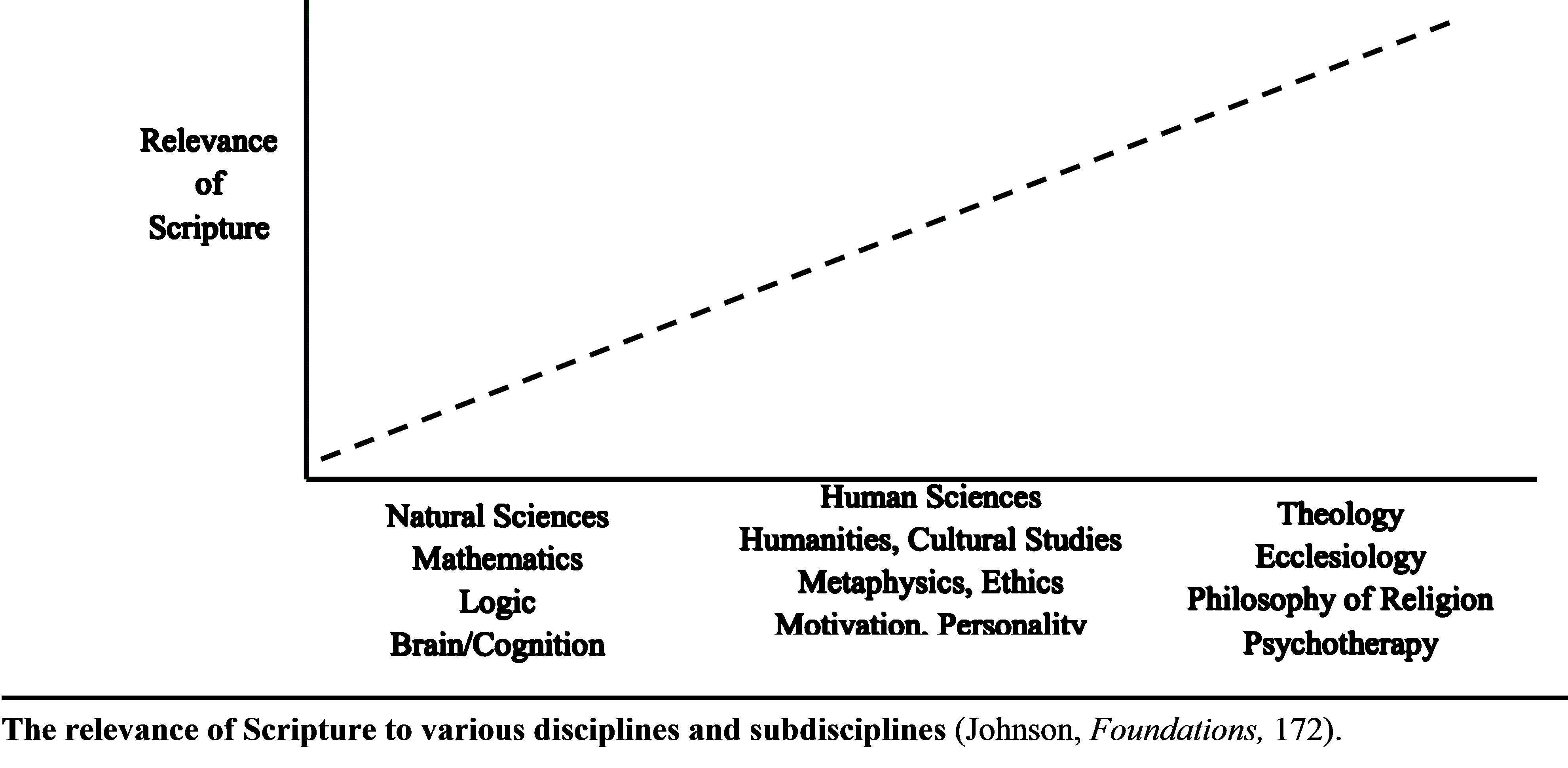
Eric Johnson points out that Paul “does not say that the Scripture contains all the soul-care information there is—all the knowledge that God has regarding the care of souls—or that all extrabiblical information that bears on human nature and counseling is irrelevant or useless or sin.”[3] Instead, he says, “The Bible contains what might be called the first principles of soul care—the most important truths for the maturation of the soul—and so it provides the God-breathed foundation for a radically Christian model of soul-healing.”[4]
So, how then is Scripture sufficient to address our problems?
First, Scripture gets to the most fundamental and important questions in all of the universe. It answers the questions: Does God exist, How did we get here, What is wrong with the world, what should we do with our life, what happens after this life, and other massive and important questions.
Second, Scripture tells us how we can receive salvation in Christ and live in Christ.[5] Thus the Bible tells us how to be transformed. David Powlison says, “The gospel of Jesus Christ is as wide as human diversity and as deep as human complexity. The Scriptures that bear witness to this Christ in the power of His Spirit are sufficient to cure souls.”[6]
Third, and something I have hinted at, the Bible gives us a lens in which to see the world. It is, again, the light to our path. John Calvin used the illustration of spectacles to explain this (Institutes 1.6.1). He said that the Bible is not only what we read, but what we read with. We use its pages as spectacles to view and read the world and the knowledge God has distributed throughout it.
Though Scripture may not be the only helpful text, it is the only necessary text. Further, and not surprisingly, God’s Word must be the authoritative text. God’s Word is the last word. That is not to say, however, that there are no other helpful resources. There certainly are. And it is in wisdom to make use of them. But, let it be clear, they must always be subordinate to the Word of the LORD.
God’s truth, as truth, is invaluable. God’s truth, as truth, is also immensely practical. It is practical for addiction.[7] It is even practical for aviation. Though, as the figure above points out, Scriptures relevance various depending on the topic. Scripture has less relevance in aviation. Yet, even in aviation Scripture is still important. For instance, it is through Scripture that we see that there is a God that rules the cosmos and thus we have laws that govern the realm in which we live. Laws that allow for flight under certain conditions. We see that the pilot must strive to be the best pilot he can be to the glory of God. We see that the pilot must praise the Lord who made the expansive world in which he lives. So we learn a few things that apply to aviation. However, we are not taught how to fly a plane. We are not taught how much fuel a plane will consume under various operating conditions.
Scripture does and does not address every relevant fact in the universe. It does address everything in that through Scripture we know the beginning and telos (goal) of all things. Yet, if obviously does not address every single datum of information. What it does is grander. More useful even.
The Word of God is truth. Guides us in truth. Makes us holy (Jn. 17:17). I realize this is not an apologetic,[8] but I can’t help but say with C. S. Lewis that I believe in Christianity and the Bible as I believe that the sun has risen. Not only because I see it, but because by it I see everything else.[9] “To the man enlightened by the Spirit, Scripture is no longer a bewildering jumble of isolated items… Part chimes in with part, Scripture meshes with Scripture, and the unified bearing of the whole Bible becomes apparent. The accompanying experience of the ‘taste’, or ‘flavour’ of spiritual realities is immediate and ineffable.”[10] Again, this is not something I can prove, it is a work of the Spirit. God the Spirit transforms by means of the Word of God. This is the biggest testimony of the sufficiency of Scripture; whether or not there is irrevocable evidence to prove it.
I will further say, that because God’s Word is truth, it gives us an accurate view of reality and of ourselves in that reality. “A true self-understanding is only possible in response to the word of God.”[11] Without God’s Word we are left to our own devices. We are left relying on a desperately wicked heart (Jer. 17:9). “Understanding Scripture promotes our understanding of God, ourselves and the way of salvation, so it is indispensable for our psychospiritual well-being (and for Christian soul care).”[12]
Look at what a proper, biblical understanding of our identity does: The Christian religion alone expels both the vice of pride and despair through the simplicity of the Gospel.
For it teaches the righteous, whom it exalts, even to participation in divinity itself, that in this sublime state they still bear the source of corruption, which exposes them throughout their lives to error, misery, death and sin; and it cries out to the most ungodly that they are capable of the grace of their redeemer. Thus, making those whom it justifies tremble and consoling those whom it condemns, it so nicely tempers fear with hope through dual capacity, common to all men, for grace and sin, that it causes infinitely more dejection than mere reason, but without despair, and infinitely more exaltation than natural pride, but without puffing us up. This clearly shows that, being alone exempt from error and vice, it is the only religion entitled to reach and correct mankind.[13]
So, as Eric Johnson has rightly pointed out the Bible claims to be and is a soul-care book.[14] “The Old and New Testament Scriptures together… have a virtue-shaping function… With the Holy Spirit’s aid, the Word of God reconfigures the minds of believers, recalibrates their hearts and reshapes their lives, moving them, communally, into an increasingly theocentric way of life.”[15]
God’s Word is truth and we are sanctified by it (Jn. 17:17). God’s Word is relevant. God’s Word is practical. God’s Word is sufficient.
_________________________________
[1] Michael Hortan says that “Theology is the lived, social, and embodied integration of drama (story), doctrine, doxology, and discipleship. I am suggesting that hearing the covenantal Word of our Lord is the source of that dethronement of the supposedly sovereign self and of the integration that subverts the disintegrating logic of Western dualism and individualism” (87). He goes on to say, “The ultimate goal of theology is practical—namely, to reconcile sinners to God in Christ and to restore them to communion with God and each other in true worship” (96).
[2] John Piper, “Thoughts on the Sufficiency of Scripture: What it Does and Doesn‟t Mean.”
[3] Foundations of Soul Care, 119.
[4] Ibid.
[5] Here are some relevant statements on Scripture: The Westminster Confession of Faith says, “The whole counsel of God concerning all things necessary for his own glory, man’s salvation, faith and life, is either expressly set down in Scripture, or by good and necessary consequence may be deduced from Scripture: unto which nothing at any time is to be added, whether by new revelations of the Spirit, or traditions of men. Nevertheless, we acknowledge the inward illumination of the Spirit of God to be necessary for the saving understanding of such things as are revealed in the Word: and that there are some circumstances concerning the worship of God, and government of the church, common to human actions and societies, which are to be ordered by the light of nature, and Christian prudence, according to the general rules of the Word, which are always to be observed” (1.6). “The Scriptures of the Old and New Testament were given by inspiration of God, and are the only sufficient, certain and authoritative rule of all saving knowledge, faith and obedience” (Abstract of Principals). “The Holy Scripture is the only sufficient, certain, and infallible rule of all saving knowledge, faith, and obedience” (The Baptist Confession of Faith [1689]). “We affirm that Scripture, having been given by divine inspiration, is infallible, so that, far from misleading us, it is true and reliable in all the matters it addresses” (XI of the Chicago Statement on Biblical Inerrancy). Wayne Grudem says, “The sufficiency of Scripture means that Scripture contained all the words of God he intended his people to have at each stage of redemptive history, and that it now contains all the words of God we need for salvation, for trusting him perfectly, and for obeying him perfectly” (Systematic Theology, 127). John Frame says “Scripture contains all the divine words needed for any aspect of human life” (John Frame, DWG, 220). He goes on, “Theology is the application of Scripture, by persons, to every area of life” (DWG, 276). I think especially helpful here is David Powlison’s article “Affirmations and Denials: A Proposed Definition of Biblical Counseling” in JBC 19 (2000): 18-25. Also see “On The Sufficiency of Scripture in a Therapeutic Culture” adopted by the Southern Baptist Convention.
[6] David Powlison, “The Sufficiency of Scripture to Diagnose and Cure Souls,” 13.
[7] Scripture surely speaks to the problem of addiction. Interestingly you could put a passage of Scripture alongside each step of many of the Twelve Step Programs. In many ways that is exactly what Celebrate Recovery has done.
[8] In defensive of Scripture I have found Frame, DWG helpful.
[9] Is Theology Poetry?”, The Weight of Glory and Other Addresses.
[10] J.I. Packer, A Quest for Godliness: The Puritan Vision of the Christian Life (Wheaton: Crossway, 1990), 92.
[11] Johnson goes on to say, “Scripture teaches that sanctification involves repentance and forgiveness of sins in Christ… and only within that context can genuine soul-healing occur. God’s word radically changes one’s perspective on one’s psychological predicament” (Ibid. 75).
[12] Johnson, Foundations, 38.
[13] Blaise Pascal, Pensees, 68.
[14] Foundations of Soul Care, 28 see also ch. 2. He says “The Bible is the primary soul care text for the Christian community” (Ibid., 18 italics mine). He says “primary” because he understands that other sources, even secular sources, can be helpful.
[15] Johnson, Foundations, 33.



 in X
in X 