The Resurrection

Peter refers to this Davidic Psalm in Acts chapter 2. He said: “Fellow Israelites, I can confidently speak to you about the patriarch David: He is both dead and buried, and his tomb is with us today” (Acts 2:29). In short, David’s dead and his body rotted. David did, however, as a prophet tell us that one of his descendants would sit on his throne (v. 30). So, David seeing that in advance “spoke concerning the resurrection of the Messiah: ‘His body was not abandoned to the realm of the dead, nor did His body see decay’” (v. 31).
Paul says it a little differently. He says King “David, after he had served the purpose of God in his own generation, fell asleep and was laid with his fathers and saw corruption” (Acts 13:36). King David saw corruption. His body decomposed. So, David is not the “Holy One” that the Psalm refers to.
Paul goes on to say, “But He whom God raised up did not see corruption” (v. 37). Ding, ding, ding! Jesus is the Holy One! He is the long-awaited Messiah and forever King!
David knew that the LORD would place one of his descendants on the throne. How did he know this? Because…
The Death
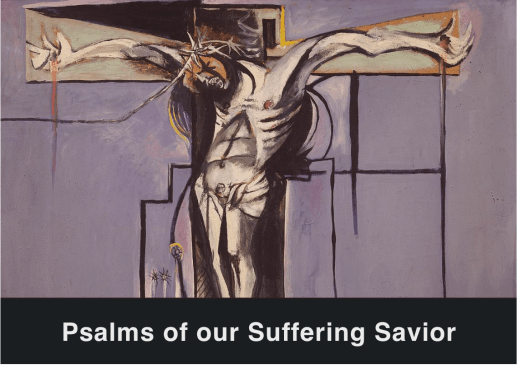
The Righteous One was not delivered. The Righteous One was afflicted and slayed. The Righteous One was condemned, condemned to die the terrible death of a criminal and slave.
Jesus was slaughtered. But it was not a senseless slaughter.
As the centurion nearby Jesus acknowledged, something more was going on behind the scenes. The centurion would have observed many deaths and many crucifixions. And so, he is in a unique position to recognize the purity and power of Jesus. The centurion said, “Certainly this man was innocent and the Son of God! (Lk. 23:47/Matt. 27:54; Mk. 15:39)
The centurion responded in that way after he saw Jesus call out and say, “It is finished. Father, into your hands I commit my spirit!” and breathe his last (Jn. 19:30/Lk. 23:46). The centurion must have been amazed by Jesus’ composure and everything else that had taken place surrounding Him. The centurion may have seen the way Jesus treated His enemies (Lk. 23:34), His promise to the criminal on the cross (v. 43), His prayer to God (v. 46), not to mention the ominous darkness (v. 44).[1]
Jesus’ death was not senseless, but according to Scripture. The Righteous One was slain in between two criminals. Jesus was, as Isaiah says, “numbered with the transgressors.” Yet in being cursed Jesus was carrying out a rescue plan that had long since been written (Rev. 13:8). “When He was hung on the cross, He took upon himself the curse for our wrongdoing. For it is written in the Scriptures, ‘Cursed is everyone who is hung on a tree’” (Gal. 3:13).
The Crucifixion
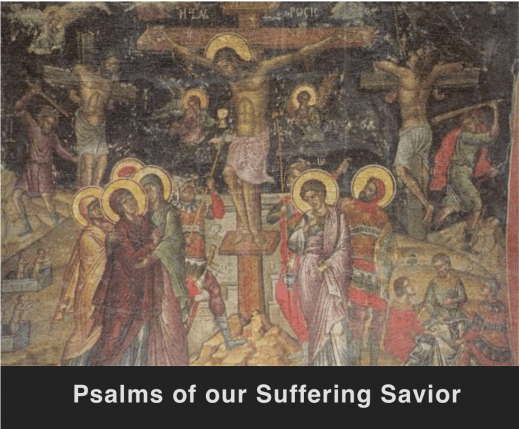
Psalm 22 has an amazing amount of parallels with Jesus’ experience on the cross on Good Friday. It says he is surrounded by rough enemies that want to harm him (v. 12), he is attacked by their words (v. 13), he is exhausted and close to death (v. 14), he experiences fatal dehydration (v. 15), his hands and feet are pierced (v. 16), his bony frame is exposed (v. 17), and his garments are divided and cast lots for (v. 18 cf. Matt. 27:35).[1]
Reading this Psalm you almost expect David to say something close to “Father, forgive them”[2] because the account of Jesus’ crucifixion is foreshadowed so many times (see also Ps. 69:4, 9, 21). Instead, in somewhat of a parallel passage to this Psalm and in great contrast to Jesus, David calls for God’s burning anger to overtake his enemies (69:24), he pleads that God would “add to them punishment upon punishment” (v. 27), and that they would be “blotted out of the book of the living” and “not be enrolled among the righteous” (v. 28).
Messiah Jesus instead Himself receives punishment upon punishment, His life is blotted out, and He joins the unrighteous on a cursed cross (see Is. 53:9 and Matt. 27:38) to save His enemies, those who are far from Him. Jesus is the perfect lamb of God, the lamb without blemish, that takes away the sin of the world (Jn. 1:29; 1 Pet. 1:19).[3]
The Betrayal and Rejection

Jesus came to His own people and they did not receive Him (Jn. 1:11). Jesus was hated, rejected, and persecuted (Is. 53:3; Jn. 15:18). His friends abandoned Him (Ps. 88:8, 18; Matt. 26:56), even after making a pledge of undying loyalty. Yet, even while He Himself was being betrayed He protected His friends (Jn. 18:7-8)
Jesus, as Hebrews says, can sympathize with us (Heb. 4:15). He knows what it is like to experience betrayal of the worst kind.
Jesus was troubled in His spirit because one of His dear friends would betray Him. And it’s no wonder that He was troubled. Have you ever been hurt by a close friend? It hurts.
Yet Jesus was betrayed, as the Scriptures said He would be (Jn. 13:18).
Judas, Jesus’ “familiar friend” (Ps. 55:13), betrayed Him with a kiss[1] (Matt. 26:48-49). Jesus used to walk with Judas in the very same garden in which He was betrayed (Jn.18:2-3). Jesus had also recently shared bread with Judas.[2]
Jesus felt the blow of a backstabber but His pain would be far worse than any knife could inflict.
The Cleansing of the Temple
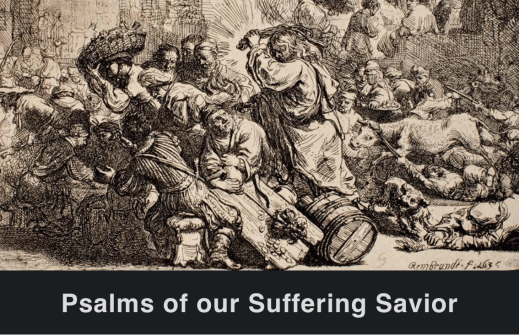
That’s exactly what happened to Jesus. He was consumed by zeal for the LORD’s house.
Can you imagine the scene? The whole city was frantic with excitement and expectation as Jesus came into Jerusalem.[1] Many expected that Jesus would soon bring freedom from Roman oppression and establish a reign of peace. People expected Jesus to ridicule Rome and inaugurate the Jewish state. Jesus, instead, condemns what’s going on in the Jewish temple.
If Jesus’ actions are unexpected it is because of misunderstanding or lack of zeal on our part. What Jesus did is in full agreement with Scripture (cf. Jer. 7:11; Zech. 14:21). The temple was to be a house of prayer, not a “den of robbers” (Is. 56:7). Specifically, the house of prayer is supposed to be “for all peoples” (v. 7). Because of all the selling, however, the court of the Gentiles would have been so filled with commotion that neither Jew nor Gentile would have been able to pray without distraction.
Jesus has concern for the poor, the sick, and the outsider. Jesus stands up for them even to the point of experiencing opposition. “Christ does more than denounce injustice—he takes action against it.”[2] That is good news!
The Hallel Psalms and the Supper

Psalm 115 is part of the Hallel Psalms. Hallel means, “praise.” Jesus would have sung the Hallel Psalms (Ps. 113-118) with His disciples on the eve of Passover.[1] Psalm 114 speaks directly of the exodus. From a New Testament perspective, we know that the salvation which began in Egypt would be finally filled in and through Jesus.
The Hallel Psalms were probably the last psalms Jesus sang before His suffering and death (Mk. 14:26). Jesus would have sung Psalm 115 knowing that He was Himself definitively showing God’s glory, love, and faithfulness. It is amazing also that Jewish people concluded the Hallel Psalms with the prayer:
“From everlasting to everlasting thou art God; beside thee we have no king, redeemer, or savior; no liberator, deliverer, provider; none who takes pity in every time of distress or trouble. We have no king but thee.”[2]
Truly! Apart from Messiah Jesus, there is no “no king, redeemer, or savior; no liberator, deliverer, provider.”
As we see in Psalm 115, idols are inept but God is a God of steadfast love and faithfulness. Whereas idols are inept God is involved. In fact, so involved that He came to this broken world in the form of Jesus Christ.
Idols are silver and gold but God came in flesh. Jesus has a mouth and with it, He spoke words of life. Jesus has eyes, and He saw this broken world and wept. Jesus has ears, and He heard the world’s bitter cries. Jesus has a nose, and He smelled the putrid smell of death. Jesus has human hands, and they were pierced. Jesus has feet, and they carried a cross, and were pinned to a cross. Jesus has a throat, and with it, He cried out: “my God, my God, why have Thou forsaken Me?!”
What did Jesus accomplish on the Cross?

Jesus purchased His people (Jn. 6:36, 39; 1 Pet. 1:18-19). He showed God’s amazing love (Jn. 3:16; 15:13; 1 Jn. 3:16). He brought justification to all who would place their faith in Him (Rom. 5:18) by dying for their sins, in their place (1 Cor. 15:3; 1 Pet. 2:24; 3:18; Is. 53). He absorbed the wrath of God (1 Jn. 2:2). He became sin and made all who trust in Him the righteousness of God (2 Cor. 5:21). He canceled debt (Col. 2:14). He brought reconciliation (Rom. 5:10; Eph. 2:16; Col. 1:20-22). He defeated Satan, sin, and death and brought victory (Gen. 2:15; 1 Cor. 15; Col. 2:11-15; Heb. 2:14; Is. 53).
Jesus knew no sin, yet He became sin. We see the idea of someone bearing sin in the place of others attested to in both the Old Testament and New Testament (cf. Lev. 10:17; 16:21-22; Is. 53:6, 11-12; Jn. 1:29). Jesus is the Lamb without blemish that takes away our sin by dying in our place but He also rises; priest and lamb are not His only office. Jesus is also the coming King who reigns eternally. Consequently, the salvation that Christ brings through His work on the cross brings not only appeasement from wrath but also entrance back into the true Promised Land, the Garden of Eden. So, “the gospel is the good news of the Kingdom through the cross,” as Kevin DeYoung and Greg Gilbert say. The New City Catechism says, “Christ’s death is the beginning of the redemption and renewal of every part of fallen creation, as he powerfully directs all things for his own glory and creation’s good” (Q. 26).
Christ’s work and resurrection propels on this world new creation (cf. Rom. 8:29; 1 Cor. 15:20; Col. 1:18), it is the inevitable avalanche that will eventually encompass the whole earth (Ps. 72:19; Is. 11:9; Hab. 2:14) and those in Christ will be swallowed up in the effulgence of its glory, there to bask in eternal joy. Christ’s work on the cross and resurrection is the dawn, the first light, but soon the full splendor of the sun.
10 Quotes from Greg Gilbert’s book *What is the Gospel?*

- “An emaciated gospel leads to emaciated worship. It lowers our eyes from God to self and cheapens what God has accomplished for us in Christ. The biblical gospel, by contrast, is like fuel in the furnace of worship. The more you understand about it, believe it, and rely on it, the more you adore God both for who he is and for what he has done for us in Christ” (Greg Gilbert, What is the Gospel, p. 21).
- “That I have rebelled against the holy and judging God who made me is not a happy thought. But it is an important one, because it paves the way for the good news” (30).
- “Nobody wants a God who declines to deal with evil. They just want a God who declines to deal with their evil” (44).
- “Since the very beginning of time, people have been trying to save themselves in ways that make sense to them, rather than listening and submitting to God” (102).
- “If we say merely that God is redeeming a people and remaking the world, but do not say how he is doing so (through the death and resurrection of Jesus) and how a person can be included in that redemption (through repentance from sin and faith in Jesus), then we have not proclaimed the good news. We have simply told the narrative of the Bible in broad outline” (107).
- “The message of the cross is going to sound like nonsense to the people around us. It’s going to make us Christians sound like fools, and it most certainly is going to undermine our attempts to ‘relate’ to non-Christians and prove to them that we’re just as cool and harmless as the next guy. Christians can always get the world to think they are cool—right up to the moment they start talking about being saved by a crucified man. And that’s where coolness evaporates, no matter how carefully you’ve cultivated it” (110).
- “Sins don’t shock us much. We know they are there, we see them in ourselves and others every day, and we’ve gotten pretty used to them. What is shocking to us is when God shows us the sin that runs to the very depths of our hearts, the deep-running deposits of filth and corruption that we never knew existed in us and that we ourselves could never expunge. That’s how the Bible talks about the depth and darkness of our sin—it is in us and of us, not just on us” (54).
- “It is only when we realize that our very nature is sinful—that we are indeed ‘dead in our trespasses and sins,’ as Paul says (Eph. 2:1, 5)—that we see just how good the news is that there is a way to be saved” (55).
- “Faith and repentance. That is what marks out those who are Christ’s people, or ‘Christians.’ In other words, a Christian is one who turns away from his sin and trusts in the Lord Jesus Christ—and nothing else—to save him from sin and the coming judgment” (73).
- “If you are a Christian, then the cross of Jesus stands like a mountain of granite across your life, immovably testifying to God’s love for you and his determination to bring you safely into his presence” (117).
Cosmic, Corporate, and Individual Reconciliation through Union with Christ (Part 4)

Cosmic, Corporate, and Individual Reconciliation through Union with Christ (Part 3)



 in X
in X 