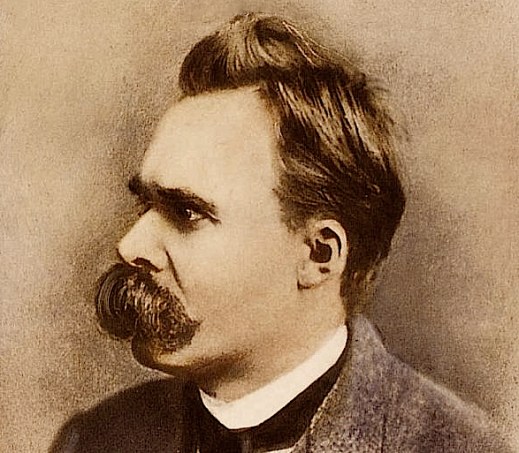
Nietzsche: Prophet of Doom (Part 2)

Nietzsche was Right, but He was also very Wrong
What I hope to show in my paper is that Nietzsche’s philosophy was either very accurate or very wrong. That is, Nietzsche’s conclusions if God is “dead” lead inevitably to certain conclusions. In my evaluation, I take three of Nietzsche’s late period writings (1886-88) as my main point of interaction.[1] This is for a two reasons. First, Nietzsche’s writings are large and this paper is not. Second, because his philosophy is more likely to be further established in his later writings.
In Nietzsche’s writings, he shows over and over again that his thought is the converse of Christianity; this is true if we look at his doctrine of eternal recurrence or his writings on slave morality. And as Nietzsche said, philosophy “always creates the world according to its own image, it cannot do otherwise”[2] and for Nietzsche’s thought, when extrapolated and applied, it makes hell. That is what I hope to argue, I hope to show how Nietzsche’s thought, when applied, makes a world in its own image, one that is terrible, filled with war, rape, and violence. I want to show this because I believe it is the inevitable outcome of the path he started. Since the beginning, it has been true that when we turn away from God we turn to our own destruction (Ps. 16:2; Jer. 2:5; Rom. 1; 3:12; etc.).
So, how is Nietzsche right? Nietzsche is right in that he paints a powerful portrait for us of what it means to be given up to our own devices (cf. Rom. 1). Nietzsche shows us the fallout from the Fall of humanity. But, Nietzsche was also gravely wrong. God is not dead!
Nietzsche’s philosophy is most clearly the converse of Christianity. Nietzsche says God is dead.[3] He says there is no truth. He says to assert yourself and make your own way. He says there is no heaven so live each moment today like it will occur eternally. In short, I hope to show that in the throwing off the “shackles” of morality and the hope of heaven Nietzsche has fettered those who follow him to hell on earth. Nietzsche’s writings and subsequent history show us that a world where right and wrong do not exist, is a world where lots of pain and oppression do.[4]
Ideas and beliefs have consequences, profound consequences. Paul says in 1 Corinthians 15 that if Christ has not been raised then let us eat and drink for tomorrow we die. Elijah says in 1 Kings 18:21 that if God is not God then don’t live for Him, live for whatever it is that you believe is true, whether Baal or, I believe he would say, whatever applicable philosophy. So, as we look at Nietzsche’s thought, which is the converse of Christianity, we can begin to understand and better appreciate Christianity.
__________________
[1] That is, Beyond Good and Evil: A Prelude to the Philosophy of the Future (1886), On the Genealogy of Morality (1887), and The Antichrist (1888).
[2] Nietzsche, Beyond God and Evil, par 9.
[3] Friedrich Nietzsche, The Gay Science, par. 108, 125, 343. Cf. e.g. Friedrich Nietzsche, Thus Spake Zarathustra, “Zarathustra’s Prologue,” par. 2 and 3.
[4] “By denying human equality and human rights, and by devaluing the lives of the masses, Nietzsche’s philosophy is really a loveless, forlorn philosophy of death, cruelty, and oppression” (Weikart, Richard, The Death of Humanity: and the Case for Life [Regnery Publishing], Kindle Locations 3394-3395.
Nietzsche: Prophet of Doom (Part 1)
Introduction
What follows is important and relevant for individuals, society, and the world. The water is deep at places but must be forded for us to get to solid ground. The world, I fear, is in a swamp of uncertainty, but the water is rising, every day the need for solid ground is more apparent but harder to reach. Wade through this with me, and perhaps we can find something solid to build upon. Something that will stand through the next wave, whatever that wave may be. As we set out, we will use Friedrich Nietzsche as our marker, though he is no North Star, he helps us map the mire.
First, we should know some about Nietzsche. Friedrich Wilhelm Nietzsche was born on October 15th, 1844 and died on August 25th, 1900. Nietzsche lived a sickly life and died at the age of 55 of pneumonia.[1] Nietzsche’s father was a Lutheran pastor. “Nietzsche’s uncle and grandfathers were also Lutheran ministers, and his paternal grandfather, Friedrich August Ludwig Nietzsche (1756–1826), was further distinguished as a Protestant scholar.”[2] Nietzsche faced many difficulties from a young age. His father died when Nietzsche was only four years old and just six months after the death of his father his younger brother died.
Nietzsche must have been gifted intellectually from a young age. For example, he composed piano, choral, and orchestral music as a teenager. He also received a good education at a first-rate boarding school. As a teenager, he read “David Strauss’s controversial and demythologizing Life of Jesus Critically Examined”[3] and it had a big impact on him. Early on Nietzsche considered himself devout, he was even called “little preacher” when he was young, but eventually, he would deny the faith, though at first not publically.[4]
Second, it should be understood, that in my mind, Nietzsche’s ramblings are closer to rhetoric than to philosophy. Nietzsche often employees ad hominem arguments and attacks a person (e.g. the Apostle Paul[5]) rather than their arguments. Nietzsche also seems fond of constructing straw man fallacies for his argumentative flame.
Third, Nietzsche wrote in a very unique and even enjoyable style. However, his lack of precision in writing is dangerous; people can construe his writings in many ways, and they have. There is much disagreement over Nietzsche and his work, which must to a large degree, must be because Nietzsche seems to have communicated often more like a poet, using words to paint, and not as much for precision.[6] It is true that Nietzsche at times is very hard to discern and it is also true that his body of work is large and there is much disagreement upon what place Nietzsche’s unpublished work should play in Nietzschean scholarship. However, all that being the case, Nietzsche is still responsible for what he wrote and the way he wrote.
Yannick Imbert has said,
In the history of Western thought, Nietzsche most likely holds the distinction of being the most misunderstood and misrepresented philosopher. Understanding him represents a particular challenge for Christians, given Nietzsche’s radical criticism of anything related to Christianity. Let us consider more closely the philosophy of the so-called father of nihilism.[7]
________________
[1] See e.g. D. Demelsoet, K. Hemelsoet, and D. Devreese, “The neurological illness of Friedrich Nietzsche,” 9-16 in Acta neurologica Belgica (April 2008).
[2] Robert Wicks, “Friedrich Nietzsche” in The Stanford Encyclopedia of Philosophy ed. Edward N. Zalta (Fall 2016 Edition)(https://plato.stanford.edu/entries/nietzsche/#Life1844 accessed on December 5th, 2016).
[3] Ibid.
[4] “From his early boyhood, Nietzsche was expected to follow the family tradition and become a minister himself. As late as 1864, when he studied classics and theology at Bonn University, he seems to have adhered to his family’s expectations (if no longer wholeheartedly). When one year later he finally dropped theology, he proved a family crisis” (Jörg Salaquarda, “Nietzsche and the Judaeo-Christian tradition,” 90-118 in The Cambridge Companion to Nietzsche [Cambridge: Cambridge University Press, 1997], 92).
[5] E.g. Nietzsche says, “In Paul is incarnated the very opposite of the “bearer of glad tidings”; he represents the genius for hatred, the vision of hatred, the relentless logic of hatred. What, indeed, has not this dysangelist sacrificed to hatred!… The life, the example, the teaching, the death of Christ, the meaning and the law of the whole gospels—nothing was left of all this after that counterfeiter in hatred had reduced it to his uses. Surely not reality; surely not historical truth!… He simply struck out the yesterday and the day before yesterday of Christianity, and invented his own history of Christian beginnings… The figure of the Saviour, his teaching, his way of life, his death, the meaning of his death, even the consequences of his death—nothing remained untouched, nothing remained in even remote contact with reality. Paul simply shifted the centre of gravity of that whole life to a place behind this existence—in the lie of the “risen” Jesus… The figure of the Saviour, his teaching, his way of life, his death, the meaning of his death, even the consequences of his death—nothing remained untouched, nothing remained in even remote contact with reality. Paul simply shifted the centre of gravity of that whole life to a place behind this existence—in the lie of the “risen” Jesus… What he himself didn’t believe was swallowed readily enough by the idiots among whom he spread his teaching.—What he wanted was power…” (Nietzsche, The AntiChrist, par. 42).
[6] So, Alvin Plantinga has said, Nietzsche “writes with a fine coruscating brilliance, his outrageous rhetoric is sometimes entertaining, and no doubt much the extravagance is meant as overstatement to make a point. Taken overall, however, the violence and exaggeration seem pathological; for a candidate for the sober truth, we shall certainly have to look elsewhere” (Alvin Plantinga, Warranted Christian Belief [Oxford: Oxford University Press, 2000], 136).
[7] Class notes from Yannick Imbert’s lecture in “History of Philosophy and Christian Thought” on Oct. 12th, 2016.
What is Art?

So, what is art? That is a difficult question. Let’s look at some examples I’ve gathered. Art is…
…according to a dictionary:
The quality, production, expression, or realm, according to aesthetic principles, of what is beautiful, appealing, or of more than ordinary significance
~dictionary.com
…indefinable
You cannot define electricity. The same can be said of art. It is a kind of inner current in a human being, or something which needs no definition.
~Marcel Duchamp , French painter and sculptor
…imitation or creation
Art is the unceasing effort to compete with the beauty of flowers – and never succeeding.
~Marc Chagall, Russian-French artist
…creating beauty or harmony
Filling a space in a beautiful way. That’s what art means to me.
~Georgia O’Keefe, American painter
Art is harmony.
~Georges Seurat, French painter
…an expression of our innate desire to decorate
The intrinsic decorative urge should not be eradicated. It is one of humankinds deep-rooted primordial urges. Primitive people decorated their implements and cult objects with a desire to beautify and enhance… it is a sense emanating from the urge for perfection and creative accomplishment.
~Sophie Taeuber-Arp, Swiss multi-media, applied arts, performance artist, and textile designer
…something that reveals the essential or hidden truth
Art does not reproduce the visible; rather, it makes visible.
~Paul Klee, Swiss painter
…a blessed mistake, a misfiring
Art is like the feathers of a peacock; there is no ultimate reason for it. It is nothing more than a leftover impulse from our distant ancestors. It is a mere signal to potential mates that we have enough time, resources, and leisure to be able to waste time on extravagance.
~This seems to be the Darwinian view (cf. Richard Dawkins, The God Delusion, 253)
…thought expressed
To give a body and a perfect form to one’s thought, this—and only this—is to be an artist.
~Jacques-Louis David, French painter
…a source of calm in a chaotic world
What I dream of is an art of balance, of purity and serenity, devoid of troubling or depressing subject matter, an art which could be for every mental worker, for the businessman as well as the man of letters, for example, a soothing, calming influence on the mind, something like a good armchair which provides relaxation from physical fatigue.
~Henri Matisse, French artist
Art has something to do with the achievement of stillness in the midst of chaos.
~Saul Bellow, American novelist
…self-expression or autobiography
What is art? Art grows out of grief and joy, but mainly grief. It is born of people’s lives.
~Edvard Munch, Norwegian artist
All art is autobiographical; the pearl is the oyster’s autobiography.
~Federico Fellini, Italian film director
…communication of feelings
To evoke in oneself a feeling one has experienced, and…then, by means of movements, lines, colors, sounds or forms expressed in words, so to transmit that feeling—this is the activity of art.
~Leo Tolstoy, Russian author
Art has to move you and design does not, unless it’s a good design for a bus.
~David Hockney, British artist
…labor
Art begins with resistance — at the point where resistance is overcome. No human masterpiece has ever been created without great labor.
~André Gide in Poétique
…philosophy
Above all, artists must not be only in art galleries or museums — they must be present in all possible activities. The artist must be the sponsor of thought in whatever endeavor people take on, at every level.
~ Michelangelo Pistoletto in Art’s Responsibility
…according to my favorite definition:
“One individual personality has definite or special talent for expressing, in some medium, what other personalities can hear, see, smell, feel, taste, understand, enjoy, be stimulated by, be involved in, find refreshment in, find satisfaction in, find fulfillment in, experience reality in, be agonized by, be pleased by, enter into, but which they could not produce themselves…
Art in various forms expresses and gives opportunity to others to share in, and respond to, things which would otherwise remain vague, empty yearnings. Art satisfies and fulfills something in the person creating and in those responding…
One person’s expression of art stimulates another person and brings about growth in understanding, sensitivity and appreciation.
~ Edith Schaeffer in The Hidden Art of Homemaking
America’s Trump Morality

The difference between Donald Trump and his explicit exploits and many guys on the street is not one of morality. It’s one of power and publicity. Sadly, there are many “average Joe” versions of Donald Trump and Anthony Weiner.[1] I have heard many “men” nearly quote Trump and recount worse exploits in various work environments.
Welcome to America. Welcome to our morality: “Life, Liberty, and the Pursuit of Pleasure,” wherever and however it might be found. This is our county’s mantra, even if not said in so many words.
Much of the American economy is marketed to our lust. Just look at advertising. We all know it, sex sells. Pornography is a booming market and so, sadly, is sex-trafficking.
To hear that Trump has appeared in XXX films and said a lot of bad and very inappropriate stuff is sad. But, it is sadly not surprising.
Are we really shocked by Trump’s inappropriate comments? No. Concerned? Yes.
“Grabbing women by…” whatever is, sadly, much of today’s culture. As a culture, we care about the quick and exciting. We care about bursting bosoms and one night stands. We care about quick fixes, porn, and pleasure at someone else’s expense (especially if no one knows and we can get away with it).
We care about having it our way. We care about following our passions, no matter what they are. We care about people’s freedom to do what feels right. We care about the right for no one to tell us what is right.
Pornography, Tinder, and all the advertisements that feed us represent where we are as a country. It represents the underlying desires of much of America. There’s many mainstream magazines and media forms–Men’s Health, GQ, and many musicians and movies (e.g. Fifty Shades of Grey),–that embody Trump’s morals even if they don’t say it outright.
So, are Trump’s words that surprising? For a presidential candidate, it’s unprecedented but it’s not surprising. That’s where we are as a country. Porn use to be something only under people’s beds and available at seedy XXX theaters but now it’s in our pockets, piped into our living rooms, and greeting us on billboards.[2]
Trump is vocalizing what many men view, say, and others often think. Obviously, I don’t agree with Trump. I think it’s sickening. But I also think we as a country have almost lost grounds on which to critique him. I clearly condemn Trump’s actions but I am afraid that much of America’s moral outrage is a hypocritical contradiction: Trump is made in our own image.
How can America say pornography is perfectly normal and acceptable and yet condemn the person that lives out what is idolized on the screen? You know what I think?! I think that Trump is not the only problem or the biggest problem; he is a harbinger of things to come and an echo of what has gone before. He is a visualization of many people’s secret sins and inner hearts.
Trump is not excused obviously! He is despicable. However, as has been said, “we see that all the time in movies” and we hear it and watch it on our phones. Trump is a problem but he is not the problem. Trump is fruit from what has been sown for quite some time. He is in many ways, I’m afraid, the personification of many people’s dreams.
What is morality after all? Isn’t it might that makes right? And Trump has plenty of “might.” Or if we measure morality by the social construct theory Trump, sadly, wouldn’t be wrong. The social environment has basically said his actions are not wrong time and time again. After all, aren’t we as people just “matter in motion” and isn’t sex just “an exchange of fluids”?[3]
In Trump’s own words “when you’re a star, they let you do it. You can do anything… Grab ’em by the @#$*!…” And sadly, that is often true. We often do anything for a star, or for money. And sadly, when someone “consents,” when someone lets someone else do… or whatever, we look at it as okay because there was consent.
Perhaps, we can all agree that it’s a shame that Trump made those comments since it reflects poorly upon the USA and offends some, but from a moral point of view on what foundation can America criticize him?
This, friend, is our world. This is where we are. And most people are fine with it.
However, doesn’t Trump’s example make it clear that it is wrong to ever look at a woman as an object in that way? Don’t we see how depraved his statement is? Don’t we see how debauched much of American society is?!
Women are not objects. Men are not objects. Pornography is wrong. And by implication, much of our advertising is wrong too. And many of us are wrong. It’s not just Trump. It’s the way we look at the Kardashians. It’s the way we idolize sexy bodies and always having it our way. It’s the way we forget what’s right and just want what we want. The problem is not just external (Trump), it’s likely to a large part internal (in our own heart).
America, wake up! We made Trump. We are Trump and Trump is us. We can’t have our cake and eat it too. We can’t indulge in licentious sexual “freedom” without the forging of certain “fetters.”
John Adams once said, “Our Constitution was made only for a moral and religious people. It is wholly inadequate to the government of any other.” Why did he say that? He said it at least in part because if we are not a moral people, a people who believe in a divinely given morality, then we will elect very corrupt officials. We will create and elect people who reflect our own character.
We will, in the words of the Old Testament prophet Jeremiah, pursue worthlessness, and become worthless (Jer. 2:5).
[[Two Postscripts: Please note that I do not support either candidate. 1) I loathe Hilliary Clinton and her pro-abortion stance (see here for example) and don’t trust her. 2) I don’t trust Trump either. Two verses to consider for those trusting Trump because he will (supposedly) “save” the Supreme Court: Ps. 118:9, “It is better to take refuge in the Lord than to trust in princes [or their modern equivalent]” (cf. Ps. 146:3) and Ps. 40:4, “Blessed is the man who makes the Lord his trust, who does not turn to the proud [certain political candidates], to those who go astray after a lie!” These verses are true even when considering such serious subjects as the future of America and unborn babies.]]
______________________
[1] Actually, it is sadly my own disposition. I am myself not beyond struggling with lust. However, by God’s grace, I am not enslaved to it and loathe porn. I have seen the chaos and curse that sexual sin brings to individuals and society through people close to me.
[2] The porn industry is one of the biggest industries and has the largest presence online. In fact, porn sites get more visitors each month than Netflix, Amazon, and Twitter combined. Pornography is also very potent. I’ve read that it’s as addictive or more addictive as heroin or cocaine. Social media very often, even if it’s not officially labeled pornographic, is teaching and influencing how we think about sex and act out sexually (see e.g. Gail Dines, “Is porn immoral? That doesn’t matter: It’s a public health crisis” in The Washington Post).
[3] E.g. Richard Dawkins has said, “There is a bottom no design, no purpose, no evil, not good, nothing but pointless indifference… We are machines for propagating DNA” (Dawkins, Unweaving the Rainbow).
The Church & Social Responsibility

C.H. Spurgeon said, “Nothing but the Gospel can sweep away social evil… The Gospel is the great broom with which to cleanse the filthiness of the city; nothing else will avail.”[1] Spurgeon experienced the truth of that statement in his city and Scripture attests of its truth over and over again.
Look at Acts 19:18-20 for a prime example of the social change that took place because of the gospel. Also look how faith changed Zacchaeus (Luke 19:1-10). He no longer defrauded people but restored fourfold those whom he had defrauded. He also gave half of his belongings to the poor. It should therefore not be our first goal to enact political and social change but spiritual change that takes place through the receiving of the gospel.[2]
If the gospel is truly received social change will follow. I do not believe in the social gospel[3] but the gospel will inevitably bear fruit in the social realm. The gospel is necessarily social; that is, it has unavoidable implications on society. As Carl F. H. Henry has said, “A globe-changing passion certainly characterized the early church… A Christianity without a passion to turn the world upside down is not reflective of apostolic Christianity.”[4] We must show and tell the gospel if there is to be a full and effective presentation.
The Lausanne Committee accurately said this of Christian social responsibility:
“We affirm that God is both the Creator and the Judge of all people. We therefore should share his concern for justice and reconciliation throughout human society and for the liberation of men and women from every kind of oppression. Because men and women are made in the image of God, every person, regardless of race, religion, colour, culture, class, sex or age, has an intrinsic dignity because of which he or she should be respected and served, not exploited. Here too we express penitence both for our neglect and for having sometimes regarded evangelism and social concern as mutually exclusive. Although reconciliation with other people is not reconciliation with God, nor is social action evangelism, nor is political liberation salvation, nevertheless we affirm that evangelism and socio-political involvement are both part of our Christian duty. For both are necessary expressions of our doctrines of God and man, our love for our neighbour and our obedience to Jesus Christ. The message of salvation implies also a message of judgment upon every form of alienation, oppression and discrimination, and we should not be afraid to denounce evil and injustice wherever they exist. When people receive Christ they are born again into his kingdom and must seek not only to exhibit but also to spread its righteousness in the midst of an unrighteous world. The salvation we claim should be transforming us in the totality of our personal and social responsibilities. Faith without works is dead.”[5]
_____________________
[1] C. H. Spurgeon, the soul winner, 247.
[2] Thomas r. Schreiner says, “Jesus did not call for political revolution; he trusted in the power of the word of God (mark 4:28) and focused on the need of the nation to repent and turn to God… what will change society is individuals turning from their sin and committing themselves wholly to God” (Schreiner, new testament theology, 52-53). However, that is not to say that political involvement is wrong (mark 6:14-20; matt. 14:1-12; acts 16:35-39; 24:25; 1 Tim. 2:1-4) only that we should not set our hopes on it. The gospel is the power to salvation and therefore the power to change (cf. Rom. 1:16; 1 cor. 6:9-11). Note, however, that john the baptizer was martyred like many other Christians, for biblically informed political convictions (I think of Bonheoffer and Martin Luther King Jr. Notice, also that they gave their life and did not take life).
[3] The social gospel movement was a movement started by Walter Rauschenbusch in the early 1900s. It emphases social justice over and against the gospel and has a defective view of the kingdom of God (among other things). Contra the social gospel movement the kingdom of God, though ushered in by Christ’s coming, does not find its fulfillment until Jesus brings it down from heaven. However, in revolting against the social gospel we should not be guilty of revolting against the Christian social imperative (see carl f. H. Henry, The Uneasy Conscience of Modern Fundamentalism, 22)
We don’t bring in the Kingdom, God does (cf. Rev. 21:1-2; dan. 2:44-45).
However much we try or even succeed in our responsibility to secure greater economic justice, Christians can look beyond this world, with all its tribulations and inequities, to the restoration of all things at Christ’s return (acts 3:21). Our faith is not pinned or limited to humanity’s capacity to share generously; for it is only at the second coming that our full humanness will be restored. This does not mean that we cease our efforts to improve this world however. On the contrary, it is because we cherish the vision of completed humanness in the end that we must all the more promote human dignity today (www.lausanne.org).
[4] Henry, The Uneasy Conscience Of Modern Fundamentalism, 16.
[5] http://www.lausanne.org (italics mine). See: Acts 17:26, 31; Gen. 18:25; Isa. 1:17; Prov. 13:31; Ps. 45:7; Gen. 1:26, 27; James. 3:9; Lev. 19:18; Luke 6:27, 35; James. 2:14-26; Jn. 3:3, 5; Matt. 5:20; 6:33; 2 Cor. 3:18; James. 2:20.
Christianity is Polarizing

Christianity is polarizing, but why?
Teachers in public schools can’t share a Bible verses with their students, let alone lead a Bible study (at least in Fairfax, VA). However, if they started a club on Plato and Aristotle’s teaching it probably wouldn’t be a problem. Actually, they would probably be able to discuss Mein Kampf and it would be less alarming than Jesus’ command to love our neighbors.
Why is this the case? Christianity has not proved to be unhealthy for individuals or society (I could make a good argument for the converse though); and there are many people in America (and in Fairfax, VA) that claim to be Christians. A lot more than claim to hold to platonism, for example.
What makes Christianity polarizing?
The two main things Christians are called to do is love God and love their neighbor. That doesn’t sound so bad. The Bible tells Christians that true religion is to take care of widows and orphans.
Christianity has had a very important place in starting schools and universities (e.g. Princeton, Harvard, Yale), various hospitals, orphanages, and, of course, chic-fil-a. Christianity brought us the YMCA (Young Men’s Christian Association) which brought us basketball which brought us the NBA… and Jordan… and Lebron…
So, what makes Christianity so polarizing? It seems like it has a lot of good aspects. Actually, Jesus Christ, who Christians worship and follow died for people that hated him; and Christians are called to love, serve, and sacrifice in the same way that he did. That’s why, for example, medical missions and orphanages sprouted up.
The Bible, the book that Christians follow, is the number one best seller of all time. No matter what people think about the truth claims of the book it is a work of profound literature. Even Richard Dawkins, a staunch atheist and many ways hater of religion, does not deny that it is an important book.
What causes all the problems when it comes to Christianity? Perhaps it’s that it teaches that we are (all) to love God and love our neighbors. We are (all) called to care for orphans and widows. We are (all) called to love in sacrificial ways.
Perhaps people appreciate these things but know that they are called to do them but don’t live up to them. Perhaps they feel guilty about it. Perhaps it’s a mixture of things. Perhaps people know that Christianity teaches that all are sinners in need of redemption.
Perhaps people know that Christianity teaches that all are sinners in need of redemption. Perhaps that’s offensive to some people, even though it seems to be a very empirical reality.
What do you think? Why is Christianity so polarizing?
Art through the Eyes of Faith

Introduction: How should we think about art? Why has art had such a varied history? What explains why we can relate to both “sad reflective art” as well as “joyous exuberant art”? How does art in its various forms sometimes make us yearn for something that seems out of reach?
These are big questions and questions that have been answered by many better minds than my own. However, I believe as we look to God’s Word as our guide we will be able to make some significant observations that will better position us to answer them.[1]
Let’s consider seven things from the storyline of Scripture.
Consider the Creator
“In the beginning, God created the heavens and the earth…” (Gen. 1:1). He made atoms and oceans, sunsets and frogs, butterflies and hogs. He made matter and motion, the stars in space and every trace of sand. He made my hands and yours too. God makes flowers and bees. God thought up nectar and the neurons that make emotion.
God created the wild crash of hydrogen and oxygen known as water; crystal clear and falls from the sky, and gives life. It’s like miraculous manna from heaven that we completely take for granted.
The only artist who is perfect in all forms of creativity—in technique, in originality, in knowledge, of the past and future, in versatility, in having perfect content to express as well as perfect expression of content, in communicating perfectly the wonders of all that exists as well as something about Himself, is of course God—the God who is Personal.[2]
God is the most majestic musician, supreme sculptor, wowing writer, and awesome artist. We can look at the flowers of the field and see that God is the most creative creator of clothing. He is the creator that gives creativity.“God is the Great Maker, the unique Creator. And all other creative activity derives from him.”[3]
God the Creator is the great Artist. He set the dome of the heavens and fashioned the universe. He created the music of the stars and set the heavenly bodies whirling in a great cosmic dance. He paints the sky of man’s earth with clouds and sunsets, and the ground with flowers and streams. He fashioned man out of dust of the earth. He tells the greatest love story of time and eternity, and unfolds it in a drama unlike any that man has ever created. He uses every art and every medium.[4]
Observation: Our creativity is contingent upon the Creator.[5] God is the great Creator and we merely reflect Him with our creations, as we will see.
Consider Creation
We see in the beginning that when God saw all He had made He pronounced, “very good” (Gen. 1:4; 10; 12; 18; 21; 25; 1:31). There was no sin, no death, and no problems. Man had perfect fellowship with God (cf. Gen. 3:8) and enjoyed God’s beautiful creation.
God’s creation shows us what God wants for us. He wants us to enjoy and take part in the creation that He has made very good. It shows us our intended design: fellowship with God and each other and the correct enjoyment and creative oversight of creation.
The heavens declare and shout forth the glory and beauty of God (Ps. 19:1-6). “Our God is beautiful in all his way; it is part of his perfection. This divine beauty has been woven into the fabric of creation, in the massive stars, inside the submicroscopic balance of the atom.”[6]
Observation: As we take in and enjoy beauty, whether Mozart, Norman Rockwell, or a brook basking in the sun, it points us back to our Creator for which we truly yearn. Even “photography is a longing for eternity, a desire for a lasting impact. When we blast our memories far and wide, we are hoping they will linger when we’re not present and maybe even when we’re gone. How odd that something seemingly instant can be rooted in a hunger for eternity.”[7]
Consider that we are Creative Creatures
What is man? A complex animal, more advanced through Darwinian Evolution? Are humans merely matter in motion?
We see the doctrine of the image of God,[8] the imago Dei, in various places in Scripture (Gen. 1:26-27; 5:1-3; 9:6; 1 Cor. 11:7 Col. 3:10; James 3:9). The most prominent is Genesis 1:27 that says, “God created man in His own image, in the image of God He created him; male and female He created them.”[9] “The ‘image (likeness) of God’ refers to a permanent aspect of our created nature, which was not affected by the fall. It is the special characteristic of the human race, which distinguishes us from other creatures.”[10]
So, “We are created in the likeness of the Creator… So we are, on a finite level, people who can create.”[11]
We were made, in part, to create. We were made to work unhindered at the creative care of the creation. However, the plot thickens. A cosmic problem is introduced. Through man’s fall we see the crash and curse of creation, which explains why everything is no longer good and why our creative care is constrained.
Observation: We are creative creatures; that is part of what we do and how we reflect the image of our Creator. We see that because that is what we were created to do we thrive as individuals and as societies as we create.
Man was created that he might create. It is not a waste of man’s time to be creative, because this is what was made to be able to do. He was made in the image of a Creator, and given the capacity to create—on a finite level of course, needing to use the materials already created—but he is still the creature of a Creator.[12]
We were created in the image of God not to procrastinate but to be productive, to create and “subdue the earth.” When we are functioning according to our design, doing what God has given us to do, it is then that we prosper (and realize I do not mean financially, I mean teleologically).
Realize there are all sorts of types of creativity, one person creates cars, another creates music, and still another manages his restaurant in thoughtful ways.[13] The important observation here is not so much what we do but how we approach our tasks.
We should approach all we do with intentionality and skill. As Timothy Keller says, “our work can be a calling only if it is reimagined as a mission of service to something beyond merely our own interests. Thinking of work mainly as a means of self-fulfillment and self-realization slowly crushes a person and… undermines society itself.”[14]
Consider the Crash
Man disobeyed and rebelled (Gen. 2:16-17; 3:6) and this brought spiritual and physical death (Gen. 2:17; 3:19), pain (3:16-17), difficulties (3:18-19), and separation from God (3:23-24). This is the bad news that we all live in.
In Genesis 3:1-24 we see the Fall of humanity. We see various forms of death given birth to. We see “’an ever-growing avalanche of sin, a continually widening chasm between man and God’. It progresses from disobedience, to murder, to indiscriminate killing, to titanic lust, to total corruption, and uncontrolled violence.”[15] Sin truly brings a litany of death. “Disease, genetic disorders, famine, natural disasters, aging, and death itself are as much the result of sin as are oppression, war, crime, and violence. We have lost God’s shalom—physically, spiritually, socially, psychologically, culturally. Things now fall apart.”[16] Sin opens Pandora’s box and unleashes a horde of evil.
We have marred more than the mediocre; we have marred the Michelangelos of the world. We have marred superb beauty and made it unbelievably hideous.
To illustrate, if I ruin a “masterpiece” that my son made with paper, glue, and crayons, the ramifications will be far less than if I destroy the Mona Lisa.
Well, creation was intended to be a Mona Lisa; that is, it was intended to be supremely glorious. God’s creation was intended to be good, beautiful, and aesthetically pleasing to our senses, emotions, and intellect beyond what we can imagine.
We often think of this world as the way it is not as the way it was intended to be. If we could see a glimpse of what the Great Creator had in mind for His masterpiece, then we’d see that we “paved paradise and put up a parking lot.” We essentially killed a thousand Beethovens and blared white noise. We backfilled the Grand Canyon with gravel. We burned a hundred museums of art. We scorched our taste buds off our tongue. We took a wrecking ball to all the wonders of the world and razed a thousand gorgeous cities. We have brought cataclysmic chaos to the world.
Sin is not a light thing. We, as humans, were created in the image of God. We were to be like Christ, God in flesh (cf. Gen. 1:26-27). The world was meant to be supremely glorious, peaceful, and loving but instead it is disgusting and understandably repugnant to God. So, as we try to grasp the wonder of what has been marred we can begin to understand how serious the situation is and how terrible sin is.
The crash happened in Genesis 3, man disobeyed God and chaos and curse ensued. In the crash, we see what went wrong with us and the world.
Observation: The image we bare is tainted and marred. It’s like one of Winslow Homer’s famous watercolor paintings had a pail of acid poured on it. We can still trace the image but it’s faded. We need a master painter to repaint us.
It is important to observe that “The arts, which speak so subjectively and so very personally regarding who and what we are in relation to our Maker are very vulnerable to the distortion that sin has brought in the world.”[17] Even in the Bible art can be used to idolatrous ends. We, after the crash, often use creativity to de-create and desecrate the good world God has made.
We see that we often desire heaven and make hell. We want back in Eden and sometimes we express that, but sometimes we express the crash. We, in the words of Makoto Fujimura, “carry the dust of Eden in our DNA.”[18] Michael Card has said, “A thousand examples speak of a deep, inner hunger for beauty that, at its heart, is a hunger for God. We hunger for beauty because it is a beautiful God whom we serve.”[19] Yet, we are stuck on the outside of Eden.[20] We are stuck yearning.
Much art reflects on this theme, from superhero movies to angsty art, we know there was a fall. We know we live after the crash. We desire the new creation but many don’t know the answer. They don’t know Christ the Promised One.
Consider Christ
After the crash of creation, after the curse was introduced, there was a promise of a deliverer that would set all right again. At first, the promised offspring (Gen. 3:15) was vague; in fact, Eve rejoiced because she thought she had the offspring (4:1) but it was all for naught because Cain was the offspring of the serpent and killed his brother.
However, later on, we see Him who even the prophets longed to see (Matt. 13:17), we know that all Scripture finds its fulfillment in Jesus who is the long awaited Messiah (2 Cor. 1:20). The one that will crush the curse and bring in the new creation.
The Bible is a true story about God making the world, man messing it up, and God becoming a man to fix the world by not messing up. It is a story of Eden—exile—repeat. It is not until the true Adam, the true and righteous Son of God—Jesus—comes that this process is broken. All of Christ’s predeceases fell short; Adam, Noah, Abraham, Saul, David, Solomon, and the lambs, priests, and prophets could not fill Christ’s role.
Through Christ we see what God has done to put things right. Christ hung, outstretched on the tree, and bore the curse and will come again to bring His eternal reign when peace will be pervasive and joy will be tangible.
Jesus is the hero of the story. He takes upon Himself the curse and brings the new creation and friendship with God that we all yearn for.
The Cosmic Creator that flung the stars in place and knows them all by name cares to the point of crucifixion. He is the author that writes Himself into the story. He makes, He comes, He dies, and He rises again. And He’s coming back to recreate the world.
Observation: In Christ, first we see our Savior, but we see also see a profound example. Christ’s character as seen in the Gospels is one of creativity and compassion. He is expressive and real. He is harsh and gentle.
Christ was honest to the reality of our current condition. He didn’t lighten the realities of the crash and the catastrophes that it created. However, He wasn’t hopeless either. He brought the world the solution they needed: Himself.
We too must understand our current condition and honestly and creatively communicate truth to the world.
Consider our Current Condition
It is important for us to correctly situate ourselves within our current condition. We, for instance, do not want to place ourselves within the new creation when we are still wheeling from the crash. In the same way, we don’t want to forget that Christ has came. We need to understand our current condition. We do not want to have an “over-realized eschatology” or an “under-realized eschatology.” We want to correctly grasp our situation and communicate the struggles and hopes that we have to the world.
Steve Turner has said, “It is not Christian to make art that assumes that the world is unblemished.”[21] It’s certainly true that the Kingdom has come in God’s Son. The light is shining and the darkness is passing away (1 Jn. 2:8) but it hasn’t passed away yet. We still live in a fallen world. Soon the darkness will be forever gone (Rev. 22:5) but for now it’s an element in our reality so to paint or portray reality means including “darkness.”
We must position ourselves after the Creator, the creation of all things, and the crash and curse of the cosmos, and we must remember that we were created as creative creatures to reflect our Creator. We must remember Christ, the hope of all the world. We must hope in Him and the new creation that He will bring at the consummation of His Kingdom.
We must not get stuck hopelessly on the crash and curse of the world, though to be in the world is to reflect realistically on its realities. Yet, we must not forget Christ and His coming Kingdom and the fact that we are not the center of the universe. So, “The Christian artist will often be an irritant, disturbing the anthropocentric view of the world that fallen nature naturally gravitates toward.”[22]
Observation: It is when we remember our current condition, all that has laid behind us and all that lays before us, that we can most profoundly and prophetically speak into our cultures. It is then that we can bring compassion and truth to bear and see God’s truth take root and change people and society.
So, David Skeel says, “The most beautiful and memorable art will reflect the tensions and complexity that only Christianity can fully explain.”[23]
Consider the coming Consummation
When Jesus came the first time, He had no beauty or majesty. When He comes again His face will shine like the sun in full strength (Rev. 1:16). We were cast out of the garden in the beginning but as Jesus said to the thief on the cross, all those who go to Him will be let back in. For those in Christ, the story of history will have a happy ending (Rom. 8:29-39).
Through Jesus the Christ, we have the unwavering hope of a new creation (2 Peter 3:13). “The creation was subjected to futility” in Adam (Gen. 317-19) but in Christ “the creation itself will be set free from its bondage to corruption and obtain the freedom of the glory of the children of God” (Rom. 8:20-21). As Isaac Watts put it in “Joy to the World,”
No more let sins and sorrows grow, Nor thorns infest the ground; He comes to make His blessings flow Far as the curse is found, far as the curse is found.
The problem (all of them!) will be fixed and there will be no more sin (Rev. 21:27; 22:3; Matt. 13:41). Everything will be more right than it was ever wrong. We will see that God did, in fact, work all things together for good (Rom. 8:28). Christ will make a new creation and we will be like Him (1 Jn. 3:2; Rom. 8:29; 2 Peter 1:4). “Just as we have borne the image of the man of dust, we shall also bear the image of the man of heaven” (1 Cor. 15:49). God will fulfill our deepest desires and we will finally live with Him in paradise in the end.
Jesus is the good news but the good news is not static it goes on and on and on; those in Christ live happily-ever-after. In contrast, God “will gather out of his kingdom all causes of sin and all law-breakers” (Matt. 13:41) and cast them into the pit of eternal fire (Rev. 20:14-15). The Lord will bring heaven down and establish His Kingdom that will not be shaken but will last forever and ever in perfect beauty and joy.
Observation: Time is working itself down to a consummation; to a renewal of the creation, in fact, a new creation. Ever since Eden, this is what we have longed for and it is made available through Christ. However, many miss it. They look to the creature rather than to the Creator to find satisfaction, life, and joy.
As we carry out various creative tasks we can thoughtfully point people to what they need and why they need it. We can address the issue of the crash, our current condition, and Christ and the coming consummation.
We can also know that art occupies a type of middle ground. In one way pointing backward (to creation) while planted firmly (in the current condition) and also pointing ahead (to the consummation).
Conclusion: So, how should we think about art?
As we carry out our creative tasks (whether or not it is typically labeled art or not) we reflect our Maker. We point to the reason and rhyme of the universe, especially when we reflect on and cause others to reflect on why, at times, there seems to be no reason and rhyme to the universe.
Lastly, as we seek to be faithful and reflect God’s image we must look to Jesus. He is the Master. He is “painting” us in His image. The brushstrokes that stand out the most are “love the LORD your God with all you are” and “your neighbor as yourself.” It is through the application of those two brushstrokes that we look more and more as we were always supposed to look.
_______________________
[1] My word is very fallible but God’s Word is truth. This is important because, as William Dyrness, has said: ““Artistic issues are, according to the biblical perspective, profoundly theological from the beginning to end” (William A. Dyrness, Visual Faith: Art, Theology, and Worship in Dialogue, 70).
[2] Edith Schaeffer, The Hidden Art of Homemaking, 14-15.
[3] Frank E. Gaebelein, The Christian, The Arts, and Truth, 72.
[4] W. S. LaSor, “Art” in The International Standard Bible Encyclopedia, 302.
[5] “Only God can imagine and make something out of nothing. In this sense, he is the only One who deserves the title of Creator. We are merely creative” (Harold M. Best in Michael Care, Scribbling in the Sand, 122).
[6] Michael Card, Scribbling in the Sand, 32.
[7] Craig Detweiler, iGods: How Technology Shapes Our Spiritual and Social Lives, 189.
[8] “That man by creation uniquely bears the divine image is a fundamental biblical doctrine—as also that this image is sullied by sin and that it is restored by divine salvation” (Carl F. H. Henry, “Man” in Baker’s Dictionary of Theology, 338).
[9] “The declaration that humanity bears God’s likeness is startling, awesome, and almost incredible, but what exactly does it mean?… Two primary, and not necessarily contradictory views are: (1) the substantive view, according to which humans share some aspects of the nature of God (intelligence, emotions, etc.); and (2) the functional view, according to which humans act like God in their divinely given role to rule the earth. The immediate context, with the language of dominion and subjugation, suggests that the functional interpretation is primary” (Köstenberger, God’s Design for Man and Woman, 29). I personally believe in a hybrid view. I believed in a functional view that implies the substantive view. That is, if we as humans are to function as vice-regents we must be endowed with the abilities to carry it out (e.g. intelligence, creativity, etc.).
[10] G. L. Bray, “Image of God” in NDBT, 576.
[11] Edith Schaeffer, The Hidden Art of Homemaking, 24.
[12] Edith Schaeffer, The Hidden Art of Homemaking, 24.
[13] I think for example of Chic-fil-a.
[14] Keller, Every Good Endeavor, 19. He also says “Everyone will be forgotten, nothing we do will make any difference, and all good endeavours, even the best, will come to naught. Unless there is God. If the God of the Bible exists, and there is a True Reality beneath and behind this one, and this life is not the only life, then every good endeavour, even the simplest ones, pursued in response to God’s calling, can matter forever” (29).
[15] Revd Victor James Johnson, “Illustrating Evil – The Effect of the Fall as seen in Genesis 4-11,” 57 in Melanesian Journal of Theology 11-1&2 (1995).
[16] Timothy Keller, The Reason for God: Belief in an Age of Skepticism (New York: Penguin Group, 2008), 177. “Disunion with God is reflected in disunion with others and with oneself” (Johnson, Foundations of Soul Care, 466).
[17] Frank E. Gaebelein, The Christian, The Arts, and Truth, 75.
[18] Makoto Fujimura, Refractions.
[19] Michael Card, Scribbling in the Sand, 32.
[20] “Christianity explains our inability to sustain transcendence as evidence that creation, and the creation, have been corrupted” (David Skeel, True Paradox: How Christianity Makes Sense of Our Complex World, 88).
[21] Steve Turner, Imagine: a vision for Christians in the arts, 86. “To portray the world as a rose garden can be as misleading as portraying it as a cesspool” (Ibid., 58).
[22] Steve Turner, Imagine: a vision for Christians in the arts, 22.
[23] David Skeel, True Paradox: How Christianity Makes Sense of Our Complex World, 82.
Desert Soul

this land is as dead as my soul
 so purge and make new
 even if it means a knife
 i want life

new life
 spring
 make me clean
 new

i want You
 oh God, rescue me
 i'm drowning
 i don't see the light
 all is night
 an endless cycle down

my soul's diseased
 and I need You please
 because the light is fading
 i'm forgetting You and Your ways
 the Devil's lies seem sweet
 give me swift feet to run
 for I am Your son
 let me not believe his lies
 they are my demise

i need You.
Procrastination

Imagine: a picture of a man standing beside a fire extinguisher contemplatively looking at his home on the verge of going up in flames. You are looking at a picture of procrastination.
Part of this was written in the woods and there were still distractions tempting me to procrastinate. Partly because I wrote this on my phone in the woods. I was getting Snapchat messages and I was tempted to start taking pictures and posting them on Instagram. I was wondering what hashtags I should use, #tree? #trees? #woods? #treesinthewoods? Or is that too redundant? Or should I use all of the hashtags? And then there’s the question of location. Should I include the location or not? Should I zoom in a cool leaf and then use the little blurry feature to make it look cool?
That’s where our minds can go and do go, and super quickly. So, how, from a Christian perspective, can we take action against inaction? How can we have victory over procrastination?
Defining Procrastination
First, it’s important that we know what procrastination is. Procrastination is the action of avoiding things that you need to do. “Procrastination… [is] willingly deferring something even though you expect the delay to make you worse off.”[1] Actually, “The essence of procrastination lies in not doing what you think you should be doing.”[2] So, one article I read said that procrastination is “the action of ruining your life for no apparent reason.”[3]
It may be an action, and even an art and science, but it sure doesn’t feel like it. It feels like there was no action involved. It feels like it was inevitable. It feels…
[[My mind just interpreted me for something really important. So, I stopped writing this, and texted a friend to say: “I can probably go to a baseball game.”]]
That’s how our minds work, or at least my mind. Of course, distraction is different than procrastination but it’s en route.
Procrastination is intentional (or unintentional) distraction. And intentional action, which leads to accomplishing something, is the opposite of procrastination. It is purposing to do something and then avoiding the many distractions, good (texting your friend, enjoying leaves) and bad (e.g. Facebook stocking old friends), to accomplish that goal.
Why is productivity prized and procrastination penalized? What’s the big deal about watching endless loops of funny dog videos on YouTube? What’s the big deal about interrupting writing to text a friend (and take pictures of leaves and post pictures on Instagram and… and…)?
Proverbs and Procrastination
Most people say that they struggle with procrastination. There is so much to be done and so much to do to distract us.
Congratulations! The human attention span has shrunk from 12 to 8 seconds in around the span of a decade. Goldfish now have a longer attention span than humans![4]
Sometimes it seems like we’re helplessly stuck in destination procrastination. So, what can help us?
The book of Proverbs teaches us that productivity is good and procrastination is bad. For example:
“Go to the ant, O sluggard; consider her ways, and be wise” (Prov. 6:6).
“Whoever works his land will have plenty of bread, but he who follows worthless pursuits lacks sense” (Prov. 12:11).
And there’s many others: Proverbs 10:5; 14:23; 19:15; 20:4, 13; 24:30-34; Ecclesiastes 5:12; Titus 3:14. “Wise wants” inform the counsel in Proverbs. Presumably, people desire to have a reputation for trustworthiness and honor; healthy friendships, including delightful romance; a sense of security and confidence; usefulness; and competence and success at work.[5]
Many Proverbs capitalize on our “wise wants.” “Lazy people are soon poor; hard workers get rich” (Prov. 10:4 NLT). “A man is praised for his insight, but a twisted mind is despised” (Prov. 12:8 HCSB). These verses capitalize on the fact that we want to avoid poverty and want approval. Proverbs teaches us that if we want to avoid poverty and want to obtain approval we must work hard. So, Proverbs uses “wise wants” to speak to the issue of procrastination.
Enjoying life and having fun is good. Even having wealth is good, when used to God’s glory. Paul tells us that we are to receive all God’s blessing with thanksgiving (I think that even includes funny dog videos, but of course in moderation) (1 Tim. 4:4).
So, I’m not knocking on fun, pleasure, and leisure. They are God-given and good. But God has also given us things to accomplish and we flourish in life as we are functioning in His ordained will. We were meant to live for more than just distraction. We were meant to live for a purpose. It’s as we understand that purpose that we begin to experience freedom from distraction and procrastination. So, what purpose are we ultimately called to?
We’re called to…
Work for the Lord (Col. 3:23)
We are to work for the Lord in “whatever” we do. There is no area of our life that is ok for our ultimate motivation to be for ourselves. What about school? Sports? Family life? Work? All of it is supposed to be done as work unto the Lord, not men, not anything else.
Our work is not to be done in a begrudging manner. Our work is to be done “heartedly.” That is, fully, sincerely, enthusiastically, energetically, to the Lord.
However, we can’t manufacture this. It can, as we have seen, be hard enough to get something done, but now I’m saying not only do we need to work and get something done, we are to do so with a happy heart. This is hard so what can motivate us to defeat procrastination and live with purpose?
Work for the Reward from the Lord (Col. 3:24a)
Ultimately procrastination, as the opening illustration shows us, is not helpful and is actually illogical. But that’s not it. Procrastination doesn’t lead to prospering. We were created in the image of God not to procrastinate but to be productive, to create and “subdue the earth.”[6] When we are functioning according to our design, doing what God has given us to do, it is then that we prosper (and realize I do not mean financially, I mean teleologically).[7]
However, that’s not it. Not only does life and our purpose in it just fit when we are carrying out what God has given us to do (that is not to say that life is easy) we also see that there is a “reward.” We have reason to keep our hand to the plow and purposely avoid distractions because we have a reward we’re working for, an “inheritance.” One that does not fade and won’t be destroyed (1 Pet 1:4).
So, hear Paul’s words from 1 Corinthians:
“Do you not know that in a race all the runners run, but only one receives the prize? So run that you may obtain it. Every athlete exercises self-control in all things. They do it to receive a perishable wreath, but we an imperishable. So I do not run aimlessly; I do not box as one beating the air” (1 Cor. 9: 24-26).
Serve the Lord (Col. 3:24b)
We’ve clearly seen that it’s not about us. It’s about the Lord, we see that very clearly from Colossians 3:23-24.
So, if the “Lord Christ” is what it’s all about, if seeing Him, and keeping Him at the forefront of our lives helps us defeat procrastination and instead live God-glorifying and productive lives then it’s important that we see and know Him. Only then will we understand the purpose He’s given us. So, what is so glorious about Christ that can arrest our attention and make us drop everything thing to live for Him?
That question has been answered by many book-length treatments so I will just quote from earlier in Colossians:
“He is the image of the invisible God, the firstborn of all creation. For by Him all things were created, in heaven and on earth, visible and invisible, whether thrones or dominions or rulers or authorities—all things were created through Him and for Him. And He is before all things, and in Him all things hold together… For in Him all the fullness of God was pleased to dwell, and through Him to reconcile to Himself all things, whether on earth or in heaven, making peace by the blood of His cross. And you, who once were alienated and hostile in mind, doing evil deeds, He has now reconciled in His body of flesh by His death, in order to present you holy and blameless and above reproach before Him.”
That’s what led Paul to say “I count everything as loss compared to the surpassing worth of knowing Christ” (Phi. 3:8). As we know Christ more and more we will strive to live for Him more and more and not to earn His approval but simply out of love. We will put away distractions because they’re just that, they’re distractions.
A Few Suggestions
- If your same old proven-not-to-work methods aren’t working then get new methods
- Don’t let short-term temptations overwhelm your more important long-term goals by intentionally remembering what it is you’re working towards
- Break tasks down into smaller goals that can be more easily accomplished (“A remarkable, glorious achievement is just what a long series of unremarkable, unglorious tasks look like from far away”[8])
- Ensure the task is specific, not vague
- Put checks in place to ensure that your tasks get done and you don’t get sidetracked (e.g. Ulysses’ knew he needed to be bound to the ship’s mast)
- Put your phone on airplane mode or throw it away
- Do what you have to do, not everything that comes into your mind
- Remember, putting things off only piles them up and makes them heavier
- Do the things you really hate first
- If you procrastinate you’re not doing the best that you can, you’re also missing a lot of real fun, like enjoying your hard earned accomplishments
As we live on purpose for the Lord we will more and more stop procrastinating because we are given amazing motivation to do so.
___________________
[1] James Surowiecki, “Later: What does procrastination tell us about ourselves.”
[2] Ibid.
[3] Tim Urban, “How to Beat Procrastination.”
[4] Lizette Borreli, “Human Attention Span Shortens To 8 Seconds Due To Digital Technology: 3 Ways to Stay Focused.”
[5] Rick Horne, “Counseling Angry, Unmotivated, Self-centered, and Spiritually-indifferent Teens.”
[6] “How sad to see brilliant, creative people pouring hours and days of their lives into creating cities and armies and adventures that have no connection with reality. We have one life to live. All our powers are given to us by the real God for the real world leading to a real heaven or hell” (John Piper, Taste and See [Colorado Springs: Multnomah Books, 2005], 139).
[7] Interestingly, although procrastination “seems to involve avoiding unpleasant tasks, indulging in it generally doesn’t make you happy” (Surowiecki, “Later”).
[8] Urban, “How to Beat Procrastination.”
Quotes on Literature

“When we are at play, or looking at a painting or a stature, or reading a story, the imaginary work must have such an effect on us that it enlarges our own sense of reality.”
~Madeleine L’Engle, Walking on Water
“Students value literature as a means of enlarging their knowledge of the world, because through literature they acquire not so much additional information as additional experience.”
~Marie Rosenblatt, Literature as Exploration
“Literature… serves to deepen and to extend human greatness through the nurture of beauty, understanding, and compassion. In none of these ways, of course, can literature, unless it be the literature of the Christian faith, lead us to the City of God, but it may make our life in the city of man far more a thing of joy and meaning and humanity, and that in itself is no small achievement. Great literature may not be a Jacob’s ladder by which we can climb to heave, but it provides an invaluable staff with which to walk the earth.”
~Roland M. Frye, Perspectives on Man: Literature and the Christian Tradition
“Art is one of the means by which man grabbles with and assimilates reality.”
~Ralph Fox, The Novel and the People
“The primary job that any writer faces is to tell you a story of human experience—I mean by that, universal mutual experience, the anguishes and troubles and gifts of the human heart, which is universal, without regard to race or time or condition.”
~William Faulkner, Faulkner at West Point
“A poem… begins in delight and ends in wisdom [and]… a clarification of life… For me the initial delight is in the surprise of remembering something I didn’t know I knew… There is a glad recognition of the long lost.”
~Robert Frost, “The Figure a Poem Makes”
______________
See Leland Ryken, The Christian Imagination



 in X
in X 