How can we refuse to bow like Daniel’s friends?

How can we refuse to bow like Daniel’s friends? How can we as the Church in exile stand strong and share the love of Christ?
Dandelions
I was reading about and thinking about dandelions the other day. I want to warn y’all, what I’m about to say is a little controversial and some of you may disagree. But, I think dandelions are cool. And actually pretty.
Dandelions, and this may not surprise you, have one of the longest flowering seasons of any plant. And, did you know, every part of the dandelion is useful? The root, leaves, and the flower. They can be used for food, medicine, and dye for coloring.
Dandelions have had quite an impact and have actually helped a lot of people. Birds, insects, and butterflies consume the nectar or seed of dandelion. Dandelions can be used to make wine and used as a substitute for coffee.
There have been times when dandelions have been appreciated for what they are, but that is not the season we’re in right now in America. We’re in the season of trying to kill dandelions and we spend a lot of money collectively on pesticides to do so.
But, as we know, dandelions are very resilient.[i]
The Church
In some ways, church history parallels the history of the dandelion. The church has had its season when it’s been celebrated. When people have seen the benefits of the church. The church, however, has also had its seasons when people have wanted to kill the church, even willing to use pesticides.[ii]
The Church in America is in exile. And more and more that is being made empirically clear. Of course, theologically it’s always been clear.
The book of Daniel has a lot to teach the Church in exile. How can we stand tall and bright like a dandelion when the whole world bows?
How can we be like dandelions? How can we be like Daniel and his friends? How can we stand when many want to cut us down? How can we adapt and even populate and grow in this often hostile climate? (Timothy Keller has some very helpful thoughts on that question here)
How are we, as Shadrach, Meshach, and Abednego, to be faithful in a faithless world? Answering these questions is one of the main purposes of the book of Daniel.[iii]
How can we refuse to bow like Daniel’s friends?
Romans 15:4 tells us that “whatever was written in former days was written for our instruction.” Daniel has a lot to instruct us about living in exile. We’ll particularly be considering Daniel chapter 3 here.
In Daniel 3 we see the King, Nebuchadnezzar, sets up a huge idol. It’s ironic because God, the true King, is the one who sets up kings. We see 8 times in Daniel chapter 3 that the king “set up” the idol (Dan. 3:1-3, 5, 7, 12, 15, 18). But in Daniel 2:21 we see that it is God, the real King, that sets up kings:
“He changes times and seasons;
He removes kings and sets up kings;
He gives wisdom to the wise
and knowledge to those who have understanding.”
So, the first lesson for us if we are to stand is to see that it is God, the true Lord, who is Sovereign.
Second, we must see the prevalence of idolatry.
We may not see actual idols all over in America, but they are there. The truth is: an idol is most massive and mighty when never mentioned. Satan, the father of lies, would like to cover our eyes to our culture of idolatry. We’ll continue to bow if we don’t know we’re bowing.
So, we must see that idolatry is the cultural air we are breathing. We are not immune. We are not untouched. Idolatry is not just out there. It is very often in our own hearts. Therefore, we must search and destroy every idol in operation in our hearts.
What even is idolatry? The New City Catechism says, “Idolatry is trusting in created things rather than the Creator for our hope and happiness, significance and security.”
Four questions to help you find your idols:
-
- What brings negative emotional responses?
- Where do you put your hope when things go well and when things go wrong?
- Who do you compare yourself to?
- How have you turned good things into ultimate things?
Third, be present to bless.
Notice Shadrach, Meshach, and Abednego refuse to comply with idolatrous practice but they aren’t wholesale against Babylon. They worked hard in the government and were a blessing to Babylon. That’s us too. We need to “come out of Babylon” as it says in Revelation 18:4. But, that means we need to not partake of Babylon’s value system. We’re not to partake of the sins of the world as Paul says in 1 Corinthians 5:10, we are not to leave the world.
We’re in Babylon, to bless Babylon. We have different values than Babylon but were not to always just bash Babylon or the Babylonians.
Fourth, die rather than partake in idolatry.
Shadrach, Meshach, and Abednego are explicitly commanded to bow an idol, which is a clear violation of the 2nd of the 10 Commandments (Ex. 20:4-6). Listen to Shadrach, Meshach, and Abednego’s response: “Be it known to you, O king, that we will not serve your gods or worship the golden image that you have set up” (v. 18).
They were willing to die rather than take part in idolatry. Very often I’m afraid we might be closer to the opposite of that. We’re more than willing to die for our idolatry.
We, like Shadrach, Meshach, and Abednego, should die rather than partake in idolatry. As it says 1 Corinthians 10:14, “Dear friends, flee from idolatry”!
Fifth, we may face various fires.
Shadrach, Meshach, and Abednego faced literal fire and each remained strong in the Lord. You have or will face fire as well—mockery, judgment, or various other obstacles—but as Christians, we can stand because we know Jesus stands with us.
We can stand when we stand in Him. We can refuse to bow, when we bow to Him.
Further, our fellowship with Christ is often nearest and dearest in the furnace of affliction; I suppose that is because all distractions are burned away. In those moments we can know, deeply know, the One who matters most.
But, sixth, no matter what we face, we know God is with us.
Over and over we may be cut down but because of Christ’s sacrifice, we can stand tall like a dandelion; strong, resilient, and bright. And point to the One who is the One True Lord of the universe.
Dear Christian brothers and sisters, remember: God doesn’t promise that He will necessarily keep His people from the fire. But, He does promise that He will be with His people in the flame (Ex. 3:12; Is. 43:2; Matt. 28:18-20; Heb. 13:5; 1 Pet. 4:12-14). Ultimately we see Christ faced the ultimate fire so no matter the fire we face, we can face it with hope. We can face it standing on His promises. God’s promise to be with us finds its fullest fulfillment in Jesus, who is Immanuel—God with us.
How should we respond to the God who is with us through the fire and through the flame? How should we respond to Jesus who waded into the fire of affliction? How should we respond to the One who went through the furnace of the wrath of God completely alone? How should we respond who did all that for us?
We should bow to Him in reverent submission and we should lovingly share the news with “all the peoples, nations, and languages” that He alone is worthy of our worship.
Conclusion
Remember dear brothers and sisters, today the world says bow to every idol, but on the last day everyone—every tribe, language, nation, and tongue—will bow to Christ the King (Phil. 2:10-11).
Let’s bow now. Let’s bow in reverent submission. Jesus is worthy of our worship—of all worship!
So, as you drive around or mow and see dandelions, think about God’s sustaining and persevering power that He gives. He is with us no matter what we face! So, we can stand like resilient dandelions, unbending, pointing to the Creator who alone is worthy of worship.
Notes
[i] Most of this was taken from Jen Kerr.
[ii] And actually, in the world today, each of those things is a reality simultaneously depending on where you are. We just happen to live in a place and time in America where “dandelions” seem to be less and less popular.
[iii] The narrations in the book of Daniel of God’s power in the midst of severe opposition serve an important purpose: the encouragement of exiles.
*Photo by Amy Earl
Why read? An argument for the importance of reading

Why read? Why am I committed to reading? For one, words matter. They matter to me and they mattered to Jesus and Paul too. I think words and reading should matter to you too.
Jesus read
Jesus apparently read or at least retained what He heard as a kid. He listened to the teachers and asked them questions and “all who heard Him were amazed at His understanding and His answers” (Lk. 2:47). So, words mattered to Jesus and especially God’s words.
When Jesus was tempted in the wilderness, He fought off the temptation by quoting Scripture (Matt. 4). Jesus clearly knew the Scriptures. He quoted from Deuteronomy chapter 6 verse 13, verse 16, and chapter 8 verse 3.[1]
Jesus read in the in the synagogue (Lk. 4:16) as was the custom on the Sabbath (Acts 15:21).
Paul read
Paul in Romans 3:10-18 quotes from ten different passages. And he did it from memory. It is unlikely that he would have looked up those passages in a nearby scroll. He certainly didn’t look it up in a concordance in the back of his Bible. No. He would have read those passages and memorized them. Scripture, however, was apparently not the only thing that Paul read and could quote. He also quoted popular poets (Acts 17:28).
Paul was in prison in Rome and he was writing his dear friend Timothy. He asked Timothy for a few items. First, we see he wants him to come before winter (2 Tim. 4:21) and bring his coat. Second, we see the importance of reading along with warmth, Paul wants his books and parchments too (2 Tim. 4:13).
Reading was important for the Apostle Paul.
You should too
Reading allows us to learn and glean from people in places and times we otherwise wouldn’t. Reading can facilitate wisdom. C.S. Lewis talks about the importance of prioritizing time-tested books.
I think there is a lot of wisdom in what Lewis said. I think our first priority should be the reading of Scripture. The Bible is the best-selling book of all time and the most translated book of all time. And Scripture gives us “the words of eternal life” (Jn. 6:68).
So, read books but especially read the Bible. Reading is important because God had revealed Himself and His will through revelation.
How to read more?
The number one advice I have is to prioritize reading. And deprioritize other lesser things, like social media. If reading is important, make sure it’s important in practice. Also, check out my advice “10 Ways to Read More Books in 2021.”
Read. Jesus and Paul the Apostle did.
Notes
[1] It’s important that we realize that the tempter also knows Scripture. In Matthew 4:6 the tempter quotes from Psalm 91:11 and 12 to try to cause Jesus to sin.
*Photo by Seven Shooter
Conquer?

As we said before, the book of Revelation is in three literary categories. It is a prophecy, apocalypse or revealing, and a letter.[1] It’s specifically a letter to seven churches in Asia. Revelation, however, is also written to us. And there is a lot of application and encouragement for us today.[2]
What does it mean to conquer? Is this talking about an armed conflict? Is this passage talking about conquering by force?
When I think about “conquering” here, I think of a sporting event. Whether baseball, soccer, basketball, football, track, or whatever; they all have difficult aspects to them. So, to win you have to overcome those obstacles. You have to sacrifice. You have to stay motivated. You have to beat the other team.
It’s not always easy and it’s not always fun. It’s challenging. So, that’s what sports are like. And, that’s what the Christian life is like. “‘Victory’ is not a matter of military might, political influence or athletic achievement; rather, it entails enduring faithfulness to Christ and his Word and spiritual conquest against sin and evil.”[3]
One of the reasons we must work to conquer is because there is one who would like to conquer us. In fact, he often kills us (Rev. 11:7; 13:7). So, the word “conquer” is fitting because life in some ways is war. We are in a cosmic battle, our lives and our allegiances matter.
Christians conquer the beast and the wicked one “by the blood of the Lamb and by the word of their testimony, for they [love] not their lives even unto death” (Rev. 12:11). Christians are in a serious war.
“We, the church, are the paratroopers dropped behind enemy lines. We, the church, are the resistance fighters in the territory occupied by the Enemy. We, the church, are the beleaguered guerrillas waging a war of liberation against ferocious odds. We are the landing troops securing a beachhead while being fired upon from massive fortifications.”[3a]
Revelation tells us this. And it tells us that we must conquer. We must work to win. We must overcome the challenges to have victory!
What are some of the challenges we face?
Christians at that time had various challenges. They were accused of cannibalism because of confusion over the Lord’s Supper. They were accused of atheism because they didn’t believe in the pantheon of Greek gods. And they were accused of political disloyalty because they wouldn’t give ultimate allegiance to the empire or offer sacrifices to the emperor.
We, of course, don’t have any of those challenges but we certainly have other challenges.
What are some of the biggest challenges you face? Perhaps actually living out your faith and making it your own. Maybe it’s living in a growing anti-Christian culture. Or it could be negative media influences and sexual temptation. It could also be your own self-image, what you think about yourself. It could be your consumed with what others think about you or maybe you’re consumed with things, items you want to have.
We may have different challenges, but we have challenges nonetheless.
This brings up an important question. Revelation 21:7 says that the one who conquers will be the son or daughter of God. On the other hand, it would seem if one does not conquer they won’t.
Does conquering save us?
The short answer is “No.”
We are not saved by conquering. We are saved by trusting in Christ our great conqueror. Titus 3:5 says, Jesus “saved us, not because of works done by us in righteousness, but according to His own mercy, by the washing of regeneration and renewal of the Holy Spirit.” And Ephesians 2:8-9 says: “by grace you have been saved through faith. And this is not your own doing; it is the gift of God, not a result of works, so that no one may boast.”
If, however, we are saved by faith we must continue in faith. We must continue to trust, continue no matter the opposition we face. So, we’re not saved by conquering but if we’re saved we will and must conquer.
Revelation is a means of grace to that end. It tells us that we cannot give in or give up. We must give our all. Revelation helps us continue by telling us we must conquer.
Revelation is like a coach cheering for us. It’s saying, “Keep going! Don’t give up! Keep your head up! Remember your motivation!”
So, conquering does not save us but it is vital that we conquer. It is vital that we run the race with endurance; that we keep our eye on the praise. We can’t be passive.
What specifically does the coach of Revelation have to say about conquering?
Revelation talks about conquering a lot.[4] Therefore, it’s an important theme of the book of Revelation. This is especially the case in chapters 2-3 (Rev. 2:7, 11, 17, 26, 3:5, 12, 21). So, what are the main takeaways from Revelation about the Christian call to conquer?
If we are going to be Christian conquers we need to…
1. See the glory and goodness of Christ
Seeing the glory and goodness of Christ is a big part of what the book of Revelation is about. When we see how awesome and worthy of worship Jesus is it motivates us to continue on following Him. It motivates us to be the conquerors we’re called to be.
As Dennis E. Johnson has said, “The church under attack needs not only to see the splendor of our King but also to hear his imperial edicts, assuring us that he knows our situation, probing and exposing our subtle alliances with the enemy, and lifting our sights to the city that is destination of our pilgrimage.”[5]
The book of Revelation is addressed to seven churches and Jesus has a word for each of them. He has encouragement, rebuke, or some mixture of those. But, in each of the parts where Jesus is addressing the specific church, there is a powerful description given of Jesus.
Jesus “holds the seven stars” (Rev. 2:1) and yet He is the one who “died and came to life” (Rev. 2:8). Jesus “has the sharp two-edged sword” (Rev. 2:12) and “has eyes like a flame of fire” (Rev. 2:18). He “has the seven spirits of God” (Rev. 3:1). He is “the holy one, the true one” (Rev. 3:7), “the faithful and true witness” (Rev. 3:14).
Before we get into anything else we need to see how awesome Jesus is. That’s the progression that Scripture shows us. We won’t care about being the conqueror we’re called to be if we don’t care about Christ. If we don’t see the glory of Christ, we won’t care to listen to Him.
The other day my sister-in-law had a really cool shirt on that she had received from running in a 5K. After I saw the shirt I was instantly interested in running in the 5K. I saw “the glory of the sweet t-shirt” and it made me consider running in a 5K in a way I haven’t considered in a long time.
When we see something cool, beautiful, and glorious, it grabs our attention. We need to have our attention grabbed not just by t-shirts and a shiny new iPhone; we need to see the might and majesty of Christ.
Seeing how awesome Jesus is, is a prerequisite to being a conqueror.
This is important for a lot of reasons, for one, Satan wants to conquer us and he uses various means to try to.
1) Distraction: Babylon has all sorts of devilish and deceitful delights.
2) Deception: Trusting the beast for deliverance. Seeing the beast as worthy of worship instead of the lamb who is the lion. Or giving into the deception of false doctrine.
3) Dominance: Another device of the devil is violent persecution. Christians paradoxically conquer by being conquered.
How can we keep from being distracted and destroyed by Satan’s schemes? Instead of being distracted, we need to, again and again, be attracted to Christ, the one alone who is worthy of all our attention.
Can I also say, however, that the one who is the Lion—who is fierce beyond imagining—is also the gentle and lowly Lamb. Jesus, though worthy of all glory and the one who holds the stars, is also accessible. He is the same one who said, “Come to me, all who labor and are heavy laden, and I will give you rest” (Matt. 11:28). “For all his resplendent glory and dazzling holiness, his supreme uniqueness and otherness, no one in human history has ever been more approachable than Jesus Christ.”[6]
We’re likely to fall in one ditch or the other. We’re likely to think of Christ as just chill and nonchalant.[7] Or, we think that Jesus is completely unapproachable and cares nothing for us. Both of those are false. Jesus takes our sin seriously because He loves us and wants what’s good for us. Jesus is good and glorious.
Look what happened when John saw Jesus:
“When I saw Him, I fell at His feet as though dead. But He laid his right hand on me, saying, “Fear not, I am the first and the last, and the living one. I died, and behold I am alive forevermore, and I have the keys of Death and Hades” (Rev. 1:17-18).
The “terrifying description of the Lord Jesus must have created shock when this letter was read”[8] to the churches. I’m sure it was sobering.
We must see and savor the supremacy of our Savior if we are to be protected from the devil’s deceitful schemes. Our vision of Christ must eclipse our vision of the world’s distractions.
So, if we are to conquer as Christ calls us to we need to see how good and glorious Christ is and we also need to…
2. Hear His approval (or rebuke)
We generally naturally want to please our coaches, parents, and teachers. And that’s actually not an inherently bad thing. It can be really encouraging to hear someone you look up to say, “Good job.” It’s just the way we are as humans.
I remember playing football and hearing people cheer my name, for whatever reason, that was motivating and seemed to give me more energy to play hard. Can you relate to that? Have you ever been in a race and towards the finish line people start shouting your name and encouraging you? It helped you push just a little bit harder, didn’t it?
That’s what we see in Revelation 2-3. Jesus is Himself coaching us. Cheering for us.
A good coach will give a lot of encouragement but there is a time for rebuke too. Coaches will know that and will do both.
Sometimes the team needs to hear “good job” and sometimes they need to hear how they can do better.
Jesus is the ultimate coach. He knows how to give us the encouragement or rebuke that we need.
Jesus coaches the churches addressed in Revelation. Some of the churches receive encouragement. They’re doing a good job. Ephesus is told that they’ve done a good job holding to right teaching and enduring (Rev. 2:1-7). Smyrna was encouraged too; they are spiritually rich and are enduring persecution (Rev. 2:8-11). And the church in Pergamum is commended for holding tight to Christ’s name and not denying Him (Rev. 2:12-17). Thyatira is encouraged for its growing love (Rev. 2:18-29) and Philadelphia is exhorted for patiently enduring and keeping God’s word (Rev. 3:7-13).
A few churches, however, do not receive any encouragement. They are simply rebuked. Sardis is said to have dead works (Rev. 3:1-6). “The church at Sardis was like a museum where stuffed animals are exhibited in their natural habitats. Everything appears to be normal, but nothing is alive.”[9] Laodicea is spiritually blind, bankrupt, naked, and lukewarm (Rev. 3:14-22). That’s not what you want to hear. Yet, if that’s the truth it’s gracious because it’s needed.
Some of us might need to hear a strong rebuke. We need to hear Revelation 3:15-16: “I know you inside and out, and find little to my liking. You’re not cold, you’re not hot—far better to be either cold or hot! You’re stale. You’re stagnant. You make me want to vomit. You brag, ‘I’m rich, I’ve got it made, I need nothing from anyone,’ oblivious that in fact you’re a pitiful, blind beggar, threadbare and homeless” (The Message).
Remember, “friendship with the world is enmity with God” (James 4:4 cf. 1 Pet. 2:11). Therefore, if we’re not loving and living for Christ we need to hear His rebuke. If we hear and heed Christ’s rebuke now, we’ll rule with Him in the end.
What rebuke do you need to hear?
Honestly. Really consider that question. It is a gracious thing if it helps you to conquer as Christ calls us to conquer.
If there’s a rebuke we need to hear, we want to hear it. It will help us. We also need to…
3. Remember the rewards for the conquerors
As we have said, Revelation is a revealing. It tells us the way things are. It doesn’t say it will be easy to hear and it doesn’t say we’ll necessarily like it, but Revelation opens up the truth to us.
And the truth is, we must conquer or face the consequences. Because the reality is, there are only two sides in the cosmic battle that we’re all in.
There’s the serpent that brought the curse on one side, and the Savior that took the curse on Himself on the other. There’s the devil that deceives, and the divine Lord that delivers on all His promises. The king of chaos or the good King of all Creation.
As Brian Tabb has said,
“The rivalry between the Lamb and the murderous beast presses Christians to choose whom they will serve. Followers of the Lamb will celebrate his consummate victory over his foes and serve him for ever in paradise (19:14; 22:3–5), while the nations under the serpent’s sway who bind themselves to the beast will face the same terrible judgment in the lake of fire (19:21; 20:10; 21:8).”[10]
I won’t deny the heaviness of the book of Revelation. It does not act like a slick salesman trying to dress something up even if it means lying. No. Revelation is sometimes rough to read because it is honest to
reality. But, better to know reality and be able to respond to it then being sold something that’s not true.
And the good news is there is a bunch of rewards promised to those on Christ the King’s side. Jesus emphatically calls us to listen. So, listen to what He has to say:
“To the one who conquers I will grant to eat of the tree of life, which is in the paradise of God’” (Rev. 2:7).
“The one who conquers will not be hurt by the second death” (Rev. 2:11).
“To the one who conquers I will give some of the hidden manna, and I will give him a white stone, with a new name written on the stone that no one knows except the one who receives it’” (Rev. 2:17).
“The one who conquers and who keeps my works until the end, to him I will give authority over the nations” (Rev. 2:26).
“The one who conquers will be clothed thus in white garments, and I will never blot his name out of the book of life. I will confess his name before my Father and before his angels” (Rev. 3:5).
“The one who conquers, I will make him a pillar in the temple of my God. Never shall he go out of it, and I will write on him the name of my God, and the name of the city of my God, the new Jerusalem, which comes down from my God out of heaven, and my own new name” (Rev. 3:12).
“The one who conquers, I will grant him to sit with me on my throne, as I also conquered and sat down with my Father on his throne” (Rev. 3:21).
“The one who conquers will have this heritage, and I will be his God and she will be my son” (Rev. 21:7 cf. Rev. 15:2).
Do you know why Christ is making that repeated point? He’s saying, “I know it’s hard. I get that. I know it’s hard but it’s worth it. He’s laying out the incentive for us.”
Conclusion
He knows there are temptations. He knows the Devil wants to destroy. He knows Satan wants to slither to us and whisper his lies.
So, Jesus, as our good coach and King, is saying: “Don’t back down! Continue! It’s worth it!”
Listen to this from Revelation 14:9-11:
“If anyone worships the beast and its image and receives a mark on his forehead or on his hand, he also will drink the wine of God’s wrath, poured full strength into the cup of his anger, and he will be tormented with fire and sulfur in the presence of the holy angels and in the presence of the Lamb. And the smoke of their torment goes up forever and ever, and they have no rest, day or night, these worshipers of the beast and its image, and whoever receives the mark of its name.”
This is serious stuff. This is why Jesus is so adamant that we conquer. And so, as verse 12-13 says, “Here is a call for the endurance of the saints, those who keep the commandments of God and their faith in Jesus. And I heard a voice from heaven saying, ‘Write this: blessed are the dead who die in the Lord from now on.’ ‘Blessed indeed,’ says the Spirit, ‘that they may rest from their labors, for their deeds follow them!’”
We need to know Christ calls us to be faithful until the end
Christ’s call to follow Him to the end because He is good. He’s that good. He’s worth the extreme cost that must be paid.
As Jim Elliot said, “He is no fool that gives what he cannot keep to gain what he cannot lose.”
Notes
[1] “First, the Apocalypse clarifies for readers that the Creator God – not Caesar – has ultimate authority and thus deserves ultimate allegiance. Second, John’s prophecy challenges readers to resist and repent of spiritual complacency, worldly compromise and false teaching, while holding fast to the sure promises of God. Third, Revelation comforts afflicted believers with assurances that the supreme Judge will hold their oppressors accountable, will vindicate his people and will secure a glorious future for those who conquer” (Tabb, Brian, All Things New).
[2] Dennis E. Johnson has said, “The seven churches of Asia belong to their first-century setting, but they are also case studies in the conflict that confronts all churches in all the world” (Triumph of the Lamb, 93).
[3] Tabb, Brian, All Things New.
[3a] Fleming Rutledge, Advent: The Once and Future Coming of Jesus Christ, 265.
[4] “The verb nikaō occurs seventeen times in the Apocalypse and is variously translated ‘overcome’, ‘conquer’ and ‘be victorious’. The term draws upon multiple spheres of meaning, including military conquest, victory in athletic competitions and faithfulness amid opposition. In the Apocalypse the ‘victory’ motif highlights the tension between the earthly and heavenly perspective on the church’s situation in the world. On the one hand, John writes from exile to the seven churches as their companion in tribulation (Rev. 1:9). Jesus’ followers face poverty and slander (2:9), imprisonment (2:10), weakness and rejection (3:8–9) and even death ‘for the word of God and for the witness they had borne’ (6:9; cf. 2:10, 13; 20:4). Further, the beast is permitted to war against and conquer (nikēsai) the saints (13:7; cf. 11:7). On the other hand, each of the prophetic messages to the seven churches concludes with a promise of eschatological blessing in the new creation for ‘the one who conquers’ (tō nikōnti). In the climactic vision of the New Jerusalem, the Almighty on the throne declares, ‘The one who conquers will inherit these things, and I will be his God and he will be my son’ (21:7). Thus the Apocalypse presents the people of God ironically as conquered conquerors, who experience present suffering and defeat yet await ultimate victory (Tabb, Brian, All Things New).
[5] Dennis E. Johnson, Triumph of the Lamb, 93-94.
[6] Dane C. Ortlund, Gentle and Lowly, 20.
[7] We find a very telling theological statement in the movie Talladega Nights, “I like to think of Jesus as wearin’ a Tuxedo T-shirt, ’cause it says, like, ‘I want to be formal, but I’m here to party too.’ I like to party, so I like my Jesus to party.” We often have self-conceived versions of Jesus. We may not say that we think Jesus is “wearin’ a Tuxedo T-shirt” but we do very often have misconceptions about who Jesus is.
[8] John MacArthur, Because the Time is Near, 73.
[9] John MacArthur, Because the Time is Near, 83.
[10] Tabb, Brian, All Things New.
Does the concept of justice even make sense today?

Humans, I believe, want justice. I believe that is a natural and good desire that is innate within us. Where, however, does the concept of justice come from? How do we know what is right and what is not right? Does the concept of justice even make sense today?
The theme of the day is, “Have it your way,” “Do what’s right for you.” It’s, “You be you.” It’s, “You be happy.” It’s, “Free yourself from the oppressive shackles of society, family, and really any expectation at all.”
Don’t discard what’s valuable
Now, to use a disturbing and fitting analogy, we often sadly throw the baby out with the bathwater. No matter what the baby or the bathwater is. We throw them both out. I don’t think we should completely throw out the baby (of course!). I think there’s some definite truth to “doing what’s right for you,” “being yourself,” “being free from oppressive shackles,” “being happy,” and even “having it your way.”
But, does that mean that there’s not an actual right way to live? Does that mean that the actual best version of yourself might not require humility and the admitting of wrong? Do all restrictions have to be considered oppressive shackles (perhaps a train is most free on the tracks!)?
If there is actual truth and justice it might not just convict the bigoted and intolerant, it might convict me of wrong. If there is such thing as actual wrong, I’m not immune from justice’s scale. I myself could be found and wanting. Perhaps it could be found out that me “having my own way,” is not the way, is not right?
What if there is no actual truth or justice?
If, however, “moral truths” are nothing more than opinions of an individual and are thus infallible then what grounds is there for justice? If we believe in “truth” by majority—truth by popular consensus, then which majority, on which continent, at which time in history? And how is this actually very different than Nazism and “might makes right” morality?
People’s cry for justice would then be nothing more than mere power grabs, people asserting themselves over others. Crying out for justice would be nothing more than enforcing one’s own or a group’s preference on others. That does not seem very tolerant. “Who are you or who are y’all to enforce your opinion on me?”
When we say we can’t actually know what is truly right or wrong it undermines the concept of justice.[1] If we can’t truly know what is just how then can we have justice? If we can know what is just, how? Where do we get this concept of justice from?
So, is there actual truth and justice?
Can we know? Or, are we left in the dark to grope our way?
I believe our flourishing as a society is bound up with the truth. Our happiness is collectively tied to knowing how to live and living that way.
If the majority collectively says there is no actual truth then we will walk in epistemological darkness. And in the darkness, we will fall. We will trip into a thousand blunders.
If we say we cannot know what is truly just, then justice will wane. If there is no just, there is no justice. If there is no conviction that we are at least sometimes wrong, there will be no conviction that anyone is wrong. But, if there is the conviction that we are sometimes wrong, there must be a confession that there is actual truth.
There is a price to moral “freedom.” That cost is to shut the lights off and to walk in darkness.
I believe the concept of truth and justice makes sense today
I believe truth is precious. Although truth at times has rough edges. And at times I collide into it’s jagged ends.
“The modern man in revolt has become practically useless for all purposes of revolt. By rebelling against everything he has lost his right to rebel against anything” (G.K. Chesterton).
“If you see through everything, then everything is transparent. But a wholly transparent world is an invisible world. To ‘see through’ all things is the same as not to see” (C.S. Lewis).
“Believe in truth. To abandon facts is to abandon freedom. If nothing is true, then no one can criticize power, because there is no basis on which to do so. If nothing is true, then all is spectacle. The biggest wallet pays for the most blinding lights” (Timothy Snyder, On Tyranny).
So, truth sometimes tears into us and sometimes hurts because it’s actually there. We get hurt when we act like it’s not. Because it is. We intuitively know this, because we care about justice. We care about people “getting what’s coming to them.” Because the concept of justice makes sense even today?
How, however, can we know the truth? And what hope is there for us who have been measured and found wanting on the scales of justice?
___
[1] Steve Wilkens and Mark L. Sanford, Hidden Worldviews: Eight Cultural Stories That Shape Our Lives, 95.
Using songs of ministries you disagree with?

What are your thoughts on using songs of ministries you disagree with?
I was recently asked this question by a dear Christian. I really appreciate this sibling in Christ and I appreciate their desire to honor our Lord. Here are some of my thoughts on the subject.
First, this is an important question because music is very important and teaches (Col. 3:16; Eph. 5:18-19).
And those who teach are held to a higher standard and must give an account (James 3:1).
Second, there is a lot I disagree with regarding a lot of different ministries.[1]
I disagree with Presbyterians when it comes to some topics but gladly sing their worship songs and count them as my dear brothers and sisters. We should not, however, sing songs that are not theologically true. I believe all songs that are sung in public worship should be evaluated to make sure they are theologically accurate and beneficial.
Third, I believe we should also note that God speaks through and uses all sorts of people and things.
In his letter to the Philippians, Paul rejoices that the gospel was being preached even when it was being preached from envy and rivalry (Phil. 1:15-18). God used Balaam and even spoke through the mouth of a donkey (Num. 22:1ff). Paul quoted secular poets.[2] Israel plundered the Egyptians (Ex. 11:2-3; 12:35-36). They took things that were not used for God’s purposes and used them for God’s purposes.
“All truth is God’s truth.” Augustine said, “let every good and true Christian understand that wherever truth may be found, it belongs to his Master.”[3]
John Calvin said something similar: “All truth is from God; and consequently, if wicked men have said anything that is true and just, we ought not to reject it; for it has come from God.”[4] And he says this in his Institutes of the Christian Religion:
“Therefore, in reading profane authors, the admirable light of truth displayed in them should remind us, that the human mind, however much fallen and perverted from its original integrity, is still adorned and invested with admirable gifts from its Creator. If we reflect that the Spirit of God is the only fountain of truth, we will be careful, as we would avoid offering insult to him, not to reject or condemn truth wherever it appears.”[5]
This actually happens a lot in biblical scholarship. There is a lot that Christian scholars glean from nonChristians and those who are heterodox and even heretics (e.g. historical studies and grammar).[6]
If there is a place to learn from and quote thoroughly secular writers and artists it seems there is a place to also learn from and quote Christian writers and authors even when we disagree on important matters. I will say, however, that this point should be caveated with the fact that Paul said not to associate with someone who bears the name of brother but acts like an unbeliever (1 Cor. 5:11). So, this is not a carte blanche principle.
Fourth, of course, it would be ideal that all sources be thoroughly orthodox.
It should also be said that sometimes a qualification is in order so that people know that just because a certain person is referenced it does not mean that their whole system of belief or ministry is supported. I believe this is a wisdom issue. Nowhere does Scripture spell out what exactly this should look like in practice.
Fifth, we benefit from a lot of resources we don’t fully agree with.
I disagree with C.S. Lewis on some important issues but I have gleaned abundantly from his ministry. Also, Reginald Heber, the author of the famous hymn “Holy, holy, holy” was an Anglican priest and bishop. I believe that Jesus is our great high priest (Heb. 4:14-16) and I believe in the priesthood of all believers but I don’t agree with the modern-day office of priest. But, I’m still thankful to sing “Holy, holy, holy.”
Sixth, conscience may not permit some people from using resources from some ministries and that is okay.
Regarding issues about questionable matters, I have found these 13 questions helpful.
Lastly, here are some questions to consider.
I have found these four questions very helpful from Todd Wagner:
1. Are you examining everything you consume (sermons, books, music, movies) through the lens of God’s Word?
2. Does the song stand on its own, proclaiming the truth of God’s Word without explanation?
3. Is it possible to separate the truth being sung from the error of its associations?
4. Would using the song cause us to actively support an errant ministry?
So, I personally do not typically have a problem singing songs of ministries that I disagree with if the song that is being sung is correct theologically and will bless and build up the body of Christ.
___
[1] For example, there is a lot I disagree with about Bethel. See e.g. “9 Things You Should Know About the Bethel Church Movement.”
[2] Acts 17:28, Epimenides of Crete (c. 600 BC) and the Stoic poet Aratus (c. 315–240 BC).
[3] On Christian Doctrine, II.18.
[4] See John Calvin’s commentary on Titus 1:12.
[5] II.2.15.
[6] On this topic, I found “Plunder Scholars” by Guy Waters helpful.
*Photo by Edward Cisneros
How to Find a Good Church

It can be hard to find a good church. We’ll look at nine important things to look for in your search.
|
Christ has no perfect churches on earth yet there are churches that wholeheartedly strive to exalt the perfect Christ through a perfected bride. |
Introduction. If you are reading this it is likely because you are leaving a church. Remember that leaving a church is not a light thing. If you are a member, you have formally covenanted with the local body and bride of Christ, that is not a light thing! We must take church membership and searching for a church seriously.
I hate to see you leave your church but as you go, I want to help you to know what to look for in your next church. “What makes for a good church?”
1. A good church will exalt Jesus
Does the preacher shy away from talking about the wrath of God poured out on Jesus to pay for sin? Is the atoning sacrifice of Jesus celebrated? Even if the sermon comes from the Old Testament is it clear that the sermon is not by a Jewish Rabbi? Does the church make much of the work and wonder of Jesus Christ?
What does this look like practically? Ask yourself, “Could that sermon have been preached by a Jewish Rabbi?” “Did the preacher seem to shy away from the truth about Jesus, whether His deity, exclusivity, or atoning death?” Of course, when asking these questions there should be grace for the minister and understanding.
2. Keep God’s Word central
God has spoken and He has spoken through Scripture. So, the Word of God should be foundational to what the church does.
The preaching should be about what God has said in His Word and not about something that the preacher thinks is nifty. If the preacher doesn’t read from the Bible or even reference the Bible it is a pretty good indication that there is no reason to go back to that church.
Jesus said sanctify them in truth, Your Word is truth (Jn. 17:17). If we want to be made holy, which we do, we need to hear God’s truth, not the thoughts of men. The disciples said that Jesus had the words of life. We need those words, “the words of life,” not just any words. We need spiritual bread; not self-help tidbits. It is all Scripture that is “profitable for teaching, for reproof, for correction, and for training in righteousness that the man of God may be complete, equipped for every good work” (1 Tim. 3:16-17). Thus, the first thing to look for is a church that has a conviction that the Word of God must be central in both the preaching and the life of the church in general.
What does this look like practically? Look at the church’s website and literature, does it talk about or reference Scripture? Check to see if the church has a statement of faith that reveals their view of Scripture. Is the Word of God read in the worship gathering? Is the Word of God taught?
3. A good church will rely on God
This can be a subjective question but an important one. We obviously cannot know the intentions of the heart. Yet, we need to realize that we do not want to be part of a church that is not relying on God’s power.
God says the gates of hell will not overcome His church because of His power. We know that God shows His amazing, wondrous power, through worthless vessels that trust in Him.
What does this look like practically? An important thing to look for here is whether or not the leaders pray and how they pray. Do the prayers show neediness, a reliance on God to meet the people’s true needs, or is it just a habitual mantra, something spouted off because, after all, it is what we are supposed to do?
4. A good church will have an atmosphere of love
Of course, this one is subjective too. However, that does not lessen its importance. We know from Scripture that people will know that we are Christians by our love so that is a good thing to look for in a church. Realizing love is not tangible or measurable.
What does this look like practically? I think a good way to look for this is simply by seeing if people were welcoming and seemed to genuinely care that you exist. Another thing to look for is what people did after the service. Did everyone run to their perspective sports games and their favorite restaurants to get the best seat? Or did they stay for a little bit to talk with others? These are not full-proof things to look for but they should help in finding a caring and loving church.
5. A good church will practice church discipline
This is important for various reasons. First, if the church practices biblical church discipline you can be sure that they are striving to be faithful to the Scriptures, Second, you want to attend a church that practices church discipline just in case you need it yourself.
What does this look like practically? Obviously, most churches won’t have banners flying proclaiming that they practice church discipline (and in fact if they do you may want to avoid them!). However, if they do practice biblical church discipline the leadership should be able to tell you why and how they typically practice church discipline.
If the church does not practice church discipline that is not necessarily a deal-breaker. There could be various reasons they don’t yet. Perhaps the pastor has not been able to teach on it and lead the church in that direction yet.
6. Have a statement of faith you agree with
This seems like a pretty obvious one but it is very important. You do not want to join a church or even attend one for an extended period of time if you do not agree with their fundamental doctrines. A church’s view on critical doctrines should be available on their website. If the church does not have a formal statement of faith or confession you would be wise to be leery.
What does this look like practically? Check the church’s website to see if they have a statement of faith and it would be good to check out the church’s membership commitment too. Remember if it is a young church they may not have these things in place yet. Talk to a leader about what they believe on critical issues. This should certainly include doctrinal issues as well as other things that are convictions for you. An example would be the church’s stance on alcohol.
7. A good church will practice discipleship and evangelism
We know from the Great Commission that we are to make disciples. This includes evangelism and teaching new apprentices of Jesus to observe “all things.” So any church that you consider attending should understand this important task. It is also good to make sure that you agree with the way that they are seeking to go about this task.
What does this look like practically? When possible it would be helpful if you could see how discipleship and evangelism are carried out first hand. This ensures that you agree with both the message and the methods.
8. A good church will have qualified pastor/elders
Here again, is another abstract question. This is a difficult one because if you are visiting a church you probably barely, if at all, know the pastor(s). Yet, it is clear from Scripture that the biblical qualification of a pastor is important.
What does this look like practically? How practically can you find out if a pastor is qualified? Well, I am not sure that you really can. But it would be possible to observe if he is not. For instance, if he is not apt to teach then he is not apt to be a pastor. If people legitimately speak ill of him then this may be an indication that he is not qualified. These things however will more than likely not be clear so I encourage you to simply ask a leader why they consider the pastor/pastors to be qualified. This will at least allow you to see if the leadership has thought through this important question. If it is not something that they have ever considered then it might be an issue.
9. Be one you can commit and submit to
Any church will have things that you do not like or even wholly agree with so you have to make a conscious choice whether or not that it will be great enough of a problem to prevent you from covenanting with the church or not.
What does this look like practically? It may be helpful to make a list of what are crucial issues for you, such as doctrinal matters like the deity of Christ, and what might be less important, like how often the Lord’s Supper is celebrated.
Conclusion
There is a whole host of other questions that could be asked but this, I trust, will be a good spur to get you thinking about the seriousness of “church hunting.”
The church is the body and bride of Christ and our connection to it is vital yet we should not foolishly connect ourselves to an unfaithful church
God is the ultimate Avenger and that’s a good thing.

God is the ultimate Avenger and that’s a good thing.
One of my kids asked me about this passage the other night. They were concerned and kind of distressed by it.
I asked my kids what it is the comic book heroes the Avengers do. They responded that they defeat the bad guys and protect the world. And I asked what would happen if they didn’t avenge and protect the world? They said the bad guys would win and the world would be destroyed.
I then asked my kids who the enemy is and what he seeks to do. We talked about Satan and how he steals, kills, and destroys (Jn. 10:10). We talked about how Satan, through human sin, brought a flood of chaos and curse upon the world.
We talked about the fact that we hate Lyme disease and want to kill Lyme disease because Leah, their mom, and my wife, is riddled with it. And we talked about how that is a good and just desire. In the same way, I am jealous for them and want to protect them. If someone wants to injure them, I will want to injure that person.
The LORD is the true Avenger. He is the true Protector. He will finally right the world of every wrong. The LORD loves fiercely.
That, however, is still a scary thing if we are standing opposed to God. If we are a cancer infecting and destroying the good world and the good people He loves. If we are in rebellion and promoting ruin, God’s love will drive Him to fierce wrath.
There’s hope for “HYDRA” (and all bad people)!
So, what hope do we have since we are all naturally enemies of God because of our rebellious sin—whether highhanded and intentional or through the struggle of our brokenness?[i]
Thankfully, God is an Avenger and Savior that carries out His wrath on all those set to destroy. But, He is also a Savior by bearing the wrath we all deserve (Reminds me of Dr. Strange, the avenger, not only defeating the enemy but dying—in his case again and again—so that others might live).
We see through Scripture that Jesus will not only crush His enemies—“the destroyers of the earth” (Rev. 11:18)—He is crushed to bring salvation and the ultimate renewal to the earth.
So, it is scary that God is an avenging God. But God, thankfully, is also good. He doesn’t pull a Thanos and snap half of the world out of existence. But He provides a way for all people to be saved by Himself providing salvation.
So, we see He is not just powerful. He is not just wrathful.
He is righteous (He always does what is right) and provides righteousness (Rom. 3:26).
___
[i] That is, there are intentional and unintentional sins, sins of commission and sins of omission.
*Image by 574nny
The Woman, the Beast, and Babylon
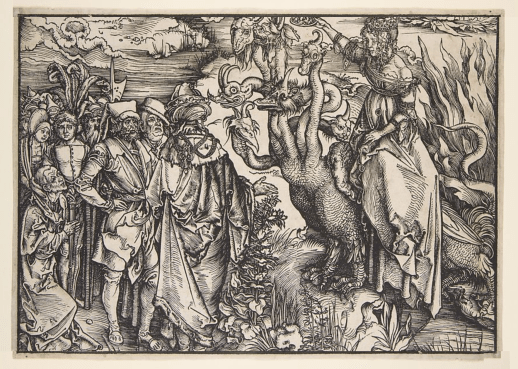
Who or what is the beast and what is the mark of the beast? And in the midst of the challenges of Babylon, what hope do we have?
Remember, the symbols of Revelation show us the truth, important things we wouldn’t see otherwise. It reminds me of The Lord of the Rings.
Sin is bad and serious. That truth, however, often falls on deaf ears. But if I tell you the story of Sméagol who turns into Gollum and ends in lava that picture is more poignant and communicates at a different level. Revelation paints powerful pictures, which vividly show us the truth.
In Revelation, we see that it says the time is near a lot of times (Rev. 1:1, 7; 22:6, 7; 22:10, 12, 20). That was like 2000 years ago. I believe the time is now for some of what it talks about in Revelation. I believe it’s happening. I believe some of it happened, is happening, and will continue to happen until the end. That’s partly how Revelation as a letter was relevant to John’s original audience and continues to be relevant to us today.
Let’s look at what I mean. First, let’s look at Revelation 12 and the…
1. The woman (Rev. 12:1-6)
“And a great sign appeared in heaven: a woman clothed with the sun, with the moon under her feet, and on her head a crown of twelve stars. She was pregnant and was crying out in birth pains and the agony of giving birth. And another sign appeared in heaven: behold, a great red dragon,[1] with seven heads and ten horns, and on his heads seven diadems. His tail swept down a third of the stars of heaven and cast them to the earth. And the dragon stood before the woman who was about to give birth, so that when she bore her child he might devour it. She gave birth to a male child, one who is to rule all the nations with a rod of iron, but her child was caught up to God and to his throne, and the woman fled into the wilderness, where she has a place prepared by God, in which she is to be nourished[2] for 1,260 days” (Rev. 12:1-6).
Who is the woman here?[3] The woman is God’s people throughout the history of redemption.[4] The woman in the garden was promised one that would crush the head of the serpent/dragon (Gen. 3:15). The woman Mary was part of the “woman” Israel from whom the Messiah, the Promised One came (was “birthed”). And it is through Jesus the Messiah, the one with the “rod of iron,” that the Bride, the Church, is wooed and won.
Satan, the dragon of old,[5] has been trying to destroy this woman all along. He tempted Eve in the garden, Jesus in the desert, and we daily face temptation. Satan seeks to steal, kill, and destroy.
The woman, the Church, however, is and will be protected. The gates of hell will not prevail. The 1,260 days refers to the limited time[6] she, God’s people, be in the “wilderness” (c.f. Ex. 16:13-18; 1 Kings 17:6; 19:5-8). We also see in Revelation 12:14 that she is given “the two wings of the great eagle” which reminds us of how God protected His people in the time of the exodus (see Ex. 19:4; Deut. 32:10-12).
So, we see the church is buffeted but the battle will end and the victory is sure. The reference to “a time, and times, and half a time” in Revelation 12:14 is a half-sabbatical period which comes from Daniel 7:25. It “signifies the brevity of the saints’ suffering”[7] because it is half of a complete period (which is signified by the number seven).
Therefore, we see that “the woman’s stay in the desert is characterized both by trials and favors from God, just as the journey of the Israelites was”[8] and just as the history of the Church has been and will be.
After we see the woman and the dragon, in Revelation 13 we see…
2. The beast(s) (Rev. 13)
John sees a hideous beast rise out of the sea. The imagery alludes to Daniel 7. In the vision in Daniel 7 we see that the beast “made war with the saints… until” Jesus comes with judgment and the saints once and for all possess the Kingdom (Dan. 7:21-22). That Kingdom shall be an everlasting Kingdom (v. 27).
It’s interesting and I believe important to note that the context of Daniel and the context of John’s Revelation is exile and apparent defeat. It looks as if the evil scary beast is going to be victorious. It looks like God’s people are going to get gobbled up.
As we look at the situation it doesn’t look good. The dragon gave his power to the beast (Rev. 13:2). And the beast imitates the Lord in some ways. Notice v. 3 says it “seemed to have a mortal wound” and v. 11 says it was “like a lamb” although it “spoke like a dragon.” The beast has things that look impressive and even resemble the Lamb. But, the beast is a sham and leads to shame.
People believe the beast will rescue them. And so, they follow the beast (v. 3) and worship the dragon (v. 4).[9] Notice, however, that doesn’t mean that they knew that’s what they we’re doing. These people are not all Satanists. Remember, Satan is the father of lies and the greater deceiver. And so, a lot of people who worship the dragon don’t know they’re worshiping the dragon. As v. 14 says, the beast deceives those who dwell on the earth.
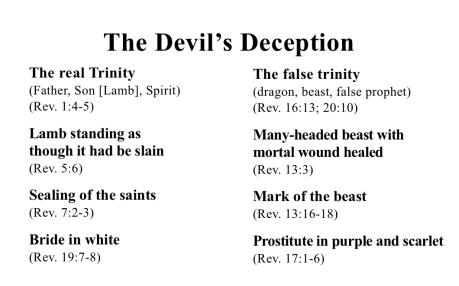
The beast is scary for a lot of reasons. The beast causes those who don’t worship the beast to be slain (v. 15 cf. Deut. 13:5). “Also it causes all, both small and great, both rich and poor, both free and slave, to be marked on the right hand or the forehead, so that no one can buy or sell unless he has the mark, that is, the name of the beast or the number of its name. This calls for wisdom: let the one who has understanding calculate the number of the beast, for it is the number of a man, and his number is 666” (Rev. 13:16-18 cf. 14:9, 11; 16:2; 19:20; 20:4).
What or who is the beast?
First, it should be understood that numbers in the book of Revelation have a lot of significance.[10] The number 7 is the number for completion and perfection. Whereas 6 is a number that represents missing the mark, it is a number for deficiency. So, the number 666 represents defect. It’s contrasted with the number 7, which, as we said, is the symbol for divine completeness.
Thus, 666 is a symbol and not a code to be cracked. It shows us that the best the beast can do is mimic. This shows us that the beast, though a convincing imitation to some, is actually completely incomplete.[11]
This, however, is not the full significance of the number 666 because Revelation 13:18 says, “the number of the beast… is the number of a man.” Who is this man?
This form of numbering was actually at least somewhat common. There is a poem of sorts on one of the walls of Pompeii that says, “I love her whose number is 545.” Let me briefly explain how this works…

Interestingly, as the ESV Study Bible points out, “Both ‘beast’ and ‘Nero Caesar,’ written in Hebrew characters, add up to 666.”[12]
I believe that 666 referred to Nero at that time. I believe, however, that there have been other similar beasts[13] and other beasts will come.[14] Just as there are many antichrists (1 Jn. 2:18, 22; 4:3; 2 Jn. 7). What, then, does it mean to be a beast in this way?
Other historical figures have been compared to beasts.[15] Nebuchadnezzar even became actually beastly (Dan. 4) and Nero acted as if he were a beast. And so beast and 666 in reference to him is fitting. There are, however, others who have and who will in the future act in a beastly way.[16] They too are also a beast and all who follow such a person have the mark of the beast.[17] They have been bitten, as it were, with the fangs of the deathly red serpent.
The Bible talks about people behaving like “irrational animals, creatures of instinct” (2 Pet. 2:12). It says that these people have their bellies as their god; that is, they instinctively pursue what they crave and their thoughts rise no higher than the earth (Phil. 3:19). Actually, since the fall, that is our default position (Eph. 2:1-3).
How do we keep from accidentally following the beast? Or being like a beast ourselves?
We follow hard after Christ the King. Jesus, “the Son of Man” (Dan. 7), shows us what it means to be fully human.[18] He exercises the dominion that Adam and Eve were commissioned to. It is as we love and follow Christ that we’re more like Christ and less and less beastly.
What is the mark of the beast?
Is the mark of the beast an implant? After all, Revelation 13:17 says, no one can buy or sell unless they have the mark. Perhaps the mark of the beast is a form of electronic currency?[19]
The mark is mentioned in various places (Rev. 14:9, 11; 16:2; 19:20) and is contrasted with the seal of God’s faithful. It’s interesting to note that the word for “mark” here is the Greek word charagama which is used in Acts 17:29. It means “imprinted mark.” Charagama can also be used to refer to the scar or abrasion of a serpent’s bite.
There’s historical precedence for a “mark” or “branding” being enforced by a godless ruler. Pharaoh Ptolemy IV (who from 221–204 BC) “proposed to inflict public disgrace on the Jewish community, and he set up a stone on the tower in the courtyard with this inscription: ‘None of those who do not sacrifice shall enter their sanctuaries, and all Jews shall be subjected to a registration involving poll tax and to the status of slaves. Those who object to this are to be taken by force and put to death; those who are registered are also to be branded on their bodies by fire with the ivy-leaf symbol of Dionysus’” (3 Maccabees).[20]
Dionysus was known as the god of wine and ecstasy. So, the “mark” here is the mark of idolatry. This happened in the past and no doubt a similar thing will happen again.
It’s interesting that in the book of Daniel, Daniel and his friends were given new names[21] and taken in by a pagan king, a beast. Yet they didn’t have the mark of the beast. What then is the mark of the beast if it isn’t a new name?! The mark of the beast is the mark of wicked idolatry. It is the bite of the serpent that bends people to foolish lies.
So, I think what’s being said here is that there is historical precedence for a beast ruler acting this way, and it’ll happen again. The question then is, will you be willing to suffer instead of taking the idolatrous mark?
Revelation “is a call not to be identified with the beast or with Babylon and to share their doom, but to bear couragesly and faithfully the testimony of Jesus to the point of death.”[22]
Satan, however, is often more subtle. As the ESV Study Bible says, “Neither the beast’s mark nor the seal of God on believers’ foreheads (cf. Rev. 7:3; 14:1; cf. also Ex. 28:36–38; Ezek. 9:4) have to be understood as physical features, though they may be that. Both symbolize the spiritual control of heart allegiance and behavior, either by the beast or by the Lamb.”[23]
The beast(s), however, are not the only foes of God’s people. We also see…
3. Babylon the harlot (Rev. 17-18)
We tend to marvel at Revelation 17-18. There’s so much mysterious imagery. Yet, we are told, “the mystery” (Rev. 17:3). Revelation tells us what’s going to happen. Remember, that’s what revelation means. It means revealing. And that’s just what the book of Revelation does. It reveals the truth. And that’s what it does here as it talks about Babylon.
The city Babylon allures us with its temptations and beauty (v. 4) but we know her end.[24] Her end is destruction along with the beast. That’s what’s going to happen.
We may see the allurements in Babylon, we may marvel greatly (. 6), but we must remember what has been revealed about the “mystery of the woman, and of the beast” (v. 7). “The beast that you saw was, and is not, and is about to rise from the bottomless pit and go to destruction. And the dwellers on earth whose names have not been written in the book of life from the foundation of the world will marvel to see the beast, because it was and is not and is to come” (Rev. 17:8).
Babylon is any type of kingdom or empire founded on any king except Christ the King. Babylon rides on and is propped up by Satan and his beast (cf. Rev. 13:1 with 17:3).
We also see that there are many leaders aligned with Satan. They are part of the beast and promote the idolatry of Babylon. As Darrell W. Johnson has said,
“John is opening up for us a sobering unseen reality of the present: governments which step out from under the rule of God do not become more divine. They become demonic. Governments that exalt humanity as the measure of all things do not become more humane; they become more bestial.”
They’re literally in a pact with the devil even if they don’t really realize it.[25] They “are of one mind, and they hand over their power and authority to the beast. They will make war on the Lamb” (Rev. 17:13-14). Matt Chandler has said, “The objective of the beast is capturing the loyalties of men and women and diverting their worship from the praise of God to the praise of the state.”
Yet, that’s not the end of the story. The kings of earth seem so powerful and unbeatable. It seems like they will be able to crush Christians. It seems like Babylon will stand forever. But, that is not the case.
Their time, however, will be short, only “one hour” it says (v. 12). And then, “the Lamb will conquer them, for He is Lord of lords and King of kings, and those with Him are called and chosen and faithful” (v. 14).
That’s what’s going to happen. That’s the life-changing reality we need to see. The one who beats will be beaten, the one who crushes will be crushed. The Lamb that was slain, will slay the wicked oppressors.
Look with me at Revelation 18:1-2, John says, “After this I saw another angel coming down from heaven, having great authority, and the earth was made bright with his glory. And he called out with a mighty voice,
‘Fallen, fallen is Babylon the great!
She has become a dwelling place for demons,
a haunt for every unclean spirit,
a haunt for every unclean bird,
a haunt for every unclean and detestable beast.’”
The harlot and her people will get full payment for their wicked ways (18:6). For their exploitive abuse of “human souls” (18:13).[26] And it will happen swiftly. “Her plagues will come in a single day” (v. 8), “in a single hour” (v.10, 17, 19). The build up and apparent power of Babylon and the beast are contrasted with their utter obliteration in a mere 60 minutes.
This is making an important point for us. Things are not as they appear. What looks mighty and attractive is not always what it appears.
People may live for wealth, but in a single hour, all wealth will be laid waste (v. 17). Revelation 18:14 says,
“All your delicacies and your splendors
are lost to you,
never to be found again!”
All the sinful entanglements, all the things you look to and love, that you think will fulfill and make your life happy, gone. They were poisoned pills, 3/4s but not whole. They were contaminated puddles that cut you off from living streams. They were the shadow that made you miss the substance.
Listen! You who live for all that is found here: Babylon, the great city,[27] will be thrown down with violence and will be found no more (v. 21). Don’t be seduced by her promises or deceived by her sorcery (v. 23).
The city and all she represents may be tempting but heed this warning:
“Alas, alas, for the great city
that was clothed in fine linen,
in purple and scarlet,
adorned with gold,
with jewels, and with pearls!
For in a single hour all this wealth has been laid waste” (v. 16-17). The great city will be like a huge stone thrown into the sea (v. 21).
So, how do we respond to that revealing? What should we do?!
We know the end of the enemy and we know the sweet eternal victory of those who conquer by continuing to trust and follow Christ the King.
So, we rejoice (v. 20). Of course, we don’t rejoice at the destruction for destruction’s sake.[28] We rejoice because of…
4. The wedding (Rev. 19)
I have a friend who is engaged to be married. He’s super stoked. He loves his fiancé and has pursued and wooed her, and bought a ring.
Jesus the Bible tells us, loves us, pursued and wooed us, and bought us by dying on the cross for our sins. The Bible says that the Church is the Bride of Jesus. It says that there will be a wedding.
We’ve not had the wedding yet. The Church is Christ’s; He bought her, loves her, and protects her. But Christ and the Church are not in perfect wedded bless yet. But, that day is coming soon.
I know the picture of the Church being Christ’s Bride is kind of weird in ways but it is also profoundly beautiful and fitting.
In Revelation 13-19 we see various attacks of the enemy. We see Satan’s beast with intimidating violence, we see the false prophet with deceptive heresy, and we see the city Babylon, the prostitute, with her beguiling seduction. Revelation reminds us of the threat we face. And it encourages us to remain resolved and trusting.
Look with me at Revelation 19:1-2: “After this I heard what seemed to be the loud voice of a great multitude in heaven, crying out,
‘Hallelujah!
Salvation and glory and power belong to our God,
for His judgments are true and just;
for He has judged the great prostitute
who corrupted the earth with her immorality,
and has avenged on her the blood of his servants.’”[29]
Look with me also at verses 6b-8a:
Then in verse 9, it says that the angel said to John: “Write this: Blessed are those who are invited to the marriage supper of the Lamb.” And he said to me, “These are the true words of God.”
Conclusion
The beast’s roar will be forever silenced by the overwhelming power of the Lamb. Babylon the great will be forever shattered in a moment and the New Jerusalem will forever stand in her place. The woman that looked defeated will arise to be the forever-glorious Bride.
What city are you in?
Who are you following?
Are you with the lion who is the lamb? Or, are you with the beast and the dragon?
Will you rejoice at the end, or weep and howl?
Notes
[1] It is of note that the color of the dragon in Revelation 12:3 is “red like the Babylonian snake and the Egyptian typhon. The Leviathan… is the monster that comes out of the sea. He also has many heads and Yahweh is said to smash them (Ps 74:13-14) and piece ‘the fleeing serpent’ (Job 26:13, AB)… The monster is the embodiment of chaos, the antithesis of Yahweh who is the source of all order in the world.” It is also interesting that “’diadem’ occurs only in Revelation (12:3, 13:1; 19:12); in all instances it is used of royal power. Our dragon is king (and possibly priest) of chaos” (J. Massyngberde Ford, Revelation, 199).
[2] “The verb ‘support,’ Gr. trephein, is employed in Deut 32:18…” and recalls God “providing quails and manna to feed the Israelites in the desert” (J. Massyngberde Ford, Revelation: Introduction, Translation and Commentary [New York: Doubleday & Company, Inc., 1975], 192).
[3] “In Revelation ‘woman’ or ‘women’ occurs nineteen times: 12:1, 4, 6, 14, 15, 16, 17; 17:3, 4, 6, 7, 9f., 18 and elsewhere in 9:8, 14:4, 19:7, 21:9. It might be said therefore, that the woman symbol is almost as important as the Lamb. This woman and the new Jerusalem are the antithesis of the harlot” (J. Massyngberde Ford, Revelation, 188).
[4] “Although the woman may be an individual, a study of the OT background suggests that she is a collective figure, like the two witnesses. In the OT the image of a woman is a classical symbol for Zion whose husband is Yahweh (Isa 54:1, 5, 6, Jer 3:20, Ezek 16:8-14, Hosea 2:19-20)” (J. Massyngberde Ford, Revelation, 195).
[5] In Revelation we see various names given to the evil one: Dragon (Rev. 12:3, 4, 7, 9, 13, 16, 17; 13:1, 2, 4; 16:13; 20:2), Devil (12:9, 12; 20:2, 10), Serpent (Rev. 12:9, 14, 15; 20:2), and Satan (2:9, 13, 24; 3:9; 12:9; 20:2, 7).
[6] The number 7 in revelation is the number of perfection and completeness whereas 3 ½ is half the number for completeness (3 ½ year = 42 months = 1,260 days). So, even here we see a subtle reminder that God’s people will not forever be pursued by the dragon, will not forever be in the wilderness. The time is short. So, we can and must endure. See Revelation 11:2-3; 12:4, 14; 13:5 for other references to limited time.
[7] The ESV Study Bible.
[8] J. Massyngberde Ford, Revelation, 202.
[9] In direct contradiction to what God’s word says (Ex. 20:34; cf. Ex. 32), the beast makes an image of a beast (Rev. 13:14) And it says, the beast is “allowed to give breath to the image of the beast” (Rev. 13:15).
[10] See Dennis E. Johnson, Triumph of the Lamb: A Commentary on Revelation, 15.
[11] Gregory Beale, “Why Is the Number of the Beast 666?”
[12] Richard Bauckham explains that one can calculate the Beast’s number based upon the Greek word for “beast” (thērion). If one takes the Greek letters of thērion and transliterates them into Hebrew, the numerical value of the Hebrew word is 666 (see Bauckham, Climax of Prophecy, 389).
[13] It’s also interesting to note that Nimrod’s name adds up to 666 using cryptogram, and Nimrod seems to be the main founder of the tower of Babel (see Gen. 10:8-12). “Babel is also the name used in the OT for the city of Babylon. As a city, Babylon symbolizes humanity’s ambition to dethrone God and make the earth its own” (ESV Study Bible on Genesis 11:9).
[14] As the ESV Study Bible says, “many interpreters expect a future, greater fulfillment in a world ruler who is violently opposed to God and his people.”
[15] “Babylon is compared to a devouring dragon in Jer 51:34; Pharaoh to one (perhaps a crocodile) who lives in the Nile in Ezek 29:3; 32:2; Pompey is probably alluded to as a dragon in Psalms of Solomon 2:29” (J. Massyngberde Ford, Revelation, 199).
[16] “When a human ruler fails to acknowledge the sovereignty of God and gives way to hubris he becomes subhuman. He becomes like a beast of the field. So, in [Daniel] chapter 7 the human superpowers, all of which to some extent give way to hubris, are depicted as beasts” (“Daniel” in the New Dictionary of Biblical Theology, 234).
[17] Thomas R. Schreiner has pointed out that “The number 777 represents perfection, but John says 666 is the number of a man. The number 666, then, represents what is anti-god and antichrist, all that is in opposition to the one true God. If 777 represents holiness and perfect goodness, then 666 signifies the enormity and totality of evil. Hence, John does not intend to point to any particular individual here. Rather, the kingdom of the beast is a human kingdom, an evil kingdom, instead of a divine one. The nature of humanity apart from God is demonic. The kingdom of the beast promises life and prosperity but brings death, misery, and devastation” (Thomas R. Schreiner “What Is the Mark of the Beast (Revelation 13)”).
[18] In fact, it’s been said that only One who was fully alive, fully human, could be an adequate substitutionary atonement for fallen humans.
[19] I think it’s significant that Revelation doesn’t say make sure you decipher what the mark of the beast is so that you’ll be sure to not receive it. And it doesn’t say if you can decipher the code you’ll be protected from suffering. Nope. It says, “If anyone is to be taken captive, to captivity he goes; if anyone is to be slain with the sword, with the sword must he be slain.” So, how does Revelation 13:10 have us respond? It says, “Here is a call for the endurance and faith of the saints.” Christians are called to preserver not to keep the time of persecution from coming. It will come. We can’t keep that from happening. What we must do, however, is endure and be faithful to Christ in the midst of it.
[20] “Such branding of a deity was not uncommon in ancient times” (The New Oxford Annotated Bible with the Apocrypha commenting on 3 Maccabees 2:28).
[21] “Nebuchadnezzar sought to assimilate the exiles into Babylonian culture by obliterating their religious and cultural identity and creating dependence upon the royal court. For this reason, the exiles were given names linked with Babylonian deities in place of Israelite names linked with their God. Daniel (“God is my Judge”), Hananiah (“Yahweh is gracious”), Mishael (“Who is what God is?”), and Azariah (“Yahweh is a helper”) became names that invoked the help of the Babylonian gods Marduk, Bel, and Nebo: Belteshazzar (“O Lady [wife of the god Bel], protect the king!”), Shadrach (“I am very fearful [of God]” or “command of Aku [the moon god]”), Meshach (“I am of little account” or “Who is like Aku?”), and Abednego (“servant of the shining one [Nebo]”). They were schooled in the language and mythological literature of the Babylonians, and their food was assigned from the king’s table, reminding them constantly of the source of their daily bread” (ESV Study Bible).
[22] Bauckham, The Theology of the Book of Revelation, 103.
[23] The “mark” also recalls phylacteries, which are black leather cube-shaped cases containing Torah texts written on parchment (see Deut. 6:8 cf. 11:18; Ex. 13:9, 16). They served as reminders of God and His Law and marked off people as God’s people.
[24] Parallels and contrasts between Jerusalem and Babylon:
- The chaste bride (21:2, 9) vs. the harlot (17:2)
- The city that provides light to walk by (21:24) vs. Babylon the city of deception (17:2; 18:3, 23; 19:2)
- Uncleanness will not enter the new Jerusalem (21:27) vs. Babylon is a city of uncleanness (17:4, 5; 18:23)
- Jerusalem provides the water of life and the tree of life (21:6; 22:1-2) vs. Babylon makes the nations drunk on wine (14:8; 17:2; 18:3)
- Jerusalem is a place of life and healing (22:1-2) vs. Babylon is a place of blood and slaughter
- God’s people are called to enter the New Jerusalem (22:14) vs. God’s people are called to come out of Babylon (18:4)
[25] Evil always implodes in on itself. It’s interesting to note that the “ten horns… the beast” will “hate the prostitute” which is the great city (cf. v. 18). “They will make her desolate and naked, and devour her flesh and burn her up with fire” (v. 16). They will do that because God has hardened their heart (v. 17 because of their idolatry cf. Rom. 1 & Pharaoh). And so, the kings destroy their own precious cities, and all the good, peace, and harmony they’re supposed to bring, because the beast and the dragon influence them. And the dragon has been a lying destroyer from the beginning. “The ancient mythic ideal” of a city was for it to be a “place where human community lives in security and prosperity with the divine in its midst. Babylon represents the perversion of this ideal, what it comes to when, instead of the true God, humanity’s self-deification is the heart of the city” (Richard Bauckham, The Theology of the Book of Revelation, 130).
[26] “Any society which absolutizes its own economic prosperity at the expense of others comes under Babylon’s condemnation” (Bauckham, The Theology of the Book of Revelation, 156).
[27] The Great harlot in the OT is a picture of idolatry.
[28] “The fall of Babylon, which occupies so much of Revelation, is what human opposition to God must come to, but it is not celebrated for its own sake. Babylon must fall so that the New Jerusalem may replace her. Her satanic parody of the ideal of the city must give way to the divine reality” (Bauckham, The Theology of the Book of Revelation, 130).
[29] “There are clearly only two options: to conquer and inherit the eschatological promises, or to suffer the second death in the lake of fire (21:8)” (Bauckham, The Theology of the Book of Revelation, 92).
Why read the book of Revelation?

Why Read Revelation?
Reading and heeding Revelation brings blessing: “Blessed is the one who reads aloud the words of this prophecy, and blessed are those who hear, and who keep what is written in it, for the time is near” (1:3).[1]
So, why read? Why care?
Because it is what is. And it tells us how to live. It tells us what to value and why.
We, essentially, are walking through life with wool over our eyes. The reality is we can’t see. We don’t always know what’s what. Satan is a great deceiver and he’s the god of this world.
Revelation is a jolt. It’s is a wake-up call. Revelation is a blind person seeing for the first time.
Revelation reveals the truth that on every forehead there is a name. We are all either aligned and carry the allegiance of Satan or Jesus our savior. We’re all ultimately marching to Satan or the Savior’s beat. We don’t always see it as it is, but Revelation says it as it is. Again, Revelation is an unveiling.
That’s what the book of Revelation is. But, what does the book of Revelation do?
What does the Book of Revelation do?
Wrestling with the book of Revelation…
1) wakes us up to the wonder & makes the unseen, seen
Have you ever said, “I’ve never seen it like that before?” That’s what the book of Revelation does.
Revelation gives us a picture of reality. A new perspective by which to see the world. John tells about all he “saw.” Revelation offers “a divine perspective on what is true, valuable and lasting.”[2]
And when we see things from the perspective of heaven it breaks the earthbound delusion of the beast’s propaganda.[3] We need to see what John saw. We need the book of Revelation to open our eyes to the unseen realities.
C.S. Lewis said, “What is concrete but immaterial can be kept in view only by painful effort.”[4] If Christians are to “resist the powerful allurements of Babylon, they [need] an alternative and greater attraction.”[5]
Revelation, as Brian Tabb has said, “reorients believers’ view of their present situation and challenges them to live by faith in the light of God’s sovereign rule over all things, which is more real and lasting than the reality they see with their eyes.”[6]
The revelation of Jesus is showing us something (v. 1). It’s showing us something we didn’t see before and we don’t see it without Jesus’ revelation. The book of Revelation is like smelling salts.
Its pictures are powerful painted to show us the point. Sin is bad but we don’t always see it as it is. I can tell you that sin is bad. I can tell you that it takes you longer, deeper, and destroys more than you’d expect and that’s true.
Sin is bad and serious. That truth, however, often fall on deaf ears. But if I tell you the story of Sméagol who turns into Gollum and ends in lava that picture is more poignant and communicates at a different level. Revelation paints a powerful picture of the awful reality of sin.
Revelation was given to John and he passed on to the churches and to us. They needed it then and we need it now. We need to see the true picture of reality.
“Revelation provides a set of Christian prophetic counter-images which impress on its readers a different vision of the world… The visual power of the book effects a kind of purging of the Christian imagination, refurbishing it with alternative visions of how the world is and will be.”[7]
We too need to see what John saw. We too need to be awakened to the wonder of it all.
Revelation helps us see that since the present world will be dissolved we should not live for this world but the next. And thus have morals shaped by the next Kingdom and not this evil one (2 Pet. 3:11; 1 Cor. 7:26, 29).
Revelation helps us see the unseen and Revelation…
2) reveals what will soon happen
Revelation tells “the things that must soon take place” (v. 1). Revelation and eschatology (the teaching on end times) are not mainly about charts and predictions. I agree with John Frame that “it is a pity that the church’s teaching on eschatology, the last days, has been concerned mostly with arguments about the order of events. In Scripture itself, the primary thrust of eschatology is ethical.”[8] Of course, that should not be a cop-out for studying the book of Revelation or eschatology though.
It is wise to be well-informed as to the major views of Christ’s return. We, however, should not be dogmatic about how and when exactly it will happen. Jesus Himself seems to clearly indicate this (cf. e.g. Mk. 13:32).
We should be dogmatic though that it will happen and will be glorious. And that it should motivate us as we seek to live faithful lives as exiles waiting for our blessed hope. We also are to constantly remind ourselves of His nearing return and of the feast we shall share with Him (cf. Matt. 26:29; Mk. 14:25; Lk. 22:16; 1 Cor.11:26; Rev. 19:9).[9]
The main point of the prophecy is that Jesus wins and all those who trust Him will dwell with God forevermore in perfect peace. The serpent that destroyed, in the beginning, will be destroyed in the end.
“The ancient serpent whose murderous lie seduced the woman and plunged the world into floods of misery (Gen. 3:1) is seen again, waging war against the woman, her son, and her other children—but this time his doom is sure and his time is short (Rev. 12; 20).”[10]
Thanos said, “I am inevitable.” We, however, know what’s actually inevitable. We know who wins.
Revelation shows us what will happen soon and Revelation…
3) helps us see the glory of the gospel
Revelation reveals the true identity of Jesus the Jewish carpenter (e.g. Rev. 1:5-8). He’s not just a lamb, He’s a lion. He roars and devours.
We need to remember, that the end of the story, and the main point of the Revelation, is to show that God through Jesus the Christ is victorious! This truth encouraged John who was exiled on Patmos and all the churches that were being persecuted to whom the letter went. If we read the letter, especially in that context, we will respond, not so much with a certain view of how everything will happen, but by saying, “Come Lord Jesus, come”! And that is the more powerful takeaway from the book.
“What is true in heaven now will be true on earth as well. God will reassert himself as ‘King of the nations’ and will execute judgments on the beast and all rival sovereigns who usurp his praise and oppress his people (15:3; 16:5–7). Therefore, readers must heed the angel’s repeated exhortation to John: ‘Worship God’ (19:10; 22:9).”[11]
The correct response to Revelation’s “dramatic presentation of Jesus is joyous worship and steadfast loyalty fuelled by confident hope in his regal return.”[12]
As The ESV Study Bible says,
“Revelation unveils the unseen spiritual war in which the church is engaged: the cosmic conflict between God and his Christ on the one hand, and Satan and his evil allies (both demonic and human) on the other. In this conflict, Jesus the Lamb has already won the decisive victory through his sacrificial death, but his church continues to be assaulted by the dragon, in its death-throes, through persecution, false teaching, and the allure of material affluence and cultural approval. By revealing the spiritual realities lying behind the church’s trials and temptations during the time between Christ’s first and second comings, and by dramatically affirming the certainty of Christ’s triumph in the new heaven and earth, the visions granted to John both warn the church and fortify it to endure suffering and to stay pure from the defiling enticements of the present world order.”
Revelation shows us that no one can ruin the One who reigns. No one can liquidate the Lord. No one can silence the Sovereign. No one can cancel the King.
That’s reality.
And soon all will see!
I want us all to see the truth now, and live in light of it now.
Notes
[1] There are actually seven blessings, the number for completeness, listed in the book of Revelation (1:3; 14:13; 16:15; 19:9; 20:6; 22:7; 22:14).
[2] Tabb, All Things New.
[3] Richard Bauckham, The Theology of the Book of Revelation, 91.
[4] C.S. Lewis, Letter to Malcolm: Chiefly on Prayer (New York: Harcourt, Brace and World, 1963), 114.
[5] Richard Bauckham, The Theology of the Book of Revelation, 129. “One of the functions of revelation was to purge and to refurbish the Christian imagination… Revelation offers a different way of perceiving the world” (Ibid., 159).
[6] Brian Tabb, All Things New.
[7] Richard Bauckham, The Theology of the Book of Revelation, 17. “One of the key themes of the book is that things are not what they seem. The church in Smyrna appears poor but is rich… What appears to the naked eye, on the plane of human history, to be weak, helpless, hunted, poor, defeated congregations of Jesus’ faithful servants prove to be the true overcomers who participate in the triumph of the Lion who conquered as a slain Lamb. What appear to be the invincible forces controlling history—the military-political-religious-economic complex that is Rome and its less lustrous successors—is a system sown with the seeds of its self-destruction” (Dennis E. Johnson, Triumph of the Lamb: A Commentary on Revelation, 9).
[8] Johnson, Triumph of the Lamb, 13.
[9] “We are called to be a people of memory, who are shaped by a tradition that is millennia older than the last Billboard chart. And we are called also called to be a people of expectation, praying for and looking forward to a coming kingdom that will break in upon our present as a thief in the night” (James K. A. Smith, Desiring the Kingdom, 159).
[10] John Frame, The Doctrine of God, 277.
[11] Tabb, All Things New.
[12] Tabb, All Things New.
What is the book of Revelation?

What is Revelation?
If Revelation were a movie what genre would it be? Comedy? Nope. Definitely not. What kind of movie?…
It would be in the genre of apocalyptic. The apocalyptic genre is about disaster and destruction. As far as movies go, it’s kind of a serious and science-fiction-ish genre.
Interestingly, these types of movies are getting more and more popular. In the pre-1950s there were 4 movies in that genre. In the 1960s there were 25. And from 2010 through 2019 there were 101 movies in that genre.
So, the genre of the book of Revelation is really popular right now. But the book of Revelation tells us the true story.
“The book of Revelation is the ultimate action thriller. Anyone who loves a great novel will certainly love this book. It contains drama, suspense, mystery, and horror. It tells of rebellion, unprecedented economic collapse, and the ultimate war of human history. Revelation is a book of astounding drama and horror, but also of hope and joy. It culminates with a happy ending, as sin and death are banished forever (21:4; 22:3).”[1]
Revelation is the last book of the Bible. Therefore, there’s a lot that came before it. And a lot that is important to understand, from Genesis to Jude, that informs our reading of Revelation.
I know some people that read books and go straight to the back and read that first. I don’t understand that. It doesn’t make sense to me. I do, however, eat pizza crust first so maybe you think I have no room to talk…
But the point is understanding the beginning parts of the book is important to understand the conclusion. This is especially important when we consider that there are some 278 allusions to the Old Testament in the book of Revelation, and that’s in a book that is 404 verses long (some commentators say over four hundred allusions)!
Revelation is a revelation, prophecy, and letter
Revelation 1:1–3 shows us a few important things about what kind of book it is. It tells us who the divine author is: “Jesus Christ.” We already talked about if it was a movie what type of movie it would be, but as a book, it is actually in three different genres…
Revelation (Apocalypse)
Revelation 1:1 says, “The revelation of Jesus Christ…” The term revelation (Greek ἀποκάλυψις, apokalupsis) here means “uncovering” or “revealing.” And that’s what the book is, it’s “an ‘unveiling’ of unseen spiritual forces operating behind the scenes in history and controlling its events and outcome.”[2]
Brian Tabb says,
“Apocalypses have two principal functions: (1) they encourage and comfort believers during severe trials… and (2) they challenge readers to adopt a new perspective on reality in the light of coming judgment and to live accordingly.”[3]
Prophecy
Revelation 1:1 goes on to say that it is also a prophecy in part by saying that it is about “the things that must soon take place.” Richard Bauckham says that
“Biblical prophecy always both addressed the prophet’s contemporaries about their own present and the future immediately impending for them and raised hopes which proved able to transcend their immediate relevance to the prophet’s contemporaries and to continue to direct later readers to God’s purpose for their future.”[4]
So, Revelation was both for the contemporary audience and for us the future audience.
Letter
John wrote “to the seven churches that are in Asia” (Rev. 1:4). So, Revelation is addressed to first-century churches. It’s a letter. But it’s also a revelation. It’s revealing the truth of the spiritual cosmic battle that’s unseen by the physical eye. Revelation is also prophecy. It’s telling us what is and what will happen.[5]
Revelation’s Wild Imagery
In the book of Revelation, you have beasts and you have Babylon. You have terrible bowls and a terrible dragon. You have persecution and plagues. You have what is pure and what is putrid. You have what is right worship and what is wrong. You have death and the second death. You have earth and the new earth. You have now and you have later. You have the Lamb that’s the Lion.
In the book of Revelation, you have things as they really are. Revelation is a revelation of the way things are. It’s a disclosure. A revealing. It’s the truth made literally seen through symbols.
It’s the uncovering. The unwrapping of a Christmas present. The truth of what was inside was hidden and unclear until the package is unwrapped and opened.
“Revelation is not a riddle to be decoded by experts or marginalized by those in the pews. It is a book – indeed, the final book – of Christian Scripture meant to decode our reality, capture our imaginations and master our lives with the word of God and the testimony of Jesus.”[6]
That’s what Revelation’s wild imagery is for. It paints a true picture for us through powerful symbols.
Revelation “is not a secret code that allows believers to decipher the timeline of Jesus’s return.”[7]
Notes
[1] John MacArthur, Because the Time is Near, 25.
[2] The ESV Study Bible.
[3] Brian Tabb, All Things New.“Revelation, with regard to both content and construction, is one of the most exquisite of all apocalypses both Jewish and Christian” (J. Massyngberde Ford, Revelation: Introduction, Translation and Commentary, 3).
[4] Richard Bauckham, The Theology of the Book of Revelation, 152.
[5] “The book of Revelation was written to seven churches as both encouragement and challenge. An apocalyptic letter, it relies on visions, symbols, and Old Testament references to reveal the ultimate fulfillment of God’s promise given to Abraham in Genesis” (https://bibleproject.com/learn/revelation/).
[6] Brian Tabb, All Things New [New Studies in Biblical Theology]. InterVarsity Press. Kindle Edition).
[7] https://bibleproject.com/learn/revelation.
Photo by Sincerely Media



 in X
in X 