The End is Near

Noah’s Ark and the Bible’s Narrative Arc

“…the whole earth was filled with violence. And God saw the earth, and behold, it was corrupt, for all flesh had corrupted their way on the earth” (Gen. 6:11b-12).
The story of Noah and his ark has always been a difficult story. Knowing the context of the story is helpful though.
So, what was going on before God destroys the world with a flood?
Well, just a few chapters earlier we see that God made an incredibly good and beautiful creation (see e.g. Gen. 1:31). We see God made people–all people–with dignity and worth (Gen. 1:26-27; 5:1-2). We see God gave people good things to do (Gen.1:28).
But, we also see, humans didn’t listen. We see that in the Fall of humanity (Gen. 3), the first murder (Gen. 4:8), and the growing corruption and violence (Gen. 6:5). In Genesis, we go from God and good creation to growing corruption very quickly (that’s also representational of my own tendency).
It was not God who “paved paradise and put up a parking lot.” That’s what humans had already done. Humans damaged and defiled the very thing that would have brought them endless delight. Humans turn from fresh fulfilling water to putrid puddles.
But, that’s not it. Humans also hate. They hate humans that were made with the dignity of God. They hate and they hurt. They abuse and injure. And even kill.
Before God destroyed the world in the flood, humans destroyed the world with their sin. In God’s act of destruction, He was actually bringing a type of deliverance. He could have, and in a sense considered, destroying the world completely (Gen. 6:6-7).[1]
Yet, God worked through Noah, a mediator (Gen. 6:8ff)[2], as He does, to bring salvation through judgment.[3] God provided a type of rescue when wrath was deserved.
Ultimately we know, the God-Man, Jesus Christ, took the wrath of God and the violence of the world on Himself. When we understand the whole context of the story of Noah’s ark, we see it is not God at fault. He is not the guilty party for the destruction of the world.
Instead, we see we are at fault. We carry out atrocities. We turn from God, where alone there is life, to trifles and trivialities. We hate humans, who have eternal value and being, and love things that perish in a moment.
When the story of Noah’s ark is understood in context, from the perspective of the whole of redemptive history, we see how amazing it is that the LORD is both just and the justifier of the one who trusts in Jesus alone for rescue (see Rom. 3:25-26).
Strangers

- The language – even though we have learned one National language and one tribal language and function in a third area trade language and deal with 3 other tribal languages.
- The bugs – even though when people ask about the most dangerous animals we have, I reply – mosquitoes, ameba, thyroid, and other assorted microbes. The Lord has been very good to us and our kids, He has, I know, protected us from many things we were not aware of.
- The snakes – I saw more snakes growing up in Eastern Oklahoma. We see some big snakes on occasion. I have seen 20ft snakes and eaten them. I have been face to face with a king cobra.
- The rivers – we travel by river, not road. And in the beginning, made some unplanned swims in the river.
- The mountains – we are thankful for missionary pilots that fly us over the mountains.
- The heat – this is a much bigger issue and seems to be affecting us more as we go along. But we have fans that help.
What I’m talking about is something that is more basic than just physical comforts. It has to do with relationships and our reason for being in a 3rd world tropical environment. The most difficult thing has been that we are always strangers/foreigners. I am always too tall, and too white. I don’t always talk and think like the natives.
Deeply Known yet Deeply Loved

The Ten Best Books I Read in 2020
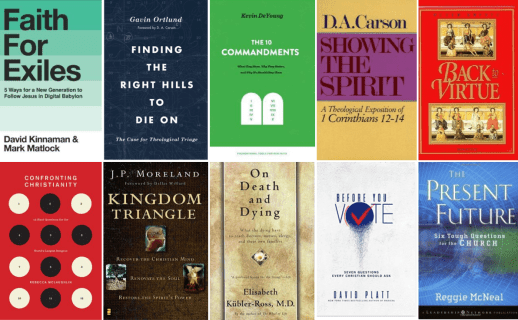
Here are my ten favorite books that I read in 2020 (they’re listed in alphabetical order by the author’s last name):
- D.A. Carson, Showing the Spirit: A Theological Exposition of 1 Corinthians 12–14
- Kevin DeYoung, The Ten Commandments: What They Mean, Why They Matter, and Why We Should Obey Them
- David Kinnaman, Faith for Exiles: Five Ways to Help Young Christians Be Resilient, Follow Jesus, and Live Differently in Digital Babylon
- Peter Kreeft, Back to Virtue: Traditional Moral Wisdom for Modern Moral Confusion
- Elisabeth Kübler-Ross, On Death and Dying
- Rebecca McLaughlin, Confronting Christianity: 12 Hard Questions for the World’s Largest Religion
- Reggie McNeal, The Present Future: Six Tough Questions for the Church
- J.P. Moreland, Kingdom Triangle: Recover the Christian Mind, Renovate the Soul, Restore the Spirit’s Power
- Gavin Ortlund, Finding the Right Hills to Die on: The Case for Theological Triage
- David Platt, Before You Vote: Seven Questions Every Christian Should Ask
And five runner-ups:
- Andy Crouch, Playing God: Redeeming the Gift of Power
- Albert Mohler Jr., The Gathering Storm: Secularism, Culture, and the Church
- Tony Reinke, Competing Spectacles: Treasuring Christ in the Media Age
- Deepak Reju, On Guard: Preventing and Responding to Child Abuse at Church
- Mark Dark Vroegop, Clouds, Deep Mercy: Discovering the Grace of Lament
Here are my favorite books from last year.
Joseph

“When Joseph woke up he did what the angel of the Lord had commanded him and took Mary home as his wife. But he had no union with her until she gave birth to a son. And he gave him the name Jesus” (Matthew 1:24-25 NIV).
Joseph is a hero of the Christmas story. Generally, at this time of year, we hear about Mary, angels, donkeys, etc. But we rarely talk about a real hero of the birth of Christ. Without Joseph, Mary would have been an outcast and unwed mother. Baby Jesus would have been a victim of a jealous king’s rage. It is not recorded that Joseph says anything, but he does a lot. He does not sing a magnificent. He does not preach or prophesy. He just immediately does what he is told to do. No questions or objections. He just does it.
In Matthew chapter 1 we read that Joseph learned of Mary’s pregnancy. How he learns this news we are not told. From Jewish traditions, we learn that he would have had limited personal contact with Mary at this time of their engagement. So, he most likely would have learned from the village gossip machine. He did not want to embarrass Mary but probably in profound disappointment was going to divorce her.
Then he had a dream and heard an angel telling him the meaning of this pregnancy. This must have been quite a dream. Because Joseph did not hesitate, did not argue, did not ask for further clarification. He did not wait to see what else would happen. He did not put out a fleece. He did not ask for money. It says he woke up and “did” as the angel commanded. He just did it.
Joseph was a man of extraordinary self-discipline. He took Mary to his house and lived with her but did not have sexual relations with her. He was a man of inner strength. An example we desperately need in this day and age of promiscuity and weak men. He was not a man without normal sexual urges as Roman Catholic traditions have us believe. We read later that he and Mary had other children.[1] In fact, we read in Matthew 13:56 there were 4 brothers and some sisters (all his sisters – plural) so this would make a minimum of 6 children besides Jesus (some traditions put the number at 10). After Jesus was born, Mary and Joseph had a normal husband/wife relationship, but not before Jesus was born. The text does not state why Joseph did this but evidently, he understood from the dream that he was to exercise this self-discipline. Joseph was a strong man, strong on the inside and strong on the outside.
Matthew 13 also states that Joseph was a carpenter. This was in the days before sawmills and power equipment. No chainsaws, no table saws, no electric planers, no square straight lumber from the store. Probably just an ax and a soot line. In those days if you made something of wood, you went to the woods with an ax and cut the tree down and hewed the object from a round log. I have lived with people that make boats, and boards from round logs with an ax from standing trees. I have gone with men that make lumber from round trees with just an ax. To hew with an ax all day long makes for tough men – rawhide tough men.
Then when the object has been “roughed out” in the woods, it has to be carried home – no trucks or tractors or forklifts. He put timbers on his shoulder and carried them home. I have known men and boys like this who carry their own weight for long distances – day after day. These are rawhide tough men and in my mind’s eye, I see Joseph as one of these men.
10 Ways to Read More Books in 2021

I read 70+ books in 2020.[1] Below I’ll tell you how.
“If you ain’t cheating, you ain’t trying.” I don’t think you should cheat. Cheating is wrong. But you should, however, make the most of every advantage you have as best as you can.
That’s what I seek to do with reading. I take advantage of everything I can.
I read all sorts of books for all sorts of reasons. Depending on the reason for reading and the type of book, I will read it in a different way. Some people shun audiobooks. But, I personally don’t get that. There are all sorts of reasons for reading and all sorts of ways that people retain things best.
As I said, I think we should wisely take advantage of everything we can as best as we personally can.[2]
Here are nine things I’ve used to my advantage:
1) Time
Time is the most precious commodity there is. Even little bits of gold have value, how much more small slots of time!
You can get a lot read when you make the most of small time slots. Waiting can easily turn into productive reading. I always have a book on hand. And my wife often listens to audiobooks while doing dishes or laundry.
2) Old fashioned books
Always have one with you. You never know when you’ll be able to get a few paragraphs or a few pages read.
3) Kindle app on my phone
It’s always with me. I always have a book I’m reading on Kindle.
4) Hoopla or Libby
Hoopla and Libby are free apps and one of them should be available through your local library. I’ve used them both at different times to listen to tons of books.
5) Audible
Audible is an audiobook service. My wife and I had a membership for a long time. It was great.
6) ChristianAudio
ChristianAudio is an audiobook service that provides Christian audiobooks. You can signup for a free audiobook a month.
7) Speechify
Speechify is an amazing app. It was created by Cliff Weitzman, someone with dyslexia, to help people with dyslexia.
With Speechify you can take a picture of a page in a book and it will convert it to audio. I will sometimes buy a book on Kindle and take a screenshot of each page of the Kindle book and load it on to Speechify. In this way, I can listen to the book.
I can also still make notes. If something sticks out to me that I want to capture I’ll take a screenshot on the Speechify app. Then I’ll search the keywords from the screenshot on the Kindle book and highlight and make any notes I want to make.
Speechify has been a huge blessing to me. I read very slowly but when I use Speechify I can read over 650 words per minute. Speechify probably triples my reading speed but I’m still able to retain what I read and make notes.
8) A community of book lovers
I have multiple friends (including my wife!) that love to talk books and encourage the reading of good books.
9) Goodreads
Goodreads is a social media site for reading. Goodreads allows you to track and review books you’ve read as well as receive recommendations from friends. You can see my Goodreads account here.
10) Pocket (very helpful but not for books)
Pocket is an app that allows you to save articles to your “pocket.” It’s a great way to save and organize articles. But, the thing I enjoy most is that it has a function that allows you to listen to articles.
Will sin be possible in heaven?

To answer the question will sin be possible in heaven, there are a number of passages we should look at.
“…the assembly of the firstborn who are enrolled in heaven, and to God, the judge of all, and to the spirits of the righteous made perfect“ (Hebrews 12:23).
“…those whom He foreknew He also predestined to be conformed to the image of His Son…” (Romans 8:29).
“No longer will there be anything accursed, but the throne of God and of the Lamb will be in it, and his servants will worship Him” (Revelation 22:3).
“…nothing unclean will ever enter it, nor anyone who does what is detestable or false, but only those who are written in the Lamb’s book of life” (Revelation 21:27).
“The one who conquers, I will make him a pillar in the temple of my God. Never shall he go out of it, and I will write on him the name of my God…” (Revelation 3:12).
“I will plant them on their land, and they shall never again be uprooted out of the land that I have given them…” (Amos 9:15).
Christians will be made “made perfect” (Heb. 12:23). They will be “conformed into the image” of Jesus (Rom. 8:29). It may be that Christians can sin, but won’t sin because they will not want to sin.
When Christians see Jesus, they shall be like Him (1 John 3:2). That is the sense in which Christians will be unable to sin (non posse peccare, as Augustine said). Christians will be like Christ!
So, no. Ultimately, Christians will not be able to sin in heaven. But it won’t be from an external constraint but from internal renewal.
Christians will finally completely have their affections rightly aligned with reality. Christians will love the LORD their God with all their heart, soul, mind, and strength.
Christmas and Christian Mission

“Again Jesus said, ‘Peace be with you! As the Father has sent me, I am sending you’” (John 20:21).
We don’t often think of Christmas as connected to missions but it really is. Let me show you. First, “Christmas” is actually shorthand for “Christ’s mass.” The English word “Mass” comes from the Latin word missa,[1] which means to be “sent.” So, Christmas reminds us that Christ was sent.
He was sent to accomplish something. And His mission was not just to be a cute little baby. Jesus’ mission was to bring salvation. That’s actually how He got His name.
Matthew clearly spells it out for us: “You shall call His name Jesus, for He will save His people from their sins” (Matthew 1:21).
The name Jesus is actually the Greek form of the name Joshua. And it means “Yahweh saves” or “Yahweh is salvation.”
Friends, the bad news is we have not loved and listened to Yahweh, the one true God, as we should. But, the good news is, Yahweh saves. He saves in unexpected and amazing ways.
He saves by sending Jesus, the Promised One, to be born in a mere manger. He saves by sending Him to die the death we deserved to die.
So, Jesus was sent on a mission. He accomplished that mission. And we see that we now are sent on mission. Jesus said, “As the Father has sent me, even so I am sending you” (John 20:21).
We are sent on a different mission but in the same way that Jesus was sent we too are sent. We too must carry out the mission. Christians join Christ in the Missio Dei, the “mission of God.” We are not the good news, but we tell the good news.
Christmas—Christ’s mission—should remind us of our mission. Thankfully, it is not our mission alone. Jesus did not leave us alone to accomplish the mission. He Himself is with us to the end of the age (Matthew 28:20). And He Himself sent the Holy Spirit to be with us as our Helper.[2]
[1] This Latin shows up in missions and in missionary.
[2] See John 20:22 and John 16:7-8.
Sometimes life gives you a gift that you want to lose but you have to use.


Do you view singleness as a gift? Sometimes we receive gifts that we don’t want to use, don’t know how to use, or don’t even want to possess. I am afraid many of us feel this way about singleness. We don’t know what to do with it, we don’t know why we’re stuck with it, and we just want to get rid of it.
The Apostle Paul saw singleness as a gift. In 1 Corinthians 7:7–9, he says “I wish that all were as I myself am. But each has his own gift from God, one of one kind and one of another. To the unmarried and the widows I say that it is good for them to remain single, as I am. But if they cannot exercise self-control, they should marry. For it is better to marry than to burn with passion.”
Pastor J.P. Pokluda from Harris Creek Baptist in Texas said about singleness “sometimes life gives you a gift that you want to lose but you have to use.” Singleness is a gift from God.
If singleness is a gift, then how do we use this gift?
In 1 Corinthians 7:32–35, Paul says “I want you to be free from anxieties. The unmarried man is anxious about the things of the Lord, how to please the Lord. But the married man is anxious about worldly things, how to please his wife, and his interests are divided. And the unmarried or betrothed woman is anxious about the things of the Lord, how to be holy in body and spirit. But the married woman is anxious about worldly things, how to please her husband. I say this for your own benefit, not to lay any restraint upon you, but to promote good order and to secure your undivided devotion to the Lord.”
The most important relationship that we can ever pursue is our relationship with God. Singleness teaches us about the sufficiency of Christ. He alone satisfies. Until Jesus is enough for us, no person, relationship, or marriage will ever be. Singleness is a unique time to pursue undivided devotion to the Lord. Contentment in life comes when we find our worth, identity, purpose, and satisfaction in Christ alone.
To the single person reading this, I encourage you to “set the believers an example in speech, in conduct, in love, in faith, in purity” (1 Timothy 4:12). Singleness is a unique opportunity to demonstrate to the church and the world that Christ is sufficient. Marriage is not the most important thing ever, Jesus is. We exist to live in relationship with Him, enjoy Him, and bring glory to Him.
Whether we are single, dating, or married let us “seek first the kingdom of God and his righteousness” (Matthew 6:33). No matter what your relationship status is, we are called to be satisfied in Him, devoted to Him, and abiding in Him. Singleness is a gift, a unique opportunity to pursue undivided devotion to Christ. Let’s use this gift for the glory of God.



 in X
in X 