Living as Canceled Christians

It happened to the elect exiles to whom Peter wrote (here’s a brief overview). Our voice can vanish too. We are not immune. We can be canceled.
But are we ready? Can we stand in the storm or will our house be blown to smithereens? Will it crumble on the sand that it is laid or is it’s foundation deep and solid? Will our life vanish and wither? Where is our source of life?
Soon these questions will meet their answer. We will see the truth with our eyes. Soon we will see our faith—or lack thereof—with sight. Soon the gold, or dross, will be revealed. Soon we will see what our treasure truly is.
Yet, even the scorching brutality of heat can be a blessing of bounty and beauty when it’s sustained by the water of the Spirit. And from the sand, we can find a foundation when from the Word we mix our mortar and ever rely upon the unshifting rock of Christ. It’s when the wind blows that the flag is most clearly waved if it’s tightly tethered. Yes, we can stand and standout if we ever lean on the Savior and not the many would-be-saviors that can’t deliver.
So, will the steep decline of morality make us fall or will we cling tighter to our Master? Notice we must cling to our Messiah and not to morality itself. The law is a stone that crushes and upon which our feet slip. Christ is a sure and steady cornerstone.
If we as canceled Christians are going to make it and obtain the outcome of our faith, the salvation of our souls (1 Peter 1:9) and the inheritance that is “imperishable, undefiled, unfading, and kept in heaven for us” (1 Peter 1:4) then we must set our hope fully on the grace and abundant goodness that will be brought to us at the coming of Messiah Jesus (1 Peter 1:13). We must set our hope on and think often of heaven, and not obsess over making heaven here. Here there is no home, only longing. Only a damp, humid, and stinky tent. Our home is being prepared for us. We are campers.
So, let’s live as campers and let’s long for our true home and for the true bed in which we can finally really rest. We as canceled Christians can flourish if we live like the campers we are.
A reader of this post thought it was gobbledygook. Here’s my response.
The Work of the Spirit | pt. 10
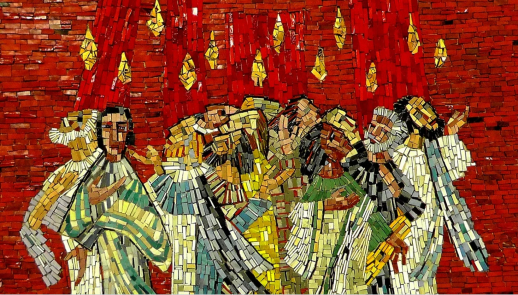
Tongues
Tongues are used in a few overlapping ways in Scripture and should be pursued and practiced as outlined in the Bible. Scripture shows us that the problem is not tongues but the abuse of the gift of tongues.[1] I think it should be admitted that even if we do not completely understand the gift of tongues we should not forbid their practice in private or publically when interpreted (1 Cor 14:27-28) because Paul explicitly says “do not forbid speaking in tongues” (v. 39).
Paul actually tells people to be ready to share a tongue (1 Cor 14:26) and he says, “I want you all to speak in tongues” (v. 5). Further, Paul tells us that he spoke in tongues more than all the Corinthians (v. 18).[2] Paul said all of this even though “one who speaks in a tongue speaks not to men but to God; for no one understands him, but he utters mysteries in the Spirit” (v. 2). Therefore, even though tongues are unintelligible to the human mind unless one is given the gift of interpretation (12:10), to speak in tongues is not wrong or bad (see 14:39); although, it should not be done publicly unless there is an interpreter (v. 28).
Many believe that tongues simply refer to a foreign human language (e.g. Ferguson, MacArthur).[3] Michael Horton says, “We should… understand ‘tongues’ as synonymous with natural languages, which some were miraculously gifted to speak and others to interpret.”[4] This understanding of tongues is simplistic and wrong for at least three reasons. (1) Tongues are used to speak to God. Paul says, the “one who speaks in a tongue speaks not to men but to God; for no one understands him, but he utters mysteries in the Spirit” (v. 2). In this way tongues, at least the way tongues are used here, may be similar to the groans that Romans speaks of (Rom 8:26-27). (2) If tongues are interpreted they seem to function in a similar way as prophecy thus they are different than a foreign speaker coming into a meeting that needs to be interpreted. (3) Paul says there are different types of tongues (1 Cor 12:10, 28). It seems that tongues (glossia) are used in overlapping ways in Scripture. R. P. Spittler points out that in Scripture we see that tongues refer to three types of overlapping phenomena. He says,
‘Kinds of tongues’ (génê glôssôn, 1 Cor. 12:10, 28) can refer to anything on a glossolalic continuum ranging from (1) prayer ‘with groans that words cannot express’ (Rom. 8:26, NIV; preferable to RSV ‘sighs too deep for words’), through (2) tongues speech in a controlled ecstatic jargon that ‘no one understands’ by someone who ‘utterers mysteries to God’ (1 Cor. 14:2), to (3) charismatic use of a recognizable language never learned by the speaker (Acts 2:8).[5]
Regarding tongues, it must also be pointed out that though tongues are good gifts that are given by the Spirit, tongues are not the marker of maturity. Further, tongues are not linked to a “second blessing” or to being filled with the Spirit.[6] Lastly, it must be understood that even if we do not understand something in Scripture does not mean it is wrong or that it does not continue. I, for example, do not understand, the seraphim. But I believe in them. In the same way, just because we may not understand every aspect of tongues does not mean that tongues do not still or cannot function as a blessing to the Church.
Here is a summary of what 1 Corinthians says regarding the gifts of tongues:
(1) There seem to be various kinds of tongues (1 Cor 12:10. 28 cf. 13:1; Acts 2:4).
(2) Tongues are unintelligible and unedifying to the group (1 Cor. 14:2-4, 6, 19) but are edifying to the speaker (v. 4).
(3) Tongues are not a foreign langue but are addressed to God (at least this is the case in 1 Corinthians) (vv. 2, 14-17).
(4) Tongues are not to be shared publically unless interpreted (1 Cor 14:6, 13, 26-33 cf. Acts 19:6).
(5) Tongues themselves are not forbidden but actually encouraged (1 Cor 14:5, 26).
(6) The regulations of tongues show that the tongues speaker is not in “ecstasy” or “out of control” (vv. 27-28).[7]
Rule #2: Don’t worship fake gods, they’re fake.

“You shall not make for yourself an image in the form of anything in heaven above or on the earth beneath or in the waters below. 5 You shall not bow down to them or worship them; for I, the Lord your God, am a jealous God, punishing the children for the sin of the parents to the third and fourth generation of those who hate me, 6 but showing love to a thousand generations of those who love me and keep my commandments” (Exodus 20:4-6).
Rules are given for a reason. We may not always like them but as we saw last week, rules are good. It is no different this week as we look at rule #2.
The rule this week—don’t worship fake gods, they’re fake—just kinda makes sense. We can just see that it makes sense. We may not at first see, however, how common it is for us to disregard this rule. We disregard it all the time. Even though we may not even know it.
This rule comes with caution. If we don’t listen there’s trouble. So, we’ll look at the warning. But, on the positive side, it also comes with a promise of blessing to those who keep it.
1) The Rule (v. 4)
“You shall not make for yourself an image in the form of anything in heaven above or on the earth beneath or in the waters below. 5 You shall not bow down to them or worship them.”
What’s the big deal? I mean, I get not bowing. That seems weird. But why can’t week make stuff?
The Bible does not mean we can’t make things like painting, portraits, or sculptures. We know this because just a little bit later in Exodus God tells His people to make various things (e.g. Ex. 25:18-20, 33-34). The Bible means don’t make things that will lead you or someone else away from worshiping God, and worship Him in the right way, the way He has told us to worship Him.
As John Frame has said, “It is the misuse of an image that God condemns, not its existence or presence.”[1]
God is invisible so we are not to try to make visible by making images of Him (cf. Deut. 4:15-19). God is living (e.g. Deut. 5:26; Josh. 3:10) so we can’t represent Him with something that is not. Unlike idols, for the one true God, “there is no assembly required.”[2]
God is. He is that He is.
As Acts 17:24-25 says, “The God who made the world and everything in it is the Lord of heaven and earth and does not live in temples built by human hands. And He is not served by human hands, as if He needed anything. Rather, He himself gives everyone life and breath and everything else.”
It is important that we worship God in the way He has told us to. For one reason, as Albert Mohler has said, “The wrong worship implies the wrong god.”[3] It implies that He is not Lord of the universe. But He is. So, we must worship Him in the right way.
Rule #1: God is first, so make sure He’s first in your life.
“And God spoke all these words: I am the Lord your God, who brought you out of Egypt, out of the land of slavery. You shall have no other gods before me” (Exodus 20:1-3).
For the next couple of weeks, we’re going to be looking at rules, the Ten Commandments. Yeah! Just what everyone wants to look at! Rules! I’m sure you’re giddy with delight.
Maybe not.
Rules often have a bad reputation. They have for me in the past. Let me ask you though, have you heard of Thomas the Train? Thomas was a train. A blue train to be exact, and a happy train most of the time. But Thomas wanted to be free. He wanted to be free from the restrictions of the train track. He was unhappy because wanted to roam in the open countryside.
One day he got fed up. He made a break for it. He was going to go off the restrictive tracks once and for all! He was going to know freedom.
So, he did. He went of the tracks. He was finally free from the railroad tracks!
What do you think Thomas’ “freedom” was like?…
It was crushing. Literally, crushing. He couldn’t move. He was stuck.
He was somewhere where he wasn’t meant to be.
We often have…
Concern about Rules
We don’t like rules. But rules are good. Have you ever played the card game Mao? It’s a game with unspoken rules. It’s really hard to play because you don’t know the rules but get penalized when you break them. Rules are good because they keep things the way they’re supposed to be kept. They keep Thomas on the tracks so that he is free to come and go, free to be what he is supposed to be. It’s also good to know the rules so you’re not “penalized” for something you didn’t know.
The Work of the Spirit | pt. 9
Fallible Apostles
Fallible apostles exist and are gifted men of God. Many church planters, for example, may have the gifts of an apostle but they do not have authority over others even while they may have much influence. This is because whereas the gift of the apostle continues the office does not.[1]
Sometimes cessationists make the argument that all continuationists believe that at least the gift of the apostle has ceased.[2] I disagree with that caricature; I believe the office of Apostle has ceased.[3] There were other apostles in the New Testament, apparently, they were gifted, and that type of apostle is still around. Obviously, no one else fits the requirement of an Apostle and thus no one should hold the office of an Apostle but that does not, therefore, mean that there are none with the grace gift of an apostle.
As we saw above, MacArthur has tried to show that the rule of apostle has ceased and so then that means that the gifts have ceased. MacArthur does not, however, succeed at what he set out to accomplish. After all, Stephan, for example, was not an Apostle and yet he performed great signs and wonders (Acts 6:8 and perhaps Timothy cf. 1 Tim 4:14; 2 Tim 1:6; 1 Thess 5:19-23; cf. Acts 8:6–7; 9:17–19; 10:44–46; 11:27-30; 19:6–7; 21:9-11).[4] So even if there are no more Apostles that does not mean that there are not still miraculous gifts. However, I do believe there are still apostles (I am not referring to the capital “A” Apostles here, I do believe they have ceased. No one today can meet their qualifications[5]).
But, the role of apostle still continues.[6] Ephesians tells us that Jesus “gave the apostles, the prophets, the evangelists, the shepherds and teachers, to equip the saints for the work of ministry, for building up the body of Christ, until we all attain to the unity of the faith and of the knowledge of the Son of God, to mature manhood, to the measure of the stature of the fullness of Christ” (Eph 4:11-13). We have these five types of leaders (i.e. apostles, prophets, evangelists, shepherds, and teachers) for how long? Paul says, essentially, until perfection (this sounds similar to 1 Cor 13:10), until “the fullness of Christ.” Further, there is no reason to think that we get to keep three of the five types of leaders and lose two (i.e. the apostles and prophets).
When we take these verses into consideration, there is no reason to think that just because the Apostles were the foundation of the church (Eph 2:20) that that means that there are no longer those today that can at times, according to the will of God, perform miraculous signs. Regarding Ephesians 4, Markus Barth rightly points out that it “does not contain the faintest hint that the charismatic character of all church ministries was restricted to a certain history and was later to die out.”[7] In fact, he says, “Ephesians distinctly presupposes that living apostles and prophets are essential to the church’s life.”[8]
There was and never will be a meaningless moment.

Our lives and our decisions matter eternally. They ripple through the corridors of time. There was and never will be a meaningless moment.
I was reminded of this truth recently by two things. One was an email from a missionary that was questioning the good that they, limited and challenged that they are, could accomplish. The second reminder came from one of my favorite books by C.S. Lewis, Perelandra.
In Perelandra Elwin Ransom is sent to the planet Perelandra (or in English, Venus) to stop the Fall of that planet (parallel in some ways to the temptation of Eve in Genesis). Weston, the great enemy, possessed by Satan has now become the un-man. The un-man is seeking to cause the destruction of the beautiful and enchanting Perelandra.
Ransom upon seeing that he is commissioned to stop the un-man and prevent the Fall is crushed by the weight of it all as well as confused over why God doesn’t send some miracle. “He tried to persuade himself that he, Ransom, could not possibly be [God’s] representative” (p. 141).
Ransom questioned. “What was the sense of so arranging things that anything really important should finally and absolutely depend on such a man of straw as himself?” (p. 142). Yet that is the way things are.
“At that moment, far away on Earth, as he now could not help remembering, men were at war,… and freckled corporals who had but lately begun to shave, stood in horrible gaps or crawled forward in deadly darkness, awaking, like him, to the preposterous truth that all really depended on their actions” (p. 142).
Or think of Eve herself. She “stood looking upon the forbidden fruit and the Heaven of Heavens waited for her decision” (p. 142).
So, Ransom came to see that it is true, that “a stone may determine the course of a river” (p. 142).
He felt it megalomania to think that he himself is the way that God will work—work a miracle. Yet, “he himself was the miracle” (p. 141). He was God’s provision. The way God was providing deliverance.
“Here in Perelandra the temptation would be stopped by Ransom, or it would not be stopped at all… This chapter, this page, this very sentence, in the cosmic story was utterly and eternally itself; no other passage that had occurred or ever would occur could be substituted for it (p. 146)… Great issues hung on his choice… It lay with him to save or to spill” (p. 148).
As he saw his call, he also felt an unbearable weight. Then he felt the weight left. “He was in God’s hands. As long as he did his best—and he had done his best—God would see to the final issue” (p. 141).
God uses mere humans as His mouthpiece. God uses humans to do His will. What we do matters. It matters eternally.
Let me ask you, friends, what are you doing?
In Mere Christianity, Lewis said, “There are no ordinary people. You have never talked to a mere mortal. Nations, cultures, arts, civilizations—these are mortal, and their life is to ours as the life of a gnat. But it is immortals whom we joke with, work with, marry, snub, and exploit—immortal horrors or everlasting splendors.”
Friends, our lives matter, our actions matter, our voices matter.
If we knew a millionth of the magnitude of our lives we’d be moved to wonder and crippled by the significance of it all. Our lives and our every action have significance because this world and this life is not all there is.
And for Christians, this is multiplied ten-fold. We are mouthpieces, ambassadors, commissioned by the one true God.
Friends, let’s live fierce purposeful lives because we have purpose. Our lives matter more than we can know.
Revelation: Triumph of the Lamb

Dennis E. Johnson’s book, Triumph of the Lamb: A Commentary on Revelation, has a lot of important and relevant things to teach us. Here are a few highlights from the introduction…
1. Revelation Is Given to Reveal.
2. Revelation Is a Book to Be Seen.
“One of the key themes of the book is that things are not what they seem. The church in Smyrna appears poor but is rich… What appear to the naked eye, on the plane of human history, to be weak, helpless, hunted, poor, defeated congregations of Jesus’ faithful servants prove to be the true overcomers who participate in the triumph of the Lion who conquered as a slain Lamb. What appear to be the invincible forces controlling history—the military-political-religious-economic complex that is Rome and its less lustrous successors—is a system sown with the seeds of its self-destruction” (p. 9).
3. Revelation Makes Sense Only in Light of the Old Testament.
“The ancient serpent whose murderous lie seduced the woman and plunged the world into floods of misery (Gen. 3:1) is seen again, waging war against the woman, her son, and her other children—but this time his doom is sure and his time is short (Rev. 12; 20)” (p, 13).
4. Numbers Count in Revelation.
For example, “The number seven symbolizes the Spirit’s fullness and completeness” (p. 15).
5. Revelation Is for a Church under Attack.
“Our interpretation of Revelation must be driven by the difference God intends it to make in the life of his people. If we could explain every phrase, identify every allusion to Old Testament Scripture or Greco-Roman society, trace every interconnection, and illumine every mystery in this book and yet were silenced by the intimidation of public opinion, terrorized by the prospect of suffering, enticed by affluent Western culture’s promise of ‘security, comfort, and pleasure,’ then we would not have begun to understand the Book of Revelation as God wants us to… Always, in every age and place, the church is under attack. Our only safety lies in seeing the ugly hostility of the enemy clearly and clinging fast to our Champion and King, Jesus” (19).
6. Revelation Concerns “What Must Soon Take Place.”
7. The Victory Belongs to God and to His Christ.
“Revelation is pervaded with worship songs and scenes because its pervasive theme—despite its gruesome portrait of evil’s powers—is the triumph of God through the Lamb. We read this book to hear the King’s call to courage and to fall down in adoring worship before him” (p. 23).
It’s not meant to be this way…

I was just thinking about the phrase, “it’s not meant to be this way.” I recently did a funeral and said those words. And I think right now, with so much that is sad going on, “It’s not meant to be this way.”
There is no such thing, however, as “meant to be” unless there is a “meant.” That is, purpose and meaning. If the world just happened randomly and will likewise run down and dissolve randomly, it doesn’t truly make sense to say something like, “it wasn’t meant to be.” Nothing and everything wasn’t meant to be. It’s all chaotic, random, and meaningless.
I believe that we sense, deep down past our bones, that many things we see and face—even in our own hearts and lives—is not what was meant to be. This world, and we ourselves, our bent.
I believe that is one of the things that points to the reality of purpose. And I’m thankful for that. I believe we can honestly say, “it wasn’t meant to be this way” because there is a way that it was meant to be but isn’t because of rebellion and hate in the human heart.
O’ for what is broken and bent to be mended. For hearts and lives to be whole.
O’ maranatha!
I’m thankful for the Savior, Messiah Jesus, who though whole, bled for this bent world. I’m thankful that He came with healing and promise of wholeness and will soon come with His host to fix every wrong.
Why do Black Lives & LGBTQ+ Lives Matter?

Why do black lives and LGBTQ+ lives matter? This is an important question because some people have views that don’t support the idea of lives mattering. For example, Charles Darwin, the most famous proponent of evolution titled his book, On the Origin of Species by Means of Natural Selection, or the Preservation of Favored Races in the Struggle of Life. And in his book, The Decent of Man, he says,
“The Western nations of Europe… now so immeasurably surpass their former savage progenitors [that they] stand at the summit of civilization…. The civilized races of man will almost certainly exterminate and replace the savage races through the world.”
Does a strict Darwinian view of the world lead to all lives mattering? It does not appear so. That’s why this question is important. Why do black lives and LGTBQ+ lives matter?
If we cut off our objective moral legs, we have no way to stand. If we say morality doesn’t matter, then it doesn’t matter. We can’t pick and choose. We can’t both say people are the way they are and have the desires they have and it’s fine and say it’s not okay for people to be certain ways and do certain things. That’s the crucial thing we need to consider.
Black lives matter. LGBTQ+ lives matter. White lives matter. Yes, yes, yes, and yes. But why?
That is a super important question and one that sadly isn’t receiving a lot of sustained thought. Why do black lives matter? Why do lives matter at all? Where do we get this concept? Is it true?
Jesus said, black lives matter.[1] Jesus said, LGBTQ+ lives matter. Jesus said, all lives matter.
“You shall love your neighbor as yourself” (Matthew 22:37-38).
But does Jesus matter? And if He doesn’t on what basis then are we saying all these lives matter? This may seem like a stupid question. We just know all types of lives matter, right? But do we?
The common view that many have is Darwinian evolution, that we came from nothing and we are going to nothing; from purposelessness to purposelessness. Where is meaning, morality, and lives mattering to be found?[2] Is there a basis for human rights?
Also, did the Roman culture, in whose hands Jesus was murdered say, all lives matter?[3] Did Joseph Stalin say all lives matter? Did Friedrich Nietzsche? Did Adolf Hitler? Did Mao Zedong? Is it even possible to say all lives matter or any lives matter when the highest maximum is have it your way and do what’s right for you? Could it be that “just as long as no one gets hurt” has been trampled upon and obliterated by “you can do whatever you want”?  If God is dead, and we killed him, as Nietzsche said, what follows? Perhaps Nietzsche was right, perhaps that makes all things permissible? Each person doing what is right in their own eyes, whatever that might be. Who is anyone, who or what is God, to restrain? …We are who we are and we want what we want and that’s nobodies business, right?
How or where, then, do we get the concept of lives, any lives, ultimately mattering? The concept of lives mattering would be merely imaginary (a social construct). Perhaps good for America right now but not for all people at all times and places.
We can’t deconstruct everything and still have a basis which to say lives matter or to say that we must love others. We can’t both say we can do whatever we want and you can’t do certain things (like be racist or homophobic).
Unrest and Our Rest

I have friends that are cops. I have friends that are black. I have friends that think COVID-19 is a hoax and friends that I couldn’t coax out of their house if I tried.
Friends, we are in a time of unrest; economic, social, political, and physical. I’m not trying to be dour or dark. I believe that is an accurate articulation of our current time. And yet people are pining for peace and rest.
Where is this peace and rest to be found?
Jesus purchased peace with God for us and will soon bring an eternal peaceful reign to the world but Jesus didn’t purchase a sleeping pill for the masses. And He doesn’t lull us to sleep. We are to neither be restless nor so settled that we don’t stir. We are to be a blessing to the cities and towns and villages that we dwell in even while we are exiles and sojourners here (Jer. 29:7). So, we are to care and be wise but thankfully our eggs are not placed in the basket of this world.
Jesus said. “Come to Me all who are restless and tired and I will give you rest for your souls.” Jesus doesn’t, however, call us to just rest and relax. He doesn’t call us to be lethargic but to love. And thankfully Jesus empowers us to do this. It is as we abide in Him that we bear much fruit.
The truth is, we are responsible to love and not just be lethargic to everything that’s going on. The truth is, we’re powerless but Jesus empowers us by the Spirit. The truth is, we live in a place that is very often godless and chaotic but Christ is the Lord. The truth is, many are restless but in Christ, all can find rest. The truth is, we need a savior, this world won’t change on its own.
Brutality to blacks is an unacceptable evil that Messiah Jesus will judge. Brutality to cops, looting of stores, disregard for people, and even property, is evil and will be judged. There will come a day of rest because there will come a day when King Jesus soon returns and puts a stop to the restless tyranny of sin and Satan’s reign (2 Pet. 3). Jesus will destroy the destroyers of the earth (Rev. 11:18).
Until then, the LORD patiently waits in love for people to repent (2 Pet. 3:9). And so, until that Day, let’s love and share the LORD’s love and lovingly fight for the cause of all those that are oppressed and hurting. And let’s show them that all hearts are restless until they rest in Him.
Let’s pray for people to find peace in the One that was oppressed and afflicted for them.
“O my God, incline Your ear and hear. Open Your eyes and see our desolations … For we do not present our pleas before you because of our righteousness, but because of Your great mercy.” (Dan. 9:18).