Evangelism as an Overflow of Worship

Why do we share the gospel? Because we’re told to? Guilted into it? Or do we share the gospel? Many of us don’t. However, what could motivate us to share the gospel? Guilt? I don’t think that’s the most helpful or biblical motivation.
We share the gospel or should share it because it is the gospel; it is good news! When we have good news will share it. If we like a certain football team, soccer team, or bad mitten team we will be excited if they win and likely even call friends that like the opposing team to brag. If we go to the store and see a certain purse or pair of pants on sale and we buy them we will be excited and even tell someone how much we paid for them. If we go to a new movie or see a show we like we will not hesitate to tell someone about it and that they “have to see it.” We do these things because we’re excited about the “good news.”
I could command you to tell the good news. I could write out the Great Commission right here and just say, “Do it.” But I think if I did that, I would be pulling that text out of context. Notice, before Jesus said His words in Matthew 28:16-20, He first did and said many other things. We find the Great Commission positioned at the end of Matthew. In fact, if my math is correct, there are one thousand and sixty-six verses before it. I believe we must first hear the rest of the book for Jesus’ last charge to be in context; not least of which is Jesus’ death and resurrection. I believe the followers of Christ who were there to hear Jesus’ charge were worshipers (cf. Matt. 28:1; 9: “Mary Magdalene and the other Mary… took hold of his feet and worshiped Him.”). They had not only heard the gospel but had seen it with their own eyes (1 John 1:1-2). They were not given some bland command in the Great Commission but rather it was to them an outlet so that they did not burst.
The singer must sing a song or go mad and the Christian must tell of Christ. Elihu describes well the feelings of compulsion we should have. “The spirit within me constrains me. Behold, my belly is like wine that has no vent; like new wineskins ready to burst. I must speak, that I may find relief” (Job 32:18b-20a).[i] Or Jeremiah says it this way, “If I say, ‘I will not mention him, or speak anymore in his name,’ there is in my heart as it were a burning fire shut up in my bones, and I am weary with holding it in, and I cannot” (20:9).[ii]
Angst

2016 and Time

“Time flies,” we say. Time, even as you read this, is tick tick ticking away never to return (are you sure you want to read further?!).
Thinking of the fleeting nature of time can be depressing. Yet, as we think of our limited time it should awaken in us intentionality and seriousness. Of course, that does not mean we shouldn’t have fun. If anything it means we should be more intentional about having fun (Ecclesiastes 2:24).
So as we think of the fleeting nature of time we must not become unhelpfully rigid. We must be intentional and purposeful not only in the good that we want to accomplish but also in the good we want to enjoy.
We must realize that much of American culture is akin to a hamster wheel. There’s many people going and doing but for what? To what end? Is it intentional, calculated, purposeful? Or is to no end (see Eccl. 2:26)?
We must also acknowledge that cultures think of time and promptness differently. Some cultures are more relational then prompt. The issue is not really about how much we do or about what people think about what we do but about being an intentional wise steward of the time that God has given us. This will likely look different in different cultural contexts but the stewardship principal remains.
God does not want us, His servants and workman, to waste the time that He has given us to labor for Him. We can rest from time to time like any worker but we must remember that there will come a time when we can no longer work at all (Jn. 9:4). We must keep in mind the perfect rest (shalom) and reward that He has waiting for His laborers.
In this post we will look at why being conscious of the way we spend our time is important. Jonathan Edwards is especially insightful here because he realized the importance of time (See esp. “The Preciousness of Time and the Importance of Redeeming it”).
The Preciousness of Time
Why is time valuable and precious? Edwards said, “Because a happy or miserable eternity depends on the good or ill improvement of it” for you and for others. “Things are precious in proportion to their importance or to the degree wherein they concern our welfare.”[i]
“Gold and silver are esteemed precious by men; but they are of no worth to any man, only as thereby he has an opportunity of avoiding or removing some evil, or of possessing himself of some good. And the greater the evil is which any man hath advantage to escape, or the good which he hath advantage to obtain, by anything that he possesses, by so much the greater is the value of that thing to him, whatever it be. Thus if a man, by anything which he hath, may save his life, which he must lose without it, he will look upon that by which he hath the opportunity of escaping so great an evil as death, to be very precious. — Hence it is that time is so exceedingly precious, because by it we have opportunity of escaping everlasting misery, and of obtaining everlasting blessedness and glory. On this depends our escape from an infinite evil, and our attainment of an infinite good.”[ii]
For example: The life preservers on the Titanic, “the unsinkable ship,” were not thought of as valuable at the outset of the cruise. People must have thought: What is the need of a life preserver on a ship that won’t sink? But that mindset changed. What was it that brought a new and priceless value to the life preservers? People realized that they were, in fact, not on the unsinkable ship; for it was sinking.
In a short time the value of the life perseveres sky rocketed. The people now clinched the life preservers tight, perhaps even fighting over them, when before they would not even give them a second thought. Just like the passengers treated the life preservers differently once they realized the ship was sinking so we must treat time differently once we see that our lives are fleeting. When we realize that time is precious we will clinch it tight and use it wisely.
Life is transitory and we do not know how long we will live. Our life is just a mist that appears for a little time and then vanishes (James 4:14). Time is so valuable, in part, because it is very short. Our time on earth is but dust in the wind, vapor that is here for a moment, grass that withers in the sun. Our time on earth is short and “the scarcity of any commodity occasions men to set a higher value upon it, especially if it be necessary and they cannot do without it… So time is the more to be prized by men, because a whole eternity depends upon it; and yet we have but a little of time.”[iii]
“Time ought to be esteemed by us very precious, because we are uncertain of its continuance.”[iv] We know that time will end for all people; however, we do not know when. We do not know the date and the time.
Time is valuable because when it is gone you can never get it back. Edwards said,
“There are many things which men possess, which if they part with, they can obtain them again. If a man have parted with something which he had, not knowing the worth of it, or the need he should have of it; he often can regain it, at least with pains and cost… But it is not so with respect to time. When once that is gone, it is gone forever; no pains, no cost will recover it.”[v]
“Once the time of life is gone, when once death is come, we have no more to do with time; there is no possibility of obtaining the restoration of it, or another space in which to prepare for eternity. If a man should lose the whole of his worldly substance, and become a bankrupt, it is possible that his loss may be made up. He may have another estate as good. But when the time of life is gone, it is impossible that we should ever obtain another such time. All opportunity of obtaining eternal welfare is utterly and everlastingly gone.”[vi]
The way we spend our time on earth has eternal consequences. This is not a subject to be taken lightly. “A person cannot do anything to time itself—delay or hasten, save or lose it—much less ‘manage’ it. The challenge is to manage ourselves under the lordship of Jesus Christ, from whom we get our goals and values.”[vii]
May we be intentional and wise stewards of 2016.
________________________
[i]Jonathan Edwards, The Works of Jonathan Edwards:2 Volume Set, (Peabody, Massachusetts: Hendrickson Publishers, 2005), 233.
[ii]Edwards, The Works of Jonathan Edwards, 233.
[iii] Ibid.
[iv] Ibid., 234.
[v] Ibid.
[vi] Ibid.
[vii] Charles E. Hummel, The Freedom from the Tyranny of the Urgent (Downers Grove, IL: IVP Books, 1997, 31.
to deep darkness the Light
“The people who walked in darkness
have seen a great light;
those who dwelt in a land of deep darkness,
on them has light shone.”
~Isaiah 9:2
This is Christmas

The holy babe in the manger looked not to riches
Nor to fame
But to the cross
To that which He came
This His one purpose
And this His delight
This is what He ever had in His sight
This greatest gift He did bring
Not to the nice who thought they kept the law
But to the naughty
To the wretched that on Him did call
He gave the gift of eternal glory where He’d ever be by their side
This is the Gospel
This is Christmas
The Good News of a Savior for sinful man
Incarnation to New Creation

Just a word and all wonders wrought,
God announced, and behold, it was all good.
Creation had communion with the Creator,
God walked in the Garden.
Yet with Adam the serpent did conspire,
and brought the world into mire.
Beckoned to the grave,
everything disarranged.
The curse burst upon the scene,
but in the midst a seed of hope was seen.
Yes, long of told
,
the Scriptures told
,
of a King who’d come.
In His wake,
death shall quake
,
and the deserts they shall bloom.
Yet, many men came and went,
was the hope of promise spent?
Many lambs, prophets, priests and kings,
yet none with true salvation in their wings.
Darkness for a time,
no prophet’s voice was heard.
Yet in the darkness,
I light it shone,
and it would overcome the darkness.
Behold, O’ world, your Prophet, Priest, and King,
Jesus the Promised seed and Lamb.
The curse brought in shall be expunged;
yes, replunged upon the Son.
Christ was crushed as promised,
but in His crushing, crushed Satan, sin, and death.
Yes, He was cursed to reverse the curse.
He felt our plight to set all things right.
Yes, creation Creator collided
yet we did not hide
for God He brought no wrath,
there was no blood bath,
the world did not implode or explode into non-being.
Instead, angelic greeting:
“Peace on the earth,
goodwill to men”
because the Great I AM is come.
Our Lord, Messiah, Savior in a crib.
Wonderful Counselor,
Prince of Peace,
Bright and Morning Star,
born.
He who lay the foundations of the earth,
laid in a manger.
The Infinite born,
a swaddled babe.
Yes, He that holds the nations in His hand,
grasps His mother’s hand.
He that calls the stars by name,
spoke no name,
nor word.
He formed Himself
in His mother’s womb.
He upheld the nails
that held His hands.
He died for you,
for me.
He became poor
to restore our riches.
Yes, He felt our plight
to set all things right.
He was born to die,
that we might live.
The Deity
incarnate brings
salvation in His wings.
Man once again will be in the Garden
because God’s Son walked from Gethsemane to Golgotha.
No more brier prick or thorn to stick.
All shall be made new.
When our King all subdue,
all shall be made new.
All foes to be forgotten.
Forever banished now.
Satan’s role will be revoked,
the Lord Messiah come.
The demons tremble in His wake;
the blind see,
creation glimmers,
soon the groaning’s cease.
This is the time in between,
the already and not yet.
The Kingdom has come, but not consummated;
it shall be slightly belated.
Peace on the earth,
goodwill to man,
God’s eternal plan in fruition.
The Kingdom has come in God’s Son,
the lion to lay down with the lamb.
No tent or temple,
for the LORD tabernacled.
Yahweh is Messiah.
Immanuel,
born the balm,
for the vacuum of our souls.
Yes, the myth came true in the manger.
God is no longer a stranger,
but makes Himself known in His Son.
Jesus, Joshua’s namesake, true!
The LORD our Savior come!
He was, and is, and is to come.
All things consummate(d) in Him.
Amen.
(click here for audio)
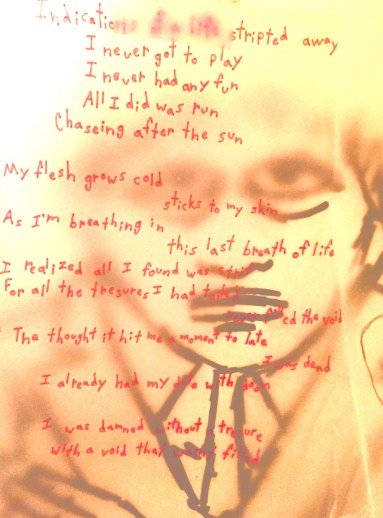
The “Yes!” we scream, whispers “No”

Greet the reaper as he reaps
and weep because of the same
  This silly game
  We do this to ourselves

We’ve mapped out our whole mission
We sketched the whole thing out
  The plan for our destruction

The black hole that is you
  It will consume you
More, more is your mantra
 The only thing that will not go is “no”

Inject the pleasure
Digest the pain
Is it all a game?

You dance,
You dance to your own dirge
The Thesis and Anti-Thesis on Life and it’s Negation

Life is futile. A senseless waste. We live, we die. That is it.
We squeeze out meaning. Or inject it into our veins. We run, but we know not for what, and then expire. We build our castles and pile up things. Then we die.
The sun rises and sets or spins and spins. Seasons come, seasons go. We grow old. We die. The same remains until the sun burns out and we grow cold.
All is futile.
There is no meaning, accept what we make. So fill your coffer, kill the pain. Feed your pleasure, though a monster it becomes.
Thus is life if there’s no hope beyond the grave.
Yet, if this is the sleepy land and we wait for what is true life then this is but the testing ground. We plant what grows for us there. If we make our meaning here, then we destroy it there. If we are lethargic and vague in pursuit then we’ll obtain the wind.
The Precious Truth of God’s Sovereignty

Introduction
The sovereignty of God is perhaps one of the most difficult doctrines in Scripture and yet one of the clearest. However, just because something is hard does not mean that it’s not helpful.
To think about and discuss the sovereignty of God can be challenging but also sweet. I think for instance of the rough shell of a coconut but of the reward contained inside. Or the difficulty of building a house but of the protective refuge you have at its completion. It may at times be difficult to wade through the deep waters of God’s sovereignty but we will never get to the island of peace if we don’t.
Our knowledge of God’s sovereignty is limited but Scripture certainly does not shrink back from saying that God is in absolute control. The Bible is replete with texts that teach us that is LORD of all (see e.g. Dan. 4:35; Is. 40:13,14; Rom. 9:15-18; Eph. 1:5, 11).
The Westminster Confession of Faith says it this way:
“God, the great Creator of all things, doth uphold, direct dispose, and govern all creatures, actions, and things, from the greatest even to the least, by his most wise and holy providence, according to his infallible foreknowledge, and the free and immutable counsel of his own will, to the praise of the glory of his wisdom, power, justice, goodness, and mercy… God, in his ordinary providence, maketh use of means, yet is free to work without, above, and against them, at his pleasure.”
The word “sovereignty” is nowhere in the Bible, yet the teaching is all over the place. We see that God declared the “the end from the beginning and from ancient times things not yet done.” God says “My counsel shall stand, and I will accomplish all My purpose” (Is. 46:10). Daniel tells us that “All the inhabitants of the earth are accounted as nothing, and He does according to His will among the host of heaven and among the inhabitants of the earth; and none can stay His hand or say to Him, ‘What have You done?’” Job tells us that “He is unchangeable, and who can turn Him back? What He desires, that He does. For He will complete what He appoints for me.” Indeed, “Our God is in the heavens; He does all that He pleases,” says the psalmist (Ps. 115:3; cf. 135:6). That is what is meant by the sovereignty of God.
A.W. Tozer said this in his excellent book The Knowledge of the Holy:
“God’s sovereignty is the attribute by which He rules His entire creation, and to be sovereign God must be all-knowing, all-powerful, and absolutely free. The reasons are these:
Were there even one datum of knowledge, however small, unknown to God, His rule would break down at that point. To be Lord over all the creation, He must possess all knowledge. And were God lacking one infinitesimal modicum of power, that lack would end His reign and undo His kingdom; that one stray atom of power would belong to someone else and God would be a limited ruler and hence not sovereign.
Furthermore, His sovereignty requires that He be absolutely free, which means simply that He must be free to His eternal purpose in every single detail without interference. Were He less than free He must be less than sovereign” (Knowledge of the Holy, 115).
God is Meticulously Sovereign
I learned an important thing from a good friend, a young Christian that was struggling with drug addiction. He told me one night he was really upset so he turned on the radio hoping that it would help him. As he turned on the radio he prayed that God would play an awesome song. And my friend’s song came on, and no it wasn’t “My Heart Will Go On” (you know, the Titanic song); instead, his song is “I am Redeemed” by Big Daddy Weave. And it came on not at the end of the song, but at the very beginning. One of the lines he heard, since he heard the whole thing, was: “I’m not who I used to be. I am redeemed.” This song had a big impact on my friend and helped him fight his enslaving sin of drug addiction that night.



 in X
in X 