Why was the Blind Man Healed Twice?
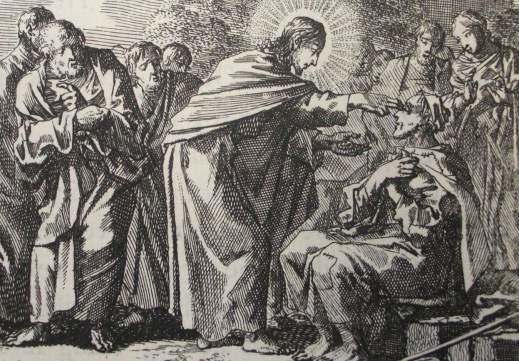
Why would Jesus touch the blind man twice to heal him? Surely He had the power to heal him the first time. So, it would appear to me that there is some significance for why this healing happened this way. Though, in this as with all Scripture we must remember that the hidden things belong to the LORD but the things that have been revealed belong to us (Deut. 29:29). Thus, we cannot take all of the mystery out of this passage but we can offer a few reasons for why this miracle went down as it did (Remember Jesus could have done it much differently cf. Matt. 9:27-31; Jn. 9:1-12). Here is the text under question:
[22]And they came to Bethsaida. And some people brought to him a blind man and begged him to touch him. [23]And he took the blind man by the hand and led him out of the village, and when he had spit on his eyes and laid his hands on him, he asked him, “Do you see anything?” [24]And he looked up and said, “I see people, but they look like trees, walking.” [25]Then Jesus laid his hands on his eyes again; and he opened his eyes, his sight was restored, and he saw everything clearly. [26]And he sent him to his home, saying, “Do not even enter the village.” (Mark 8:14-26)
As with any passage, the context must be considered. This is a cursory look at the passage but we should be able to get at the reason for the double healing. So in the broad context of the New Testament and the Gospels there is quite a lot about spiritual seeing. In Mark chapter four Jesus explains His use of parables. He said (see Mk. 4:10-12) I use parables “so that ‘they may indeed see but not perceive, and may indeed hear but not understand, lest they should turn and be forgiven’” ( cf. Is. 6:9-10).
In the immediate context in chapter 8 we see that Jesus talks about “seeing,” i.e. understanding. He says, “Having eyes do you not see, and having ears do you not hear? And do you not remember? When I broke the five loaves for the five thousand, how many baskets full of broken pieces did you take up?” They said to him, “Twelve.” “And the seven for the four thousand, how many baskets full of broken pieces did you take up?” And they said to Him, “Seven.” And He said to them, “Do you not yet understand?’” (Mk. 8:18-21).
After this the disciples and Jesus (“they”) went to Bethsaida (Mk. 8:22). So there was some time that elapsed between verse 21 and verse 22 in historical reality. Yet Mark places the healing of the blind man directly following the conversation between Jesus and the disciples.
Why? And why such a strange healing? Why would Jesus spit in the blind man’s eyes and yet not completely heal him? Why would he still have poor sight (Mk. 8:24)? Why would Jesus have to touch him again (Mk. 8:25)?
Based on the context I think it reminds us of the disciples and their vision. They “see,” i.e. understand, but their understanding is still very poor. They too will need a second touch. Notice what follows this passage. Jesus asks His disciples, “What do you say that I am?” Peter as the disciples typical spokesman said, “You are the Christ.”
Jesus is essentially asking the disciples, “Do you see, do you understand?” The disciples respond, “Yes, we see you are the Christ.” Yet, they did not know but they didn’t see as clearly as they thought they did. They saw “men , but they look like trees,” you could say (Mk. 8:24). This is proven later especially by the once very vocal Peter as he denies Jesus (Mk. 14:66-72). He truly did not see what it meant for Jesus to be the Christ. He too needed a second touch. He too needed to be healed of his blindness.
Thus I think in retrospect the healing of the blind man in this passage is a type of parable. Jesus asked, “Having eyes do you not see, and having ears do you not hear? And do you not remember?” (Mk. 8:18). The disciple did see and yet they did not see. It is a strange paradox. They had in a sense been healed as the blind man but their vision, their understanding, was still a long way off. Their vision would not be truly “fixed” until they saw the Lord again and He fixed them (Mk. 16:12-14). At the end of Luke, after Jesus’ resurrection, we see that Jesus gave the disciples the correct understanding of the Christ that they lacked (Lk. 24:27, 44-47). After this lens adjustment they could see clearly.
So why was the blind man healed twice? I think to teach something about the disciples. And about us. It appears that way to me based on the immediate context of the passage and the way that blindness and seeing is used in Scripture. It has also been pointed out to me that there is a chiastic structure in this passage. Here’s the diagram:
A: The Apostles don’t see clearly (vv. 14-21)
B: The blind man can’t see clearly (vv. 22-24)
B’: The blind man can see clearly (vv. 25-26)
A’: The Apostles see clearly (vv. 27-30)
We see that the blind man needed a second touch, the Apostles needed a second touch, and we often need second, third, fourth, etc., touches to see as well. We need more contact with Jesus the Lord of life if we are going to see.

Our Missionary God and Our Mission

God incarnated Himself. Became poor, despised. God is the ultimate missionary. He Himself who is the good news, brought good news.
If we are going to be “missional,” i.e. intentionally evangelistic, we must focus on and learn from God the Great Missionary. God’s love is unrelenting and displayed through a vast array of means. It is tangible. It cares. It comes to us. It gives. God’s love is present, active, premeditated.
God’s mission is not disconnected from who He is but expressive of who He is. God’s character, in Christ, literally bled out. God’s missionary heart is not forced but fundamental. God is a God who calls, reaches, and loves the unloving; and He always has been.
We cannot expect our hearts to overflow with missional love unless we meditate on God’s love that we see expressed through the Scriptures. For the good news of Christ to overflow out of our hearts it must daily be in our hearts as good news. We don’t want the gospel and a life of love to be forced, we want it to be so natural that it pours out. We don’t just need our actions to change, we need our character to change. We need to be different. We need to care in ways that we don’t care. We want to intentionally share, not mainly because we have to but because we want to.
We must regularly challenge ourselves by the active nature of mission. God did something. He was not passive. He came. He had a plan (since before the foundation of the world) and He executed it. It cost Him but He carried it out. He opened wide His arms and welcomed in the unloving and hateful world as He hung stretched out on the tree.
We too must be active. We too must enter the world in tangible and intentional ways. We must have a plan and execute it; even if it costs us.
We are ambassadors for Christ, God makes His appeal through us. God speaks through us! So we must implore people on behalf of Christ to be reconciled to God (2 Cor. 5:20).
The Present State

The nations plot and rage
The world goes grinding on
            Many caught in her cogs
            Continually disarranged

The turmoil triumphs
The plague it plunges all

Here we fall
We are the fall
O’ the hell we’ve made!

The world is groaning
I reciprocate her pain

O’ maranatha!
Technology: Connected and Out of Touch

How surreal, I am sitting in a Starbucks and there is an older couple sitting across from me. By all appearances they do not know each other. Their “date,” from what I can tell from spying, consists of looking at their cell phone (maybe the new iPhone 6s), touching it, and occasionally showing each other something on their phone; no doubt a new high score on “angry birds” or some other profound thing like a YouTube video of a monkey.
This is surreal for two reasons: 1) When this couple got together and started dating they could never have imagined the technology that would be available in the palm of their hand. Maybe this partly explains why they are so captivated by their phone and not by the actual person setting beside them. 2) When this couple got together, maybe thirty years ago, they could not have imagined wanting to hold some device in their hand rather than their loved ones’ hand.
Yet how things change. Affections fade and technology grows. And perhaps there is a correlation between the two distancing polls. If we hold a device in our hand instead of our loved ones’ hand, if we have “facetime” instead of real face time, if we have “facebook” and not time with real faces, if we have tweets and not conversations there will necessarily be a distancing effect from technology. And it will likely be that as technology advances so will be the chasm between relationships. However, if we start to put the work in on our relationships that any computer programmer puts in on technology then we may be able to keep pace with the discordant dissidents of technology. But this will require the intentionality and work ethic of those that are bringing us these great advances in technology.
In all of this realize that I am by no means saying that technology and advances in technology are bad, they are not in and of themselves (For instance, things like Skype can help relationships). Yet we must be very conscious in our use of technology. We must consider, am I playing “Tomb Raider” (or whatever it is called) when I should be looking deeply into my loved ones’ eyes? Am I “iTexting” when I should be talking to the person beside me? When I turn on my phone do I turn off my head? Does the “feed” on Facebook or Twitter feed my soul and intellect or does it leave me malnourished and hungry for something of substance like a book? Does being connected to the internet connect me to the world or allow me to be safely removed from it?
I have found these questions surprisingly relevant and present but often unheeded in my own life. I have noticed on more than a few occasions when my family is visiting that we will set around in the living room with more than one person on a technological device. We’ll be “hanging out” yet the majority of the people in the room are on a computer or some such thing. This form of “hanging out” is much different then I remember growing up, and I’m only twenty-eight! My kids will have to be especially careful in their use of technology.
“Genetic Homosexual?” and our morality…

John is attracted to men. Jane is attracted to women. And so, our cultural says, “Go for it! If that’s the way you feel (the culture’s only form of “objective” truth). After all, that’s the way you were born. It’s in your genes.”
I, Paul, am attracted to women (pl.) and yet I am married, to a singular woman. I also have the tendency, bent, disposition, because of innumerable factors (nature, nurture, etc.) to be angry and act out in anger. If I left myself unchecked and just did whatever I felt like, I, sad to say, would be an abusive adulterer. Something that would not be good for me, my wife, my children, or society.
So, even if I am by nature a genetic abusive adulterer is that ok? Should I be content with that? Promote that?
I do not see how that is admirable. Many people would lead me to believe that is the higher good; to be something akin to animals. To do whatever we want, whatever our natural self would want to do. It sounds like many would sniff the wind and follow their inner impulse. However, does anyone realize that our inner impulse, whatever it might be, will often lead to some very bad places?
We all have many dispositions: selfishness, pride, boastfulness, etc. but that does not make it right; even if natural. If we want to just say that everyone should just do whatever their genetic disposition has given them, then we should just do away with the penal system and society in general. For what, in that line of thought, would allow us justification to repress any inner and natural desire?
Many studies, for instance, show that many drug addicts, whether meth, heroin, or cocaine, have a genetic disposition to drug addiction. However, we don’t say, or most of us don’t say, that drug addiction is okay. Why? Many would say because it harms the body and harms society. Just because someone has a disposition for something does not justify that disposition.
The logic that says homosexuality is fine because people have a disposition towards it is faulty. That just does not follow. People have dispositions in all sorts of ways. But that does not make it morally good.
People say: “To your own self be true” and other such phrases. But where does our deepest self lay? In our pants? Or does our mind and our convictions play a pretty big part? Maybe being “true to our self” also, and more fundamentally, means being true to our convictions, to what we think and believe at the core of our being. If I ask, “Is love more than bodily fluids?” This will be answered not unbiasedly but according to other deeper and more fundamental questions. The real issue at stake in this conversation is about fundamental convictions; how we see the world, our ultimate desires, our view of life and our view of “the good.”
People, for instance, compare sex to eating. Yes, sex is like eating in some ways. It is a natural enough thing (although much more significant psychologically, relationally, etc.), yet if we don’t eat we die. That is not the case with sex. Yet sex, under certain belief systems, e.g. naturalistic hedonism, will be seen as close to ultimate. Whereas the Christian sees sex as a good gift from God. A gift that must be enjoyed in the right way to the right end. In the Christian’s belief system there is something more awesome more significant than sex, infinitely more.
When the Christian, whether their tendency is more towards heterosexual, homosexual, or bisexual temptation, has found that there is something more significant, lasting, and satisfying than sex (yes, something better than sex!) it obviously impacts them. They can be recreated and desire what is more significant than some of their inner dispositions.[1] Through relationships, whether with friends, a spouse, or God, we see that we are not just sexual animals; that is one part of our constitution. It is not, or I don’t think we should let it be, the fundamental and driving part. That view is shallow, problematic, and simply just not accurate to reality.
What we are seeing in our culture is two worldviews colliding. One says we are fundamentally animals and thus expects us to live according to our innate animal desires. And from that worldview, it’s consistent. Only why stop with adultery or homosexuality?… whatever one finds to do, whatever the desire, it should be allowed in that system.[2] The other worldview says we are not animals and we should not live simply according to our desires. Our desires can be wrong, very wrong. The Christian says that we were created in the image of God but have been marred through sin. We need to be remade in God’s image by listening to His Word. The problem happened in the beginning exactly because we were not listening and did what we (wrongly) desired.
Our desire must be shaped, informed, led by He who knows; namely God. God has all wisdom. Not us. He, as our good Father, knows how to give good gifts, even if we think we want something else. He knows what we ultimately need and what will ultimately satisfy.
So, there may be “genetic homosexuals” that are not practicing homosexuals. I myself am a “genetic adulterer” yet, by God’s empowering grace, I am not a practicing adulterer.
___________________________________________
[1] Of course, here, if someone sees humans as fundamentally just sexual animals then what I am saying will be scoffed at. However, I will also rightfully scoff at their shallow, sad, and bankrupt view. If we are mere animals then what of love, what of society, what of the penal system? Obviously, “non-Christian presuppositions will lead to non-Christian interpretations and ultimately to non-Christian conclusions” (Michael J. Kruger, “The Sufficiency of Scripture in Apologetics,” 87 in The Master’s Seminary Journal, Vol. 12, No. 1, Spring 2001). Yet, those conclusions are chaotic, problematic, and wrong.
[2] “Logic, science, and morality make no sense within the non-Christian worldview. For example, how can the atheist justify and explain the origin and universal applicability of moral absolutes? He simply cannot. Consider philosopher William Lane Craig as he explains the impossibility of moral absolutes in an atheist worldview: If there is no God, then any ground for regarding the herd morality evolved by homo sapiens as objectively true seems to have been removed. After all, what is so special about human beings? They are just accidental by-products of nature which have evolved relatively recently on an infinitesimal speck of dust lost somewhere in a hostile and mindless universe and which are doomed to perish individually and collectively in a relatively short time. Some action, say incest, may not be biologically or socially advantageous and so in the course of human evolution has become taboo; but there is on the atheistic view nothing re ally wrong about committing incest. If, as Kurt states, ‘The moral principles that govern our behavior are rooted in habit and custom, feeling and fashion,’ then the non-comformist who chooses to flout the herd morality is doing nothing more serious than acting unfashionably (William Lane Craig, The Indispensability of Theological Meta-Ethical Foundations for Morality, located at http://www.leaderu.com/offices/billcraig/meta-eth.html, 4)” (Michael J. Kruger, “The Sufficiency of Scripture in Apologetics,” 83n35 in The Master’s Seminary Journal, Vol. 12, No. 1, Spring 2001).
Our Chronological and Geographical Snobbery and Our Need for a Standard Beyond Ourselves

Science is about what is and can never be about what ought be. Thus, left to our own devices, left to science and our subjective view of what ought to be, we are left with a “might makes right” morality. We are left to Nietzsche and Nazism, to Stalin and suffering. We need a standard that science with all its greatness cannot give us. We need a salvation that science with all its greatness cannot give us. Science, what is, without what ought be, a moral standard beyond us, will inevitably lead to the moral atrocities committed in concentration camps.
Hitler and Nazism justified extermination camps based on what they thought was a good rationale. The U.S. Supreme Court ruling on Dread Scoot vs. Sandford shows that humans are not omniscient. Even now in the 21st century. We will continue to make grave mistakes if we continue in our historical snobbery and arrogant pride and disregard all previous history. As we say “we’ve arrived, we know,” we quote many dead civilizations. I guess we might say with those civilizations, “we’ve arrived” …to our tomb.
We can look down our nose at the Aztecs for their bloody sacrifices. But then, they didn’t know any better. We can look in disdain at Baal worshipers and their practice of baby sacrifice. Perhaps we can even look to Africa, India, and Islam and disdain some of their practices. But, here in the States, here where we lay more babies down each day then what the U.S. lost on D-Day, here where “have it your way” is the moral mantra, here there is nothing to be gained. We’ve arrived. We don’t need a moral compass. We are the moral compass.
We’ll follow our impulses. “Might will make right” and “have it your way” will hold sway. We’ll wade in blood. We’ll turn away. Until we drown.
We don’t need the light of history or God’s word. We are god. We make the rules.
We walk in the darkness we’ve created (cf. Is. 59:10ff). We walk on bodies through the cemetery we’ve created. No wonder we don’t want a light.
Is it not plain that we need Truth, Jesus the Lord of life and the Great Light of the world, to shine away our darkness (Is. 35:5)? We need the Lamb to set on the throne and be our Shepherd (Rev. 7:14-17). All other leaders fail. Scientists and Presidents cannot and will not bring salvation or what finally ought be. The One in the beginning that said it was very good (Gen. 1:31) alone can make it good again (Rev. 21:1ff). The LORD in the face of Jesus Messiah is our sure hope.
Church Membership?
Church membership is often not the priority it should be. There are a few possible explanations for this: (1) lack of understanding of church membership and its importance, (2) lack of commitment, or (3) a lack of desire to submit to biblical authority. This will only cover the first issue, lack of understanding. I think it can be assumed that if you are a Christian you should be committed (see for example Rom. 12:1) and you should submit to biblical authority (see for example Heb. 13:17).
What is Church Membership?
When a person is born again by the Spirit they instantly become a member of the invisible universal Church body. Church membership is a formal covenant of a believer to a local visible church body for mutual growth and accountability.
Reasons for and Advantages of Church membership
There are several reasons to be connected to a local church body: worshiping together (Col. 3:16; Eph. 5:19-21), equipping (Col. 1:28; Eph. 4:12-13), exhortation and teaching (1 Tim. 4:13), exercising spiritual gifts (Rom. 12:6-8; 1 Cor. 12:4-7; 1 Pet. 4:10-11), church discipline (Matt. 18:15-20; 1 Cor. 5), sharing the Lord’s Supper (Luke 22:17-20; Matt. 26:26-28; Mark 14:22-24), celebrating baptism (Matt. 28:19), giving (Matt. 23:23; 1 Tim. 6:17-19), encouragement (Heb. 10:24-25), as well as, having faithful leaders to care for and help you (1 Tim. 3:1-13; Titus 1:5-9).
There are also several advantages to church membership. Church discipline may not seem like an advantage but it is. It may be the very thing to deliver a soul from hell (1 Cor. 5:5), this is a true and gracious advantage. As a church member you can enter into the life of the church in a unique way such as voting on specific church issues. Church membership is a covenant of commitment one to another. Through church membership you clearly know who your brothers and sisters are and pastors/elders know who exactly they are responsible for. Members have church resources available to them that otherwise would not be. Members also very often have more opportunities to serve in the churches various ministries. Lastly, church membership is biblical.
Church Membership is Biblical
“Biblical? Where is the chapter and verse?” you ask. Well, there is no chapter and verse that states explicitly that you must join a church. Yet, I believe we can see it implicit in the New Testament. In the book of Acts we see that the early churches’ practice was to baptize believers and then add them to the church (Acts 2:41, 47; 5:14; 16:5). In fact, those that were saved and baptized in the early church “devoted themselves” (which could have taken the form of a formal covenant) to the apostles’ teaching, fellowship, and prayer (Acts 2:41-42).
There is no explicit text calling believers to belong to a church because it was everywhere assumed and practiced in the early church so there was no need for a formal statement. Also, many of the first churches were smaller house churches so membership or commitment would be more easily recognized (especially under persecution). However, many churches are much larger today so it serves the leadership of the church and the church as a whole to keep track of those who have formally covenanted to church membership.
We see that there was a list of widows that were entitled to financial support (1 Tim. 5:9) and there may also have been a growing list of church members (see for example Acts 2:41, 47; 5:14; 16:5). Churches would also write a letter of commendation (Acts 18:27; Rom. 16:1; Col. 4:10; cf. 2 Cor. 3:1-2) for believers that were moving to a different area. This leads us to conclude that church roles were likely kept in the early church. However, even if they did not have a formal list they obviously knew who was part of the body and this was very important to them and should be to us as well.
We also see a New Testament mandate for godly qualified leadership. Men who are called to shepherd the church (Acts 20:28; 1 Peter 5:2) by laboring (1 Thess. 5:12; 1 Tim. 5:17), and watching over souls (Heb. 13:17). Pastors (a synonym of elders and shepherds) will give an account to God of how they shepherded so it is important that they know who their sheep are.
Church membership is implied from church discipline (see Matt. 18:15-17; 1 Cor. 5:1-13; 1 Tim. 5:20; Titus 3:10-11) and it assumes that the elders of the church will know who the members of the church are. We also see much biblical imagery that points us to church membership. The church is called: body, bride, family, royal priesthood. These things suggest tight connection, even formal covenant. We as the church are to be like an outpost in enemy territory, an embassy amongst a distant land. If you are a citizen of the heavenly Kingdom you should be connected to the local embassy. The church is that embassy, the church represents the Kingdom of God on earth.
Conclusion
Local church membership, though obviously not required for salvation, is vital. It is my prayer that more and more believers would covenant together as the body and bride of Christ to be committed together to be and do what Christ our Lord has called us to do with the short time that we have here to labor for our Lord.
Suggested
Introductory: Jonathan Leeman, Church Membership
In-depth: Jonathan Leeman, The Church and the Surprising Offense of God’s Love
Singing, Sanctification, and Transformation

Why sing? Why are “psalms, hymns, and and spiritual songs” important? What does singing do?
In the world we live in
“There is a ‘downward pressure’ continually in operation, which seeks to take that which is penultimate, and make it ultimate… The antidote to such ‘downward pressure’ is the continual eschatological emphasis of word and sacrament, of prayer and praise, and of koinonia [fellowship] lived in the present in light of the age to come.”[i]
Truly, “unless there is within us that which is above us, we shall soon yield to that which is around us.”[ii] St. Gregory reportedly said something similar: “If you do not delight in higher things, you most certainly will delight in lower things.” Truly, “worship shapes individual and community character.”[iii] That is, all worship, good or bad, Christian or other, intentional or unintentional. Thus we must focus on what is true, noble, right, pure, lovely, admirable, excellent, and praiseworthy (see Phil. 4:8).[iv] We must keep “the good,” the true good—God and His truth—the summum bonum ever before us.
Our ultimate love, the place where we rest our desire, has an ultimate affect. So, “moral decay doesn’t happen in a vacuum. It is supported by the idolatry of the society at any given time, and expressive of its worship, even if such be completely unarticulated.”[v] Moral decay happens when something other then God is our ultimate good (cf. Rom. 1).
Thus, it is important that we temper our hearts variously through singing, community, and the absorption of God’s word. That’s how we’re shaped biblically and practically. The more we have our chief end in view, through various means, the better we will live to that end.
We need deep and substantive reflection and celebration. We need to work at fostering transformative experiential worship where we can taste and see that the LORD is good. We need God to restore to us the joy of our salvation. We need God to open the eyes of our heart, we need the Spirit to move, we need God’s strength to comprehend His amazing love that surpasses knowledge.
Truly
“It is… superior satisfaction in future grace that breaks the power of lust [or addiction]. With all eternity hanging in the balance, we fight the fight of faith. Our chief enemy is the lie that says sin will make our future happier. Our chief weapon is the truth that says God will make our future happier… We must fight [our sin] with a massive promise of superior happiness. We must swallow up the little flicker of lust’s pleasure in the conflagration of holy satisfaction.”[vii]
Where do we turn for this? “The role of God’s Word is to feed faith’s appetite for God. And, in doing this, it weans [our] heart away from the deceptive taste of lust.”[viii] Therefore, we must feast on Scripture. And singing is an especially useful tool to help the word of Christ dwell in us richly (Col. 3:16).
Singing psalms and hymns and spiritual songs and being involved in Christian community is very important because, as C.S. Lewis said, “What is concrete but immaterial can be kept in view only by painful effort.”[ix] We need each other, we need music, we need preaching to shake us awake to unseen realities. That’s why we’re told—commanded even when we don’t feel like it—to make a joyful noise to the LORD (Ps. 66:1; 81:1; 95:1, 2; 98:4, 6; 100:1).[x]
We’re told to sing because when we sing with our voice our whole body, and I would argue, our whole self (i.e. our heart) reverberates with the truth of what we sing. When we sing lyrics, whether good or bad, they get into us and shape us. We are essentially preaching to ourselves, teaching ourselves, telling our self what we should desire, we are holding up a vision of prospering and “the good.”[xi] If we are driving down the highway listening to Taylor Swift, Blink 182, or Eminem it has a very real potential to shape us. We, at least, very often, internalize what we are singing. We imagine and feel not only the rhythm and tone but what the whole artistic message is putting forth. Music shapes us by implanting seeds of desire.[xii]
We are to be filled with the Spirit, instead of being drunk with alcohol or high on drugs, in part through singing (Eph. 5:15-20). Thus,
“Worship is one of the most transforming activities for us to engage in as Christians… When we become duly impressed with God our lives change because the things that matter to us change. We no longer want some of the things we previously desired. An overridding and overwelming passion for God himself, God’s people, and God’s kingdom purposes in this world replace those desires. True worship happens when we get a glimpse of God–who he is and what he is about–and just stand there in awe of him, being impressed and transformed down to the very depths of our being by the magnificent vision of the glory of our heavenly Father.”[xiii]
Truly, “Reality is simply far too great to be contained in propositions. That is why man needs gestures, pictures, images, rhythms, metaphor, symbol, and myth. It is also why he needs ceremony, ritual, customs, and conventions: those ways that perpetuate and mediate the images to us.”[xiv] We must use a collaboration of means to remind ourselves that it is the LORD God, the Maker of heaven and earth alone, that can meet our every need. We must use good songs, good stories, the Bible, Christian community, logic, etc. to stir up our (correct) desires for the LORD and all the good He is and has for us. We must take care least there be an unworthy thought in our heart (Deut. 15:9). We must pursue things that bring light and life and reject what is rank in ruin and worthlessness (see e.g. Ps. 101).
Truly, wherever our treasure (i.e. desire, view of “the good,” or our view of the good life) is, our heart (“heart” in Scripture has to do with our whole self; cognition, volition, emotions) will be also (Matt. 6:21; Lk. 12:34).[xv] Thus, we must work at fostering worship of the one true God.
Singing sinks God’s truth deep within our souls. Singing works because it leads us to worship. Singing teaches us what we should truly desire. Singing tunes our hearts to sing God’s praise.
_______________________________
[i] Doe, Created for Worship, 236.
[ii] Christian worship: it’s Theology and practice, 81
[iii] Doe, Created for Worship, 234.
[iv] Cf. Payne, The Healing Presence, 140.
[v] Doe, Created for Worship, 236.
[vi] Ibid., 235 see also Jonathan Edwards very important book Religious Affections.
[vii] Piper, Future Grace, 336.
[viii] Ibid., 335.
[ix] C.S. Lewis, Letter to Malcolm: Chiefly on Prayer (New York: Harcourt, Brace and World, 1963), 114.
[x] “Worship isn’t merely a yes to the God who saves, but also a resounding and furious no to lies that echo in the mountains around us. The church gathers like exiles and pilgrims, collected out of a world that isn’t our home, and looks hopefully toward a future. Our songs and prayers are a foretaste of that future, and even as we practice them, they shape us for our future home” (Mike Cosper, Rhythms of Grace: How the Church’s Worship Tells the Story of the Gospel [Wheaton: Crossway, 2013] 104).
[xi] “Music gets ‘in’ us in ways that other forms of discourse rarely do. A song gets absorbed into our imagination in a way that mere texts rarely do… Song seems to have a privileged channel to our imagination, to our kardia, because it involves our body in a unique way… Perhaps it is by hymns, songs, and choruses that the word of Christ ‘dwells in us richly’” (Smith, Desiring the Kingdom, 171).
[xii] Even Nirvana communicates; even if it’s emptiness or aggression that they put forward. However, realize that I am not saying that we cannot listen to Garth Brooks or Bruno Mars. Though I am not sure how or to what end those and other artist will shape you. I would say that “For Today,” a Metal band that is explicitly Christian, would have more of intentional transformative affect upon me then most artists. This is, I guess, both because of the content of their lyrics and the package in which they are wrapped (i.e. often very active and passionate singing and yes even screaming). However, Garth Brooks could perhaps have a transformative affect for some people as well (I am not one of them). Bruno Mars may be close to a-formative. Yet, as humans, I think we are similar to water. If we are not moving, i.e. being transformed, then we are stagnating, being deformed. Our bent, since the Fall, is away from our creator. Thus, perhaps, if we listen too much Bruno Mars and the like, a-formative music, we will stagnate. If we are left to our own devises and don’t have a gaud we do not progress. Our default is digression.
[xiii] Richard E. Averbeck, “Spirit, Community, and Mission: A Biblical Theology for Spiritual Formation,” 38 in the Journal of Spiritual Formation & Soul Care). I think Eph. 5:17-21 is noteworthy here. See also “Singing, in the Body and in the Spirit” by Steven R. Guthrie in JETS and “Being the Fullness of God in Christ by the Spirit” by Timothy G. Gombis in Tyndale Bulletin.
[xiv] Payne, The Healing Presence, 146 cf. 148.
[xv] “Disordered action is a reflection and fruit of disordered desire” (Smith, Desiring the Kingdom, 177)
there’s not enough white paint

In 1939 there was a maintenance building in Germany not too far from Munich that looked real nice; it had white-washed paint and a motto on the roof that said: “There is one path to freedom. Its milestones are obedience, honesty, cleanliness, sobriety, hard work, discipline, truthfulness and love of the fatherland.” Inside, however, behind the thin veneer, there were dead men’s bones.
Dachau, the home of Germany’s first concentration camp, bustled on by and life went on, for some. Apparently, it’s easy to conceal atrocities with thin paint. It’s especially effective to paint over blood with politics. It’s easy to not see things for what they are; or, not care.
It’s easy to bustle on by Dachau. It’s easy to remember “choice,” “planning.” It’s easy to paint.
But, blood is thick. And it lasts.
The haunting halls of Dachau won’t soon be forgotten.
Yet will we still paint our thin veneer and still preach our motto?!
Because as we paint “choice,” the blood shows through.



 in X
in X 