The King’s Priceless Vessel

Once upon a time, in a faraway land, in an even further away palace, depending on the route you take, lived a king with all the things that kings have. Fancy things, shiny things, showy things, normal things, things, things, things. However, this is a simple story about one particular thing, a humble pot. To be honest with you, it was hard to tell what the pot was, was it a washbasin? Was it a bowl? Was it a trashcan? No one seemed to know, or care for that matter. We must simply refer to this thing as as the humble vessel. Well, I am getting ahead of myself, to the story!
The king, as we said, had lots of things but he found that many of those things were not very useful. So, he sent one of his various servants on a mission to find something that would be useful.
The king’s servant searched high and low across the great kingdom. He brought fancy goblets that boasted of great feasts. Yet the king was not satisfied with goblets. They just sat there; they were only there for feasts. And so back on the road the servant went. The servant was confused, what could the king want? Surly, he must want more shine, more bling. The goblet, though fancy, did not shine.
The king’s servant had an idea. He would spread news across the land that he would pay a large sum of money to the person that could bring him the shiniest, fanciest, most specialist, and brightest bowl. And so people hoping to get a fast buck lined up for days. The servant decided that he would wash each bowl up real nice and look into the bowl. Whichever bowl showed his reflection the best would win. It was the fifth day of bowl shining and face looking and the servant was exhausted but then he saw it, he saw the bowl. Sure enough, when he shined the bowl up he could see his reflection, it was just like looking into a mirror, and this bowl even had rubies on the side of it, big ones!
The servant, in his haste and excitement leapt out of his seat and bumped a stack of bowls that he had on the table, crash! Every last one of them broke, and in nearly a million pieces. So the servant had to buy a stack of broken useless bowls, a very very expense fancy bowl, and an odd shaped vessel (known to us as “the humble vessel”) of some sort to put all the of broken pieces into.
The servant quickly swept up the shards of bowls spewed across the floor and dumped them into the humble vessel. He also gingerly wrapped the fancy bowl in layers and layers of cloth and placed it gently inside. Then he picked up the humble vessel with all the bowls, or I should say, broken bowls inside. He noticed that the handles on the container were in just the right spot and it was made of just the right material to be both durable and light.
On the way back to the palace, the broken bowls looked at the fancy bowl and admired it. They were impressed by the fancy bowl. They said the fancy bowl was the best bowl ever, it was just so impressive looking. The fancy bowl agreed. It was glad it was so shiny and it was glad it had pretty rubies and it was glad that the other bowls thought it was great, but most of all, it was glad it did not have to do what the larger humble vessel had to do. In fact, it told the other bowls that it was glad that it didn’t have to carry them all around. The broken bowls all agreed, but they didn’t stop there. They said, Even though we’re broken and not as good as we used to be, we’re still better and more important than this humble vessel that has to carry us.
The large humble vessel heard the other bowls talk about him. He was saddened and hurt by what they said, but he went on because he was bringing the kings treasure to him. When he thought about that, that he got to serve the king, it put a little skip in his step. He was overjoyed to serve the king of the great land, no matter what that service was.
At last the servant arrives, the journey is finally through. He walks into the kings throne room confident that he has found just what the king is looking for. He places the humble vessel down that has carried the others the whole way and pulls out the fancy, shiny, glowing bowl, and over the king walks. He exclaims, That is perfect, that is what I need, that is what I want! It is just right! Thank you, good servant. You did well. And the servant with a sigh of relief goes to hand the king his prized bowl. The bowl slips between the king’s hands and falls crashing to the ground. The king picks up the neat humble vessel (without noticing “the priceless bowl” crash to the ground), This is what I need, something I can use. This thing will be trusty. I have so many things but I need something that can be a trash can, be a laundry container, be, be… this container! Good job servant, you found just what I wanted. This is truly priceless.
As the servant swept up the very expensive, once very fancy bowl (that was no longer a bowl at all), he learned something. The king may want things we would not think he would want. He may not want to use fancy things that think they’re something special, or that the world thinks is special. He may be happy to simply use useful things that are glad to be useful, regardless of what they’re doing, simply because they’re serving the king.
Are you an Animal?

“He is just an animal.” That is not a very nice thing to say. However, sometimes it is not far from the truth. Sin is sub-human. Think of how Professor Weston becomes the “Un-man” in C.S. Lewis’ Perelandra or think of how J.R.R. Tolkien’s Smeagol mutated into Gollum.
God created us in His image. Not in the image of a dog sniffing the air for food or…. God made us to resemble Himself, morally and spiritually. The more sin we live in, the less we are being what God created us to be, and the closer we are to being animals. The way of the fool is the way of the animal: living on instinct and unaware of higher forms of reality.
Are you an animal? That is a strange question. But the Bible talks about people behaving like “irrational animals, creatures of instinct” (2 Peter 2:12). It says that these people have their belly as their god; that is, they instinctively pursue what they crave and their thoughts rise no higher than the earth (Phil. 3:19). Actually, since the fall, that is our default position (Eph. 2:1-3). I, you, John Doe and Jane Doe—everyone—is naturally desperate.
There is a lot wrong with us. But the solution is Jesus. He transforms us. He makes us into His image. He makes us the way we were intended to be. Yet, how are we to be what we are intended to be?
If you have been raised with Christ, seek the things that are above, where Christ is. Set your minds on things that are above, not on things that are on earth (i.e. don’t act like an ignorant animal).
Don’t act like an animal but put to death what is earthly in you: sexual immorality, impurity, lust, evil desire, and materialism, which is idolatry. Because of these the wrath of God is coming. In these you once walked, when you were living in them. But now you must put them all away: anger, wrath, meanness, insult, and rude talk. Don’t act like an animal! But put off the old self with its practices and put on the new self, which is being renewed in knowledge after the image of its creator.
Put on then, as God’s chosen ones, holy and beloved, compassionate hearts, kindness, humility, meekness, and patience, bearing with one another and, if one has a complaint against another, forgiving each other; as the Lord has forgiven you, so you also must forgive. And above all these put on love, which binds everything together in perfect harmony. And let the peace of Christ rule in your hearts, to which indeed you were called in one body. And be thankful. Let the word of Christ dwell in you richly, teaching and admonishing one another in all wisdom, singing psalms and hymns and spiritual songs, with thankfulness in your hearts to God. And whatever you do, in word or deed, do everything in the name of the Lord Jesus, giving thanks to God the Father through him (Col. 3:1-3, 5-10, 12-17).
What is the Gospel?

It must be understood here that even if all the books ever written were expositions of the gospel they would not begin to reach the summit of all the gospel is. John Piper has demonstrated in his book that God is the Gospel and God is infinite and thus the good news is infinitely and inexhaustibly good and cannot begin to be fully comprehended.[1]
The gospel means good news.[2] It is the announcement of the good news of Christ but as I have said, there is a lot of good news to announce. In fact, a limitless amount of good news. We have, in Christ, reconciliation with God and will with men, we have appeasement from God’s wrath and peace in its place, we have a new heart that loves the Lord, we are holy and being made holy, we will be glorified, we have riches in heaven, we are sons and daughters of God, and this is just the beginning of all the good news that is found in Christ.
In Kevin Deyoung’s and Greg Gilbert’s book What Is the Mission of the Church?, they have a helpful discussion on the wide-angle lens and the zoom-lens aspect of the gospel. When asked, “’What is the whole good news of Christianity?’” they say, “the gospel of the kingdom through the cross.”[3] The good news is legion but it all flows from the good news of Jesus’ death, burial, and resurrection according to the Scriptures (cf. 1 Cor. 15:3-4 and 51-57). I wonder if the reason why we as Americans are sometimes not excited about the gospel of the Kingdom is that we are so enamored by the present earthly kingdom. Though, I do realize that the gospel of the Kingdom has suffered many abuses. The gospel of the Kingdom has an “already/not yet” aspect to it, that must be remembered. Sadly, however, the pendulum often swigs too far in one direction or another.
D. A. Carson in writing on the wide and narrow senses of the gospel shows what a helpful balance looks like:
“There is but one gospel of Jesus Christ. The narrower focus draws you to Jesus—his incarnation, his death and resurrection, his session and reign—as that from which all the elements of what God is doing are drawn. The broader focus sketches in the right dimensions of what Christ has secured. But this means that if one preaches the gospel in the broader sense without also emphasizing the gospel in the more focused sense of what God has done to bring about such sweeping transformation, one actually sacrifices the gospel. To preach the gospel as if this were equivalent to preaching, say, the demands of the kingdom or the characteristics and promises of the kingdom, both now in its inauguration and finally in its consummation, without the making clear what secures the whole, is not to preach the gospel…
The heart of the gospel is what God has done in Jesus, supremely in his death and resurrection. Period. It is not personal testimony about our repentance; it is not a few words about our faith response; it is not obedience; it is not the cultural mandate or any other mandate. Repentance, faith, and obedience are of course essential, and must be rightly related in the light of Scripture, but they are not the good news. The gospel is good news about what God has done.”[4]
________________________________
[1] “The finite cannot take in all of the infinite… The end of increasing pleasure in God will never come. God is inexhaustible, infinite” (John Piper, Taste and See [Colorado Springs: Multnomah Books, 2005], 148). “Here is the way Edwards puts it: ‘I suppose it will not be denied by any, that God, in glorifying the saints in heaven with eternal felicity, aims to satisfy his infinite grace benevolence, by the bestowment of a good [which is] infinitely valuable, because eternal: and yet there never will come the moment, when it can be said, that now this infinitely valuable good has been actually bestowed’ (The End for Which God Created the World, ¶285, in God’s Passion for His Glory [Wheaton: Crossway, 1998], 251).
Moreover, he says, our eternal rising into more and more of God will be a ‘rising higher and higher through that infinite duration, and…not with constantly diminishing (but perhaps an increasing) [velocity] …[to an] infinite height; though there never will be any particular time when it can be said already to have come to such a height’ (God’s Passion for His Glory, 279). It will take an infinite number of ages for God to be done glorifying the wealth of his grace to us—which is to say he will never be done. And our joy will increase forever and ever, Boredom is absolutely excluded in the presence of an infinitely glorious God” (Ibid.).
[2] Knowing that the good news of the gospel encapsulates more than could ever be written down Mark Dever offers this helpful definition: “The good news is that the one and only God, who is holy, made us in his image to know him. But we sinned and cut ourselves off from him. In his great love, God became a man in Jesus, lived a perfect life, and died on the cross, thus fulfilling the law himself and taking on himself the punishment for sins of all those who would ever turn and trust in him. He rose again from the dead, showing that God accepted Christ’s sacrifice and that God’s wrath against us had been exhausted. He now calls us to repent of our sins and to trust in Christ alone for forgiveness. If we repent of our sins and trust in Christ, we are born again into a new life, an eternal life with God” (Mark Dever, The Gospel and Personal Evangelism [Wheaton, IL: Crossway Books, 2007], 43).
[3] What Is the Mission of the Church?: Making Sense of Social Justice, Shalom and the Great Commission (Wheaton, IL: Crossway, 2011), 111.
[4] D. A. Carson, “What is the Gospel?—Revisited” in For the Fame of God’s Name, 161-62.
The Storyline of Scripture
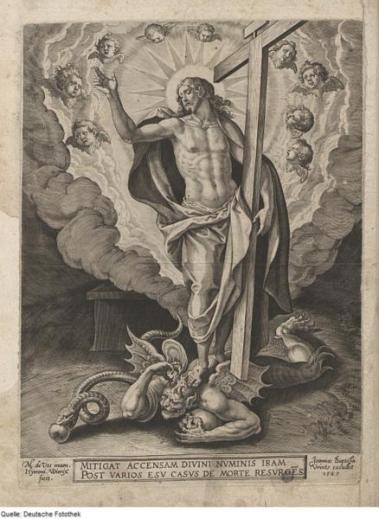
Scene 1 & 2: Creation and Fall
The Bible is a true story about God making the world, man messing it up, and God becoming a man to fix the world by not messing up. It is a story of Eden—exile—repeat. It is not until the true Adam, the true and righteous Son of God comes that this process is put to an end. All of Christ’s predeceases fell short; Adam, Noah, Abraham, Saul, David, Solomon, and the lambs, priests, and prophets could not fill Christ’s rule.
From the beginning of time and the beginning of God’s word, the Word has been a prominent character in the script of history (Gen. 1:1ff; Jn. 1:1ff). At first, the promised offspring (Gen. 3:15) is vague, in fact, Eve rejoiced because she thought she had the offspring (4:1) but it was all for naught for Cain was of the offspring of the serpent and killed his brother. However, now we have seen that which even the prophets longed to look (Matt. 13:17), we know that all Scripture finds its fulfillment in Jesus who is the long awaited Messiah (2 Cor. 1:20).
When Jesus came the first time, He had no beauty or majesty (Is. 53:2). When He comes again His face will shine like the sun in full strength (Rev. 1:16). We were cast out of the Garden in the beginning but as Jesus said to the thief on the cross, we will be with Him in paradise in the end. Jesus is the linchpin among all the cogs of Scripture. “The trajectory of the arrow shot from the Hebrew Scriptures finds its target (fulfillment) in Jesus of Nazareth.”[1]
The Storyline of the Scripture has all sorts of twists and turns, conflicts and resolutions, but the overarching story can be summed up: creation, fall, redemption, and new creation.
Through the creation part of the narrative we see that God made everything (Gen. 1:1ff; Jn. 1:1-3) and it was good (Gen. 1:4; 10; 12; 18; 21; 25; 31). There was no sin, no death, and no problems before man sinned. Man had perfect fellowship with God (cf. Gen. 3:8).[2]
However, the plot thickens. A cosmic problem is introduced. Through man’s fall, we see the collapse of the creation, which explains why everything is no longer good. Man disobeyed and rebelled (Gen. 2:16-17; 3:6) and this brought spiritual and physical death (Gen. 2:17; 3:19), pain (3:16-17), difficulties (3:18-19), and separation from God (3:23-24). This is the bad news. We deserve death and hell.
Scene 3 & 4: Redemption and New Creation
This is not the end of the story. There is good news. Even at the beginning of the story, God promised that He would send someone (i.e. the Messiah/Christ) to defeat the “bad guy” (i.e. Satan) of the story (cf. Gen 3:15). In a similar scene, seen throughout the Bible, man’s nemesis is once again at it with him. Satan is tempting not Adam but the second Adam in the wilderness (Luke 4). However, unlike Adam in paradise, the second Adam does not give into the serpent’s temptation, although He is in the desert. Jesus was tempted in every way that Adam was, and we are, yet He did not sin (Heb. 4:15) and still He bore our sin upon Himself.
Jesus became man so “that through death he might destroy the one who has the power over death, that is, the devil” (Heb. 2:14). Jesus’ heel was “bruised” at the cross but through that same cross, where He received the bruising, He struck the serpent with a definitive death blow to the head (cf. Gen. 3:15). From the cross, Jesus cried out, “It is finished!” In Jesus’ death, the devil, and death are defeated! He has delivered us from the domain of darkness (Col. 1:13). He disarmed the demonic rulers and authorities and put them to open shame, by triumphing over them through the cross (Col. 2:15).
Jesus is the Promised One (Luke 24:27, 44-46; Acts 13:23, 27; 17:3; Rom. 1:2-4; 1 Cor. 15:3-4;) who brings the redemption of all things (cf. Rom. 5:10; Col. 1:20; Titus 2:14; Gal. 3:13; Eph. 1:7, 10).[3] He secures for us an eternal redemption by means of His own blood (Heb. 9:12). Jesus Christ is the solution to the problem; He takes our sin, our problem, upon Himself on the cross. This is the good news; Jesus is the good news![4] Jesus reversed the curse of sin by becoming a curse for us (Gal. 3:13). Jesus was cast out of the garden so that we could be welcomed back in. Through the one man Adam we all have condemnation yet through the one Man Jesus Christ the grace of God has abounded for many (Rom. 5:12-21).We deserved to be crushed under God’s wrath because of our sin but instead Jesus was crushed in our place (Is. 52:13-53:12). Jesus is the solution to our problem of sin, the sole solution (Jn. 14:6; Act. 4:12). Jesus is the Lamb of God, without blemish, that takes away the sin of the world (John 1:29; Heb. 9:14)!
Jesus is the good news but the good news is not static it goes on and on and on; those in Christ live happily-ever-after (see endnote 3). In contrast, God “will gather out of his kingdom all causes of sin and all law-breakers” (Matt. 13:41) and cast them into the pit of eternal fire (Rev. 20:14-15). “They will suffer the punishment of eternal destruction, away from the presence of the Lord and from the glory of his might” (2 Thess. 1:9). However, for those in Christ the story of history will have a happy ending (Rom. 8:29-39).[5]
I concur with what C.S. Lewis says in The Last Battle,
“We can most truly say that they all lived happily ever after. But for them it was only the beginning of the real story. All their life in this world and all their adventures in Narnia had only been the cover and the title page: now at last they were beginning Chapter One of the Great Story which no one on earth has read: which goes on forever: in which every chapter is better than the one before.”[6]
I believe we, upon arrival to the new Eden, will exclaim with Lewis’ Unicorn:
“I have come home at last! This is my real country! I belong here. This is the land I have been looking for all my life, though I never knew it to now. The reason why we loved the old Narnia [“old creation”] is that it sometime looked a little like this.”[7]
Through Jesus the Christ we have the unwavering hope of a new creation (2 Peter 3:13). “The creation was subjected to futility” in Adam (Gen. 317-19) but in Christ “the creation itself will be set free from its bondage to corruption and obtain the freedom of the glory of the children of God” (Rom. 8:20-21). As Isaac Watts put it in “Joy to the World,”
“No more let sins and sorrows grow,
Nor thorns infest the ground;
He comes to make His blessings flow
Far as the curse is found,
Far as the curse is found.”
The problem (all of them!) will be fixed and there will be no more sin (Rev. 21:27; 22:3; Matt. 13:41). Everything will be more right than it was ever wrong. We will see that God did, in fact, work all things together for good (Rom. 8:28). Christ will make a new creation and we will be like Him (1 Jn. 3:2; Rom. 8:29; 2 Peter 1:4). “Just as we have borne the image of the man of dust, we shall also bear the image of the man of heaven” (1 Cor. 15:49). God will fulfill our deepest desires and we will finally love the LORD our God with all our heart, soul, mind, and strength when we receive our glorified bodies (Deut. 30:6; Jer. 31:33-34; 32:40; Phil. 3:20-21)! There will be no more pain or problems and God will wipe away all our tears (Rev. 7:17; 21:4). We will once again be in Paradise, the New Jerusalem, and we will have fellowship with God (Rev. 21:3)![8]
Epilogue
This story by its nature, by the fact that it claims to be true, does not leave us alone but calls for a response. We can receive this story or we can reject it outright. God can rewrite us, as it were, into His marvelous script or He can cast us, the unruly “cast,” into hell. We must respond to this story, will we respond rightly? Will we strive to obey the God who reveals Himself?
I can’t say it better than Michael Hortan. Those of us who have believed this story and are found in Christ,
“God has ‘rescripted’ us and recast us in his story. No longer trying to fit ‘God’ or the gods into our own life story, we become characters in his unfolding drama: seated at the table with Abraham, Isaac, and Jacob. From God’s perspective, our own script was wrong. Regardless of the role we thought we had, our inherited character was that of ‘strangers and to the covenants of promise” who were ‘having no hope … in the world’ (Eph. 2:12). But God calls us, as he did Abram and the disciples, away from our dead-end character. In God’s, our old character dies and a new character emerges who is now given a supporting role in a plot that centers on Christ. As the casting director, the Spirit gives us not only a new identity with new clothes but a new script, with new lines.”[9]
This is the gospel, the story of all the woes of existence finding there solution in Christ.
________________________________________________
[1] Emlet, CrossTalk, 47.
[2] Perfect in sense but not like it will be in the new creation; Adam and Eve related to God as creation to Creator and we will relate to God in the new creation as the redeemed to the Redeemer. Therefore, we will enjoy a consummated perfect fellowship with God.
[3] Jesus has inaugurated the Kingdom of God but there is an already/not yet aspect to it. Although the Kingdom has been ushered in through Christ it will not reach its zenith until Christ’s second coming and the culmination of the new creation. Jesus has saved us and “put away sin by the sacrifice of Himself” (Heb. 9:26) and yet there is still a future aspect to our salvation; He will save us (v. 28).
[4] Luke 2:10-11 says, “I bring you good news of great joy that will be for all people… a Savior, who is Christ the Lord” (or even, LORD!). Matthew 1:24 says, Immanuel (which means, God with us)! Notice the genealogies point to Jesus as being the Christ that was promised to defeat “the Serpent of old” (Matt. 1:1-18; Luke 3:23-38 says, “Jesus… the son of Adam” who will crush Satan under His feet as promised).
[5] Sadly, those who do not have faith in Jesus Christ will be cast into the lake of eternal fire (Dan. 12:2; Matt. 25:46; John 5:28-29; Acts 24:15; Rev. 20:12-13). It should be understood that this is part of God’s reconciliation of the world, but not in redemption, but in recompense. The story for those in Christ is happily-ever-after, even more so than can be imagined, but for those not in Christ the story does not end nicely; in fact, it never ends, but is incomprehensible torment-ever-after. We should never take this part of the story lightly but we must seek to spread the good message of Christ and the hope of a “happily-ever-after.” Look at the difference between God’s people in Isaiah 65:17-25 and the rebellious in 66:24.
[6] C.S. Lewis, The Last Battle (New York: NY: Harper Collins, 2002), 228.
[7] Ibid., 213.
[8] Jesus is surly coming soon (Rev. 22:7, 20), may we be found ready (v. 12; 3:23; Luke 12:47-48; Matt. 16:27; 1 Cor. 3:14-15) and may we respond with John: “Come, Lord Jesus!”
[9] Michael Hortan, The Christian Faith: A Systematic Theology for Pilgrims on the Way, 643.
What Forms and (Re)forms You?

Introduction
First off, this in many ways is the prequel to “Are You Mindful of Your Mind?” It is also very related to “The Fight of Faith: How we are Transformed” but from a different vantage point. In the future I hope to put the three together in a more substantial article.
We’re shaped by a whole host of things—constitution, genetics, socioeconomic factors, health, education, culture, upbringing, etc.; and we are (re)shaped by a few, consciously and subconsciously. Therefore, we see the importance of understanding how it is that we are transformed. For when we know how transformation takes place we can make a better conscious effort at transformation.
We’re shaped by one of two Gods, one of two voices. The god of this world (Jn. 12:31; Eph. 2:2-3; 6:12), or the one true God. There are two masters with two different sets of commands, we will obey one of them (Matt. 6:24; Lk. 16:13). We will be slaves, that’s inevitable (Rom. 6). The question is to who? And with what result? Life or death (Rom. 6:23)? We’re shaped by one of two kingdoms. Our kingdom, informed by Satan; or, God’s Kingdom, informed by God.
This post is not concerned with which kingdom we should desire. It is assumed that we should desire the Kingdom of God. This post is concerned with helping us understand how we are (re)shaped or transformed to desire the right Kingdom. This is a more difficult task than it would first appear. However, if you know Scripture, and indeed your own heart, you know this is a difficult task. Yet, it is terribly grave and important (e.g. think of Judas desiring his own kingdom and thus betraying the Messiah and the true Kingdom).
We are being shaped. But how? And by what?
Definitions
Putting things in categories, like putting things in containers, is helpful. However, their strength lies where their fault lies: they keep things that naturally run together from running together. With food this is helpful for taste, with thoughts it is helpful for understanding, but, when it’s all said and done, we must realize that containers like categories do not finally keep the contents apart. They are helpful, and perhaps necessary, but in the end affect (and yet assist) precision. Our categories are: 1) knowledge, 2) worship, and 3) practice. Below is a figure that shows their interconnected relationship (Figure 1).

______________________________________________
Figure 1. The Interconnectedness of Knowledge, Worship, and Practice in Transformation.
Knowledge
By “knowledge” I mean worldview or view of our chief end or “the good.” Worldview deals with more then what we see as “the good.” However, it does, or should, also shape what we see as our ultimate goal as well. A worldview answers questions and tells the story of our existence, but it must also tell us where, if anywhere, that story is going or should go.
Notice also that it’s not just the intentional thinker or the Christian that is shaped by a worldview, by knowledge. We are all shaped and informed by what we know, or think we know. For instance, the sex addict and gangster are shaped by a worldview, even if it is a sub-conscious and unarticulated form of hedonism or nihilism. However, I do believe that one will be shaped more when one’s knowledge or worldview is more explicit. So, perhaps a sex addict who is also a convinced and proud naturalistic hedonist will have less restraint when it comes to illegal sexual practices (e.g. rape, prostitution, etc.); rather, for him it is more a practical matter of will he be caught, than a question of whether such and such practice is ethical or not.[1]
Worship
What then is “worship”? Worship here is the (often purposeful and artistic) ingesting of “the good.” This definition equally applies to the sex addict watching porn, the gangster listening to rap, and the Christian singing songs, meditating on Scripture, or celebrating the Lord’s Supper. Worship, as you can see, very clearly incorporates both the two other categories. Worship is, you could say, the conscious (and also subconscious) practice (our second category) of thinking about something (our first category).
Therefore we see that many things that we would not typically consider worship are in fact worship under this definition. Television, the mall, the radio, and innumerable other things shape and influence our view of the good life or our view of “the good” and thus are a form of worship. They move and inspire us. They shape us to a certain end. And this clearly happens subconsciously and consciously. Just as if we feed upon something or imbibe food through a different means it becomes part of us through the metabolic process. What we feed on, intentionally or unintentionally, shapes us into who we are and thus also greatly shapes what we do.
Practice
Practice is the conscious and subconscious practices that shape our life.[2] What some have explained as thick and thin habits or practices.[3] These habitual practices have greater or lesser affect upon us depending upon their significance.
What we do has an effect upon who we are and what we will be. So, for example, when three different types of men see an attractive lady jogging on the side of the road they will have three different responses because of their conscious and subconscious practices which are ingrained in them through their “knowledge” and “worship.” Yet, their practices, as we’ll see, serve to further their worship and knowledge.
So, for example, the sex addict will undress the attractive jogger. This will in part be because of his worship and knowledge and will yet undergird and inform his worship and knowledge. He will in a sense say to himself subconsciously that his knowledge of things is justified by the image of this woman and his worship is also justified. The gangster will have a similar response. But, perhaps to a different end; he may think of all the money he could make with her body. The Christian man also informed by his knowledge and worship will pray for the jogger; or, perhaps, not look at her so as not to be tempted.
Whatever the specific example, we see that our knowledge, worship, and practices have a very real impact on us and how we are shaped. Each aspect serves it’s purpose, yet it is closely tied to the other two. We cannot neglect any aspect or the fact that they are closely interconnected.[4] Now that we have defined each category, we will look at each aspect in more detail.
How are we Transformed?
In Aristotle’s terms our view of “the good” is reshaped by knowledge.[5] And, in catechismal terms, if our chief end is to glorify God and enjoy Him forever[6] it will necessarily have a specific impact on our lives. That is just the way we are as humans. We all, without exception, live towards our chief end, our view of the “good life.” However, this is messy, there are many things and ideas which vie for this place. Thus the importance of knowledge rightly directed (i.e. wisdom), worship, and habits; all of which inform, play off, and undergird the others (see figure 2 below). Notice also that it is not just the Christian that worships, all men do (e.g. the gangster has a certain type of rap music that glorifies his view of the good life).
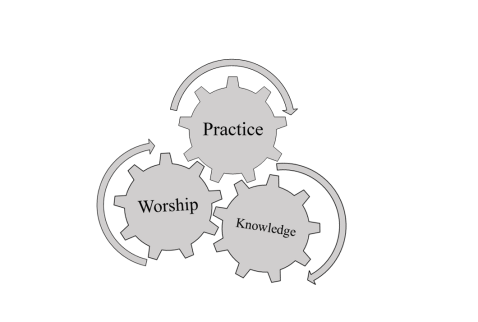 _______________________________________________
Figure 2. The Reciprocal Transforming Relationship of Knowledge, Worship, and Practice.
It is clear then that right and good worship is vital because it exalts and holds before us our chief end. If our worship has as its object the wrong thing we will thus go wrong in innumerable ways (cf. Rom. 1:18-32). Because of this, the reformation of our lives is a slow, and often painful, process. Witness the fall (the body of the book) and rise (the epilogue) of Raskolnikov from Dostoyevsky’s Crime and Punishment.[7] If we dig ourselves into a ditch we do not magically rise out of it (cf. Prov. 26:27). We have to dig ourselves out of it. Of course, as Christians we do believe that the Spirit assists us (e.g. Jn. 14:16). Yet, the fact remains, transformation is difficult and does not finally occur here.[8]
Scripture and reality are not at odds. We are shaped by what we know, worship, and do (and these are all interrelated). Scripture tells us to know the LORD, worship Him, and serve Him and thus be transformed. We see this same type of thing when we understand the relationship of faith and works, and the relationship of indicative and imperative. We know/believe God’s truth (faith) thus worship and have corresponding actions (works). Again, when we (rightly and supernaturally) understand God’s truth (indicative) we will worship, which in turn will change the way we live (imperative).
In Scripture we see huge importance placed on listening to He who speaks wisdom, the LORD, and not to the father of lies, Satan. We see this especially in the beginning. Eve listens to the serpent’s words and disregards the LORD’s, and chaos and curse ensue. However, notice that she did not just receive information/knowledge or believe the wrong source. Her desires were also wrongly informed. Because Eve listened to the serpent she saw the tree as delightful. She saw the tree as desirable (Gen. 3:6). Thus she fell.
As the Scripture says, “Each person is tempted when he is lured and enticed by his own desire. Then desire when it has conceived gives birth to sin, and sin when it is fully grown brings forth death” (James 1:14-15). We, thus, resist the devil by being firm in the faith. We, like Jesus, fight off wicked desires with God’s Word. Satan would have us be reconstituted by his words, wicked untruth, yet we combat his lies by teaching ourselves to desire good things by the implantation of God’s words, the truth (e.g. the place of Prov. 7:1-5 in the larger context of Prov. 7). When we feed on the Word of God the metabolic result is a healthy representation of God. God would have us (re)shaped into His image, the image of His Son. Conversely, Satan would have us formed into what C.S. Lewis called the “unman.”
Our thinking and our beliefs play a large part but we are tempted not by thinking and believing but by our desires (recall James 1:14-15 from above). I do think, however, that thinking and beliefs are the atmosphere in which desire lives. They are the soil and habitat; they’re the ocean in which desire can swim. Thinking and believing are not unimportant. Eve would have never sinned had she not heard Satan’s “knowledge” and believed him. Yet, we are understanding Eve, and ourselves, wrongly, if we don’t also realize that she desired (again, recall Gen. 3:6; also Eph. 2:3 says that we also once carried out the desires of the flesh).
I think it also must be noted here that our desires are shaped by our thinking and believing but they are also shaped by less conscious things. I am quite sure, for instance, that quite a few Nazi Youth did not read Hitler’s Mein Kampf but yet were shaped by the very same image. This was because they lived and breathed and ingested it’s teaching, though not mainly consciously, but because it was the cultural air they breathed.
We have a lot of things externally and internally that seek to shape us. As Calvin has famously said, we are idol factories.[8] That’s why we see much emphasis in Scripture placed on loving God with our whole heart (cf. e.g. 1 Chron. 12:38; 28:9; 29:9, 19; 2 Chron. 15:15; 16:9; 19:9; 25:2; Ps. 9:1; 16:9; 86:12), not just a portion of it.
We temper our hearts variously through understanding (cf. Deut. 6:4-9; Neh. 8), worship (e.g. Ps.; Eph. 5:18-20) and practice (e.g. Lev.). That’s how we’re shaped biblically and practically. The more we have our chief end in view and the better our chief end is the better we will live.
For instance, Jesus reasons with us in Matthew 6:19-24 about desire. He shows that what is in our best interest, i.e. what we should desire, is laying up treasure in heaven. He tells us specifically in verse 21 that what we desire, i.e. “treasure,” will bring the rest of us along (i.e. “heart”). So, again, Eve was led into sin because she desired (“treasured”) the fruit. Our battle is thus the battle of treasuring, desiring. That’s why sex education doesn’t work, for example. You can show a bunch of kids images of a bunch of nasty things and tell them a bunch of bad stories. But, in the end, if sex is what they treasure then that’s what they’ll do. After all, that is what is glorified on the screen and in our culture.
On the positive side, Paul lived the way he did, and died the way he did, not merely because of his cognitive understanding or because of his beliefs; but because of what he desired (though, as we have said, they are closely related). Paul, in his letter to the Philippians, tells us of the desire that fueled his powerful life. He drove on through thick and thin because he had counted everything as loss because of the surpassing worth of knowing Christ Jesus His Lord. For Christ’s sake Paul suffered the loss of all things and counted them as rubbish, in order that he may gain Christ (Phil. 3:8).
Truly, wherever our treasure (i.e. desire, view of “the good,” or our view of the good life) is, our heart (“heart” in Scripture has to do with our whole self; cognition, volition, emotions) will be also (Matt. 6:21; Lk. 12:34).
If we are transformed by knowledge, worship, and practices, how do you think they can transform us? How should our everyday life be different?
___________________________________________________________
[1] There is a transcript from Reasonable Faith’s podcast that shows the truth of my statement. Our worldviews have consequences, good or bad. R.C. Sproul shows this in his book The Consequences of Ideas. Friedrich Nietzsche even says in Beyond Good and Evil that philosophy always creates a world in it’s own image, it cannot do anything different.
[2]“Certain habits stir up corresponding affections and appetites; certain core affections and desires are expressed in corresponding habits. You can’t separate desire from practice” (Michael R. Emlet, “Practice Makes Perfect?” 42).
[3] See James K. A. Smith’s insightful book Desiring the Kingdom: Worship, Worldview, and Cultural Formation, esp. 80-85.
[4] Michael Emlet understands the complex nature of change. He says, “What we do flows out of who we are, but who we are is indeed shaped by what we do… We are changed by doing and we are changed by a self-conscious and iterative process that scrutinizes thoughts, affections, and actions of their faithfulness to a kingdom ethic, and then chooses certain actions and practices in response” (Michael R. Emlet, “Practice Makes Perfect?” 44).
[5] E.g. Aristotle says, “All knowledge and every choice have some good as the object of their longing” (1095a14 Page 4 for in Aristotle’s Nicomachean Ethics Trans. Robert C. Bartlett and Susan D. Collins [The University of Chicago Press: Chicago, 2011]). The glossary says that “Aristotle famously argues that all human beings do everything for the sake of what seems or is held to be good” (Ibid., 309).
[6] From the first question of the Westminster Shorter Catechism.
[7] “While God is always free to work miraculously and instantaneously, soul-change is typically a slow process that involves the replacement of old beliefs, affective responses, attitudes, and motives and patterns of relating to others with new ones, one at a time. Given what we know now of the neurological conditions of such change, it is not surprising why this process is gradual. Old neural networks must be shut down, and new ones must be constructed. None of this happens in genuine sanctification apart from the work of the Holy Spirt, but in this age most of the time God tends to work through the created order, and not take shortcuts. Though an incremental approach is sometimes hard for counselees to accept, such a stance, when grounded in justification, helps them to accept their present limitations and to be more realistic about the speed of their recovery, without undermining the ongoing call to grow in conformity to the image of Christ” (Eric L. Johnson, “Reformation Counseling: A Middle Way,” 26-27).
[8] Though I do not agree with everything, I believe “The Spiritual Experience of the Divine Truth of Transformation” is helpful.
[9] “The human mind is, so to speak, a perpetual forge of idols” (Calvin, Institutes, 97).
Eternity in our Hearts
We have eternity in our hearts.
We cry out like two daughters: Give and Give.
The fire of our soul won’t be quenched or squelched.
It burns on,
consumes all,
and is left
empty.
Empty abyss,
blank, black hole.
We suck in stars, oceans, all;
and yet repine.
Yes, my soul’s an arid land.
An empty dry sponge.
It sucks up all it can,
yet remains coarse and craving.
My soul’s a vacuum
that won’t be filled.
All is engulfed,
yet I’m left empty.
We have eternity in our hearts
and can only be filled with the Eternal
We have an infinite longing
that is only meant by the Infinite.
Our cavernous soul is only filled
by the LORD.
We can only be sated
by our Savior.
Our repining will finally wane
when we stand on heaven’s plane.
Our soul’s fallowed ground
will burst with new life.
Our bottomless shaft
will abound in streams of joy.
Are You Mindful of Your Mind?

What is the place of the mind in Christianity? Is thinking relevant to the faith? What, if any, emphasis should we place on the importance of knowledge? Does hard thinking bring any beneficial fruit to the Christian life or is the tree bare, shorn of any value?
If we boil down and distil Christianity the remaining content is not logical argument. Christianity is more than a philosophy, more than a religion. It is more than cognitive assent. It is more than a social club. Christianity is not simply about ritual. It is not just about emotions. It is not just about the mind.
Christianity is a relationship with a God who has made Himself known. It is more than formulas and repetition of rote words; though there are meaningful words and ceremonies. Christianity is something that must be believed, but belief is merely the beginning (though it must continue). Christianity gives true—chiasm bridging—fellowship, but is not merely a fellowship. Christianity is a philosophy, indeed, the philosophy. We, in a sense, worship wisdom incarnate.[1] But still, Christianity is not just a philosophy.
Christianity is not just about thinking and knowing. Yet, thinking and knowing are vital.
The Christian mind is vital because it is emphatic in Scripture.[2] It is vital because Christian living is. It is vital because we are commanded to worship the LORD with all we are, are mind included (Matt. 22:37; Mk. 12:30; Lk. 10:27).[3]
The Christian mind is very important. Yet, where do we see this in Scripture? Why is this the case? And what affect does it have?
The Christian Mind and the Bible
The Bible shows us that the Christian mind is very important.[4] Thinking for Christians is not just theoretical, it is practical. We trust God because we know Him (Ps. 9:10).[5]
God tells us to think. He tells us He will teach us, yet we must learn and not be like animals without understanding (Ps. 32:8-9 cf. 73:22). In fact, we must learn so that we can obey (Josh. 1:8-9; Ps. 37:31; 86:11; 95:10; 119:11, 34).
Cosmic Christmas

Long of old
the Scriptures told
of a King who’d come.
In His wake
death shall quake
and the deserts they shall bloom.
Yes, creation creator collide
yet we did not hide
for God He brought no wrath,
there was no blood bath,
the world did not implode or explode into non-being.
Instead, angelic greeting:
“Peace on the earth,
goodwill to men”
because the Great I AM is come.
Our Lord, Messiah, Savior in a crib.
Wonderful Counselor,
Prince of Peace,
Bright and Morning Star,
born.
He who lay the foundations of the earth,
laid in a manger.
The Infinite born,
a swaddled babe.
He that holds the nations in His hand,
grasps His mother’s hand.
He that calls the stars by name,
spoke no name, nor word.
Wonder see!
the Omnipresent crawl!
He formed Himself
in His mother’s womb.
He upheld the nails
that held His hands.
He died for you,
for me.
He became poor
to restore our riches.
Yes, He felt our plight
to set all things right.
He was born to die,
that we might live.
The Deity
incarnate brings
salvation in His wings.
From incarnation,
liberation;
new life has been set free!
The hypostatic union
brings communion;
the LORD walks with man.
Man once again will be in the Garden
because God’s Son walked from Gethsemane.
Satan’s role has been revoked,
the Lord Messiah come.
The demons tremble in His wake;
the blind see,
creation glimmers,
soon the groaning’s seize.
This is the time in between,
the already and not yet.
The Kingdom has come, but not consummated;
it shall be slightly belated.
Peace on the earth,
goodwill to man,
God’s eternal plan in fruition.
The Kingdom has come in God’s Son,
the lion to lay down with the lamb.
Satan and his host defeated,
all their power to be depleted,
they won’t sleep, but feel the wrath of the Lamb.
The immaterial
infused material;
God in the flesh behold!
No tent or temple,
for the LORD tabernacled.
Yahweh is Messiah.
The Offspring Madonna bears
shall wipe all tears
and crush the serpent’s head.
Every fear and tear to be forgotten
in the splendor of our joy.
The beatific vision brings
life and joy in its wings;
for when we see Him, we shall be like Him.
Immanuel,
born the balm,
for the vacuum of our souls.
The myth came true in the manger.[1]
God is no longer a stranger,
but makes Himself known in His Son.
Jesus, Joshua’s namesake, true!
The LORD our Savior come!
He was, and is, and is to come.
All things consummate(d) in Him.
Amen.
____________
I use myth in the sense that C. S. Lewis used it.
Don’t need no Spotify or CataCombo
So I heard about a coffin that you can buy that has a sound system built into it. It says it comes with an “upgradeable music server with 4G-connection prepared to tackle whatever afterlife throws at it.” It streams Spotify so that you can select whatever you want to play for the deceased. The casket’s price tag is a deadly $31,000.
What does the Bible say about “The CataCombo Sound System”? Well, to be honest, the CataCombo is never mentioned. Should we all go out and buy one? I mean, we like music… No, no, no. Hold your horses.
The Bible does not mention the CataCombo but that does not mean that it does not address it. Paul reminds us that we do not grieve as those without any hope (1 Thess. 4:13). Instead we can be sure that those in Christ that die will be with Christ in heaven (2 Cor. 4:14; 1 Thess. 4:14). In other words, we do not lay CataCombos in the ground where worm and rust destroy and thieves dig down and steal but we invest in treasures in heaven (Matt. 6:19-20).
Those in Christ don’t need no Spotify or CataCombo! They will enjoy “an eternal weight of glory beyond all comparison” (2 Cor. 4:17). Sadly those who know not Christ, who have not confessed Him as their Lord and Savior, will hear “Hells Bells” and it won’t be AC/DC coming through their CataCombo speakers.
I am presently listening to classical music, actually from The Lord of the Rings vol., and I am reminded of the almost transcendent aesthetic beauty of music.
So C.S. Lewis says,
“Creatures are not born with desires unless satisfaction for these desires exists. A baby feels hunger; well, there is such a thing as food. A duckling wants to swim; well, there is such a thing as water. Men feel sexual desire; well, there is such a thing as sex. If I find in myself a desire which no experience in this world can satisfy, the most probable explanation is that I was made for another world” (Mere Christianity).
Thus the desire we have for a CatacCombo points us to the true and greater desire we have: to be restored to fellowship with God. Once we see God face to face we will understand that His glory, beauty, and wonder is “beyond all comparison.” That everything (even Bach and the coolest guitar solo) we once enjoyed was the faintest whisper of what awaited us before God’s throne.



