The Work of the Spirit | pt. 6
You can see the previous post in the series here.
There is no exegetical reason for believing the gifts have ceased. Ninth, despite what many believe, there is no convincing exegetical argument for the cessation of the grace gifts.[1] 1 Corinthians 13:10 plays a prominent role in many cessationists’ arguments. It did for me when I was taught as a kid. There is another hermeneutical issue, however. Thomas R. Schreiner says,
To see ‘the perfect’ as referring to the New Testament canon is an example of anachronism…
Instead of referring to spiritual maturity or to the canon of the New Testament, ‘the perfect’ most likely refers to the second coming of Christ, the end of the age. The perfect is equivalent with seeing God face to face (1 Cor. 13:12).[2]
John MacArthur says although many “scholars [e.g. B.B. Warfield, Richard Gaffin, Robert Thomas, Thomas Edgar, Simon J. Kistemaker] disagree on the identification of the ‘perfect,’ they all reach the same conclusion—namely, that the miraculous and revelatory gifts have ceased.”[3] He goes on to say that “we must look elsewhere than 1 Corinthians 13:10, to passages like Ephesians 2:20, where Paul indicated that both the apostolic and prophetic offices were only for the foundational age of the church.”[4]
Many, such as John MacArthur, Richard B. Gaffin, along with Schreiner, end up making the argument that the gifts of the Spirit have ceased because they claim, otherwise, the canon of Scripture would be in jeopardy.[5] That, however, is rather a different issue than if the gifts of the Spirit continue or not. For one, the canon of Scripture, as well as the very existence of the Church, has been in jeopardy since the outset. The way to defend Scripture, as well as the church, is a more robust understanding of what Scripture teaches, not fear.
The Work of the Spirit | pt. 5
You can see the previous post in this series here.
Gifts of the Spirit confirm the gospel. Fourth, the gifts of the Spirit serve to authenticate the gospel message (e.g. Rom 15:18-19[1]) and that is still necessary especially in certain contexts but that is not the exclusive reason that God gave the gifts of the Spirit. D.A. Carson correctly points out that just “because miraculous signs have a distinctively attesting role in some instances, it does not follow that this is the only role they play.”[2] Although some assert that the gifts of the Spirit ceased with the closing of the canon they make that claim without biblical warrant. As Carson says, “There is no exegetical warrant for thinking certain classes of the Spirit’s manifestations cease once the crucial points of redemptive history have passed.”[3]
Gifts of the Spirit are poured out in the last days. Fifth, the gifts of the Spirit are part of what it means to be in the last days and we are in the last days.[4]
Cessationists who claim that the healings of Jesus and the apostles where merely authenticating signs of their status as bearers of canonical revelation misunderstand Jesus’ own explanation of them. For Jesus, they are rather expressions of the liberating reign of God, bursting into history, and it is as such that they attest the message of the kingdom.[5]
The gifts of the Spirit are to be expected because they indicate the presence of the Kingdom in the last days. The presence of the Holy Spirit is a sign of the new covenant.
The Work of the Spirit | pt. 4
You can see the previous post here.
There is no indication that the gifts would cease before Christ’s second coming. The Bible never indicates the cessation of the grace gifts until the return of Jesus, this is the second reason I believe in their continuance. There is no indication in the New Testament that the gifts would cease before the coming of Christ. Of course, it is possible that they could just fade out but we would not expect that to be the case from reading the Bible. Jack Deere contends that “If you were to lock a brand-new Christian in a room with a Bible and tell him to study what the Scriptures have to say about healing and miracles, he would never come out of the room a cessationist.”[1]
In 1 Corinthians 1, it seems to indicate the expectation that the gifts will continue until the coming of Christ. If you read the letter as the first recipients would have there is nothing at all that would make you think otherwise. In 1 Corinthians 1:7, Paul says, “…you are not lacking in any gift[2], as you wait for the revealing of our Lord Jesus Christ.” Notice it says “any gift” and it seems as if the gifts will continue until the revealing of the Lord Jesus Christ. That seems to clearly indicate that the gifts of the Spirit will continue until Jesus returns.
Paul, thus, seems to believe that all of the gifts will not be lacking until “the revealing of our Lord Jesus Christ” (1 Cor 1:7). Paul expects that those who are witnesses of Christ[3] will have the spiritual gifts available to them until “the perfect comes” (cf. 13:8-12), that is “the revealing of our Lord Jesus Christ” (1:7).[4] It is also important to note that in the context of 1 Corinthians, “spiritual gifts” (χαρίσματι cf. HCSB, NLT, NIV, Rom 1:11) cannot be limited to encouragement and the like but must also include what is considered the “charismatic gifts.”[5]
The Work of the Spirit | pt. 3
In the last post, we looked at “God the Spirit and the Filling of the Spirit.” In this post, we will be looking at…
Grace Gifts
Next, we need to understand that God the Spirit gives “grace gifts.”[1] God’s abundant grace that we see demonstrated all throughout redemptive history issues in grace gifts.[2] God expresses His grace concretely in the rich number of grace gifts He bestows upon the Church for its upbuilding.[3] Schreiner observes this and says, “I would define spiritual gifts as gifts of grace granted by the Holy Spirit which are designed for the edification of the church.”[4]
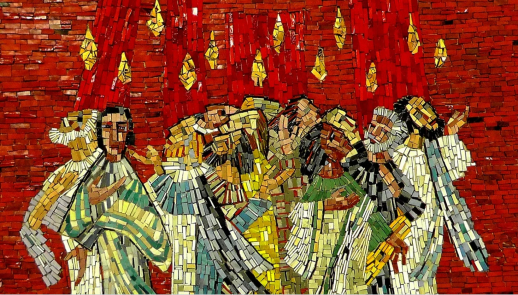
The Spirit was vital at the beginning of the church and He continues to be on through to the consummation. He brought the birth of the Church, He hovered over the Church like He hovered over the water at the beginning. The Spirit does not bring charismatic chaos but the creation of order. That was the Spirit’s work at the beginning and it is the Spirit’s work today. There is no biblical warrant for believing in some big discontinuity between the work of the Spirit then and the work of the Spirit now in the last days. Actually, Scripture says, “in the last days I will pour out my Spirit on all flesh” (Acts 2:17). We are in those latter days today and we still need the empowering presence of the Spirit.
The hodgepodge, unlearned, and often unimpressive group of Jesus followers did not see the messianic movement die. Instead, the people of the way (Acts 9:2) actually exploded in growth, this group of people that followed a crucified and cursed man who claimed to be God, this group of people who had no leader on earth. How did this group survive let alone thrive?
Because Jesus did not leave His disciples without what they needed. Jesus sent the Helper.
Jesus said, that it was better that He go. That seems shocking. As it should. And as it did for the first disciples. We are left asking, how could it be better that Jesus’ bodily presence not be with us?
Thankfully Jesus answers that question. He tells us that He will not leave us as orphans. He gives us the Helper, the Holy Spirit, to be with us (See John 14).
The Grace Gifts Continue Today
“You shall receive power when the Holy Spirit comes upon you; and you will be My witnesses” (Acts 1:8[5]). Will we? Will we receive power?
The Work of the Spirit | pt. 1
Introduction and Thesis
The Apostle Paul said, “Now concerning spiritual gifts: brothers and sisters, I do not want you to be unaware” (1 Cor 12:1).[1] This is a very important subject yet sadly very divisive. The reality is “there is one body and one Spirit” and “one Lord, one faith, one baptism” (Eph 4:4-5) but there are many divergent views on the work of the Spirit within the Church. So we have all the more reason to carefully evaluate this subject.[2]
This subject is important to consider because we want Christ’s church to be as healthy as it can possibly be, we want it to be adorned as Christ would have it. If there are good gifts that are available to the church for it’s upbuilding then we should want to and should make use of them.[3] Especially because 1 Corinthians 12:31 tells us we are to eagerly desire the greater grace gifts.
I believe that all the good gifts that were available at the outset of the church continue to be available and will be until the consummation when the Lord Jesus comes back to get His bride. So my thesis is that God the Spirit continues to empower and provide various grace gifts[4] to the Church for its upbuilding and these gifts should be earnestly desired and practiced in accordance with Scripture. This is very important to consider because “despite the affirmations in our creeds… and the lip service paid to the Spirit in our occasional conversations, the Spirit is largely marginalized in our actual life together as a community of faith.”[5]
Setting the Context
I have a number of questions that are important for us to honestly consider.[6] Could it be the case that some people have a bias against the continuation of the gifts of the Spirit?[7] Could it be that people do not have solid biblical reasons for believing that the “more miraculous” gifts of the Spirit have ceased? Could it be that most people’s beliefs in this regard are simply based upon what they have heard someone else say? Could it be that in this case, people have failed to check what was taught to ensure it was in accordance with Scripture (See Acts 17:11)?
Could it be that the Western enlightenment worldview has crept into our own view of the world and impacted the way we think about spiritual things?[8] Many have adopted a view of reality that sees “the universe as a uniform system based strictly on the cause-and-effect relationships between its constituent parts, each in a determinate relationship one to the others, utterly closed to any dimensions of reality that transcend the natural.”[9] Of course, many Christians rightly confess with Abraham Kuyper, that “there is not a square inch in the whole domain of human existence over which Christ, who is sovereign over all, does not cry: ‘Mine!’” But, could it still be the case that “naturalism nonetheless deeply influences our view of the daily events of our lives”[10]?
Can we concede that the continuation of the gifts would be a good thing? Should not we want all the grace that our good Father has availed to us? How can we say something is bad that our Father has called good?[11] If the grace gifts are part of the “every good and perfect gifts” (Jas 1:17) that God has graciously given us then should we not receive them gratefully?[12] If spiritual gifts are as bad and unhelpful as many make them seem, then why would the gifts have ever existed at all?



 in X
in X 