Back to Virtue by Peter Kreeft

I recently read Peter Kreeft’s book Back to Virtue. Kreeft is a Roman Catholic philosopher, theologian, apologist, and a prolific author. He is a professor of philosophy at Boston College and The King’s College.
Here are some quotes from Back to Virtue that stuck out to me:
“We control nature, but we cannot or will not control ourselves. Self-control is ‘out’ exactly when nature control is ‘in’, that is, exactly when self-control is most needed” (Peter Kreeft, Back to Virtue, 23).
“Nothing is so surely and quickly dated as the up-to-date” (Peter Kreeft, Back to Virtue, 63).
“It is hard to be totally courageous without hope in Heaven. Why risk your life if there is no hope in Heaven. Why risk your life if there is no hope that your story ends in anything other than worms and decay” (Kreeft, Back to Virtue, 72).
“The only way to ‘the imitation of Christ’ is the incorporation into Christ” (Ibid., 84).
“There are only two kinds of people: fools, who think they are wise, and the wise, who know they are fools” (Ibid., 99).
“Humility is thinking less about yourself, not thinking less of yourself” (Ibid., 100).
“God has more power in one breath of his spirit than all the winds of war, all the nuclear bombs, all the energy of all the suns in all the galaxies, all the fury of Hell itself” (Ibid., 105).
“We can possess only what is less than ourselves, things, objects… We are possessed by what is greater than ourselves—God and his attributes, Truth, Goodness, Beauty. This alone can make us happy, can satisfy the restless heart, can fill the infinite, God-shaped hole at the center of our being” (Ibid., 112).
“The beatitude does not say merely: ‘Blessed are the peace-lovers,’ but something rarer: ‘Blessed are the peacemakers’” (Ibid., 146).
“There is only one thing that never gets boring: God… Modern man has… sorrow about God, because God is dead to him. He is the cosmic orphan. Nothing can take the place of his dead Father; all idols fail, and bore” (Ibid., 157).
“God’s single solution to all our problems is Jesus Christ” (Ibid., 172).
“An absolute being, an absolute motive, and an absolute hope can alone generate an absolute passion. God, love and Heaven are the three greatest sources of passion possible” (Ibid., 192).
20 Quotes from Gregory Koukl’s Tactics
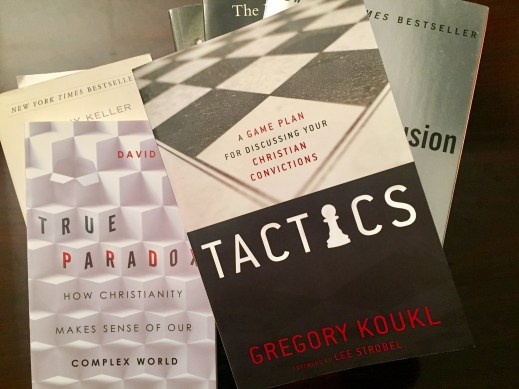
I found Gregory Koukl’s book Tactics helpful. Here‘s a book review to check out and here are some quotes from the book that I enjoyed:
- “Even though there is real warfare going on, our engagement should look more like diplomacy than D-Day” (19).
- “You must be careful not to use your tactics merely to assault others… I am not opposed to being assertive, direct or challenging. However, I never intend to be abrasive or abusive” (27).
- “Always make it a goal to keep your conversations cordial. Sometimes that will not be possible. If a principled, charitable expression of your ideas makes someone mad, there’s little you can do about it. Jesus’ teaching made some people furious. Just make sure it’s your ideas that offended not you, that your beliefs cause the dispute and not your behavior” (31).
- “The ability to argue well is vital for clear thinking. That’s why arguments are good things. Arguing is a virtue because it helps us determine what is true and discard what is false” (33).
- “It doesn’t follow that if God’s Spirit plays a vital role, then reason and persuasion play none” (35) (cf. Acts 17:2-4).
- “Some people think Christians are the only ones who need to answer for their beliefs. Of course, we should be able to give reasons for what we think is true. But we are not the only ones; others should be able to do this, too” (58).
- “Many Challenges to Christianity thrive on vague generalities and forceful but vacuous slogans” (58).
- Ask people for facts to support their conclusions. “Most critics are not prepared to defend their faith” (61).
- “Reversing the burden of proof is not a trick to avoid defending our own ideas. When we give opinions, we have to answer for them just like anyone else. We have a responsibility, but so do they” (65).
- “When someone asks for your personal views about a controversial issue, preface your remarks with a question that sets the stage—in your favor—for your response. Say, ‘You know, this is actually a very personal question you’re asking. I don’t mind answering, but before I do, I want to know if it’s safe to offer my views. So let me ask you a question: Do you consider yourself a tolerant person or an intolerant person on issues like this? Is it safe to give my opinion, or are you going to judge me for my point of view? Do you respect diverse points of view, or do you condemn others for convictions that differ from your own?’ Now when you give your point of view, it’s going to be very difficult for anyone to call you intolerant or judgmental without looking guilty, too” (78).
- “The quickest way to deal with a personal attack is to simply point it out with a question. When someone goes after you rather than your arguments, ask, ‘I’m a little confused about your response. Even if you were right about my character, could you explain to me exactly what that has to do with this issue?’” (79).
- “Think about using the phrase ‘Have you considered’ to introduce your concern, then offering a different view that gently questions the person’s beliefs or confronts weaknesses with his argument… ‘Have you ever considered… that the existence of evil is actually evidence of the existence of God, not against it?’… ‘Have you ever considered… that if Jesus was wrong about being the only way of salvation, it is difficult to call him a good man, a prophet, or a wise religious teacher? What do you think about that problem?’” (84).
- “Can you help me understand this? If there is no evidence that life came from non-life (abiogenesis)—that life spontaneously arose from inanimate matter to kick off the sequence of evolution—and there is much evidence against it, how can we say that Darwinian evolution is fact?” (85)
- “If someone’s thinking is flawed, the key to finding the error is to listen carefully to the reasons and then ask if the conclusions follow from the evidence. Point out errors with questions rather than statements. You might soften your challenge by phrasing your concern as a request for clarification or by suggesting an alternative with the words ‘Have you considered…’ before offering your own ideas” (88).
- “As a general rule, go out of your way to establish common ground. Whenever possible, affirm points of agreement. Take the most charitable read on the other person’s motives, not the most cynical. Treat them the way you would like others to treat you” (95).
- “If all religions are true, then Christianity is true. Yet a central claim of classical Christianity is that other religions are false when taken as a whole. Clearly, Jesus was not a pluralist. Either Christianity is correct that Jesus is God’s Messiah for the world and other religions are deceptions, as Scripture teaches, or Christianity is false and some other view is true. In no case, though, can all religions be true and valid” (119).
- “If you help someone see in advance that the route his map recommends will actually lead him off a cliff, he might consider changing his course. He might even discover he is using the wrong worldview map altogether and exchange it for one that is more reliable” (143).
- “When there is a conflict between methodology and materialism, the philosophy always trumps the facts. Modern science does not conclude from the evidence that design is not tenable” (171).
- “When an academic begins with naturalism, a series of ‘facts’ fall into place before any genuine historical analysis begins… Starting with one’s conclusions, though, is cheating. Nothing has been proved, only assumed” (173).
- “Carnage of unimaginable proportions resulted not from religion, but from institutionalized atheism” (177).
Apologetics Resources

I really enjoy apologetics and believe it’s important that we know why we believe what we believe. Here are some resources I’ve found helpful.



 in X
in X 