The Shroud of Turin: Evidence of a Resurrection?
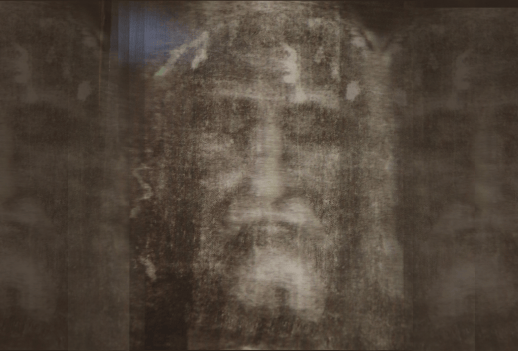
The Shroud of Turin is a cloth bearing the negative image of a man.[1] Some people believe it is the burial cloth of Jesus of Nazareth. There’s also a face cloth known as the Sudarium of Oviedo, which matches the shroud.[2] Why would anyone think it is Jesus’ burial cloth? It may seem loopy, but there are at least some interesting things to consider.
So, what caused the image on the burial cloth? How did it get there? No one knows exactly, even after thousands and thousands of hours of scientific investigation. We do know no substances were manually applied; no paint, ink, dye, pigments, stains, or secretions of the body were used to make the image. “No one has satisfactorily explained how the image was produced.”[3] Even though the shroud is the single most studied artifact ever, no other artifact comes close.
The image on the Shroud of Turin is from discoloration. The discoloration is only 200 nanometers deep into the linen fibers. Strangely, many believe the “image was formed by a sort of electromagnetic source of energy.”[4] The best explanation is that light—ultraviolet light—emanating from inside the shroud caused the image on the shroud. It has been estimated that about 6 billion watts of energy is what would be needed to produce the image.
This is where it seems like science fiction. What could explain this? Are there other things about the shroud that are mysterious? Yes. There are type AB bloodstains on the cloth. And the bloodstains are consistent with a victim of crucifixion. There is also pollen from ancient Palestine on the cloth. And the cloth has recently been dated to the time of Jesus (amending a previous date).[5]
Amazingly, the information gleaned from the burial cloth is compatible with the accounts in the Bible. The image and the blood stains show wounds on the wrists, a wound on the feet, and a wound on the side, and the stains account for the effect of gravity (showing the body hung from a vertical position). But there are no stains from the decomposition of the body and no sign that the man’s legs were broken.
The image on the shroud shows it was wrapped around a person when the image was formed. The image on the shroud varies in proportion to the distance between the cloth and the body, thus communicating 3D information about the body wrapped in the shroud. That is, the intensity of the image is directly proportional to the distance between the body and the shroud. It is similar to a topographical map. The parts of the cloth that touch the body (like the forehead) are darker, and the farther away parts (like the eye sockets) are fainter.
This has enabled researchers to take the data and create an anatomically proportional three-dimensional human form. This data can even be used to make a sophisticated guess about the height and weight of the figure in the shroud. The estimate is between 5 feet 10 inches and 6 feet, with a weight of 165 to 180 pounds.
National Geographic has called the shroud “one of the most perplexing enigmas of modern times.” Of course, it cannot be proved that this was Jesus’ burial cloth. But it forces questions upon us. What explains the Shroud of Turin? We don’t know for sure. But if Jesus actually did rise from the dead as the Bible reports, it would make sense that a burst of energy would be involved in His resurrection and that His burial cloth would be kept.
It currently seems like the Shroud of Turin is either awesome physical proof of Jesus’ resurrection, or a miraculous forgery. Because even with all our scientific understanding and technology, the shroud still cannot be replicated. So, how could it have been created a long time ago? No one knows.
The New Testament, however, does mention Jesus’ face cloth and burial cloth (John 20:7), and Acts says Jesus showed Himself to be alive from the dead through many convincing proofs (Acts 1:3). Was the shroud one of those convincing proofs?
Notes
[1] See “What Is the Shroud of Turin? Facts & History Everyone Should Know.”
[2] Barta, César & Alvarez, Rodrigo & Ordóñez, M. Almudena & Sánchez, A. & García, J.. (2015). “New coincidence between Shroud of Turin and Sudarium of Oviedo.” SHS Web of Conferences. 15. 00008. 10.1051/shsconf/20151500008.
[3] W.H. Gloer, “Shroud,” 496 in The International Standard Bible Encyclopedia Bromiley, Geoffrey W. Bromiley, ed. (Grand Rapids: Eerdmans, 1982).
[4] https://www.sci.news/physics/scientists-suggest-turin-shroud-authentic.html. W.H. Gloer, “Shroud,” 496.
[5] See “New test dates Shroud of Turin to era of Christ” and “Turin Shroud ‘is not a medieval forgery’.”
Life Beyond Life? What Explains Near-Death Experiences?

As many of you know, I’m a hospice chaplain and experience the reality of death on a consistent basis.
Recently I’ve been reading about near-death experiences (NDEs). I also met a very dear lady who had an incredible and, as is often true, transformative NDE. She was very loving. She contributes her love to Jesus. She tells of drowning in the ocean and giving up hope when a loving presence she describes as Jesus embraces her. She had an overwhelming sense of peace and love as she had never experienced. She was later rescued and revived. She was never the same.
I myself have almost died in a car accident on Interstate 71. I went through the median and got hit by an oncoming semi-truck. (I want to interject here, “Kids, don’t sleep and drive.”)
I almost died, but that’s not the kind of near-death experience I’m talking about. Actually, in many “near-death experiences,” people actually die. That is, their heart stops for some period of time, there are no brain waves, or they’re pronounced dead.
Very wild and interesting stuff. Here’s a summary of some of what I’ve learned about NDEs (not generated by AI).
Confirmation of Data Experienced During NDEs
NDEs are common.[1] Of course, common does not equal credible. But many people have had out-of-body experiences where they accurately report real-world events and sights while they were unconscious or clinically dead. People have reported data after they revived from being brain dead that medical science cannot explain. And many of these reports have been corroborated as accurate and factual.[2]
“Many cases have been gathered in which dying persons were able to view individuals, events, or circumstances around them, or even in other places, with amazing accuracy after coming close to dying or being pronounced clinically dead. Some of the descriptions were of events that happened even while the patients were comatose. In other words, these subjects reported independently corroborated data that would not normally have been in the range of their senses even if they were fully conscious at the time.”[3]
Like, how did Maria know there was a specific left-footed tennis shoe on the third-story window ledge of the hospital after she was resuscitated?[4] Or what explains the lady who reported seeing a single red shoe on the top of the hospital, which was later confirmed to be there?[5] How did a patient know about specific goings-on in their home when they were flatlined and pronounced dead at the time? How did a blind person accurately describe specific visual details?[6] How have people recognized family members they never knew existed but were later confirmed to have died?
Or how do you explain Tony’s experience? He traveled from his home in Florida to Wisconsin for a complex open-heart surgery. Tony’s “heart was arrested for 30 minutes.” During this trauma, Tony had an NDE and reported correct observations regarding his wife in the hospital waiting room and was able to look in on his home in Florida over 1,200 miles away. These reports were confirmed later by discussions with the house sitter, their own observations when returning home to Florida, and were also investigated later by a physician.[7]
Or here’s another NDE example: “A woman who had both a flat EEG reading and no vital signs had been declared dead. But she spontaneously revived about three and one-half hours later… Then she reported that she had floated over her body during the resuscitation attempts. She precisely described not only the procedures used in her attempted rescue but also the number of persons who came into the hospital room, what they said (she even repeated a joke told to relieve the tension), and perhaps most interestingly, she described the designs on the doctors’ ties.”[8]
How can so many people report accurate real-world events and sights that transpired while they were unconscious or clinically dead? Perhaps an elaborate hoax? Or just a bunch of liars with super random guesses that just happen to be accurate? Perhaps something more sinister?
Consistency across NDEs
While there’s no universally accepted definition of a near-death experience, a remarkable consistency exists in what people report. Here’s a breakdown of the common experiences that Dr. Jeffrey Long drew from data from thousands of verified NDE accounts gathered through detailed surveys:
- Out-of-body experience: separation of consciousness from the physical body (75.4%)
- Heightened senses (74.4% said “more conscious and alert than normal”)
- Intense and generally positive emotions or feelings (76.2% “incredible peace”)
- Passing into or through a tunnel (33.8%)
- Encountering a mystical or brilliant light (64.6%)
- Encountering other beings, either mystical beings or deceased relatives or friends (57.3%)
- A sense of alteration of time or space (60.5%)
- Life review (22.2%)
- Encountering unworldly (“heavenly”) realms (52.2%)
- Encountering or learning special knowledge (56%)
- Encountering a boundary or barrier (31%)
- A return to the body (58.5% were aware of a decision to return)[9]
Dr. Long explains that medical science fails to fully explain why people from vastly different cultures, languages, and religions report such similar and highly lucid sequences of events while clinically dead or unconscious.[10]
What accounts for the consistency of NDEs? If NDEs are a hoax, why are they consistent across cultures?
Corroboration with the Christian Bible
Interestingly, many aspects of NDEs are corroborated in the Bible. Actually, many think what Paul says in 2 Corinthians 12:1-3 (“whether in the body or out of the body”) describes an NDE. Some think the NDE may have happened when Paul was stoned and left for dead as recounted in Acts 14:19. Or it could have happened one of the times he was shipwrecked (2 Cor. 11:25). Of course, we don’t know. But what Paul relates in 2 Corinthians 12 has a lot of similarities with modern NDEs.
Many NDEs fit with what the Bible says about the afterlife:
- Many people experience a rapid, panoramic evaluation of their lives (Matt. 25:31; 2 Cor. 5:10).
- Enjoyment of beauty that is better than can be imagined (Is. 64:4; 1 Cor. 2:9).
- Reunited with loved ones (2 Sam. 12:23; Jn. 14:1-3; 1 Thess. 4:13–18).
- Experiences that communicate the relational love of God (Jn. 15:15, 17:3).
- Overwhelming sense of peace and love (1 Cor. 13:8; 1 Jn. 4:8; 16; Is. 54:10; Jn. 14:27; Phil. 4:7).
- Some people have negative experiences akin to punishment (Gal. 6:8; 2 Thess. 1:9)[11]
- Radiating and pervasive light (Rev. 21:23; 22:5).
- Many encounter other beings (Rev. 22:9).
- Many note cessation of pain (Rev. 21:4).
If NDEs were influenced by one’s religious beliefs and background, you would expect there to be big differences in the content of NDEs across cultures. But that’s not the case. In Dr. Long’s review of over 500 NDEs from dozens of countries around the world, he found impressive similarities.[12] “The differences are in the explanation and the interpretation of the experience,”[13] and not the content of the NDEs.
If people—especially people from different cultures—report similar experiences and those experiences line up with a powerful and time-tested religious text, could their collaboration lend credibility to the reality of life after death? And could NDEs support the truthfulness of the Christian Bible?
Conclusion
Many NDEs have outside confirmation of the data experienced during the NDE. Many people have had out-of-body experiences where they accurately report real-world events and sights while they were unconscious or clinically dead. There is also surprising consistency across NDEs. Many NDEs corroborate what the Christian Bible says about the afterlife.
The phenomenon experienced during NDEs is medically inexplicable. NDEs challenge our understanding of consciousness, mortality, and the possibility of life beyond death. Do near-death experiences provide credible, scientific proof of an afterlife? Many believe so.
What do you think? Have you thought about life after death? What explains the prevalence of NDEs?
Notes
[1] “NDE data have been presented in more than 100 peer-reviewed medical, psychological, and other reputable journals. Many millions of people claim to have experienced them. Documented cases of patients with neither measurable brain waves nor heartbeats have clearly reported rather incredible data during these times that were actually verified by others, both from their own vicinity as well as far away. Over 300 cases of highly evidenced NDEs have been reported.” (Gary R. Habermas, On the Resurrection, 951).
[2] Gary R. Habermas and J. P. Moreland, Beyond Death: Exploring the Evidence for Immortality, 156.
[3] Habermas and Moreland, Beyond Death, 157.
[4] John Burke, Imagine Heaven, 41-42.
[5] Gary Habermas, On the Resurrection, 974.
[6] “Other particularly interesting cases involve blind persons. A chemist, for example, after being blinded a year earlier in an accident, correctly reported the visual details surrounding his near-death experience. Other individuals who had been blind for years (and were even tested for blindness again afterward) accurately described the design and colors of clothing and jewelry worn by those around them when they almost died… These cases are not rare; they are unexpectedly common.” (Habermas and Moreland, Beyond Death, 158).
[7] Habermas, On the Resurrection, 975.
[8] Habermas and Moreland, Beyond Death, 161.
[9] Long and Perry, Evidence of the Afterlife: The Science of Near-Death Experiences.
[10] “It is fascinating to consider, therefore, that some of the most vivid memories these people had were of events that happened while their brains registered no known activity.” (Habermas and Moreland, Beyond Death, 160).
[11] “Some studies have also mentioned negative experiences in NDEs, including ‘hellish’ ones, although it seems that some NDEr’s may still be reluctant to share their experiences” (Amirhossein Hashemi, Ali Akbar Oroojan, Maryam Rassouli, and Hadis Ashrafizadeh, “Explanation of Near-Death Experiences: A Systematic Analysis of Case Reports and Qualitative Research.”).
[12] Jeffery Long, “Near-Death Experiences Evidence for Their Reality.”
[13] Hashemi, Oroojan, Rassouli, and Ashrafizadeh, “Explanation of Near-Death Experiences.”