The Crucifixion
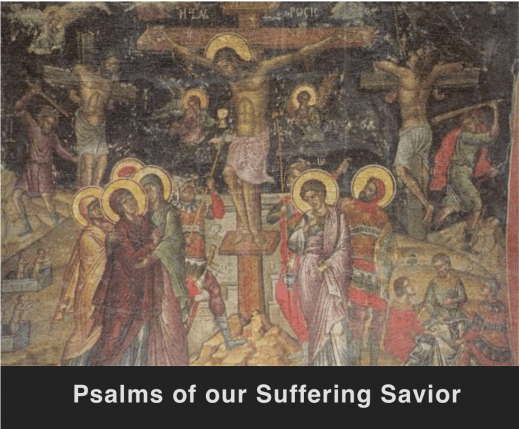
Psalm 22 has an amazing amount of parallels with Jesus’ experience on the cross on Good Friday. It says he is surrounded by rough enemies that want to harm him (v. 12), he is attacked by their words (v. 13), he is exhausted and close to death (v. 14), he experiences fatal dehydration (v. 15), his hands and feet are pierced (v. 16), his bony frame is exposed (v. 17), and his garments are divided and cast lots for (v. 18 cf. Matt. 27:35).[1]
Reading this Psalm you almost expect David to say something close to “Father, forgive them”[2] because the account of Jesus’ crucifixion is foreshadowed so many times (see also Ps. 69:4, 9, 21). Instead, in somewhat of a parallel passage to this Psalm and in great contrast to Jesus, David calls for God’s burning anger to overtake his enemies (69:24), he pleads that God would “add to them punishment upon punishment” (v. 27), and that they would be “blotted out of the book of the living” and “not be enrolled among the righteous” (v. 28).
Messiah Jesus instead Himself receives punishment upon punishment, His life is blotted out, and He joins the unrighteous on a cursed cross (see Is. 53:9 and Matt. 27:38) to save His enemies, those who are far from Him. Jesus is the perfect lamb of God, the lamb without blemish, that takes away the sin of the world (Jn. 1:29; 1 Pet. 1:19).[3]



 in X
in X 