Empowering the Church Body: Beyond the SuperPastor

What if church were different? What if we emphasized the ministry of people instead of a “SuperPastor”? When we say, “I follow Paul,” or, “I follow Apollos,” we are being merely human. What then is Apollos? What is Paul? We are all God’s fellow workers (1 Cor. 3:4-9).
What if we emphasized the ministry of the church body instead of one “professional”? The early church leaders valued the ministry of the church’s people, the ministry of the “non-pastors.” We see this, for example, in all the people Paul greeted in his letters. He knew them and appreciated them. And part of this was valuing the ministry of women. Romans 16 mentions 29 people and 10 of them are women.[1]
Church as event communicates that the special people on the stage are equipped to do the work of the ministry. The people who sit in the audience are simply passive and not gifted to do ministry. That is exactly backward. God has given leaders to equip the saints for the work of the ministry (Eph. 4:12), God has already given the people of the church various gifts (Rom. 12:6-7; 1 Pet. 4:10-11).
Even though Paul was the church planter par excellence, he practiced partnership and co-leadership, which Jesus Himself established (cf. Mark 6:7). Jesus turned the world upside down in part through the hands of 12 ordinary men who had clearly been with Him (Acts 4:13).
Paul followed this same pattern. He was almost always with a colaborer[2] and always desired to be with them. When Paul was separated from his colaborers he said, “Come as soon as possible” (Acts 17:15 cf. 2 Tim. 4:10-12; Titus 3:12-13) and he waited for them (Acts 17:16). Paul mentions his fellow shepherds—Timothy, Titus, Silas, and Barnabas—all over the place.[3] From his first church-sponsored “mission trip” (11:30 cf. Gal. 2:1) to his last (notice “we” in Acts 28) he sought to be with fellow laborers. We also see Paul “appointed elders [pl.] for them in each church” (Acts 14:23; cf. 11:30; 15:2; 20:17-18; 21:18; Titus 1:5), which also establishes the importance of co-leadership.[4]
Pastors are important. Pastors ensure attention is concentrated in the right place—on Christ. No pastor should ever be the focus. Jesus should ever be everyone’s focus. Jesus is central. Everyone else plays a supporting role. But everyone must play their role. The church is a body and Jesus is the head. Every part of the body must be engaged and functioning properly for the body to flourish (1 Cor. 12:27; Eph. 4:16).
The church is the body, and each member is to do their part for the body to function as it is supposed to (1 Cor. 12:4-31). Each member is equipped with gifts from the Spirit (Rom. 12:3-8) and is to employ them for the common good (1 Cor. 12:7). Sadly, but not surprisingly, a Gallup survey found that only 10% of church members in America are active in any kind of personal ministry.[5]
The church is supposed to be the furthest thing from fans sitting in the stands. The church is more like the football team on the field. The church gathers once a week in a huddle to remember and carry out the play. The church works together to hold tight to the gospel and move it forward. Sideline Christianity is not biblical Christianity. Every single Christian—not a special breed of Christian—is to be on the field, whatever that particular field is, loving Jesus and loving others. We all have a part to play, and when we aren’t doing our part gospel movement is hindered.
May pastors stop building fans and equip the saints. And may the saints stop sitting in the stands and get on the field. The war is raging. The time is now.
Notes
[1] The New Testament, in contrast to the literature of the time, knows the inestimable worth of women. Here is the list of the females mentioned: Phoebe (Rom. 16:1-2), Priscilla (Rom. 16:3-5), Mary (Rom. 16:6) Junia (Rom. 16:7), Tryphena, Tryphosa, and Persis (Rom. 16:12), Rufus’ mother (Rom. 16:13), Julia and Nereus’ sister (Rom. 16:15). Women were valuable colaborers in the early church. Here are some other women Paul mentions in his letters: Claudia (2 Tim. 4:21), Priscilla (Acts 18:25; 1 Cor. 16:19; 2 Tim. 4:19), Chloe (1 Cor. 1:11), Nympha (Col. 4:15), and Apphia (Philemon 1:2).
[2] See Acts 11:30; 12:25; 13:2, 13, 42-43, 46; 14:1 [“they”]; 15:2, 25-27; after a disagreement Silas goes with Paul v. 40; 16:3, 25; when he went to Corinth he connected with Aquila and Priscilla 18:1-3; when he went to Antioch he took them with him v. 18; in ch. 19 he found other believers; 20:4-5.
[3] For Timothy see Acts 16:1, 3; 17:14, 15; 18:5; 19:22; 20:4; Rom. 16:21; 1 Cor. 4:17; 16:10; 2 Cor. 1:1, 19; Phil. 1:1; 2:19, 22; Col. 1:1; 1 Thess. 1:1; 3:2, 6; 2 Thess. 1:1; 1 Tim. 1:2, 18; 6:20; 2 Tim. 1:2; Philemon 1; Heb. 13:23. For Titus see 2 Cor. 2:13; 7:6, 13-14; 8:6, 16, 23; 12:18; Gal. 2:1, 3; 2 Tim. 4:10; Titus 1:4. For Silas see Acts 15:22, 27, 32, 40; 16:19, 25, 29; 17:1, 4, 5, 10, 14-15; 18:5; 2 Cor. 1:19; 1 Thess. 1:1; 2 Thess. 1:1; 1 Pet. 5:12. For Barnabas see Acts 9:27; 11:25; 12:25; 13:2; 15:2, 36-41; 1 Cor. 9:6; Gal. 2:1, 13.
[4] Even in Paul’s address to churches, he often includes his colaborers. For instance, 1 Thessalonians 1:1 says, “Paul, Silvanus, and Timothy, To the church…” (cf. 1 Cor. 1:1; 2 Cor. 1:1; Phil. 1:1; Col. 1:1; 2 Thess. 1:1; Philemon 1). Also, from the time of his conversion Paul realized the importance of discipleship since he was taught by Gamaliel (Acts 22:3), Ananias (Acts 9:17), Peter (Gal. 1:17), and heard from Peter about Jesus’ own emphasis on discipleship.
[5] Rick Warren, The Purpose Driven Church, 365-66.
Why Simplicity is Key to Church Growth
What if church were different? What if we were simple instead of complex?
One of the problems with what has become the “traditional church model” in America is its complexity. It’s difficult to quickly replicate because there’s so much involved—typically a building, band, “professional” clergy, and all sorts of programming. This is not the model in many contexts overseas, nor has it been the lone model throughout church history. The early church required simplicity. “They devoted themselves to the apostles’ teaching and to fellowship, to the breaking of bread and to prayer” (Acts 2:42). That’s simple but transformative and powerful, it’s also very replaceable. The early church, as simple as it was, grew. “The Lord added to their number day by day those who we being saved” (Acts 2:47). The early church is not the lone example of this happening. It happens across history and across the globe.
There are some 485,000 churches in the United States and the vast majority remain under eighty per congregation.[1] What if we leaned into the strength of small simple churches? What if we found the easiest size to manage, grow, and host, and keep replicating around that size? Wouldn’t that model save money, necessarily engage the church in constant discipleship, and wouldn’t the church function as a body, using their gifts and practicing the one another passages?[2]
Jeff Christopherson has said, “The spiritual movement required to transform secular nations with the gospel is unlikely to emerge from complex structures that are usually associated with church. Something simpler, leaner, and far easier to reproduce is required to experience a gospel-saturating movement.”[3]
What if we lowered the bar for what is required for church—no building or paid professional clergy necessary—and raised the bar in our expectation for disciples of Jesus? That might just be means to a movement and be closer to what we see in the New Testament and in various contexts overseas.
To replicate and reach America and the nations, simplicity is essential. Simplicity allows for speed and better stewardship of our resources. Simplicity also allows the Church to get more of the priesthood of believers involved in ministry. Simplicity requires us to rely on the Spirit and all He has given us. Simplicity also holds Jesus before people without any distractions.
We started a simple micro church because we need Jesus and each other but we do not need all the other stuff. In fact, we believe some of the “extra stuff” can be a distraction and diversion from Jesus’ call to sacrificial discipleship. Church is not about coffee and convenience, it’s about worshiping Jesus and being shaped into His image. We also believe in replicating micro churches, we always want to be about the mission Jesus has given us; we don’t want to be a mere “holy huddle.” The “huddle” happens so we can better love the world that needs Jesus’ love.
Micro church is an intentionally simple approach to church that’s often small and informal in style. There are, however, certain requirements a micro church must meet to be a biblically faithful church (e.g., qualified leadership and teaching, preaching the good news of Jesus, regular singing and reading of God’s word, celebrations of baptism and communion, discipleship and purity, and sharing the good news of Jesus and loving the world).
We are working to build multiplying micros instead of a mega church. But as we know from microbiology, microbes can grow, and grow fast. If conditions are right (like ample nutrients and correct temperature), a single cell will quickly split into two identical cells. This rapid replication is due to their simple genetic structure with only one chromosome. Simple DNA allows for quick multiplication. This is true in the church too, simplicity facilitates discipleship and replication.
Notes
[1] Hirsch, The Forgotten Ways, 215.
[2] There are many “one another” passages: honor one another (Rom. 12:20), accept one another (Rom. 15:7), bear with one another (Eph. 4:2; Col. 3:13), forgive one another (Eph. 4:32; Col. 3:13), pray for and confess sins to one another (James 5:16), cheer and challenge one another (Heb. 3:13; 10:24-25), admonish and confront one another (Rom. 15:14; Col. 3:16; Gal. 6:1-6), warn one another (1 Thess. 5:14), teach one another (Col. 3:16), be real and honest with one another (Gal. 5:15; Rom. 12:9), bear one another’s burdens (Gal. 6:2), share possessions with one another (Acts 4:32), and submit to one another (Eph. 5:21).
Why Consumerism Harms Church Discipleship
What if church were different? What if we disciple instead of entertain? I recently read this striking description of church: “Sunday services are essentially a bunch of people gathered to sing along with a worship cover band.”[1] But church was always meant to be much more than an entertaining sing-along.
Jesus talked about the cross yet we encourage and support consumerism. Jesus said, “If anyone would come after me, let him deny himself and take up his cross daily and follow me” (Lk. 9:23). What if the church growth method of coddling Christians is backfiring? Perhaps our emphasis on entertainment over discipleship is partially at fault for this startling statistic: “51% of Churchgoers Don’t Know of the Great Commission.”[2] Clearly, being a churchgoer is not the same as being an apprentice of Jesus.[3]
It seems like at least many of the biggest and brightest churches across America are the most successful vendors of “religious goods and services.”[4] As Kenneth Woodward said, “Some of the least demanding churches are now in the greatest demand.”[5] Yet, as has often been said, “What you win them with, is what you win them to.” Of course, most churches will not be able to compete with the world when it comes to amazing entertaining experiences, but “even if we could produce cool church events, we would create a generation of Christian consumers who look to the church to entertain them.”[6]
Plus, the church has what the world can never duplicate. We foolishly put the emphasis on the wrong thing if we put it on entertainment. America is drowning in entertainment. We are “amusing ourselves to death.”[7] We have the bread of life, if the world has butter, why are we offering more butter?! They need bread! They may not know it, but they’re desperately hungry for substance.
Further, when we entertain and coddle Christians, is it any wonder why Christians don’t want to take up their crosses as Jesus commands? Dietrich Bonhoeffer, in The Cost of Discipleship, said, “When Jesus bids a man, He bids him come and die.” We, instead, offer entertainment and amusement. The church often tries to compete with what the world offers all the while Jesus is calling us to put to death what is earthly in us. I’m not saying all entertainment is wrong, but entertainment as a church growth model is problematic for discipleship.
Christ tells us to take up our cross but we’re often worried about our coffee. Jesus tells us to lay our life down but “the sermon didn’t really speak to me.” This mindset is problematic and prevalent. And it’s been bred in our churches in America. Alan Hirsh has said,
Ninety percent or more of the people who attend our services are passive. In other words, they are consumptive. They are the passive recipients of the religious goods and services being delivered largely by professionals in a slick presentation and service. Just about everything we do in these somewhat standardized services and ‘box churches,’ we do in order to attract participants, and to do this we need to make the experience of church more convenient and comfortable. It is the ultimate religious version of one-stop shopping-hassle-free. But alas, all we are achieving by doing this is adding more fuel to the insatiable consumerist flame. I have come to the dreaded conclusion that we simply cannot consume our way into discipleship. Consumerism as it is experienced in the everyday and discipleship as it is intended in the scriptures are simply at odds with each other.[8]
We have so distorted the radical call of Jesus that the standard for Christian faithfulness has become somewhat frequent church attendance or checking out the church’s livestream. It is such the norm for pastors to pander to the middle classes’ desire for safety and security, comfort and convenience, that it’s hardly ever seen for what it is. It’s just the way it is, the way it’s always been. Pastors will run themselves ragged, be chewed up, and spit out, all the time catering to the church’s perceived “needs.” The pastor can feel good because he sacrificed himself—and probably his family—for the “good” of the church. But what if “good of the church,” is equal to “sufficiently coddled and entertained”?
A major threat to the viability of Christianity in America is consumerism. Revelation warns Christians of the beast and Babylon. Perhaps American Christians are unaware that one of the evils of Babylon is its consumerism. Consumerism and following Christ are contradictory, they are positive and negative magnets, they repel each other. Again, “We plainly cannot consume our way into discipleship.”[9] In part, because “The task of the church is not to make men and women happy; it is to make them holy.”[10]
Entertainers provide popcorn and reclining chairs. Coaches provide water to replenish sweat and bandages to stop bleeding. Fans sit in their seats and buy hot dogs. Players lay it all on the line on the field. When we entertain we make fans. When we coach we make players. Fans may not sweat and bleed from the stands but are often overweight and unhealthy.
When we overprotect and provide, we stunt growth. In this way, people and plants are both byproducts of their environments. Biosphere 2 was built in Arizona to test the possibility of creating an ecological system that would support plant and human life in outer space. Everything was thought of; everything was perfect—too perfect. The trees in Biosphere 2 appeared strong and healthy until they collapsed.
The trees did not experience the stress of real life outside their perfectly designed environment. There was no wind, which resulted in a weaker cellular structure and roots that did not grow as deep. Perfectly curated environments hinder actual maturity. In the same way, an emphasis on entertainment is antithetical to an apprenticeship with Jesus. Curated comfortable environments can curb our conformity to Christ.
Notes
[1] Justin Sarachik, “Everybody Loves a Good Cover,” 48 in Common Good
[2] https://www.barna.com/research/half-churchgoers-not-heard-great-commission/
[3] Being a disciple of Jesus is much more than knowledge but what we believe is very important. When we look at the beliefs of “evangelical Christians” there is much reason for concern. The 2022 Ligoniers State of Theology found that 43% of evangelical Christians agree with this statement: “Jesus was a great teacher, but he was not God” and 56% agree with this statement: “God accepts the worship of all religions, including Christianity, Judaism, and Islam” (See https://thestateoftheology.com).
[4] Alan Hirsch, The Forgotten Ways, 110.
[5] Charles Colson and Ellen Vaughn, Being the Body, 22.
[6] Tim Chester and Steve Timmis, Everyday Church: Gospel Communities on Mission, 49.
[7] See Neil Postman’s book with the same title: Amusing Ourselves to Death.
[8] Hirsch, The Forgotten Ways, 110.
[9] Hirsch, The Forgotten Ways, 45.
[10] Colson and Vaughn, Being the Body, 26.
Rethinking Church: From Invitation to Evangelism
What if church were different? What if we evangelize instead of invite?
Admittedly, this is an old study, but in 1988 George Barna found that
Despite the fact that churches and para-church organizations have spent billions of dollars on evangelism. More than 10,000 hours of evangelistic television programming have been broadcast, in excess of 5,000 new Christian books have been published, and more than 1,000 radio stations carry Christian programming. Yet despite such widespread opportunities for exposure to the Gospel, there has been no discernible growth in the size of the Christian body.[1]
Could it be because invitation has replaced evangelism, and inviting people to the Christmas program has replaced dinner in our homes? The church was always supposed to incarnate the good news of Jesus and show the lived reality of His reign through Christian love. Francis Schaeffer went as far as to say that the love of Christians must be visible, for it is “the final apologetic.”[2]
Perhaps we must take a different approach than the church growth experts have promoted for decades. Instead of watching the neighbor’s kids, who is a single mother and in need of a lot of help, we are exhausting ourselves in the nursery supporting the church service. What if we did the opposite?! What if we didn’t serve in nursery, and instead knew and helped our neighbors? The church was never meant to be for itself. It exists to love Jesus and love others like Jesus.
The Bible tells us to “go and tell.” It doesn’t instruct us to “invite people to a building.” We are to be the church, not invite people to a building we’ve falsely labeled “church.”
“Letting our light shine” was never meant to become: “gather all the lights in the same building and keep them from the dark.” Too often, Christian life circles around propping up and keeping the institution of the church afloat. It becomes a vicious cycle. The church needs people at the “church” to keep the “church” going, all the while taking the church out of the world.
People often ask me, “Why is the world such a dark place?” Could it be, in part, because the church—the light of the world—has left the world and gone into a building? Sadly, churches are notorious for taking people out of actual outreach to put them on an outreach committee.
Further, we’ve hamstrung ourselves by encouraging and facilitating invitation over evangelism. Instead of the whole body being deployed in specific contexts where different people are specifically equipped to contextually share the good news of Jesus, we’ve allowed the onus to fall on professional clergy. Inviting someone to church is now the faithful thing to do. We’ve essentially taken an army off the frontlines where they are desperately needed and given a weapon to one person to wield from the stage.
UPS delivers packages to us, typically Amazon packages. What if UPS went around town and told us we could go to the distribution center one day a week between 9 and 11 AM and pick up packages? First, that’d be bizarre. Second, it would be very unhelpful and UPS wouldn’t be in business very long. Third, it would be a lot like our “evangelism” in America. Yet, as Bill Hull has said, “There are no commands in Scripture for non-Christians to go to church, but there are plenty about Christians going to the world.”
Instead of being missionaries, we expect those who would be part of the church to become missionaries. The responsibility is on them to cross boundaries and learn a new vocabulary. Instead of crossing the thresholds into people’s homes and inviting them into ours, we’re inviting them to a sterile church building. We’re inviting them to a strange and foreign institution. Jesus and Paul sought out people where they were, they didn’t invite them to a church service.
Jesus who is the good news, brought good news. He did not merely call us up to heaven. He came down from heaven—to walk, dine, and die for us—to bring us up. And Jesus said, “As the Father has sent me, even so I am sending you” (Jn. 20:21; 17:18). He has sent us not to merely invite people to a church building, but to compel people into the Kingdom.
Notes
[1] George Barna, Marketing the Church (Navpress, Colorado Springs, CO, 1990), 22.
[2] Bryan A. Follis, Truth with love: the apologetics of Francis Schaeffer, 58.
[3] Luke 14:23 says, “Go out to the highways and hedges and compel people to come in, that my house may be filled” but the context (note v. 15) informs us that the parable is about the Kingdom, and not any one church. It’s certainly not about a church building.
The Work of the Spirit | pt. 2
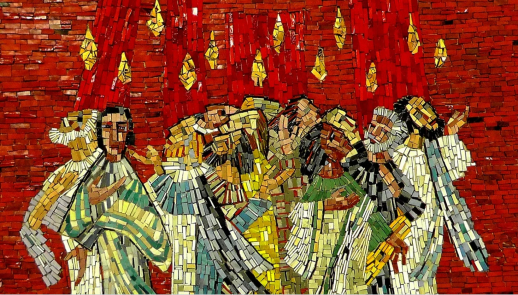
God the Spirit and the Filling of the Spirit
God the Spirit. Since we are considering the work of the Spirit within the church, it is important that we consider God the Spirit, who He is and what He does. First, without going into any detail, the Holy Spirit is the third person of Trinity. The Spirit is fully God.[1] The Holy Spirit also has personhood; He is not an impersonal force.[2] That is who the Spirit is.
Second,[3] it is important that we briefly consider what it is that the Spirit does. The Old Testament teaches us various things about the Holy Spirit. The Spirit molds creation into shape and gives life to created beings (Gen 1:2; 2:7; Ps 33:6; Job 26:13; 33:4). The Spirit controls the course of nature and history (Ps 104:29-30; Isa 34:16). The Spirit teaches and reveals God’s truth and will to His messengers.[4] The Spirit elicits personal response to God.[5] The Spirit equips individuals for leadership.[6] We also see that the Spirit equips individuals with skill and strength (Exod 31:1-11; 1 Kgs 7:14; Hag 2:5; Zech 4:6).
The Spirit is given as our Helper (John 14:24). He takes what belongs to the Son and shares it with those who believe (John 16:14), beginning with the new birth (John 3:6), teaching and guiding (John 16:14), and transforming (2 Cor 3:5-18) in ways that surpass human capacity (1 Cor 2:10-14). He empowers believers to be Jesus’ witnesses to the end of the earth (Acts 1:8) and to the end of the age (Matt 28:20). By indwelling believers (Rom 8:9; 1 John 2:27), the Spirit washes and renews (Titus 3:5), pours out divine love in our hearts (Rom 5:5), reproduces the divine virtues (Gal 5:22-23; Rom 14:17), enables us to resist sin (Rom 8:13) and pursue holiness (2 Thess 2:13), and build unity among the church (Eph 2:22; 4:3, 13; Phil 2:1-2).[7] The Spirit hears, speaks, witnesses, convinces, shows, leads, guides, teaches, commands, forbids, desires, gives speeches, helps, and intercedes with groans.[8] It is vital that we not leave out the most miraculous work that the Spirit works within people; He makes them new creations in Christ (2 Cor 5:17; 3:3, 6, 18; Titus 3:5-6; Ezek 36:25-28; Rom 2:28-29).
The Work of the Spirit | pt. 1
Introduction and Thesis
The Apostle Paul said, “Now concerning spiritual gifts: brothers and sisters, I do not want you to be unaware” (1 Cor 12:1).[1] This is a very important subject yet sadly very divisive. The reality is “there is one body and one Spirit” and “one Lord, one faith, one baptism” (Eph 4:4-5) but there are many divergent views on the work of the Spirit within the Church. So we have all the more reason to carefully evaluate this subject.[2]
This subject is important to consider because we want Christ’s church to be as healthy as it can possibly be, we want it to be adorned as Christ would have it. If there are good gifts that are available to the church for it’s upbuilding then we should want to and should make use of them.[3] Especially because 1 Corinthians 12:31 tells us we are to eagerly desire the greater grace gifts.
I believe that all the good gifts that were available at the outset of the church continue to be available and will be until the consummation when the Lord Jesus comes back to get His bride. So my thesis is that God the Spirit continues to empower and provide various grace gifts[4] to the Church for its upbuilding and these gifts should be earnestly desired and practiced in accordance with Scripture. This is very important to consider because “despite the affirmations in our creeds… and the lip service paid to the Spirit in our occasional conversations, the Spirit is largely marginalized in our actual life together as a community of faith.”[5]
Setting the Context
I have a number of questions that are important for us to honestly consider.[6] Could it be the case that some people have a bias against the continuation of the gifts of the Spirit?[7] Could it be that people do not have solid biblical reasons for believing that the “more miraculous” gifts of the Spirit have ceased? Could it be that most people’s beliefs in this regard are simply based upon what they have heard someone else say? Could it be that in this case, people have failed to check what was taught to ensure it was in accordance with Scripture (See Acts 17:11)?
Could it be that the Western enlightenment worldview has crept into our own view of the world and impacted the way we think about spiritual things?[8] Many have adopted a view of reality that sees “the universe as a uniform system based strictly on the cause-and-effect relationships between its constituent parts, each in a determinate relationship one to the others, utterly closed to any dimensions of reality that transcend the natural.”[9] Of course, many Christians rightly confess with Abraham Kuyper, that “there is not a square inch in the whole domain of human existence over which Christ, who is sovereign over all, does not cry: ‘Mine!’” But, could it still be the case that “naturalism nonetheless deeply influences our view of the daily events of our lives”[10]?
Can we concede that the continuation of the gifts would be a good thing? Should not we want all the grace that our good Father has availed to us? How can we say something is bad that our Father has called good?[11] If the grace gifts are part of the “every good and perfect gifts” (Jas 1:17) that God has graciously given us then should we not receive them gratefully?[12] If spiritual gifts are as bad and unhelpful as many make them seem, then why would the gifts have ever existed at all?
Q&A: Many churches adopt confessions, why then do leaders and laypersons often stray from orthodoxy? What lessons can we learn from this?

Q. Many churches adopt confessions, why then do leaders and laypersons often stray from orthodoxy? What lessons can we learn from this?
A. Confessions are good and have biblical precedent. Humans, however, are fallen and as 1 Timothy 4:1 says, “some will abandon the faith and follow deceiving spirits and things taught by demons.” People are lovers of self rather than lovers of God (2 Tim. 3:2-4). That is why there are problems with heterodoxy and heresy, even where there are solid confessions in place. Confessions may not keep false teaching from emerging but it is helpful to have them in place to quench the spread (like gangrene) of unhealthy teaching.
One lesson we learn from the prevalence of unhealthy belief and teaching is the importance of qualified leaders. It is vital that pastors/elders be able to teach (1 Tim. 3:2) and correct opponents of the truth (2 Tim. 2:25). We also see the important place of church discipline. The church is set apart as the light of the world and the “pillar and buttress of the truth” (1 Tim. 3:15) if the truth is not proclaimed and protected by the church how dark will the darkness be?!
The second lesson is that churches must work hard to be watchful and stand firm in the faith (1 Cor. 16:13). If someone is contradicting orthodox teaching and causing division then they should be removed from the church community (1 Tim. 6:20-21; 2 Tim. 3:5; Titus 3:10). The church is to be the set apart people of God (Eph. 1:4; 5:27). Thus, Paul writes “stand firm and hold to the traditions that you were taught by us, either by our spoken word or by our letter” (2 Thess. 2:15).
Baptism

What does baptism mean?
In Scripture, we see that believers are called to be baptized (Matt. 28:19; Mark 16:16; Acts 2:38; 22:16) but what does baptism mean? First, let’s consider the etymology; where the word came from and what it means. The English word “baptize” comes from the Greek word baptizo. Many believe that this word is correctly translated as “immerse” or “dip.” That is, in part, why we practice baptism by immersion. Also, submersion under water and raising out of it best pictures what baptism represents. What does baptism represent? Let’s look at Romans 6:3-8:
“Do you not know that all of us who have been baptized into Christ Jesus were baptized into his death? We were buried therefore with him by baptism into death, in order that, just as Christ was raised from the dead by the glory of the Father, we too might walk in newness of life. For if we have been united with him in a death like his, we shall certainly be united with him in a resurrection like his. We know that our old self was crucified with him in order that the body of sin might be brought to nothing, so that we would no longer be enslaved to sin. For one who has died has been set free from sin. Now if we have died with Christ, we believe that we will also live with him.”
Baptism is a proclamation of the believers union with Christ, in His death and resurrection. When the believer goes under the water it shows that in Christ they have died to sin. When they raise out of the water it shows they have been resurrected to a new pure (Acts 22:16; 1 Cor. 6:11) life in Christ. Baptism is an outward sign of an inner reality. Baptism pictures many things.
- Death with Christ, death to sin
- Union with Christ
- Identification with the body of Christ, the church
- Proclamation of the work of the Trinity (“In the Name of…” cf. Matt. 28:19)
- Purification, the washing away of sins
- It looks forward to the resurrection, new creation, and going through the waters of judgment and being raised to new life justified
Should I be baptized?
Like many areas of baptism, there has not been uniform understanding on who should be baptized. We believe, however, that a clear case can be made biblically and historically for believer’s baptism. “Believer’s baptism” means only those who believe in Jesus and repent of their sins should be baptized (i.e. credobaptism instead of paedobaptism).
We see no scriptural support leading us to believe that non-believers were baptized. On the other hand, we have clear scriptural support to baptize believers. Peter preaches in Acts chapter two and says, “Repent and be baptized every one of you in the name of Jesus Christ for the forgiveness of your sins, and you will receive the gift of the Holy Spirit… So those who received his word were baptized” (38, 41 see also 8:12-13).
On the Frequency of the Lord’s Supper

There are a variety of practices regarding the frequency of the Lord’s Supper. Some celebrate the Lord’s Supper every Sunday and others only once a year. The Westminster Directory of Public Worship says “The communion, or supper of the Lord, is frequently to be celebrated; but how often, may be considered and determined by the ministers… of each congregation, as they shall find most convenient for their charge.” I agree that the Lord’s Supper is to be frequently celebrated and I appreciate the leeway that the Directory acknowledges.
With that being said, I think it’s ideal that the Lord’s Supper be celebrated every Sunday.[1] There is no command in Scripture for this but it seems from my reading of Scripture to be the practice of the early church (see Act 2:42, 46; 20:7; 1 Cor. 10:14ff; 11). It is also a vital element of the gathered worship of the church and is a picture of the gospel so I think we would be wise to include it in the gathered worship of the church every Lord’s Day.
Notice that in Acts 2:42, it says “the bread” (the definite article in Greek precedes the noun bread) and so this seems to refer to more than just eating together. It should also be noted that “breaking of the bread” is listed along with other practices that were common or characteristic of the early church.[2] Also, upon studying 1 Corinthians 11 my understanding of the text is that Paul expected that the Corinthians were and should partake of the Lord’s Supper every Lord’s Day. But they should do it in a worthy manner.
Things to remember from Timothy Keller’s book Center Church




 in X
in X 