The Problem and Prevalence of Narcissism in the Church

The problem of selfishness and self-aggrandizement has always been a problem. Now, however, social media[1] and church structures add to the prevalence of the problem. In fact, self-aggrandizement is often incentivized. In great contrast to Jesus, “Ministry leaders and churches today are obsessively preoccupied with their reputation, influence, success, rightness, progressiveness, relevance, platform, affirmation, and power.”[2]
Christian leaders are often selected based on their charisma and ability to attract a large following.[3] A narcissistic personality can easily be interpreted as pastoral giftedness, a personality well-suited to lead a large church.[4] A narcissistic person is set up well to succeed in today’s church. They can charm, seem superior, and come off as an all-around exceptional person. “They have an almost desperate need to be seen.”[5] This bodes well for churches saturated in social media.
Paul David Tripp gives an important warning in his book, Lead: 12 Gospel Principles for Leadership in the Church:
A leader whose heart has been captured by other things doesn’t forsake ministry to pursue those other things; he uses ministry position, power, authority, and trust to get those things. Every leadership community needs to understand that ministry can be the vehicle for pursuing a whole host of idolatries.
Sadly, the structures we build in the church can foster narcissism’s unchecked growth. It’s problematic when Jesus’ character is not the measurement of success. Instead, the narcissistic profile of grandiosity, entitlement, and absence of empathy becomes the pattern of a good leader. Is it any wonder we have so many pastoral problems and people deconstructing?
Ministry growth, fame, and money are often seen as proof of God’s presence and work. But if that’s true, then Jesus Himself was a failure. He gave up power and riches. He didn’t pursue them. God’s presence isn’t found in power and fame. And His blessing isn’t necessarily found there either. What we should look for in leaders is godly character and fruit—like the fruits of the Spirit—love, joy, peace, patience, kindness, goodness, faithfulness, and self-control.[6]
The abandonment of the humble way of Jesus is not the way to please Jesus. Philippians 2:5-8 says,
Have this mind among yourselves that is yours in Christ Jesus, who, though He was in the form of God, did not count equality with God a thing to be grasped, but emptied Himself, by taking the form of a servant, being born in the likeness of men. And being found in human form, He humbled Himself by becoming obedient to the point of death, even death on a cross.
It would probably be good here to share a modern paraphrase of all of Matthew 23, but instead, I will share just verses 11-12: “The greatest among you shall be your servant. Whoever exalts himself will be humbled, and whoever humbles himself will be exalted.” Or, here’s John 13:14-15: “If I then, your Lord and Teacher, have washed your feet, you also ought to wash one another’s feet. For I have given you an example, that you also should do just as I have done to you.”
Selfishness and self-aggrandizement are not the way of the Savior. And should not be the way of His church or under-shepherds. Success should be measured by our likeness to Jesus and in our ability to make disciples like Jesus who, in turn, make other disciples like Jesus. In general, across the board, studies bear out bad results about churches making disciples.[7]
In a narcissistic ministry, however, the leader is especially geared towards making acolytes of themselves rather than disciples of Jesus. The leaders may not realize it, but real-life, gritty, and sacrificial discipleship may not even be on the ministerial map. Instead of equipping the saints for the work of the ministry, it’s easy to create a whole host of fans who cheer from the sidelines.
Some Characteristics of a Narcissistic Ministry
First, “The narcissistic system parades its specialness… Who would dare question God’s work?”[8] And, because the mission is so special, certain staff members are asked to make large sacrifices with little or no remuneration. The special work that the ministry is doing is reason to give and serve sacrificially.[9]
Second, “The system often compares itself to others and finds others wanting.”[10] People are led to believe “the church down the block isn’t as blessed, special, or faithful. A collective sense of grandiosity is common in these situations.”[11] This belittles Jesus’ Kingdom and is counteractive to the unity for which Jesus prayed, died, and will finally obtain. It can also blind the church from the log in its eye when they are critical of the speck in a different ministry (Matt. 7:3-5).
Third, because the church is doing such “amazing work,” you can’t question it. It’s seen as obviously bad to question the vine when the fruit seems to speak for itself.
Loyalty to Christ and loyalty to the founding pastor’s vision can get muddled. This is especially true if the pastor says that his own vision is Christ’s—that God directly told him what the church should do next regarding its building, outreach, or finances. Elders or lay leaders who question those decisions are setting themselves up to question God. And who wants to look like they’re questioning God? Especially when following the pastor’s/God’s vision has led to enormous growth, souls saved, lives changed, and communities transformed, and when other churches are looking to your church as the ultimate success story.[12]
It is therefore easy for those who are drawn into the gravitational pull of narcissism to enable the narcissist by letting him off the hook for his behavior.[13] After all, they’re doing so much for the church.[14] And, as Andy Crouch says in Playing God, “One of power’s invisible perquisites is that others grant you deference without your having to ask for it.”
Sadly, those who don’t toe the line and “refuse to idealize the leader are chewed up and spit out.”[15] This is obviously dangerous for all sorts of reasons. For one, feedback is not given, or at least, not honestly.[16] Individuals tend to favor the most favorable interpretation, disregarding potential inconsistencies and downplaying minor relational transgressions. They conveniently dismiss reservations about the leader. That “is why many who get close to the epicenter of leadership either forfeit their integrity or resign.”[17]
Mark Driscoll, the former pastor of Mars Hill Church, infamously said, “There is a pile of dead bodies behind the Mars Hill bus, and by the grace of God it will be a mountain by the time we’re done. You either get on the bus or you get run over by the bus, those are the two options, but the bus ain’t stopping.” The person driving the bus, however, is Mark Driscoll himself, and it is his mission and his brand that have become central, and people must serve his agenda or be fired.
The LORD, the Good Shepherd, will not stand for such abuse of His blood-bought sheep. “Behold, I am against the shepherds, and I will require my sheep at their hand” (Ezek. 34:10). He says, “Woe to the shepherds who destroy and scatter the sheep” (Jer. 23:1). Again He says, “Wail, you shepherds, and cry out… No refuge will remain for the shepherds” (Jer. 25:34, 35).
Faithful pastors won’t stand for the mistreatment of sheep or fellow pastors. Instead, they, like the Good Shepherd, will willingly lay their job, title, and life down for the good of the sheep (Jn. 10:11-18). Faithful pastors will stand their ground and guard the sheep, come what may.
Fourth, narcissistic leaders might bring church growth, but not all growth is healthy. Cancer can cause quick growth. So, anxious churches driven by narcissistic pastors may grow numerically, but healthy churches flourish. We should not mistake numerical growth for flourishing.[18] Especially when Jesus has called us to make disciples, and not fans who sit on chairs.
Fifth, and we have already touched on this, but it’s important to make it explicit: there is a lot of incentive for the narcissistic pastor and ministry to conceal the narcissism. People might say, “he has a few rough edges,” “we all make mistakes,” or “she’s just passionate.” For all of these reasons, “for those hurt by a narcissistic pastor, the pathways to justice may be few.”[19] People believe the gifted pastor over and above anyone else.
A Few of the Problems with Narcissism
The problem with narcissism in the church is that narcissism has no place in the church, or at least, unrepentant narcissism. I realize we’re all in process. And yes, there should be an appropriate self-love. To that I agree. But unrestrained and uncontained narcissism is not in alignment with the Lord Jesus, who came as a servant.
Narcissistic personality disorder is a mental health condition in which people have an unreasonably high sense of their own importance. They need and seek too much attention and want people to admire them. People with this disorder may lack the ability to understand or care about the feelings of others. But behind this mask of extreme confidence, they are not sure of their self-worth and are easily upset by the slightest criticism.
Narcissistic pastors, knowing what they know about the christian ethic, must walk the fine line between supposed omnipotence and feigned humility. “He wants you to see that he is the best and brightest, but he wants you to think he is a humble servant of the Lord. He speaks of justice, of faithfulness, of humility, but he longs to be the center of attention, where his need to be special is affirmed.”[20]
From a biblical perspective, narcissism stems from pride, which Scripture identifies as sin. Scripture says: “God opposes the proud but shows favor to the humble” (James 4:6). Scripture warns that where there is pride, there will be destruction (Prov. 11:2; 16:18).
Narcissists also struggle with empathy because of their self-centeredness, which directly contradicts the Bible. Scripture commands believers to “look not only to your own interests, but also to the interests of others” (Phil. 2:4), a directive narcissists routinely disobey. Christians are called to esteem others more highly than themselves and to serve others in love—the exact opposite of narcissistic behavior.[21]
Two characteristics of narcissism are jealousy and selfish ambition, these the letter of James says, are earthly, natural, and demonic, and thus are clearly not in alignment with followers of Jesus. It’s also very problematic because where jealousy and selfish ambition exist, there is disorder and every evil thing (James 3:14-16). As many stories demonstrate (Mark Driscoll, James MacDonald, Ravi Zacharias, etc.). In contrast, “the wisdom from above is first of all pure. It is also peace loving, gentle at all times, and willing to yield to others. It is full of mercy and the fruit of good deeds. It shows no favoritism and is always sincere” (v. 17). Note that last part, wisdom from above is “always sincere.”
The Christian leader’s job is not to put on a show, especially a show featuring themselves; it is to equip the saints for the work of the ministry. It’s not to attract a crowd, build a big modern church, or build their ministry; no, it’s to equip others for ministry. The narcissist is well equipped to be on the stage, put on a performance, and attract a following, but isn’t as good at stepping out of the limelight and sending and supporting others to flourish in their gifts.
The problem with narcissism is it’s not the way of Jesus and His church. It ends up being a rival faction, a monster with a protruding head. Jesus is the actual head of the church, but churches with narcissistic leaders and systems betray that reality and picture a grotesque copy of Jesus’ actual ideal. One in which a man (or woman) has set up a thiefdom and subtly robs the real King of the glory due only to Him, and robs laborers who would have otherwise labored in the harvest to build the King’s Kingdom are now enlisted to build the narcissistic leader’s little hobby town.[22]
Conclusion
Churches, especially modern churches, incentivize building a brand and putting the pastor’s name (read “gifted speaker”) in lights. But this is not the way of Jesus. The way of Jesus is humble equipping and discipling. It’s authentic, not artificial. It builds a blood, sweat, and tears army ready to give their life in love for the world; not fans who like the funny stories and music. Narcissism is not just nauseating because of the failure of leadership, the eventual church fallout, but also because of the malformation of disciples of Jesus. Narcissism is a cancerous cell that replicates and contaminates.
Notes
[1] Sadly, people can “use their congregations to validate a sense of identity and worth. The church becomes an extension of the narcissistic ego, and its ups and downs lead to seasons of ego inflation and ego deflation for the pastor. Today socialmedia platforms add to this mix. Because his sense of identity is bound up in external realities, his sense of mission is wavering and unmoored, often manifesting in constantly shifting visions and programs, frequent dissatisfaction with the status quo, and anxious engagement with staff and members.” (Chuck DeGroat, When Narcissism Comes to Church: Healing Your Community From Emotional and Spiritual Abuse.
[2] DeGroat, When Narcissism Comes to Church.
[3] We often tend to select leaders in the Christian world according to their gifts rather than their character. We see gifts and assume the leader’s character matches the image they project (Diane Langberg, When the Church Harms God’s People).
[4] DeGroat, When Narcissism Comes to Church.
[5] DeGroat, When Narcissism Comes to Church. “If ministry leadership is your identity, then Christ isn’t… Ministry leadership identity produces fear and anxiety and will never produce the humility and courage that come with identity in Christ. Looking horizontally, as a leader, for your identity, meaning, purpose, and internal sense of well-being asks people, places, and position to do for you what only your Messiah can do. This will produce either pride in success or fear of failure but never the kind of humility and courage of heart that results in humble, willing, confessing approachability.Ministry as a source of identity will never result in healthy gospel-shaped relationships in your leadership community, the kind of relationships in which candor is encouraged, confession is greeted with grace, and bonds of love, appreciation, affection, understanding, and respect grow strong” (Paul David Tripp, Lead, 156).
[6] See Diane Langberg, When the Church Harms God’s People.
[7] “Only 8% of U.S. Protestant pastors are extremely satisfied with discipleship in their church” (“Few Pastors Believe Discipleship Tops Their Churches’ Efforts” based on studies from “The State of Discipleship” https://research.lifeway.com/state-of-discipleship/).
[8] DeGroat, When Narcissism Comes to Church.
[9] Even though the sacrifice is about the “name brand church” which is closely connected to the lead pastor’s name and reputation, and not mainly about Jesus’ Kingdom. Of course, “Sacricice and devotion are part and pacel of the Christian life. Jesus said, “Whoever loses their life for me will find it.” (Matt. 16:25). But when the call to sacrifice is set in a context like Willow Creek and other dynamic churches, it’s not always clear whether members are being called to sacrifice for Christ or for the church and its programs” (Katelyn Beaty, Celebrates for Jesus: How Personas, Platforms, and Profits are Hurting the Church).
[10] DeGroat, When Narcissism Comes to Church.
[11] Ibid.
[12] Katelyn Beaty, Celebrates for Jesus.
[13] DeGroat, When Narcissism Comes to Church.
[14] How sad that “We ignore and cover up that for which he bears nail scars, all the while using his name to sanction our deeds. When evil is discovered, our response too often is to hide misdeeds in the name of protecting the reputation of the church.” (Langberg, When the Church Harms God’s People).
[15] DeGroat, When Narcissism Comes to Church.
[16] This is in part because “when the narcissistic leader is under attack, his response is defensiveness and a victim complex” (Ibid.). “Those affected by narcissism’s bite were led to believe it was their fault—a lack of humility, a failure to submit. Systems of power and wealth that fostered abuse” (Ibid.). “Entitled pastors snap when pricked, however. Even the smallest pinprick of challenge or concern from another leads to defensiveness and self-protective strategies” (Ibid.).
[17] Ibid.
[18] Ibid.
[19] Ibid.
[20] “Narcissistic pastors walk the fine line of omnipotence and feigned humility. He wants you to see that he is the best and brightest, but he wants you to think he is a humble servant of the Lord. He speaks of justice, of faithfulness, of humility, but he longs to be the center of attention, where his need to be special is affirmed.” (Ibid.).
[21] R. K. Bufford, “Narcissism,” in New Dictionary of Christian Apologetics, ed. Campbell Campbell-Jack and Gavin J. McGrath (Leicester, England: Inter-Varsity Press, 2006), 472.
[22] Jesus is about His Kingdom and His reign being realized in the hearts, hands, and heads of all people, regardless of their organizational affiliation. We get messed up messing around with a lesser leader’s little project. King Jesus is often working in the margins with the low and humble. The sad reality is, “Christendom’s institutional priorities often have nothing to do with, and may be antithetical to, following Jesus” (Langberg, When the Church Harms God’s People).
What is the difference between self-confidence and pride?

Theologically what is the difference between self-confidence and pride?
Self-confidence
God does gift individuals. And it is good to acknowledge that truth. The manager in Jesus’ parable that invested his talents and earned a good return for the owner had to have a type of confidence (Matt. 25:14-30).
Further, God created us as a “work of art” to carry out the good deeds and mission He wants us to accomplish (Eph. 2:10). So, in a sense, we can have confidence in the self that God intended us to be. Therefore, self-confidence is not in itself bad.
Of course, these truths need to be balanced by the humbling reality that we are sinners and that every good thing we have is a gift. What do we have that we did not receive (1 Cor. 4:7)? And we should always recall that every good gift and every perfect gift comes from God (James 1:17). It’s not innately ours.
Self-confidence can mean prideful evaluation of one’s ability. It does not, I don’t think, have to be understood that way though. It could mean something like: confidence in who God made you to be and in your God-given abilities. If understood that way, perhaps “God-confidence” or “God-acknowledgment” would be better.
Either way, it does not seem to me that self-confidence is inherently bad. I also think considering the opposite term can be helpful to consider: “self-skepticism” or “self-suspicion.” The Bible does say that our hearts are desperately wicked (Jer. 17:9). So, does “self-skepticism” better describe what the view of ourselves should be?
I don’t think so. I don’t think self-confidence or self-skepticism gives us the whole picture. And if left with just one of them or even a balance of both of them together, we still miss something huge! We miss our self in relation to God.
If we consider ourselves without relation to or thought of God, we’re going to get it wrong. We’ll error on either over-confidence or over-suspicion about our self. Yet, when we consider ourselves with reference to what God can and does do, we can be confident in who He has made us to be. While at the same time not obsessing about our self, because we’re focused on Him. We can have a healthy suspicion of our self but that’s not crushing. Because we know that God can and does overcome our sin.
Pride
“Pride,” at least how I think about it, has to do with what one has done. In my mind, it means someone is proud of what they themselves have accomplished. Pride is less an evaluation of one’s ability and more so a belief that’s one’s ability is simply a result of one’s own efforts. There’s no grace in pride, given or received; all is earned.
So, with pride, there is a fundamental misunderstanding of who humans are and who God is. God is the giver we, as humans, are receivers. God is, and we are contingent. Pride is a foolish misunderstanding of ontology. God is independent, humans are dependent.
Notice, King Nebuchadnezzar was humbled after he praised himself and all he thought he himself had accomplished. Nebuchadnezzar found out that God humbles those who walk in pride (Dan. 4:37). When pride comes, then comes disgrace (Prov. 11:2).
We should, however, understand that there is a difference between “pride” and “pleasure.” King Nebuchadnezzar didn’t just take pleasure in his kingdom and in all that God had entrusted to him, he took pride in it. That is, he acted as if he was responsible for it all himself. He exalted himself and failed to exalt God.
I believe it is good to take pleasure in the abilities God has given us—whether preaching, building cabinets, or whatever. In a movie about Eric Liddel, a Christian Olympic runner, he says, “God made me fast. And when I run, I feel His pleasure.” There’s nothing wrong with taking pleasure in what God has given us to do. But, notice an important point: Liddel said, “God made me fast.” Liddel acknowledged God even in his abilities.
But wait, didn’t Liddel run? Didn’t Liddel sweat? Didn’t Liddel sacrifice? He showed amazing discipline to be an Olympic runner, right? Yes. And every good gift is from God. Including Liddel’s ability to do each of those things and also his ability to breathe and his very existence was from God.
So, I believe one could evaluate themself as very good at what they do and that it required a lot of work on their part to become effective, without being prideful. How so? They acknowledge that it is all a gift. Discipline—a gift. Breathing—a gift. Etc.—a gift.
Conclusion
Perhaps the fundamental difference between “pride” and “self-confidence” as we are considering the terms is this: One is an exaltation of self without reference to God, the other can be confidence in God with reference to who He has made you to be.
The apostle Paul had a sort of confidence—we see it demonstrated through his letters and missionary work—but he also said it was not him but Christ in him (Gal. 2:20). Paul, after He met and was radically transformed by Christ, was not so much confident in himself as what God was able to do through him, though he was a mere disposable jar of clay (2 Cor. 4:7).
So, I believe it is right and good to have a kind of self-confidence in who God has made us to be even while we work at killing pride.
*Photo by Nicolas I.
4 Points to Pop Pride

The last thing Christians should be is puffed up with pride. Below are four points to pop pride.
Pride is damaging and is at the heart of what damned the devil himself. We would be wise to destroy pride before it destroys us (Prov. 16:18).
1. Group Connection
Pride protects us from the penetrating eye of others, at least, until it is too late. To kill pride we must let at least a select group pry; pry into our lives and our inner motivations. We must let them lovingly dive-in and help dig out roots of sin that we can’t see because the seed hasn’t yet sprouted and blossomed its poisonous plume (see 1 Tim. 5:24; Heb. 12:15).
When I drive with my wife you can often hear me say, “Clear right?!” As soon as she says, “Clear!” I’m making that lefthand turn. I’m squealing the tires (in our minivan…).
I ask her because I can’t see what’s coming. And I know that blind spots can cause big problems. So, I need her help.
Blind spots are no less dangerous on the road of life. We need each other to see what we don’t see ourselves. What’s going on in our own hearts is hard to truly understand. We need wise brothers and sisters to help us discern what’s going on (cf. Prov. 20:5).
Connection in an honest and loving community is vital for health. We need spiritual wellness exams. We want to kill cancerous sin before it grows and brings forth death (cf. James 1:15). We need to be sharpened (Prov. 27:17) and we need the occasional friction of rebuke (1 Tim. 5:20; 2 Tim. 4:2).
Like a horse, we need a goad to guide us to good works (Heb. 10:24-25). Like a rope, we need to be interlaced with others to be strong (Eccl. 4:12). Like a general, we need counsel to wage war wisely (Prov. 24:6).
Ironically, if we’re going to pop pride, we need people in our bubble.
2. Gifts are a Gift
Gifts are given. They are not deserved. If we have a gift, it’s because we received it. We didn’t own it on our own. Therefore, we shouldn’t boast as if we did not receive it (1 Cor. 4:7). And no matter what we have—strength or smarts, artistry or arithmetic, wealth or wisdom—it’s all a gift given by God (Jn. 3:27; James 1:17).
And gifts are given, not for our own good, but for the good of others (1 Pet. 4:10; 1 Cor. 12:7). Gifts are given with an understanding from God that there will be a return on His investment. It is required of servants that they be faithful (1 Cor. 4:2). But, that is nothing out of the ordinary. A servant is supposed to be faithful (Lk. 17:10).
If they are a servant with more gifts entrusted to their care, they are just being faithful with what God has given them, which is really not much different than the other servants. Except that they may go through more pain and have more of a demand on their life.[1]
Also, it should be remembered that no body part, whatever that body part is and how gifted it is, functions on its own. In the same way, the quarterback may lead the team but he’s not the only one on the team. If he were, he would be crushed.[2]
We all have different parts to play in the body (1 Cor. 12:12-31). The different parts have different roles, different gifts, as God assigned. But, notice, it is God that arranged and appointed it that way (v. 18, 28). It is not as if anyone earned their particular gift or role in the body.
So, since gifts are given they should never be a cause of pride.
3. Given Identity
The Bible teaches us that we don’t earn an identity, we are given an identity. Anyone in Christ, for example, is a new creation (2 Cor. 5:17). That is who they are. They are new. They are an adopted son or daughter of God (Eph. 1:5).
Paul David Tripp’s book on leadership is very helpful here. I shared a few quotes from his book recently. Here’s one that’s especially applicable here:
“Ministry leadership identity produces fear and anxiety and will never produce the humility and courage that come with identity in Christ. Looking horizontally, as a leader, for your identity, meaning, purpose, and internal sense of well-being asks people, places, and position to do for you what only your Messiah can do.”
We don’t boast in who we are, we boast in the Lord (Jer. 9:23-24; 1 Cor. 1:31)! Therefore, we don’t falter when we fail and we don’t overly seethe with success. And we don’t compare ourselves with others because we’re not looking for commendation from others (2 Cor. 2:12, 17-18). We’re looking for a smile on our Father’s face, even if it brings a frown from others (Matt. 25:21; Rom. 2:29; 1 Cor. 4:5).
So, we rest in our God-given identity—who we are in Christ—and not in any merely earthly identity.
4. God’s Glory
Everything we have, we have been given. And everything we have been given is to be given back to God in the form of praise. All we do is to be to His praise and glory, even when we eat (1 Cor. 10:31).
Everything is about Him, it is the height of folly and stupidity when we make it about us. That’s worse than an ant that thinks it deserves praise for moving a speck of sand. The ant is nothing and its work is nothing compared to the might and majesty of God. To think that God would owe us is worse still (see Job 35:7; 41:11; Rom. 11:35)!
All things are about Him (Col. 1:16) and the fact that He chooses to use mere humans only highlights His glory (2 Cor. 4:7 cf. 2 Cor. 12:8-10).
So, we pop pride when we see that it’s all about God and His glory.
—
[1] See “The Pastoral Long-Suffering of Spurgeon and Boyce”
[2] The success of the body rests on the individual parts of the body and not on any one part on its own, no matter how gifted that part is. Tom Brady knows this. He gave up millions so that the other important parts of the team could get filled up.
*Photo by Hamed darzi
United in a Time of Disunity

Christians are united and need to be united. This is especially important in this time of disunity as a country.
In Christ Jesus all—Jew and Gentle, rich and poor, black and white, republican and democrat, Clemson and Ohio State, Steelers and Browns, young and old—are one. That is what Scripture teaches. That is reality.
In Christ, we are one. That is what the Bible tells us. And that’s reality.
Paul highlights that in his letter to the Ephesians. The Ephesian church faced similar difficulties that we face. They lived in divisive days too.
Acts 19 talks about a riot in Ephesus and there may have been divisions when it came to sporting events too. Ephesus had the largest theater in Asia Minor with accommodation for up to 25.000 people. The theater housed sporting events. So, people probably fought about sports then too. Not sure, though, if gladiator games count…
Christians are united in Christ
Jesus’ Kingdom is not divided. Although Jesus’ Kingdom is made up of people from Sierra and Senegal, Armenia and America, China and Chad, Portugal and Pakistan, Mexico and Malaysia (and many many more). In Christ, we are all one. And so, “The Christian’s primary solidarity is not with those who pledge allegiance to a particular flag, but those who confess Jesus as the Lord, regardless of their nationality”[1]

We may not always feel like we’re together or unified, we may not always want to be together, but the reality is that we are. We are united and one in Christ Jesus (Eph. 4:4-7).[2] Believers in Africa and America, Iraq and Iran, Canada and Cambodia, all have the one Spirit in them. Although we look and act and think differently, we all have this in common: We are temples of the living God. More significant than our culture and country is that God lives in us believers.
All Christians have one Spirit and all Christians have one Lord (Eph. 4:5).[3] It reminds me of marching in the army. As we marched together, there was no distinction, in a whole company of 200 soldiers. No matter who you were or where you were from, there was no distinction… When our commander said, “left” we put our left foot down. When he said, “right” we put our right foot down.
We were a lot different, but we all had the same commander and so there was no distinction.
That’s the same for Christians. We all have “one Lord.”[4] And we all march the same.
Christians are to be United
In Christ we are united and we are to be united (Eph. 4:1-3). Paul says, “keep the unity of the Spirit.” In fact, he says, “make every effort to keep the unity.”
Paul knows it will take effort. That’s why he says, “make every effort.” So, what is the motivation for making this effort? The good news of Jesus.[5]
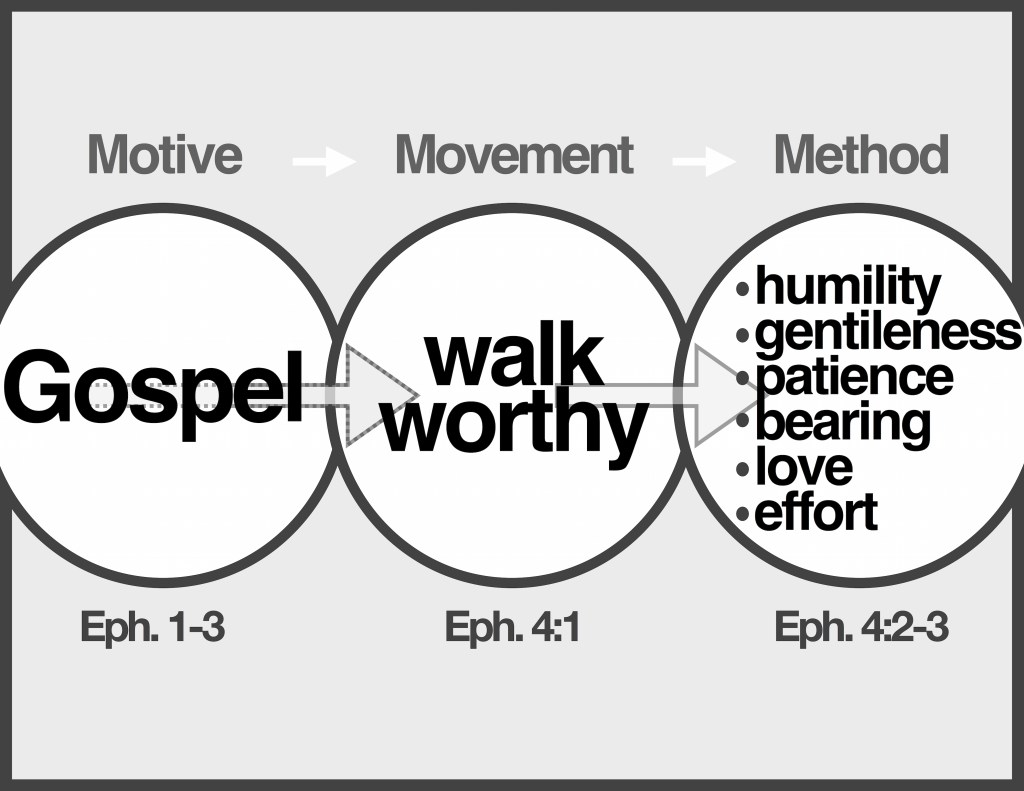
Our motivation is important because unity can be very difficult.[6] Imagine the context and challenges for Paul’s audience: Jew, Gentile, slave, free, lawbreaker, law keeper all in the same church.
That’s actually a good thing though. And a beautiful thing. As Scot McKnight has said, “The church God wants is one brimming with difference.”[7]
Imagine the context now… These are very divided and divisive times. The apparent reality is that Christians have a ton to divide over. But, the theological reality is that Christians are united and one in Christ.
People will know we are Christians by our love for one another. When we have both glaring differences and yet radiant unity we become a mosaic of Jesus’ transforming beauty.
What does it look like to “make every effort”? Paul tells us. Paul gives us five things that are necessary if we are going to be untied. John Stott rightly says that these are the “foundation stones of Christian unity. Where these are absent no external structure of unity can stand.”[8] Those foundation stones are gentleness, patience, love[9] effort, and humility which we’ll be concentrating on.
Humility: Essential to Unity
Ephesians 4:2 says “Be completely humble.” Stott correctly said, “Humility is essential to unity. Pride lurks behind all discord.”[10] I know that’s been true in my own life.
How can we have humility? Well, for one, we as Christians know we’re not all that. We know we sin. We know we get it wrong sometimes. We all stumble many ways. That should humble us.
And amazingly, the only sinless one, Jesus, the Son of God, the one that never did anything wrong, He humbled Himself. He humbled Himself to the point of death. Even the death of a cross (Phil. 2).
So, we as Christians must practice humility too. That’s part of what it means to “make every effort to maintain unity.” That’s what we’re called to do. Spare no expense. Do what it takes.
Winston Churchill during WWII made things happen. He would sometimes stamp his commands in red with the words “Action this Day.” And that’s what he expected. He expected that command to be done. He expected his people to make every effort, and I literally mean every effort to make sure it what done on that day.
I think Paul is saying something similar to us. I think he’s giving us a stamp in red ink that says: “Action this Day.” He’s saying do it. It’s that important. “Make every effort to keep the unity.”
Being united is part of what it means to walk in a worthy way; “to live a life worthy of the calling you have received” (Eph. 4:1). And that is supernatural. That’s part of what it means to be a city on a hill and a light in the darkness.
It’s abundantly clear that union with Christ implies union with others. The reality is that we are together built into a dwelling of God (Eph. 2:22). We are united and one whether we like it or not. If a person names and follows Jesus, we belong together even if we don’t always like that truth.
It’s also important for us to remember that we get grace from God vertically, but we also get much-needed grace from God horizontally from other people. Even when we don’t always like or agree with them.
Conclusion
Brothers and sisters, we have fellowship with each other and with God through our Lord Jesus! Rejoice in that good news. Division is dead. We are united. So, let’s live together in purposeful unity. It will not be easy, but Jesus’ blood was spilled to welcome us into union with Him and each other. Let’s not disregard Jesus’ great sacrifice for us.
May the God who gives endurance and encouragement give us the same attitude toward each other that Christ Jesus has towards us. Encourage one another, be like-minded, live in peace, be sympathetic, love one another, be compassionate, and humble. And the God of love and peace will be with us. So that with one mind and one voice we may glorify the God and Father of our Lord Jesus Christ. Lastly, accept one another, just as Christ accepted us, for the glory of God.[11]
Jesus prayed that we would be one[12] and He gave us one mission. So let’s work together to accomplish that mission.
Endnotes
Pride→disgrace. Humility→wisdom.

“When pride comes, then comes disgrace,
but with the humble is wisdom” (Proverbs 11:2).
When we see gray clouds we know a storm and rain are probably coming. Proverbs leads us to see other connections and correlations from other phenomena and make other important deductions. Just as if we see gray clouds we know rain is coming, if we see pride we know disgrace is coming.
Disgrace follows pride like dessert follows dinner; one comes then the other. Superiority then scandal, self-importance then shame. Disgrace follows pride as surely as two follows one. There’s a sequential relationship. If one is not humble there will be humiliation.
The prideful person, however, may not even see or experience the humiliation though. They may further puff up against the pain rather than confront their inadequacies.
The arrogant are in the dangerous place of not seeing their own ignorance. If we see ourselves as superior, we aren’t in a good place to see our own stupidity. Those who think they stand then should take heed lest they fall (1 Corinthian 10:12).
What is the solution? Humility.
We should be willing to admit we are sometimes wrong. We have done wrong and been wrong in the past, we should know that this could (and will) happen in the future too.
Christianity gives a basis for humility.[1] It teaches us repeatedly that we don’t always get it right. And Jesus said, blessed are the humble who know that truth (See Matthew 5:5ff).[2]
Christians should be willing to listen, willing to learn. We should be humble because our Lord Jesus has called us to humility. We don’t know it all and we should admit that truth.
“With the humble is wisdom.” Those who know they don’t know, are in a good place to know. If we realize what we don’t realize, we are open to realizing.
Pride → disgrace.
Humility → wisdom.
_____
[1] Christian behavior is not based on knowledge alone, that leads to pride and destroys others, even those for whom Christ died; Christian behavior is based on love grounded in the knowledge of Christ. We tend to think we know all we need to know to answer all kinds of questions—but sometimes our humble hearts can help us more than our proud minds. As Eugene Peterson has said in his paraphrase of the Bible, the Message: “Knowing isn’t everything. If it becomes everything, some people end up as know-it-alls who treat others as know-nothings.” I appreciate what Richard Baxter said, “If we have any knowledge at all, we must needs know how much reason we have to be humble; and if we know more than others, we must know more reason than others to be humble” (The Reformed Pastor, 144). I also appreciate this from Thomas à Kempis: “What good does it do to speak learnedly about the Trinity if, lacking humility, you displease the Trinity? …I would rather feel contrition than know how to define it. For what would it profit us to know the whole Bible by heart and the principles of all the philosophers if we live without grace and the love of God” and neighbor?” (The Imitation of Christ).
[2] Proverbs also tells us repeatedly that “the fear of the LORD is the beginning of wisdom.”
Our Questions and Arriving at Answers

First, our disposition or the way we approach questions is really important. How should we approach questions? What should characterize us?
Humility! Why? Because we are fallible, we make mistakes (We should also be aware of chronological snobbery). However, God does not. Isaiah 55:8-9 says, “For my thoughts are not your thoughts, neither are your ways my ways, declares the LORD. For as the heavens are higher than the earth, so are my ways higher than your ways and my thoughts than your thoughts.”
Also, kindness, patience, and understanding are an important part of humility and asking questions and arriving at answers.
Second, where do we get answers from? Scripture. Why is this important? Again, I am and you are fallible, that is, we make mistakes. And how should we approach getting those answers? Are we above Scripture or is Scripture above us? Who holds more sway? Scripture supplies the truth to us, we do not decide what we think and then find a way to spin things so that we can believe whatever we want…
Third, community is important. God, for instance, has given the church elders who rightly handle the Word of truth and shepherd the community of believers. We don’t decide decisions and come to conclusions on our own. God helps us through Christ’s body the Church.
Fourth, it is important to remember mystery, we cannot expect to know all things. We are… fallible. So, we should keep Deuteronomy 29:29 in mind: “The secret things belong to the LORD our God, but the things that are revealed belong to us and to our children forever, that we may do all the words of this law.” There are certain things that are revealed and certain things that are not revealed.
Fifth, our questions and answers are not simply about head knowledge. God doesn’t just want us to be able to talk about theology. Deuteronomy 29:29 says “that we may do…” So, there may be questions that are not especially helpful. I’m not saying we can’t ask them, we can. Only we may not be able to have a definitive answer and the question may be of a less practical nature (e.g. supralapsarianism or infralapsarianism).
True Knowledge Should Truly Humble


Knowledge[1] is dangerous. Not only the consequence that ideas themselves have but also the tendency that knowledge has to puff up. Truths that should lay us low in humility often conflate our egos. Paradoxically, knowledge is also the very thing that humbles.[2] We may not be proud without knowledge but neither will be humble. We will be ignorant. Knowledge is dangerous. Albeit, a necessary danger.
Knowledge is indispensable to live life rightly. We must understand though, that knowledge is not innate within us. It must be pursued. However, the very fact that knowledge is external should press us to pursue it in humility. It is not ours. We do not have the market on knowledge. Also, if we pursue it arrogantly we will miss much of it (Prov. 3:5-6; 15:14, 22). We should realize that not only is knowledge external from us but so is the desire for knowledge. We should not think we are better than the ignorant because our very desire for knowledge is itself a gift (James 1:17).
The desire for knowledge with the goal of being humbled is good. The fear of the LORD is the beginning of knowledge and humility comes before honor (Prov. 1:7; 9:10; 15:33; Job 28:28). Jesus pronounces woes upon the Pharisees, not for their knowledge, their knowledge is commendable, but on the result that their knowledge had upon them. It did not humble them (Matt 23:5-7, 11-12). The publican had little knowledge but it served to humble him. If we truly understand, if the eyes of our hearts are enlightened, we will praise God and not ourselves. We can have all knowledge but if we have not love, it profits us nothing (1 Cor. 13:1-3).
Thomas A Kempis said in The Imitation of Christ that “On the day of judgment, surely, we shall not be asked what we have read but what we have done; not how well we have spoken but how well we have lived.” That is not to say that knowledge is not important, it is. However, knowledge that does not lead to life change and humility is worthless and condemning. The person that knows the right thing to do and does not do it for that person it is sin (James 4:17). Kempis rightly says, “The more you know and the better you understand, the more severely will you be judged, unless your life is also the more holy. Do not be proud, therefore, because of your learning or skill. Rather, fear because of the talent given you.” God will judge us according to all that He has entrusted to us (see Matt. 25:14-30).
As our minds rise to exalted things, our consciousness of ourselves must fall. Truth humbles, or it is not understood to be truth to ourselves. Again Kempis says,
“What good does it do to speak learnedly about the Trinity if, lacking humility, you displease the Trinity? …I would rather feel contrition than know how to define it. For what would it profit us to know the whole Bible by heart and the principles of all the philosophers if we live without grace and the love of God?”
Knowledge is vital, we cannot serve or know the LORD without it, but knowledge must always humble.
How do we fight the damning affect that knowledge so often has? It all has to do with our motivation from the outset. As J.I. Packer has said, in his classic book Knowing God, “there can be no spiritual health without doctrinal knowledge; but it is equally true that there can be no spiritual health with it, if it is sought for the wrong purpose.”[3] Do we study the Trinity to be in awe and wonder before the God who is three-in-one? Or do we study the Trinity to look astute before our peers? The choices are not restricted to arrogance or ignorance but we have to fight for the last alternative, humility. If we go the way of ignorance we will never know humility, who or what would we be humbled before? And arrogance is the misapplication of knowledge. It is a pursuit of knowledge with the wrong goal in mind. Do we read science journals and Scripture to merely gain knowledge? Or do we do it to be humbled by the God that formed the furthest reaches of the galaxies and yet revealed Himself to us; yea, atoned for our sins (cf. Heb. 1:3)?
Pursue knowledge. Pursue it in whatever field. But do so in humble worship with your ultimate end being to glorify God. May we be amazed by and enraptured in the truths of Scripture as children. May we continually go to God humbly in awe of Him and His truth that is contained everywhere around us for God gives grace to the humble (James 4:6).
~Whatever you study or seek to know, do it all to the glory of God~
______________________
[1] I say “knowledge” and not any specific stream of knowledge because I believe that all truth is God’s truth. What I mean by knowledge is knowledge that is true, true truth, as Schaeffer put it. This could be in the realm of science, math, history, etc. All truth is God’s truth because God upholds the universe by the Word of His power thus all mathematical equations are held together by His hand. Science shows us the extent to which the glory of God is manifested in His universe (as Johannes Kepler said, “science is thinking God’s thoughts after Him”), all history is a story of God unfolding Himself and is actually a testimony of His grace to redeem such as we are.
[2] Richard Baxter rightly says, “If we have any knowledge at all, we must needs know how much reason we have to be humble; and if we know more than others, we must know more reason than others to be humble” (The Reformed Pastor, 144).
[3] J.I. Packer, Knowing God, 22. He further says, “if we pursue theological knowledge for its own sake, it is bound to go bad on us. It will make us proud and conceited” (21). Rather “our concern must be to enlarge our acquaintance, not simply with the doctrine of God’s attributes, but with the living God whose attributes they are” (23).



 in X
in X 