The Cleansing of the Temple
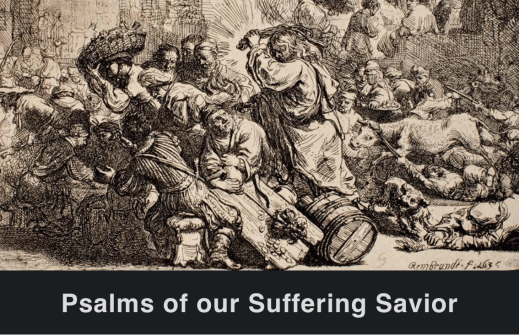
That’s exactly what happened to Jesus. He was consumed by zeal for the LORD’s house.
Can you imagine the scene? The whole city was frantic with excitement and expectation as Jesus came into Jerusalem.[1] Many expected that Jesus would soon bring freedom from Roman oppression and establish a reign of peace. People expected Jesus to ridicule Rome and inaugurate the Jewish state. Jesus, instead, condemns what’s going on in the Jewish temple.
If Jesus’ actions are unexpected it is because of misunderstanding or lack of zeal on our part. What Jesus did is in full agreement with Scripture (cf. Jer. 7:11; Zech. 14:21). The temple was to be a house of prayer, not a “den of robbers” (Is. 56:7). Specifically, the house of prayer is supposed to be “for all peoples” (v. 7). Because of all the selling, however, the court of the Gentiles would have been so filled with commotion that neither Jew nor Gentile would have been able to pray without distraction.
Jesus has concern for the poor, the sick, and the outsider. Jesus stands up for them even to the point of experiencing opposition. “Christ does more than denounce injustice—he takes action against it.”[2] That is good news!
The Hallel Psalms and the Supper

Psalm 115 is part of the Hallel Psalms. Hallel means, “praise.” Jesus would have sung the Hallel Psalms (Ps. 113-118) with His disciples on the eve of Passover.[1] Psalm 114 speaks directly of the exodus. From a New Testament perspective, we know that the salvation which began in Egypt would be finally filled in and through Jesus.
The Hallel Psalms were probably the last psalms Jesus sang before His suffering and death (Mk. 14:26). Jesus would have sung Psalm 115 knowing that He was Himself definitively showing God’s glory, love, and faithfulness. It is amazing also that Jewish people concluded the Hallel Psalms with the prayer:
“From everlasting to everlasting thou art God; beside thee we have no king, redeemer, or savior; no liberator, deliverer, provider; none who takes pity in every time of distress or trouble. We have no king but thee.”[2]
Truly! Apart from Messiah Jesus, there is no “no king, redeemer, or savior; no liberator, deliverer, provider.”
As we see in Psalm 115, idols are inept but God is a God of steadfast love and faithfulness. Whereas idols are inept God is involved. In fact, so involved that He came to this broken world in the form of Jesus Christ.
Idols are silver and gold but God came in flesh. Jesus has a mouth and with it, He spoke words of life. Jesus has eyes, and He saw this broken world and wept. Jesus has ears, and He heard the world’s bitter cries. Jesus has a nose, and He smelled the putrid smell of death. Jesus has human hands, and they were pierced. Jesus has feet, and they carried a cross, and were pinned to a cross. Jesus has a throat, and with it, He cried out: “my God, my God, why have Thou forsaken Me?!”
An Easter Devotional
I wrote the blog series, “Psalms of our Suffering Savior,” to help us “remember Jesus Christ, risen from the dead” (2 Tim. 2:8).
It is to be used devotionally leading up to Easter (Resurrection Sunday). It is a 12-day devotional that starts with the Triumphant Entry and goes through to the Ascension of Jesus Christ.[1]
In these devotions, we’ll be looking at Psalms that express Jesus’ experience. Jesus “saw in the experiences of David the pattern, writ small, of his own calling.”[2] And as Jesus said, in Luke 24:44 “the Psalms must be fulfilled.”[3]
These devotionals will help us see how it is that Jesus fulfilled the Psalms.[4] And it is quite amazing to see.
Remember “many prophets and righteous people longed to see what you see” (Matt. 13:17)! So, let’s intentionally celebrate and “remember Jesus Christ, risen from the dead”!
If you’re interested in this devotional series, like the Facebook page here or follow the blog via email (look to the right under the search bar) and receive the devotionals that way.
Jesus, Rebel With A Cause

Jesus was a rebel. But not like James Dean; not a “Rebel Without a Cause.”
Jesus had a cause. Actually, we might say He had a lot of causes. Of course, if we left off thinking Jesus was merely a rebel with a cause we’d be gravely mistaken. He’s much more than that. It is, however, still important that we not forget that He was indeed a rebel.
How was Jesus a Rebel?
This is an important question to ask, in part, because “People didn’t get crucified for being gentile or spiritual or for saying their prayers. They got crucified for being understood to be rebels.”[1]
Jesus was a rebel because…
What did Jesus accomplish on the Cross?

Jesus purchased His people (Jn. 6:36, 39; 1 Pet. 1:18-19). He showed God’s amazing love (Jn. 3:16; 15:13; 1 Jn. 3:16). He brought justification to all who would place their faith in Him (Rom. 5:18) by dying for their sins, in their place (1 Cor. 15:3; 1 Pet. 2:24; 3:18; Is. 53). He absorbed the wrath of God (1 Jn. 2:2). He became sin and made all who trust in Him the righteousness of God (2 Cor. 5:21). He canceled debt (Col. 2:14). He brought reconciliation (Rom. 5:10; Eph. 2:16; Col. 1:20-22). He defeated Satan, sin, and death and brought victory (Gen. 2:15; 1 Cor. 15; Col. 2:11-15; Heb. 2:14; Is. 53).
Jesus knew no sin, yet He became sin. We see the idea of someone bearing sin in the place of others attested to in both the Old Testament and New Testament (cf. Lev. 10:17; 16:21-22; Is. 53:6, 11-12; Jn. 1:29). Jesus is the Lamb without blemish that takes away our sin by dying in our place but He also rises; priest and lamb are not His only office. Jesus is also the coming King who reigns eternally. Consequently, the salvation that Christ brings through His work on the cross brings not only appeasement from wrath but also entrance back into the true Promised Land, the Garden of Eden. So, “the gospel is the good news of the Kingdom through the cross,” as Kevin DeYoung and Greg Gilbert say. The New City Catechism says, “Christ’s death is the beginning of the redemption and renewal of every part of fallen creation, as he powerfully directs all things for his own glory and creation’s good” (Q. 26).
Christ’s work and resurrection propels on this world new creation (cf. Rom. 8:29; 1 Cor. 15:20; Col. 1:18), it is the inevitable avalanche that will eventually encompass the whole earth (Ps. 72:19; Is. 11:9; Hab. 2:14) and those in Christ will be swallowed up in the effulgence of its glory, there to bask in eternal joy. Christ’s work on the cross and resurrection is the dawn, the first light, but soon the full splendor of the sun.
How to Keep Christ Central this Christmas Season

Christians often say, “He is the reason for the season,” which is true. Yet, it is easy in the “hustle and bustle” of the holidays for that not to ring true in our homes. So, here are some suggestions I have complied to help you keep Christ central this holiday season…
Give God a Gift
The notion of giving God a gift may sound funny since it is He that is the “giver of every good gift” (James 1:17 cf. 1 Cor. 4:7). Yet the Bible certainly gives us precedence for giving God gifts, from Abel offering gifts to God (Gen. 4:4) to Paul’s exhortation in Romans 12 for us to offer our bodies as living sacrifices in light of all His goodness to us.
So, this holiday season give the LORD a gift. No, He does not need it. But He does deserve it and it is thoroughly biblical. When we give gifts to God it gets our mind on God (Matt. 6:21). Here are a few ideas: Fast. Fast one of the holiday feasts. Not for the purpose of limiting your caloric intake but because you want to focus and intentionally praise the one who is “the reason for the season.” You could also give a financial gift to your church or other good ministry. Use your creativity and give a gift that you believe God would appreciate.
Read the Christmas Story on Christmas Day
Reading the Christmas story on Christmas is a super good thing to do if the whole season is supposed to be about the coming of the Messiah Jesus. I would personally chose Luke 1:5-2:20. I would also suggest singing a hymn and offering a prayer of thanks too.
Set up a Nativity Scene in your Home
This is a helpful visual representation of what the holiday season is really all about. The One who created the world—the One who was in the beginning with God—the One who made all things and holds all things together—He became flesh and dwelt among us. When we see the nativity scene we can rejoice that God waded into this broken world to redeem it.
Jesus on Anxiety

We all worry. We all struggle with anxious hearts.
Jesus’ words in Matthew 6 are helpful. Listen to what Jesus says:
“Therefore I tell you, do not be anxious about your life, what you will eat or what you will drink, nor about your body, what you will put on. Is not life more than food, and the body more than clothing? 26Look at the birds of the air: they neither sow nor reap nor gather into barns, and yet your heavenly Father feeds them. Are you not of more value than they? 27And which of you by being anxious can add a single hour to his span of life? 28And why are you anxious about clothing? Consider the lilies of the field, how they grow: they neither toil nor spin, 29 yet I tell you, even Solomon in all his glory was not arrayed like one of these. 30But if God so clothes the grass of the field, which today is alive and tomorrow is thrown into the oven, will he not much more clothe you, O you of little faith? 31Therefore do not be anxious, saying, ‘What shall we eat?’ or ‘What shall we drink?’ or ‘What shall we wear?’ 32For the Gentiles seek after all these things, and your heavenly Father knows that you need them all. 33But seek first the kingdom of God and his righteousness, and all these things will be added to you. 34Therefore do not be anxious about tomorrow, for tomorrow will be anxious for itself. Sufficient for the day is its own trouble” (Matt. 6:25-34).
Jesus is talking to poor people. Some of them are subsistence farmers. They hope each day to have enough food to make it to the next day. The people Jesus is talking to have no running water in their homes and no toilets. They have no refrigerators and no supermarkets. They have no health care. Their welfare and even their lives depend on whether or not they get the right amount of rain.
We have many “cares of the world” (Matt. 13:22) and we have to build bigger houses for our “abundance of possessions” (Lk. 12:15). We have many things to think and fret about.[1] So, sometimes it’s hard to see how what Jesus says applies to us. Yet, the truth is, if the first recipients of Jesus’ words were called not to be anxious, how much more does it apply to us?!
This passage applies to us. The problem is we often fail to understand Jesus’ first point and so it’s downhill from there for us.
1. First Jesus makes a point by asking a question: isn’t life more than ______________? (v. 25)
The way we answer this question tells us a lot about where our hearts are and how much help we will get from this passage. If our life is all about stuff then we have to fret and be anxious. Because we have to protect our stuff! It is of absolute importance.
2. Jesus tells us to look at the ravens (Lk. 12:24).
Why?
Well, do you know what a raven is? They are rather nasty. Ravens were listed as unclean animals in the Old Testament (Lev. 11:15; Deut. 14:14). Ravens are trash birds. And they’re like the only bad animal in “Winnie the Pooh.” So, what’s Jesus’ point? He is saying God takes care of ravens. Ravens! He’s going to take care of you! Don’t be anxious. God will provide.
3. Jesus tells us about the benefits of anxiety: Nothing. Anxiety adds… nothing. It doesn’t help at all. (v. 27)
4. Jesus tells us to look around to see the lilies and wildflowers. Who takes care of the wildflowers? No one. Well, that’s kinda right but kinda really wrong. No human takes care of the wildflowers. God does! God beautifully dresses wildflowers. They don’t worry. God takes care of them. We should trust God, He is capable.
5. Jesus tells us that we should be different from those who don’t know God. We shouldn’t worry and ask: “Will I have what I need to wear?” Why? Because we have a Father in heaven. We have a very capable Father. Through Jesus, God is our Dad.
Wow.
So, we should trust that our heavenly Father will provide for all our needs (v. 32). And He will know what our needs truly are.
Of course, if we read this and we don’t trust our heavenly Father then it comes down to us. We must fret and fear and plan. We have every reason to be anxious. If we think we are lord of the universe and king of the domain then we must be always on patrol. We must protect our stuff, even if it means no sleep.
6. Jesus tells us there is something better to seek.[2] Something that can’t make us fearful because nothing can touch it. Jesus’ Kingdom cannot be shaken. And it is the Father’s good pleasure to give us the kingdom (Lk. 12:32). That is good news for the weary.
7. Jesus tells us to be where we’re at. Today’s troubles are sufficient. Let’s be where we are today and do what God has called us to today. And let’s trust Him for tomorrow.
Let’s not get ahead of ourselves. “Sufficient for the day is its own trouble” (v. 34).
Verses to Instill Faith and Fight Fear
Discussion Questions
- Is there something you’ve been anxious or fearful about in the past?
- When you’re anxious what are some ways you fight anxiety?
- What are some takeaways from Matthew 6 that Jesus says that could help you?
______________________
[1] “A worrier is storing ‘treasure’ in the wrong place. If what you most value can be taken away or destroyed, then you set yourself up for anxiety” (David Powlison, “’Don’t Worry,’” 58).
[2] Edward T. Welch says, “Whatever is most important is the thing that rules us” (Edward T. Welch, Running Scared, 198). He goes on to say, “Do the opinions of other people control you? What you love and value is showing. You love reputation, love, respect, adoration” (Ibid., 199).
Why should I believe the Bible? (pt 7)

We have already looked at many reasons why we can believe the Bible. Yet, there are still many more. Here we briefly look at the Bible being trustworthy because it is…
Prophetic
The Bible contains all sorts of fulfilled prophecies (see e.g. “The Prophecy of Daniel 8”), particularly about Jesus. These attest to the Bible’s uniqueness, truthfulness, and authority.
“Whatever one may think of the authority of and the message presented in the book we call the Bible, there is a world-wide agreement that in more ways than one it is the most remarkable volume that has ever been produced in these some five thousand years of writing on the part of the human race.
It is the only volume ever produced by man, or a group of men, in which is to be found a large body of prophecies relating to individual nations, to Israel, to all the peoples of the earth, to certain cities, and to the coming of One who was to be the Messiah. The ancient world had many different devices for determining the future, known as divination, but not in the entire gamut of Greek and Latin literature, even though they use the words prophet and prophecy, can we find any real specific prophecy of a great historic event to come in the distant future, nor any prophecy of a Savior to arise in the human race…”[1]
The Christ of the Cosmos
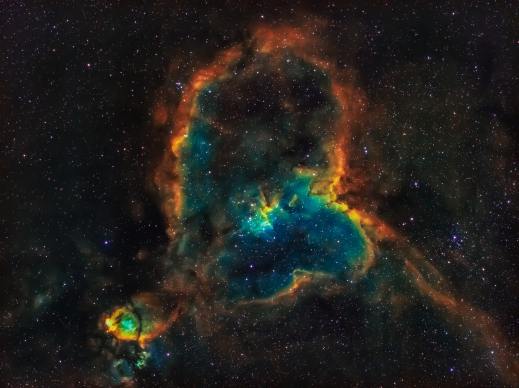
The Massive Size of the Universe
The heavens scream out and tell us of God’s surpassing worth (Ps. 19:1; Rom. 1:20). God’s glory is beyond our comprehension.
Do you know how far away the closest star is (besides the sun)? It is approximately 4 light-years away. A light-year is the length that light travels in one year. Light travels fast! 186,000 miles per second and there are 31,536,000 seconds in a year. A light year is really really really far. One light year is almost 6 trillion (6,000,000,000,000) miles! So, it takes four years for the light from the closest star to get to us.
And did you know that the sun is so big that about 1,300,000 earths could fit inside of it?[1] The universe is vast beyond comprehension.
The Astrophysicist, Hugh Ross has said, “Somewhere around 50 billion trillion stars make their home in the observable universe.”[2] That is impossible to conceive of. “A comparison may make it more comprehensible: if that same number of dimes were packed together as densely as possible and piled 1,500 feet high (as high as some of the world’s tallest skyscrapers), they would cover the entire North American continent.”[3]
Wow.
Jesus’ Massive Glory
And God—the One who created each star, named each one of them, and holds the entire universe together (Is. 40:26; Col. 1:16-17; Heb. 1:3)—cares about you! He cares so much that He sent His Son to die for you. Jesus, God in flesh, humbled Himself, came, and died for anyone who turns to Him for salvation.
Christ who created the cosmos and holds all things together (Col. 1:16-17) made Himself nothing, took the form of a servant, was born in the likeness of men, and humbled Himself to the point of death, even death on a cross (Phil. 2:7-8). Jesus, the Holy One, the spotless Lamb of God, became sin, so that in Him we might become the righteousness of God (2 Cor. 5:21).
The One who died on the cross for us died as He held the planets in orbit. He died, though He is the one that held the very nails together that pinned Him to that tree (Heb. 1:3).
He calls the host of stars by name and He knows your name! His judgments are just, His Word is true, and He is a God of sacrificial love. His faithfulness is never stopping, always and forever.
“Love so amazing, so divine
Demands my soul, my life, my all.”
The Christ of the cosmos deserves our praise!
Notes
[1] To get a visual of the expanse of the universe, use a tennis ball to represent the sun (2.7 inches in diameter) and the edge of a dime to proportionally represent the earth (0.02 inches), then place the tennis ball and dime twenty-four steps apart. That will help you see the distance between the sun and the earth (Jeffrey D. Arthurs, Preaching as Reminding, p. 76). Arthurs goes on to explain that “To explain the distance to Alpha Centauri, the nearest star: the tennis ball would be in Boston and Alpha Centauri would be in Memphis” (Ibid.).
[2] Hugh Ross, Why the Universe is the Way it Is, p. 31.
Jesus and Jihad (part two)

Jesus and Jihad
I talked to a Muslim friend recently that said Islam and Christianity are ninety-six percent the same. I strongly disagree with him and believe most informed Muslims would as well. There is an irrevocable difference between Christianity and Islam. Some Christian missionaries go and die if need be, whereas some Muslim “missionaries” go and kill if need be. This is because Jesus died and said take up your crosses whereas Muhammad killed and said take up your swords. Jesus promises salvation through justification; Muhammad claims it comes through jihad.
It is important to understand that Jesus (Isa in the Qur’an) is quite prominent in the Qur’an and is held to be a prophet. The Qur’an assumes that its readers will have a working knowledge of Jesus and His teaching (cf. Surah 2:136; 4:29; 5:46). Islam even teaches that Jesus will return and carry out justice and “break the cross.”[1] However, there is a very large contrast between what the Qur’an teaches about religious use of violence and what Jesus teaches on violence. So, let’s look at what Jesus has to say about violence.



 in X
in X 