The Committal
Jesus’ life was bathed in the language of the Psalms. Yet, when Jesus quotes Psalm 31 He doesn’t quote it exactly. Instead, He says, “Father, into your hands I commit my spirit” (Lk. 23:46).[1] And so, Jesus’ dying moment was one of trust in His Father. Jesus trusted as He taught us to pray (“Our Father in heaven…”—Matt. 6:9-15). Jesus trusted as He brought a way for us too to go to the Father (Jn. 14:6).
And so we see that Jesus who cries out in despair—trusts God.[2] And we see He laid His life down. Jesus committed Himself into the care of His Father[3] and said, “It is finished” (Jn. 19:30) and breathed His last. Jesus was in control of His life, and He laid it down. The fact that no one took His life from Him but that He laid it down[4] also implies that He is able to “take it up again” (Jn. 10:17).
It is because Jesus trusted God His Father in His life and in His death, and because He freely laid His life down, that we have access to the Father. Jesus makes a way for us by being the perfect sacrifice. Jesus always perfectly trusted God.
So, through Jesus we can have God as our Father. We can go to Him in prayer as Jesus taught us (Matt. 6:9-15). We don’t have to be anxious like unbelievers because we know that we have a heavenly Father who knows all that we need (v. 32). And we can be assured of our Father’s love and care for us because He loved us so much that He sent Jesus (Jn. 3:16).
The Trial and Mocking

See more devotionals in this series here.
Jesus is on trial. He who calmed the storm and reached out and healed lepers is on trial. Jesus could have answered as God had once before when He was questioned. He could have said, “Who is this that darkness counsel by words without knowledge?!” (Job 38:2).
Jesus could have responded: “Where were you when I laid the foundation of the earth?! (v. 4). Do you make the sun rise? (v. 12). Can you send forth lightning? (v. 35). Do you give the horse his might? (39:19). Is it by your understanding that the hawk soars? (v. 26).
And yet the One who created the universe by the word of His power and holds it together (Heb. 1:3), is on trial and even mocked. And the people cry out: “Crucify, crucify Him!”
Jesus is hated without cause (Ps. 35:19; 69:4) and people are wrongfully His foe because He never did a single thing that was wrong (1 Pet. 2:22; Heb. 4:15; 1 Jn. 3:5). And so, because He has never done anything wrong, He is attacked with lies and words of deceit (Ps. 35:20; 69:4). Jesus’ accusers said, “Aha, Aha! Our eyes have seen it!” (Ps. 39:21). But they hadn’t. They hadn’t because Jesus was without sin.
The Betrayal and Rejection

Jesus came to His own people and they did not receive Him (Jn. 1:11). Jesus was hated, rejected, and persecuted (Is. 53:3; Jn. 15:18). His friends abandoned Him (Ps. 88:8, 18; Matt. 26:56), even after making a pledge of undying loyalty. Yet, even while He Himself was being betrayed He protected His friends (Jn. 18:7-8)
Jesus, as Hebrews says, can sympathize with us (Heb. 4:15). He knows what it is like to experience betrayal of the worst kind.
Jesus was troubled in His spirit because one of His dear friends would betray Him. And it’s no wonder that He was troubled. Have you ever been hurt by a close friend? It hurts.
Yet Jesus was betrayed, as the Scriptures said He would be (Jn. 13:18).
Judas, Jesus’ “familiar friend” (Ps. 55:13), betrayed Him with a kiss[1] (Matt. 26:48-49). Jesus used to walk with Judas in the very same garden in which He was betrayed (Jn.18:2-3). Jesus had also recently shared bread with Judas.[2]
Jesus felt the blow of a backstabber but His pain would be far worse than any knife could inflict.
The Cleansing of the Temple
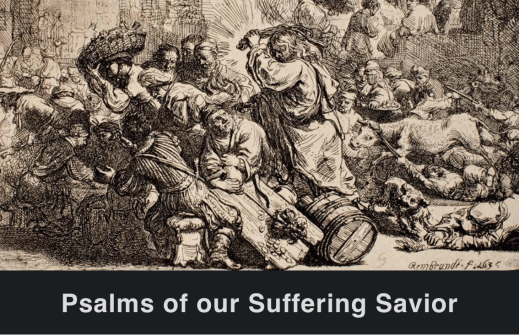
That’s exactly what happened to Jesus. He was consumed by zeal for the LORD’s house.
Can you imagine the scene? The whole city was frantic with excitement and expectation as Jesus came into Jerusalem.[1] Many expected that Jesus would soon bring freedom from Roman oppression and establish a reign of peace. People expected Jesus to ridicule Rome and inaugurate the Jewish state. Jesus, instead, condemns what’s going on in the Jewish temple.
If Jesus’ actions are unexpected it is because of misunderstanding or lack of zeal on our part. What Jesus did is in full agreement with Scripture (cf. Jer. 7:11; Zech. 14:21). The temple was to be a house of prayer, not a “den of robbers” (Is. 56:7). Specifically, the house of prayer is supposed to be “for all peoples” (v. 7). Because of all the selling, however, the court of the Gentiles would have been so filled with commotion that neither Jew nor Gentile would have been able to pray without distraction.
Jesus has concern for the poor, the sick, and the outsider. Jesus stands up for them even to the point of experiencing opposition. “Christ does more than denounce injustice—he takes action against it.”[2] That is good news!
The Triumphant Entry

In Matthew’s passage about the Triumphant Entry, he quotes from and links to Psalm 118. It is likely that Jesus sang this Psalm, along with the other Hallel Psalms (Pss. 113-18), with the disciples after He instituted the Lord’s Supper (Mk. 14:26). That’s not surprising since Psalm 118 highlights God’s steadfast love and has many Christ connections.
Psalm 118 talks about the gate that the righteous enter through to go into the presence of God (v. 20). That is not a gate that we can open on our own because we cannot be righteous on our own (Rom. 3:10). Actually, the Bible says even the best we can do on our own is like filthy rags (Is. 64:6). We need the righteousness of Jesus Christ (Heb. 10:19-22). Jesus is the gate that gives us access to God the Father (Jn. 14:6), He is the one that makes us righteous.
Jesus was the rejected stone (Matt. 21:42) but He is the Messiah, the cornerstone (Ps. 118:22). All promises rest upon Him (2 Cor. 1:20). When Jesus made His way to Jerusalem, the people cried out: “Hosanna! Save us, we pray, O LORD!” (Matt. 21:9). The people spoke better than they knew. They cried out to Jesus who is God in flesh to save—and He soon would. He would fulfill their prayer to save by answering the next cry of the crowds, that He be crucified.
The Psalm says, “The LORD is God, and He has made His light to shine upon us” (Ps. 118:27). Truly. God in flesh dwelt among us. And yet He was the “festal sacrifice” (v. 27). Jesus is finally triumphant not by overthrowing the Roman government but by overthrowing Satan, sin, and death through His death and resurrection.
An Easter Devotional
I wrote the blog series, “Psalms of our Suffering Savior,” to help us “remember Jesus Christ, risen from the dead” (2 Tim. 2:8).
It is to be used devotionally leading up to Easter (Resurrection Sunday). It is a 12-day devotional that starts with the Triumphant Entry and goes through to the Ascension of Jesus Christ.[1]
In these devotions, we’ll be looking at Psalms that express Jesus’ experience. Jesus “saw in the experiences of David the pattern, writ small, of his own calling.”[2] And as Jesus said, in Luke 24:44 “the Psalms must be fulfilled.”[3]
These devotionals will help us see how it is that Jesus fulfilled the Psalms.[4] And it is quite amazing to see.
Remember “many prophets and righteous people longed to see what you see” (Matt. 13:17)! So, let’s intentionally celebrate and “remember Jesus Christ, risen from the dead”!
If you’re interested in this devotional series, like the Facebook page here or follow the blog via email (look to the right under the search bar) and receive the devotionals that way.
The Psalms and Our Songs

The Psalms are important for a number of reasons. For one, they take up a fairly large portion of Scripture and they have been a comfort for many. Spurgeon, known as the “prince of preachers,” struggled with depression and he found comfort and solace in the Psalms. He spent some twenty years writing his three-volume commentary on the Psalms.
The Psalms are also important because we are exhorted to sing Psalms. The Psalms are important because they give powerful truths poetic expression. This is helpful because it not only helps us remember the truths but helps us feel the truth. The Psalms are beautiful and will have a very practical impact on us when we soak in them.
Interestingly, Scripture has laments in it and so does our surrounding culture. Most Christian circles, however, do not have laments. Why is this? Is it because Christians are always happy? And always live victoriously? I don’t think so.
“To God be the Glory!” Sermon on Psalm 115
Discussion Questions
- When you think of God’s glory, what are some of the things that first come to mind?
- God deserves glory for so many reasons. What are some reasons you think of that weren’t talked about in the sermon?
- Can you relate to C.S. Lewis’ struggle? Is it hard to understand why God cares so much about His own glory? What has been helpful for you as you think about this?
- What are some of the results of idolatry in our lives?
- What is an idol? Give some examples of good things in life that can become idols.
- What idols do you currently struggle with?
- How can personal success and achievement lead to a sense that we ourselves are god?
- What are possible signs in an individual’s life that point to the fact that success is an idol?
Why Do We Sing In Church? [Part 1]

Introduction
A lot of times we find it hard to engage in singing at church. There are a lot of things to distract us: funny unfamiliar phrases, me singing off-key in front of you, and a thousand other things. Why sing? Why purposely engage in worship?
Singing at Sunday gatherings is basically one-third of what we do. Why do we do it? Why does so much time go into singing? Why have a worship team? Why should so many dedicate so much time so that we can sing songs? There are a lot of reasons. We will only look at three below; the three “T’s” of singing within the church. Singing teaches us, transforms us, and helps us cultivate a heart of thanksgiving.
Singing Teaches Us
“Let the word of Christ dwell in you richly, teaching and admonishing one another in all wisdom, singing psalms and hymns and spiritual songs” (Col. 3:16).
“Addressing one another in psalms and hymns and spiritual songs, singing and making melody to the Lord with your heart” (Eph. 5:19).
Singing teaches us. But how? First, what is singing and what is music? Dicionary.com says singing is “to utter words or sounds in succession with musical modulations of the voice; vocalize melodically.” Music is “an art of sound in time that expresses ideas and emotions in significant forms through the elements of rhythm, melody, harmony, and color.”[i] So, singing can “expresses ideas and emotion” in a unique way. In a way that informational teaching cannot. I can teach on the fact that God sent His Son to die for us but singing that same truth will impact us diffrently. Take these lines for example:[ii]
“And when I think that God, his Son not sparing,
Sent him to die, I scarce can take it in,
That on the cross, my burden gladly bearing,
He bled and died to take away my sin.”[iii]
Singing and music hold the glories of Christ before us in a unique and powerful way.
Singing is a form of communicating ideas and emotions with voice and tune. Music is a gift. Music has the distinct ability to focus truth with laser precision. Music in Scripture is thus rightly placed in the same category as other speech gifts (see 1 Cor. 14:15, 26).
It is widely known that music has a special ability to affect people emotionally. It can help men march into war or weep at a funeral. Music is a powerful and precious gift but should not be wrongly used to stir peoples’ emotions up. That is, we desire the Spirit to move and transform people by the content of the song, not merely by the contours of the song. We are to sing praise with our spirit, and our mind also (1 Cor. 14:15). So it’s important that when people are moved in Christian worship that they “be moved by the impact of the truth on the mind and conscience. Any attempt to bypass these is both wrong and dangerous.”[iv]
First Corinthians 14:26 tells us that “When you come together, each one has a hymn, a lesson, a revelation, a tongue, or an interpretation. Let all things be done for building up.” So when we “come together” we have “a hymn” for the purpose of “building up” each other. Thus, one of the reasons we sing and play various instruments is for the purpose of building each other up.
The “word of Christ dwells in us richly” not just through listening to preaching, talking with friends, or even through the memorization of scripture, but also through “singing” (Col. 3:16). Thabiti Anyabwile has said, “Singing is the moving van taking the Word of Christ into the temple of our lives.” Notice that when we sing more of our whole person is involved—our intellect, emotion, and volition. It should be our desire when we worship to involve as much of our self as we can—body, mind, emotions.
We are physical people; we’re not just souls. We have bodies. So, I believe physical actions (see kinesthetic learning) are important while we sing. So, when you worship: kneel, clap, raise your hands, bow your head, and even dance! We see precedence for these things in Scripture (Ps. 2:12; 47:1; 95:6; 134:1-2; 150:4). Of course, everything should be done “decently and in order” (1 Cor. 14:40).
We must consciously think hard about what the song is communicating (thus we use our mind/cognition; 1 Cor. 14:15). We should thus also be greatly impacted by it (emotions). And as we worship our will (or volition) should be actively engaged as well (both in short-term kinesthetic acts and by long-term acts of service like ministering to orphans and widows). That is, we should actively pray for God’s truth to impact us, we should actively contemplate why God’s truth is amazing, we should actively think about the emotional response we should have, and we should actively evaluate how our everyday life should be reshaped in light of God’s truth.
The question could be asked, “To whom do we sing? I thought that when we gather and sing together, we sing praise to God. So how is teaching part of our songs of worship? How does singing teach us?”
Perhaps surprisingly, we see from Scripture that there are two audiences. We sing to “one another” and we “make music in our hearts to the Lord” (Eph. 5:19). Music has both a horizontal and vertical element to it. Music has the function of edifying and transforming us from the inside out as we meditate on and proclaim God’s truth (cf. 17:17) and it also thanks God for who He is and what He has done.
As we sing praise to God we are also teaching our brothers and sisters (and even ourselves). As we sing in unison we are united in the teachings of the church. We are confessing truth. We are telling others of the gospel and the wonders of God. We are also internalizing God’s truth for ourselves. We are hiding God’s truth in our heart. We are letting Christ and His truth take up residence within us. We are teaching ourselves what to treasure and love.[v]
We give roughly one-third of our Sunday gatherings to singing songs of worship because singing these songs not only teaches but also transforms us. How does God use singing to transform us? …See Part Two.
__________________
[i] Dictionary.com.
[ii] However, I do not mean that teaching is not important. Instead, I believe they compliment each other.
[iii] “How Great Thou Art.”
[iv] Noel Doe, Created For Worship, 235 see also Jonathan Edwards very important book Religious Affections. John Calvin said, “We should be very careful that our ears be not more attentive to the melody than our minds to the spiritual meaning of the words” (Institutes book III, 895).
[v] “Music gets ‘in’ us in ways that other forms of discourse rarely do. A song gets absorbed into our imagination in a way that mere texts rarely do… Song seems to have a privileged channel to our imagination, to our kardia, because it involves our body in a unique way… Perhaps it is by hymns, songs, and choruses that the word of Christ ‘dwells in us richly’” (Smith, Desiring the Kingdom, 171).



 in X
in X 