Insights & Quotes from Peter Scazzero’s book, Emotionally Healthy Discipleship
Peter Scazzero’s book, Emotionally Healthy Discipleship, gives some important correctives to the modern church’s approach to discipleship. Sadly, many churches tolerate immaturity and emphasize “doing” over “being,” and mistakeactivity for spiritual maturity. This leads to an undercurrent of sin and unaddressed hurts under the surface. Everything may look good, but at the smallest pin prick and behind closed doors, the ugly reality shows.
The book contrasts the “shallow” traditional model, which focuses on attendance and service within the church building, in contrast to the “transformative” model, which focuses on deep, long-term heart change. For us to have in-depth discipleship, Scazzero says we must do at least four things:
- We must emphasize being with God over doing for God.
- We must not tolerate emotional immaturity.
- We must not ignore the treasures of church history.
- We must not define success wrongly.
The book also helpfully gives seven marks of healthy discipleship:
- Be Before You Do
- Follow the Crucified—not the “Americanized”—Jesus
- Embrace God’s Gift of Limits
- Discover the Treasures Hidden in Grief and Loss
- Make Love the Measure of Spiritual Maturity
- Break the Power of the Past
- Lead Out of Weakness and Vulnerability
The illustration that stuck with me the most is Scazzero’s reference to Oliver Sacks’ book, The Man Who Mistook His Wife for a Hat. It tells of a 60-year-old woman who was born with cerebral palsy. She never used her hands for any functional purpose because she was literally spoon-fed and waited on hand and foot. She learned helplessness. She lived as if she had no hands.
However, when Dr. Sacks saw her, he eventually left food just out of reach, which forced her to use her hands. This led to her not only gaining the use of her hands but also discovering a talent for sculpting. She eventually became locally famous for her sculptures.
This is a disturbingly similar dynamic at work in our churches. Too many people are spoon fed and babied. Tragically, many churches are disabling people spiritually. Each and every Christian is gifted and empowered by the Spirit, but is too often crippled by pastors who do the ministry instead of equipping the saints for the work of the ministry (Eph. 4:12).
Also, too often, ministry is seen as happening inside the four walls of the church building. So, if people are equipped for ministry, it’s ministry connected to the institution of the church—ministry like childcare, security, greeting, and leading a Bible study. One of the concerns here is that even the equipping the church does essentially takes people away from being the light of the world they are called to be, and shuts them up in a church building. Instead of the church making disciples, it makes props within the business of the Sunday service.
Here are some quotes I found helpful:
An emotionally healthy disciple refers to a person who rejects busyness and hurry in order to reorient their entire life around their personal relationship with Jesus, developing rhythms, setting limits, and following him wherever he leads. At the same time, they intentionally open the depths of their interior life—their history, their disorientations, their areas of brokeness, and their relationships—to be changed by Jesus. And they are deeply aware how everything they have and all they are is a gift. So they carry a profound awareness of stewarding their talents as a gift to bless the world for Jesus.
God came to earth, not in a flashy show of signs and wonders, but as an infant born into poverty and obscurity. After living as a refugee in Egypt, he returned to grow up in Nazereth, a backwoods town a long way from the big city. He waited thirty hears to begin any public ministry, and even then, refused to do miracles on demand on overwhelm people with his brilliant intellect. His ministry was small and almost invisible by the world’s standards.
Do not be in a rush. We didn’t get into the problem of shallow discipleship overnight. And neither will we solve the problem overnight.
When we define success wrongly, it means our best energies will be invested in things such as cutting-edge weekend services, cultivating our brand, and preparing captivating messages. Little is left over for discipleship our own or that of others especially when it produces what appears to be such a small and slow return.
With the little time left to invest in the messy work of discipleship, we do the next best thing. We standardize discipleship and make it scalable. Our approach resembles more of a conveyor belt in a manufacturing plant than the kind of relational discipleship Jesus modeled for us. We like standardization. Jesus preferred customization.
Work for God that is not nourished by a deep interior life with God will eventually deteriorate-and us with it. Over timeour sense of worth and validation gradually shifts from a grounding in God’s love to the success or failure of our ministry work and performance. And that’s when the peace, the clarity, and the spaciousness of our life with Christ slowly, almost imperceptibly, disappears.
Much of discipleship in the church today is the spiritual equivalent of cladding… On the surface, everything looks like the real thing. Our people are upbeat and optimistic, filled with faith that Jesus will get them through crises and valleys. They are uplifted spiritually through moving worship experiences and dazzling messages… And yet, their transformation in Christ remains at the level of cladding, a thin veneer on a life that has yet to be touched beneath the surface.
Normally, our goal is to build a church in which people attend worship services, participate in small groups, invest financially, and serve. We assume that active participation in these activities means people are maturing in a vital, personal relationship of loving union with Jesus.
We assume wrongly. It does not.
In fact, I marvel at how many excellent communicators lead as if discipleship takes place primarily through sermons. That is like going to the nursery, spraying the babies with milk, and walking away claiming we fed them.
Biography As A Form of Discipleship: Edwards, Spurgeon, & Lloyd-Jones (pt. 2)

Different Levels of Gifting, Same Stewardship
Lloyd-Jones had a profound memory, “it was as if he was unraveling an endless ball of wool.”[1] Edwards had a keen intellect being the foremost of American thinkers. Spurgeon was “the Prince of Preachers.” As we can see by these small examples, these men were especially gifted by God but they were not merely gifted, they were also faithful with the gifts God entrusted to them. We will all be held accountable for what God has entrusted to us but praise God I am not held accountable for the intellect of Edwards. That, however, in no way clears me from being faithful. These men were not merely amazingly gifted but amazingly faithful. We may not be able to preach like Spurgeon but we can seek by God’s empowering to be faithful like him.
We are all stewards entrusted with different amounts, some 30, 60, and a 100 fold, but we must all be faithful (Matt. 13:8; 25:14-30; Luke 12:35-48; 1 Peter 4:10). I have not been entrusted with the same stewardship as the men of whom we are seeking to emulate, and it is highly unlikely that you have either. However, these men were not merely gifted, they were all entirely dedicated to the Lord (we will turn to this in more detail shortly). Michael Jordan, arguably the best basketball player of all time, still worked hard. What made him so great was that he was not just talented but also tough in his discipline. The men we are looking at were gifted, there is no doubt, but they were also incredibly faithful. So the first thing we see to emulate from them is their faithfulness.
They were Consumed with God’s Glory
All three of these men here were greatly concerned for the glory of God, even if this desire came to fruition differently in the lives of each man. They did not all, like Edwards, write The End for Which God Created the World, but they all would have agreed with what he wrote and desired, like him, to glorify God with their utmost ability.
It is said that though “Edwards was intellectually brilliant and theologically commanding, his true greatness lay in his indefatigable zeal for the glory of God.”[2] Likewise, “The chief element of Spurgeon’s entire career” was not his preaching, or anything else; it “was his walk with God.”[3] This was also central to Lloyd-Jones: “A God-centered theology was not an addition to his personal life, it was central to it… His jealousy for God’s glory… flowed from his knowing something of being in the presence of God.”[4] In fact, Lloyd-Jones’ concerned for God’s glory, told Iian H. Murray, his biographer, that the biography should be done “for God’s glory only.”[5]
We should, like these men, seek in whatever we do to glorify God. We must, however, remember that we are all gifted differently and thus the route we take may be different than that of these three men. We are all called to different things, but we are all called to seek to glorify God in whatever we do.
They had an All-Encompassing Commitment to Christ[6]
This section is one of the most significant sections. We must remember, however, that these men’s complete commitment to God was not something they mustered up on their own. God gave even that to them. He showed Himself glorious to them, more glorious than anything else, and their complete devotion followed.[7] These men invested all, their time and talent, indeed, their heart, soul mind, and strength because they had been granted eyes to see that God and His glory were worth it.
Their all-encompassing commitment to Christ flowed out of their understanding of the glory of Christ. Not only did these men see that God was glorious and thus worthy for themselves to entirely comment to but also that He was Lord of all. They understood the language in the New Testament that says that Jesus is our Master/Lord and we are slaves, which clearly implies that we do whatever He says, whenever He says it.[8]
Benjamin B. Warfield said that Edwards committed himself without reserve to God. His whole spirit panted to be in all its movement subjected to God’s government.[9] Edwards explained his reasoning for his total commitment. He said,
If God be truly loved, he is loved as God; and to love him as God, is to love him as the supreme good. But he that loves God as the supreme good, is ready to make all other good give place to that; or, which is the same thing, he is willing to suffer all for the sake of this good.[10]
Edwards was entirely committed to God because He is “the supreme good.”
Spurgeon commenting on first Kings 18:21 said, “If God be God, serve him, and do it thoroughly; but if the world be God, serve it, and make no profession of religion.” Later he goes on to tell us, “Either keep up your profession, or give it up… Let your conduct be consistent with your opinions.”[11] What Spurgeon was saying is, if the Bible and the gospel are true we must live as though they are. We must live in line with what we believe. As the scriptures say, “The LORD is God; there is no other… therefore be wholly true to the LORD our God, walking in His statutes and keeping His Commandments” (1 Kings 8:60-61).
Spurgeon lived out what he said. People told Spurgeon that he would break down his constitution by preaching ten times a week among all his other labors. But Spurgeon’s desire, like Paul’s, was to spend and be spent. Spurgeon could say, “If I had fifty constitutions I would rejoice to break them down in the service of the Lord Jesus Christ.”[12]
Spurgeon gave his money, time, and self completely to the Lord. God used Spurgeon greatly. He wrote over 140 books, penned around 500 letters a week, spoke to thousands of people each week, started an orphanage, started a pastor’s college, and led countless people to Christ among other things. That was all possible because he gave himself entirely to the Lord. One of Spurgeon’s biographers, Arnold Dallimore said, “Early in life he had lost all consideration of his own self, and his prayer that he might be hidden behind the cross, that Christ alone might be seen, had expressed his heart’s chief purpose.”[13] Dallimore also said, “Spurgeon was characterized by an earnestness that almost defies description.”[14]
Lloyd-Jones, too, saw that “our supreme duty is to submit ourselves unreservedly to Him.”[15] In fact, “Essential Puritanism,” Lloyd-Jones argued, “put its emphasis upon a life of spiritual, personal religion, an intense realization of the presence of God, a devotion of the entire being to Him.”[16] You can see that Lloyd-Jones did exactly that all over the place in his life, he gave himself to God and the work that He had for him. “When God calls us,” Lloyd-Jones said, “He is to be obeyed in spite of all natural feelings.”[17] Lloyd-Jones not only said this but practiced it himself because he was entirely commented to Christ.
God is looking for individuals in this generation who will rise above the status quo of contemporary Christianity and say with Lloyd-Jones, Spurgeon, and Edwards, “‘I am completely Yours.’”[18] We must resolve, as Edwards did, to be the jar of clay through which God will display his surpassing power. We must seek for pleasure in God above all things. We must seek to be so heavenly-minded that we can be of some earthly good. We must do all this with all the power that God so mightily works in us by His grace. “If one is to impact this world for Jesus Christ, he must live as Edwards did, with extraordinary purpose and firm determination.”[19]
Notes
[1] Murray, The Fight of Faith, 376 see also 406n1, 453, 759.
[2] Steven J. Lawson, The Unwavering Resolve of Jonathan Edwards (Lake Mary, Florida: Reformation Trust Publishing, 2008), 4.
[3] Arnold Dallimore, Spurgeon: A New Biography, (Carlisle, PA: The Banner of Truth Trust, 1999), 177.
[4] Murray, The Fight of Faith, 764-65.
[5] Ibid., 729 see also xxiv.
[6] See Deut. 6:5; 1 Kings 8:61; Matt. 8:22; 22:37-38; Mark 12:30 (heart, soul, mind and strength, i.e. total devotion); Luke 10:27; 14:25-33; 16:13; Rom. 14:7-8; 1 Cor. 7:35 (Paul wants to secure an “undivided devotion to the Lord”); 10:31; 2 Cor. 5:9; 14-15; Phil. 3:7-8; Col. 3:17, 23, and 1 John 2:3-6 for some examples of the all-inclusive nature of the call of Christ. Also in Romans 12:1, we are told to present our bodies as a living sacrifice because that is our reasonable (logical) worship. Thomas R. Schreiner says, “Paul used the term with the meaning ‘rational’ or ‘reasonable,’ as was common in the Greek language. His purpose in doing so was to emphasize that yielding one’s whole self to God is eminently reasonable. Since God has been so merciful, failure to dedicate one’s life to him is the height of folly and irrationality” (Thomas R. Schreiner, Romans [Grand Rapids: Baker Academic, 1998], 645 [italics mine].). In addition, Schreiner points out that “the word ‘bodies’ here refers to the whole person and stresses that consecration to God involves the whole person… Genuine commitment to God embraces every area of life” (Ibid., 644. Italics mine). Christianity is all-encompassing.
[7] God often shows His glory to us before He calls us to comment to Him in unreserved obedience. Note, for example, in the Decalogue. God gives the commands but first He adds a relational and redemptive element, namely, “I am the LORD your God [relational], who brought you out of the land of Egypt, out of the house of slavery [redemptive]” (Deut. 5:6). This same thing is seen throughout Scripture, both OT and NT.
[8] “Edwards would say that actions do reveal something about a man’s will and heart. Professing Christ implies being subject to him in practice, it entails the promise of universal obedience to him” (Iain H. Murray, Jonathon Edwards: A New Biography, (Carlisle, PA: The Banner of Truth Trust, 2008), 336). Edwards understood that “none profess to be on Christ’s side, but they who profess to renounce his rivals” (Idem, Jonathon Edwards: A New Biography, 337). Lloyd-Jones clearly saw that one cannot “receive Christ as Saviour without receiving Him as Lord” (Idem, The Fight of Faith, 470).
[9] Murray, Edwards, 98.
[10] Jonathon Edwards, Charity and its Fruits, (Carlisle, Pennsylvania: The Banner of Truth Trust, 2005), 257.
[11] C. H. Spurgeon, sermon “Elijah’s Appeal to the Undecided” from 1 Kings 18:21 (italics mine).
[12] Dallimore, Spurgeon: A New Biography, 132.
[13] Ibid., 239.
[14] Ibid., 76.
[15] Murray, The Fight of Faith, 181 (italics mine).
[16] Ibid., 460n1 (italics mine).
[17] Ibid., 588.
[18] Lawson, The Unwavering Resolve of Jonathan Edwards, 60.
[19] Ibid.
Biography As A Form of Discipleship: Edwards, Spurgeon, & Lloyd-Jones (pt. 1)
Introduction
We have clear scriptural warrant for emulation. We see this through Jesus’ earthly ministry; He made disciples and in the Great Commission, He instructed us to make disciples (Matt. 28:19). We see this precedence all throughout the New Testament. We will examine a few examples to establish the usefulness and biblical grounds for Christian biography.
The writer of Hebrews instructs us to be “imitators of those who through faith and patience inherit the promises” (Heb. 6:12). He also encourages us with the thought of all the saints that have gone before us. He says, “Let us also lay aside every weight, and sin which clings so closely, and let us run with endurance the race set before us” (12:1). Of course, he wisely reminds us that our supreme example is Jesus (12:2). Again, he says, “Remember your leaders, those who spoke to you the word of God. Consider the outcome of their way of life, and imitate their faith” (13:7). I think here, we can deduce that many times it is a good principle to wait to imitate leaders until we have considered “the outcome of their way of life.” This also shows us that we should not imitate them wholesale but evaluate them. We can emulate good Christian leaders, and that is fine, but we must always remember that only “Jesus Christ is the same yesterday and today and forever” (13:8).
Paul tells us to “honor such men” (Phil. 2:29)[1] who are faithful in service to the Lord. Paul even urged people to imitate himself (1 Cor. 4:16), but only as much as he imitated Christ (1 Cor. 11:1).[2] I wonder if one reason for this is proximity. It is one thing to ask, “What would Jesus do,” it is another thing to see someone who by our evaluation tends to do things that Jesus would have done had He faced similar circumstances. It is easier to understand what love is when it has flesh on. Paul continues to say imitate me, but not just me, but also those who follow my example (Phil. 3:17). Thus, in as much as Jonathan Edwards, Charles Spurgeon, and Lloyd-Jones follow Paul as he followed Christ we should seek to learn from biography’s and emulate them.[3]
It is helpful for most human beings to see something demonstrated before they attempt to do it themselves; it is just how we tend to learn. This is also what we see when it comes to spiritual matters. We need someone to imitate because we are naturally imitators, but not just anyone. Imitators (mimetes) simply means ones who follow. We see this in some of its related words: a “mime” is someone who acts out an imitation of another person or animal. And a “mimeograph” is a machine that makes copies from a template. Thus, we see the template/person we chose to copy/imitate is vital because if we do our job well we will be a lot like them.
The New Testament shows us the importance of discipleship and there is even a sense in which those who have died can still teach us.[4] Look for example at the impact that Jonathon Edwards has had on John Piper or the impact of both Edwards and Spurgeon on Lloyd-Jones.[5]
Then look at the impact that Piper has had on many others. It reminds me of Paul’s exhortation to Timothy (2 Tim 2:1-2). Obviously, Paul is an apostle and Edwards is not, but the principle still applies. We in the 21st century have an unprecedented opportunity to entrust good teaching to faithful men who will teach others also. Biographies are a good source to use when discipling men. It is helpful for us to see men who though they are dead, still speak by the life of faith they lived. However, we must remember to evaluate them in light of Christ and see where they succeeded in following Him and where they failed.[6] We must learn from both the good and the bad. To this, we will turn momentarily but first, we will look at the unique way that God gifts certain people differently yet expects everyone, though not equally gifted, to be equally faithful.
Notes
[1] In this verse, in the Greek, we see the present imperative so Paul is commanding them to continually honor faithful men, in this case, Epaphroditus.
[2] In both these verses from First Corinthians, we see the present imperative tells us to habitually follow the command. It is to be our long-term commitment, our lifestyle, to imitate Paul as he imitates Christ.
[3] We could look at many other texts here to establish the legitimacy, indeed, the blessing of biographies however; we do not have the space for that here. Here are some further texts to look at Phil. 4:8-9; 1 Thess, 1:6, 7; 2 Thess. 3:9.
[4] The Hebrew writer reminds us that we can learn even from Abel though he has long since been dead. Even Abel “through his faith, though he died, he still speaks” (Heb. 12:4) Even though we do not know very much about him we can still learn from what he “speaks” with his demonstration of faith.
[5] Iian H. Murray, D. M. Lloyd-Jones: The Fight of Faith, (Carlisle, PA: The Banner of Truth Trust, 2009), 421 see also idem, D. M. Lloyd-Jones: The First Forty Years, (Carlisle, PA: The Banner of Truth Trust, 2008), 196n1.
[6] As J. C. Ryle has said, “The best of men are only men at their very best. Patriarchs, prophets, and apostles,—martyrs, fathers, reformers, puritans,—all, all are sinners, who need a Saviour: holy, useful, honourable in their place,—but sinners after all” (Murray, D. M. Lloyd-Jones: The Fight of Faith, 752).
Photo by Aaron Burden
4 Benefits of a Book Club

I recently became part of a book club. It has already been beneficial. I also asked my sister, a long-time “book cluber,” for her perspective. She, in turn, phoned her book club friends and they shared their thoughts too. Below are the 4 benefits of a book club that especially stuck out.
Accountability & Encouragement
Reading is important. There is much to gain from reading but we have to read to get those gains. And what we get from reading is not tangible. We can see a book but it’s difficult to see the impact a book has. Reading also takes concentrated effort. Reading is difficult in our age of distraction, especially if we’re out of practice.
With anything difficult, positive peer pressure is helpful. Atomic Habits, one of our book club books, says this:
One of the most effective things you can do to build better habits is to join a culture where your desired behavior is the normal behavior. New habits seem achievable when you see others doing them every day… Your culture sets your expectation for what is “normal.” Surround yourself with people who have the habits you want to have yourself. You’ll rise together.1
Discovery & Expansion
There are some books I would never choose to read. I used to only read nonfiction books but now I read about every genre. In fact, and I feel embarrassed to admit this now, there was a time when I didn’t want to read the Harry Potter book series. I told people that when I’m sitting in a nursing home then I’ll start them.2 Thankfully my son convinced me. I have the last book to finish but it’s been really good.
C.S. Lewis talks about the importance of reading old books “because they are unlikely to go wrong in the same direction.” Reading widely gives us a perspective we would not otherwise have. Reading can also help us “walk in someone else’s shoes.” Thus, reading widely can help us obtain wisdom and empathy. Getting out of our reading “comfort zone” might just help us see something we would otherwise be blind to. Of course, we must always be discerning readers.
Diverse Perspective
To misappropriate “A Whole New World” from Aladdin:
Books show you the world
shining, shimmering, splendid
books can open your eyes
take you wonder by wonder
over, sideways, and under
on a magic book ride
a whole new world
a new fantastic point of view
Or as Peter Kreeft has said, “There’s a real place you can go where you can really find magic. You can get into other worlds there… Like getting into Narnia through the wardrobe. There are thousands of other worlds there, and holes to get into each one… It’s called a library.”3
A book club is like a magic boost. One of the great things about book club is you not only read books that you otherwise might not read but you have conversations with people and perspectives that you otherwise wouldn’t have. When echo chambers are in vogue, it’s important to seek out real conversation and even, perish the thought, disagreement. If we are to learn to be patient with people with different perspectives, it’s helpful to sit across from those people, to hear them and not just soundbites.
Seeking out diversity in book clubs, both in books read and people reading, is important because “even as we live with increasing diversity, it’s easier than ever to restrict our contact, both online and off, to people who resemble us in appearance, views, and interests. That makes it easy to dismiss people for their beliefs or affiliations when we don’t know them as human beings. The result is a spiral of disconnection that’s contributing to the unraveling of civil society today.”4
Social Connection
Social connection is vital. In fact, in Vivek H. Murthy’s book, Together, he says, “People with strong social relationships are 50 percent less likely to die prematurely than people with weak social relationships… weak social connections can be a significant danger to our health.”5 So not trying to oversell this, but being part of a book club can help you live longer!
One mother said one of the benefits of book club is “guaranteed grown-up conversation once a month.” In my observation, “grown-up conversation” is sadly lacking in many people’s lives. We might talk with people a little or a lot, but is our talk deep and meaningful? A book club can help people have not only relationships but also meaningful relationships through the important themes discussed in the books that are read. Many books, as one respondent said, “show us the depths and height of the human heart.” A book club also allows deep and meaningful conversations for introverts and extroverts without it being too awkward.
If you’re not part of a book club, you should join one. You will reap a bunch of benefits. You might even live longer.
- James Clear, Atomic Habits, p. 117. ↩︎
- I now say this about the Wheel of Time series. Although, I have enjoyed a Wheel of Time graphic novel as well as the Wheel of Time TV show. Most of my nine siblings get angry at me for talking about their cherished book series in this way. ↩︎
- Peter Kreeft, Making Sense of Suffering. ↩︎
- Vivek H. Murthy, Together: The Healing Power of Human Connection in a Sometimes Lonely World, p. 134. ↩︎
- Vivek H. Murthy, Together: The Healing Power of Human Connection in a Sometimes Lonely World, p.13. ↩︎
The Ten Best Books I Read in 2020
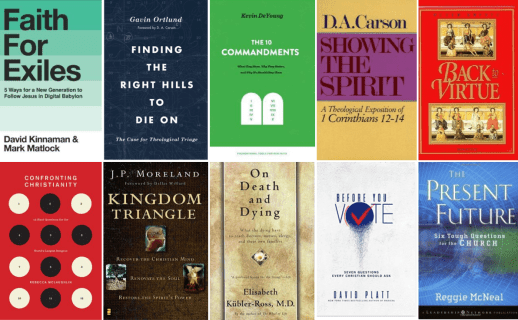
Here are my ten favorite books that I read in 2020 (they’re listed in alphabetical order by the author’s last name):
- D.A. Carson, Showing the Spirit: A Theological Exposition of 1 Corinthians 12–14
- Kevin DeYoung, The Ten Commandments: What They Mean, Why They Matter, and Why We Should Obey Them
- David Kinnaman, Faith for Exiles: Five Ways to Help Young Christians Be Resilient, Follow Jesus, and Live Differently in Digital Babylon
- Peter Kreeft, Back to Virtue: Traditional Moral Wisdom for Modern Moral Confusion
- Elisabeth Kübler-Ross, On Death and Dying
- Rebecca McLaughlin, Confronting Christianity: 12 Hard Questions for the World’s Largest Religion
- Reggie McNeal, The Present Future: Six Tough Questions for the Church
- J.P. Moreland, Kingdom Triangle: Recover the Christian Mind, Renovate the Soul, Restore the Spirit’s Power
- Gavin Ortlund, Finding the Right Hills to Die on: The Case for Theological Triage
- David Platt, Before You Vote: Seven Questions Every Christian Should Ask
And five runner-ups:
- Andy Crouch, Playing God: Redeeming the Gift of Power
- Albert Mohler Jr., The Gathering Storm: Secularism, Culture, and the Church
- Tony Reinke, Competing Spectacles: Treasuring Christ in the Media Age
- Deepak Reju, On Guard: Preventing and Responding to Child Abuse at Church
- Mark Dark Vroegop, Clouds, Deep Mercy: Discovering the Grace of Lament
Here are my favorite books from last year.
10 Ways to Read More Books in 2021

I read 70+ books in 2020.[1] Below I’ll tell you how.
“If you ain’t cheating, you ain’t trying.” I don’t think you should cheat. Cheating is wrong. But you should, however, make the most of every advantage you have as best as you can.
That’s what I seek to do with reading. I take advantage of everything I can.
I read all sorts of books for all sorts of reasons. Depending on the reason for reading and the type of book, I will read it in a different way. Some people shun audiobooks. But, I personally don’t get that. There are all sorts of reasons for reading and all sorts of ways that people retain things best.
As I said, I think we should wisely take advantage of everything we can as best as we personally can.[2]
Here are nine things I’ve used to my advantage:
1) Time
Time is the most precious commodity there is. Even little bits of gold have value, how much more small slots of time!
You can get a lot read when you make the most of small time slots. Waiting can easily turn into productive reading. I always have a book on hand. And my wife often listens to audiobooks while doing dishes or laundry.
2) Old fashioned books
Always have one with you. You never know when you’ll be able to get a few paragraphs or a few pages read.
3) Kindle app on my phone
It’s always with me. I always have a book I’m reading on Kindle.
4) Hoopla or Libby
Hoopla and Libby are free apps and one of them should be available through your local library. I’ve used them both at different times to listen to tons of books.
5) Audible
Audible is an audiobook service. My wife and I had a membership for a long time. It was great.
6) ChristianAudio
ChristianAudio is an audiobook service that provides Christian audiobooks. You can signup for a free audiobook a month.
7) Speechify
Speechify is an amazing app. It was created by Cliff Weitzman, someone with dyslexia, to help people with dyslexia.
With Speechify you can take a picture of a page in a book and it will convert it to audio. I will sometimes buy a book on Kindle and take a screenshot of each page of the Kindle book and load it on to Speechify. In this way, I can listen to the book.
I can also still make notes. If something sticks out to me that I want to capture I’ll take a screenshot on the Speechify app. Then I’ll search the keywords from the screenshot on the Kindle book and highlight and make any notes I want to make.
Speechify has been a huge blessing to me. I read very slowly but when I use Speechify I can read over 650 words per minute. Speechify probably triples my reading speed but I’m still able to retain what I read and make notes.
8) A community of book lovers
I have multiple friends (including my wife!) that love to talk books and encourage the reading of good books.
9) Goodreads
Goodreads is a social media site for reading. Goodreads allows you to track and review books you’ve read as well as receive recommendations from friends. You can see my Goodreads account here.
10) Pocket (very helpful but not for books)
Pocket is an app that allows you to save articles to your “pocket.” It’s a great way to save and organize articles. But, the thing I enjoy most is that it has a function that allows you to listen to articles.
10 Quotes from Jonathan Pennington’s book, Jesus the Great Philosopher

I appreciated Pennington’s book. He did a good job showing that “Christianity is more than a religion. It is a deeply sophisticated philosophy” (Jonathan T. Pennington, Jesus the Great Philosopher: Rediscovering the Wisdom Needed for the Good Life, 159).
Here are 10 quotes that stuck out to me:
“When we try to live without knowledge of physics and metaphysics—how the would is and how works—then we are foolish, not wise, living randomly, haphazardly, without direction or hope for security, happiness, or peace” (Pennington, Jesus the Great Philosopher, p. 23).
“The Bible is addressing precisely the same questions as traditional philosophy” (p. 53).
“The Old and New Testaments teach people to act in certain ways, knowing that cognitive and volitional choices not only reflect our emotions but also affect and educate them” (p. 120-21).
“Without intentional reflection, we will live our lives without direction and purpose. Or worse, we will live with misdirected and distorted goals” (p. 124).
“Relationships aren’t an add-on to life, they make up our life” (p. 134).
“Jesus himself emphasized that his kingdom is not of this world (John 18:36). This does not mean Christians are free to ignore this world, but instead it frees Christians to relate in a gracious and humble way, knowing their citizenship is ultimately something more and greater and different” (p. 166-67).
“The reason Jesus was so infuriating to both religious and government leaders was not because he was taking up arms and trying to overthrow governments but because his radical teachings were so subversive to society. Jesus was subversive because he sought to reform all sorts of relationships. In his teachings and actions, Jesus continually subverted fundamental values of both Jewish and Greco-Roman society” (p. 172).
“Christianity is a deeply intentional and practical philosophy of relationships” (p. 173).
“Unlike sitcom relationships, the reality is that our lives are broken through sin—the brokenness not only of sin that has corrupted creation itself but also of personal acts of evil, foolishness, and harm. Thus, the Christian philosophy’s vision for relationships within God’s kingdom is not naive or idealistic” (p. 181).
Back to Virtue by Peter Kreeft

I recently read Peter Kreeft’s book Back to Virtue. Kreeft is a Roman Catholic philosopher, theologian, apologist, and a prolific author. He is a professor of philosophy at Boston College and The King’s College.
Here are some quotes from Back to Virtue that stuck out to me:
“We control nature, but we cannot or will not control ourselves. Self-control is ‘out’ exactly when nature control is ‘in’, that is, exactly when self-control is most needed” (Peter Kreeft, Back to Virtue, 23).
“Nothing is so surely and quickly dated as the up-to-date” (Peter Kreeft, Back to Virtue, 63).
“It is hard to be totally courageous without hope in Heaven. Why risk your life if there is no hope in Heaven. Why risk your life if there is no hope that your story ends in anything other than worms and decay” (Kreeft, Back to Virtue, 72).
“The only way to ‘the imitation of Christ’ is the incorporation into Christ” (Ibid., 84).
“There are only two kinds of people: fools, who think they are wise, and the wise, who know they are fools” (Ibid., 99).
“Humility is thinking less about yourself, not thinking less of yourself” (Ibid., 100).
“God has more power in one breath of his spirit than all the winds of war, all the nuclear bombs, all the energy of all the suns in all the galaxies, all the fury of Hell itself” (Ibid., 105).
“We can possess only what is less than ourselves, things, objects… We are possessed by what is greater than ourselves—God and his attributes, Truth, Goodness, Beauty. This alone can make us happy, can satisfy the restless heart, can fill the infinite, God-shaped hole at the center of our being” (Ibid., 112).
“The beatitude does not say merely: ‘Blessed are the peace-lovers,’ but something rarer: ‘Blessed are the peacemakers’” (Ibid., 146).
“There is only one thing that never gets boring: God… Modern man has… sorrow about God, because God is dead to him. He is the cosmic orphan. Nothing can take the place of his dead Father; all idols fail, and bore” (Ibid., 157).
“God’s single solution to all our problems is Jesus Christ” (Ibid., 172).
“An absolute being, an absolute motive, and an absolute hope can alone generate an absolute passion. God, love and Heaven are the three greatest sources of passion possible” (Ibid., 192).
20 of the best books I read in 2019

Here are twenty of my favorite books that I read in 2019. I think I only read three fiction books this year. I need to fix that. I plan to read quite a bit more fiction next year. Anyhow, here’s some of my favorites… (in no particular order)
- Why Suffering?: Finding Meaning and Comfort When Life Doesn’t Make Sense
by Ravi Zacharias - Safely Home by Randy Alcorn
- Apologetics at the Cross: An Introduction to Christian Witness by Josh Chatraw and Mark D. Allen
- Them: Why We Hate Each Other–and How To Heal by Ben Sasse
- How Long O Lord?: Reflections on Suffering and Evil by D.A. Carson
- Titan: The Life of John D. Rockefeller, Sr. by Ron Chernow
- Alienated American: Why Some Places Thrive While Others Collapse
by Timothy P. Carney - Holy Sexuality and the Gospel: Sex, Desire, and Relationships Shaped by God’s Grand Story by Christopher Yuan
- Remember Death: The Surprising Path to Living Hope by Matthew McCullough
- The Autobiography of Martin Luther King Jr by Clayborne Carson
- Today Matters: 12 Daily Practices to Guarantee Tomorrow’s Success by John C. Maxwell
- Elon Musk: Tesla, SpaceX, and the Quest for a Fantastic Future by Ashlee Vance
- Walking with God through Pain and Suffering by Timothy Keller
- Preaching as Reminding: Stirring Memory in an Age of Forgetfulness by Jeffrey D. Arthurs
- An Unhurried Leader: The Lasting Fruit of Daily Influence by Alan Fadling
- Everyday Church: Gospel Communities on Mission by Tim Chester and Steve Timmis
- Susie: The Life and Legacy of Susannah Spurgeon, wife of Charles H. Spurgeon by Ray Rhodes Jr.
- To the Golden Shore: The Life of Adoniram Judson by Courtney Anderson
- Endurance: Shackleton’s Incredible Voyage by Alfred Lansing
- Deep Work: Rules for Focused Success in a Distracted World by Cal Newport
Out of all the books I read last year, Remember Death by Matthew McCullough, is the one I would suggest you read over all the rest.
Read it.
10 Hospitality Quotes

1. “Engaging in radically ordinary hospitality means we provide the time necessary to build strong relationships with people who think differently than we do as well as build strong relationships from within the family of God” (Rosaria Butterfield, The Gospel Comes with a House Key, 13).
2. “The truly hospitable aren’t embarrassed to keep friendships with people who are different… They know that there is a difference between acceptance and approval, and they courageously accept and respect people who think differently from them. They don’t worry that others will misinterpret their friendship. Jesus dined with sinners, but he didn’t sin with sinners. Jesus lived in the world, but he didn’t live like the world” (Rosaria Butterfield, The Gospel Comes with a House Key, 13).
3. “A cold, unwelcoming church contradicts the gospel message” (Alexander Strauch, Leading with Love, 100).
4. “If you are looking for ways to evangelize, opening your home is one of the best methods of reaching unbelievers” (Alexander Strauch, Leading with Love, 102).
5. “Some theologians go so far as to state that the growth in the earliest churches was wholly dependent on the meals and hospitality of the believers” (Verlon Fosner, Dinner Church, 24).
6. “Jesus does not have us here to straighten out our dinner guests’ thoughts and realign their lives, and it’s good thing, because their challenges are quite impossible at times. What Jesus needs most from us is for us to be their friends” (Verlon Fosner, Dinner Church: Building Bridges by Breaking Bread, 73).
7. “A lot of our language presents and reinforces the idea that church is an event… we talk about ‘going to church’ more often then we talk about ‘being’ the church” (Krish Kandiah, “Church As Family,” 68).
8. “Look at any church website and what is advertised worship services for us to enjoy, sermons for us to listen to, use provision for our children, and perhaps a small group that can provide for other needs. We post pictures of our smart buildings, of our edgy youth work, and of well designed sermon series; we invest time and money and brilliant branding and hip visual identity. This all serves to reinforce the idea that our churches exist primarily as events for consumer Christians to attend” (Krish Kandiah, “Church As Family,” 68).
9. “God’s guest list includes a disconcerting number of poor and broken people, those who appear to bring little to any gathering except their need” (Christine D. Pohl, Making Room, 16).
10. “Although we often think of hospitality as a tame and pleasant practice, Christian hospitality has always had a subversive countercultural dimension” (Christine D. Pohl, Making Room, 61).
And…
“We welcome others into our home, but generally those who don’t even need it. Our hospitality is only lateral and transactional. We host peers in a system that expects reciprocity, not one that displays free grace” (Elliot Clark, Evangelism as Exiles).



 in X
in X 